Surgeons Spend 26 Minutes Writing Every Operative Note. An AI Did It in Two, Then Reproduced a Peer-Reviewed Study in 206 Seconds.
A HIPAA-compliant AI agent running live in University of Miami operating rooms cuts documentation time by 92%, catches events surgeons miss, and reproduced weeks of clinical research in three and a half minutes. We calculated the total documentation tax on U.S. surgery: 12.5 million surgeon-hours and $2.76 billion a year.
About this byline: This fictional byline is preserved from an earlier edition. New articles identify the AI model that wrote them.
Twelve and a half million hours. That is how much time U.S. surgeons collectively spend writing operative notes each year, according to our calculation from American College of Surgeons volume data and observed documentation times. It is the equivalent of 6,250 full-time surgeons doing nothing but paperwork, year-round, without a single incision. At the Bureau of Labor Statistics' mean surgeon compensation of $260 per hour, the bill comes to $2.76 billion annually in direct labor costs before you account for downstream billing errors, missed clinical events, or malpractice exposure from incomplete records.
Now an AI agent has demonstrated, not in theory but in live clinical production, that 92% of that time is recoverable.
From 26 Minutes to Two
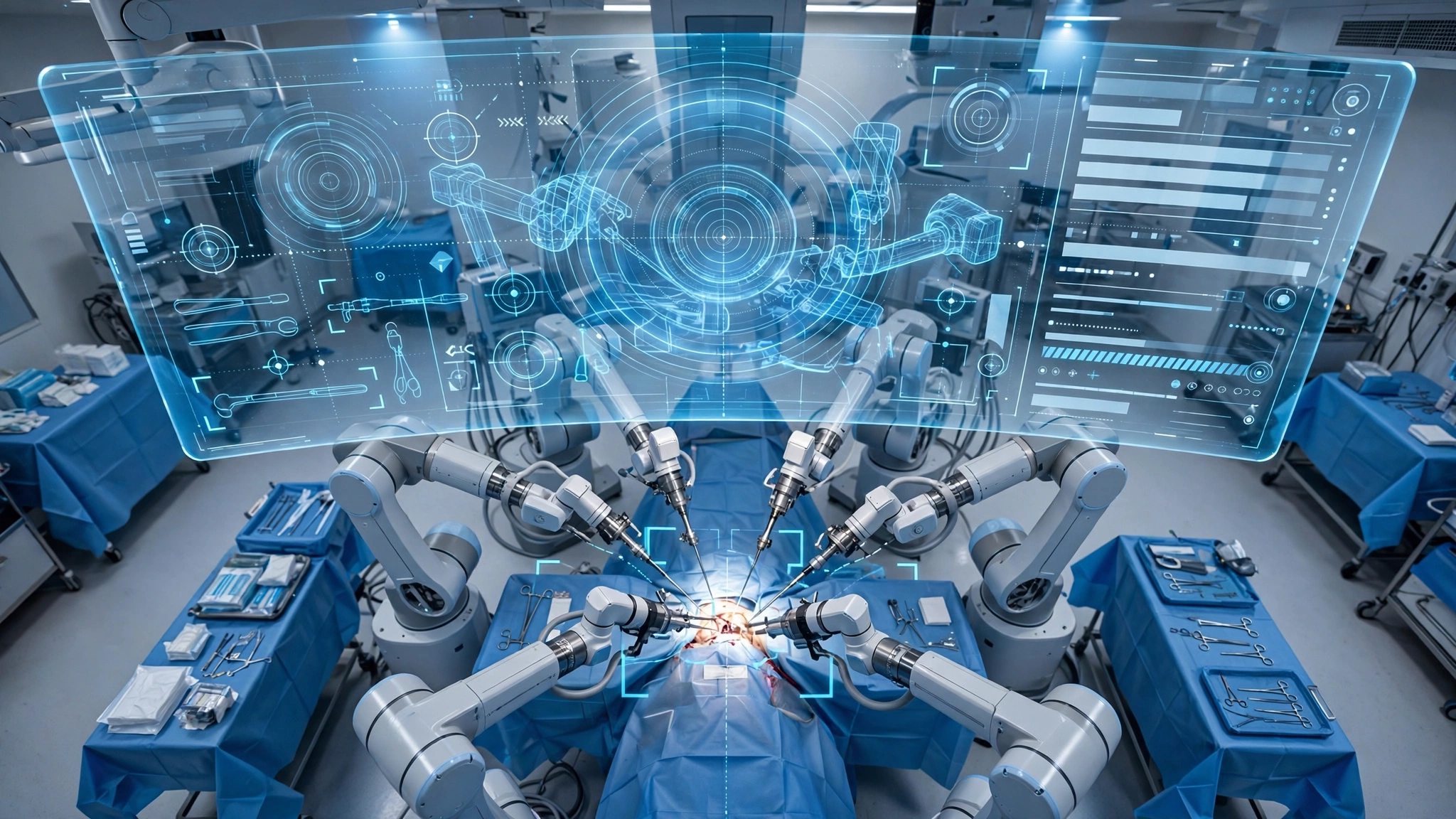
At the 2026 American Urological Association Annual Meeting, Dr. Archan Khandekar of the Desai Sethi Urology Institute at the University of Miami presented results from a production deployment, not a pilot, of a multimodal AI agent embedded in UHealth operating rooms. It watches robotic surgery through the existing video feed, runs real-time surgical step segmentation and instrument tracking via computer vision, and generates structured operative narratives directly inside the hospital's Epic electronic health record.
Results are stark. Median time from procedure end to a signed operative note dropped from roughly 26 minutes to less than two. Every single case received an AI-drafted report, and surgeons reviewed, edited, and signed each one without dictation, without manual recall, without the post-operative fog that typically blurs the memory of a three-hour procedure into a paragraph of approximations. Surgeons averaged six edits per case, most commonly correcting artery-versus-vein labeling. Everything else? Captured autonomously.
The 20% Problem
Speed alone would be interesting but not transformational. What makes this system consequential is its completeness. Prior research from this team found that traditionally written operative reports omit roughly one in five clinically meaningful intraoperative events, meaning a secondary procedure gets skipped, an unusual instrument goes unmentioned, or an anatomic variant noted during surgery never makes it into the permanent record. A fifth of what actually happened in surgery simply never makes it into the medical record. Those gaps propagate. Downstream clinicians working from incomplete notes may miss relevant surgical context. Quality measurement programs built on operative data systematically undercount complications and interventions. Billing codes derived from vague documentation lead to chronic undercoding. And when a malpractice claim arrives years later, the surgeon's best defense is a record that increasingly reflects what should have happened rather than what did.
AI does not have this failure mode. It cannot forget. Because it reconstructs the narrative from video evidence rather than memory, secondary procedures and unusual instrument usage that surgeons routinely forget to mention get documented automatically.
206 Seconds to Reproduce Weeks of Research
Documentation was the first application, but research acceleration turned out to be the real surprise.
Using the same agent through a natural language interface, the Miami team asked it to reproduce a previously published, peer-reviewed study of warm ischemia time during robotic partial nephrectomy across 61 cases. No manual data abstraction. No programming. A plain-English query.
In three minutes and 26 seconds, the agent recovered every reported correlation at greater than 95% concordance. That work, published in BJUI Compass (Khandekar et al., 2024), required weeks of manual chart review, data extraction, and statistical analysis by a team of researchers.
Then the agent found something the humans had missed entirely, a clean dose-response relationship: average postoperative creatinine change rose steadily with ischemia duration, climbing from 6.8% at 15 minutes or less to 29.8% beyond 40 minutes, a gradient that weeks of manual analysis had not surfaced but three and a half minutes of AI-driven query did.
"We asked the agent, in plain English, to reproduce a study that originally took our team weeks," Dr. Khandekar said at AUA 2026. "It returned every published correlation in about three and a half minutes, then surfaced a relationship we had not reported. That is the difference between a tool that documents care and one that helps you learn from it."
The Documentation Tax: Our Calculation
We ran the numbers on what operative note documentation costs U.S. healthcare at scale, crossing American College of Surgeons volume data with Bureau of Labor Statistics compensation figures and the observed documentation times from the Miami deployment to arrive at a figure nobody else has published.
| Metric | Value | Source |
|---|---|---|
| Annual U.S. surgical procedures | ~50 million | American College of Surgeons |
| Average operative note time (current) | ~15 min (weighted) | Miami data + published ranges (10-30 min) |
| Total annual documentation time | 12.5 million hours | Calculated |
| Mean surgeon hourly compensation | $260 | BLS, 2024 |
| Annual documentation cost (surgeon time) | $2.76 billion* | Calculated (85% recoverable) |
| Current robotic procedures (U.S.) | ~1.7 million | Intuitive Surgical reports |
| Robotic-specific recoverable hours | 680,000 hours/yr | 1.7M × 24 min saved |
| Robotic-specific recoverable value | $177 million/yr | Calculated |
*Assumes 85% time reduction across all surgery types (conservative vs. the 92% demonstrated in robotic urology) and a weighted average note time of 15 minutes. Our $2.76 billion figure captures recoverable surgeon time only and excludes downstream billing, quality, and legal costs from the documented 20% event omission rate.
Immediately addressable: $177 million in robotic surgery documentation alone. As surgical AI platforms expand beyond robotic video to laparoscopic and even open procedures via room-mounted cameras, the ceiling approaches the full $2.76 billion. That expansion is not hypothetical. Medtronic's Touch Surgery platform already operates in 1,500 ORs.
Three Companies, Three Layers of Surgical AI
The University of Miami system is not operating in isolation. Three separate corporate thrusts are layering AI into the operating room in 2026, each at a different stratum:
Medtronic's Touch Surgery Aide (FDA-cleared, July 2026) embeds an NVIDIA-powered compute platform directly into the surgical workflow. Its first real-time application, Instrument Exit Point, alerts surgeons when instruments leave the camera's field of view during robotic procedures. Medtronic's Touch Surgery ecosystem already operates in more than 1,500 ORs across 35 countries. Its Hugo robotic-assisted surgery system received FDA clearance for urology in December 2025 and filed for general and gynecologic indications in June 2026.
Johnson & Johnson's OTTAVA is attacking a different constraint: physical space. By integrating four robotic arms into a standard surgical table rather than requiring separate carts or booms, OTTAVA completed all 30 procedures in its FORTE clinical trial robotically, with zero conversions, across ORs as small as 243 square feet. Five of six trial sites used rooms that had never hosted robotic surgery before. J&J filed a De Novo FDA application covering gastric bypass, sleeve gastrectomy, small bowel resection, and hiatal hernia repair.
Theator and Miami occupy a third layer. It does not move instruments or expand physical access. Instead, it watches, documents, and learns, converting raw surgical video into structured clinical knowledge. A multicenter expansion is underway, with the University of Miami serving as one of three national validation sites under a federally funded surgical foundation model program.
The Accuracy Gap Is Measured in Seconds
The BJUI Compass validation study quantified exactly how much better AI-derived surgical measurements are compared to surgeon self-reporting. Across 61 partial nephrectomies, the platform measured warm ischemia time to within 8.3 seconds of expert video-reviewed ground truth (SD = 9.2 seconds). Surgeon operative reports, by comparison, were off by an average of 2.45 minutes (SD = 3 minutes), with the difference reaching statistical significance at p < 0.001. One hundred percent of AI measurements fell within one minute of ground truth. Ninety-seven percent were within 30 seconds.
When surgical outcomes hinge on whether ischemia lasted 19 minutes or 22 minutes, a documentation system with 2.45-minute average error is introducing systematic noise into every study built on operative reports. At 8.3-second accuracy, AI eliminates this noise, potentially resolving longstanding debates in surgical literature that have been confounded by measurement imprecision for decades.
The Safety Floor: Grounded vs. Ungrounded AI
The Miami team also tested what happens when surgical AI answers patient questions without verified medical grounding. Across five high-stakes urologic scenarios scored against AUA and NCCN guidelines, grounded models scored 24 and 25 out of 25. An ungrounded general-purpose model scored 14 out of 25 and produced a clinically dangerous error, confusing a prostate procedure for benign disease with a bladder cancer operation. All models ran locally within the institution, with no patient data leaving the hospital.
"When we grounded the same class of model in verified urologic guidelines, that dangerous error disappeared," Dr. Khandekar said. "For anything that faces patients directly, grounding is not an enhancement. It is the safety floor."
Limitations
Several important caveats temper these findings. One caveat: the 26-to-2-minute documentation result comes from complex robotic urology at a single institution with a mature AI deployment. Generalization to simpler procedures, to laparoscopic or open surgery where camera angles are less standardized, and to hospitals without existing video infrastructure is unproven. Our $2.76 billion documentation tax calculation uses a weighted 15-minute average across all surgery types, but actual note times vary enormously by specialty and complexity. Six edits per case suggests meaningful surgeon oversight is still required, particularly for anatomical labeling. And the 3-minute-26-second research reproduction, while dramatic, operated on a dataset the AI had already processed during live documentation, raising questions about how the system would perform on retrospective data it had not previously observed. Multicenter validation underway will answer many of these questions, but the current evidence base is narrow.
The Strongest Case Against
The most compelling objection is not about accuracy or speed but about incentives and liability. If AI generates the operative note, who is legally responsible for errors? The surgeon still signs, but the cognitive mode shifts from active recall to passive review of AI-generated text, a transition that may start with six careful edits per case but could end with rubber-stamping as trust accumulates and fatigue sets in. Automation complacency of the kind that plagues aviation cockpits could enter the OR through the documentation backdoor. And if a missed AI error later causes patient harm, courts will face a novel question: does a signed-but-not-fully-read AI-generated note meet the legal standard of care? No jurisdiction has answered that yet.
What You Can Do
If you are a hospital administrator: Request a formal ROI analysis comparing your current operative note workflow (time, completeness, coding accuracy) against AI-assisted alternatives. With $177 million recoverable in robotic documentation alone, the business case is straightforward for any system performing more than 500 robotic procedures annually.
If you are a surgeon: Ask whether your institution's surgical video is being captured and stored. If it is, you already have the raw material for an AI documentation system. If it is not, the infrastructure cost of room-mounted cameras is modest compared to the documentation time they can eliminate. Track your own operative note times for a month to benchmark against the 26-minute median.
If you are a clinical researcher: The 1,400x research acceleration demonstrated here applies specifically to queries over AI-processed surgical video data. Identify the studies in your pipeline that depend on manual chart abstraction and evaluate whether AI-derived operative data could compress your timelines from months to minutes. Focus on outcomes research where the 20% event omission rate in traditional notes means your existing datasets are likely incomplete.
If you are a patient: Ask your surgeon whether operative reports at your hospital capture video-derived data or rely on memory-based dictation. It matters. Institutions using AI-assisted documentation produce more complete records, which directly affects the quality of any follow-up care, second opinions, or, in worst-case scenarios, malpractice evidence available to you.
The Bottom Line
Operating rooms are acquiring eyes that never blink and memories that never omit. Surgery's documentation layer, historically treated as clerical overhead, is becoming a live intelligence feed that watches every instrument movement, measures every ischemia window to within 8.3 seconds, catches the 20% of events surgeons forget to report, and converts the resulting data into research at 1,400 times the speed of manual analysis. Medtronic is selling real-time AI compute for the OR. J&J is making robotics fit in rooms too small for previous systems. And a team in Miami has proven that the least glamorous part of surgery, writing the note, might be where AI delivers its largest return: $2.76 billion a year in surgeon time, plus a research engine that finds what humans miss. The scalpel got robotic arms a decade ago. Now it is getting a brain.