AI Agents Just Ran an 11,382-Step DNA Experiment. Humans Only Refilled the Reagents
A Shanghai lab let seven AI agents run DNA experiments for 203.5 straight hours. One run equals 16 work-weeks of a human technician, and the DNA data-storage demo moved information at 1.85 bits per hour.
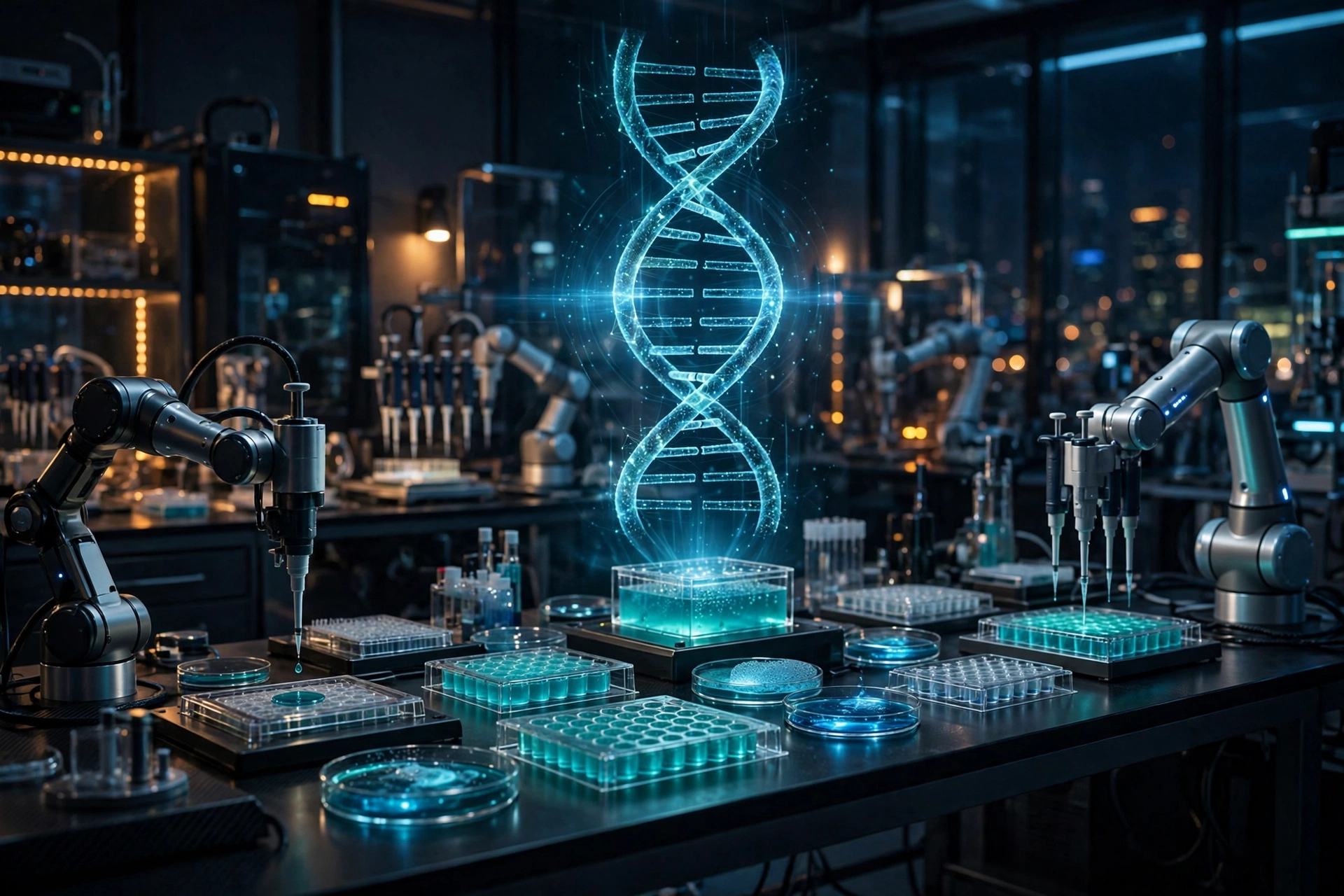
203.5 hours. That is how long an AI system in Shanghai ran a DNA experiment without a scientist touching a pipette, across 11,382 hardware steps, while the humans in the room did little more than refill reagents and empty the waste. On November 4, 2026, Nature published the paper, and the same day Anthropic reported that its Claude model had helped solve the first three-dimensional structure of a vault particle, a hollow protein shell whose job scientists have failed to work out for 40 years. Two teams, one week, one message: AI has stopped merely suggesting biology experiments and started running them.
Until now, the pattern was familiar. A model proposed a molecule, a hypothesis, a protocol, and then a person did the slow physical work of testing it. James Zou, a Stanford data scientist who wrote the commentary Nature ran alongside the Shanghai paper, put the gap plainly: an AI system might design a promising biologically active molecule in minutes, but testing it can take weeks or months. AutoDNA is the first peer-reviewed attempt to close that gap with hardware, not just with better suggestions.
What AutoDNA actually did
AutoDNA is a laboratory built around seven language-model agents, not a robot with a chatbot bolted on. A central planner coordinates six specialists for literature, reagents, protocols, code, hardware, and hypothesis generation, and together they orchestrate more than 20 types of instruments. Published reports say the system runs on Google's Gemini 2.5 Pro, though the paper's abstract does not name the model. Human intervention, in the paper's own words, is limited to hardware maintenance tasks such as reagent and labware replenishment.
Researchers at Shanghai Jiao Tong University tested the system on four tasks. It synthesized DNA enzymatically at a 97.8% yield, matching results human experts had optimized by hand. It ran several protocols at the same time, 3.2 times faster than running them one after another. It stored digital data in DNA and read it back with zero errors. And it took a real, preprocessed colorectal cancer tissue sample, found a KRAS G13D mutation at chromosome 12, position 108029963, designed its own detection primers, and validated the result against the clinical finding.
KRAS mutations are not an academic curiosity. Tumor mutations are the basis of personalized cancer vaccines, and Merck and Moderna's mRNA-4157 cut the risk of recurrence or death by 42% in a phase 3 melanoma trial reported on October 22, 2026. A machine that can find a mutation and build the test for it, unprompted, is a machine pointed at the front door of precision oncology.
Milad Abolhasani, a chemical engineer at North Carolina State University who did not work on the project, called AutoDNA remarkable both for its degree of autonomy and because it can readily incorporate a diverse range of lab equipment. He added that the future of science is going to involve a lot of autonomous labs. He is probably right. But the numbers underneath the headline deserve a closer look than the press releases gave them, because they cut in both directions at once.
The math nobody ran
Start with the labor. AutoDNA's longest run, the DNA data-storage test, lasted 203.5 hours and took 11,382 hardware steps, according to the team's own release, relayed by the Chinese outlet 36Kr and the Korean daily Chosun Ilbo. That run's 3.2-fold parallel speedup means the same work done one protocol at a time would have taken 651.2 hours, or 27.1 days of continuous operation. Convert that to human terms and it is 81.4 eight-hour workdays, which is 16.3 work-weeks of one technician's full-time labor, compressed into 8.5 calendar days during which people only restocked supplies. A single run ate four months of one person's working life and gave it back as a week and a half.
Now the other side of the ledger. That same run stored exactly one sentence in DNA, 78 strands encoding the words "Intelligence is the ability to adapt to change." Count the characters and the arithmetic gets brutal: 47 characters at 8 bits each is 376 bits, spread over 203.5 hours, which is 1.85 bits per hour, or about 32.5 minutes per bit, or 4.82 bits per strand. At that rate, storing a single 1-megabyte photo would take roughly 494 years. DNA storage is real, and it is nowhere near a storage business. This was an autonomy demonstration wearing a data-storage costume, and the costume does not fit.
Then the failure math, which the authors report honestly. Across the experiments, 14 hardware errors occurred. AutoDNA fixed 8 on its own. Six needed a person. That is a per-step error rate of 0.12%, an autonomous recovery rate of 57%, and one human intervention every 1,897 steps, or roughly once every 33.9 hours. A 0.12% error rate sounds negligible until you scale it: a million-step campaign at that rate produces about 1,230 errors, and 43% of them still need a human hand. Every intervention is also a clock: the system ran 8.5 days, and a person was summoned six times. That is not a lab with no scientists. It is a lab where scientists became janitors and quality control.
| Figure | Value | How it was computed |
|---|---|---|
| Serial equivalent of the 203.5-hour run | 651.2 hours (27.1 days) | 203.5 × 3.2 parallel speedup |
| Human labor equivalent | 81.4 workdays (16.3 work-weeks) | 651.2 hours / 8-hour shifts |
| Data-storage rate | 1.85 bits per hour | 376 bits (47 chars × 8) / 203.5 hours |
| Time to store a 1 MB photo | ~494 years | 8,000,000 bits / 1.85 bits per hour |
| Hardware error rate | 0.12% per step | 14 errors / 11,382 steps |
| Human interventions | 1 per 1,897 steps (every 33.9 h) | 11,382 / 6; 203.5 / 6 |
| Growth during peer review | +21.5% steps, +24.9% hours | Preprint: 9,365 steps, 162.9 h (July 2025) |
One more number hides in the paper's history. AutoDNA first appeared as a preprint in July 2025, and that version ran a shorter data-storage test: 162.9 hours over 9,365 steps. Between preprint and publication, the system grew 21.5% in steps and 24.9% in hours. Fifteen months of revision bought a fifth more machine. Peer review is slow, and the machine kept getting bigger while the reviewers read.
The other lab in the same week
Anthropic's vault result is the flashier sibling and the weaker evidence, and the contrast matters. Claude Science, a version of the model built for science, scanned about 15 billion computationally predicted proteins and found vault relatives in 29 groups of bacteria and four groups of archaea. Researchers then produced the first 3D structure of a vault built from a bacteriophage protein, a shell of 96 copies of a protein they named L05, holding about 25% more interior space than the human vault's 78 copies.
Speed is where the result shines. Anthropic says a vault purification that conventionally takes three days took about 90 minutes, a 48-fold speedup, and a first structural model was ready 34 hours later, which the team estimates would normally have taken weeks. Vaults were discovered in 1986 and their function is still unknown after 40 years, so a new, engineerable variant is a genuine opening. But this is a company preprint describing its own product, posted to bioRxiv on November 5, 2026, with no peer review. Anthropic also lists its failures: one protocol called for a growth-medium additive that blocked part of the work and cost about two weeks, and early in the microscope-image analysis the model skipped a standard step and produced a flawed 3D map blended with its own mirror image, so the team told it to stop improvising. That candor is worth more than the speedup. A model that invents a wrong additive and a mirrored map is a model that still needs a scientist watching it, closely.
Limitations
Several numbers in this article come with asterisks that belong in the open. The 11,382-step and 203.5-hour figures come from the team's own release via 36Kr and Chosun Ilbo, not from the paper's abstract, which says only "more than 11,000 steps." Strand length for the 78 DNA strands is not stated in the sources consulted, so bits-per-nucleotide density cannot be computed, and the honest rate is bits per hour. The 16-work-week equivalence assumes a human could sustain the machine's step rate without sleep; it is a labor-equivalence illustration, not a measured head-to-head race. The 494-year photo figure assumes the 1.85 bits-per-hour rate holds at scale, which it would not, since parallelization improves throughput, so treat it as an order-of-magnitude illustration of how far DNA storage is from practicality, not a forecast. Gemini 2.5 Pro as the base model is reported by secondary coverage, not confirmed in the abstract. No independent replication of AutoDNA exists yet, and the vault preprint has not been peer-reviewed. Reproducibility is an open question the authors themselves flag: the inherent stochasticity of the language model means the same plan may not give the same result when run again.
Strongest case against
Steelmanned, the skeptic's case has three legs, and each one is load-bearing. First, scope: AutoDNA ran four narrow, pre-scoped nucleic-acid tasks in one lab, on one reported model, and the authors warn that the randomness built into large language models can change whether the same plan produces the same result when run again. A lab that cannot reproduce its own plans is a demonstration, not infrastructure. Second, the error math does not scale gracefully: at 0.12% per step, a million-step campaign is about 1,230 errors, and with 43% needing a human, that is more than 500 interruptions, which means the scientist never actually leaves the room. Third, the vault result is a company preprint about its own product, and its two disclosed failures, a two-week medium error and a mirrored map, show the model still improvises past its competence in ways that cost real time. Put together, the skeptic says this is not a lab with no scientists, it is a lab where scientists became janitors and quality control, and the headline numbers flatter a system that has not yet been reproduced by anyone else, anywhere. Every clause of that sentence is true. It is also compatible with the direction of travel being real, which is why the code and data being public matters more than the press release.
What you can do
If you run a lab, the next hire is not a technician, it is a protocol reviewer, and the budget line that grows is reagent logistics, not pipetting hours. If you are a researcher, AutoDNA's code and data are public on GitHub and Zenodo, and the replication test is free to run, which is the single most useful thing you can do with this paper: try to reproduce it on a different model, in a different lab, without the original authors guiding it. If you invest in or found biotech startups, DNA data storage is an autonomy demo, not a storage business, and the near-term money is in autonomous mutation detection and synthesis services, where a 97.8% yield that matches human experts is already a product. If you are everyone else, watch for the second lab. A result reproduced once, on different hardware, by strangers, is worth more than a hundred press releases about the first run.
Bottom line
Seven AI agents ran a DNA experiment for 203.5 hours and 11,382 steps, found a cancer mutation, and needed a human about once every 34 hours, mostly to refill bottles and empty waste. That is a real event, and the labor math is genuinely startling: 16 work-weeks of a technician's time compressed into 8.5 days. It is also, by the same arithmetic, a long way from a scientist-free lab. The data-storage demo moved information at 1.85 bits per hour, the error rate would produce hundreds of interruptions at campaign scale, and the model that solved a vault particle also invented a wrong growth medium and mirrored its own map. Science is getting a new kind of worker, one that never sleeps and still needs watching. The question is no longer whether AI can run the lab. It is whether anyone else can run the same lab twice.