400,000 Fusions In, 2 Cell Lines Out: Doubled Chromosomes Made Heart Cells Grow Up, and the Bottleneck Is Brutal
Tokyo researchers fused stem cells to double their chromosomes before turning them into heart muscle, and the resulting cells beat stronger, faster, and longer, but only 1 in 40,800 fused cells survived to become a usable line.
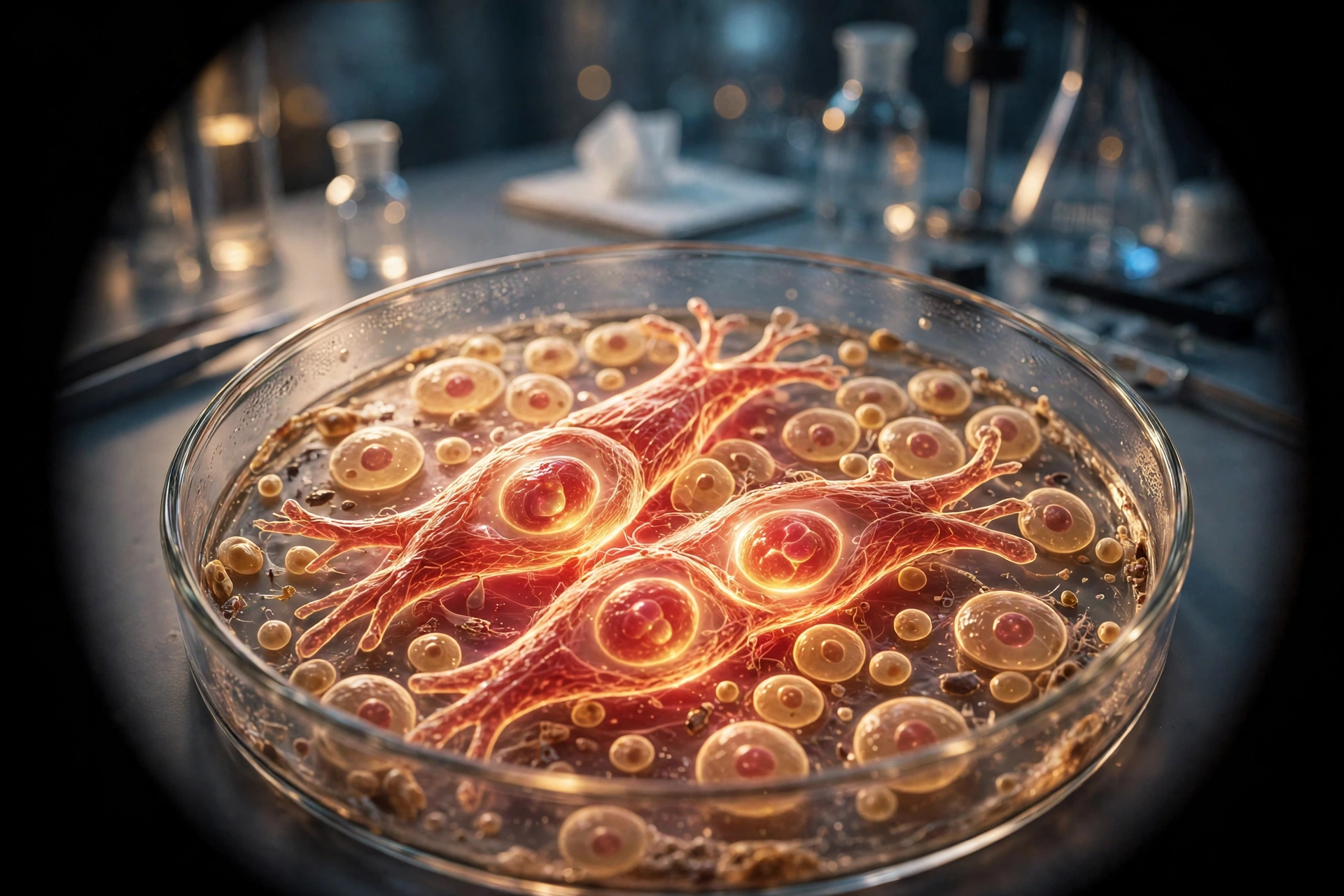
Four hundred thousand cells went into the fusion dish. Two colonies came out.
That brutal yield sits underneath one of the cleanest ideas in regenerative medicine this year, published in Communications Biology on August 17, 2026 by Ittetsu Nakajima, Yuichiro Miyaoka, and colleagues at the Tokyo Metropolitan Institute of Medical Science and the Institute of Science Tokyo. Adult heart muscle cells carry double the usual chromosome count, four copies of each chromosome instead of two, and lab-grown heart cells stubbornly refuse to follow suit, staying in a fetal-like state that limits their use for transplants, drug testing, and disease research. Instead of coaxing lab cells to double their chromosomes after they became heart cells, which nobody had managed, the Tokyo team doubled the chromosomes first, fusing two ordinary stem cells into one tetraploid stem cell and only then turning it into heart muscle.
It worked. On the measures that matter, anyway.
More than 80 percent of adult cardiomyocytes are tetraploid in a real human heart, and conventional lab-grown cardiomyocytes mostly never get there, which is why they beat weakly, burn energy inefficiently, and react to drugs like fetal tissue rather than adult tissue. Heart failure already affects roughly 6.7 million adults in the United States, a number the American Heart Association expects to pass 11 million by 2050, and lab-grown heart cells are already reaching patients in early trials, with HeartSeed dosing its first catheter-delivered cardiomyocyte patient in March 2026, so a more mature lab cell is not an academic curiosity. It is a manufacturing input for a therapy class that has started.
Math nobody ran
Start with the fusion bottleneck, because the headline number flatters the method. Researchers mixed 200,000 stem cells carrying a yellow fluorescent marker with 200,000 carrying a red one, added Sendai virus envelope particles to fuse them, and after one hour 20.4 percent of treated cells glowed with both colors, proof of fusion. Sounds efficient. Then came six days of culture, and only two double-positive colonies survived, one of which became the tetraploid line used for everything that followed. Run the full chain: 400,000 input cells times 20.4 percent equals 81,600 fused cells, and 2 survivors out of 81,600 equals a survival rate of 0.00245 percent, or 1 usable line per 40,800 fused cells and 1 per 200,000 input cells. Anyone quoting the 20.4 percent fusion rate without the colony survival rate is quoting the audition, not the hiring.
Next, the growth penalty, which compounds quietly. Tetraploid stem cells doubled every 22.9 hours against 21.2 hours for ordinary diploid stem cells, a gap of just 1.7 hours that looks trivial until it compounds. Over 30 days, or 720 hours, diploid cells complete 33.96 doublings while tetraploid cells complete 31.44, a difference of 2.52 doublings, and 2 raised to the power of 2.52 equals 5.7, meaning a tetraploid batch grown from the same seed yields about 5.7 times fewer cells after a month. Put differently, catching up costs roughly 2.52 extra doublings at 22.9 hours each, about 57.7 hours or 2.4 extra days of culture, plus the bioreactor time, media, and contamination risk those days carry. Maturity is not free. It bills by the hour.
| Metric | Diploid (2N) route | Tetraploid (4N) route | Source |
|---|---|---|---|
| Cells fused in the reported run | Not applicable | 400,000 input; 81,600 fused at 1 hour | Paper, Fig. 1 |
| Surviving double-positive colonies | Not applicable | 2 after 6 days (1 per 40,800 fused) | Paper, Fig. 1 (this article's math) |
| Stem cell doubling time | 21.2 hours | 22.9 hours (5.7x fewer cells over 30 days) | Paper, Fig. 2 (this article's math) |
| Tetraploid share after differentiation | About 10% | Nearly 100% | Paper, Fig. 3 |
| Purity after lactate selection | Over 93% | Over 93% | Paper, Fig. 3 |
| Beating after 900 nM terfenadine | Stopped | Kept beating | Paper, Fig. 4 |
| Hybrid cross-donor karyotype | Not applicable | 10 of 20 cells with gain or loss | Paper, Fig. 5 |
Now the dose arithmetic, which is where the tetraploid advantage actually pays. A published phase I/IIa protocol for epicardial cardiomyocyte injection escalates through doses of 100 million, 200 million, and 400 million cells, so take the top dose as the yardstick. At roughly 10 percent tetraploid, a conventional 400-million-cell dose carries about 40 million tetraploid cells. At nearly 100 percent, a tetraploid-route dose carries about 400 million, a difference of 360 million tetraploid cells per patient, delivered in the same injection volume, with no extra surgery. Caveat, stated plainly and repeated in the limitations section below: tetraploid share is a proxy for maturity, not a proven measure of pumping power, and nobody has yet shown that a tetraploid-rich dose heals a human heart better than a conventional dose. Still, if maturity tracks tetraploidy at all, this is the largest single lever in the paper.
One more number deserves a warning label rather than a celebration. Tetraploid stem cells measured 1.1 times the diameter of diploid ones, and cubing that ratio gives about 1.33 times the volume, a neat piece of geometry that tempts writers into claiming bigger heart cells. Resist it. Researchers reported the diameter ratio for undifferentiated stem cells only, never for the cardiomyocytes themselves, so applying the cube to heart cells would be inventing data, and this article does not do that. Geometry is not biology, and a bigger stem cell is not automatically a stronger heartbeat.
What did the tetraploid heart cells actually do better? Their cell-cycle genes switched off, exactly as mature heart cells stop dividing, with PCNA, CDC20, PLK1, and seven other proliferation genes repressed and all ten of the most shifted biological processes tied to cell-cycle control. Their mitochondria multiplied and worked harder, with higher mitochondrial DNA ratios and higher basal and maximal respiration. Their beating held up: ordinary cells peaked on day 5 and faded, tetraploid cells held high amplitude past day 6 with faster upstroke velocity, and when dosed with terfenadine, a potassium channel blocker that stopped ordinary cells cold at 500 and 900 nanomolar, tetraploid cells kept beating at both doses, behaving like adult tissue rather than fetal tissue. For drug safety testing, where fetal-like cells can falsely condemn a candidate drug, that resistance alone may be worth more than any transplant application in the near term.
Strongest case against this story
Here it is at full strength, because it might be right. Tetraploidy could be a consequence of maturity rather than its cause: adult heart cells become tetraploid because they stop dividing, so forcing the chromosome count up front may be copying the badge of maturity without the underlying program, like giving a student a graduation gown and calling them educated. Evidence for that reading sits inside the paper itself, since apart from cell-cycle genes the authors found no consistent differences in sarcomere, metabolism, or ion-channel gene programs between tetraploid and ordinary heart cells, and a mouse study they cite found tetraploid-derived cardiomyocytes electrophysiologically indistinguishable from diploid ones. Add the practical ledger, a 1-in-40,800 line yield, a 5.7-fold growth penalty, extra sensitivity to hydrogen peroxide oxidative stress, extra cell death during lactate purification, and 50 percent karyotype abnormality in cross-donor hybrids, and the honest summary is narrower than the headline: researchers made a more mature-looking cell by an expensive, inefficient route, through a mechanism they openly say remains unknown, with no animal transplant data and no direct force measurement in newtons anywhere in the study. Contraction strength here is an impedance proxy measured on a plate, not a heart pumping blood.
What this does not prove
This analysis rests on one peer-reviewed paper, a dish study with no transplant arm, and its limits deserve a full accounting rather than a footnote. No animal received these cells, so engraftment, arrhythmia risk, immune response, and survival in a beating, scarred human heart are all untested. No mechanism is established: the authors state plainly that how tetraploidy enhances maturation remains elusive, and the narrow gene-expression result means the maturity claim rests on cell-cycle shutdown, mitochondria, and impedance traces, not a wholesale adult program. Manufacturing hazards are real, from oxidative stress sensitivity in the stem cells to lactate-selection losses to the cross-donor hybrid result, where 10 of 20 karyotyped cells gained or lost chromosomes, a warning against mixing donor lines casually. Terfenadine resistance signals maturity; it does not prove clinical safety, and terfenadine itself left the United States market years ago over QT prolongation, so the test is a laboratory yardstick, not a drug endorsement. Finally, every original calculation in this article inherits the paper's small numbers: one selected line, one fusion run described in detail, and percentages that will move when other labs repeat the work.
What you can do
Three moves, depending on who you are. If you run a cell therapy program, the immediate application is not a transplant, it is a better safety screen: tetraploid cardiomyocytes that behave like adult tissue could reduce false cardiotoxicity flags that kill drug candidates, so the first experiment worth funding is a head-to-head screen of known safe and toxic compounds on tetraploid versus ordinary cells, with the paper's terfenadine result as the pilot, not the proof. If you invest in regenerative medicine, watch three gates in order: an independent lab reproducing the fusion line and the impedance result, a large-animal transplant study reporting engraftment and arrhythmia rates, and any manufacturing disclosure that closes the 1-in-40,800 yield gap, because a therapy that cannot be made at scale is a publication, not a product. And if you live with heart disease or love someone who does, the practical takeaway is patience with a specific watch item: ask whether a trial you consider uses matured cells or fetal-like cells, and treat any clinic selling lab-grown heart cell treatments today, outside a registered trial, as a red flag, since nothing in this paper is a treatment yet and the authors claim no such thing.
The Bottom Line
Doubling chromosomes before differentiation produced heart cells that look and act more adult, stronger beating that holds up over days, more and better mitochondria, cell-cycle genes switched off, and resistance to a drug that silences fetal-like cells, and the dose math says a tetraploid-rich batch could deliver 360 million more tetraploid cells per 400-million-cell injection than a conventional batch. It also cost a fusion yield of 1 line per 40,800 fused cells, a 5.7-fold growth penalty over a month, and a mechanism nobody understands, with no animal or human data behind it. That combination, a real maturity signal wrapped in a manufacturing problem, is exactly why this paper matters: it proves the biology is reachable, and it prices the engineering honestly. Watch the yield, not the headline, because the lab that closes the fusion bottleneck will own this field.