25 Million Americans Can't Reliably Recognize Faces, and the Number Will Double by 2050
Six distinct populations need technology that identifies faces and whispers names. Prosopagnosia, Alzheimer's, mild cognitive impairment, vision loss, combat-related TBI and eye injuries, and autism each impair face recognition through different mechanisms. Combined and deduplicated, they affect 25-30 million Americans today. Demographic projections push that figure past 50 million by mid-century.
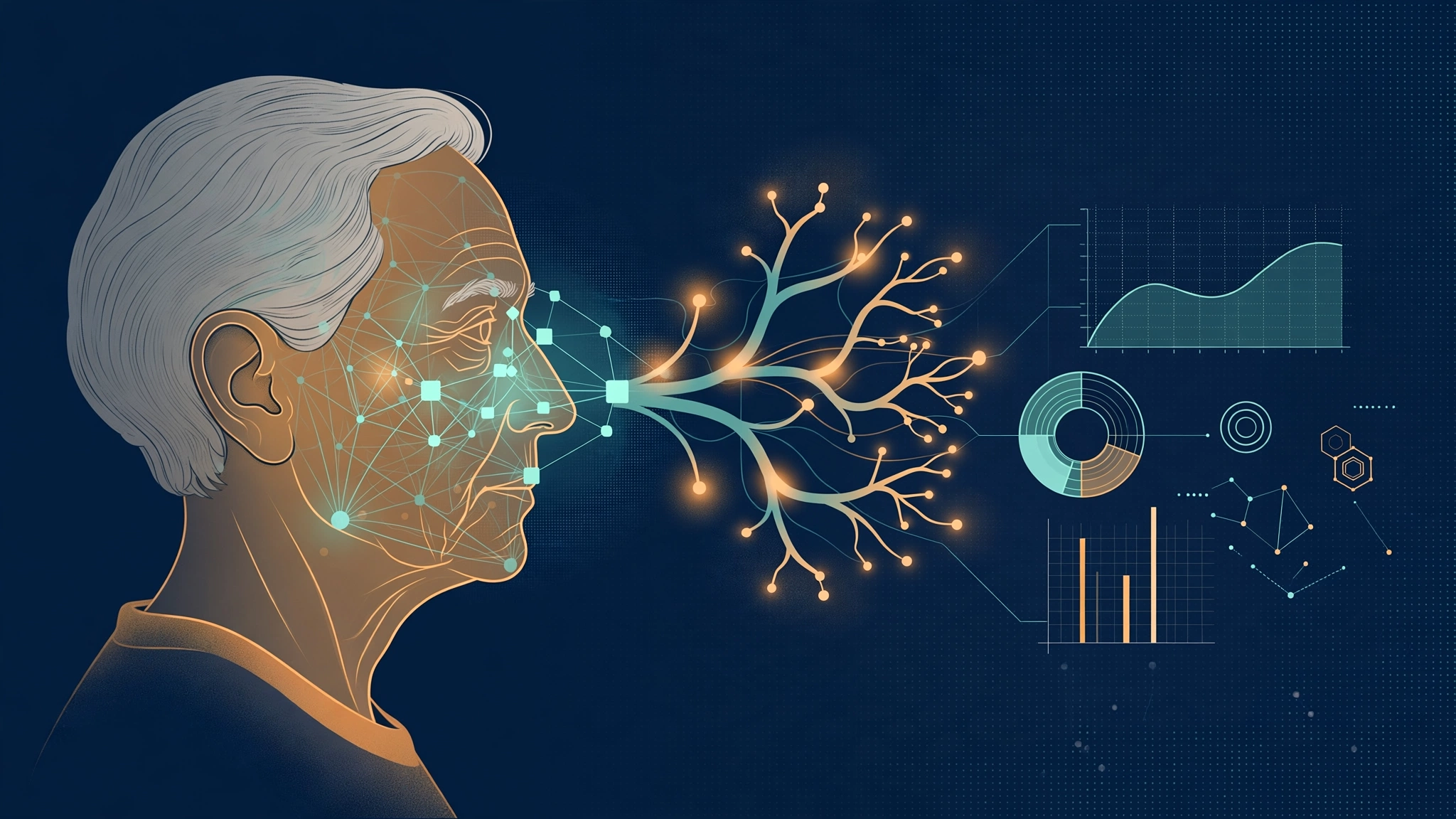
More than 10 million Americans cannot reliably recognize the faces of immediate family members in unexpected contexts. A February 2023 study by DeGutis and colleagues at Harvard Medical School found developmental prosopagnosia affects 3.08% of the population under broadest diagnostic criteria, with 35% of those affected unable to identify close relatives when encountered outside the home. That is one condition. There are five more, each large enough to justify its own intervention, and they almost never appear in the same analysis. Aggregating across all six, conservatively deduplicating for overlap, yields a U.S. population exceeding 25 million people with clinically meaningful difficulty recognizing faces or recalling names, and worldwide figures an order of magnitude larger.
prosopagnosia
dementia (65+)
mild cognitive impairment
worldwide (WHO)
TBI diagnosis
face blindness
Six Populations, One Unbuilt Product
Prosopagnosia affects 10 million or more Americans. Under DeGutis's strictest cutoff for major cases, roughly 1 in 108 people qualifies, yielding 3 million cases. No pharmacological treatment exists. Behavioral training produces modest lab gains that rarely transfer to daily life. Real-time face identification remains the only plausible near-term intervention.
Alzheimer's and dementia affect 7.4 million Americans aged 65 and older. "Difficulty remembering names or events" is listed as the first early symptom. Prevalence rises from 5.2% at ages 65-74 to 35.8% at 85 and above, with U.S. projections reaching 13.8 million by 2060. Globally, dementia cases hit 49 million in 2021, up 160% since 1991. Name recall deteriorates years before patients lose independence, creating a 4-to-8-year window where face-recognition aids could extend social participation.
Mild cognitive impairment sits between normal aging and dementia. Twenty-two percent of U.S. adults 65 and older meet MCI criteria, roughly four times more prevalent than dementia, with 8-15% progressing to dementia annually. MCI patients retain enough cognitive capacity to use assistive technology but are impaired enough to benefit meaningfully, making them the single most promising target population.
Vision impairment makes face recognition difficult to impossible. The WHO reports 2.2 billion people globally with some form of vision impairment, including 43.3 million blind. In the U.S., visual impairment among adults 40+ is projected to more than double, from 3.22 million in 2015 to 6.95 million by 2050. For blind users, the system must perform the entire recognition task; wearable devices with bone-conduction audio are the most viable form factor.
Veterans: Compounding TBI and Vision Loss
Between 2000 and Q1 2023, 479,953 Department of Defense service members received a TBI diagnosis, with 82.2% classified as mild. Memory impairment is the most common persistent complaint: 48% of TBI patients report memory problems that interfere with daily functioning. Among 2.5 million post-9/11 veterans, 17.5% experienced mild TBI and 3.0% moderate-to-severe TBI. Even mild TBI is linked to approximately twice the risk of developing dementia later in life.
But TBI is only half the story. The VA estimates that 64% of service members with TBI also have a vision problem, including blurred vision, double vision, and visual field defects. Among veterans at Polytrauma Rehabilitation Centers with moderate-to-severe TBI, 12.7% met criteria for legal blindness, and visual dysfunction afflicted over 50% of those with active symptoms. Blast exposure, behind 84-90% of combat TBIs, causes both cognitive memory deficits and direct ocular damage, a dual impairment where the veteran can neither remember a face nor see one clearly.
The VA operates 13 Blind Rehabilitation Centers, serves roughly 130,000 legally blind veterans, and estimates over one million veterans have uncorrectable vision loss. For a veteran with blast-related memory deficits and visual dysfunction, face-recognition technology is not a convenience but a prerequisite for reintegration.
Autism spectrum disorder rounds out the six populations. Thirty-six percent of autistic adults meet criteria for prosopagnosia, 12 times the general population rate. With roughly 5.4 million autistic adults in the U.S., that implies 2 million with ASD-related face recognition deficits. Unlike dementia, these are lifelong and stable, making assistive technology a decades-long tool.
Where the Lines Converge
Every condition except prosopagnosia and ASD is age-dependent. Dementia, MCI, and vision loss all accelerate after 65. Americans 65+ numbered 48 million in 2015 and will reach 88 million by 2050. The 85+ segment, where 35.8% have Alzheimer's, will triple from 6.7 million to 19+ million by 2060.
Consider an 82-year-old American woman in 2040: 25% chance of MCI, 15% chance of dementia, roughly 1-in-8 chance of significant vision impairment. If she has both MCI and moderate vision loss, face recognition fails at the cognitive and perceptual level simultaneously. No single intervention addresses both. A wearable camera with audio prompting is the only approach that compensates for both at once.
Globally, the 65+ population is projected to double from 761 million to 1.6 billion by 2050. Japan already has more adults over 65 than under 15. South Korea's total fertility rate of 0.72 means caregiver capacity will halve within a generation. Automated face-recognition aids shift from enhancement to essential infrastructure.
Original Analysis: The Compound TAM
No published study aggregates these six populations because they span different medical specialties: prosopagnosia lives in cognitive neuroscience, Alzheimer's in geriatrics, TBI in military medicine, ASD in developmental psychology, vision loss in ophthalmology. Cross-referencing their prevalence data reveals a total addressable population larger than hearing aids serve: 25-30 million in the U.S. (deduplicated) and 580-700 million worldwide, heading toward 1 billion by 2050.
| Condition | United States | Worldwide |
|---|---|---|
| Prosopagnosia (all severity) | ~10M | ~250M |
| Alzheimer's / dementia (65+) | 7.4M | 49M |
| Mild cognitive impairment (65+) | ~10.6M | ~150M |
| Vision impairment (significant) | ~4.2M | 338M |
| Veterans with TBI + vision loss | ~0.5M | est. ~5M |
| ASD with face recognition deficits | ~2M | ~28M |
| Deduplicated total | 25-30M | 580-700M |
United States
Worldwide
Limitations
Overlap estimates are conservative approximations, not actuarial calculations. Prosopagnosia prevalence under the strictest cutoffs drops to 0.93%, reducing the U.S. figure by 7 million. Not all MCI involves name or face recognition; amnestic MCI is the relevant subtype, and population surveys report all-subtype prevalence. The WHO's 2.2 billion vision impairment figure includes uncorrected refractive error addressable with glasses. Technology adoption barriers, including cost, stigma, privacy concerns about facial recognition databases, and the cold-start problem of enrolling faces before the system becomes useful, constrain uptake. Treatment breakthroughs (lecanemab, gene therapy for retinal disease) could alter trajectories.
The Bottom Line
If you care for someone with early-stage dementia, ask their neurologist about structured social engagement before isolation accelerates decline. If you are building assistive technology, stop designing for a single condition: all six populations benefit from the same core system: a camera that identifies faces, a processor that matches them to a local database, and an audio channel that whispers the name. For investors, the addressable population exceeds that of hearing aids, CPAP machines, or insulin pumps. For regulators, the dual-use tension between assistive and surveillance facial recognition needs a framework before the hardware ships. By 2040, the oldest boomers will be 94, the caregiver ratio will be at historic lows, and tens of millions of people will need a machine to do what their brains no longer can: put a name to a face.
Related
🧠 The 2-Sigma Myth and the 0.5 Reality · 🧬 Single-Shot Aging Reversal Across Six Organs