Up to 9,000 Wind Turbine Blades Retire Every Year in America. There Is No System to Take Them
The most famous blade landfill in America has taken none since mid-2021, the outlets that exist serve one customer or one region each, and no neutral party tracks a blade from the turbine to its final destination.
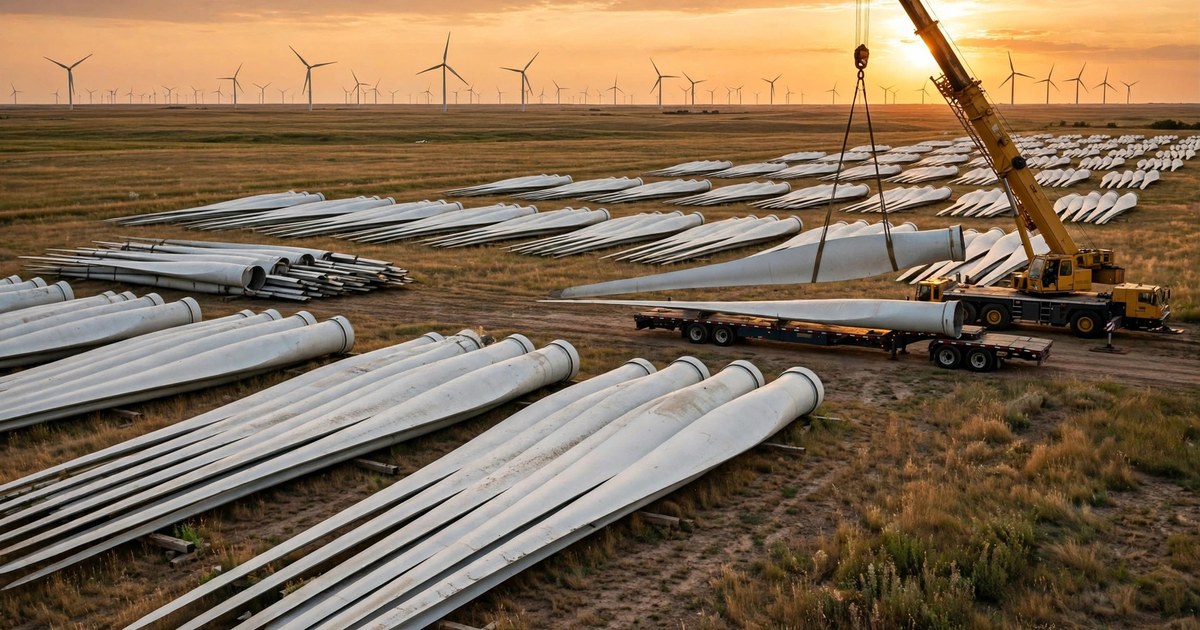
The Problem
By the end of 2025, the United States had 161 gigawatts of wind power on the grid. That is about one-tenth of the country's electricity. The turbines installed during the building boom of the 2000s are now reaching the end of their 20-to-25-year design life. The Department of Energy counts 3,000 to 9,000 blades coming down every year, a flow it expects to reach 10,000 to 20,000 a year by 2040. One energy-industry commentary puts the current figure near 8,000 blades a year. Each blade is a 40-to-80-meter composite structure, and no established industry is waiting to take it.
About 85 to 90 percent of a land-based turbine's mass is steel, aluminum, copper, and iron that existing infrastructure can already process. Blades sit in the remaining tenth, and they are the exception. Steel towers, copper wiring, and electronics all have mature scrap markets. Blades are built from glass fiber and carbon fiber set in epoxy resin, a thermoset composite engineered to survive two decades of hurricane-force loads without breaking down. That same chemistry makes a blade nearly impossible to recycle, since it cannot be melted and remade. It can be cut, ground, or burned, and each option recovers only part of the value.
So most retired blades go to a landfill. Photographs of blades stacked in the Casper, Wyoming landfill went viral years ago. The landfill took 1,124 blades between 2019 and 2020; none have arrived since mid-2021. With landfill space tightening, proposals to bury blades in former mine pits have circulated in Wyoming.
That is not a circular economy. It is burial with a different permit.
A handful of recycling outlets exist, and each is real but narrow. Veolia shreds blades in Missouri for cement kilns under a multiyear agreement with GE Renewable Energy. Cement kilns burn the epoxy resin for fuel and melt the glass fiber into clinker, which displaces coal but still emits carbon dioxide and recovers no fiber for reuse. It is diversion and energy recovery, not closed-loop recycling. Carbon Rivers runs a pilot glass-recovery process in Tennessee. Regen Fiber grinds blades into concrete additive in Iowa. Each is a single processor with a single outlet, tied to one region or one customer, and none of them publishes a price list. An owner planning a repowering project gets quotes by phone, arranges cutting crews and oversize-load permits separately, and hopes the processor still has capacity when the crane arrives. The sequence repeats from scratch for every project, because nothing about the last one was recorded in a form the next one can reuse.
Owners also carry the paperwork. Many counties require a decommissioning plan and financial assurance as a condition of the project's permit, though requirements vary widely and some jurisdictions require no bond at all. Investors ask what share of blade material was diverted from landfill. Today the answer is usually an estimate, because no neutral party tracks a blade from the turbine to its final destination. An industry that builds wind farms in months has no system for taking them apart.
Market Size
Original TAM calculation: the blade end-of-life market has two layers. First comes blade-scope decommissioning spend: crane time, cutting, transport, and processing for the blades alone. Second is the recovered material itself. Below, both layers run at three retirement rates, using a planning assumption of $20,000 per turbine for the blade scope and $237.50 a ton for recovered fiber and powder, the midpoint of the $200-to-$275 range. Take the Department of Energy's midpoint, 6,000 blades a year, as the base case. Treat the 8,000-blade figure as the optimistic case.
| Blades retired per year | Tons of blade material | Blade-scope services | Recovered-material value | Total TAM |
|---|---|---|---|---|
| 3,000 (DOE low end) | 24,000 | $20M | $5.7M | ~$26M |
| 6,000 (DOE midpoint, base case) | 48,000 | $40M | $11.4M | ~$51M |
| 8,000 (commentary high end) | 64,000 | $53M | $15.2M | ~$69M |
SAM narrows to the states where the fleet actually sits. Texas, Iowa, Oklahoma, and Kansas hold about 44 percent of installed US wind capacity, and their turbines are among the oldest. At that share, the serviceable market is roughly $22 million a year on the base case. Capacity share is a proxy for serviceable share here; the four states' turbines are among the oldest, so their share of retirements should run ahead of their share of capacity. SOM in year three: route $12 million of blade-scope work through the platform and take 7 percent, or $840,000. Materials brokerage adds $288,000 across twelve projects. Fifteen fleet subscriptions at $1,500 a month add $270,000. Total year-three revenue is about $1.4 million. That is a small business by venture standards, and this article says so plainly in the Limitations section. The case for building it is that the market more than doubles by 2040, the customers are concentrated enough to reach, and nobody else is building the coordination layer. Whoever publishes the retirement map and signs the processors first gets the dataset, the relationships, and the certificates before anyone else starts.
For scale, the fleet behind these numbers is large and still growing. In 2025 the US added 6.9 gigawatts of wind, taking cumulative capacity to 161 gigawatts, and the American Clean Power Association projects 42 gigawatts of new capacity between 2026 and 2030. Repowering is the larger driver of retirements: 48.4 gigawatts of non-repowered projects are already over ten years old, and turbine makers expect 15 to 20 gigawatts of repowering work between 2026 and 2030, while every repowered megawatt produces blades that need a destination.
The Product
A neutral end-of-life platform for wind blades, built around the blade's journey from turbine to final outlet rather than around any single processor. Five modules:
- Fleet retirement forecast: Every US turbine mapped from the US Wind Turbine Database, matched to OEM blade specifications for model, material, and mass. A county-level retirement schedule shows how many blades, of which type, come down in which year. Owners see their own exposure years ahead; processors see where to build capacity.
- Decommissioning marketplace: Owners post blade-removal jobs with turbine count, blade model, and schedule. Cutting crews, crane operators, haulers, and processors bid. Bids are ranked on all-in cost, distance to outlet, and diversion rate, not just the headline price. Owners get one contract and one invoice instead of five vendors and five phone calls.
- Logistics engine: A modern blade is 70 meters long and does not fit on a standard flatbed. It plans the cut sequence, the oversize-load permits by state, and the route, then matches empty backhauls so trucks do not run home with nothing on the trailer. Transport is one of the largest costs in the chain, and it is the one nobody optimizes today.
- Chain-of-custody certificates: Each blade carries a serial number from the turbine to its final outlet. It issues an auditable diversion certificate per blade: cut, shipped, received, processed, with weights at each step. Owners use it for voluntary ESG reporting and as supporting documentation for permit files where a county asks for it. A certificate that survives an audit is worth more than a press release about recycling. Certificates must be verified by an independent auditor, not self-issued by the platform, since the platform earns fees on the jobs it certifies.
- Recovered-materials marketplace: Shredded glass fiber sells to concrete and asphalt producers. Whole blades sell to reuse projects: pedestrian bridges, playground structures, and shelters, the kind of second life the Re-Wind research network has demonstrated. It aggregates supply from many small decommissionings into lots large enough for an industrial buyer to bother with.
Unit Economics
| Metric | Value |
|---|---|
| Average blade-scope job (50-turbine repower) | $1,000,000 |
| Platform take rate | 7% |
| Platform take per project | $70,000 |
| Materials brokerage margin per project | $24,000 |
| Revenue per project | $94,000 |
| Cost to serve per project | $18,000 |
| Gross profit per project | $76,000 |
| Gross margin | 81% |
| CAC per owner account | $60,000 |
| LTV (large owner, 4 years, 2.5 projects/year) | $760,000 |
| LTV:CAC ratio | 12.7:1 |
| Startup cost | $1.35M |
| Break-even | Month 21 |
Methodology note: LTV uses gross profit per project only: $76,000 times 2.5 projects a year times 4 years equals $760,000, and it assumes a large owner with a rolling repowering program. Mid-size owners doing their first repowering run fewer projects, so early-account LTV is lower and CAC payback is longer. CAC of $60,000 reflects a 6-to-12-month enterprise sale to a utility or independent power producer, including a paid pilot, legal review, and conference presence. Materials brokerage margin is $20 a ton on the 1,200 tons in a typical project, which is the $24,000 in the table.
Rows 1 through 8 are per 50-turbine project; CAC and LTV are per owner account; startup cost and break-even are company-level. Of every number in the table, the $20,000-per-turbine planning assumption carries the most uncertainty; the sensitivity analysis in the Original Contribution section shows what happens at $10,000 and $30,000, and at the two filing anchors themselves. Break-even means monthly operating break-even: gross profit covering the $55,000 monthly burn, reached around month 21 on a linear ramp from zero to 12 projects a year during year 2; the full 12-a-year run rate is reached in month 24. Startup cost of $1.35 million funds the build and exactly 12 months of burn, so cash is zero at month 12 and the plan has no buffer if the first year-2 projects slip. On that ramp, year 2 completes about 6 projects, producing roughly $456,000 of gross profit against $660,000 of burn, so the plan needs about $200,000 to $240,000 of additional capital, earlier revenue, or a faster ramp to reach month 24 with cash. Cumulative cash break-even, counting the build, does not arrive until about month 34. All three pilots run at cost and cover their own costs.
Startup Costs
| Category | Cost | Notes |
|---|---|---|
| Fleet database + retirement forecast engine | $140K | US Wind Turbine Database, OEM blade specifications, county-level retirement schedule. 4 months. |
| Marketplace + matching + logistics engine | $210K | Job posting, bidding, oversize permits, route planning, backhaul matching. 6 months. |
| Chain-of-custody + certificates module | $80K | Per-blade serial tracking, weights at each step, auditor-ready certificate export. |
| Recovered-materials marketplace | $60K | Buyer onboarding for concrete and asphalt producers, lot aggregation, quality specs. |
| Pilot program (2 owners, 2 processors) | $70K | Three paid pilot decommissionings run at cost in exchange for case-study rights and references. |
| Sales + industry presence, year 1 | $90K | American Clean Power events, direct outreach to the asset owners that control most of the fleet. |
| Legal and regulatory | $40K | Decommissioning-bond rules by state, transport permitting, certificate audit standards. |
| Build subtotal | $690K | |
| Operating runway (12 months at $55,000/month) | $660K | Four-person team, cloud hosting, support. Covers the build period and the pilot phase. |
| Total startup cost | $1.35M |
Go-to-Market
Phase 1 (months 1-6): Build the fleet retirement map and publish it free. A public US Blade Retirement Forecast, with county-level tonnage by year, is the cheapest possible inbound engine: every asset manager planning a repowering, every county writing a decommissioning ordinance, and every processor choosing a plant site needs that dataset. Sign two recyclers and two owners as design partners in exchange for free platform access during the pilot.
Phase 2 (months 7-12): Run three paid pilot decommissionings end to end: cutting crew, transport, processing, certificate. Each pilot has to prove two numbers, not one. First, that the platform's all-in cost per blade beats the owner's ad-hoc cost. Second, that the diversion certificate survives the owner's own audit. If either number fails, the product is a directory, not a marketplace, and the pricing has to change before scale.
Phase 3 (months 13-24): Open the marketplace in Texas, Iowa, and Oklahoma, where the oldest fleets and the most processors overlap. Add materials buyers in concrete and asphalt, and sell the diversion certificate as a standalone product for owners who already have a processor but need auditable documentation. Publish a quarterly Blade Diversion Index showing diversion rates alongside haul distance and processor access. A county with no local outlet is not ranked against one with three, and owners can see who is actually diverting rather than who happens to sit near a plant.
Competitive Landscape
| Company | What It Does | Gap |
|---|---|---|
| Veolia North America | Shreds blades in Missouri for cement kiln co-processing under a GE agreement; the program reports more than 7,000 blades processed since 2020, more than 1,000 a year on average | Single-OEM channel, not neutral; no marketplace, no logistics layer, no certificate product for independents |
| Carbon Rivers | Glass-to-glass fiber recovery pilot in Tennessee, DOE-funded, tested with LM Wind, PacifiCorp, and GE | A processor, not a platform; pilot-scale throughput; no demand aggregation |
| Global Fiberglass Solutions | Mechanical blade recycling in Sweetwater, Texas | Regional, single outlet; capacity is the constraint, and it has no way to signal that to owners |
| Regen Fiber | Fairfax, Iowa plant shredding blades into concrete and asphalt additive; 30,000 tons a year capacity, about 47 percent of the 64,000-ton national flow | Single plant, single outlet; owners outside its haul radius have no equivalent option |
| Re-Wind Network | Research consortium demonstrating whole-blade reuse as bridges and structures | Research-led and project-based; no commercial marketplace connecting supply to reuse buyers |
| Landfills and decommissioning contractors | Default path: cut, haul, bury, with the contractor arranging each step | No diversion documentation, no price discovery. Landfill remains the cheapest option in most states, and the best-known blade landfill has taken none since mid-2021 |
| This startup | Neutral forecast, marketplace, logistics, certificates, and materials sales across all outlets | Must earn trust from both sides before either side will transact |
Every existing player owns one outlet: Veolia owns cement, Carbon Rivers owns fiber recovery, Regen Fiber owns concrete additive, and Re-Wind owns reuse. None of them owns the decision: which outlet a given blade should go to, who cuts it, who hauls it, and who certifies where it ended up. Owners make that decision today by calling around, and the result is that most blades take the path of least resistance, which is a landfill. A neutral platform does not need to beat any single processor at processing. It needs to be the place where the decision gets made, with the data to make it well.
Why Now
Five forces converge on this startup.
First, the retirement wave is arriving on a fixed schedule. Turbines have 20-to-25-year design lives. The capacity installed in the 2005-to-2012 boom comes due between 2025 and 2037. The American Clean Power Association counts 48.4 gigawatts of non-repowered projects already over ten years old, and turbine makers expect 15 to 20 gigawatts of repowering between 2026 and 2030.
Retirements are not a forecast. They are a calendar.
Second, the landfill exit is narrowing. The European wind industry adopted a voluntary, self-imposed landfill ban on blades effective January 1, 2026, and WindEurope is pressing the EU to write it into law; no EU-wide ban is yet in force. In the United States, the most famous blade landfill, Casper's, has taken none since mid-2021. When the cheap option disappears, the costlier options become the market.
Third, processing capacity finally exists at working scale, but it is fragmented. Veolia's program reports more than 7,000 blades processed. That total is less than a single year of retirements at the high-end rate. Regen Fiber's Iowa plant has 30,000 tons a year of capacity. Global Fiberglass Solutions expanded in Texas. Three years ago the honest objection was that there was nowhere to send a blade. Today there are several places, and the problem has moved up the stack: matching supply to the right outlet, at the right price, with the paperwork to prove it.
Fourth, investors and sustainability frameworks increasingly ask owners to disclose what happened to their blades, and no rule today mandates blade-level reporting. That gap is the opening. An auditable certificate per blade is a product owners can buy today from nobody, which is why the certificate, not the marketplace, may turn out to be the business that survives contact with the market. The first platform to issue certificates that survive an audit owns the compliance layer, and the compliance layer is stickier than the marketplace. A certificate baked into an owner's audit trail and permit file is far harder to rip out than a listing on a marketplace that any competitor can copy.
Fifth, blades keep getting bigger, which makes the logistics problem worse every year. The average turbine installed in 2025 was 3.8 megawatts with a 141-meter rotor, against roughly 2 megawatts and a 90-meter rotor for the machines now retiring. A modern blade set weighs about 38 tons, nearly double the 20 tons of the older machines. Longer blades mean more expensive oversize permits, more route restrictions, and more cutting. The transport cost that nobody optimizes today grows with every new turbine installed.
Original Contribution: The Blade-Waste Arithmetic
A calculation nobody has published in this form. Start with the retirement flow. The Department of Energy's Wind Energy End-of-Service Guide puts US blade retirements at 3,000 to 9,000 a year now, rising to 10,000 to 20,000 a year by 2040. Start from the midpoint of the current range, 6,000, and the high end of recent reporting, about 8,000. Blade mass follows the industry rule of thumb of 10 tons per megawatt of turbine capacity, which means a retiring 2-megawatt machine carries about 20 tons of blade material, or roughly 7 tons per blade, while a modern 3.8-megawatt machine carries about 38 tons. Blending the old small machines that dominate today's retirements with the larger ones entering the stream gives an average near 8 tons per blade. That average is unweighted: a retiring 2-megawatt machine carries about 7 tons per blade by the same rule, so the average leans on larger machines entering the stream. At 7 tons, the tonnage falls to 56,000 and the material value to $13.3 million, while the services layer, priced per turbine rather than per ton, does not move.
Multiply it out. At 8,000 blades a year times 8 tons, the US produces about 64,000 tons of blade waste a year today. An Electric Power Research Institute assessment put grinding at $90 to $120 a ton and the recovered fiber and powder at $200 to $275 a ton. That makes the processing layer alone worth $5.8 to $7.7 million a year in cost and $12.8 to $17.6 million a year in material value, a midpoint of $15.2 million. Blade-scope decommissioning spend is the larger number, and here the public record gives two honest anchors that disagree by an order of magnitude. A New York decommissioning filing prices dismantling hub and blades, blade transport, and blade disposal at about $48,600 per turbine for a 7-turbine project. A North Dakota filing prices hub-and-blade removal by truck-mounted crane at about $3,000 per turbine for 61 turbines. The gap is method: a full-service job with large cranes against a minimal job with a truck crane, and neither filing is the whole story.
Take a planning assumption of $20,000 per turbine for the blade scope. That figure is not the midpoint of the two anchors: their arithmetic midpoint is $25,800. It is a conservative planning number below it. At 8,000 blades a year, about 2,667 turbines retire annually, and 2,667 times $20,000 is about $53 million a year in blade-scope spend. Add the $15.2 million midpoint of material value, and the total addressable transaction volume is about $69 million a year on the high-end case and about $51 million on the 6,000-blade base case. Run the sensitivity. At $10,000 per turbine the services layer falls to $27 million and TAM to about $42 million. At $30,000 it rises to $80 million and TAM to about $95 million. On the 6,000-blade base case, the same $10,000 and $30,000 assumptions give TAMs of about $31 million and $71 million. At the anchors themselves, the range is far wider: $3,000 a turbine gives $8 million in services and a TAM near $23 million, while $48,600 gives about $130 million in services and a TAM near $145 million. The planning range trims those extremes for a reason. The $48,600 figure comes from a 7-turbine job where fixed mobilization costs inflate the per-turbine price, and the $3,000 figure appears to cover removal only, not transport or processing. A typical 50-turbine repowering sits between them, and the honest statement is that the range is wide, the point estimate is a planning number rather than a measurement, and any investor should underwrite the low end of the band rather than the middle.
Make it concrete per project. A 50-turbine repowering of 2-megawatt machines produces 150 blades and about 1,200 tons of blade material. At the $20,000 planning assumption, the blade-scope job is worth $1 million. The platform's 7 percent take is $70,000, materials brokerage adds about $24,000, and the owner's alternative is five vendors, five contracts, and a landfill receipt nobody can audit. By 2040 the same arithmetic runs at 15,000 blades a year, about 5,000 turbines, $100 million in blade-scope spend, and about $28.5 million in material value, for a total near $129 million. Blades will also be heavier by then, since the average new turbine is already 3.8 megawatts, so $129 million is a floor, not a ceiling. The market more than doubles. The coordination problem roughly triples, because the number of owners, processors, and permits grows faster than the tonnage.
Limitations
This analysis has several weaknesses that should be stated plainly.
First, the retirement flow is a range, not a measurement. The Department of Energy gives 3,000 to 9,000 blades a year, and the 8,000 figure comes from a single commentary on MasterResource, an energy-policy advocacy site, not a government or industry statistical release. If the true number is 4,000 rather than 6,000, every market size in this article falls by a third. Direction of travel is not in doubt, since a large share of the installed base is already over ten years old, but the current-year volume is genuinely uncertain.
Second, the $20,000-per-turbine planning assumption is a judgment call built on two filings that differ by a factor of sixteen. The New York filing and the North Dakota filing describe different methods, different crane strategies, different scopes, and different project sizes, 7 turbines against 61, and neither is necessarily representative of a typical repowering in Texas or Iowa. The sensitivity analysis shows the TAM survives at $10,000 a turbine, but the unit economics per project get thin if the true figure is at the low end.
Third, the recovered-material value of $200 to $275 a ton comes from a 2020 Electric Power Research Institute assessment, and the market for recovered glass fiber is thin and opaque. Regen Fiber and Carbon Rivers do not publish realized prices. If the actual price a concrete producer will pay is $120 a ton rather than $200, the materials layer of the TAM shrinks by about half against the $237.50-a-ton midpoint, and the materials brokerage margin in the unit economics table falls with it. The platform's second revenue stream becomes a rounding error until recovered-fiber demand matures.
Fourth, the TAM assumes owners will pay a platform take on work they currently procure directly. A 7 percent take is unproven, and the largest owners already have decommissioning contractors they trust. Realistic early customers are mid-size independent power producers doing their first repowering, not utilities with 40-gigawatt fleets and in-house teams.
Fifth, recyclable blade designs could shrink the future waste stream. Siemens Gamesa launched its RecyclableBlade in 2021, using a resin that dissolves for recovery, and other manufacturers are developing thermoplastic blades. These designs help the turbines installed from now on. They do nothing for the roughly 160 gigawatts of thermoset blades already in the ground, which will retire over the next two decades regardless of what gets installed tomorrow.
Finally, the costs land somewhere, and this article has not said where. Higher decommissioning costs flow to ratepayers through power prices or to counties when bonds fall short, and the communities nearest shredding plants and truck routes absorb the noise and traffic. The cutting crews face the most direct harm: fiberglass dust and respirable silica from cutting and grinding 70-meter blades, and the platform's growth would send more crews to do that work. Landfill burial, for all its faults, is legal, permitted disposal by regulated operators. Hauling 70-meter blades hundreds of miles by diesel truck carries its own emissions, which the diversion math in this article does not subtract. The platform's routing engine can only minimize those miles, not eliminate them, since the nearest processor may still be several states away. For proportion, composite components including blades are 6 to 14 percent of a turbine's mass, so the blade stream, while real, is roughly a tenth of what comes off a decommissioned wind farm by weight. And the platform proposed here has a conflict to manage: it profits from steering blades to costlier outlets while selling the certificates that verify the steering. Those certificates must be verified by an independent auditor. Self-issued certificates from a platform that profits from the jobs it certifies would not survive the audit they exist to pass.
Strongest Counterargument
The most compelling case against this startup is that the market is too small, too fragmented, and too cheap to support a middleman, and that the players who matter have already solved the part that matters.
Start with size. A $51 million base-case TAM today is a rounding error in energy infrastructure, and a 7 percent take on it is under $4 million of revenue even at total market capture. Large utilities and big independent power producers retire the most blades, and they already have decommissioning contractors, crane relationships, and landfill contracts, so they do not need a marketplace to find a processor; they call the processor directly. Small owners doing their first repowering need the marketplace most, yet they retire a handful of turbines once a decade and will not pay a subscription for a problem they face once.
Then consider the supply side. Processors are capacity-constrained today, which means they have no reason to pay a marketplace for leads. Veolia's channel is GE. Regen Fiber's single plant can only take so much. A marketplace that charges the processor a fee for a blade it could have gotten by answering the phone adds cost to a cost-driven decision, and the owner who chooses on price will choose the landfill until regulation removes that choice. The startup's answer is that landfill capacity is shrinking, Europe's voluntary ban is tightening the market, volume more than doubles by 2040, and the value sits in logistics optimization and auditable certificates rather than lead generation. That answer is plausible but unproven, and it depends on landfill bans arriving faster than recyclable blade designs make the problem smaller. If either assumption fails, this is a consulting business with a website, not a platform.
The Bottom Line
America built 161 gigawatts of wind power with no plan for what happens when the blades come down, and the bill is now arriving at 3,000 to 9,000 blades a year. Most of them go into the ground, not because recycling is impossible but because nobody coordinates it: the processors exist, the buyers exist, and the owners exist, and they find each other by phone. Processing capacity built in the last five years, Veolia's cement kilns, Regen Fiber's Iowa plant, and Carbon Rivers' fiber recovery, proves the outlets work. What does not exist is the layer that matches a blade to its best outlet, moves it there at the lowest cost, and certifies where it ended up. That layer is the whole business. Coordination, documentation, and logistics, sold to an industry that currently buys all three by phone, separately, and only when it has to. That layer is a $51 million market on the base case today, growing toward $129 million by 2040. Too small for a unicorn. Exactly the right size for a focused vertical business that charges for coordination, documentation, and logistics instead of for the recycling itself.
What You Can Do
If you own or operate wind assets: pull your turbine register, match every machine to its blade model and install date, and build the retirement schedule for the next ten years. Get a quote for blade removal and processing now, before the repowering, so the number is a budget line instead of a surprise. Ask your processor for a diversion certificate per blade, and if it cannot provide one, that is information about the processor. If you run a recycling or reuse business: publish your prices, your capacity, and your haul radius, because the owners who need you cannot find you today. If you build this: start with the forecast, not the marketplace. A free retirement map that every asset manager bookmarks is distribution no competitor has, and a marketplace without distribution is a database with a login page.
Related
📰 Interconnection Queue Intelligence SaaS for Clean Energy Developers — the same developers, the same data problem, applied to grid connection instead of decommissioning
📰 20,000 Solar Panels at 85% Strength Are Coming Off a 5 MW Farm. Recycling Costs up to $900,000. Reselling Earns $300,000. — the structural twin: second-life energy hardware, same missing marketplace, applied to solar panels instead of blades
📰 Used EV Battery Health Certification and Valuation Intelligence SaaS — certification as the product: the same trust layer, applied to batteries instead of blades