20,000 Solar Panels at 85% Strength Are Coming Off a 5 MW Farm. Recycling Costs up to $900,000. Reselling Earns $300,000.
The United States has installed roughly 250 GW of solar, and the first big vintage, the 2010-2014 arrays built with 250-watt modules, is aging into repowering. A 2012 five-megawatt commercial array holds 20,000 panels, each degrading under 1% per year per NREL's long-run data, so most of the fleet still produces 85 to 88 percent of nameplate power. Recycling those modules costs $15 to $45 each, per the DOE/NREL benchmark, which means the asset owner pays up to $900,000 to destroy $300,000 worth of working hardware. Used modules already clear $0.058 to $0.14 per watt on the secondary market, one 180,000-module listing sold at $0.14/W within a week according to EnergyBin's 2025 secondary-market data, but the resale market has no certification, no transferable warranties, and no decommissioning logistics. The recyclers shred. The listing boards list. Nobody owns the stack between the roof and the resale: scheduled decommissioning, field testing and grading, certified resale with warranties, and routing rejects to the right recycler.
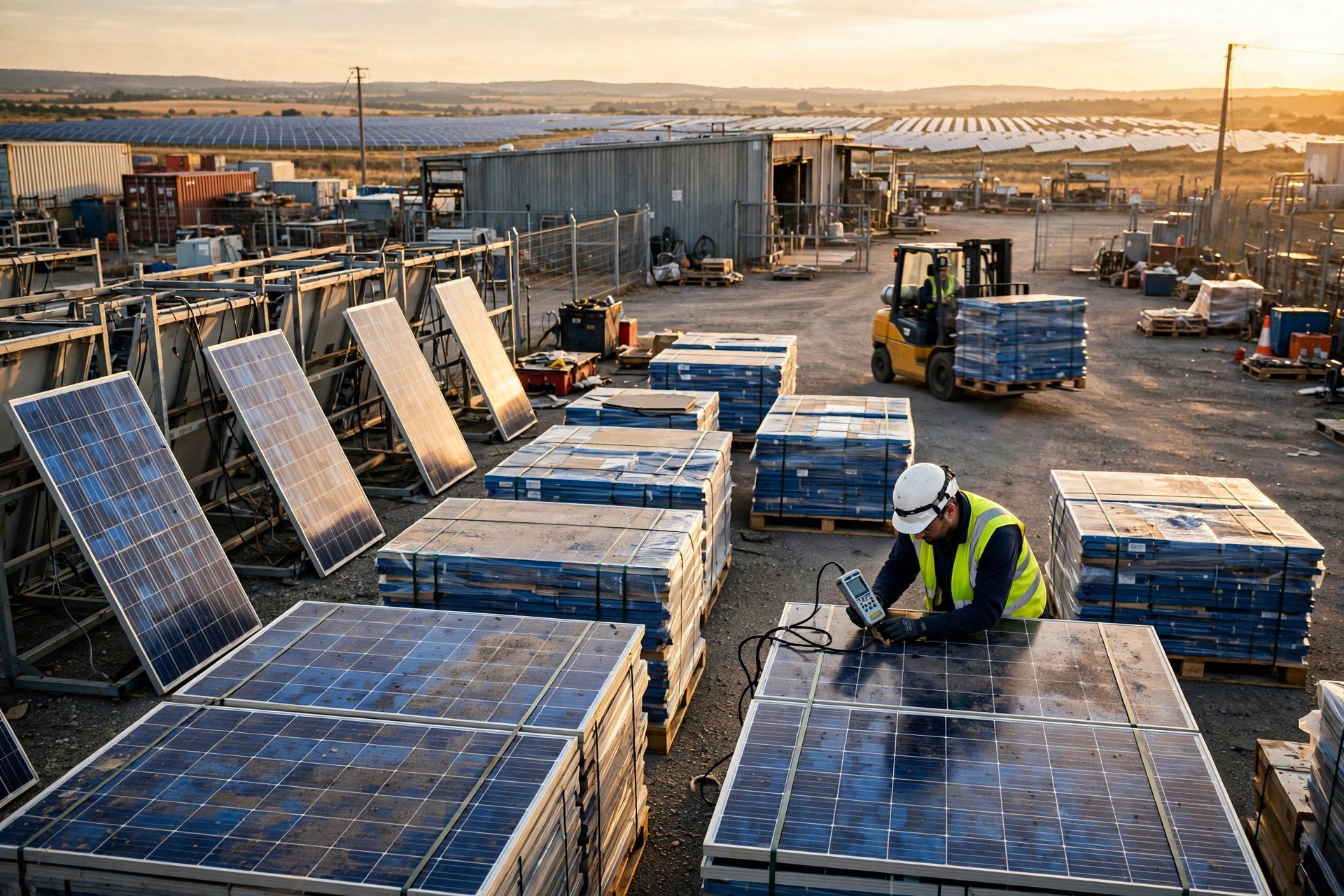
The Problem
Solar panels outlive their owners' plans. A crystalline-silicon module loses less than 1% of output per year, and most manufacturers warranted at least 80% of nameplate power for 20 years. A panel installed in 2012 is, electrically, a panel with a decade of life left. But the economics of solar now punish old hardware. A 250-watt module from 2012 occupies the same land, the same racking, the same interconnection agreement as a 550-watt module from 2026. Swap the fleet and the site doubles its output without a new permit or a new grid connection. So owners repower, and 20,000 working panels come down with nowhere to go. Working panels, no buyers, no grades, no warranties. The default destination is destruction, and the DOE/NREL benchmark puts recycling one c-Si module at $15 to $45 in the US, against $1 to $5 to landfill it. Bloomberg Law estimated up to $11.2 million to recycle every panel on a 100 MW utility system. A June 2026 pv magazine analysis was blunt: for c-Si modules, which are roughly 95% of the installed base, recycling's economics "do not close without policy intervention," because recovered material value stays below collection, transport, and processing cost. Silver and silicon are the value drivers, but rarely at recovered purity worth the effort.
Meanwhile a parallel market exists and is starved of trust. EnergyBin's price index tracked used modules at $0.095/W in December 2023, falling to $0.058/W by Q4 2025 after a 30% collapse as new-module oversupply pushed new TOPCon to $0.090/W FOB China. Used modules trade roughly a third below new TOPCon at $0.090/W FOB China, and up to 75% below US-made new stock priced above $0.20/W. Demand is real: one 180,000-module listing cleared at $0.14/W within a week on multiple take-all bids, per EnergyBin's 2025 secondary-market data, and 2025 US used-module exports to Pakistan, India, Nigeria, Afghanistan, and South Africa totaled 50 MW, much of it bypassing wholesale exchanges entirely, which shows the export channel clears volume fast when grading is honest, and honest grading is exactly what a certification platform produces at the point of decommissioning, before modules scatter to brokers who cannot verify them. The spread is the tell: at $0.058/W, a 300-watt used panel grosses about $17 while recycling that same panel costs up to $45, and testing and certifying it flips a cost center into revenue. Testing is the arbitrage. But buying blind is the friction: modules listed with no test data, no grade, no warranty, and manufacturer warranties that do not transfer to second owners. Trust is the missing ingredient.
The residential side is messier and larger in transaction count, because a roof replacement forces the array down whether or not the owner has any plan for the modules, and the removal economics punish delay: Angi's 2026 data puts temporary removal at $1,000 to $2,000, permanent removal at $1,500 to $5,000, and per-panel pricing at $115 to $250. Installer A&R Solar notes that remove-and-replace runs roughly one third of the original project price, and warns customers were sold unrealistic cheap-R&R promises. Then there is the orphan wave, the installers whose failures strand their customers: Bloomberg reported at least 10 solar installer bankruptcies in two years, and SunPower filed Chapter 11 in August 2024 with $1 to $10 billion in assets and liabilities, voiding labor warranties and O&M support for hundreds of thousands of systems. Solar Insure counts over 820,000 abandoned installations in California alone. A repair that should cost $120 turns into $3,000 because nobody services orphaned systems, as one installer put it, and most installers are too busy with their own customers to help. Millions of working panels sit on roofs nobody maintains, come down at roof replacements, and get stacked in garages or dumpsters because the owner cannot verify what they are worth and has no buyer.
The Second-Life Math: An Original Calculation
No public dataset prices the decommissioning brokerage opportunity directly, but we can build it from the hardware.
Start with a single 2012-vintage 5 MW commercial array, ground-mounted. The assumptions are documented 2012-era specs: 5,000 kW divided by roughly 250 watts per panel equals about 20,000 modules. Seventy-two-cell commercial modules of that era weighed 22 to 25 kg each, so the array is 440 to 500 tonnes of modules. At NREL's sub-1%-per-year degradation, 14 years of aging leaves 85 to 88% of nameplate output. Most of these panels carried 25-year, 80%-of-nameplate performance warranties, so electrically, the fleet is healthy.
There are three fates. Fate one, recycling: $15 to $45 per module times 20,000 modules equals $300,000 to $900,000 paid out, before freight. Fate two, landfill: $1 to $5 per module equals $20,000 to $100,000 paid out, where permitted. Fate three, resale, is where the arithmetic gets interesting: Grade A modules, top-quality, under 10 years in field terms with intact backsheets, trade per EnergyBin at $0.058 to $0.095/W, with take-all bids reaching $0.14/W. Assume 70% of the 20,000 modules grade A. That is 3.5 MW of resalable capacity: at $0.058/W, roughly $203,000; at $0.095/W, roughly $333,000; at the $0.14/W take-all price, roughly $490,000. Even the full-array fire sale at $0.058/W on all 5 MW equals about $290,000 gross, with zero grading labor.
The delta is the business: fate one costs up to $900,000, fate three earns up to $490,000. That is a $1.4 million swing on one mid-size commercial project, and the swing grows with scale because removal logistics, the crew that takes the array down, does not change. The testing is what converts one fate to the other. A flash test (IV curve trace) takes about two minutes per module on portable equipment; 20,000 modules is roughly 660 tester-hours, or an eight-person crew for two weeks, at a fully loaded cost under $40,000. Electroluminescence imaging catches the cracked cells flash testing misses; a day-rate EL rig with an operator runs about $2,500. Total grading cost: under $60,000 against a $500,000 to $1,400,000 value swing.
Scaling it to the national level, conservatively, starts from roughly 250 GW of cumulative US capacity (SEIA/Wood Mackenzie: 43.2 GW installed in 2025). Assume 0.5% of the fleet turns over annually through repowering and retirements, 1.25 GW of modules per year coming down. At 70% resalable and $0.08/W blended resale, that is $70 million per year in gross second-life module value by the end of this decade, growing as the 2015-2020 installation cohorts age into repowering. IRENA projects global PV waste reaching 4 megatonnes by 2030 and over 200 megatonnes by 2050, with BloombergNEF estimating Americas solar waste at 2 million tonnes annually by 2050, up from about 2,500 tonnes in 2019. Rystad Energy values recyclable PV materials at $2.7 billion in 2030, rising toward $80 billion by 2050. The reuse slice, selling working hardware instead of shredding it, sits on top of every one of those tonnes.
Where Current Players Fail
| Player | What It Does | What's Missing |
|---|---|---|
| SOLARCYCLE (Mesa, AZ) | Advanced recycling with electrostatic separation; claims 95% material recovery back to the supply chain. Customers include Ørsted, Sunrun, Silicon Ranch, AES, EDF Renewables. $69.7M raised. Reuse triage exists on intake but is incidental to the shredder. | That makes SOLARCYCLE a materials company rather than a brokerage: no spot market, no certification product, no decommissioning logistics service for the asset owner, while their margin sits in materials and yours would sit in working hardware. |
| We Recycle Solar (Yuma, AZ) | Removal, decommissioning, recycling, and remarketing. Processes 7,500 modules/day; 500,000+ panels handled; describes itself as the only recycler fully EPA-permitted for hazardous secondary materials. | Closest to the thesis, but a single-facility processor in one state, not a multi-region marketplace and logistics platform. Capacity is the moat; it is also the ceiling. |
| EnergyBin | B2B secondary exchange for solar equipment; publishes the price index the whole industry cites. | Pure listing board: no testing, no certification, no grading standards, no removal logistics, no decommissioning service. That missing stack is the gap the startup closes. |
| First Solar | Closed-loop recycling of its own thin-film modules at ~90% semiconductor and glass recovery, but thin-film only and only its own modules, which is irrelevant to the 95% c-Si fleet. | |
| SEIA National PV Recycling Program | Industry collection network plus R2-certified recyclers. | Collection network, not resale and not decommissioning logistics. Gets panels to a shredder; does not find them a second buyer. |
| Roofers + Craigslist + scrap yards | The actual current market for residential modules. Panels get stacked in garages or dumpstered at roof replacements. | Zero testing, zero grading, zero trust, zero aggregation. This is the inventory your platform harvests. |
The pattern: recyclers shred value to recover materials, and listing boards list value without verifying it. The full stack, scheduled decommissioning of commercial and utility arrays, field testing and grading, certified resale with a real warranty, and routing rejects to the right recycler, belongs to nobody. Vertical integration is the moat, because the testing data is what makes the marketplace trustworthy, and the marketplace is what makes the testing worth paying for.
The Solution
A second-life solar brokerage that buys nothing and owns the workflow, because the company never takes title to panels. It runs the decommissioning, grades the hardware, certifies the resale, and takes a fee at every step, across four products in one pipeline. Vertical integration is the moat.
1. Decommissioning logistics (project fee, $0.08-$0.12/W): For commercial and utility owners repowering or retiring arrays, the company project-manages removal: crew scheduling, module extraction without the microcracks that careless removal causes, palletizing to shippers' specs, and freight to regional test depots. Residential aggregation runs through roofing partners: the roofer quotes the remove-and-replace, the platform buys the modules at $5 to $15 each depending on grade, and the homeowner's removal bill drops because the panels have a buyer. This is the feedstock engine, and the roofing channel is why it scales beyond one-off commercial projects.
2. Test-and-grade certification ($3-$5/module): Every module gets an IV curve trace and visual inspection, with electroluminescence imaging on a sample to catch the cracked cells that flash testing misses, and the output is a graded certificate, A through D, carrying measured Pmax, degradation rate against nameplate, backsheet and junction-box condition, plus a serial-numbered test report. The certificate is the product the market lacks. It is what converts a Craigslist gamble into a bankable purchase, and it is defensible: building the grading protocol, the equipment fleet, and the dataset correlating test results to field failure rates takes two years and nobody does it for fun.
3. Certified resale marketplace (10-15% transaction fee): Graded lots list with certificates, and the platform underwrites a 5-year performance warranty, backstopped by an insurance partner, priced at roughly 4% of transaction value. Buyers are the already-proven demand segments: off-grid installers, agricultural and irrigation projects, developing-market exporters, and DIY/homestead buyers who value condition data over price. The 50 MW of 2025 US used-module exports to Pakistan, India, Nigeria, Afghanistan, and South Africa shows the export channel clears volume fast when grading is honest.
4. Reject routing (referral fee): Grade D modules, cracked backsheets, delamination, failed diodes, route to partner recyclers (SOLARCYCLE, We Recycle Solar, regional R2 shops) with a volume referral fee. This keeps the platform's own warehouses clear of junk and gives asset owners a single invoice for the whole array: resale revenue net of grading and logistics, recycling cost for the tail, one settlement.
The owner of a 5 MW repower sees one contract and one number: modules down, graded, and sold, with the reject tail recycled, and a settlement check or invoice for the net. One contract, one number. Today that owner gets three vendors, three invoices, and a dumpster.
Revenue Model
| Revenue Stream | Amount | Notes |
|---|---|---|
| Decommissioning project fee | $0.08-$0.12/W | Crew scheduling, extraction, palletizing, freight coordination. On a 5 MW project: $400K-$600K gross, ~60% subcontracted to crews. |
| Test-and-grade certification | $3-$5/module | IV trace + visual on 100%, EL on sample. High margin: equipment amortizes over hundreds of thousands of modules. |
| Marketplace transaction fee | 12% | On certified resale. 3.5 MW of Grade A at $0.08/W = $280K gross resale, $34K fee. |
| Warranty underwriting spread | ~4% of resale | 5-year performance warranty priced at 4%, reinsured at ~2.5%; the spread earns on volume. |
| Recycler referral fee | $2-$4/module | Volume referral on Grade D rejects routed to partner recyclers. |
Unit economics on one 5 MW repower: Decommissioning fee at $0.10/W = $500K gross, roughly $200K net after crew subcontracts. Testing 20,000 modules at $4 = $80K revenue against ~$60K in labor and equipment amortization. Marketplace fee of 12% on $280K resale = $34K, warranty spread ~$4K, and recycler referrals on 6,000 rejects at $3 = $18K. Total per-project revenue: roughly $275K, with about $360K in pass-through and direct costs sitting against the $500K decommissioning gross. A 25-person regional team can run 40 such projects a year, about $11M in revenue, and the residential roofing channel adds high-margin testing volume at near-zero customer acquisition cost because the roofer brings the panels.
At scale: 40 commercial projects plus 200,000 residential modules per year across three regional depots equals roughly $15M in annual net revenue with 55% gross margins once the testing equipment is amortized and the warranty loss ratios are proven. The warranty data becomes the moat: five years of graded-module field performance is an actuarial asset no competitor can buy, which means every lot the platform grades makes the next lot cheaper to warrant and harder for a rival to undercut.
Market Size
TAM: the decommissioning spend. Every module that comes down generates removal, testing, transport, and disposal or resale spend. On 1.25 GW of annual US turnover at roughly $0.20/W in combined decommissioning services (removal $0.10-$0.15, testing $0.02, freight and disposal the rest), the addressable service market is about $250 million per year today. By 2035, as the 2015-2020 cohorts age into repowering and annual turnover reaches 6 to 8 GW, the service TAM reaches $1.2 to $1.6 billion per year. Rystad's $2.7 billion in recyclable material value by 2030 is the materials layer beneath this; the service layer is additive, not overlapping.
SAM: the certified second-life slice. The brokerage captures the transaction layer, not the raw labor. The math: 875 MW of resalable modules (1.25 GW at 70% yield) at $0.06 to $0.10/W resale with a 12% transaction take equals $6.3 to $10.5 million in marketplace fees, and testing 5 million modules (1.25 GW at 250W average) at $3 to $5 each equals $15 to $25 million in certification revenue. Combined, the platform's addressable revenue on that turnover is roughly $22 to $36 million per year, of which a first mover with three regional depots could plausibly capture 20 to 30%, or $4 to $11 million in annual revenue, within five years. Fees at every step. That is the software-and-services wedge; the decommissioning project fees on owned-crew work expand it.
It looks like a small market, but it is an early one, which is better: customer acquisition cost is lowest before competitors exist.
Why Now
The feedstock wave is starting, not peaking. Skeptics correctly note that IRENA's old forecasts overshot because panels last longer than assumed; PV CYCLE collected only 135,000 tonnes since 2010, about 2 GW. That is the point, and the business does not need end-of-life. It needs repowering, roof replacements, and bankruptcies, which are happening now: the 250W-to-550W repower arbitrage that doubles site output on existing interconnection, 820,000 orphaned California systems with voided warranties, and a steady drumbeat of installer failures that keeps orphaning more.
Regulation is shifting the cost of the alternative. At least 8 US states now have solar recycling laws or task forces on the books, according to Bloomberg Law's 2026 survey, and states are actively weighing extended producer responsibility that would make manufacturers or owners pay for end-of-life handling. The EU's WEEE directive already mandates roughly 85% collection and 80% recovery for PV; PV CYCLE collected 25,000 tonnes in 2025 alone. Every landfill restriction and every EPR rule raises the cost of fate one and fate two, which widens the arbitrage for fate three.
IRA tailwinds raise new-module prices in the US market. Tariffs and domestic-content incentives push US buyers toward US-tested stock, and 65.5 GW of US module manufacturing capacity came online by end-2025 with cell and wafer capacity expanding, which matters because NREL estimates recycling can meet 25 to 30% of domestic solar manufacturing material needs by 2040, keeping recyclers funded and the reject-routing channel liquid. Policy widens the arbitrage. Meanwhile the used-module price collapse to $0.058/W is the entry ticket: inventory is cheap, and certified, warrantied lots command the premium end of the range.
The warranty vacuum is a distribution opportunity, because the bankruptcies handed it over. SunPower's Chapter 11 stranded hundreds of thousands of systems with voided labor warranties. A platform that shows up to service, test, and buy orphaned hardware inherits customer relationships the bankrupt installers abandoned, at zero acquisition cost.
Risks and Challenges
New-module prices keep falling, which is the existential risk. The strongest headwind is the one already visible: used modules fell 30% in two years because new TOPCon hit $0.090/W FOB China. If new keeps falling, the resale spread compresses toward zero and the arbitrage dies. The counterweights are tariffs, IRA domestic-content premiums, and the certified-grade premium, but this is the existential risk and it deserves first position.
Reverse logistics is the hard part, and it wears a marketplace costume. A 5 MW site is 30 to 40 truckloads from one location, easy. Two hundred thousand residential modules from ten thousand roofs is a reverse-logistics business wearing a marketplace costume. The roofing-partner channel mitigates it but does not eliminate it; depot placement and freight contracts are the operational core of the company.
Used panels carry no manufacturer warranty, so the platform's 5-year performance warranty is self-created risk, and mispricing the failure rate blows up the warranty book. The mitigation is the grading dataset: conservative grading early, actuarial data accumulating with every lot, reinsurance from day one.
Incumbents can add the missing piece, and EnergyBin could add certification tomorrow. SOLARCYCLE could formalize its reuse triage into a resale product. The defense is the vertical stack and the regional logistics contracts: any one piece is copyable, the integrated workflow with three years of grading data is not.
Timing is back-loaded, so the company must survive on the trickle while positioning for the wave. Most US panels were installed after 2020 and will not retire for a decade. Near-term revenue must come from repowering projects, roof R&R aggregation, and orphaned systems, not true end-of-life. The company must survive on the trickle while positioning for the wave, which means the residential channel is not optional, it is the bridge, and building that bridge means signing roofing partners in the Sun Belt states where the 2010-2014 commercial vintages and the orphaned residential systems overlap most densely.
Limitations
This analysis has real blind spots. The 0.5% annual turnover assumption is an estimate, not a measured figure; no public dataset tracks US repowering volumes directly, and if actual turnover is 0.2%, the near-term SAM halves. The 70% Grade A yield assumes careful removal; careless crews can crack cells and halve the resalable share, which is why the decommissioning logistics product and the marketplace product are inseparable: the platform that controls the removal crew controls the yield. The $0.058-$0.14/W resale range comes from EnergyBin's index and one 50 MW listing; thin markets move on single transactions, and export demand to Pakistan, India, Nigeria, Afghanistan, and South Africa depends on import regimes that change. The decommissioning fee math assumes ground-mount commercial arrays; rooftop commercial removal costs more per watt. Finally, the warranty loss model is theoretical until the first lots age in the field, which is why the warranty launches on conservatively graded lots, priced at 4% and reinsured from day one, and only loosens its terms as actuarial data accumulates. Treat the unit economics as a thesis with error bars, not a forecast.
What You Can Do
If you own a commercial solar array: Before your next repower quote, ask the EPC what happens to the old modules and what they assume for disposal cost. Get a competing bid that includes test-and-grade resale; on a 5 MW system the swing is six figures. Do not let working hardware go to a shredder at your expense.
If you are a roofer: Every remove-and-replace is a pallet of modules with resale value walking out your door. Partner with a testing service, quote the homeowner a removal price net of module buyback, and win bids against roofers who quote the dumpster.
If you are an off-grid or agricultural installer: Certified second-life modules at $0.06-$0.10/W with test data beat new at $0.20+/W for applications where 85% of nameplate is plenty. Demand the IV curve trace before you buy; the sellers who have one are the market's future.
If you're building this: Start with the certificate, not the marketplace. One regional depot, one testing rig, and a grading protocol, then sell testing as a service to asset owners and recyclers while the marketplace supply accumulates. The depots go in the Sun Belt first: Arizona, Texas, California, North Carolina, where the 2010-2014 commercial vintages are densest. Launch the marketplace only when you have 500,000 graded modules of inventory, because a marketplace with no supply is a website.
The Bottom Line
Twenty thousand panels, each still producing 85% of its nameplate power, will come off a single 5 MW farm in a repower, and the industry's plan is to pay up to $900,000 to shred them or $100,000 to bury them, while a buyer in Nigeria or a homesteader in Texas would pay $300,000 for the working ones. The only thing between those two outcomes is a test report, a grade, a warranty, and a truck. That is the whole business. The recyclers built the shredders and the listing boards built the listings, but the company that owns the workflow between the roof and the resale, decommission, test, certify, sell, route the rejects, collects a fee at every step and turns the industry's fastest-growing liability into its cheapest source of working hardware. At roughly $1.2 million in startup costs, three depots, testing rigs, a marketplace, and a warranty reinsurance line, that is the cheapest seat at a table where $70 million a year in second-life module value is about to change hands.