A Restaurant's $150,000 Kitchen Sells for $30,000 When It Closes. Nobody Built the Marketplace.
When a restaurant closes, its $150,000 kitchen sells for about $30,000, because no verified marketplace with inspection, escrow, and freight exists for a $6.34 billion global used-equipment market.
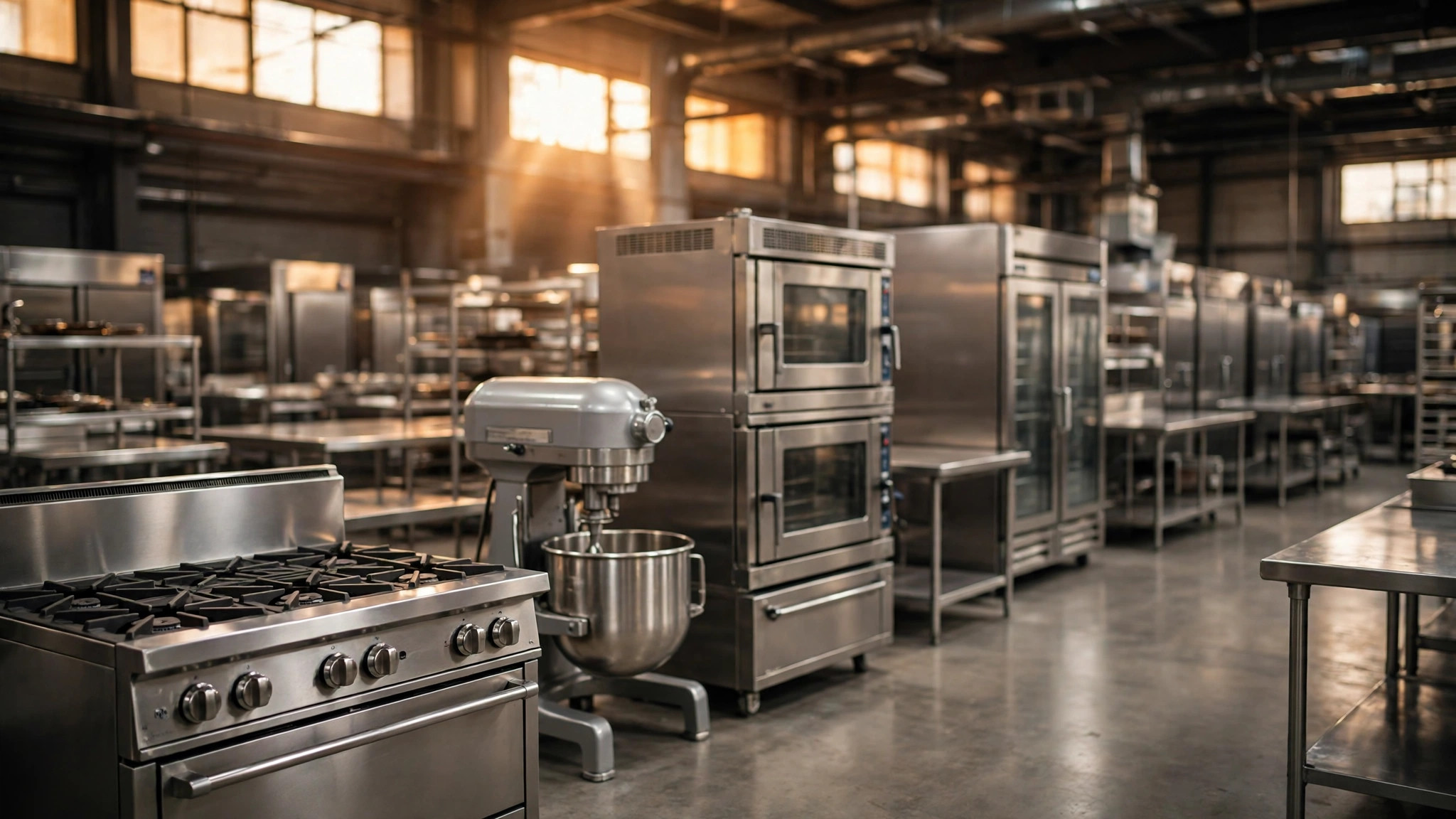
- A $150,000 kitchen sells for $30,000 at closing.
- A verified sale at 40% of new returns $52,800 after fees: $22,800 more than the dealer.
- The missing layer is trust: inspection, escrow, freight.
The Problem
In May 2024, Red Lobster closed more than 50 restaurants that month, 48 of them in a single week, and TAGeX Brands auctioned the contents of each one, winner takes all, in what it called the largest restaurant equipment auction ever. Behind every one of those lots sat a kitchen that had cost $100,000 or more to build, and behind every kitchen sat cooks, servers, and dishwashers who lost their jobs, plus an owner who often lost savings or a personal guarantee along with the business. Equipment was the only asset left with a price, and the price was whatever the room would pay.
More than 700,000 restaurants operate in the United States, and the National Restaurant Association counts over 1 million foodservice establishments once institutional dining and catering are included. Its 2026 report projects $1.55 trillion in sales and more than 100,000 new jobs, up from about $1.5 trillion in 2025. Ohio State hospitality researcher H.G. Parsa tracked 2,439 restaurants in Columbus and found 26 percent closed in the first year and 59 percent within three years. A UC Berkeley study put first-year failure lower, at 17 percent. Parsa's study is from 2003, covering Columbus restaurants in 1996 to 1999, and the Berkeley figure comes from Luo and Stark (2014), so both numbers are old. What has not changed is the shape of the problem: a steady share of new restaurants closes fast, and every closure strands a kitchen.
The famous 90 percent figure is a myth. Parsa's literature review found no evidence for it anywhere.
What happens to that kitchen is a fire sale with a deadline, because the owner often has 30 days or less to clear a leased space while the landlord waits for the keys. A local dealer offers cash today at 10 to 30 cents on the dollar, because the dealer absorbs the storage, the refurbishment, and the risk that the walk-in cooler has a dying compressor. An auction house takes the whole lot, spends 10 to 14 days marketing it, and returns whatever the bidders offer that week. Classifieds are free, and the service matches the price: no-shows, lowball offers, and buyers who expect the seller to move a 500-pound range. eBay has the deepest liquidity and the only real price data, in its sold-listings filter, but nobody verifies that the fryer works and nobody arranges the freight.
On the buyer side, a first-time operator opening a fast-casual spot needs $100,000 to $180,000 of equipment new, according to current buildout guides, and financing runs 9 to 14 percent APR for a restaurant with no operating history, per equipment finance data. Used gear would cut that bill by 40 to 60 percent, according to QSR buildout guides. A buyer should not need a technician's eye to tell a good Hobart mixer from a dying one, and no listing tells them which one they are looking at until the health inspector or the first dinner rush does, which is why the same buyer who would happily pay $4,000 for a used mixer with a grade will not pay $2,000 for the same mixer without one, because the discount is not a bargain, it is a gamble with the buyer's own opening week.
So they buy new, borrow more, and start deeper in the hole. Closing that gap is the business: the owner recovers more of what the kitchen cost.
The 20-Cent Math Nobody Runs
Take a representative mid-range independent restaurant, one whose kitchen cost $150,000 new. Buildout guides put a commercial kitchen at $75,000 to $300,000, and $150,000 sits near the middle of what fast-casual operators actually spend. Suppose it closes in year two. Here is what the owner gets, channel by channel.
| Channel | Gross sale | Fees | Net to seller | Recovery of new cost |
|---|---|---|---|---|
| Dealer buyout | $30,000 | $0 | $30,000 | 20% |
| Auction | $45,000 | Seller commission ~26% plus $175 platform fee (GRS Auctions typical rate) | ~$33,300 | ~22% |
| Verified marketplace | $60,000 | $7,200 (12%) | $52,800 | 35.2% |
Dealer buyout at 20 cents on the dollar, the midpoint of the 10 to 30 percent range that Grafe Auction cites from the Burkett Blog: $30,000. Auction at the top of that same range: $45,000 gross, less a seller commission of about a quarter, the typical rate at GRS Auctions, for a net around $33,300. The buyer also pays a 15 percent premium on top of the hammer price, so the house takes its cut from both sides. Direct sale on a verified marketplace at 40 percent of new: $60,000, of which the platform takes 12 percent, or $7,200, leaving the seller $52,800. That is $22,800 more than the dealer offered, a 76 percent improvement.
Same steel.
Two numbers in that table deserve a second look. First, the seller's net recovery rate on the verified channel is 35.2 percent, and the $22,800 advantage is measured against the dealer only: against the auction's net it is $19,500, or 59 percent. Second, the buyer saves $90,000 against new before inspection, freight, rigging, and installation, which run a few hundred dollars for a single item and a few thousand for a full kitchen. Dealers lose a sale they would have bought cheaply, but they earned that spread by offering immediate cash and absorbing the storage, refurbishment, and resale risk, a service the marketplace replaces with verification rather than with nothing.
One assumption carries the whole calculation, so it belongs in the open: the 40 percent direct-sale price is not an observed market average. At a 30 percent direct sale the seller nets $39,600, a 32 percent improvement over the dealer, and at 35 percent the seller nets $46,200, a 54 percent improvement. The model holds up across that range, but the headline 76 percent depends on the 40 percent price clearing.
Scale it. The global used restaurant equipment market was $6.34 billion in 2024 and is projected to reach $8.51 billion by 2028, growing 7.6 percent a year. That is gross merchandise value already changing hands through dealers, auctions, and classifieds. Demand is proven. Who earns the fee for making the transaction safe is the only open question.
The Gap in the Market
Every channel that moves used kitchen equipment today is missing at least one piece of the transaction, whether it is verification, escrow, financing, freight, or simply a price the buyer can check against anything other than a stranger's asking price.
| Company | What They Do | What's Missing |
|---|---|---|
| eBay | Deepest liquidity; sold listings are the only price data. | No verification, escrow, or freight; generalist platform. |
| Facebook Marketplace / Craigslist | Free, local, fast for single items. | No verification or payment protection; scams common. |
| BidSpotter / Proxibid / HiBid | Timed auctions run by professional liquidators. | As-is, where-is; buyer pays rigging and removal. |
| Grafe Auction and regional houses | Full-kitchen liquidation in a single event. | One shot at the market; commission plus marketing fees. |
| Burkett / Restaurant Equippers / ACityDiscount | Dealers buy outright and pay cash immediately. | Speed costs the seller: 10-30 cents on the dollar. |
| WebstaurantStore | Dominant new-equipment retailer with financing. | Sells new only; no used channel or trade-in. |
| KitchenEquipmentTrader.com | Specialized listings with sold-price data. | Listings only; no transaction layer or freight. |
Liquidity exists. Price discovery exists in fragments. What does not exist is a single place where a buyer can see a verified condition report, pay through escrow, finance the purchase, and get the equipment delivered and installed. Every incumbent monetizes one piece of that chain, and nobody owns the chain.
Trust is the product.
The Solution
A verified marketplace for used commercial kitchen equipment, sold in three layers:
Inspection-first listings
Every item over $1,000 gets a 40-point inspection by a certified technician before it lists. A compressor test, gas leak check, electrical load test, and remaining-life estimate make up the checklist, and the technician who runs it signs the report, so the grade is a professional opinion with a name on it rather than a seller's guess in a listing photo. Photographs of the manufacturer's data plate show the NSF (or ETL/UL sanitation) listing, model, and serial number, and the model gets checked against the NSF listings directory. The report is the listing rather than an attachment to it. Items under $1,000 list with seller photos and a condition grade, no inspection required. One honest caveat belongs here: a data plate shows the model was certified when made, not that a repaired or modified used unit still complies, since non-OEM parts, re-welding, or re-sealing can place the unit outside its original certification (compliance can be re-established by field evaluation; the local health authority decides).
Transaction layer
Under the proposed design, escrow would hold payment until delivery and a 48-hour function test. A buyer would discover a dead compressor while the money is still held rather than after it has cleared, and the seller would be paid when the test passes, subject to a dispute process. Financing is built into checkout, priced against the inspection grade, so a B-grade fryer costs less to finance than an ungraded one. That 48-hour test covers immediate function only, not latent defects: a compressor that dies on day five is a different problem, and the warranty product exists for exactly that gap.
Whole-kitchen sales get a UCC lien search before closing. A restaurant that closes with a lender's lien on its equipment is a routine risk, because equipment lenders almost always file a UCC-1, and buyer-in-ordinary-course protection does not apply here, since a closing restaurant is not in the business of selling equipment. A buyer who discovers a perfected lien after paying generally takes the equipment subject to it and must pursue the seller (if the sale documents did not disclaim the warranty of title, which as-is and auction sales commonly expressly disclaim) for breach of warranty of title (UCC 2-312) or fraud, a claim that is often against a closing, judgment-proof seller, which is why the search and a payoff or release must happen before closing, not after. No search is perfect: it can miss misfiled or name-variant filings, and it does not cover fixture filings at the county recorder, tax liens, or landlord liens, nor does it show equipment the seller leases rather than owns, or liens created by a prior owner. Liens kill deals.
Freight and install
Flat-rate insured freight by item class, with rigging and haul-away quoted up front, so the buyer in Cleveland knows the full landed cost of a range in Columbus before bidding, instead of discovering the rigging bill after winning. A range ships differently from a walk-in cooler, and the quote should know that. Contracts with regional riggers in each launch metro cover the last mile, rather than leaving a first-time buyer to find one on a deadline. Holding buyer funds can trigger state money-transmitter licensing plus federal FinCEN registration, and independent escrow is licensed in many states (with banks, attorneys, and title companies operating under their own licenses elsewhere), so the licensing work starts before the first range ships, not after.
Revenue Model
| Revenue Stream | Amount | Year-3 revenue | Notes |
|---|---|---|---|
| Marketplace take rate | 12% of GMV | $3.89M | Core stream; charged to the seller at close. |
| Inspection and certification | $199 per item | $716K | Required for items over $1,000; cost-plus at scale. |
| Logistics coordination | ~$180 markup per delivery | $648K | Carrier charges pass through at cost; the platform books its coordination markup as revenue. |
| Financing referral | 1.5% of financed amount | ~$39K | Assumes ~8% of GMV financed. |
| Extended warranty | 8% of sale price | ~$65K | Assumes ~10% attach and a 25% referral share of the premium; the underwriter keeps the rest (no partner secured). |
| Dealer SaaS | $299/mo | Not in year-3 total | Price guide and inventory tools for high-volume sellers. |
| Total | ~$5.36M | Sum of the five Year-3 streams above, excluding Dealer SaaS ($5,356,080 exact). |
Unit economics at year-three scale: 3,600 transactions a year at $9,000 average gross merchandise value is $32.4 million in GMV. Those streams total about $5.4 million in annual revenue at an estimated 55 percent gross margin, against a $1.27 million startup investment. Year three assumes one inspected item and one delivery per transaction. At year-three run-rate gross profit of about $2.95 million a year, the $1.27 million is covered in about five months of run-rate profit, so the payback date depends entirely on how fast the first two years ramp, and the base case puts it around the end of year two. That payback is computed on gross profit, not free cash flow. Grade first. Sell second.
Market Size
TAM: Globally, the used restaurant equipment market was $6.34 billion in 2024 and is projected to reach $8.51 billion by 2028. At a 12 percent take rate, the platform revenue available on that flow is roughly $760 million a year on the 2024 figure, rising to about $1.0 billion by 2028 on the projected $8.51 billion. For scale, the new commercial foodservice equipment market was $44.83 billion globally in 2025, against $6.34 billion of used sales in 2024, so the used market runs about a seventh of new sales, and that ratio understates the opportunity, since the new market sells each machine once while the used market can sell the same machine two or three times over its working life, collecting a fee at every turn.
SAM: Not every used item is addressable online, since custom-fabricated pieces, built-in hoods, and walk-in coolers that need disassembly will stay local and offline. Serviceable here means standardized, shippable equipment in the top 30 US metros: ranges, refrigeration, mixers, fryers, dish machines, and prep tables where model numbers are standard and parts are available. That is roughly half the used market on the 2028 projection, about $4.3 billion in GMV (about $3.2 billion on the 2024 figure), or about $511 million in platform revenue at a 12 percent take ($380 million on the 2024 figure).
SOM (year 3): $5.4 million in annual revenue on $32.4 million of GMV, about 0.5 percent of the 2024 TAM's gross merchandise value (0.4 percent of the projected 2028 figure). Inspection capacity and seller onboarding in five launch metros are the constraint, not demand, because every month restaurants close and restaurants open in the same cities, often on the same streets.
Why Now
Tariffs cut both ways. Section 232 duties on steel and aluminum are tiered: the 50 percent tier (now Annex I-A) has stood since June 4, 2025 (25 percent for UK-origin metal). An April 2026 proclamation applied the duty to the full customs value of covered derivative articles, effective April 6, 2026. What a new kitchen actually pays is a mix, not a single rate: commercial cooking stoves, ranges, and ovens fall under the Annex III transitional cap, a combined rate capped at 15 percent through December 31, 2027, while refrigeration, freezers, household dishwashers, and steel tables and sinks sit in Annex I-B at 25 percent on full value, per the proclamation analysis. Higher metal costs widen the discount on used gear, and the same duties raise the price of a new range for every operator who still has to buy new. The opportunity here comes from a policy that makes kitchens more expensive overall.
Closures and openings are a permanent flow. About a quarter of new restaurants close in year one and 59 percent within three years, per the Ohio State study, while the National Restaurant Association projects $1.55 trillion in sales for 2026 with operators adding more than 100,000 jobs. Growth here is a function of how fast the marketplace can grade, photograph, and list, because the closures keep coming whether the marketplace is ready or not.
Large liquidations normalized the channel. Red Lobster closed more than 50 locations in May 2024 and liquidated the kitchens through TAGeX Brands, winner takes all, in what the liquidator called the largest restaurant equipment auction ever. Chain rollouts and closures of that scale used to be handled quietly through dealer networks. Now they run through structured auctions with published results, so institutional sellers already accept third-party channels. The stigma is gone, but the infrastructure is not.
Price discovery already exists in pieces. eBay sold listings are the de facto price index for used equipment, and specialized sites publish sold-price data. Data is proven. What nobody built is the transaction layer on top of it: verification, escrow, financing, and freight. Adding trust to a market that already has liquidity does not require teaching anyone to buy used; it requires teaching them to buy used without getting burned.
Startup Costs
| Category | Cost | Notes |
|---|---|---|
| Marketplace + pricing engine (10 months) | $420K | 4 engineers at contractor rates. Listing flow, inspection workflow, escrow, financing integration, price guide from sold-listing data. |
| Inspection network (5 launch metros) | $150K | Certified technicians, training, and the 40-point inspection standard. Every item over $1,000 gets inspected before it lists. |
| Seller onboarding | $140K | Field team to reach liquidators, dealers, and closing owners early, so sellers get competing quotes before signing a buyout under a lease deadline. |
| Logistics partnerships | $90K | Contracted regional riggers and freight carriers in each launch metro, plus insurance for in-transit damage. |
| Demand sales (year 1) | $150K | Two AEs selling to new restaurant openings, ghost kitchen operators, and food truck builders. |
| Insurance, escrow, and legal | $110K | Escrow operations, UCC lien search process, liability coverage for used equipment sales. Get this right before the first range ships. |
| Pilot program (3 metros, 6 months) | $120K | Subsidized take rate during the pilot to seed liquidity; goal is 500 inspected transactions and a publishable price guide. |
| Operating buffer (12 months) | $90K | Cloud hosting, customer support, data licensing. |
| Total | $1.27M |
The $1.27 million funds roughly a year of operations at the planned burn, and revenue starts with the pilot in month six. If the pilot slips, the buffer is the first thing that breaks.
Limitations
The used-market size figure comes from a Toast blog post citing unnamed market research, not an audited study. Treat the $6.34 billion to $8.51 billion trajectory as directional. It is the best public number in the category, which is itself part of the problem this business exists to solve. Trade estimates of the used market vary widely by definition, and the Toast figure should be read as an order of magnitude, not a precise count.
There is no public registry of restaurant closures or liquidation recovery, so the per-kitchen math uses midpoints of published ranges: a representative $150,000 buildout, a 20-cent dealer recovery, a 40 percent direct-sale price. The 40 percent price is an assumption, not an observed market average, and the financing and warranty revenue assumes a 10 percent warranty attach rate, a 25 percent referral share of the warranty premium, and 8 percent of GMV financed. Real kitchens vary wildly, since a pizza shop's deck oven holds value differently from a sushi bar's custom refrigeration, and the model does not capture that spread, so treat the per-kitchen math as a planning tool for a typical fast-casual buildout, not a valuation for any specific kitchen: applying the 35.2 percent recovery rate to a sushi bar or a bakery without adjusting for the equipment mix is using the model wrong.
New-equipment market estimates disagree by a wide margin. PW Consulting puts the global market at $44.83 billion in 2025, while Grand View Research puts North America at $10.9 billion in 2025, versus PW Consulting's $17.86 billion for the same region, which runs about 64 percent higher than Grand View's figure. Resolving it does not change the used-market TAM, but the disagreement is a reminder that every number in this category carries a wide error bar.
Twelve percent is a planning assumption rather than a tested price, and it has to survive contact with sellers who are used to paying nothing on classifieds and buyers who are used to paying auction commissions. If the market clears at 8 percent, take-rate revenue falls by a third, from $3.9 million to $2.6 million, and total year-three revenue falls by about 24 percent, from $5.4 million to about $4.1 million, and the payback stretches well into year three. Xenia's own buildout guide advises buying cooking equipment new, warning that a fryer or range that breaks mid-service costs more than the money saved. An inspection grade is the marketplace's answer, not a denial of the risk.
Strongest Counterargument
Dealers are not villains. They are the price of a market with no trust. Used equipment is a lemon market, and the 20-cent recovery is the price of that fact rather than a market failure, because when the buyer cannot tell a working compressor from a dying one, the rational price for every machine is the price of the worst machine in the pile. Condition is unobservable, a dead compressor kills the deal, and the dealer earns the spread by absorbing the risk, the storage, the refurbishment, and the local relationships that move a walk-in cooler out of a basement on a deadline, which is work that no software demo has ever done and no marketplace listing has ever replaced. A marketplace that lists photos with a take rate is Craigslist with a fee. eBay already has the liquidity and the sold-listings price discovery, and the auction houses already run the liquidation channel. The moat you are describing, verification plus logistics, is operationally heavy, low-margin field work, not software. And the best inventory never reaches you: chain rollouts and large closures go to professional liquidators who already have buyer lists, while the kitchens that do list are the ones nobody local wanted.
The rebuttal has three parts, and the first is that verification is the product rather than a feature. A certified inspection with a photographed serial number and a function test converts an unobservable condition into a graded asset, which is what Copart did for salvage cars and Carvana did for used cars, though both operated on titled, VIN-identified assets with established title infrastructure, which restaurant equipment lacks, and both did it by building capital-heavy physical operations, Copart's yards and Carvana's inspection and reconditioning centers, which cost billions. That proves grading creates value, not that a capital-light marketplace can deliver it cheaply.
Second, the wedge is not whole-kitchen liquidations but single high-value standardized items: Hobart mixers, Rational combi ovens, True refrigeration, where model numbers are standard, parts are available, prices are comparable across listings, and the buyer pool is national rather than confined to whoever happens to drive past the closing restaurant that week. Whole kitchens come later, once the grading standard and the freight network exist.
Third, the lien and title problem is a feature, not a bug. Private sales die on exactly that surprise, and a platform that runs the UCC search as part of checkout removes the failure mode that keeps buyers on classifieds and sellers with dealers. That leaves a real gap: the most distressed sellers, with ungraded or lien-encumbered kitchens, still need a channel, and a marketplace that only takes graded inventory does not serve them.
The Bottom Line
Every year, restaurants that close sell $150,000 kitchens for $30,000, and restaurants that open borrow $150,000 to buy the same steel new. The $120,000 in between is the total dealer discount, not the prize. The recoverable prize in this article's own model is $22,800 per kitchen for the seller and $90,000 in gross savings for the buyer before inspection, freight, rigging, and installation, and the company that grades the equipment, backs the transaction with inspection, escrow, and a 48-hour test, and moves the steel will set the first honest price a used kitchen has ever had.
A $150,000 kitchen should not sell for $30,000 just because nobody checked whether it worked.
What You Can Do
If you are closing a restaurant: Get three quotes before you sign anything, a dealer buyout, an auction estimate, and a direct-sale price from sold listings for your exact models. Before accepting a cash buyout, check whether any equipment is leased or pledged as loan collateral, and ask the landlord for extra days to sell line items rather than the whole lot, since a dealer deadline is negotiable more often than it looks. Photograph every model plate and serial number before the power gets cut.
If you are opening one: Price the used route before you commit to new. Check sold listings for your exact models, ask for the data plate and check the model against the NSF listings, and budget 20 to 40 percent above the purchase price for delivery, installation, and first-year repairs. A used fryer that breaks mid-service costs more than the money you saved buying it. If you know someone opening a restaurant, send them the 20-cent math before they sign a lease.
If you are building this: Start with one SKU category in one metro, inspection-first. A graded Hobart mixer is a product, while a whole ungraded kitchen is a gamble. Launch the price guide before the marketplace: a free monthly report on what used ranges and mixers actually sold for is the cheapest customer acquisition in the category, and every sold listing makes the guide harder to replicate. Do not expand to a second metro until you have 500 inspected transactions proving the grading standard holds, because the standard is the company, and a marketplace that grades loosely in city two will lose the trust it earned in city one.
Related
📰 Cold Storage Rents Doubled Since 2020. Nobody Will Tell You the Price. The same playbook, opaque prices and a marketplace fix, applied to refrigerated pallets instead of ranges
📰 Predictive Maintenance for Restaurant Kitchens. The other side of the same equipment: keeping the kitchen you already own running instead of replacing it
📰 Renting a Dumpster Costs $294 to $800 a Week. The Price Depends on Who Answers the Phone. Price transparency for another opaque, phone-quote market