41% of Americans Have Had a Package Stolen. Small Apartment Buildings Still Have Nowhere to Put Them.
US parcel volume reached 22.4 billion shipments in 2024, and apartment residents get victimized by package theft far more often than homeowners. Locker vendors sell $7,000 to $20,000 banks to big portfolios that can sign a capital check. A 60-unit building with a lobby the size of a closet gets a quote for the same bank, the same install crew, and the same service contract, and the deal dies. A leased locker bank sized for small buildings, priced per unit per month with no upfront purchase, is the business nobody is selling.
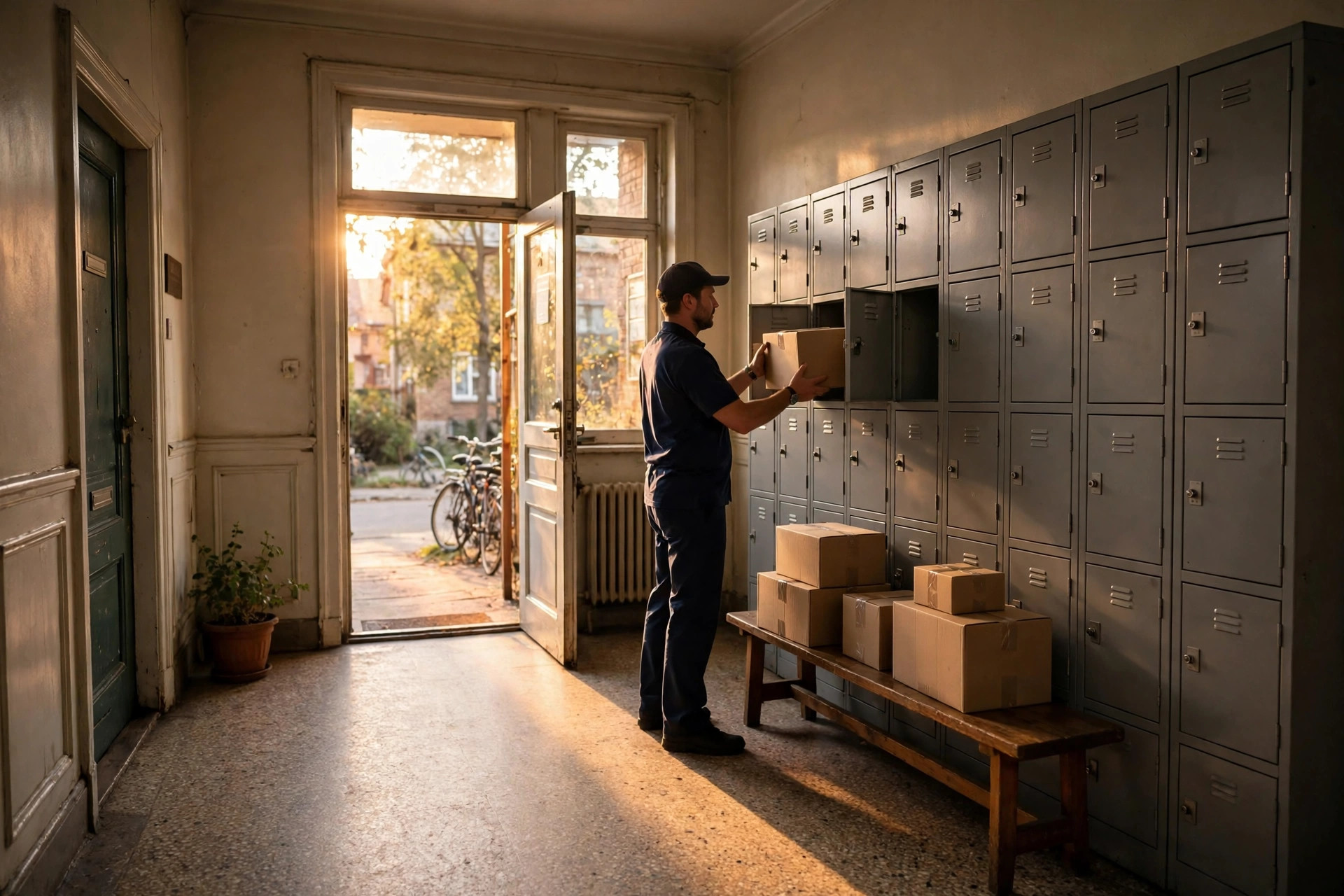
The Problem
Start with the flood. Pitney Bowes counted 22.4 billion US parcel shipments in 2024, up 3.4 percent from the year before, and the carrier mix behind that number is fragmenting fast: Amazon Logistics moved 6.3 billion parcels, USPS moved 6.9 billion, and the "other" carriers grew 23 percent in a single year. A building lobby in 2026 does not receive deliveries from one driver in a brown uniform. It receives them from Amazon, USPS, UPS, FedEx, OnTrac, UniUni, and a rotating cast of gig couriers, each with a different handheld, a different code system, and a different idea of where a package belongs.
Now put that flood into a building with no staff. Parcel Pending's research, cited in Habitat Magazine, puts the volume at about 875 package deliveries per month at an average 300-unit complex, and one hour of staff time for every 15 packages managed. Scale that rate down to a 60-unit building and you get roughly 175 packages a month, or about 11.7 hours of someone's month spent logging, stacking, hunting for, and apologizing about boxes. Small buildings do not have that someone. Packages end up in a hallway, behind a leasing-office door that is locked half the day, or in a pile by the mailboxes where anyone walking past can help themselves.
That pile is not a minor annoyance. InsuranceQuotes found 31 percent of respondents had a delivered package stolen from a porch, doorstep, or building lobby in its 2024 survey, up from 24 percent two years earlier. ValuePenguin's 2024 study put the lifetime figure higher, at 41 percent of Americans having had a package stolen at least once, with one in four hit in the past year. Security.org's 2025 report found apartment residents were victimized 3.5 times more often than homeowners in the most recent three-month period it measured. Renters order more, stay home less, and share lobbies with strangers. Porch piracy is, to a large degree, an apartment problem wearing a single-family name.
So why doesn't every small building just buy lockers? Because the locker industry sells to the buildings that look like its sales deck. A 300-unit tower with a leasing office, a maintenance tech, and a capital budget can absorb a $10,000 to $20,000 purchase, a freight delivery, an install crew, and a service contract. A 40-unit walk-up owned by a retired couple in Ohio cannot, and its property manager, if it has one at all, manages a dozen such buildings scattered across town. Nobody in the locker business has built a product for that buyer: no upfront purchase, no install crew camping in the lobby for a week, no service contract that requires a facilities manager to administer. The result is a market where the buildings with the worst package problem have the least access to the fix.
Market Size
TAM calculation: Anchor to the small-building stock, not all apartments. Enterprise Community Partners, using Census and HUD data, counts 5,415,882 rental units in 5 to 9 unit buildings, 5,229,583 in 10 to 19 unit buildings, and 4,194,332 in 20 to 49 unit buildings, for a total of 14,839,797 units in buildings of 5 to 49 units. Price the service at $5 per unit per month, building-paid and passed through as an amenity line item, or $60 per unit per year. Multiply: 14,839,797 units times $60 equals $890 million per year in TAM. That figure excludes buildings under 5 units, where a locker bank rarely fits, and buildings over 49 units, where the incumbents already compete. It is the small-building market, priced honestly.
SAM: Not every small building can take a locker bank. Some have no lobby at all, some are in markets where package volume is thin, and some owners will never pay for an amenity they consider the tenant's problem. Assume 40 percent of the 5 to 49 unit stock sits in buildings of 20 or more units inside the top 50 metros, the segment with both the volume and the lobby space to make a bank work. That is 5,935,919 units times $60 per year, or $356 million per year in SAM. The SAM is an assumption, stated as one: the 40 percent share is a planning judgment, not a published figure, and it is the number most worth arguing with in this whole piece.
Year 3 target: 2,000 buildings at an average of 60 units equals 120,000 units under management. At $60 per unit per year, that is $7.2 million in ARR, plus $750 per building in onboarding fees for 2,000 buildings, or $1.5 million in cumulative onboarding revenue. Getting there runs through small-portfolio managers, not individual landlords: one manager with 40 buildings at 60 units each is 2,400 units in a single contract, and a metro with 200 such managers is a real business.
Why Now
Four forces are converging, and the fourth is seasonal. First, carrier fragmentation broke the single-carrier locker. When one carrier delivered most packages, a locker branded by that carrier was tolerable. Now Amazon, USPS, UPS, FedEx, and a fast-growing tail of regional carriers all deliver to the same lobby, and a locker that only accepts one carrier's codes is a partial solution. Carrier-agnostic access, one code system for every driver, stopped being a nice feature and became the requirement.
Second, theft is getting worse on the exact metric that sells this product. InsuranceQuotes measured 31 percent victimization in 2024, up seven points in two years, and ValuePenguin measured 41 percent lifetime victimization. Every holiday season resets the conversation in every building lobby in America, and the building that just had three packages stolen in a week is a building whose owner will finally take a meeting. That meeting has a short shelf life, which is why the product has to install in weeks, not quarters.
Third, the big landlords already validated the category, which de-risks the pitch to small ones. Amazon struck deals with Greystar, Bozzuto, AvalonBay, and Equity Residential to install Hub lockers across thousands of large properties, with owners paying $10,000 to $20,000 per installation. When the largest owners in the country buy a product category, a small owner no longer needs to be convinced that lockers work. They need to be convinced that lockers work for a building their size, at a price their budget can carry. That is a much easier sale.
Fourth, the calendar. Package volume peaks in the fourth quarter, theft peaks with it, and a company that launches its sales push in October is selling into the one quarter when every building manager is living the problem daily. A November install that survives the holiday peak becomes a January renewal conversation the company does not have to fight for. Timing a launch to the peak is not a gimmick. It is the difference between a demo and a reference customer.
The Product
A leased parcel locker bank plus the software that runs it, sold to buildings of 20 to 100 units with no upfront hardware purchase. The building pays per unit per month; the company owns, installs, maintains, and eventually replaces the hardware. Five pieces:
- Right-size bank: The wedge. Most vendors quote a 40 to 60 compartment bank because that is what their catalog holds. This company sizes from the building's actual package flow (see the locker-count math below) and ships a 24-compartment bank as the default for a 60-unit building, with bolt-on modules when volume proves otherwise. Smaller bank, smaller footprint, smaller install: the bank fits in the lobby these buildings actually have.
- Carrier-agnostic drop: Any driver gets a one-time code by text or through the building's existing intercom panel, opens a compartment, drops the parcel, and closes the door. No carrier app, no carrier account, no building staff involved. The resident gets a pickup code the same way. If a driver cannot figure it out in under 30 seconds, the product failed, and the install team finds out from the first week's drop data rather than from an angry property manager.
- Overflow room software: Lockers cannot hold a kayak, a 65-inch TV, or a week's worth of Chewy boxes. The product includes a managed overflow protocol: oversize parcels go to a designated locked closet or cage, logged with a photo and a pickup code in the same system, so the resident experience is identical whether the parcel fit in a locker or not. Vendors that only sell compartments leave the hardest 20 percent of parcels unsolved. That 20 percent is where the complaints live.
- Theft and chain-of-custody log: Every drop and pickup is time-stamped with a photo, which turns "my package was stolen" from a shouting match into a record. Buildings get a monthly report: parcels received, parcels picked up, average dwell time, and any parcel that sat unclaimed past the policy window. Unclaimed parcels trigger a reminder sequence, then a building-policy disposition, instead of accumulating until someone throws them away.
- Manager dashboard for portfolios: A small-portfolio manager sees all their buildings in one view: which banks are full, which buildings have unclaimed parcels aging out, and which drivers are struggling with codes. One dashboard across 40 buildings is the reason a manager buys from this company instead of buying a bank per building from a catalog.
Unit Economics
| Metric | Value |
|---|---|
| Revenue per unit/month | $5.00 (building-paid) |
| Hardware lease and depreciation per unit/month | $1.20 |
| Connectivity and cloud per unit/month | $0.40 |
| Support per unit/month | $0.45 |
| Field maintenance per unit/month | $0.55 |
| Gross margin per unit/month | $2.40 (48%) |
| CAC per building (60-unit average) | $2,400 ($40/unit) |
| LTV per building (36-month retention) | $5,184 (60 units x $2.40 x 36) |
| LTV:CAC | 2.2:1 |
| Payback period per building | 16.7 months |
| Onboarding fee per building | $750 |
| Startup cost (18-month runway) | $1.15M |
| Break-even | Month 27 (model output) |
Methodology note: CAC of $2,400 per building assumes a sale to a small-portfolio manager covering several buildings per deal, not door-to-door landlord prospecting, which would blow the number up. The 36-month retention assumption is doing real work in the LTV math: if buildings churn at 24 months, LTV per building falls to $3,456 and the LTV:CAC ratio drops to 1.4:1, which is a bad business. Hardware cost assumes a white-label locker bank bought at volume, not a custom design. The $1.15M startup figure breaks down as roughly $700K in loaded personnel (three engineers, one operations lead, one sales lead over 18 months), $250K in hardware deposits and first-run inventory, $100K for legal, insurance, and carrier-access compliance, and $100K for cloud, tooling, and install contractor onboarding. Break-even at month 27 is a model output assuming the Phase 3 portfolio ramp below, not a commitment.
Go-to-Market
Phase 1 (months 1-6): Sell in one metro, to managers, not landlords. Pick a metro with dense small-building stock and a real winter or holiday package peak, Chicago or Philadelphia fit, and sign 50 buildings through five to ten small-portfolio managers. The pitch is one line: no purchase, no install crew in your lobby for a week, one monthly line item per unit. Every install is measured for driver success rate, and any building where drivers fail more than 5 percent of drops in week one gets a same-week fix. Early reputation is the whole company at this stage.
Phase 2 (months 7-14): Convert the first metro's data into the sales deck. Driver success rates, theft reports before and after install, and staff hours saved become the numbers that sell the next metro. Expand to three more metros using the same manager-first playbook, and add the overflow room as a paid add-on for buildings whose oversize share runs above 25 percent. Target 500 buildings by month 14.
Phase 3 (months 15-24): Move from managers to the channels that aggregate them: local apartment associations, property-management software marketplaces, and insurance brokers who write renter package-theft riders. An insurer that sees a building's theft claims drop after a locker install is a distribution partner with a financial reason to refer. Target 2,000 buildings by month 24, and start the conversation about refrigerated modules for grocery and meal-kit deliveries, the one parcel category lockers still handle badly.
Competitive Landscape
| Company | What It Does | Why It Leaves the Gap | Pricing |
|---|---|---|---|
| Parcel Pending (Quadient) | Electronic locker systems for apartments, the category incumbent | Sells banks starting around $6,900 and up to $20,000, built for portfolios with capital budgets and staff | $6,900 to $20,000 purchase |
| Luxer One | Indoor, outdoor, and refrigerated lockers plus smart package rooms | No standard public pricing; third-party estimates put hardware and install at $6,000 to $20,000, and the sales motion is quote-based enterprise | Quote-based; $6,000 to $20,000 third-party estimate |
| Amazon Hub | Apartment lockers from Amazon, sold to large landlords | No monthly fee, but a $10,000 to $20,000 upfront purchase, and the deals run through the largest owners, not small buildings | $10,000 to $20,000 purchase |
| Fetch Package | Off-site package management: parcels go to a Fetch warehouse, then Fetch redelivers door to door | Needs a metro warehouse and a delivery fleet, so it only works in covered metros; reported pricing of $10 to $15 per door per month is double this product's price | $10 to $15 per door per month (third-party reporting) |
| ButterflyMX Delivery Pass | Single-use codes for couriers at the video intercom | Solves building entry, not package storage; a courier who gets in still leaves the box in the lobby | Quote-based intercom pricing |
| This startup | Leased, right-sized, carrier-agnostic locker bank with overflow software for 20 to 100 unit buildings | The gap: nobody sells lockers as a per-unit monthly service to buildings too small for a capital purchase | $5 per unit per month, $0 upfront |
The gap is a pricing-model failure, not a technology failure. Locker hardware is a commodity. White-label banks with electronic locks, cameras, and cellular connectivity are available from multiple manufacturers. What does not exist is a vendor willing to own the hardware, size it for a 60-unit building, and charge rent instead of a purchase price. Incumbents sell boxes because boxes are how they have always sold. A service company that rents the box, maintains it, and owns the resident relationship is playing a different game on the same hardware.
Original Contribution: The Locker-Count Math, Stated Honestly
A calculation vendors rarely show their work on: how many compartments does a 60-unit building actually need? Start from Parcel Pending's rate: 875 packages per month at a 300-unit complex, or 2.92 packages per unit per month. A 60-unit building receives about 175 packages per month, or 5.8 per day. Parcels do not get picked up the same day they arrive, so multiply daily inflow by dwell time. Assume parcels sit an average of 2 days before pickup, an assumption, not a measured figure, and the best data the company collects in its first 90 days is the real dwell distribution. In-system parcels at any moment: 5.8 times 2, or 11.6.
Now apply two derates in opposite directions. First, peak bunching: weekend and holiday deliveries cluster, so multiply by a 1.8 peak factor, giving 20.9 parcels in system at peak. Second, oversize bypass: roughly 20 percent of parcels will not fit a standard compartment and go to the overflow room instead, so locker parcels at peak are 20.9 times 0.8, or 16.7. Round up, add a small buffer for the week a resident goes on vacation without telling anyone, and a 24-compartment bank covers the building with about 43 percent headroom over the calculated peak need of 17 compartments. A vendor selling a 48-compartment bank to this building is selling twice the hardware the math supports, which is exactly why the quote dies in the owner's inbox.
Now the money version of the same honesty. A $10,000 vendor bank amortized over 5 years costs $167 per month before service fees, and the building owns a depreciating box. This service at $5 per unit per month on 60 units costs $300 per month, or $18,000 over 5 years, and the building owns nothing. Leased is more expensive over five years. Say it plainly, because the customer will figure it out anyway: the pitch is not total cost, it is cash flow, maintenance included, and the right to cancel if the building sells or the product disappoints. A building that cannot write a $10,000 check will pay $300 a month for a problem that costs it 11.7 staff hours a month, and at a $22 loaded hourly rate that staff time is worth $257 a month before a single theft claim is counted.
Limitations
Several weaknesses in this analysis deserve plain acknowledgment. First, the 40 percent SAM share is a planning assumption, not a measured figure. If the true addressable share of small-building units is 25 percent instead of 40 percent, SAM falls from $356 million to $223 million per year, and the Year 3 target gets harder without changing the product at all.
Second, the 2-day average dwell time is assumed, and dwell is the single most sensitive input in the locker-count math. If real dwell averages 4 days because residents treat lockers as free storage, the 24-compartment bank overflows and the overflow room becomes the product. The company needs dwell data from its first installs before it can size banks with confidence, and its first banks should be sized conservatively until that data exists.
Third, the $22 loaded hourly rate for staff time is a round-number estimate, and small buildings often have no staff at all, which means the "hours saved" argument converts to nothing on their P&L. For an owner-managed building, the sale is theft reduction and tenant satisfaction, not labor savings, and those are harder to price.
Fourth, carrier cooperation is not guaranteed. A carrier-agnostic code system works only if drivers use it, and drivers are measured on stops per hour, not on building security. If drivers keep leaving boxes in the lobby because the code step costs them 30 seconds, the product's core promise fails at the last ten feet. Early driver-success data is the metric that matters most, and a week-one failure rate above 10 percent should trigger a product redesign, not a training memo.
Fifth, the LTV math assumes 36-month retention, and small-building ownership turns over. When a building sells, the new owner inherits a monthly charge they did not choose, and some will cancel on principle. Retention in this segment is a real risk, and the 2.2:1 LTV ratio leaves little room for it to be worse than modeled.
Strongest Counterargument
The strongest case against this startup is that the locker business is a race to a commodity price, and Amazon already won the part that matters. Amazon delivers more parcels to these buildings than anyone, its Hub lockers carry no monthly fee, and its deals with the largest landlords prove it will subsidize hardware to own the last ten feet of delivery. If Amazon decides small buildings are worth chasing, it can offer a free or near-free bank and fund it from delivery economics no standalone locker company can match. A $5 per unit per month service looks expensive next to free, and "carrier-agnostic" is a weak shield when the carrier that matters most is also the competitor.
That pricing-model gap cuts both ways. Leasing hardware means the company carries the capital cost of every bank it installs, and a 2,000-building fleet at even $4,000 per bank is $8 million of hardware sitting in other people's lobbies. If churn runs above model, the company repossesses used locker banks with little resale value and a balance sheet full of depreciation. Vendors that sell banks transfer that risk to the buyer. This company keeps it, which is the whole reason the incumbents chose the model they did.
Finally, the building count itself is the trap. Reaching 2,000 buildings means winning 2,000 separate sales, each with its own owner, lobby dimensions, intercom system, and package closet situation. Portfolio managers aggregate some of that, but the long tail of small buildings is genuinely long, and every install has a site survey, a delivery, a bolt-down, and a driver-education problem. That is a field-services business wearing a SaaS costume, and field-services businesses scale like field-services businesses: slowly, expensively, and one lobby at a time.
Honestly, this company may be an acquisition target rather than a standalone business. If the leased, small-building channel proves real, the likely acquirers are Parcel Pending or Luxer One, which would gain a downmarket channel without cannibalizing their purchase model, or a property-management software company that wants package handling inside its platform. Building to be acquired is a fine strategy as long as it is the strategy, because the standalone path requires winning a land war of individual lobby installs against better-funded incumbents and possibly Amazon.
The Bottom Line
22.4 billion parcels a year. 41 percent of Americans hit by package theft at least once. Apartment residents victimized 3.5 times more often than homeowners. And 14.8 million rental units sitting in buildings of 5 to 49 units, where the locker industry's $7,000 to $20,000 purchase quotes go to die. A 60-unit building needs about 24 compartments, not 48, and it needs them as a monthly service, not a capital purchase, with overflow handling for the oversize parcels that break every locker-only design. Caveats are real: Amazon could go downmarket, dwell time could break the sizing math, and the hardware balance sheet is a genuine risk. But the company that sizes banks honestly, owns the hardware, and signs small-portfolio managers building by building becomes the default package infrastructure for the segment everyone else skipped, and infrastructure does not get ripped out over a $5 line item.
The buildings with the worst package problem have the least access to the fix. Sell them the fix as a service.
What You Can Do
If you manage a small building: count your parcels for two weeks before you buy anything, because the vendor's 48-compartment quote is sized for a building twice yours, and the count will tell you whether 24 compartments plus an overflow closet covers you. Ask any locker vendor for its driver success rate in the first week, not its feature list, since a locker drivers skip is a lobby pile with a monthly fee. Price the service as a building amenity at $5 per unit per month rather than a resident-paid fee, because resident-paid fees create an opt-out class of tenants whose packages still end up in the lobby. If you rent and your packages keep disappearing: ask your manager for the building's theft log, in writing, since a building that cannot produce one has no idea how big its problem is, and a written record is what turns a complaint into a budget item. And if you are considering building this company: the right-size bank is the whole wedge. Sell the count first, the hardware second, and never let a building buy compartments it does not need.
Related
📰 The Federal Charger Subsidy Died on June 30. 23 Million Apartments Still Need Plugs. — the same small-building buyer, a different infrastructure gap: load-management software that fits ten chargers on the panel that used to hold one
📰 Multifamily Water Leak SaaS — another per-unit monthly service sold to property managers, where one avoided incident pays for years of subscription
📰 Self-Storage Dynamic Pricing SaaS — what happens when storage capacity gets priced like inventory, and why a fixed bank of compartments is the wrong mental model