Your Remediator Quoted $10,000 for the Basement. The Per-Foot Math Says $4,000.
Texas and Florida made it illegal for the company that finds your mold to also bill you for removing it, because at $10 to $25 per square foot, the company writing the scope of work is setting its own invoice. The average professional job costs $2,368. A $485 independent assessment is the missing referee.
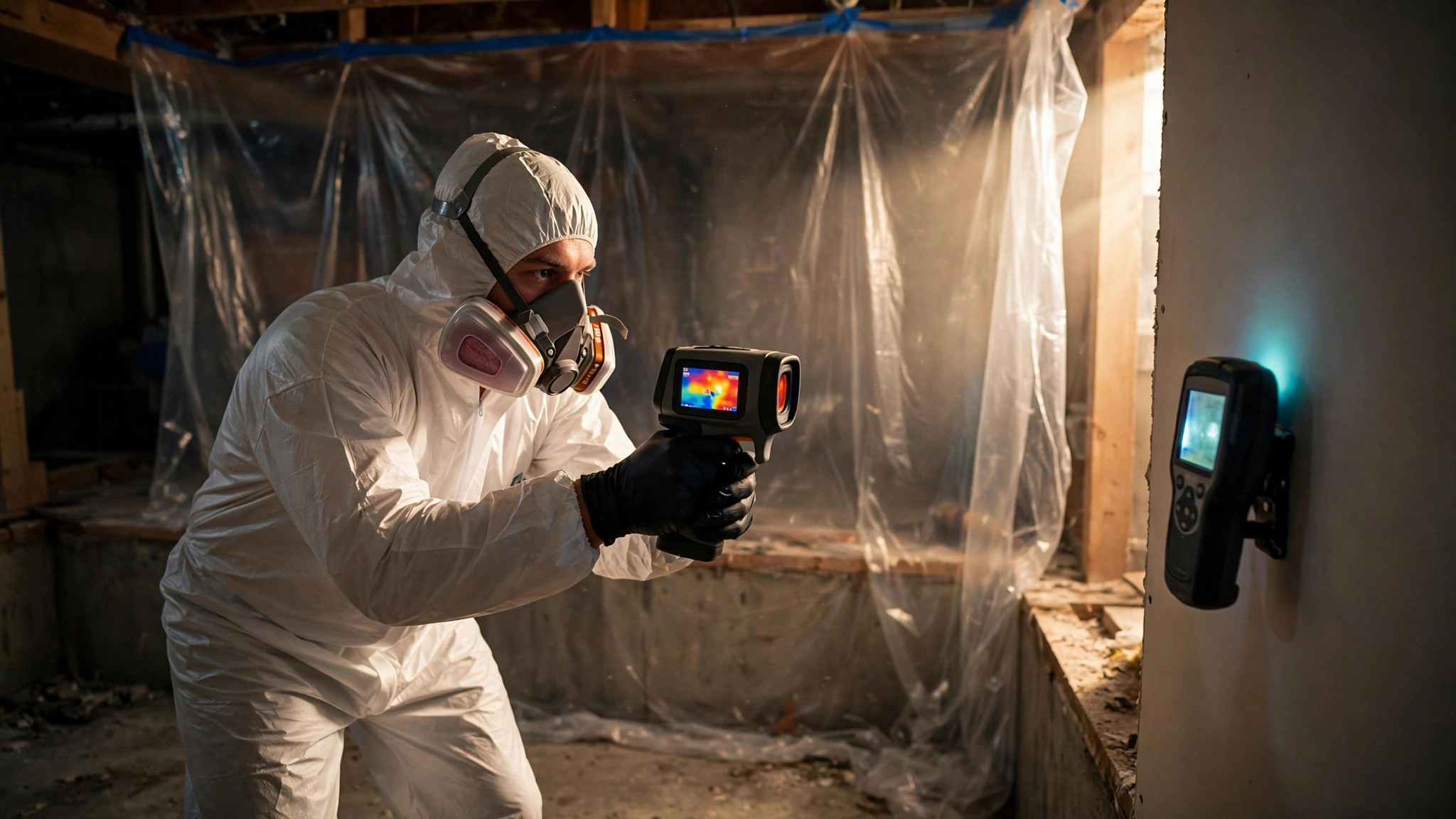
The Problem
The average American mold remediation job costs $2,368, according to HomeAdvisor's 2026 cost data, with most jobs landing between $1,223 and $3,757. Pricing runs by the square foot: $10 to $25 of it, per Angi. Run that band across a 400-square-foot basement and the quote stretches from $4,000 to $10,000 for the same basement and the same mold, a $6,000 spread decided entirely by who writes the scope of work.
Here is the structural problem. Usually the person who diagnoses the mold is also the person paid to remove it. One inspection finds the contamination, defines how many square feet are contaminated, and then bills $10 to $25 for every one of those feet, plus containment, plus HEPA air scrubbers, plus the drywall and insulation that get torn out along the way. Every square foot of mold the assessor reports is revenue for the remediator, when they are the same company. Nobody who profits from the quote will tell you the patch is smaller than it looks.
Two of the moldiest states in America already solved this problem on paper. Texas has licensed mold assessors and mold remediators separately since 2003, and Occupations Code Section 1958.155 forbids the same company from performing both on a single project, with only a narrow school-district exception. Texas sets the threshold at 25 contiguous square feet: above it, state law requires a licensed remediator working from a written protocol, and that protocol must come from a separate licensed assessor. Afterward, the remediator must issue the homeowner a certificate of mold damage remediation. Florida's version is arguably stricter: Section 468.8419 bars an assessor from remediating any structure they assessed within the last 12 months, and the statute separately prohibits referral fees and kickbacks between assessors and remediators. Both states run on the same logic. No party that grades the contamination should also bill for removing it.
So the law mandates an independent referee, but no scaled marketplace exists to supply one. On the assessor side sit thousands of fragmented local firms, the kind with a TDLR license number in the footer and a service radius of forty miles. Homeowners find them the way they find everything: a panicked Google search at 11 p.m. after the home inspector's report lands, followed by the first remediator with a good ad budget. Angi sells that lead to the remediator, the remediator writes the scope, and the scope sets the invoice. But that legal separation exists only if the homeowner already knows to demand it.
Then there is the fear premium. "Black mold" is the industry's favorite two words, and Stachybotrys chartarum is the species name that gets whispered like a diagnosis. CDC's actual position is blunt: it is generally not necessary to identify the species of mold growing in a residence, and routine sampling is not recommended, because sampling cannot reliably determine health risk and no standards exist for what counts as an acceptable quantity of mold. No matter what type is present, the CDC says, arrange for its removal. That guidance demolishes the business model of the $250-to-$800 species-identification upsell, the testing tier Angi lists at $300 to $800, which exists largely to convert anxiety into a lab invoice before the real quote even arrives.
Insurance sharpens the trap. A standard HO-3 homeowners policy specifically excludes mold, fungi, and wet rot, with one narrow carve-out: mold hidden inside walls or floors that grew from a sudden accidental discharge of a plumbing system or appliance. Gradual leaks, humidity, flooding, and anything visible are out. Even when coverage applies, policies typically cap mold payouts between $1,000 and $10,000, against whole-house jobs that run $10,000 to $30,000. Most mold bills are paid out of pocket, by a homeowner who just learned their policy excludes the problem, negotiating against a contractor who wrote the scope. That is the worst possible buyer at the worst possible moment.
Market Size
TAM calculation: Dataintelo sizes the global mold abatement service market at $6.64 billion in 2025, with the United States representing approximately $2.8 billion, growing at a 5.8 percent CAGR toward $11.03 billion globally by 2034. Treat the house range as accurate within ±30 percent and never mix service-revenue figures with turnkey project figures: the market reports measure what the industry collects, while the homeowner experiences the invoice. A cross-check from the unit side: $2.8 billion divided by HomeAdvisor's $2,368 average job implies roughly 1.18 million professional mold jobs a year in the US, a plausible figure for a country where the EPA says any wet material not dried within 24 to 48 hours starts growing mold. Residential work is 58.2 percent of the market, per the same report, and the named incumbents are franchise remediators: SERVPRO, ServiceMaster Restore, PuroClean, Paul Davis Restoration, AdvantaClean, and BELFOR.
Buyable SAM means the referee layer, not the remediation. US residential mold spending runs about $1.63 billion ($2.8 billion times 58.2 percent residential). Inspection and assessment is 24.8 percent of service mix in the indoor-remediation segmentation, which puts the US residential assessment layer at roughly $400 million a year, and nobody owns it. At maturity, the platform's buyable SAM: 50,000 assessments a year at a $100 platform take ($5.0 million), 15,000 remediation referrals at a $350 flat award fee ($5.25 million), and 25,000 clearance tests at a $75 take ($1.9 million). Combined SAM: roughly $12 million at maturity.
Year 3 target: 20,000 assessments at a $100 take ($2.0 million), 6,000 awarded referrals at $350 ($2.1 million), and 10,000 clearance tests at a $75 take ($0.75 million), for about $5 million in Year 3 revenue.
The Product
A buyer-side mold intelligence platform that audits the scope, not just the price. Existing options answer different questions. A franchise remediator answers "how much to make it go away," asked by the company billing by the foot. Angi answers "who will call me back." The DIY test kit answers "is it the scary kind," which the CDC says is the wrong question. Nobody answers "how many square feet is this really, what does the written protocol require, and did the clearance test pass before I paid the final invoice." The working name is ClearScope.
- Triage X-ray: The free wedge. Upload photos of the growth plus answers to a moisture questionnaire: where is it, how long has it been wet, is the source fixed. Triage applies the EPA's own bright line, under about 10 square feet on a hard surface with no extensive water damage is usually a homeowner job with an N-95, gloves, and goggles, and routes everything above it to a licensed assessor. Every triage feeds an anonymized quote database, which becomes the industry's first public record of quoted-versus-protocol scope.
- Licensed assessor marketplace: The compliance layer. In Texas, Florida, and Louisiana the law already requires assessor-remediator separation, so the platform is not inventing the referee, it is industrializing one the state mandates. Flat-fee assessments benchmarked to the market, a Houston independent assessment starts at $485 including two air samples, lab analysis, and the written report. Assessors are licensed, carry no remediation revenue, and are barred from the bid side. Retired industrial hygienists are ideal supply: they have run ten thousand moisture surveys and sell no remediation.
- Protocol-based bid auction: The product that kills scope inflation. Remediators bid against the assessor's written protocol as line items, containment square footage, HEPA scrubber days, drywall removal square footage, antimicrobial application, instead of writing their own scope and handing the homeowner a single terrifying number. Flat $350 award fee per job, no lead auction, no referral kickbacks, which also keeps the platform clean under Florida's anti-kickback rule. For remediators, the pitch: pre-scoped buyers with the protocol already written close faster and dispute less than Angi's shared-lead lottery.
- Clearance test coordination: The grading-the-homework fix. Texas requires the remediator's work to be verified before a certificate of remediation issues, and the company that performed the remediation cannot perform its own clearance test. ClearScope schedules the independent post-remediation verification, typically $299, and holds the homeowner's final payment until it passes. Failed clearances come back with the assessor's corrective plan, which the remediator addresses under warranty.
- Insurance and transaction pack: The documentation annuity. Insurers that do pay mold claims demand independent assessment reports and clearance certificates. Texas sellers must hand buyers copies of mold remediation certificates from the prior five years, and visible mold history can cut a home's value by up to 40 percent. All of it vaults into a transferable record that follows the property: the assessment, the protocol, the clearance result, and the certificate. Pre-listing assessments become the product's second act: sellers buy the referee before the buyer's inspector finds the problem.
Unit Economics
| Metric | Value |
|---|---|
| Independent assessment (one-time, consumer-paid) | $485 |
| Platform take per assessment | $100 |
| Clearance test (one-time, consumer-paid) | $299 |
| Platform take per clearance test | $75 |
| Remediation referral fee (contractor-paid, flat) | $350 per awarded job |
| Consumer CAC (per assessment booked) | $45 |
| Assessor CAC | $120 |
| Remediator CAC | $600 |
| Gross margin on assessment booking | 75% |
| Startup cost (18-month runway) | $750K |
| Break-even | 22 months |
Methodology note: Consumer CAC of $45 is achievable because demand is manufactured by water and concentrated in time. Every hurricane landfall, flash flood, and burst-pipe winter sends a wave of homeowners searching "mold remediation cost" within days, and the EPA's 24-to-48-hour rule means the search happens while the drywall is still wet. Capture is SEO on "[state] mold assessment vs remediation" plus storm-season content marketing, timed to hurricane season and freeze events when intent peaks. That 75 percent follows from the table: ($100 take minus $25 scheduling, support, and payment cost) divided by $100. Company-level margin rises as the higher-margin referral and clearance revenue scale. Break-even at 22 months assumes 400 assessors and 900 remediators on the platform by month 18 and a 30 percent assessment-to-referral conversion, higher than the generator analogue because the written protocol directly becomes the remediator's scope of work. Honest footnote: the $485 upfront assessment is the behavioral bet. Against a $2,368 average job it is 20 percent of the transaction, steep for a referee fee, which is why the triage X-ray must first filter out every sub-10-square-foot job the EPA says the homeowner can handle alone. An assessment only earns its fee where the scope is genuinely contestable.
Go-to-Market
Phase 1 (months 1-6): Launch the Triage X-ray as a free tool gated on email, seeded in Texas, Florida, and Louisiana, the three states where assessor-remediator separation is already law and the compliance story sells itself. Distribute through SEO on "mold assessment vs remediation [state]" queries and through storm-season content: every hurricane landfall and major flood produces a two-week window of peak search intent while drying decisions get made. Every triage feeds the anonymized quote database, which becomes the industry's first public record of quoted-versus-protocol scope.
Phase 2 (months 7-14): Monetize with the $485 assessment marketplace and launch the protocol-based bid auction. Recruit retired industrial hygienists and licensed assessors; their independence is the product, and the flat fee removes the incentive to inflate. Remediators hear a different pitch: a $350 flat award fee, no lead auction, no kickbacks, and the protocol pre-writes the scope so the close rate beats the shared-lead lottery. Publish the annual Scope Gap Report, the share of assessments that shrank the remediator's quoted scope and the average square feet removed. That report is the marketing.
Phase 3 (months 15-24): Open the clearance-test holdback and the transaction pack at full depth. Recurring revenue lives in the installed base: every remediated property carries a five-year disclosure tail in Texas, and every sale is a moment the documentation vault earns its keep. Pre-listing assessments become the wedge with real-estate agents, because a seller who commissions the referee before listing never has to negotiate against the buyer's inspector. The transaction pack becomes the product that outlives the remediation.
Competitive Landscape
| Company | What It Does | Audits the Scope? | Pricing |
|---|---|---|---|
| SERVPRO / ServiceMaster / PuroClean / Paul Davis | Franchise remediation; water, fire, and mold restoration at national scale | No: the assessor and the invoice share a P&L outside the separation states; revenue rises with square feet remediated | $10-$25/sq ft typical; whole-house $10K-$30K |
| Angi / Thumbtack / HomeAdvisor | Lead generation; sells the homeowner's contact info to remediators | No: sells the lead, never reviews the protocol; the remediator who buys the lead writes the scope | Free to consumer; remediators pay per lead |
| Local independent assessors | Licensed assessment-only firms in TX, FL, LA and voluntary elsewhere | Partially: honest ones exist and the law requires them in three states, but finding one at 11 p.m. after the inspection report lands has no scaled version | $300-$800 per assessment |
| DIY test kits (Pro-Lab, MyMoldDetective) | $50 mail-in or instant mold tests sold at retail | No: the CDC does not recommend routine sampling and says species ID is unnecessary; kits monetize fear and upsell to partner remediators | ~$50 per kit plus lab fees |
| Accredited labs (EMSL Analytical) | Lab analysis for professional samplers | Different layer: sells data to assessors, never touches the consumer decision | B2B per-sample |
| General contractors | Will remediate small jobs as part of larger repairs | No: below the 25-sq-ft licensing threshold in Texas anyone can do the work, and the GC's scope is whatever the GC says it is | Varies |
| This startup | Triage X-ray, licensed assessor marketplace, protocol-based bid auction, clearance holdback, transaction vault | Core product: revenue from the buyer and flat award fees, never from specifying more square feet | $485 assessment; $350 referral; $299 clearance |
No incumbent is paid by the buyer to answer the one question that matters. The franchise remediator, the closest thing to an authority, is paid by the square foot. An independent assessment, a licensed assessor paid a flat fee by the homeowner to write the protocol, has no scaled marketplace anywhere in the country, even in the three states where the law already demands the separation.
Why Now
Five forces are converging. First, the water keeps coming. NOAA tracked 27 separate billion-dollar weather and climate disasters in the US in 2024 at roughly $182.7 billion in costs, the fourth-costliest year on record, following 2023's record 28 events. Every flood, hurricane, and burst-pipe freeze is a mold job with a 24-to-48-hour fuse, because the EPA's rule is that wet material not dried in that window starts growing mold. Demand for assessments arrives on a weather schedule, predictable in aggregate and urgent in particular.
Second, insurance is paying less of the bill. The HO-3 mold exclusion is decades old, but sublimits of $1,000 to $10,000 against $10,000-to-$30,000 whole-house jobs mean the out-of-pocket share keeps growing as job sizes grow. A buyer spending their own money shops harder than a buyer spending the insurer's. Every tightening of the mold sublimit is a demand increase for the referee.
Third, the law created the market and nobody built the store. Texas has mandated assessor-remediator separation since 2003. Florida's 12-month prohibition and anti-kickback rule are on the books. Louisiana's statute bars any licensee from performing both assessment and remediation on the same property, and from holding an interest in both entities on one job. Three of the highest-mold states in the country legally require the exact service this platform industrializes, and the assessor side remains thousands of unfindable local firms. Regulation without a marketplace is a mandate without a mechanism.
Fourth, the fear premium is at its peak and the science is on the referee's side. The "black mold" economy, species-identification upsells, $800 lab invoices for information the CDC says is unnecessary, thrives on the gap between what homeowners fear and what the guidance says. A platform whose triage opens with the EPA's 10-square-foot rule and the CDC's sampling guidance deflates the fear before the quote arrives. The honest answer is the product.
Fifth, transactions force documentation. A visible mold history can cut a home's value by 20 to 37 percent in Austin and up to 40 percent in Boston, per Angi's market pages, and Texas sellers must disclose remediation certificates from the prior five years. Every sale with a mold history is a moment when an independent assessment, a written protocol, and a clearance certificate are worth more than the remediation itself. The transaction pack turns a one-time referee into a property record.
Original Contribution: The 13x DIY Line and the Referee ROI
Two calculations we could not find published anywhere. First, the DIY line. HomeAdvisor's $2,368 average job divided by the $17.50 midpoint of Angi's $10-to-$25 per-square-foot band implies the average professional mold job covers roughly 135 square feet. The EPA's bright line for homeowner cleanup is about 10 square feet. The average professional job is therefore about 13 times the size the EPA says you can handle yourself with an N-95 and detergent. That ratio is the entire information problem in one number: every homeowner with a mold patch needs to know which side of the 13x line they are on, and the person currently answering that question bills by the foot.
Second, the referee ROI. Take a 200-square-foot job. At the top of Angi's band, $25 per foot, the quote is $5,000. At the bottom, $10 per foot, it is $2,000. An independent assessment at the $485 Houston market price that moves the scope from the top of the band to the bottom saves $3,000 gross, $2,515 net of the assessment fee. That is better than a 5-to-1 return on the referee, before counting the clearance test that keeps the final invoice honest. Nobody publishes the band-to-band arbitrage because nobody in the transaction is paid to compute it.
Methodology note: The 135-square-foot figure assumes the average job's cost is dominated by per-foot remediation charges, which the cost guides support for mid-size jobs but which breaks down at the extremes: whole-house jobs carry fixed mobilization costs that lower the effective per-foot rate, and small jobs carry minimum charges that raise it. The 5-to-1 referee ROI assumes the assessment actually moves the scope across the full band, the optimistic case; a realistic case moves it partway, and the triage X-ray exists precisely to filter out jobs where the scope is not contestable. Both numbers are directional, computed from published cost bands, and the platform's own Scope Gap Report would replace them with measured hit rates within eighteen months.
Limitations
Several weaknesses deserve plain acknowledgment. First, assessment quality is genuinely variable. A bad protocol is worse than no protocol, because it carries the authority of a license number. Moisture meters misread, thermal cameras need interpretation, and hidden growth behind a wall cavity is the thing most likely to be missed by a rushed assessor. The marketplace needs ruthless QA: sampled re-inspections, assessor scorecards, and removal of anyone whose protocols consistently miss.
Second, the scope-inflation thesis is structural inference, not a measured finding. No dataset quantifies how often a remediator's quoted square footage exceeds the independent protocol. The per-foot band and the conflict of interest support the existence of the practice but not its frequency. Until the platform publishes its own Scope Gap Report, the thesis stays anecdotal.
Third, the legal wedge covers three states. In the other forty-seven, anyone can assess and anyone can remediate, and Massachusetts requires no mold license at all. The "licensed independent assessor" brand is harder to defend where the license does not exist, and the platform's vetting has to substitute for the state's.
Fourth, the moisture source is often a different trade's problem. The mold is the symptom; the roof leak, the failed flashing, the grading that slopes toward the foundation is the disease. A mold-only protocol that scopes the remediation without scoping the source fix is a recurring-revenue machine for remediators, and the platform that does not coordinate the roofer or the plumber has solved half the problem.
Fifth, clearance testing has failure modes the marketing will not mention. Air scrubbers run during sampling can mask true spore levels and produce a false pass, which is why the protocol must require sampling after containment comes down and scrubbers stop. A clearance regime the remediator can game is theater.
Sixth, speed beats precision after a flood. Mold colonizes in days, and every day of assessment scheduling is a day of growth. In a post-hurricane surge, telling a homeowner to wait a week for an independent protocol while the framing wicks water upward is bad advice honestly given. The triage X-ray must know when to say "start drying now, assess later," or the referee becomes the bottleneck.
Strongest Counterargument
The strongest case against this startup is that the bundled remediator quote is often the efficient outcome, and the referee is a 30-percent tax on it. A $485 assessment plus a $299 clearance test on a $2,368 average job is $784 of overhead, a third of the transaction, spent to referee a job that a reputable local remediator would have scoped honestly anyway. The best remediators already hire third-party assessors voluntarily, carry IICRC certification, and photograph everything; the platform's value concentrates entirely in the segment of the market served by bad actors, and bad actors are the least likely to join a bid auction that constrains them.
The delay cost is real and unpriced in the referee ROI math. Mold does not wait for the marketplace to match you with an assessor. A week of scheduling latency on a wet wall cavity is the difference between a $2,000 containment job and an $8,000 tear-out, and the platform that inserts itself between discovery and drying owns that delta morally if not legally. The remediator who shows up tomorrow with a HEPA scrubber and a dehumidifier is selling the one thing the platform cannot: speed.
And the fear the article dismisses is sometimes justified. Stachybotrys on saturated drywall after a flood is not a detergent-and-N-95 situation; it is a gut-the-room situation, and the homeowner who paid $485 to be told what the remediator said for free has bought redundancy, not insight. The CDC's "don't bother identifying the species" guidance is about health-risk assessment, not about scope: the remediation protocol for a flooded wall cavity does not care what grew on it, which means the assessment's value is in the moisture mapping, not the lab invoice the platform bundles with it.
The Bottom Line
Americans spend roughly $2.8 billion a year on mold abatement, growing at a 5.8 percent CAGR, and the average professional job costs $2,368 priced at $10 to $25 per square foot by the company that also decided how many feet are contaminated. Texas and Florida already made that conflict illegal, requiring a separate licensed assessor to write the protocol and verify the work, but the assessor side of the industry is thousands of unfindable local firms and no scaled marketplace exists. The average job covers about 135 square feet, thirteen times the EPA's 10-square-foot DIY line, and an independent $485 assessment that moves a 200-square-foot quote across Angi's per-foot band returns better than 5 to 1. Every incumbent either bills by the foot, sells the lead, or sells a $50 test kit for a question the CDC says is unnecessary. Nobody is paid by the buyer to answer the one question that matters: how many square feet is this really. A triage X-ray, a licensed assessor marketplace, a protocol-based bid auction, and a clearance test that holds the final payment is the missing referee. Honest caveats stand: assessment quality varies and a bad protocol is worse than none, the scope-inflation thesis is structural inference until the platform measures it, the legal wedge covers three states while forty-seven require no license at all, and after a flood speed beats precision. But the scope of work is not a technical document. It is a pricing event. And right now the person writing it is billing by the foot.
What You Can Do
- Measure the patch before you panic: the EPA says mold under about 10 square feet on a hard surface, with no extensive water damage, is usually a homeowner job with an N-95 respirator, gloves, and goggles; knowing the 10-square-foot line keeps a $300 cleanup from becoming a $3,000 invoice.
- Never let one company test and treat: in Texas and Florida it is illegal for the same company to assess and remediate the same property, and everywhere else it is still a conflict of interest; if the inspector also sells remediation, get a second opinion from someone who does not.
- Demand the protocol in writing: make the assessor produce square footage, containment plan, and line items before any remediator quotes, because a quote against a written protocol is comparable and a quote against thin air is not.
- Fix the moisture before the mold: the EPA's core rule is that mold cleaned without fixing the water source comes back; scope the roofer or the plumber in the same week as the remediator.
- Skip the species-identification upsell: the CDC says identifying the mold species is generally unnecessary and routine sampling is not recommended; pay for moisture mapping and scope, not a lab report naming the genus.
- Hold final payment for the clearance test: require independent post-remediation verification, with air scrubbers off and containment down, before releasing the last invoice; a remediator grading their own work is the conflict the law was written to prevent.
- Read your policy's mold sublimit before you file: most HO-3 policies cap mold at $1,000 to $10,000 and exclude gradual leaks entirely, so price the job against your actual coverage instead of assuming the claim covers it.
- Keep the certificate: in Texas the remediator must issue a certificate of mold remediation and sellers must disclose five years of them; vault the assessment, the protocol, and the clearance result with the property, because documented remediation protects resale value.
Related
📰 Asbestos Abatement Project Compliance — the adjacent abatement trade: licensed assessors, containment protocols, and the compliance layer that keeps everyone honest
📰 Home Insurance Displacement Triage — the coverage gap on the other side of the claim: what the HO-3 policy excludes and who pays when disaster displaces you
📰 Foundation Repair Quote Intelligence — the same referee playbook in a different trade: the $15,000 pier quote, the independent engineer, and the scope that sets the invoice