Your Foundation "Needs" $20,000 in Piers. A $600 Engineer Is the Only One Paid to Disagree.
Foundation repair is a $3.4 billion market where the diagnosis is free and the treatment runs $20,000, and the person doing the diagnosing is paid to sell the treatment. An independent structural engineer charges about $600 and sells nothing. Nobody has built the marketplace that puts the engineer first.
The Problem
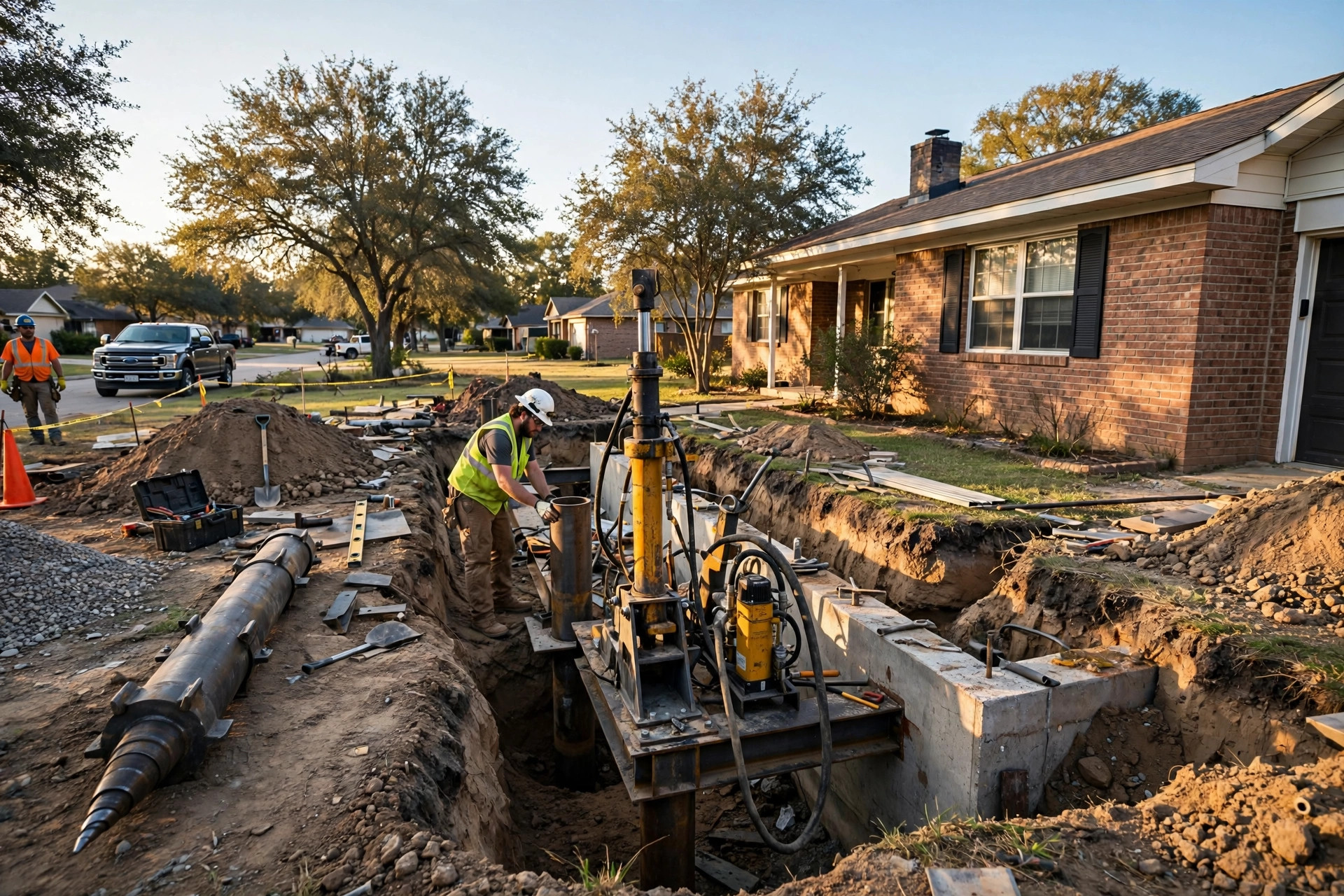
You notice a stair-step crack in the brick veneer. You call the company with the billboards. A friendly "certified structural technician" spends 90 minutes in your crawlspace with a digital level, then sits at your kitchen table and shows you a diagram: 14 steel piers, $1,650 each, $23,100 total, with a lifetime transferable warranty and 18-month same-as-cash financing if you sign today. The inspection was free.
That last sentence is the entire business model. Foundation repair companies give away the diagnosis because the diagnosis is the sales pitch. One Kansas City operator's own 2026 pricing guide is admirably blunt about it: most inspections are free, and because they are free, you should get three of them. Three free sales pitches, each performed by someone whose compensation is tied to the number of piers on the diagram. The person counting your piers is paid to find piers.
Now meet the person who is paid to find nothing. A licensed structural engineer will inspect your foundation for $400 to $700, produce a stamped written report with photos and a repair specification, and then go home. Engineers do not sell piers. Most state licensing boards treat an engineer specifying a repair and then selling the installation as a conflict of interest, which is exactly why the separation is worth buying. This Old House puts the typical cost at about $600 and calls the engineer the most qualified choice for the job, a sentence no foundation repair company's marketing department would ever print.
The price of skipping the engineer is documented in the complaint record. A Florida homeowner told the BBB that LRE Foundation Repair's "structured engineering plan" put a dozen adjustable jacks under the house, financed with a HELOC; nine months later the house was sinking again and the company quoted an additional $20,000, work the complainant says should have been in the original plan. A Texas couple with a Hercules lifetime warranty reported new ceiling cracks, a burst water pipe, and measurements showing the house was never leveled; their complaint says the company's own follow-up measurements agreed the foundation was not level, and the redo left their yard full of uncovered holes, steel shim, and loose dirt. A Nebraska customer waited seven months for Thrasher to close out a city permit the company had opened, chasing an 800 number and a salesperson while the permit clock ran down. These are not outliers in a clean industry. They are the predictable output of a market where the diagnostician and the treatment vendor are the same person.
Here is the industry's own tell. Olshan, the most established name in the business, operating since 1933 across 20-plus locations, states on its Angi listing that about a quarter of the homes it visits do not require foundation repair. Read that again. At the reputable incumbent, one visit in four ends with "you need nothing." Every one of those visits was performed by a company technician, not an independent engineer. If the best operator in the industry finds nothing a quarter of the time, the false-positive rate at the average operator, the one running radio ads for free inspections, is the number nobody measures. And it is the number that decides whether you spend $23,100 or $0.
Market Size
TAM calculation: The Business Research Company sizes the foundation repair services market at $3.35 billion in 2025, growing to $4.61 billion by 2030 at a 6.6 percent CAGR. Dataintelo's segmentation puts residential work at 52.8 percent of the market. Applying that share gives roughly $1.8 billion in annual U.S. residential foundation repair spend (treat as accurate within ±40%; the underlying reports disagree on scope, with broader definitions that include infrastructure running as high as $9.8 billion, and the residential share is borrowed across reports, so stress-test at the low end). Cross-check: $1.8 billion divided by a typical project cost of just over $5,000 (the national cost-guide average, with typical projects landing between $2,200 and $8,100) implies roughly 350,000 residential projects per year. Groundworks alone says it repairs more than 100,000 homes a year, and Olshan serves more than 10,000 annually, so the implied project count leaves ample room for the long tail of regional operators.
The buyable SAM is the intelligence layer, not the pier revenue. The funnel: 150,000 independent engineer assessments per year at $600, with a 12 percent platform referral take ($10.8 million). A quote-audit product converting 40,000 worried homeowners a year at $149 ($6.0 million). A certified-contractor program reaching 1,500 contractors at $400 per month ($7.2 million). Combined SAM: roughly $24 million in referral, audit, and certification revenue at maturity.
Year 3 target: 20,000 engineer referrals ($1.4 million in take), 12,000 quote audits at $149 ($1.8 million), and 500 certified contractors at $400 per month ($2.4 million), for about $5.6 million in Year 3 revenue.
The Product
A buyer-side foundation intelligence platform that puts the engineer before the salesperson. Every tool in this market is built to sell piers. Angi and Thumbtack monetize by selling the lead to the repair companies. The manufacturers' dealer networks monetize by moving proprietary pier systems. Nobody's revenue depends on the homeowner buying fewer piers than the diagram says.
- Engineer-first triage: A flat $600 independent structural engineer assessment, booked through the platform, before any contractor sets foot in the crawlspace. The report includes a stamped repair specification: pier count, pier type, and lift targets. Contractors then bid against the engineer's spec instead of writing their own. The wedge is the incentive flip: this is the only $600 in the transaction paid to someone who profits from finding nothing.
- Pier-count X-ray: Upload any contractor quote as a photo or PDF. Parsing normalizes it to cost per pier by pier type (steel push, helical, drilled, polyurethane foam), flags pier-count inflation against the engineer's spec, and benchmarks the per-pier price against regional distributions. The X-ray turns three incomparable bids into one table.
- Warranty decoder: "Lifetime transferable warranty" is the industry's favorite closing line, and it means whatever the contract says it means. The decoder extracts transfer terms, exclusions for plumbing and drainage, maintenance requirements that void coverage, and the underwriter behind the promise. A lifetime warranty from a company doing fifteen acquisitions in two years is a different product than one from a 93-year-old operator, and the decoder prices the difference.
- Drainage-first check: A large share of "foundation problems" are water problems wearing a foundation costume. Failed gutters, negative grading, and downspouts dumping at the slab cause the exact symptoms, sticking doors, wall cracks, that trigger $20,000 pier quotes. A $300 drainage fix is not a pier job. The triage rules out the cheap causes before anyone prices the expensive one.
- Soil-risk map: Expansive clay zones, drought-cycle exposure, and new-construction fill risk by address, so a buyer in Dallas sees the Blackland Prairie risk before the crack appears and a seller in Ohio sees that their clay is not Texas clay.
- Contractor scorecard: License verification, BBB complaint rates, permit closeout record, and warranty-claim responsiveness, compared side by side. The cheapest bid from an operator with a trail of unclosed permits is not the same product as the mid-priced bid from a contractor whose permits close on time.
Unit Economics
| Metric | Value |
|---|---|
| Engineer assessment (flat, consumer-paid) | $600 |
| Platform take on engineer referral | 12% |
| Quote audit report (one-time) | $149 |
| Certified contractor badge | $400/month per contractor |
| Audit review + data cost per audit | $18 |
| Consumer CAC (per assessment booked) | $85 |
| Contractor CAC | $1,100 |
| Gross margin | 80% |
| Startup cost (18-month runway) | $700K |
| Break-even | 22 months |
Methodology note: Consumer CAC of $85 reflects the brutal intent curve of this market: the buyer searching "foundation repair cost [city]" at 11pm after finding a crack is the highest-intent consumer in home services, but convincing that buyer to pay $600 before the free inspection requires paid search against the repair companies themselves, who bid those same keywords to give the inspection away. The 80 percent gross margin reflects a marketplace model where the expensive input (the engineer's time) is paid by the consumer and the platform keeps the take rate plus audit revenue. Break-even at 22 months assumes the contractor certification program reaches 350 paying contractors by month 18. Honest footnote: the $600 upfront payment is the entire behavioral bet of this company. If fewer than one in twenty worried homeowners will pay for an opinion before the free one, the funnel math breaks and the business becomes a content site with a nice calculator.
Go-to-Market
Phase 1 (months 1-6): Launch in five expansive-soil metros (Dallas-Fort Worth, Houston, San Antonio, Denver, Nashville) with a vetted panel of independent structural engineers and a free "do I need an engineer?" triage quiz. Distribute through SEO on cost and crack-diagnosis queries, which carry desperate commercial intent and are currently served by contractor content. Partner with real estate agents, who encounter foundation flags during transactions when buyers have a 30-day clock: an engineer-first report is the fastest way to keep a deal alive without handing the buyer to a salesperson. Every assessment and uploaded quote feeds the anonymized per-pier benchmark database.
Phase 2 (months 7-14): Monetize with the $149 quote audit and launch the certified contractor program. The pitch to contractors inverts the usual dynamic: instead of buying leads and racing to install the most piers, they pay a flat monthly fee for a badge that says they bid against independent engineer specs. The honest mid-priced operators, the ones currently losing to both the cheapest pier-slinger and the PE-backed national, become the product's best salespeople. Add the warranty decoder as the audit upsell.
Phase 3 (months 15-24): Open the managed-bid marketplace: escrowed deposits, milestone payments tied to the engineer's lift targets, and post-job engineer verification. Add insurance and warranty partnerships, since documented pre- and post-repair elevations are underwriting data. Expand to the adjacent trades that run the same free-diagnosis playbook: chimney and masonry restoration, then basement waterproofing.
Competitive Landscape
| Company | What It Does | Engineer-First? | Pricing |
|---|---|---|---|
| Groundworks | PE-backed national (Cortec Group, 2020; KKR partnership, 2023); 80+ offices, 1M+ homeowners, 15 acquisitions in two years | No: free inspections by company technicians; they are the quote being evaluated | Typical jobs $2,500-$15,000+ depending on pier count |
| Olshan | Operating since 1933; 20+ locations; 10,000+ homes a year; proprietary Cable Lock ST Plus system | No: free assessments by "Certified Structural Technicians," honest enough to admit a quarter of visits need no work | Free assessment; repair quotes vary by market |
| Ram Jack | Patented steel pier system sold through a franchise and dealer network; the product company behind its local installers | No: its dealers are the salesforce | Varies by dealer |
| Angi, Thumbtack, HomeAdvisor | Lead generation for repair contractors | No: they sell the lead; bigger jobs are more valuable leads, a direct conflict | Free to consumer; contractors pay per lead |
| Independent structural engineers | Licensed PEs doing $400-$700 inspections with stamped reports | Yes, but: no marketplace, no booking infrastructure, no quote benchmarking; nearly invisible to a panicked homeowner at 11pm | $400-$700 per assessment |
| This startup | Engineer-first triage, pier-count X-ray, warranty decoder, certified contractors bidding against engineer specs | Core product: revenue comes from the buyer and flat-fee contractor certification, never from pier count | $600 engineer assessment; $149 audit; $400/mo contractor |
The gap is structural. Every incumbent either sells the piers, sells the lead, or sells the pier system to the people selling the piers. The independent engineer is the only actor in the market with no financial interest in the repair happening, and today that actor is a solo practitioner with a voicemail box. Organizing the engineers, standardizing the spec, and benchmarking the bids is the greenfield.
Why Now
Five forces are converging. First, demand just spiked. Groundworks' own field data shows foundation repair demand surged more than 20 percent in the first five months of 2026, while its survey found 86 percent of homeowners believe their home is structurally sound. That is a lot of newly worried people entering a market they do not understand.
Second, the housing stock is hitting structural middle age. Nearly half of America's homes were built before 1980, and an estimated 38.4 million homes built in the 1970s through 1990s are entering their 40-year structural service window, the age when foundation attention historically accelerates, per First American data cited by Groundworks. The 1980s Sun Belt building boom poured millions of slabs on expansive clay with the construction standards of the era. Those slabs are now forty years old.
Third, the industry is consolidating into a national sales machine. Groundworks took private equity money from Cortec Group in 2020, partnered with KKR on employee ownership in 2023, and has done 15 acquisitions in two years on its way to 80-plus offices. Consolidation standardizes the free-inspection playbook and the proprietary pier systems across markets, which is good for consistency and bad for the homeowner's negotiating position. A roll-up needs volume; volume needs conversions; conversions need piers on the diagram. The independent engineer is the natural counterweight, and it does not exist yet as an organized force.
Fourth, the bill is entirely out of pocket. Most homeowners insurance policies exclude damage caused by soil movement, which is the cause of most foundation movement. There is no adjuster, no negotiated rate, no second set of eyes. The homeowner pays the full $23,100 with no institutional buyer in the loop, which makes independent price intelligence more valuable here than in any insured trade.
Fifth, the climate input is worsening. North Texas weather, heavy spring rains followed by hot dry summers, creates rapid moisture swings in clay soil, and extended droughts shrink the soil into voids under the slab before the rains swell it back unevenly; one Dallas operator calls it among the worst foundation weather in the country. Drought-flood cycling is the demand engine, and the cycles are getting more extreme.
Original Contribution: The Pier-Count Arbitrage
A calculation we could not find published anywhere: price the incentive, not just the job. Installed piers run roughly $1,000 to $3,000 apiece depending on type and market (Angi puts helical piers at up to $3,000 per pier installed, with totals easily exceeding $20,000). Take a representative perimeter job. The salesperson's diagram shows 14 piers. An independent engineer, paid a flat $600 and barred from the install work, specs 9. At a $1,500 midpoint per pier, the five-pier gap is worth $7,500, and every dollar of it flows to the company that counted the piers.
Now the ratio that matters. The engineer's $600 fee against a $20,000 pier job is 3 percent. Three percent of the transaction buys the only opinion in the room that gets cheaper when the answer is "you need nothing." There is no other $20,000 purchase in American life where the independent second opinion costs 3 percent and almost nobody buys it, because the seller gives away a worse version for free.
A second unpublished number, built on the industry's own admission. Olshan says a quarter of the homes it visits need no repair. Apply a conservative version of that logic to the market: if just 10 percent of the $1.8 billion U.S. residential market is unnecessary or overscoped work, that is $180 million a year in piers that did not need to be installed. The assumptions are doing real work here (the 25 percent figure is one company's claim about its own visits, not a measured industry false-positive rate, and "overscoped" is doing quiet duty inside the 10 percent), but the direction is hard to dispute: the person counting piers is paid per pier, and nobody audits the count.
Limitations
Several weaknesses in this analysis deserve plain acknowledgment. First, online quote and complaint data is self-reported and skewed toward the outraged. People post the $23,100 quote and the failed warranty; they do not post the $6,000 job that held. The true distribution is less dramatic than the forums suggest, though the incentive structure is not in doubt.
Second, pier type is not interchangeable, and per-pier benchmarking can mislead. A helical pier at $2,800 and a steel push pier at $1,200 are different products for different soils and depths; the X-ray must normalize by type and depth-to-load-bearing-strata or it manufactures false precision. Early versions will misclassify this.
Third, the TAM derivation borrows a residential share from one report and applies it to another report's total, then treats the result as accurate within ±40 percent. That band is honest but wide. Stress-test the business at $1 billion, not $1.8 billion.
Fourth, engineers are the bottleneck. Licensed structural engineers carrying errors-and-omissions insurance are scarce, expensive to recruit, and culturally allergic to marketplaces. The platform needs density in every metro before the product is trustworthy anywhere, and the first metro is the hardest.
Fifth, Olshan's 25 percent figure is a marketing claim on a lead-generation listing, not a measured false-positive rate, and it cuts both ways: it is evidence of honesty at one operator, not evidence of fraud at others. The $180 million unnecessary-work estimate inherits all of that softness.
Sixth, the certified-contractor badge is paid by the party being rated. Flat-fee softens the distortion versus per-lead models, but it is still a conflict: the company needs published audit standards and a real revocation policy, or the badge is just advertising with better fonts.
Strongest Counterargument
The strongest case against this startup is behavioral, and it is brutal: homeowners will not pay $600 for an opinion when the competing opinion is free. The free inspection is not just cheaper; it arrives with a friendly technician, a digital level, same-week availability, and 18-month same-as-cash financing. The engineer is a $600 invoice, a two-week wait, and a PDF that says "monitor the crack for a year." Loss aversion, urgency, and the sheer hassle differential mean the engineer-first funnel may convert at a rate that never funds the business, no matter how righteous the incentive analysis.
There is also an adverse-selection trap in the contractor network. The contractors most eager to bid against an independent engineer's spec, and to pay $400 a month for the privilege, may be the ones with the emptiest schedules, which is not a quality signal. The best operators are booked six weeks out on reputation alone and do not need the badge. If the certified network fills with the available rather than the excellent, the badge becomes a mark of desperation and the scorecard inverts.
And the villain narrative overstates its case. Groundworks' NPS is 82.4, it paid a $31 million dividend to 5,000 employee-owners, and its lifetime guarantees are backed by an 80-office company rather than a pickup truck. PE consolidation brought standardized training, real warranties, and capacity to markets that previously had none of those things. Some free inspections are honest, some pier counts are correct, and some $23,100 jobs are worth every dollar. A platform built on the premise that the industry is a scam will misread the honest majority and alienate the contractors it needs.
The Bottom Line
American homeowners will spend roughly $1.8 billion this year on residential foundation repair, in a market where the diagnosis is free, the treatment runs past $20,000, the person diagnosing is paid per pier, and the resulting complaints read like a catalog of predictable incentives: unnecessary scope, unclosed permits, warranties that outlive the companies that sold them. The independent structural engineer, the only party paid to say "you need nothing," charges about $600 and is nearly invisible to a panicked homeowner at 11pm. A platform that puts the engineer first, benchmarks every quote to cost-per-pier, and certifies contractors who bid against independent specs is the missing instrument panel. The honest caveats stand: homeowners may never pay $600 when free exists, the contractor network can adversely select, and the PE-backed nationals are better operators than the pitch admits. But the pier count is the whole business, and right now nobody audits the count.
What You Can Do
- Hire the engineer before the contractor: pay $400 to $700 for a licensed structural engineer's stamped report before accepting any free inspection, because the engineer is the only party in the transaction paid to find nothing.
- Get three free inspections, then compare per pier: divide each quote by its pier count and match pier types across bids, since totals lie and a 14-pier quote at $1,650 each is a different job than a 9-pier quote at $2,400 each.
- Ask who gets paid per pier: find out whether the person who drew your diagram earns commission on pier count, and discount the diagram accordingly.
- Fix the water first: extend downspouts, regrade soil away from the slab, and clean the gutters before buying piers, because a large share of "foundation problems" are grading and gutter failures with structural symptoms.
- Read the warranty's exclusions, not its headline: check transfer terms, maintenance requirements that void coverage, and who backs the promise if the brand gets acquired.
- Check permit closeout: ask the contractor for proof that past jobs' permits were closed, since an open permit becomes your problem at sale time.
- Know your soil: expansive clay plus drought-flood cycling is the demand engine; a crack in Dallas clay and a crack in Ohio clay are different risk profiles.
- Never sign on the first visit: the today-only financing and the fear framing are documented patterns, so sleep on every $20,000 quote as a matter of policy.
Related
📰 A $30,569 Quote for 12 Openings. The National Average Is $7,183. — the same free-diagnosis playbook, one trade over: in-home window quotes and the discount theater around them
📰 The 'Free Roof' Is a $9,609 Lie. A Fixed-Price Marketplace Could Clean Up America's $19B Residential Roofing Market — storm-chaser pricing, insurance-claim markups, and the buyer-side instrument panel
📰 The $29 Service Call Is a Lie. A Fixed-Price Marketplace Could Clean Up America's $2.6B Garage Door Repair Trade — the teaser-price funnel at smaller tickets: how the $29 visit becomes a $900 upsell