The $1,999 Implant Is Just the Screw. The Other $3,000 Nobody Itemizes Is the Real Business.
Dental implants are a $2.1 billion North American market where the advertised price covers one of three parts. The nationwide median for a finished single implant is $4,000, the city medians run from $3,665 to $5,505, and specialists somehow charge less than general dentists. Nobody has built the quote-intelligence layer that prices the whole treatment.
The Problem
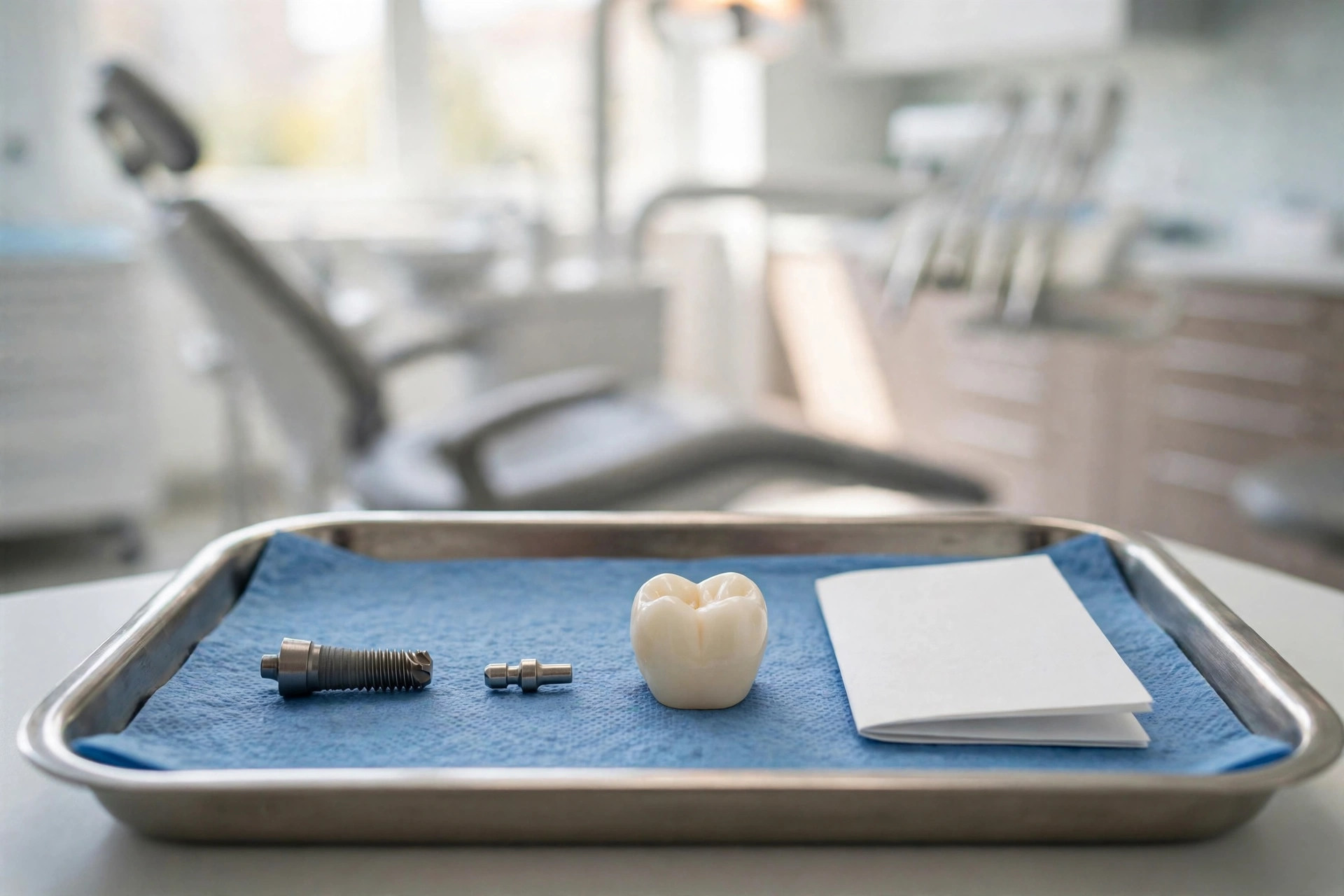
Your dentist says you need an implant. You Google the price and the first three ads all say the same thing: "Implants $1,999." That number is the surgical fixture, the titanium screw that goes into the bone. It is one of three parts. After the fixture comes the abutment, the connector, and then the crown, the visible tooth. Then there is the imaging, the extraction, and frequently a bone graft. The finished tooth, the thing you can chew with, costs about $4,000 at the nationwide median, per a 2025 survey of 278 practices in six metro areas published in Dental Economics. The ad did not lie. It just priced a different thing than the thing you are buying.
This is not a scam. It is a component problem. An implant treatment is a kit of separately billable parts, and every quote in the market is a partially assembled kit. One office quotes $1,999 for the fixture and charges $2,200 more for the abutment and crown. Another quotes $4,800 for everything. A patient comparing "$1,999 vs $4,800" is comparing a screw to a tooth. The ADA's own patient guidance now devotes a full section to what a written estimate should itemize, cash price, allowed amount, insurer payment, deductible, remaining annual maximum, plus whether extraction, grafting, imaging, anesthesia, and the crown are included. The guidance exists because almost no quote meets it.
The spread is real money. The same survey found city medians ranging from $3,665 in Houston to $5,505 in Minneapolis, a 50 percent swing for the identical procedure between two large American metros. And then there is the number that breaks the pricing story open: the median was $3,400 when a specialist performed the treatment and $4,800 when a general dentist did. The expert costs less than the generalist, by $1,400 per tooth. This is the tell that the market is priced by confusion rather than competition. Specialists place implants all day, own the imaging, and do their own surgery. General dentists, who perform a smaller share of implants, often subcontract the surgery to an oral surgeon and mark it up on the way through. The generalist's quote carries a subcontractor margin the specialist's does not, and the patient has no line on the bill where that margin appears.
Now add the exit valve, because this market has one and it is enormous. A 2025 systematic review in the Journal of International Oral Health found dental tourists save 50 to 80 percent, and DentaVacation's 2026 report prices single implants in Mexico at $450 to $1,650 against $2,000 to $8,000 in the US. For full-mouth All-on-4 reconstruction, the US number sits near $30,000 while Mexican clinics quote $7,000 to $15,000. That is a $15,000-plus arbitrage on a flight that costs $400, and the entire cross-border industry exists because domestic quotes are incomparable rather than merely expensive. Patients do not fly to Los Algodones for fun. They fly there because the local market gave them no tool to tell a $4,000 tooth from an $8,000 tooth.
The insurance piece makes it worse. Most dental plans cap annual benefits at a level far below the cost of a single finished implant, so the patient pays the full median $4,000 out of pocket, with no adjuster and no negotiated rate. This is the largest out-of-pocket purchase in American healthcare where the buyer cannot get an itemized, comparable quote and the seller's headline price excludes most of the product.
Market Size
TAM calculation: Market Research Future sizes the global dental implants market at $5.2 billion in 2024, projected to reach $12.49 billion by 2035 at an 8.28 percent CAGR, with North America holding a 40.38 percent share, roughly $2.1 billion. A second house, pmarketresearch, puts 2025 at $5.5 billion growing to $9.1 billion by 2032 at a 7.5 percent CAGR, with North America at $1.9 billion. Note the house range: treat device-market totals as accurate within ±30 percent.
But the device market is not the buyable number. The device revenue is the screw; the consumer spend is the tooth. Cross-check from the consumer side: the nationwide median finished implant is $4,000, and American dentists place on the order of 3 million implants a year (the long-standing AAID industry figure). At a blended finished price, that implies roughly $10 to $12 billion in annual US consumer implant spend. Treat that as directional, accurate within ±50 percent, because the fixture-to-finished conversion varies by case. Even at the low end, the consumer spend is four to five times the device market, and the intelligence layer gets built on the consumer spend, not the device revenue.
The buyable SAM is the intelligence layer: quote X-rays converting 50,000 anxious patients a year at $99 ($5.0 million), placement referrals on 6,000 cases a year at $350 per case ($2.1 million), and clinic subscriptions for price benchmarking at $300 per month for 600 clinics ($2.2 million). Combined SAM: roughly $9.3 million at maturity.
Year 3 target: 25,000 quote audits at $99 ($2.5 million), 3,000 referrals at $350 ($1.1 million), and 250 clinic subscriptions ($0.9 million), for about $4.5 million in Year 3 revenue.
The Product
A buyer-side implant intelligence platform that prices the whole tooth, not the screw. Every existing tool in the market answers a different question. FAIR Health answers "what does this procedure code cost in my zip code." The $1,999 ads answer "how do I get you in the chair." Nobody answers "is this quote complete, is it fair, and who should place it."
- Quote X-ray: Upload any treatment plan or estimate as a photo or PDF. Parsing normalizes it to the component table: fixture, abutment, crown, imaging, extraction, grafting, anesthesia, temporaries. It flags what is missing. A $1,999 quote with no abutment or crown line is not a bargain; it is an unfinished kit, and the X-ray prices the missing parts from regional medians. Three incomparable quotes become one table.
- Specialist router: The $1,400 expertise discount is the wedge. The product routes patients to high-volume specialists with published medians near $3,400 instead of general-dentist quotes near $4,800. The counterintuitive pitch writes itself: pay the expert less. The referral is the revenue: $350 per placed implant, paid by the clinic, earned only when the patient proceeds.
- Component price database: An anonymized per-component, per-metro price distribution built from every X-rayed quote, like the pier-count database one trade over. Patients see what the abutment "should" cost in Houston versus Minneapolis before the dentist names a number.
- Graft honesty check: Bone grafting is the most common add-on and the hardest to verify from the chair. The check cross-references graft line items against the CBCT findings summary, flagging graft quotes on cases with adequate bone volume. Not every graft is padding, but padding hides inside grafts more than anywhere else in the plan.
- Tourism vetting: The Mexico arbitrage is real, and it is also where quality risk lives. A certification program for cross-border clinics covering implant brand traceability, sterile protocol audits, and post-op complication handling, sold as the thing that makes the 79 percent discount buyable. Nobody certifies Los Algodones today.
- Full-mouth planner: All-on-4 is the $30,000 version of the component trap, with four fixtures, a bar, and a full prosthesis that clinics price as a single scary number. The planner itemizes the full-arch kit across 20 domestic clinics and 10 certified cross-border clinics, turning the most expensive dental decision of a patient's life into a comparable table.
Unit Economics
| Metric | Value |
|---|---|
| Quote X-ray (one-time, consumer-paid) | $99 |
| Placement referral fee (clinic-paid) | $350 per case |
| Clinic benchmark subscription | $300/month |
| Tourism clinic certification | $5,000/year |
| Audit review + data cost per audit | $12 |
| Consumer CAC (per X-ray completed) | $55 |
| Clinic CAC | $900 |
| Gross margin | 84% |
| Startup cost (18-month runway) | $600K |
| Break-even | 20 months |
Methodology note: Consumer CAC of $55 is the lowest in this price-transparency series, because the $1,999 ads do the demand generation for free: every patient who clicks the ad and then discovers the quote is incomplete is a pre-qualified lead searching "what does a dental implant really cost." The capture is SEO plus paid search on "implant cost [city]" against advertisers who cannot bid on their own incompleteness. The 84 percent gross margin reflects a marketplace model where the expensive input, the clinical review behind each X-ray, is a trained technician plus rules engine, not a dentist's time. Break-even at 20 months assumes 150 clinic subscribers by month 18. Honest footnote: the $99 upfront payment is the behavioral bet, same as the $600 engineer assessment one trade over. But the anchor is friendlier here: $99 against a $4,000 median purchase is 2.5 percent of the transaction, and patients are already paying $150 to $300 for the consultation visit where they receive the confusing quote.
Go-to-Market
Phase 1 (months 1-6): Launch the Quote X-ray as a free tool gated on email, seeded in five high-spread metros (Minneapolis, New York, Los Angeles, Chicago, San Francisco) where the $5,505-to-$3,665 gap is largest. Distribute through SEO on "dental implant cost" queries, which carry desperate commercial intent and are currently served by the $1,999 advertisers themselves. Partner with independent fee-survey publishers and patient advocates. Every X-ray feeds the anonymized component database.
Phase 2 (months 7-14): Monetize with the $99 paid X-ray and launch the specialist referral network. The pitch to clinics: flat $350 per placed case, no lead fees, no bidding. The honest high-volume specialists, who already charge less than the generalist average, become the product's proof point. Add the graft honesty check as the audit upsell.
Phase 3 (months 15-24): Open the full-mouth planner and the tourism certification. All-on-4 is the highest-margin decision in dentistry and the least shopped. Certify 30 Mexican clinics and 10 Turkish clinics with brand traceability and complication protocols, take a per-case certification fee, and let the domestic referral network and the cross-border network price-check each other in the same table.
Competitive Landscape
| Company | What It Does | Prices the Whole Tooth? | Pricing |
|---|---|---|---|
| FAIR Health | Nonprofit claims database; fairhealthconsumer.org added 20th-to-90th percentile sliders in May 2026; 21 billion claims, 150 million covered lives | No: procedure-code percentiles, no component itemization, no treatment-plan comparison, no referrals | Free to consumer |
| 1-800-DENTIST | Dental lead generation and matching | No: sells the lead; the receiving dentist still quotes an unitemized kit | Free to consumer; dentists pay per lead |
| DentalPlans.com | Discount dental plans | No: a discount on whatever the quote says, not a check on the quote itself | Annual membership fee |
| DentaVacation, Bookimed | Dental tourism brokerage to Mexico, Turkey, Thailand | Partially: they quote packages, but no independent certification and no domestic comparison in the same table | Commission from clinics |
| CareCredit | Healthcare financing | No: finances the quote, never questions it; deferred-interest terms deserve their own calculator | Interest to the lender |
| Implant advertisers | $1,999 fixture ads from corporate dental chains | No: they are the incomplete quote; they price the screw to sell the tooth | $1,999 plus everything else |
| This startup | Quote X-ray, specialist routing, component database, graft honesty check, tourism certification, full-mouth planner | Core product: revenue from the buyer and flat case fees, never from procedure volume | $99 audit; $350 referral; $300/mo clinics |
The gap is structural. Every incumbent either sells the lead, sells the discount, sells the financing, or sells the fixture at a teaser price. FAIR Health is the closest thing to price data in the market, and it is procedure-code percentiles from claims data: it will tell you the 50th percentile of a code in your zip, not whether your $1,999 quote is missing $2,500 of parts. The component table is the greenfield.
Why Now
Five forces are converging. First, the data just got fresh. The Dental Economics fee survey that established the $4,000 median and the $3,400-versus-$4,800 specialist gap was published in February 2026, which means the expertise discount is a 2026 fact, not folk wisdom. And FAIR Health's May 2026 percentile-slider upgrade normalized consumer price research as a behavior, training patients to ask "what percentile is my quote" for the first time.
Second, the teaser-ad war is at peak volume. Corporate chains are bidding the $1,999 fixture price against each other on every metro's search results, which manufactures exactly the confused patient this product rescues. The ads are the demand engine and the evidence in the same package.
Third, the bill is almost entirely out of pocket. Annual dental maximums sit far below the cost of a single finished implant, so there is no adjuster and no negotiated rate anywhere in the transaction. The patient is the payer and the payer has no instrument panel.
Fourth, the demographics are a tailwind. Edentulism concentrates in the aging population, the cohort with both the clinical need and the savings to pay $4,000 to $30,000 out of pocket, and it is the cohort least equipped to comparison-shop a componentized medical quote.
Fifth, the border is already the market's pressure valve. Record dental travel to Mexico, with hundreds of thousands of monthly border crossings documented by industry surveys, proves patients will act on price spreads of this size. The current version of that market is unregulated word-of-mouth. The certified version is a business.
Original Contribution: The Expertise Discount
A calculation we could not find published anywhere: the specialist does it cheaper, and the number is checkable. Take the survey medians. General dentist: $4,800. Specialist: $3,400. The gap is $1,400 per tooth, or 29 percent. Now the volume math that explains it. A specialist placing 400 implants a year amortizes a $150,000 CBCT and guided-surgery setup over 400 cases, about $375 per case. A general dentist placing 40 a year faces $3,750 per case on the same equipment, or outsources surgery to an oral surgeon at $800 to $1,200 per case and marks it up. The specialist's cost structure is better and the specialist keeps the surgery margin in-house. The published medians are consistent with this: the expert is cheaper because the expert owns the workflow.
The second unpublished number is the component trap ratio. The advertised fixture price of $1,999 against a finished median of $4,000 means the hidden components, abutment, crown, imaging, graft, average about $2,000, roughly equal to the advertised price. The ad prices half the product. On the teaser end of the market the ratio is worse: a $999 fixture ad against a $4,000 finished median means 75 percent of the purchase is unadvertised. There is no other common medical purchase where the advertised price routinely covers a minority of the delivered product.
The honest caveat on both numbers: survey medians describe surveyed metros, not the country, and the specialist-versus-generalist gap may carry case-mix confounds, since specialists may receive cleaner referred cases or general dentists may bundle premium cosmetic work into the same quote. The direction is well supported; the exact $1,400 should be treated as a point estimate from one survey, not a law of nature.
Limitations
Several weaknesses deserve plain acknowledgment. First, the survey data comes from six metropolitan areas and 278 practices. It is the best public fee survey available, but it is not a census, and rural pricing may diverge in either direction.
Second, quote data is self-reported and skewed toward the outraged, same as every price-transparency business. Patients upload the $8,000 quote, not the $3,400 one that held. The database must correct for complaint bias or it becomes a scare machine.
Third, the TAM derivation chains the device-market total to consumer spend through an implant-volume figure borrowed across sources. The ±50 percent band is honest but wide. Stress-test the business at $5 billion of consumer spend, not $11 billion.
Fourth, the specialist-versus-generalist gap carries the case-mix confound noted above. If specialists get simpler cases or general dentists bundle more cosmetic work, part of the $1,400 is composition, not efficiency. The routing product needs outcome data, not just price data, before claiming the specialist is strictly better value.
Fifth, graft necessity is genuinely hard to adjudicate from a treatment plan. The graft honesty check will flag legitimate grafts as padding until its rules engine sees enough CBCT-annotated cases. Early false positives will cost clinic relationships.
Sixth, the tourism certification is a liability business wearing a data business's clothes. One certified-clinic complication cluster with nerve damage, and the certifier is in the deposition. The underwriting behind the badge has to be real before the badge ships.
Seventh, the $350 referral fee walks into fee-splitting law. Many state dental practice acts bar non-dentists from sharing in professional fees, and a per-case payment from a clinic to a referral platform can read as fee-splitting in those states. The model may need to be restructured as flat-fee advertising or consumer-paid referrals in the strict states, which shrinks the referral revenue line in exactly the markets where specialists are densest.
Strongest Counterargument
The strongest case against this startup is that dentists will treat it as an enemy and the enemy has the charts. Quote transparency only works if clinics engage, and the clinics with the most to gain from engaging, the high-volume specialists, already have full schedules and do not need a $350 referral channel. The clinics with the emptiest schedules are the $1,999 teaser advertisers, who will never submit their quotes to an X-ray that exposes them. The marketplace can adverse-select into the available rather than the excellent, and a referral network of desperate clinics is worse than no network.
There is also a data-moat problem. FAIR Health already publishes percentile bands for the relevant procedure codes, free, from 21 billion claims. The X-ray's advantage is component itemization, but that requires the patient to upload the quote, which requires the patient to know the quote is incomplete, which is the awareness the product is trying to create. The cold start is a chicken-and-egg problem wearing a calculator.
And the villain narrative overstates its case. Many $1,999 ads come from corporate chains that deliver competent surgery at genuine scale, and their upsell is disclosed in the fine print the patient does not read. Some general dentists at $4,800 deliver a premium experience, sedation, temporaries, follow-up, that the $3,400 specialist median does not include. A platform built on the premise that the industry is a con will misread the honest operators and alienate the specialists it needs as supply.
The Bottom Line
American patients will spend something like $10 billion this year on dental implants, in a market where the advertised price covers one of three parts, the finished median is $4,000, the same tooth costs 50 percent more in Minneapolis than in Houston, and the specialist somehow charges $1,400 less than the generalist. Every incumbent either sells the lead, the discount, the financing, or the teaser fixture. Nobody prices the whole tooth. A quote X-ray that itemizes the kit, routes patients to the cheaper expert, and certifies the cross-border arbitrage is the missing instrument panel. The honest caveats stand: dentists may refuse to play, the cold start is real, and the honest operators are better than the pitch admits. But the screw is not the tooth, and right now nobody is allowed to say so with a number attached.
What You Can Do
- Ask for the component table: demand an itemized quote with separate lines for the fixture, abutment, crown, imaging, extraction, and graft, because a single number is not a quote, it is a teaser.
- Compare finished prices only: normalize every bid to the full finished tooth before comparing, since $1,999 for a screw and $4,800 for a tooth is not a comparison.
- Get the specialist's number: ask a periodontist or oral surgeon what they charge for the same case, because the survey data says the expert's median is $1,400 below the generalist's.
- Check FAIR Health first: look up the procedure-code percentiles at fairhealthconsumer.org for your zip code before the consultation, so you walk in knowing the 50th percentile.
- Question the graft: ask what the CBCT showed that requires grafting and whether the bone volume is adequate without it, since grafts are where padding hides.
- Price the temporaries: ask what you will chew with during the three to six months of healing and what that costs, because the answer is rarely on the quote.
- Read the financing terms: deferred-interest plans punish the full balance if you miss the payoff window, so price the financing, not just the monthly payment.
- Never decide on the consultation visit: the today-only discount on a $4,000 medical decision is a sales tactic, so take the treatment plan home and X-ray it first.
Related
📰 Your Foundation "Needs" $20,000 in Piers. A $600 Engineer Is the Only One Paid to Disagree. — the engineer-first playbook, one industry over: diagnosis decoupled from treatment
📰 A $30,569 Quote for 12 Openings. The National Average Is $7,183. — the same component-trap structure in home services: headline price versus finished price
📰 Vet Lab Pricing Intelligence — the price-benchmark database playbook applied to another opaque health-adjacent market