American Data Centers Throw Away 192 Terawatt-Hours of Heat a Year. Almost None of It Warms Anything
A single 50-megawatt data center delivers enough heat in the 5,000-hour heating season for 15,000 homes. The European Union reuses 1.8 percent of its reporting data centers' heat. America does not even measure its own.
Heat is already warming homes in Odense, and Google gives it away free in Hamina. Near Helsinki, Fortum's plants are running on grid power, with Microsoft's data-center heat to follow in 2027. The missing piece in America is not technology. It is a standard way to buy and sell it.
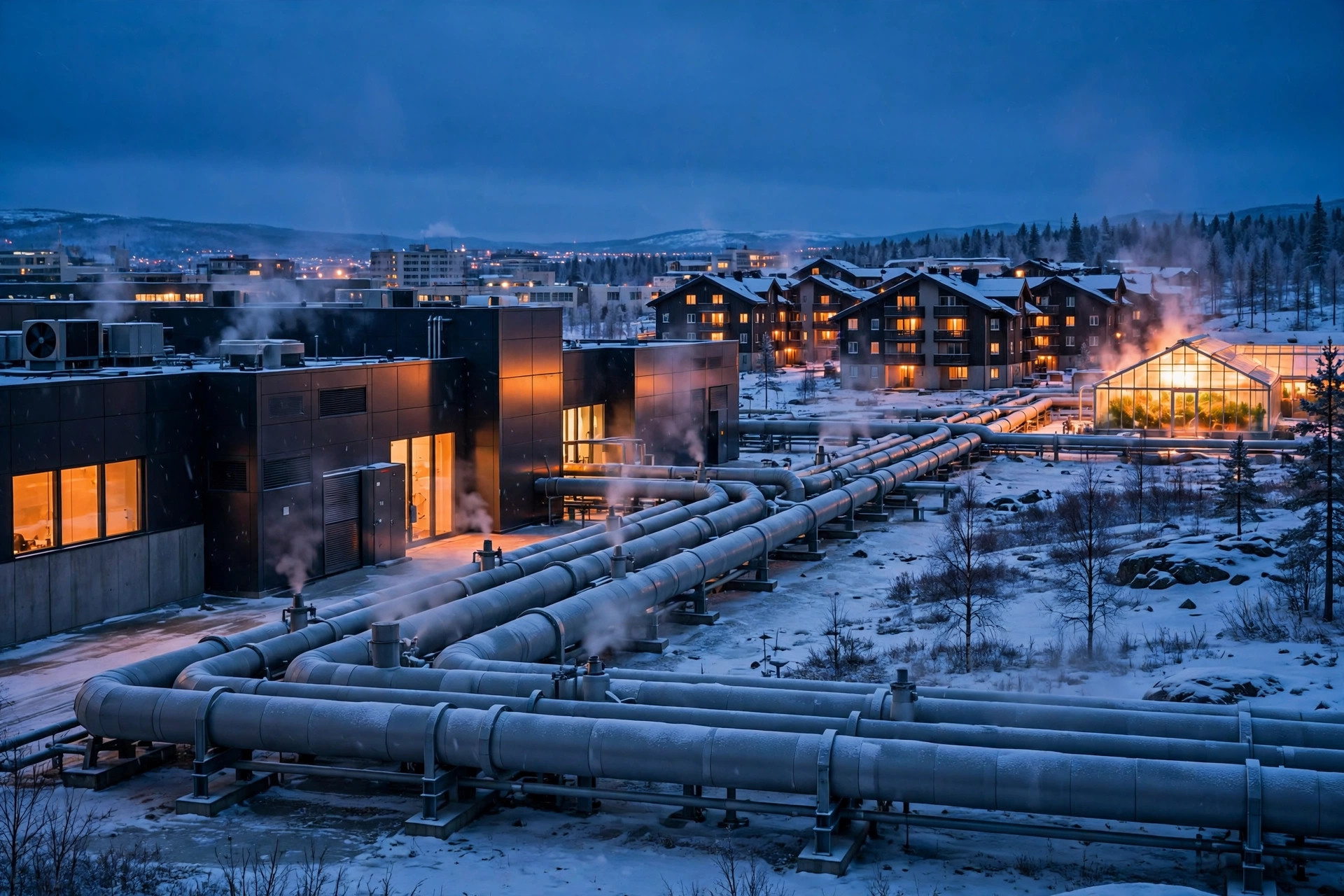
The Problem
American data centers consumed an estimated 192 terawatt-hours of electricity in 2024, about 4.7 percent of all US electricity, according to Lawrence Berkeley National Laboratory, enough heat, if captured, to warm more than 10 million homes for a year at 18 megawatt-hours-thermal per home. Practically all of that energy leaves the building as heat, because servers do not store electricity: they turn it into computation and then into warm air and warm water, and the industry spends billions on chillers, cooling towers, and fans to throw that warmth away as fast as possible.
That heat has always had a buyer: a 50-megawatt data center rejects about as much heat as a small city's heating system consumes, and it does so 24 hours a day, 365 days a year, at a steadier rate than any boiler ever built, through winter cold snaps and summer heat waves alike, with no flame or smokestack on site. Emissions are upstream, in the electricity that powers the servers and the heat pump, which is why the carbon figure here is net, not gross. District heating networks, greenhouses, hospitals, universities, and factories all buy heat by the megawatt-hour-thermal. Yet almost no American data center sells a single megawatt-hour-thermal of it. In the European Union, where reuse is actually measured, about 1.8 percent of data center heat gets reused, and only 67 of 770 reporting data centers, 8.7 percent of centers, reported any waste-heat reuse. That figure comes from the European Commission's report on data center energy efficiency, COM(2026) 500. Per the Commission, it may not be fully representative. Only about 36 percent of in-scope centers reported. No US figure exists, because no agency collects one. An honest guess puts the American number lower.
A data center is a furnace that happens to compute.
Finland shows what the alternative looks like. Fortum switched on two industrial heat pump plants near Helsinki in May 2026. They hold 180 MW-th of heat pump capacity, 200 MW-th of electric boilers, and 800 MWh-th of storage, about four and a half hours of the heat pumps' full output. Those plants are part of Fortum's Espoo Clean Heat programme, costing about 225 million euros, which also covers about 15 kilometres of new or upgraded district heating pipeline. Once Microsoft's two nearby data centers start feeding them heat in 2027, the plants are expected to cover about 40 percent of the area's 2 terawatt-hours-thermal a year of district heating demand, serving roughly 250,000 heat users (apartments and flats on the network, not detached homes), a scale no American data center heat project has reached.
Meta's data center in Odense, Denmark has supplied district heat since late 2019. Ramboll's full-system design figure is 215,000 megawatt-hours-thermal a year to a network serving roughly 100,000 households, enough for about 12,000 of them. Meta's figure for the expanded system is about 165,000 megawatt-hours-thermal a year, enough for about 11,000 homes, with heat pumps lifting the waste heat to 70 to 75 degrees Celsius for the city network. Google's Hamina facility in Finland was designed to supply up to 80 percent of the district heat for Hamina at full output. It gives the heat away free, apart from a nominal 1 euro annual administrative fee plus VAT. The operator's 2026 expectation once fully operational is 70 to 75 percent, with first heat delivered in late 2025 and the facility inaugurated on 12 May 2026. Stockholm's open district heating program pays heat producers, data centers among them, for surplus heat: about 20 suppliers, including supermarkets and other industries, delivered more than 100 gigawatt-hours-thermal in 2022, and the scheme covered about 1.5 percent of the network's customers' needs, per the EU Covenant of Mayors case study of September 2023.
Europe counts its wasted heat and still wastes 98.2 percent of it.
None of this is a research project. It is plumbing, heat pumps, and a contract, and the reason it stays rare is that every deal today is a bespoke bilateral negotiation between a hyperscaler and a municipal utility, taking years and a small army of lawyers. A town with a district system and a data center 3 kilometers away has no catalog, no price list, and no standard contract. That is the gap.
Market Size
Start with the heat stream itself. US data centers used 192 terawatt-hours in 2024, and the Lawrence Berkeley National Laboratory reference case puts that at 464 terawatt-hours in 2028 and 649 terawatt-hours in 2030, or 11.8 percent of forecast US electricity under the NERC forecast the laboratory cites, with 2030 scenarios running from 521 to 843 terawatt-hours, a spread of more than 300 terawatt-hours around the reference case. Nearly all of it becomes heat. Not all of it can be sold. Three filters apply, and the first is capture: liquid cooling now captures 70 to 85 percent of a hall's heat into water, a planning range used for the estimates below, while air-cooled halls capture far less, so use 70 percent as the planning rate, the conservative end of a range only liquid-cooled halls reach. That leaves 134 terawatt-hours-thermal of capturable heat in 2024.
Three filters turn capturable heat into sellable heat: capture (70 percent), proximity (35 percent within 5 kilometres of demand), and season (57 percent of hours with heating demand). The table applies all three.
| Year | Data center electricity (TWh/yr) | Capturable heat (70% of electricity, TWh-th/yr) | Sellable heat (35% near demand × 57% seasonal, of capturable heat, TWh-th/yr)‡ | Heat value at $45/MWh-th |
|---|---|---|---|---|
| 2024 | 192 TWh | 134 TWh-th | 26.8 TWh-th | $1.21B/yr |
| 2028 (LBNL ref case) | 464 TWh | 325 TWh-th | 64.8 TWh-th | $2.92B/yr |
| 2030 (LBNL ref case) | 649 TWh | 454 TWh-th | 90.6 TWh-th | $4.08B/yr |
‡ Sellable heat = capturable heat × 35% × 57% (19.95% of capturable heat).
Figures computed from unrounded values; displayed values rounded.
Proximity is the binding filter, because heat cannot travel far. Beyond about 5 kilometers the pipe costs more than the heat is worth, so only data centers sitting near real heat demand count. Assume 35 percent of capturable heat sits in cold-climate corridors with district heating or dense institutional demand within 5 kilometers: Columbus and Chicago, Minneapolis and Des Moines, Portland and the upper Midwest buildout.
Season is the third filter, and heating demand runs about 5,000 hours a year in those climates, roughly 57 percent of the year, while summer heat goes unsold unless a buyer stores it or an industrial user takes it. Apply both filters and the sellable heat stream is 26.8 terawatt-hours-thermal a year in 2024.
At $45 per megawatt-hour-thermal, inside the $35 to $65/MWh-th thermal offtake range in a waste-heat project calculator, that is a $1.21 billion a year market today, growing to $4.08 billion by 2030 on the laboratory's reference case, a market that exists only if the heat can be captured, moved, and sold in season. Big market. Tiny capture. The $45/MWh-th price sits above the roughly $39/MWh-th cost of delivered gas heat ($33 per megawatt-hour of fuel in an 85-percent-efficient boiler, using 1.037 MMBtu per thousand cubic feet). Sensitivity: at $35/MWh-th the 2024 TAM is $0.94 billion, at $65/MWh-th it is $1.74 billion, and at a 50 percent capture rate instead of 70 it falls to $0.86 billion.
SAM narrows to six cold-climate corridors where the startup actually operates: Columbus, Chicago, Minneapolis, Des Moines, Portland, and the upper Midwest. Those corridors are assumed to hold about 40 percent of the sellable-heat TAM, or roughly $480 million a year. That 40 percent is a planning assumption, not a measured share, since no public dataset maps data centers against heat demand by corridor. SOM at full run-rate once all three projects are operating: three operating projects, producing about $3.15 million of recurring platform revenue per year, or 0.26 percent of the $1.21 billion TAM. Of that $3.15 million, about $1.30 million is certificates and monitoring SaaS booked while certificates are provisional (see Limitations); without it, run-rate recurring revenue is about $1.85 million. Platform revenue would be about $9.0 million in a year only if all three fees landed in the same year alongside a full year of recurring revenue from all three projects. On the Phase 3 schedule (closings in months 13-24) the fees land in year two, when recurring revenue is still partial: the first hall operates only from month 16, the second from month 22. Year-two platform revenue is roughly $6.9 million, not $9.0 million. Actual year-three recurring revenue is about $2.9 million, since the third hall only starts operating in month 28, nine months into year three; $3.15 million is the run-rate once all three are operating. That is a small business by venture standards. Build it anyway. By 2030 the market more than triples, the customers are concentrated enough to reach by name, and nobody else is building the coordination layer. Whoever publishes the heat map and signs the first thermal offtake contracts gets the dataset, the relationships, and the standard contract before anyone else starts.
A 2018 Energy Information Administration market characterization counted 660 district energy systems in the United States, serving 5.5 billion square feet of heated floorspace in 2012. That is a small share of all US heated floorspace, yet they sit on university campuses, hospital complexes, military bases, and downtowns, which is exactly where a data center's heat is most useful: a single institutional buyer with one decision maker, a 20-year horizon, and a boiler it would love to retire.
A campus 2 kilometers from a data center should not need a two-year negotiation to learn the heat costs $45 a megawatt-hour-thermal.
The Product
This is a neutral thermal developer and marketplace for data center waste heat, built around the heat's journey from server rack to radiator rather than around any single utility or hyperscaler. If the platform favors one side, the other side stops trusting it. Six modules:
- Heat map: Every US data center mapped against every district heating system, campus steam loop, greenhouse cluster, and industrial heat user within 5 kilometers, with heating degree days, network supply temperatures, and the data center's cooling type. Owners see which of their halls sit on top of a buyer; buyers see which halls will be built near them next.
- Thermal offtake marketplace: Data centers post available heat by temperature, flow, and season. Buyers post demand by temperature and schedule, and the platform matches them, pricing the heat against the buyer's alternative, usually a gas boiler, not against the data center's cost, which is near zero.
- Project development: The platform engineers the connection: heat exchangers, booster heat pumps, insulated pipe, and thermal storage, sized to the pair, including refrigerant selection (ammonia or CO2), a published safety plan, and a published pipe route. It assembles the capital stack from infrastructure funds and green banks, so neither the data center nor the buyer pays upfront, but investors are repaid through the 20-year heat price, and green-bank capital is public money, so the premium over gas heat is ultimately paid by the buyer and its tenants, students, or patients. Green-bank capital, assumed at up to 30 percent of the stack on concessional terms, is conditional on the signed CBA and public quarterly reporting of delivered heat and prices, so the public's return is the agreement, the data, and the heat, not a dividend. The resident discount carve-out covers only the discount itself, not the base premium over gas heat.
- Standard thermal PPA: A 20-year standard heat purchase agreement, within a 15-to-25-year range for exceptions. Metered delivery, availability guarantees, temperature guarantees, and a price indexed to gas and electricity rather than renegotiated annually. Under the standard thermal PPA, the cost of a cooling-design change that strands the heat pump falls on the data-center operator, not on the infrastructure investor or the buyer locked into the heat price. Buyout is at the greater of depreciated book value and the net present value of remaining contracted heat revenue net of avoided operating costs, less salvage value, at an 8 percent discount rate, plus decommissioning. A cooling-design change means any permanent change reducing delivered heat by more than 10 percent for more than 90 days. It requires 12 months prior notice, secured by a letter of credit or parent guarantee equal to unrecovered project capital. Forced changes required by law or safety are treated the same; the PPA may not carve out forced changes from the buyout, and any purported carve-out of the notice or security requirement is ineffective as between the parties. Reductions are aggregated over any rolling 12 months, and a reduction of more than 10 percent in aggregate triggers the same buyout. That contract is the product as much as the pipe. A standard form cuts a two-year negotiation to a quarter.
- Verified recovered-heat certificates: Each megawatt-hour-thermal of delivered heat carries a metered certificate: source hall, delivery temperature, gas displaced, carbon avoided. Buyers lower their filing by physically displacing metered gas use under building performance standards, such as New York City's Local Law 97 (Admin. Code §28-320.3.1 for the 2024-2029 limits, §28-320.3.1.1 for the 2024-2029 GHG coefficients, and §28-320.3.2 with 1 RCNY §103-14 for 2030-2034), which calculates emissions from metered energy use by fuel type and credits no recovered-heat certificate. For sustainability reporting, though, no cited standard currently accepts platform-issued certificates, so the certificate's value depends on auditors accepting the methodology.
- Certificate verification: Certificates are verified by an independent auditor, not self-issued by the platform, since the platform earns fees on the heat it certifies. Verification is annual. An ISO 14065:2020-accredited verifier (applied with ISO/IEC 17029:2019), appointed by the neutral registry named in the thermal PPA, not by the buyer, operator, or platform, serves a three-year term, with no reappointment for three years thereafter and no concurrent work for the operator, platform, buyer, or project investor. The registry, the independent body named in the thermal PPA that appoints the verifier, is selected jointly by the seated neighborhood representatives and the buyer, and may hold no financial interest in certificate sales. If the representatives and the buyer cannot agree on the registry within 30 days, the seated representatives choose. It is paid from escrowed project funds funded at financial close, not by the platform. Metered delivery data is published alongside each certificate. Certificates issued before annual verification are marked provisional and may not be sold as verified. Any certificate failing verification is publicly revoked on the registry within 30 days, the sale price is refunded, and every buyer who relied on it is notified.
Heat is free. The pipe, the pump, and the contract are the business.
Unit Economics
One project: a 50-megawatt liquid-cooled data center paired with a district network 3 kilometers away. All numbers below are per project per year unless marked one-time. The $6.84 million net operating margin is before the roughly $615,000-a-year benefit pool and the roughly $175,000-a-year community costs. This hall is fully liquid-cooled, so it uses the 85 percent top end of the capture range from Market Size, against the 70 percent fleet planning rate used there.
| Metric | Value |
|---|---|
| Inputs | |
| IT load | 50 MW |
| Heat captured into liquid loop (85%) | 42.5 MW-th |
| Heat delivered after heat pump lift (COP 4.5)* | 54.6 MW-th |
| Heating-season offtake | 5,000 hours/yr |
| Heat delivered per year | 273,000 MWh-th |
| Homes heated (at 18 MWh-th/home/yr)† | ~15,000 |
| Project result | |
| Gross heat revenue at $45/MWh-th | $12.3M/yr |
| Heat pump electricity (12.14 MW × 5,000 h × $70/MWh-e, assumed industrial price) | ($4.25M/yr) |
| Network operations and maintenance | ($1.2M/yr) |
| Project net operating margin (before capital cost) | $6.84M/yr |
| Heat pumps, 55 MW-th nameplate (one-time) | $45M |
| Insulated pipe, 3 km (one-time) | $9M |
| Interconnection (one-time) | $6M |
| Thermal storage (one-time) | $5M |
| Project capital cost (one-time) | $65M |
| Simple payback (undiscounted) | 9.5 years |
| Discounted payback (at 8% cost of capital) | ~18.5 years |
| Platform revenue | |
| Platform development fee (3% of capex, one-time, payable at closing) | $1.95M |
| Platform take (5% of gross heat revenue) | $615K/yr |
| Certificates + monitoring SaaS (provisional; see Limitations) | $434K/yr |
| Platform revenue per project, closing plus first operating year ($1.95M one-time fee at closing + $1.05M recurring in the first operating year) | $3.0M |
| Platform recurring revenue per project | $1.05M/yr |
* Delivered heat exceeds captured heat because the heat pump adds 12.14 MW of compressor electricity to the 42.5 MW-th of source heat.
† That 18 MWh-th/home/yr figure is derived from Ramboll's Odense design figures (215,000 MWh-th for about 12,000 homes); Meta's figure for the expanded system implies about 15 MWh-th/home.
Certificate, SaaS, and network operations figures are planning estimates, not quoted prices; the $434,000 certificates and SaaS line assumes about $1.59 per delivered megawatt-hour-thermal. Rows rounded; totals computed from unrounded inputs.
That 54.6 MW-th delivery figure comes from the heat pump math, not a catalog: source heat of 42.5 MW-th lifted from 40 to 70 degrees Celsius at a COP of 4.5 delivers 42.5 times 4.5 divided by 3.5, or 54.6 MW-th. Those extra 12.14 megawatts are compressor electricity, which is the $4.25 million cost line. COP 4.5 is conservative: a published calculator example for the same 40-to-70 lift gives 5.7, and the LUMI supercomputer in Finland reported a heat reuse COP of 4 at a 32-degree inlet. At COP 5.7 the delivered heat falls to 51.5 MW-th, since a higher COP adds less compressor electricity to the source heat, but compressor cost falls to about $3.16 million, so project net margin rises to about $7.2 million. COP 4.5 is the conservative figure the table uses. Conservative on purpose. COP 5.7 is the Carnot figure for a 40-to-70 lift at 50 percent second-law efficiency (343 K / 30 K × 0.5 = 5.7).
Carbon avoided: 273,000 megawatt-hours-thermal times 0.201 tonnes per megawatt-hour-thermal for displaced gas heat is 55,000 tonnes gross, minus 22,000 tonnes for the heat pump's electricity at the US grid average of about 0.36 tonnes per megawatt-hour, for about 33,000 tonnes net a year. For the grid factor, the EIA United States Electricity Profile 2024 figure is 785 lb CO2/MWh, about 0.36 tonnes per megawatt-hour; the gas factor uses the EPA factor of 53.06 kg CO2/MMBtu, about 0.181 tonnes per megawatt-hour of fuel, or 0.201 tonnes per megawatt-hour-thermal of delivered heat at about 90 percent boiler efficiency. On the cost comparison's 85 percent boiler efficiency the gas factor would be 0.213 tonnes per megawatt-hour-thermal and net avoided would be about 36,300 tonnes; the 33,000-tonne figure is used throughout. Carbon uses 90 percent boiler efficiency, the newer condensing boiler, while the cost comparison uses 85 percent, the older boiler most campuses actually run.
Capital cost of $65 million breaks down as $45 million for 55 MW-th of heat pump capacity (nameplate, against 54.6 MW-th delivered after the heat pump lift) at about $820 per kilowatt-thermal, $9 million for 3 kilometers of insulated pipe, $6 million for interconnection, and $5 million for thermal storage, with the pipe the only line item that scales with distance rather than capacity. Community-benefits costs sit outside that $65 million: about $150,000 one time for the independent adviser, trustee setup, and legal work, and about $175,000 a year, assuming two named census tracts, for participation budgets, the annual audit, and trustee and verifier fees (about $125,000 for participation and the adviser, leaving about $50,000 a year for the audit, trustee, and verifier). Funding follows independence: the adviser, trustee, and participation budgets are paid by the platform from its development fee and its 5 percent take, while the audit and verifier are paid from escrow funded by the project investors at financial close, never from project capital and never from residents' bills. That $820-per-kilowatt equipment figure is a planning estimate, not a published price; no vendor publishes list prices for industrial heat pumps at this scale. Fortum's published 225-million-euro program buys 180 MW-th of heat pumps plus 200 MW-th of boilers and 800 MWh-th of storage, so no clean per-kilowatt benchmark exists: roughly 1,250 euros per kilowatt-thermal on heat-pump capacity alone, about 590 euros on total thermal capacity. At about $1,190 per kilowatt-thermal of delivered heat all-in (roughly EUR 1,026 at 1.16 dollars per euro), the $65 million assumed here sits between the two in euro terms, so the comparison brackets the estimate rather than confirming it. A 40 percent overrun on capital cost would stretch the 9.5-year payback to about 13 years; the discounted payback never arrives, since $6.84 million a year does not cover 8 percent interest on $91 million of capital.
Startup Costs
| Category | Cost | Notes |
|---|---|---|
| Heat map + thermal matching engine | $180K | Data center registry, district system database, 5 km proximity and temperature matching. 5 months. |
| Contract + certificate platform | $140K | Standard thermal PPA templates, metered certificate issuance, auditor integration. |
| Monitoring SaaS | $120K | Flow, temperature, and availability telemetry for buyers and operators. |
| Pilot engineering studies (2 sites) | $180K | Feasibility, pipe routing, and heat pump sizing for the first two pairs. |
| Legal and regulatory | $120K | Utility rules by state, thermal PPA enforceability, who may sell heat. |
| Sales + industry presence, year 1 | $160K | District energy conferences, direct outreach to the campuses and utilities that control the buyers. |
| Build subtotal | $900K | |
| Operating runway (18 months at $150,000/month) | $2.7M | Eight-person team: two thermal engineers, two developers, two business developers, one contracts lead, one founder. Cloud hosting, support. |
| Total startup cost | $3.6M |
Build and runway figures are planning estimates, not quotes. The $900,000 build excludes the eight-person team's salaries, which are counted in the $150,000-a-month runway.
Monthly recurring revenue covers the $150,000 burn once the second project is operating, provided certificates are accepted: two projects produce $2.10 million a year ($175,000 a month), including $868,000 a year of certificates and monitoring SaaS booked while certificates are provisional. Without that line, two projects produce $1.23 million a year ($102,500 a month), below the burn, and coverage waits for the third project operating in month 28, when three projects produce $1.85 million a year ($154,000 a month) on take alone, a $4,000-a-month margin over the burn. On the Phase 3 schedule the second project starts operating in month 22, four months after the 18-month runway in the table runs out. The $3.6 million total therefore does not reach breakeven on recurring revenue alone, but it does if the first project's $1.95 million development fee, payable at closing in month 13 into escrow and released when the pipe is complete in month 16, lands before month 18, which the Phase 3 schedule already does, net of any overrun forfeiture. Without accepted certificates the fee must bridge to month 28 rather than month 22, which it does: net burn from month 16 to month 28 is about $880,000 against the $1.95 million fee. That fee also funds the third study and the platform-paid community costs, so headroom after those draws is roughly $700,000, still ample. Otherwise, fund 24 months of runway ($3.6 million operating, $4.5 million total).
Go-to-Market
Phase 1 (months 1-6): Build the heat map and publish it free. A public US Data Center Heat Map, with every hall, its cooling type, and the nearest district system, is the cheapest possible inbound engine: every campus energy manager planning a boiler replacement, every city writing a data center ordinance, and every developer choosing a site needs that dataset, which is why the map is free. Data first. Deals second. Sign two data centers and two buyers as design partners in exchange for free platform access during the pilot.
Phase 2 (months 7-12): Run two pilot engineering studies end to end: heat source, pipe route, heat pump sizing, thermal PPA draft, capital stack. Each pilot has to prove three things, not one. First, delivered heat must come in at or below the buyer's all-in gas cost on a 20-year basis, once the boiler's capital and maintenance and any carbon price the buyer faces are included: $45/MWh-th against ~$39/MWh-th for delivered gas heat before boiler capital and maintenance (~$33/MWh for gas fuel alone). It passes only if boiler capital, maintenance, and carbon pricing close at least the $6/MWh-th gap. Separately, the project's own all-in cost is ~$44/MWh-th discounted, leaving less than $1/MWh-th of producer headroom at the $45 price. That headroom does not pass the buyer-side gate above, which still needs boiler capital, maintenance, and carbon pricing to close the $6/MWh-th gap. If the adders do not close the gap, recovered heat is the slightly expensive, lower-carbon option, not the cheap option. Second, that the data center will sign a 20-year availability commitment (15-year minimum). Third, a signed community-benefits agreement with the named host neighborhoods, negotiated before offtake terms are final, and signed before permitting and financing close, whichever comes first. A pilot without it does not advance to Phase 3, however good the price. If any of the three fails, the product is a map, not a marketplace, and the pricing has to change before scale.
Phase 3 (months 13-28): Close the first three projects in the cold-climate corridors, with infrastructure funds carrying the capital cost. The first two are the Phase 2 pilots. The third project's engineering study runs in months 16-18, funded from the first closing's development fee once it is released in month 16, and it closes in month 24. Closings land in months 13, 18, and 24, and the halls start operating in months 16, 22, and 28, with the first hall fastest at three months and the next two at four months each. Use each closing as proof for the next buyer, because a campus energy manager who has watched a neighboring campus sign a 20-year thermal contract at a published price needs far less convincing than one being asked to be first, which is why the price is published rather than negotiated in private. Publish a quarterly Recovered Heat Index showing delivered megawatt-hours-thermal, prices, and reuse rates by region, so the next buyer can see what the last one paid. Sell the certificate as a standalone product for data centers that already have a buyer but need auditable documentation.
Competitive Landscape
| Company | What It Does | Gap |
|---|---|---|
| Stockholm Exergi | Open District Heating program pays data centers for waste heat | Stockholm only; a municipal utility, not a developer or marketplace; no US presence |
| Fortum | 180 MW-th of heat pumps built to take Microsoft data center heat near Helsinki from 2027, about 40 percent of area district demand | Utility-owned, no third-party access |
| Google (Hamina) | Designed for up to 80 percent of Hamina's district heat; operator expects 70 to 75 percent once fully operational, free | Philanthropy, not a business; no price discovery, no contract other operators can copy |
| Equinix (Paris PA10) | Lifts data center heat from 28 to 65 degrees Celsius to warm the Olympic swimming pool and the Plaine Saulnier development zone, over 1,000 homes at full capacity, free for 15 years | One site and one buyer; no marketplace or contract other operators can copy |
| Small Finnish heat-recovery operators | Small heat pump plants selling data center heat to Finnish district networks | Sub-scale, no US presence |
| Engineering consultants (Ramboll and peers) | Design heat recovery for individual data centers and utilities | Consultants, not developers; paid by the hour, they do not finance, contract, or aggregate |
| Chillers and cooling towers (the incumbent) | Default path: reject the heat to the air, pay for the electricity and the water to do it | Pure cost with no revenue, heavy water use, and no answer when a community asks what the data center gives back |
| This startup | Neutral heat map, marketplace, project development, standard thermal PPA, and certificates across all operators and buyers | Must earn trust from both sides before either side will sign a 20-year contract |
Every existing player owns one deal: Fortum has Helsinki, Stockholm Exergi has Stockholm, Google has Hamina, Equinix has a swimming pool.
None of them owns the decision that actually matters: which buyer a given hall should serve, what the heat is worth, who finances the pipe, and who certifies where it went. A neutral platform needs to be the place where the deal gets made, with the data to price it well.
Why Now
The heat stream is tripling. Lawrence Berkeley National Laboratory puts US data center electricity at 192 terawatt-hours in 2024 and 649 in 2030 on its reference case. Every one of those terawatt-hours becomes heat, concentrated in AI halls that run hotter and steadier than the enterprise halls they replace. A market that triples in six years forgives a slow start. Not a late one.
Liquid cooling changed the temperature of the product. AI racks now run at 100 to 135 kilowatts each, and air cannot cool them. In a warm-water liquid-cooling design, coolant circulates well above the 30 to 38 degrees at which air-cooled halls reject heat, close to what a district network wants. Hotter coolant means a smaller lift, a higher COP, and cheaper delivered heat. Five years ago the heat was too cold to sell. The AI buildout warmed it up.
Five years ago the heat was too cold to sell. The AI buildout warmed it up.
Europe now requires Member States to demand reuse where feasible, and American hyperscalers operating in the EU must comply there. Article 26(6) of the EU Energy Efficiency Directive (Directive (EU) 2023/1791) requires Member States to ensure that data centers with a total rated energy input exceeding 1 MW utilise their waste heat or other waste-heat recovery applications. Reuse is excused only where a center can show it is not technically or economically feasible; the Article 26(7) cost-benefit assessment that makes that showing is required for newly planned or substantially refurbished installations. Operators feel that duty through national transposition, due 11 October 2025 and still incomplete in some Member States. Germany's Energy Efficiency Act (EnEfG section 11(2)) requires new data centers (300 kW non-redundant connected load and above) starting operation on or after 1 July 2026 to reuse at least 10 percent of the energy they consume, measured as the energy reuse factor. For centers starting on or after 1 July 2027 the planned share is at least 15 percent, and for centers starting on or after 1 July 2028 it is at least 20 percent. Each must be met as a sustained annual average no later than two years after start-up, subject to statutory exemptions. The engineering those rules demand already exists in Europe; the American market for it does not. Europe builds. America waits.
Nordic proof is no longer a pilot: Fortum's plants are running, heat starts flowing from Microsoft's halls in 2027, and investors can visit a working plant, read a meter, and see the price, which is the difference between a showcase and a market.
American communities are fighting data centers over power demand, water use, and noise. Heat reuse answers none of those three directly. What it can do is give host residents (the neighborhoods along the pipe route and within 1 kilometer of the heat-pump plant site, named by census tract in the community-benefits agreement) a tangible, negotiated benefit, such as a contracted discount on heat for local schools or homes, or a share of heat revenue. It is a benefit, not a permitting argument, but only if residents, not just the developer and the utility, are at the table when the offtake terms are set. The benefit is negotiated, not automatic. At $45 per megawatt-hour-thermal, recovered heat costs more than gas heat, so any discount to residents is paid for by someone, and the contract must say who: the data-center operator and the platform fund it from heat revenue rather than loading it onto other tenants' bills, which is the difference between a benefit and a cost shift.
Buyers need lower-carbon heat and have run out of easy sources. Cities are adopting building performance standards, campuses are retiring gas boilers, and district systems need baseload heat with lower direct emissions than a gas flame. It is not emissions-free: the servers and the compressor both draw on the grid. A data center delivers heat at a flat rate all winter, the load shape a district network wants and the shape wind and solar cannot provide, from a machine that is already built and running.
Original Contribution: The Heat Arithmetic
A calculation nobody has published in this form. Run the chain: 50 MW in, $6.84 million net a year against $65 million of capital, a 9.5-year payback on a 20-year asset. That is infrastructure math, not software math, and the startup's job is to make infrastructure math happen three times, then thirty times.
Now the price anchor: the gas boiler in the basement of nearly every campus and hospital in America.
US commercial natural gas averaged $10.07 per thousand cubic feet in 2024, according to the Energy Information Administration, which is roughly $33 per megawatt-hour of fuel (one thousand cubic feet holds about 1.037 million Btu). Burn it in an 85-percent-efficient boiler and delivered gas heat costs about $39/MWh-th before the boiler's capital and maintenance. Recovered heat costs about $20/MWh-th to produce before capital, the $4.25 million of heat pump electricity plus $1.2 million of network operations divided by 273,000 megawatt-hours-thermal. Add capital on a straight-line, undiscounted basis, $65 million spread over 20 years is about $12/MWh-th, and all-in recovered heat is about $32/MWh-th on that basis. Discounted at the same 8 percent cost of capital used for payback, the levelized capital charge is about $24/MWh-th and all-in recovered heat is about $44/MWh-th, roughly at parity with the $45/MWh-th price itself before the boiler's own capital and maintenance. So the $32/MWh-th figure flatters the comparison. The $45/MWh-th figure is a price charged, not a production cost. That 9.5-year payback is likewise undiscounted; at an 8 percent cost of capital it is about 18.5 years.
Recovered data center heat at $45 is the slightly expensive option that happens to be lower-carbon, with the net carbon figure worked out in Unit Economics, with a 20-year contracted price indexed to gas and electricity, so it dampens gas volatility without eliminating it. That framing matters, because it sets the real customer: the campus or city that must decarbonize heat and will pay a small premium for a 20-year indexed price. Bargain hunters were never the customer. At $35/MWh-th the heat undercuts gas outright, and at $65/MWh-th it only sells to buyers with a carbon mandate. No US thermal offtake prices are published, so the $45 midpoint is an assumption, not an observed market price. It is a bet that the decarbonization buyer arrives faster than the bargain buyer.
35 percent of heat near a buyer is a guess. $45 per megawatt-hour-thermal is a guess. Measuring both is the first job.
Limitations
The weak points, in order.
First, the 35 percent proximity assumption is a judgment call, not a measurement. No public dataset maps US data centers against district heating networks with distances, so the share within 5 kilometers of a buyer is an estimate. If the true share is 15 percent rather than 35, the TAM falls from $1.21 billion to about $0.52 billion. New halls keep landing in cold-climate states, but the current-year volume is genuinely uncertain. Measure first, then build.
Second, the $45 thermal price comes from a project calculator. No observed market quotes exist. That $35 to $65/MWh-th range appears in a waste-heat project calculator, and the Nordic deals do not publish prices: Stockholm Exergi pays data centers for heat, Fortum's terms are private, and Google gives its heat away, and no American thermal offtake price is published to quote. If the price a US campus will actually pay is $30/MWh-th rather than $45/MWh-th, project net margin falls by about $4.1 million a year and the payback stretches past 20 years. That sensitivity runs through the whole model, and the tables do not hide it.
Third, the capital cost of $65 million is extrapolated from a single data point, Fortum's 225-million-euro program, as detailed in Unit Economics, so no clean per-kilowatt benchmark exists. Pipe costs vary wildly by terrain, permitting, and whether the route crosses a highway or a river. A 3-kilometer urban pipe can cost double the $9 million assumed here, and a 10-kilometer route kills the project outright. Those unit economics assume the easy route, and the easy routes are the exception.
Fourth, heat demand is seasonal and the mismatch is structural. A district network wants heat for 5,000 hours and has little use for it in July, while the data center produces it for 8,760 hours. Thermal storage helps at the margin, but the 800 MWh-th Fortum built is hours of storage, not months. Summer heat gets curtailed: pure lost revenue that the 57 percent seasonal factor bakes in but does not solve.
Fifth, the TAM assumes buyers will sign 15-to-25-year contracts with a counterparty they have never met, for a product they have never bought, at a price above gas, which is a lot to ask of a procurement office whose rules were written for boilers and whose committee meets four times a year. Universities and cities move slowly, procurement rules often favor the lowest bidder, though many jurisdictions allow best-value award. Realistic early customers are campuses with a decarbonization mandate and a retiring boiler, not cities shopping for the cheapest therm.
Finally, some costs still fall outside the model: a heat pump plant is an industrial facility with ammonia or CO2 refrigerant, fans, and a substation, and the neighborhoods nearest the pipe route absorb months of construction, noise, and disruption, plus the ongoing facility. Those neighborhoods are often not the campus or hospital that buys the heat, so the benefit and the burden can fall on different people. But the discount carve-out does not change the base premium: tenants, students, and patients of the buyer who do not live in a host neighborhood still pay it, with no discount. And the $434,000 a year of certificates and monitoring SaaS revenue in Unit Economics is booked while certificates are provisional, until a building-performance standard accepts the methodology.
That split is an environmental-justice question. Before siting, the project maps the pipe route and heat-pump plant site against EPA EJScreen and the applicable state mapping tool. Every census tract intersected by the pipe route or within 1 kilometer of the heat-pump plant site counts as a host neighborhood and is named by census tract in the CBA. Any census tract within 1 kilometer of the pipe route, or at or above the 80th percentile nationally on EJScreen for low-income population or for any EJScreen environmental-justice index, or designated disadvantaged under the state tool, counts as a host neighborhood even if the pipe route does not intersect it. Offtake terms are set only after the CBA names them. They get at least two funded seats per named census tract, with a participation budget of at least $50,000 per project per year per tract, indexed to inflation, stated in the agreement and paid by the platform, starting before construction. They also get an independent technical adviser, selected by the seated neighborhood representatives and paid by the platform at a minimum of $75,000 per project through financial close, indexed to inflation. A post-close adviser budget of at least $25,000 per year, indexed to inflation, covers re-consent decisions. The adviser must have no prior work for the operator, platform, or buyer in the preceding three years. They are not a generic host community.
Any project must publish the pipe route, the refrigerant and safety plan, and a community-benefits agreement on the platform's public project page at least 30 days before permitting and financing close, not just before construction starts. The published pipe route must include the alternatives considered and an independent review of the route choice by the independent technical adviser. A project that does not publish does not proceed. The agreement is negotiated before offtake terms are final and signed before either permitting or financing close, whichever is first. It is negotiated with host-neighborhood representatives elected or designated by a public process stated in the CBA, with at least two representatives per named census tract. Before the first representatives are seated, the affected tracts' neighborhood associations name interim representatives; the platform may convene the first public meeting but may not select interim representatives. If a tract has no neighborhood association, or an association does not name interim representatives within 30 days of the first public meeting being called, the platform must convene an open meeting of that tract's residents to elect interim representatives by simple majority of residents present. Interim representatives may not sign the CBA or consent to any material change. The CBA is signed only by representatives elected within 90 days of the first public meeting. Seated representatives serve two-year terms, may be recalled by their tract, and act by majority of those present with at least two-thirds of the seated representatives present. The agreement must state the quantified benefit host residents receive, in dollars per megawatt-hour-thermal and in percent terms. The minimum is an annual benefit pool equal to the greater of (a) $2/MWh-th, indexed to inflation, multiplied by total delivered megawatt-hours-thermal that year, and (b) 5 percent of gross heat revenue that year. It is paid quarterly from escrowed heat revenue. That revenue is paid into escrow before any distribution to the operator, platform, or project investors, and the benefit pool is funded before those distributions. It is distributed only to host residents under the allocation formula stated in the CBA. At financial close the operator funds a benefit reserve in escrow equal to one year's benefit pool at the CBA minimum rate, and the reserve is replenished from heat revenue before any distribution to the operator, platform, or project investors whenever it falls below that amount. During any suspension the benefit pool is paid from the reserve. The formula states the benefit per eligible household as well as the total pool. If the representatives decline to sign, the project does not proceed. Any material change after signing, including a pipe reroute, a refrigerant change, a re-pricing, an ownership change, a PPA assignment, or any other change that reduces the benefit, the delivered heat, or the enforceability of the CBA, requires fresh written consent from a majority of all seated representatives before it takes effect. It runs 20 years, matching the thermal PPA, and binds successors.
A third-party trustee enforces it. It is named in the CBA and selected jointly by the seated neighborhood representatives and the buyer, from a list of at least three independent trustees with no financial interest in the operator, platform, buyer, or project investor. If the representatives and the buyer cannot agree within 30 days, the seated representatives choose from the list. It serves a 3-year term and may be removed for cause by the seated representatives following an independent determination by the neutral registry, and may not be removed while a breach claim is pending. Failure to act within 30 days of a written request from the seated representatives is cause for removal. The trustee reports to the seated representatives quarterly. Its fee is stated in the CBA, indexed to inflation, and paid from escrow funded by the platform at financial close. Escrowed funds cover trustee, auditor, and verifier fees for the full 20-year term. It holds and disburses the escrowed benefit funds, declares breach after written notice, and, after 30 days' written notice followed by a 30-day cure period, can direct suspension of heat sales until cure. If it fails to act within 30 days of a written request from the seated representatives, the representatives may enforce the CBA directly in court or arbitration. Reasonable legal costs come from an enforcement fund of at least $250,000, indexed to inflation, held in escrow and funded by the platform at financial close. The operator replenishes the fund within 30 days if it is drawn. The breaching party replenishes it if the representatives prevail. Failure to replenish within 30 days is itself a breach subject to suspension. Breach remedies must be spelled out. Any breach carries liquidated damages, whether or not the breach is cured within the cure period, accruing from the date of breach until the date the withheld benefit is paid in full, in addition to any unpaid benefit. The amount is the greatest of $10,000 per week, indexed to inflation; the weekly benefit amount withheld; or any cost saving or revenue gain from the breach. It is paid into the escrowed benefit fund. The gain-based prong is stated as a genuine pre-estimate of the residents' loss from the breach, not as a penalty. During any suspension, the buyer must substitute gas heat at the operator's expense, so host residents keep receiving heat, and the benefit pool keeps being paid from escrow.
Construction mitigation (noise, dust, and traffic controls, plus restoration of the pipe route) and any pipe cost overrun come out of project capital and the platform's development fee, in that order: the fee is first-loss, then project capital. Operations mitigation, noise limits, ammonia safety monitoring, and exceedance reporting, runs for the 20-year life of the project, funded from project revenue. Construction and overrun costs never reach residents' heat bills; the base premium over gas heat does, and is disclosed separately. Resident discounts total at least the annual benefit pool stated in the CBA, which must be no less than the greater of $2/MWh-th, indexed to inflation, multiplied by total delivered megawatt-hours-thermal that year, and 5 percent of gross heat revenue that year. The split is 75 percent from the operator's share of heat revenue and 25 percent from the platform's share. That money sits in escrow with a bank named in the CBA. An independent auditor appointed by the seated neighborhood representatives for a three-year term, with no reappointment for three years thereafter, audits it annually, paid from investor-funded escrow. The PPA bars passing any of it through to tenants. As a condition of the PPA, the buyer must require in writing that any landlord or billing agent who controls a resident's heat bill give the resident the full discount, and never charge the resident for the cost of that discount. Renters whose heat is bundled in rent receive the discount as a rent credit. A pass-through found on audit is credited back to the affected resident's bill in full, and twice the amount passed through is repaid into the escrowed benefit fund. Audit scope includes landlord billing, and findings are published within 30 days of each audit. A 15 percent contingency on total project capital, $9.75M on the $65M example project, is held in escrow at financial close in addition to project capital, funded by the project investors and stated in the thermal PPA. Overruns up to the full contingency are absorbed from that escrow, with the development fee as first-loss up to its full $1.95 million. That $1.95M development fee is payable at closing into escrow, held until the pipe is complete, and is forfeited first against any overrun. A pipe-cost doubling (+$9M on the $9M assumed) fits inside the $9.75 million contingency but exceeds the fee alone, so it is absorbed from the contingency escrow. Only overruns above the full contingency trigger re-pricing or no-go, never silent absorption by residents' bills. Any re-pricing requires written consent of the seated neighborhood representatives and the buyer. It may not raise the price charged to host residents, and it may not pass any overrun through to tenants. If consent is not given within 60 days, the project is a no-go, and sunk costs fall on project capital and the platform, not on the buyer or host residents. Disclosure without a benefit and an enforcer is not consent.
Who pays and who benefits, in one place. The operator turns heat it now throws away into contracted revenue, the infrastructure investor gains a 20-year contracted revenue stream, and the platform gains a $1.95 million development fee per project plus $1.05 million a year recurring. Host residents gain the CBA benefit, the greater of $2/MWh-th and 5 percent of gross heat revenue, about $615,000 a year at the 5 percent minimum on the example project, plus the participation budget and the adviser. Non-host tenants, students, and patients pay the base premium over gas heat with no discount, about $108 a year per household at $6/MWh-th on 18 MWh-th a year. And the public, through green-bank capital, funds up to 30 percent of the stack and gets the CBA, public price reporting, and lower-carbon heat in return.
Data center operators may also resist 20-year availability commitments (15-year minimum) that constrain how they run their halls, and a hall that changes its cooling design mid-contract can strand the heat pump. A cooling-design change that strands the heat pump is allocated as the standard thermal PPA provides (see The Product): the operator bears it, including buyout of unrecovered project capital, because the operator controls the change and the buyer is the party least able to negotiate it. Doing nothing is the incumbent: the cooling tower works fine, costs nothing to negotiate, and asks no permission.
Doing nothing is the incumbent: the cooling tower works fine, costs nothing to negotiate, and asks no permission.
Strongest Counterargument
Here is the most compelling case against this startup: heat is worthless in most of America, most of the year, and the Nordics work because of conditions the United States does not have.
Start with geography: the largest US data center market is Northern Virginia, which is warm. Texas is the second growth market, which is warmer. District heating in the United States is a campus curiosity, 660 systems serving mostly universities and hospitals, against thousands of systems covering whole cities in Northern Europe. Finland has high energy taxes, cold winters, dense networks, and a culture of municipal energy planning; the United States has cheap gas, sprawling suburbs, and almost no district heating outside a campus gate. A platform built for Helsinki economics will starve in Ashburn.
Then consider the supply side, where hyperscalers do not need a marketplace to sell heat. Microsoft negotiated directly with Fortum. Google gave its heat to Hamina directly. When the buyer is one city and the seller is one hyperscaler, the deal is bilateral by nature, and a middleman charging 5 percent adds cost to a cost-driven decision. Its answer is that the next hundred deals are mid-size hall to campus, where neither side has a deal team, and the standard contract is the product. That answer is plausible but unproven: if the count of mid-size halls near buyers comes back small, this is a consulting business with a map, not a platform.
After years of mandates, subsidies, and showcase projects, the European Union reuses 1.8 percent of its reporting data centers' heat. Berlin has already cut those targets once, from 30 to 40 percent in early drafts to the 10, 15, and 20 percent in the enacted 2023 law. A government bill to amend the EnEfG (Bundestag Drucksache 21/8027) would keep those quotas while widening exemptions, including where no technically and economically reasonable heat-network connection exists, shown by a cost-benefit analysis. The bill had its first reading on 24 September 2026 and a committee hearing on 5 October 2026, and it is still in committee, with second and third readings not yet held as of 21 November 2026. It would also replace the general waste-heat avoidance duty with a cost-benefit analysis, and stretch the compliance window from two years after start-up to four. That bill would also relax the PUE caps for pre-July-2026 centers (1.5 to 1.6 from July 2027, 1.3 to 1.4 from July 2030), move the 100-percent-renewable-electricity duty from 2027 to 2030, count internal heat use toward the reuse share, and narrow the scope from 300 kW non-redundant load to 500 kW installed IT power. If the most favorable regulatory environment on earth, with the coldest climate and the densest networks, gets to 1.8 percent, the American market in 2030 may capture only 1 percent of the $4.08 billion sellable-heat TAM. One percent of $4.08 billion is $41 million of heat sold. Five percent of that is $2 million of take, plus about $1.4 million of certificates and monitoring SaaS at $1.59 per delivered megawatt-hour-thermal, for about $3.5 million of platform revenue in the pessimistic case. That assumes auditors and building-performance standards accept the methodology, which no cited standard currently does. Small. That is a lifestyle business, not a venture business. It is the outcome the optimistic case has to beat.
Even the pessimistic case sells $41 million of heat a year. Business or hobby?
The Bottom Line
America built the largest data center fleet on earth with no plan for the heat it produces, and the bill is now arriving at 192 terawatt-hours of electricity a year, heading for 649.
Nearly all of it goes up a cooling tower because nobody coordinates it: the heat, the buyers, and the heat pumps all exist, and they find each other by press release. Finland proves the outlets work. What does not exist is the layer that matches a hall to its best buyer, finances the pipe, writes the standard contract, and certifies where the heat went. That layer is the whole business. Too small for a unicorn. Exactly the right size for a focused thermal business that charges for coordination, contracting, and certification instead of for the heat itself.
Too small for a unicorn. Exactly the right size for a focused thermal business.
What You Can Do
- If you run a campus, hospital, or district system: pull your boiler replacement schedule, map every data center within 5 kilometers, and ask for its cooling type and outlet temperature before your next boiler purchase.
- Ask your utility what a thermal offtake contract would need to contain, and if it cannot answer, that is information about the utility.
- If you operate a data center: measure your outlet temperature and publish it, because the buyers who need you cannot find you today.
- If you build this: start with the map, not the marketplace. A free heat map that every campus energy manager bookmarks is distribution no competitor has, and a marketplace without distribution is a database with a login page.
Related
📰 Data Center Water Compliance & Benchmarking SaaS: the same data centers, the same community fight, applied to water instead of heat
📰 Heat Pump Quotes for the Same House Differ by $10,000. The $2,000 Federal Credit Just Expired.: heat pumps as the product: the same machine, applied to houses instead of halls
📰 Interconnection Queue Intelligence SaaS for Clean Energy Developers: the same developers, the same data problem, applied to grid connection instead of heat
Forward this to the campus energy manager, facilities director, or city council member who decides what happens to your next boiler. The map is the cheapest first step, and the boiler decision is the one that locks in the next 20 years.