A 5 MW Solar Farm Pays a Farmer $1,500 an Acre and the Tomatoes Still Grow
A farmer in Illinois rents corn ground for about $200 an acre. A solar developer will pay $1,500 an acre for the same ground, every year, for 25 years. That gap is the entire American solar land rush in one number, and it is also the reason county boards keep voting solar down. Agrivoltaics is the format that lets both sides keep what they want: the farmer keeps farming, the developer keeps the megawatts, and the sheep get shade. What makes it a startup instead of a policy paper is a deadline. New solar projects must be placed in service by December 31, 2027 to claim the 30 percent federal tax credit, and the median small project waits 45 months for a grid connection.
America loses about 2,000 acres of farmland a day to development, according to the American Farmland Trust's Farms Under Threat 2040 report. Eleven million acres disappeared between 2001 and 2016, and another 18.4 million are projected to convert by 2040. Solar is now a visible part of that conversion. AFT's own modeling projects more than 2 million agricultural acres converting to solar between 2020 and 2040, with nearly half of it on land the trust classifies as nationally significant for productivity and resilience. Flat, dry, cleared, and close to existing infrastructure: the qualities that make a field good for corn make it good for panels, and developers know it.
The Problem
Solar needs land at a scale most people have not absorbed. NREL's Solar Futures Study models solar supplying 45 percent of American electricity by 2050, which requires 2 to 4 million acres by 2030 and 4 to 10 million acres by 2050. Cumulative installed solar reached 279 GWdc at the end of 2025, and the industry added 43.2 GWdc in 2025 alone, per SEIA and Wood Mackenzie. Every gigawatt needs roughly 6 to 8 acres per megawatt, which means the 2025 build alone consumed something like 300,000 acres. Most of it was farmland, because farmland is where the flat ground and the grid connections already are.
Farmers are not the obstacle. Developers sign 25- to 40-year leases paying landowners $1,000 to $3,000 per acre annually, according to UC Davis Rural Migration News. Compare that with what the ground earns as farmland. According to USDA data released in March 2026, 2 million landowners rent out 347.8 million acres for $34.1 billion a year, which works out to about $98 an acre on average. In McLean County, Illinois, some of the best corn ground in the world, cash rents run $161 to $290 an acre, per the Illinois farm managers' survey cited in the same analysis. A $1,500 solar lease pays five to ten times cash rent, for 25 years, with no drought, no input costs, and no 4 a.m. harvest. Most farmers would call that the best offer their land will ever see, and most would be right.
Neighbors are the obstacle, and they have learned to win. A solar farm that takes 40 acres of corn ground out of production reads, to the people who live next to it, as a farm that died. County boards hear that argument in every hearing, and they keep voting no. Zoning fights have become the binding constraint on solar deployment in the Midwest and Northeast, more than panels, more than capital, more than demand. Developers respond by offering more money, which changes nothing, because the objection was never the price. It was the loss of the farm.
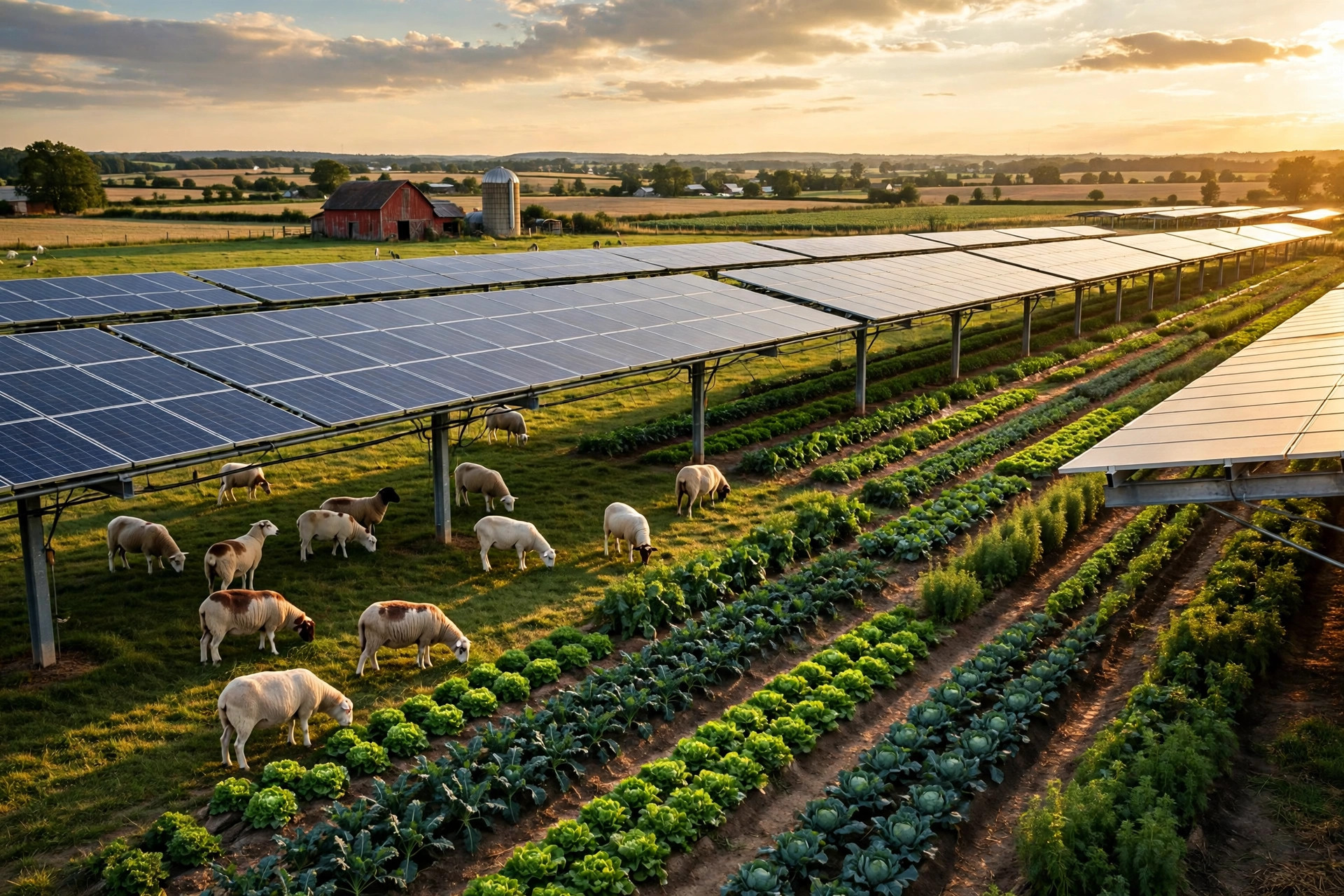
Agrivoltaics answers the objection directly, by keeping the farm. Panels go up on elevated racking, eight to ten feet in the air, and the land underneath keeps producing: sheep graze, vegetables grow, bees work pollinator habitat. NREL's InSPIRE project counted nearly 600 agrivoltaic sites in the United States by November 2024, covering roughly 60,000 acres and producing 10 GW, up from 27,000 acres and 4.5 GW in 2020. More than 400 of those sites are pollinator habitat. A separate American Farmland Trust survey counted 47 commercial agrivoltaic projects across 21 states, most of them between 200 kW and 5 MW. That size range is the tell. Commercial agrivoltaics in America is a small-project business, and nobody has built the company that does small projects repeatedly.
Crop science backs the format, with an important caveat about where the data comes from. Researchers at the University of Arizona, working at Biosphere 2 outside Tucson, published in Nature Sustainability in 2019 that chiltepin peppers grown under panels produced three times as much fruit as open-sun controls, cherry tomatoes produced roughly twice as much, and jalapeños produced the same harvest while losing 65 percent less water to transpiration. Soil under the panels stayed about 15 percent wetter between waterings. Those numbers come from experimental plots in a desert, not from thousand-acre commercial farms, and the honest version of this story keeps that distinction visible. What the plots prove is the mechanism: shade cuts heat stress and evaporation in hot climates, and many crops are light-saturated well below full sun. What they do not prove is a yield figure a developer can underwrite in New York.
Sheep are the more bankable half of the practice, because the economics are already measured at scale. The American Solar Grazing Association estimates 130,000 acres of American solar farms were grazed by sheep in 2025, about 10 percent of all solar acreage, and its census counted roughly 113,050 sheep on 129,000 acres at more than 500 sites in 2024. Grazers are paid a median of $112 an acre, slightly less than the $120 an acre mowing costs and far less than the $291 an acre herbicide costs, while season-long full-service contracts in the Midwest run $300 to $500 an acre. A typical grazing business runs about 1,300 sheep across 1,500 acres a year. Sheep do not damage panels, they fertilize as they go, and a joint ASGA and American Farmland Trust soil study across 28 grazed sites in the Northeast found organic matter, soil protein, and active carbon all significantly higher where sheep had grazed. A Cornell trial published in October 2026 added a refinement: at 0.8 sheep per acre, bees and lady beetles rose 38 percent against ungrazed plots, while at high densities bee abundance fell 42 to 68 percent. Stocking rate is a design decision, not an afterthought.
The Gap in the Market
Money has arrived for agrivoltaics at utility scale and for community solar at scale. What has not arrived is a company that does small dual-use projects, one farm at a time, as a repeatable product. Every developer below can build an agrivoltaic project. None of them is organized around the 1 to 5 MW working farm, where the farmer stays on the land and the project lives or dies on a town board vote.
| Company | Scale | Focus | What it does not do |
|---|---|---|---|
| Lightsource bp | 173 MW Bellflower project, Indiana, commercial operation early 2023 | Utility-scale solar with sheep grazing and beekeeping | Builds 100 MW-plus projects; a 40-acre family farm is below its minimum deal size |
| BlueWave | 150-plus MW portfolio; acquired by Axium Infrastructure in May 2022 | Community solar, dual-use, and storage; B Corp | Dual-use is a practice inside a larger development portfolio, not a standalone small-farm product; its Maine wild blueberry project was built with Navisun as a one-off |
| Encore Renewable Energy | Vermont-based; dozens of community solar projects | Community solar and agrivoltaics in the Northeast | Regional and project-by-project; no standardized sub-5 MW farm playbook it sells to other developers |
| Pine Gate Renewables | Utility-scale developer, gigawatt pipeline | Utility-scale solar and storage, agrivoltaics as a feature | Does not develop 5 MW community projects on working farms |
| Silicon Ranch | Utility-scale owner-operator, one of the largest in the US | Sheep grazing across its fleet as vegetation management | Grazing is an operations choice, not a farmer-income product; the landowner is a lessor, not a farming partner |
| Nexamp | One of the largest community solar developers in the US | Community solar at scale | Pure solar; dual-use is not the product, and its projects do not keep the host farm in production |
| Jack's Solar Garden | 1.2 MW on 5 acres, Boulder County, power for 300-plus homes | Community solar and agrivoltaics research with NREL | A research site, not a developer; proves the model, does not sell it |
| Perch Energy | Spun out of BlueWave | Community solar subscriber management | Manages subscriptions for other developers' projects; develops nothing |
| AgriSolar Clearinghouse | DOE-funded, run through NREL | Research, standards, and technical assistance | A resource hub, not a company; it publishes the playbook nobody has commercialized |
Look at the pattern in that table. The developers with dual-use experience work at 100 MW and up, or treat dual-use as one practice among many. The community solar specialists build pure solar. The research sites prove the agronomy and stop there. Meanwhile the commercial project census says the action is at 200 kW to 5 MW, on working farms, in states with community solar programs. That is a gap with a shape: a developer-operator that takes a 40-acre farm from option to operation, with the farming contract signed before the permit hearing, and repeats the process in the next county.
State programs have started paying for exactly this format, which is why the gap is closable now rather than in five years. Massachusetts pays a dual-use adder under its SMART program, $0.06 per kWh under the earlier blocks and $0.09 in the 2026 program year, but only on systems up to 2 MW unless the state agriculture department grants a waiver, and the tariff runs 20 years, not the 25-year lease. New Jersey's Board of Public Utilities awarded 16 dual-use projects totaling 52.06 MW in August 2026, in the first solicitation of a pilot that can support up to 200 MW over three years, with individual projects generally capped at 10 MW. Thirty-three proposals totaling about 140 MW competed for that first round, and the winning projects average 3.25 MW each, squarely in the small-farm band. NYSERDA awarded more than $7 million in 2025 for agrivoltaics research, demonstration, and construction in New York. A permanent program is the stated goal in New Jersey, and the pilot's research arm at Rutgers will measure yield under the panels. For a developer, that is a procurement pipeline with a published scoreboard.
The Solution
This is a development company for small-farm agrivoltaics: 1 to 5 MW community solar projects on working family farms, where the farmer keeps farming and the developer handles everything else. Five functions, in order.
First, site selection on distribution feeders, not transmission lines. A 5 MW project connects to the local distribution grid, which means the interconnection study is a utility process, not a regional transmission operator queue. That matters because the transmission queue is where solar projects go to die: Berkeley Lab's Queued Up 2026 edition counted 2,061 GW of generation and storage waiting for connection at the end of 2025, and the median project that reached operation in 2025 spent 61 months between its request and operation, up from 36 months in 2015. Distribution is faster but not fast. A separate Berkeley Lab analysis of 2.7 million interconnection applications across 188 utilities in 24 states found solar projects between 1 and 5 MW needed a median of 45 months to get permission to turn on between 2020 and 2025, a span that includes construction and inspection time, not just the utility's study process. Site selection therefore starts with feeder capacity maps and utility queue data, not with pretty farmland. A farm 200 feet from a feeder with capacity beats a farm 2 miles from a congested substation, every time.
Second, a standardized dual-use design. Elevated fixed-tilt or single-axis trackers at eight to ten feet of clearance, rows spaced for farm equipment or sheep, and a crop or grazing plan chosen for the site: sheep on pasture ground, shade-tolerant vegetables on high-value ground, pollinator habitat on the margins. Germany's DIN SPEC 91434 standard, the only formal agrivoltaics standard in wide use, requires that genuine dual use retain at least two-thirds of reference crop yield, with the land lost to posts and foundations capped at 10 percent for elevated systems and 15 percent for ground-level systems; the design targets that bar and documents it. Standardization is the business. A one-off 5 MW project is a construction job. Ten projects from the same design package, with the same racking, the same inverter skid, and the same grazing contract template, is a company.
Third, the farming contract comes before the permit hearing. The developer signs the landowner to a 25-year lease at $1,000 to $1,500 an acre and signs a grazier or crop farmer to a vegetation management contract at the same time. At the hearing, the farmer sits next to the developer and says the farm stays a farm. That testimony is worth more than any rendering. It is also the reason the lease includes an agricultural-use clause with a defined crop or grazing plan, a soil-health baseline, and a decommissioning bond that returns the land to farming. The 2026 Farm Bill draft directs USDA to study agrivoltaics and to require best practices so land can return to agricultural production after removal. Writing those practices into the lease now is free; retrofitting them after a town demands it is not.
Fourth, financing built around the tax credit deadline. Construction capital comes from project finance: tax equity plus construction debt, the standard community solar stack. The 30 percent federal investment tax credit under Section 48E is the difference between a financeable project and a marginal one, and the One Big Beautiful Bill Act (P.L. 119-21), signed July 4, 2025, set a hard clock on it. Projects that did not begin construction by July 4, 2026 must be placed in service by December 31, 2027 to claim the credit. Projects that did begin construction by that date keep a four-year completion window, as late as December 31, 2030. A new project started today lives under the 2027 deadline, which is 13 months away and shorter than the median interconnection wait. That collision is the central strategic fact of this business, and the Limitations section deals with it honestly. Two mitigations matter. One is buying late-stage pipeline: projects that already hold interconnection agreements, or New Jersey pilot awards, where the clock is manageable. The other is storage. The same law left the energy storage credit alone, so pairing a 5 MW array with a battery keeps a credit-bearing asset in the project after the solar credit expires, and adds capacity revenue. Bonus depreciation is also back at 100 percent for equipment acquired after January 19, 2025.
Fifth, operations as a service the farmer can see. Vegetation management is contracted to a local grazier or farmer, not to a mowing crew from three counties away. Soil organic matter, grazing records, and crop yields are measured annually and published in a one-page site report the landowner, the town, and the subscribers can all read. Subscriber management runs on white-label community solar software, the same category Perch Energy sells, so the company does not build billing software. The operating model is boring on purpose: the same design, the same contracts, the same report, farm after farm.
The Original Calculation: The 40-Acre Ledger
Take one project: 5 MWdc of community solar on 40 acres of working farmland in the Northeast, elevated racking, sheep grazing under the array, single-axis trackers. Run the ledger line by line, with every assumption stated so a reader can re-run it with different numbers.
Generation first. A 5 MWdc array in upstate New York or Massachusetts produces about 1,350 kWh per kW per year with single-axis tracking, which gives 6,750 MWh a year. Revenue second. Community solar subscribers in those states pay a blended value of about $0.12 per kWh once the bill credit, the renewable certificate, and the program incentive are combined. New Jersey's SREC-II base is about $65 per MWh before its dual-use adder, and wholesale energy adds roughly $40, so the all-in value lands near $105 per MWh before the adder, close to the $120 the ledger assumes. At $120 per MWh, 6,750 MWh earns $810,000 a year.
| Line item | Annual amount | Basis |
|---|---|---|
| Electricity revenue | $810,000 | 6,750 MWh at $120 per MWh |
| Land lease | -$60,000 | 40 acres at $1,500 per acre |
| Grazing contract | -$12,000 | 40 acres at $300 per acre, full-service season |
| Operations and maintenance | -$75,000 | $15 per kW per year |
| Insurance, admin, subscriber management | -$55,000 | Allowance |
| Net operating income | $608,000 | Revenue minus operating costs |
Capital cost is where the agrivoltaic premium shows up. Utility-scale solar now builds for roughly $1.0 to $1.5 million per MW: Vesper Energy's 600 MW Hornet project in Texas closed financing at about $983,000 per MW, its 201 MW Nazareth project at about $1.17 million per MW, and Pathway Power's 150 MW Greenridge project, which includes storage, at about $1.33 million per MW. A 5 MW community project with elevated racking, wider row spacing, and a distribution interconnection builds at about $1.5 million per MW, or $7.5 million all-in. Apply the 30 percent investment tax credit, $2.25 million, and net capital is $5.25 million. Simple payback on $608,000 of annual net operating income is 8.6 years. Over a 25-year lease, the project generates $15.2 million of net operating income against $5.25 million of net capital.
Run the same project without the tax credit and the story changes. Net capital rises to $7.5 million and payback stretches to 12.3 years. At current debt costs, a 12-year payback on a 25-year asset clears almost no lender's hurdle, which is why the December 31, 2027 deadline is not a footnote. It is the difference between a financeable project and a stranded one. Any pitch that treats the credit as permanent is selling a 2025 model in a 2026 market.
Run the pure-solar comparison and the agrivoltaic premium is smaller than it looks. Same 5 MW, same 40 acres, no elevated racking, no grazing: capital at $1.35 million per MW is $6.75 million, or $4.73 million after the credit. Vegetation is mowing at $120 an acre, $4,800 a year, instead of grazing at $12,000. Net operating income is about $615,000 a year, and payback is 7.7 years. Agrivoltaics costs roughly nine months of payback against pure solar. What those nine months buy is the permit, the farmer's public support, and, in Massachusetts, a dual-use adder worth up to $405,000 a year on this project's output at the earlier $0.06 rate, before block limits, though only the first 2 MW qualifies without a waiver, about $162,000 a year at that rate. In a state with an adder, the agrivoltaic version is the more profitable project, not the less profitable one. In a state without one, the premium is the price of getting built at all.
130,000 acres of American solar farms are already grazed by sheep. The operating model is proven. The company that productizes it is not.
Now the farmer's side, because the farmer is the customer who has to say yes. Forty acres of Illinois corn ground rents for $161 to $290 an acre, and the national average cash rent is about $98 an acre. A $1,500 solar lease pays five to fifteen times that, every year, for 25 years, and the farmer keeps farming the same ground. A grazier running about one sheep per acre in continuous stocking puts roughly 40 sheep on the site, or 80 to 160 head in short rotational moves, collects a $12,000 season contract, and sells the lambs. A ewe is worth $250 to $300, according to the American Solar Grazing Association, so a 100-ewe flock is $25,000 to $30,000 of livestock working ground the grazier does not own. Nobody in that stack is doing charity. The landowner gets a lease worth ten times cash rent, the grazier gets paid to run sheep on free pasture, and the developer gets a project a town board will approve.
One more number belongs in the ledger, because it is the number opponents will cite. France Agrivoltaisme, the French agrivoltaics association, reported that dual-use systems made up 20 percent of the 1.6 GW of ground-mounted solar installed in France in 2024. Germany's DIN SPEC 91434 requires dual-use projects to retain at least two-thirds of reference crop yield. The format is not an American experiment. It is a European procurement category, and the American version is three to five years behind.
Revenue Model
Development fees are the capital-light path. A developer earns $150,000 to $250,000 per 5 MW project at financial close, paid out of the construction financing, for taking a site from option to notice to proceed. Four projects a year is $600,000 to $1 million of fee revenue against a development burn of about $850,000 in year one. That is a real business, but it is a services business, and services businesses sell for low multiples.
Retained ownership is where the money compounds. A developer that keeps a minority stake, or holds projects through construction and sells into a yield vehicle, captures a share of the $608,000 annual net operating income per project. Four projects a year for three years is 12 projects and about $7.3 million of annual net operating income at run rate, before debt service, which takes roughly half. Equity cash flow near $3 million a year on a 60 MW portfolio is the scale case, and it is the reason BlueWave's acquirer, Axium, paid to own the portfolio rather than the pipeline. The honest version of this model holds both truths at once: fees pay the salaries in years one and two, retained ownership pays the valuation in years five and beyond, and the company needs the discipline to survive the gap between them.
Two smaller lines round out the model. Asset management fees run about $25,000 a year per project for owners who buy operating agrivoltaic assets and want the farming contracts managed. Grazing coordination, matching graziers to sites and running the stocking-rate and soil reporting, is a service the industry currently gets from a trade association for free, which means it is a service waiting for someone to charge for it. Neither line carries the company. Both deepen the moat, because a developer that already manages the sheep has the relationship when the next farm comes up for option.
Market Size
Global agrivoltaics was a $5.9 billion market in 2025, according to Emergen Research, projected to reach $14.23 billion by 2035 at a 9.2 percent annual growth rate. Other research firms put the 2025 figure anywhere from $4.2 to $6.5 billion, so treat the headline as a range rather than a point. North America holds about 35 percent of it, according to Astute Analytica. That is the TAM, and it is mostly irrelevant to a startup, because most of it is utility-scale construction in Asia and Europe.
Serviceable market is American small-scale dual-use. Community solar installed 1,435 MWdc in the United States in 2025, down 25 percent from the record 2024, and cumulative installations passed 10.1 GWdc at year end, per SEIA and Wood Mackenzie. New York and Illinois supplied 68 percent of 2025 volume. If a quarter of future community solar goes dual-use, at $1.5 million per MW, that is roughly $538 million a year of project capital in the small dual-use segment. Add grazing and vegetation contracts at $300 an acre across the roughly 60,000 acres already in agrivoltaics, and the operating-services layer is about $18 million a year today, growing with the acreage.
Obtainable market is deliberately small. Four 5 MW projects a year is 20 MW, or $30 million of project value, of which the developer keeps $600,000 to $1 million in fees plus a growing share of retained net operating income. By year three, 12 projects produce about $7.3 million of gross net operating income, roughly $3 million to equity after debt service. A company does not need to win the agrivoltaics market. It needs to win 20 MW a year of it, in three states, with a design package its competitors cannot be bothered to standardize.
Why Now
Five forces converge on the next 13 months, and four of them will still be true in 2028. One will not, which is the point.
The tax credit clock is the forcing function. A project started today must be placed in service by December 31, 2027 to claim the 30 percent credit, and that deadline is 13 months away. After it passes, community solar economics get materially harder, and the projects that do get built will be the ones that started earlier or paired storage. Urgency is real, but it cuts both ways, and the Counterargument section says how.
States are awarding dual-use megawatts right now. New Jersey's first dual-use solicitation drew 33 proposals for 140 MW and awarded 16 projects at 52 MW in August 2026, with up to 200 MW to come over three years. Massachusetts has paid its dual-use adder for years. New York put more than $7 million into agrivoltaics in 2025. These are procurement programs with published rules, not pilot press releases. A developer entering today competes in the second New Jersey solicitation, not the first, which means the rules are known and the winners are public.
Farmland politics have made pure solar harder to permit and dual-use easier. The draft 2026 Farm Bill directs USDA to study agrivoltaics and to require best practices so solar land can return to farming. American Farmland Trust's Smart Solar program has spent years building the policy case that dual-use, not prohibition, is the answer to solar on farmland. County boards are listening, because the alternative they keep choosing is a ban, and a ban serves nobody. A project that arrives with a farmer, a grazing plan, and a soil baseline is a different hearing from a project that arrives with a lease and a rendering.
Grazing is a proven operating model now, not a pilot. Three years ago a developer promising sheep under panels was asking a lender to underwrite a novelty. Today the grazing association counts 130,000 acres under sheep, publishes median fees, runs a template contract, and has soil data showing the practice improves the ground. Lenders underwrite what has a census. Solar grazing has one.
Storage changes the post-2027 math. The same law that ends the solar credit left the storage credit intact, and 100 percent bonus depreciation is back for equipment acquired after January 19, 2025. A 5 MW array paired with a 2-hour battery keeps a credit-bearing asset in the project, adds capacity revenue, and gives the utility a firmer interconnection case. Storage is not a footnote to this model. It is the bridge across the credit cliff.
Startup Costs
Development is a cheap business to enter and an expensive business to finish. The first-year budget below gets a company to its first notice to proceed. Construction capital is project finance, tax equity plus construction debt, and does not come from startup equity. Confusing the two is the most common way solar startups die.
| Line item | Year-one cost | Notes |
|---|---|---|
| Founders, two, below market | $240,000 | $120,000 each; one development, one finance |
| Development manager | $130,000 | Permitting and interconnection lead |
| Part-time counsel | $60,000 | Leases, grazing contracts, interconnection |
| Site options, 12 farms | $30,000 | $2,500 per site option payment |
| Interconnection applications and studies, 6 sites | $180,000 | $30,000 per site average |
| Permitting, environmental, legal | $80,000 | Wetlands, glare, decommissioning bond |
| Agronomy pilot and grazing partner | $40,000 | Soil baseline, crop plan, grazier retainer |
| Software, white-label subscriber management | $30,000 | Do not build billing software |
| Travel, insurance, miscellaneous | $40,000 | County hearings are in person |
| Total, year one | $830,000 | Round to $850,000 with contingency |
That budget assumes the founders take below-market salaries and the company options more sites than it builds. Twelve options, six interconnection applications, and two or three projects reaching notice to proceed is the expected funnel, and the funnel is the product. A company that options one perfect farm and waits has a hobby. A company that options twelve farms across three utilities has a pipeline a tax equity investor can underwrite. First project to notice to proceed in 12 months is the target; first project operating in 24 to 36 months is the honest timeline, given interconnection.
Limitations
Several numbers in this piece are softer than they look, and a reader building this company should know which ones.
Yield data comes from research plots. Chiltepin peppers tripling and tomatoes doubling happened at Biosphere 2 in Arizona, on small plots, under controlled irrigation. Commercial farms in the Northeast will see smaller effects, and some crops will yield less under panels, not more. Germany's standard tolerates up to one-third crop loss and still calls a project dual-use. A developer that underwrites Arizona yields into a Massachusetts pro forma is lying to its lender.
Revenue per kWh is a blended estimate, not a tariff. The $120 per MWh figure combines a bill credit, a renewable certificate, and a program incentive, and the mix varies by state, utility, and program block. Massachusetts SMART values decline across blocks. New Jersey's SREC-II base is about $65 per MWh before its adder, and the adder is awarded competitively. A project in a state without an adder, or in a late program block, earns less. Re-run the ledger at $100 per MWh before committing to a site: net operating income falls to $473,000, and payback with the credit stretches to 11.1 years.
Interconnection timelines are the largest single risk and the least controllable. A median of 45 months for 1 to 5 MW distribution projects means a project started today is likely operating in 2030, past the tax credit deadline. Site selection on feeder capacity helps, and buying late-stage pipeline helps more, but neither repeals the queue. Every month of interconnection delay is a month of option payments, study fees, and salaries with no revenue.
Grazing fees vary by region and by service level. The $300 per acre figure is a Midwest full-service contract. The national median is $112 an acre, and a developer that budgets the median while promising full service will underpay its grazier or overpromise its lender. Sheep also need water, fencing, predator control, and veterinary care, and the contract has to say who pays for each.
Finally, the tax credit analysis is current as of November 2026 and the law is contested. IRS Notice 2025-42, which had eliminated the 5 percent safe harbor for establishing beginning of construction, was vacated in full on June 6, 2026, by the U.S. District Court for the District of Columbia in Oregon Environmental Council v. IRS, restoring the safe harbor unless the decision is stayed or reversed on appeal or the IRS issues replacement guidance. Prohibited foreign entity rules add sourcing complexity to panel procurement. Tax advice belongs to a tax adviser, not a startup idea page, and the numbers here assume the credit is claimed exactly as the statute reads today.
Strongest Counterargument
Here is the case against this idea, stated at full strength. Community solar is contracting, down 25 percent in 2025, with SEIA's base case expecting existing state markets to shrink about 5 percent a year through 2030. The tax credit that makes the ledger work expires for new projects in 13 months, while the median small project waits 45 months for a grid connection, which means a greenfield project started today cannot plausibly claim the credit at all. Without the credit, payback stretches past 12 years, and no lender funds a 12-year payback on a 25-year asset at current rates. Meanwhile the big developers already do dual-use at 100 MW and up, the community solar specialists already own the subscriber relationships, and the grazing business is a $112-an-acre service that a mowing crew already provides for $120. Put together, the argument says agrivoltaics is a nice policy story attached to a contracting market, a missed tax window, and a queue that eats the business model. A rational founder would build something else.
Most of that argument is correct, which is why the company described here does not start greenfield projects and wait 45 months. It buys late-stage pipeline: projects that already hold interconnection agreements, or New Jersey pilot awards, where the clock from notice to proceed to operation is 12 to 18 months and the December 2027 deadline is reachable. It pairs storage, whose credit survives, so the project keeps a tax-advantaged asset even if the solar credit slips. And it treats the contracting community solar market as a feature rather than a bug, because a shrinking market with published programs and known rules is a better place to be a disciplined small developer than a growing market with a land rush. The counterargument kills the naive version of this company, the one that options a farm, files an interconnection request, and hopes. It does not kill the version that buys time instead of filing for it.
What would kill the disciplined version is a world where states stop awarding dual-use megawatts, where interconnection reform stalls entirely, and where the credit cliff arrives with no storage bridge. All three are possible. A founder should price that risk before spending the first $30,000 on options, and should be able to say, in one sentence, what the company does if the December 2027 deadline passes with no operating project. The honest answer is that it becomes a storage-paired developer in states with adders, at lower returns, or it sells its pipeline to a bigger developer and returns capital. Either outcome beats pretending the deadline does not exist.
What You Can Do
If you farm land near a distribution feeder: Check whether your state has a dual-use or community solar program before signing anything. Massachusetts, New Jersey, New York, Minnesota, and Illinois all have programs that pay for dual-use; most other states do not, and a lease in a state without one is worth less. Get the lease reviewed by an attorney who has seen solar leases, not a general practitioner. Insist on an agricultural-use clause with a defined crop or grazing plan, a soil-health baseline measured before construction, and a decommissioning bond that returns the land to farming. Never sign a 40-year lease. Twenty-five years, with a renewal option you control, is the standard, and a developer who demands more is telling you something.
If you are building this: Start with the second New Jersey dual-use solicitation and the Massachusetts SMART program, where the rules and the winners are public, not with a greenfield site in a state with no program. Buy late-stage pipeline before you file new interconnection requests, because the 45-month median wait is longer than the 13 months left on the tax credit. Partner with a grazier before the permit hearing, not after, and put the grazier's name on the application. Price the project at $100 per MWh, not $120, and if it does not clear your hurdle at $100, it is not a project yet.
If you subscribe to community solar: Ask your provider whether the project keeps the host farm in production. Subscribers are the demand side of this market, and a subscriber base that asks for dual-use gives developers a reason to build it. In states with a low-income carve-out, ask how the carve-out is verified, because a program that cannot prove its subscribers are who it claims is a program waiting for an audit.
The Bottom Line
One acre of farmland can grow food and make power at the same time, and the research proving it is a decade old. What is new is the market structure around it: states are awarding dual-use megawatts, graziers are a census-counted industry, and a 5 MW project on 40 acres pays the farmer $1,500 an acre while earning about $608,000 a year. The tax credit that makes the math work expires for new projects on December 31, 2027, which is either a deadline that kills the naive version of this company or a filter that leaves the field to the disciplined one. Build the version that buys time, pairs storage, and signs the farmer before the hearing, and the farm stays a farm.
A solar farm that kills the farm is a 25-year lease on a dead field. A solar farm that keeps the farm is a second crop.
Related
📰 Farmland Lease Rate Intelligence SaaS for Tenant Farmers and Non-Operating Landlords. Cash rent benchmarks are the denominator for every solar lease: the same ground rents for $98 an acre on average and $1,500 an acre to a solar developer
📰 Pollination Contract Intelligence SaaS for Commercial Beekeepers and Specialty Crop Growers. Four hundred-plus American agrivoltaic sites are pollinator habitat, and the beekeeper under the array is the same business model with different livestock
📰 20,000 Solar Panels at 85% Strength Are Coming Off a 5 MW Farm. Recycling Costs up to $900,000. Reselling Earns $300,000.. The other end of the same asset: what happens to panels at year 26, and who gets paid for it