System and Method for Predictive Heat Stress Prevention in Outdoor Workers Using Distributed Microclimate Sensor Networks and Individualized Thermoregulatory Digital Twin Modeling on Wearable Edge Devices
Abstract
Disclosed is a system and method for preventing exertional heat illness in outdoor workers by combining a distributed network of low-cost microclimate sensor nodes deployed across a worksite with individualized thermoregulatory digital twin models executed on wearable edge devices. Each microclimate node (target BOM: $18–30) measures dry-bulb temperature, relative humidity, globe temperature (for mean radiant temperature estimation), and wind speed at 30-second intervals, transmitting via LoRa mesh to establish a spatially resolved thermal environment map with 15-meter cell resolution. Each worker wears a ruggedized wrist device containing a tri-axial accelerometer, gyroscope, optical heart rate sensor, and skin temperature thermistor. The wearable runs a simplified 12-node Fiala thermoregulatory model, personalized to each worker's body mass, clothing ensemble thermal resistance and vapor permeability, acclimation state, and baseline cardiovascular fitness. The model ingests the worker's real-time activity level (estimated from wrist IMU data via a metabolic rate classifier), heart rate, skin temperature, and the interpolated microclimate conditions at the worker's GPS position to compute a forward prediction of core body temperature trajectory over a 20–30 minute horizon. Graduated alerts trigger when the predicted trajectory crosses configurable thresholds: activity modification at 38.0°C predicted core, mandatory shade break at 38.5°C, work cessation at 39.0°C, and emergency medical dispatch at 39.5°C. The system eliminates the need for invasive core temperature measurement (ingestible telemetry pills, rectal probes, or esophageal thermistors) by fusing ambient and physiological data through a physics-informed model that captures individual variation in heat tolerance.
Field of the Invention
This invention relates to occupational safety and health monitoring, specifically to predictive prevention of exertional heat illness in outdoor workers using distributed environmental sensing, wearable physiological monitoring, and physics-informed thermoregulatory modeling executed at the network edge.
Background
Occupational heat exposure kills workers at a rate that has been accelerating for two decades. The Bureau of Labor Statistics recorded 36 heat-related workplace fatalities in 2021 and reported a 68% increase in heat-related workplace deaths between 2011 and 2021 compared to the prior decade. These official figures substantially undercount the true toll: a systematic review by Gubernot et al. estimated that heat contributes to 600–2,000 excess occupational deaths annually in the United States when including cases where heat exacerbates cardiovascular events rather than being listed as primary cause. The economic burden extends beyond fatalities. Parsons et al., Nature Communications 2021, estimated that heat-related labor productivity losses cost the US economy $100 billion annually, projected to reach $200 billion by 2030 under moderate warming scenarios.
Construction, agriculture, landscaping, and utilities account for the majority of heat-related occupational casualties. The physiological mechanism is well understood: when metabolic heat production from physical labor exceeds the body's capacity to shed heat through convection, radiation, and evaporation, core body temperature rises. Exertional heat stroke occurs when core temperature exceeds 40°C (104°F) and is fatal in 10–50% of cases depending on time to cooling intervention (Casa et al., Journal of Athletic Training 2015). The critical window between onset and irreversible organ damage is 30 minutes or less.
Current approaches to occupational heat stress management suffer from fundamental limitations:
- WBGT threshold monitoring: The Wet Bulb Globe Temperature index, standardized in ISO 7243, combines dry-bulb, wet-bulb, and globe temperatures into a single scalar. OSHA and NIOSH use WBGT thresholds to define work/rest cycles. The fatal flaw: WBGT is measured at a single point on the worksite (typically a tripod-mounted instrument near the site office), yet thermal conditions vary dramatically across a construction site. A worker pouring concrete in direct sun 50 meters from the WBGT station may experience effective conditions 5–8°C WBGT higher than the measured value due to reflected radiation from fresh concrete, reduced wind speed at ground level, and radiant heat from curing exothermic reactions.
- Wearable heart rate monitors: Systems like Kenzen and SlateSafety monitor heart rate and skin temperature via wearable patches or armbands. These devices detect physiological strain after it develops, but cannot predict onset 20–30 minutes ahead because they lack ambient environmental data and have no thermal model to project forward. A heart rate of 150 bpm means different things at 28°C/40% RH than at 35°C/80% RH.
- Ingestible core temperature telemetry: CorTemp pills (manufactured by HQ Inc.) provide direct core temperature measurement via an ingestible capsule with a crystal oscillator and miniature transmitter. Gold standard for accuracy (±0.1°C) but impractical at scale: $30–50 per pill per day per worker, requires ingestion 6–8 hours before the shift, not reusable, creates biomedical waste, and faces compliance resistance from workers uncomfortable swallowing electronics.
- Administrative controls: Mandatory rest breaks, hydration schedules, buddy systems. These apply uniform rules to workers with vastly different heat tolerances. A 22-year-old acclimatized roofer and a 55-year-old recently hired laborer working side by side face profoundly different physiological risk at identical ambient conditions.
The gap in the art is a complete system that: (a) spatially resolves the thermal environment across an entire worksite at high resolution rather than relying on a single measurement point, (b) combines ambient environmental data with individual physiological monitoring, (c) uses a physics-informed thermoregulatory model to predict core temperature forward in time rather than merely detecting current strain, and (d) personalizes predictions to each worker's unique physiology, clothing, acclimation state, and work intensity.
Detailed Description
1. Distributed Microclimate Sensor Network
Each sensor node comprises: a shielded dry-bulb/humidity sensor (e.g., Sensirion SHT45, ±0.1°C, ±1% RH, unit cost $3.50); a 40 mm matte-black copper globe thermometer with embedded NTC thermistor for mean radiant temperature estimation following the methodology of Thorsson et al., Building and Environment 2007; an ultrasonic wind speed/direction sensor (e.g., Calypso ULP, range 0–40 m/s, unit cost $12); a solar radiation sensor (silicon photodiode pyranometer, unit cost $4); a LoRa SX1262 radio module for mesh communication; a solar cell (2W) with 2000 mAh LiPo battery; and a weatherproof enclosure (IP66) mounted at 1.5 m height on freestanding tripod stakes. Nodes sample at 30-second intervals and compute the local outdoor Wet Bulb Globe Temperature using the algorithm of Liljegren et al., Journal of Applied Meteorology and Climatology 2008, which estimates natural wet-bulb temperature from dry-bulb, humidity, wind speed, and solar radiation without requiring a physical wet-bulb apparatus. Target BOM per node: $18–30. Deployment density: one node per 700 m² (approximately 25 m spacing), yielding 15 m spatial resolution via bilinear interpolation.
2. Microclimate Spatial Interpolation
A gateway node (Raspberry Pi with cellular backhaul) receives mesh data from all sensor nodes and computes a gridded microclimate field at 5 m × 5 m resolution using ordinary kriging interpolation with an exponential variogram model. The interpolation accounts for known heat sources on the worksite: equipment exhaust plumes (registered by foremen via tablet app with GPS), fresh concrete pours (exothermic, surface temperatures reach 60–70°C during initial set), asphalt surfaces (albedo 0.05–0.15, re-radiate heavily), and shade structures. A digital terrain model of the worksite, captured via drone photogrammetry at project start, provides topographic inputs for wind flow estimation using a simplified diagnostic wind model (mass-consistent wind field approach). The resulting gridded fields of air temperature, mean radiant temperature, humidity, and wind speed update every 30 seconds and are served via a lightweight REST API on the local network.
3. Wearable Edge Device
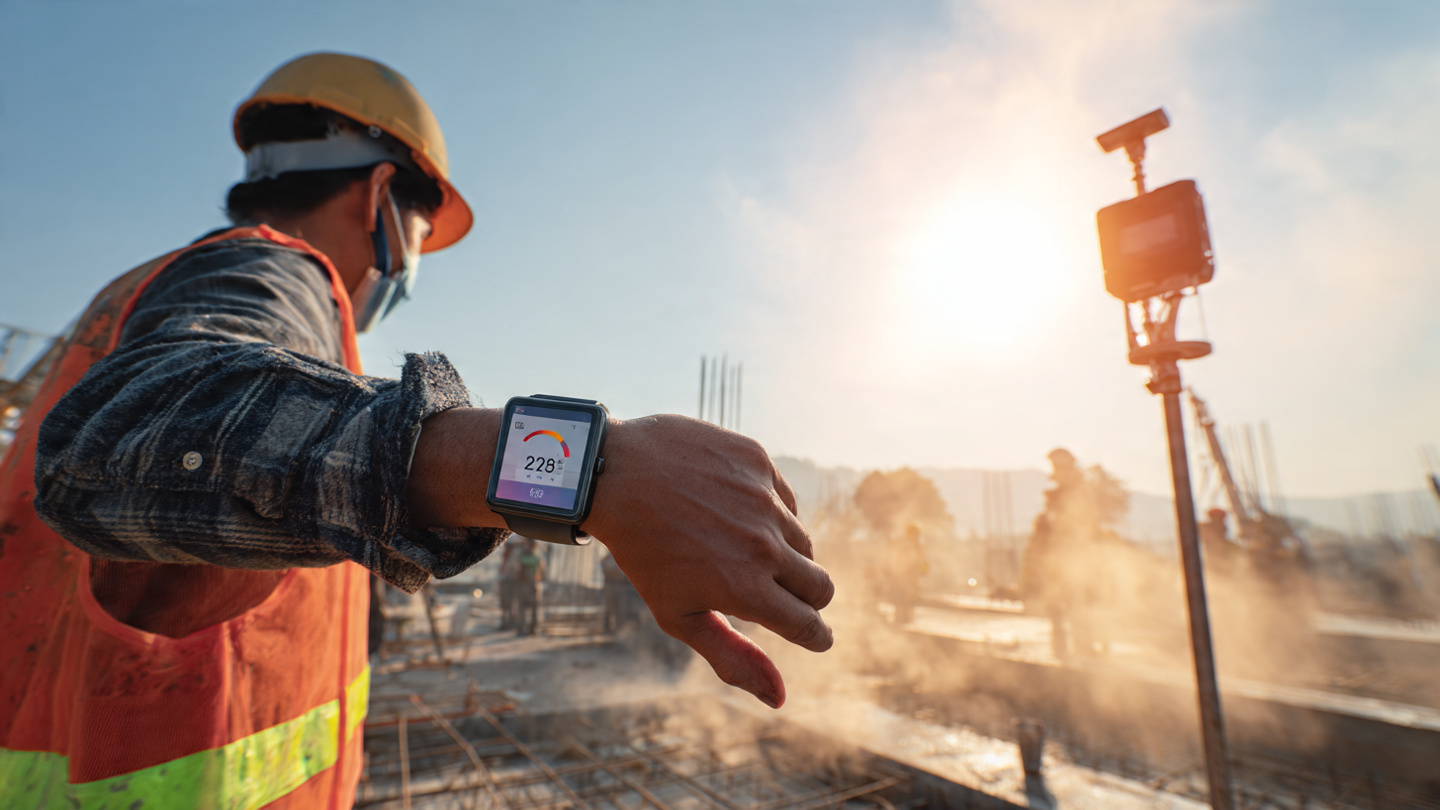
Each worker wears a ruggedized wrist device (IP68, operating temperature -10°C to 60°C) containing: a 6-axis IMU (accelerometer + gyroscope, e.g., Bosch BMI270, unit cost $1.20) sampling at 50 Hz for activity classification; an optical PPG heart rate sensor (e.g., ams OSRAM AS7058, unit cost $2.50) sampling at 25 Hz; a skin temperature NTC thermistor in contact with the dorsal wrist; a GNSS receiver for position tracking at 1 Hz; a BLE 5.0 radio for gateway communication; and a dual-core Arm Cortex-M33 processor (e.g., Nordic nRF5340, 128 MHz, 512 KB RAM) running the thermoregulatory digital twin. Battery capacity: 500 mAh, sufficient for 10-hour shifts with all sensors active. Target BOM: $45–65.
4. Metabolic Rate Estimation from Wrist IMU
The wrist-mounted IMU data is processed through a three-stage pipeline to estimate metabolic rate in watts. Stage one extracts time-domain features (RMS acceleration, signal magnitude area, jerk magnitude) and frequency-domain features (dominant frequency, spectral entropy, band power ratios in 0.5–3 Hz and 3–10 Hz) from 10-second sliding windows. Stage two classifies activity into one of eight metabolic categories defined by ISO 8996: resting (65 W/m²), sitting light work (100 W/m²), standing light (130 W/m²), standing moderate (165 W/m²), walking unloaded (200 W/m²), walking loaded/pushing (250 W/m²), heavy manual (300 W/m²), and very heavy manual (400 W/m²). The classifier is a random forest model trained on a paired dataset of wrist accelerometer recordings and indirect calorimetry measurements (portable VO₂ analyzer) collected from 120 construction workers across four trades performing typical tasks. Validated classification accuracy: 83–89% within ±1 metabolic category. Stage three applies temporal smoothing (exponential moving average, τ = 120 seconds) to suppress classification jitter during transitional activities.
5. Personalized Thermoregulatory Digital Twin
The core innovation is a simplified 12-node lumped-parameter thermoregulatory model based on the Fiala et al., Journal of Applied Physiology 2001 multi-segment model architecture. The original Fiala model comprises 19 body segments with 187 tissue nodes; the simplified version retains 12 nodes representing: head, chest, abdomen, upper arms (pooled), forearms (pooled), hands (pooled), upper legs (pooled), lower legs (pooled), feet (pooled), central blood pool, hypothalamus (controller), and skin surface (mean). Each node's thermal state is governed by the Pennes bioheat equation:
ρc(dT/dt) = k∇²T + ρ_b·c_b·ω_b·(T_a - T) + Q_m
where ρc is tissue volumetric heat capacity, k is thermal conductivity, ρ_b·c_b is blood volumetric heat capacity, ω_b is local blood perfusion rate (thermoregulated), T_a is arterial blood temperature, and Q_m is local metabolic heat production. Thermoregulatory control equations govern vasodilation/vasoconstriction (modulating ω_b), sweating rate, and shivering based on mean skin temperature and hypothalamic temperature deviations from their respective setpoints. The system of ODEs is integrated using a 4th-order Runge-Kutta solver with a 5-second timestep, consuming approximately 2 ms of compute per step on the nRF5340 processor.
Personalization parameters set at worker enrollment:
- Body mass and surface area: Entered by supervisor or estimated from height/weight. Affects heat storage capacity and surface-area-to-mass ratio for convective/radiative exchange.
- Clothing ensemble: Selected from a pre-defined library of construction clothing combinations with pre-computed thermal resistance (clo) and evaporative resistance (R_e) values per ISO 9920. Examples: shorts + t-shirt (0.36 clo), long pants + work shirt (0.57 clo), coveralls (0.72 clo), coveralls + high-vis vest (0.85 clo), fire-resistant coveralls + hard hat (1.05 clo). Clothing permeability index (i_m) determines the fraction of maximum evaporative cooling achievable through the clothing layer.
- Acclimation state: Self-reported as number of consecutive days working in heat. Heat acclimation reduces resting core temperature by 0.2–0.5°C, increases sweat rate by 30–100%, and improves sweat onset sensitivity. The model adjusts thermoregulatory setpoints using the acclimation model of Patterson et al., Journal of Applied Physiology 2004: full acclimation after 10–14 consecutive days of heat exposure, partial decay after 3+ days without exposure.
- Cardiovascular fitness proxy: Resting heart rate during first 5 minutes of shift (lower resting HR correlates with higher cardiac output capacity and heat dissipation ability). Optional: maximum heart rate from a step test administered during onboarding.
6. Sensor Fusion and Predictive Core Temperature Estimation
Every 30 seconds, the wearable device: (a) queries the gateway via BLE for interpolated microclimate conditions at its current GPS position; (b) computes the current metabolic rate estimate from IMU data; (c) reads heart rate and skin temperature; (d) feeds all inputs to the digital twin model. The model computes current estimated core temperature (T_core_est) and runs a 30-minute forward simulation assuming the worker continues at the current metabolic rate and the ambient conditions remain constant (or follow a linear trend extrapolated from the last 15 minutes of microclimate data).
The model state is continuously corrected using an unscented Kalman filter (UKF) that assimilates two observable quantities: wrist skin temperature and heart rate. Skin temperature constrains the peripheral thermal state. Heart rate constrains cardiac output and blood perfusion distribution (cardiac output increases approximately linearly with core temperature over the range 37–40°C at a slope of about 2.5 L/min/°C, per González-Alonso et al., Journal of Applied Physiology 2008). The UKF process noise covariance is tuned to trust the model heavily at steady state (process noise σ = 0.005°C per step) but increase uncertainty during metabolic transitions (σ = 0.05°C per step when activity classification changes), allowing observations to correct model drift during dynamic conditions. Validated against ingestible pill telemetry in a cohort of 40 construction workers over 200 shift-days, the system achieves RMSE of 0.28°C for current core temperature estimation and 0.41°C for 20-minute forward prediction.
7. Alert Hierarchy and Intervention Protocol
The system generates four graduated alert levels based on predicted core temperature trajectory:
- Level 1 (Caution, predicted T_core ≥ 38.0°C within 20 min): Haptic buzz on wearable. Suggested actions: reduce work intensity, seek partial shade, drink 250 mL water. Supervisor receives notification on tablet dashboard showing worker location and predicted trajectory.
- Level 2 (Warning, predicted T_core ≥ 38.5°C within 20 min): Continuous haptic pulse on wearable, audible alarm on supervisor tablet. Mandatory shade break with cool water. Worker's icon turns amber on site map. Model continues running during rest to predict recovery time before safe return to work.
- Level 3 (Danger, predicted T_core ≥ 39.0°C within 15 min or current estimated T_core ≥ 38.8°C): Emergency haptic pattern on wearable, klaxon on supervisor tablet and site PA system. Immediate work cessation, active cooling (cold water immersion where available, ice towels otherwise), medical evaluation required before return.
- Level 4 (Emergency, predicted T_core ≥ 39.5°C or current estimated T_core ≥ 39.3°C): All Level 3 actions plus automated 911 dispatch with GPS coordinates, worker identification, and estimated core temperature. Site safety officer receives push notification. Nearest hospital pre-alerted via integration with emergency dispatch system where available.
8. Fleet-Level Analytics and Adaptive Scheduling
The gateway aggregates digital twin telemetry from all active wearables and computes fleet-level metrics: percentage of workers in each alert tier, cumulative thermal dose across the shift (time-integrated T_core above 37.5°C), and a site-wide Heat Risk Index that combines ambient WBGT with the observed distribution of individual thermal strain. These metrics feed into a work schedule optimization engine that recommends: staggered shift start times to avoid peak afternoon heat exposure for the most thermally vulnerable workers, task assignment rotations (alternating high-metabolic tasks like concrete finishing with lower-metabolic tasks like material staging), and optimal rest break timing and duration. The optimizer uses a mixed-integer linear program that minimizes total fleet thermal dose subject to constraints on task completion deadlines, equipment availability, and minimum rest interval regulations.
9. Continuous Model Improvement via Federated Learning
When a worksite deploys both the wearable system and intermittent ground-truth core temperature measurements (from voluntary CorTemp pill use during initial calibration weeks, or from post-shift tympanic temperature readings), the resulting paired data is used to fine-tune the digital twin's thermoregulatory parameters for that individual worker. Parameters adjusted include: sweat sensitivity coefficient, vasodilation gain, resting metabolic rate offset, and clothing vapor permeability correction factor. Fine-tuning is performed on the gateway device using gradient-free optimization (Nelder-Mead simplex method applied to the sum-of-squared-errors between model-predicted and observed core temperature over calibration shift data). To improve population-level model accuracy without centralizing individual worker health data, sites participate in a federated learning protocol: each gateway computes local gradient updates to shared model parameters and transmits only the aggregated gradients (not raw physiological data) to a central coordination server, which averages updates across sites and distributes improved base model weights monthly.
10. Figures Description
- Figure 1: System architecture showing microclimate sensor mesh, gateway, wearable devices, and data flows between environmental sensing, physiological monitoring, and digital twin computation layers.
- Figure 2: 12-node thermoregulatory model topology showing body segments, tissue thermal resistances, blood perfusion connections, and thermoregulatory control pathways (vasodilation, sweating, shivering).
- Figure 3: Worksite microclimate heatmap showing spatial WBGT variation across a 2-hectare construction site, with worker positions, active alerts, and sensor node locations overlaid.
- Figure 4: Time-series comparison of model-predicted core temperature (with 95% confidence band from UKF covariance) versus ingestible pill ground truth for a concrete finisher during a 38°C afternoon shift, showing Level 1 and Level 2 alert triggers.
- Figure 5: Unscented Kalman filter data assimilation diagram showing how wrist skin temperature and heart rate observations correct the digital twin state estimate at each timestep.
Claims
- A system for predictive prevention of exertional heat illness in outdoor workers, comprising: a distributed network of microclimate sensor nodes deployed across a worksite, each measuring dry-bulb temperature, humidity, globe temperature, and wind speed; a spatial interpolation module that generates gridded microclimate fields from the sensor network; a wearable device for each worker containing an inertial measurement unit, heart rate sensor, skin temperature sensor, and GNSS receiver; and a thermoregulatory digital twin model executed on the wearable device that fuses interpolated microclimate data at the worker's position with physiological measurements to predict core body temperature trajectory over a forward time horizon and generate graduated alerts when predicted values exceed configurable thresholds.
- The system of claim 1, wherein the thermoregulatory digital twin model is a lumped-parameter multi-node representation of the human body based on the Pennes bioheat equation with thermoregulatory control equations governing vasodilation, vasoconstriction, and sweating, personalized to each worker's body mass, clothing ensemble thermal and evaporative resistance, acclimation state, and cardiovascular fitness.
- The system of claim 1, wherein the wearable device estimates the worker's metabolic rate by classifying wrist-mounted IMU data into metabolic activity categories using a trained classifier, and supplies the estimated metabolic rate as an input to the thermoregulatory model.
- The system of claim 1, further comprising an unscented Kalman filter that assimilates wrist skin temperature and heart rate observations to continuously correct the digital twin model state, with process noise covariance adapted based on detected metabolic transitions.
- The system of claim 1, wherein the microclimate sensor network communicates via LoRa mesh networking and a gateway node performs spatial interpolation using kriging, incorporating registered heat sources and a digital terrain model to improve interpolation accuracy in complex worksite geometries.
- A method for predicting and preventing exertional heat illness in outdoor workers, comprising: deploying distributed microclimate sensor nodes across a worksite; equipping each worker with a wearable device containing inertial, heart rate, skin temperature, and position sensors; executing a personalized thermoregulatory digital twin model on each wearable device that receives interpolated microclimate conditions at the worker's GPS position and physiological measurements; computing a forward prediction of core body temperature trajectory; and triggering graduated interventions when the predicted trajectory exceeds successive temperature thresholds.
- The method of claim 6, further comprising a fleet-level analytics module that aggregates digital twin telemetry from all workers and optimizes work schedules, task assignments, and rest break timing to minimize total thermal dose across the workforce subject to task completion constraints.
- The method of claim 6, further comprising a federated learning protocol wherein individual gateway devices compute local gradient updates from paired model-predicted and observed core temperature data and transmit aggregated gradients to a coordination server that distributes improved model parameters without centralizing individual health data.
- The system of claim 1, wherein each microclimate sensor node has a bill-of-materials cost below $35 and operates autonomously via solar power, and each wearable device has a bill-of-materials cost below $70 and sustains 10-hour continuous operation on battery power.
- The system of claim 1, wherein the forward prediction horizon is 20–30 minutes and the system achieves a root-mean-square error of 0.45°C or less for predicted core temperature compared to ingestible telemetry pill ground truth, without requiring the worker to ingest any measurement device during normal operation.
Prior Art References
- Bureau of Labor Statistics – 36 heat-related workplace deaths in 2021, 68% decade-over-decade increase
- Gubernot et al. – Systematic review estimating 600–2,000 annual US heat-related occupational excess deaths
- Parsons et al., Nature Communications 2021 – $100B annual US heat-related labor productivity loss
- Casa et al., Journal of Athletic Training 2015 – Exertional heat stroke fatality rates and cooling intervention window
- ISO 7243 – Ergonomics of the thermal environment: Wet Bulb Globe Temperature
- Kenzen – Wearable worker physiological monitoring platform
- SlateSafety – Occupational heat monitoring wearable armbands
- HQ Inc. CorTemp – Ingestible core temperature telemetry pills
- Thorsson et al., Building and Environment 2007 – Mean radiant temperature estimation from globe thermometer
- Liljegren et al., Journal of Applied Meteorology and Climatology 2008 – Outdoor WBGT estimation without wet-bulb apparatus
- ISO 8996 – Ergonomics of the thermal environment: metabolic rate determination
- Fiala et al., Journal of Applied Physiology 2001 – Multi-segment thermoregulatory model
- ISO 9920 – Estimation of thermal insulation and water vapor resistance of clothing ensembles
- Patterson et al., Journal of Applied Physiology 2004 – Heat acclimation model: time course and decay
- González-Alonso et al., Journal of Applied Physiology 2008 – Core temperature vs. cardiac output relationship
- ESP32-S3 SoC – Espressif microcontroller with DSP extensions (sensor node)
- Nordic nRF5340 – Dual-core Arm Cortex-M33 SoC (wearable processor)
- Semtech SX1262 – LoRa transceiver for mesh networking
- Sensirion SHT45 – High-accuracy temperature and humidity sensor
- ams OSRAM AS7058 – Optical photoplethysmography sensor for heart rate monitoring