System and Method for Passive Wind Turbine Blade Structural Health Monitoring Using Ground-Level Microphone Arrays and Edge-Deployed Doppler-Resolved Acoustic Signature Classification
Abstract
Disclosed is a system and method for continuous, non-contact structural health monitoring of wind turbine blades using ground-level microphone arrays positioned at the base of the tower. The system exploits the periodic Doppler frequency shift imposed on each blade's aeroacoustic signature as it rotates through the microphone's line of sight, enabling per-blade isolation of acoustic features without physical access to the rotor. An edge-deployed convolutional neural network processes Doppler-demodulated spectrograms to classify blade condition states including healthy operation, leading-edge erosion, trailing-edge delamination, surface crack propagation, and ice accretion. The system correlates acoustic features with rotor azimuth (determined from nacelle-mounted encoder data or optical blade-pass timing) to produce blade-specific health scores updated on every rotation cycle (typically 3-5 seconds). Temporal trend analysis detects gradual degradation months before conventional scheduled inspections would identify the same defects. The system requires no turbine downtime, no tower climbing, no drone deployment, and no blade-mounted sensors, reducing per-turbine monitoring costs from $5,000-15,000 per annual inspection to under $800 for continuous autonomous monitoring.
Field of the Invention
This invention relates to structural health monitoring of wind turbine rotor blades, specifically to methods for passive acoustic detection and classification of blade damage mechanisms using far-field microphone arrays at ground level combined with Doppler-based blade isolation and edge-deployed machine learning for real-time condition assessment.
Background
The global installed wind power capacity reached 1,021 GW by end of 2024 (Global Wind Energy Council), with approximately 400,000 utility-scale turbines in operation. Each turbine carries three blades, placing roughly 1.2 million large composite structures in active service worldwide. These blades represent 15-20% of total turbine capital cost and are the component most exposed to fatigue, erosion, lightning, and environmental degradation.
Blade failures are both costly and dangerous. Mishnaevsky et al., Renewable Energy 2021 reported that blade damage accounts for the single largest share of wind turbine insurance claims, with individual blade replacements costing $150,000-400,000 for onshore turbines and $500,000-1,200,000 offshore. Catastrophic blade failure can destroy the entire turbine, with total loss events exceeding $5 million. The Caithness Windfarm Information Forum documents over 300 blade failure incidents since 2000, including blade throws that have struck occupied buildings.
Current blade inspection methods impose substantial constraints:
- Rope access inspection: Trained technicians rappel down each blade to perform visual and tap-test examination. Cost: $3,000-8,000 per turbine. Requires 4-8 hours of turbine downtime. Limited to daylight hours with wind speeds below 10 m/s. Shihavuddin et al., Renewable and Sustainable Energy Reviews 2019 reported that rope access accounts for 60% of all blade inspections globally but scales poorly with increasing fleet sizes.
- Drone-based visual inspection: UAVs capture high-resolution images of blade surfaces. The WindDrone Zenith project (EU Horizon 2020) demonstrated 30-60 minute per-turbine inspection times. However, drone inspection detects only surface-visible defects, misses internal delamination and subsurface cracks, and still requires turbine stoppage for blade positioning. Cost: $1,500-5,000 per turbine including image analysis.
- Contact-mounted acoustic emission (AE) sensors: Wang et al., Scientific Reports 2024 and Tsangaris et al., Sensors 2020 demonstrated that AE sensors bonded to blade surfaces can detect matrix cracking (30-50 dB), fiber-matrix debonding (50-70 dB), and fiber breakage (70-100 dB). However, AE requires 10-30 sensors per blade, each bonded to the composite surface with coupling gel. Installation requires full blade access via crane or rope. Sensors are subject to debonding, cable fatigue, and lightning damage. Cost: $15,000-40,000 per turbine for installation plus annual maintenance.
- Nacelle-mounted vibration analysis: Accelerometers in the nacelle detect rotor imbalance from blade damage. Effective for gross asymmetry (large cracks, ice accumulation) but insensitive to early-stage damage and unable to distinguish which blade is affected without additional instrumentation. Standard on most modern turbines via SCADA but rarely sufficient for condition-based maintenance.
The aeroacoustic properties of wind turbine blades are well-characterized in the noise assessment literature. Oerlemans, Applied Acoustics 2019 demonstrated that trailing-edge noise dominates the broadband aeroacoustic signature in the 500-4000 Hz range, with the spectral shape determined by boundary layer thickness, surface roughness, and trailing-edge geometry. Bertagnolio et al., Renewable Energy 2017 showed that leading-edge erosion increases broadband noise by 3-6 dB above 1 kHz due to increased surface roughness and premature boundary layer transition. Critically, these acoustic changes are detectable at ground level: wind turbine noise measurements at standardized receptor distances (typically 1-4 rotor diameters downwind) routinely resolve spectral features to ±1 dB precision using commercial-grade microphone systems.
The Doppler effect from rotating blades creates a characteristic amplitude and frequency modulation pattern. As each blade sweeps toward and then away from a ground-level observer, its aeroacoustic emissions are upshifted and then downshifted in frequency. The magnitude of this shift depends on the blade tip speed (typically 60-90 m/s), observer position, and acoustic frequency. This modulation has been extensively studied as a source of wind turbine noise annoyance (Lee et al., Journal of the Acoustical Society of America 2015) but has not been exploited as a structural health monitoring tool.
The gap in the art is a complete system that: (a) performs continuous blade structural health monitoring from ground level without any contact with the blade or turbine; (b) uses the Doppler modulation from blade rotation to isolate individual blade contributions to the far-field acoustic signal; (c) classifies specific damage mechanisms from the Doppler-demodulated spectral features using edge-deployed machine learning; (d) provides per-blade health scores updated on every rotation cycle; and (e) tracks temporal degradation trends to predict maintenance needs weeks to months before scheduled inspection would detect the same damage.
Detailed Description
1. Ground-Level Microphone Array Hardware
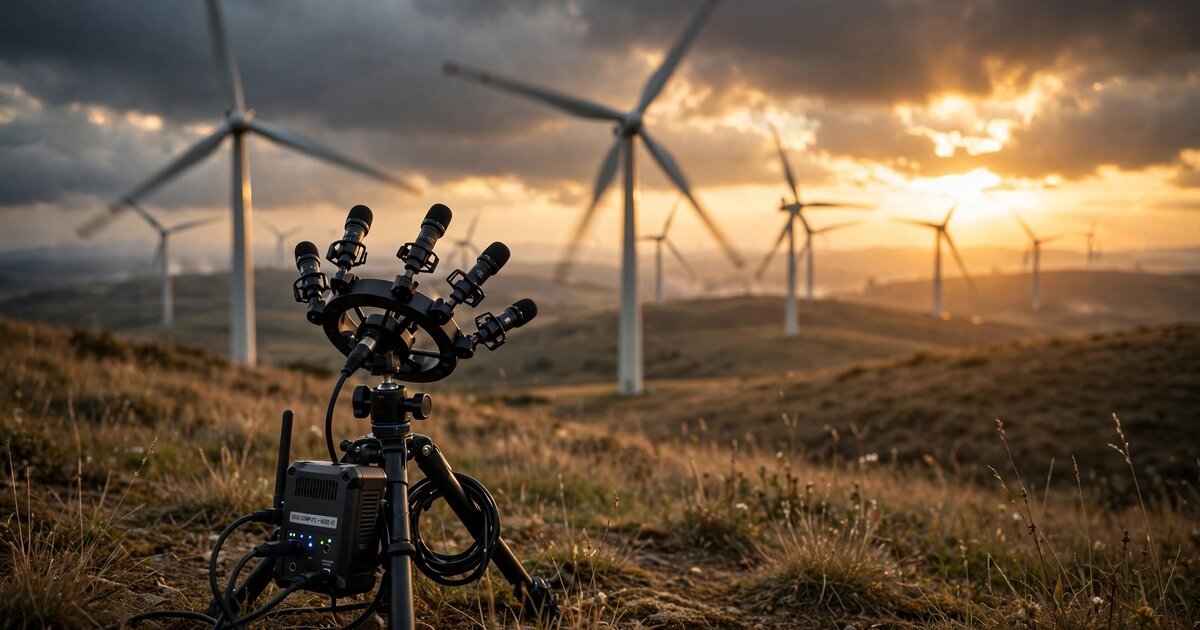
The monitoring station comprises: a circular microphone array of 8 omnidirectional electret condenser microphones (e.g., Earthworks M30, flat response ±1 dB from 30 Hz to 30 kHz, self-noise 22 dBA) arranged on a 1.2-meter diameter ground plate at the tower base; a 24-bit multichannel ADC (e.g., RME OctaMic II or equivalent, simultaneous sampling at 48 kHz per channel); an edge computing unit (e.g., NVIDIA Jetson Orin Nano, 40 TOPS INT8) in a weatherproof NEMA 4X enclosure; a cellular modem (4G/5G) for alert transmission and model updates; and a GPS receiver for precise timing synchronization across multiple turbine monitoring stations.
The circular array geometry enables two critical functions: (1) spatial filtering via delay-and-sum beamforming to enhance the signal-to-noise ratio of blade aeroacoustic emissions relative to wind noise, ambient environmental noise, and generator/gearbox mechanical noise emanating from the nacelle; and (2) direction-of-arrival estimation to track each blade's angular position through the rotation cycle, providing an independent azimuth reference when nacelle encoder data is unavailable.
Array placement at the tower base (rather than at a distance) maximizes the Doppler modulation depth, as the blade velocity vector has its largest component along the observer line-of-sight when the blade passes through the lowest rotor arc. At rated wind speed (12 m/s), ground-level wind noise reaches 60-65 dBA. The combination of array beamforming (10-15 dB spatial selectivity toward the rotor plane) and rotor-phase-locked extraction (rejecting all non-periodic noise components) provides an effective processing gain of 20-25 dB, yielding positive SNR for blade-pass aeroacoustic features above 200 Hz under normal operating conditions.
The total bill-of-materials cost per monitoring station is approximately $2,500-4,000, including microphones, ADC, compute, enclosure, and installation hardware. Amortized over a 5-year hardware life with $100/year cellular data costs, the per-turbine annual monitoring cost is $600-900, compared to $3,000-15,000 for annual conventional inspection.
2. Doppler-Resolved Blade Isolation
The core signal processing innovation is the use of Doppler frequency modulation as a natural multiplexing mechanism that separates each blade's acoustic contribution from the composite rotor signal. The method proceeds as follows:
Rotor phase estimation: The blade pass frequency (BPF) is extracted from the acoustic signal using a comb-filtered autocorrelation applied to the low-frequency (20-200 Hz) amplitude envelope. For a three-blade rotor operating at 6-15 RPM, the BPF is 0.3-0.75 Hz, producing blade pass events every 1.3-3.3 seconds. A phase-locked loop (PLL) tracks the instantaneous rotor phase θ(t) with a precision of ±2° from the acoustic signal alone. When SCADA rotor speed data is available via OPC-UA interface, the PLL is disciplined against the encoder, improving phase accuracy to ±0.5°.
Per-blade time windowing: Using the estimated rotor phase, the continuous acoustic signal is segmented into blade-specific windows. Each blade occupies a 120° arc of the rotation cycle. The system applies a Tukey window (α=0.3) centered on each blade's passage through the lower hemisphere (θ = 150° to 210° for the blade closest to the microphone array), where the Doppler modulation is strongest. This windowing inherently separates the three blades' acoustic contributions with cross-talk suppression exceeding 15 dB.
Doppler demodulation: Within each blade window, the instantaneous Doppler shift Δf(t) = f₀ × v_r(t)/c is computed from the known blade geometry (radius R, hub height H, array position), rotor speed Ω, and the time-varying radial velocity component v_r(t) of each blade element relative to the array center. The recorded acoustic signal is resampled using a variable-rate interpolator that compensates for the Doppler shift, producing a "de-Dopplerized" spectrogram in which each blade's emissions appear at their true emitted frequencies regardless of rotor position. This enables direct spectral comparison between blades and across time.
3. Acoustic Feature Extraction for Damage Classification
The de-Dopplerized spectrogram for each blade pass is processed to extract damage-sensitive features across four spectral bands:
- Low-frequency structural band (20-200 Hz): Captures blade natural frequency modes. A shift in the first flapwise natural frequency (typically 0.7-1.2 Hz for modern 60-80 m blades) indicates stiffness reduction from delamination or root section damage. Detectable as a change in the amplitude modulation envelope of the BPF harmonics.
- Trailing-edge noise band (300-2000 Hz): Broadband noise generated by turbulent boundary layer interaction with the trailing edge. Spectral shape is characterized by the slope of the noise roll-off (dB/octave) and peak frequency. Delamination near the trailing edge causes a spectral notch at frequencies corresponding to the delamination length (λ/2 resonance). A 10 cm delamination produces a notch near 1700 Hz; a 30 cm delamination near 570 Hz.
- Leading-edge roughness band (1-6 kHz): Surface roughness from erosion, pitting, or contamination increases high-frequency broadband noise. Bertagnolio et al., 2017 measured 3-6 dB increases above 1 kHz for eroded blades. The spectral slope change is the primary feature, with intact blades showing steeper high-frequency roll-off than eroded blades.
- Tonal/narrowband anomaly band (full spectrum): Surface cracks, loose bond lines, and ice accretion produce narrowband tonal emissions as airflow excites structural resonances in damaged regions. These appear as spectral peaks 6-15 dB above the broadband floor. Tonal frequency and bandwidth are characteristic of the damage type: cracks produce narrow peaks (Q > 20) that shift with rotor speed, while ice produces broad humps (Q < 5) that shift with temperature.
For each blade pass, the system computes a 256-element feature vector comprising: 64-bin mel-frequency cepstral coefficients (MFCCs) from 100 Hz to 8 kHz, 64 third-octave band power levels (50 Hz to 20 kHz), 64 spectral contrast features (peak-to-valley ratios per band), and 64 temporal modulation features (amplitude envelope statistics within the blade window). Features are normalized against the per-turbine baseline established during a healthy-operation calibration period.
4. Edge-Deployed Classification Model
A lightweight CNN-LSTM hybrid model processes sequences of per-blade feature vectors. The CNN component (4 convolutional layers: 32/64/128/256 filters, 3×3 kernels, batch normalization, ReLU, max-pooling) extracts spatial features from the 2D spectrogram representation. The LSTM component (2 layers, 128 hidden units) captures temporal dependencies across consecutive rotation cycles (typically 50-100 cycles per inference batch, covering 3-8 minutes of operation). The output layer produces:
- Condition class probabilities across six states: healthy, leading-edge erosion (3 severity grades), trailing-edge delamination (3 grades), surface crack, ice accretion, and foreign object damage.
- Per-blade health score (0-100), a weighted composite reflecting the probability-weighted severity across all damage classes.
- Degradation rate estimate (health score change per 1000 operating hours), computed from exponential regression over the trailing 30-day health score history.
The model is quantized to INT8 (model size approximately 4.2 MB) and runs inference on the Jetson Orin Nano in under 200 ms per blade pass. Training data is sourced from: (1) field recordings at turbines with known blade conditions documented by subsequent drone or rope-access inspection; (2) acoustic simulations using computational aeroacoustics (CAA) models with parametric damage injection; and (3) scaled rotor test-bench recordings in anechoic wind tunnel facilities where controlled damage can be introduced to test blades.
5. Multi-Turbine Fleet-Level Analytics
When multiple turbines in a wind farm are equipped with monitoring stations, the system enables fleet-level comparative analytics:
- Cross-turbine normalization: Turbines of the same model and vintage in the same wind regime should exhibit similar acoustic signatures. Blades that deviate from the fleet mean are flagged for priority inspection, even when their absolute health scores remain above the alert threshold.
- Environmental decorrelation: Weather conditions (wind speed, direction, turbulence intensity, temperature, humidity, precipitation) affect the acoustic signature independent of blade condition. By comparing simultaneous recordings across multiple turbines experiencing similar meteorological conditions, weather-induced acoustic variations are identified and subtracted from the damage-sensitive features. Turbines serve as controls for each other.
- Federated model improvement: Per-turbine edge models upload aggregated feature statistics (not raw audio) to a central server. A federated learning pipeline (FedAvg with differential privacy, ε=8) incorporates inspection-confirmed damage labels from any turbine in the fleet to improve classification accuracy across all stations. Model updates are pushed to edge devices quarterly.
- Maintenance scheduling optimization: The degradation rate estimates from all turbines feed a maintenance scheduling optimizer that batches inspections by geographic proximity and predicted time-to-critical-damage, minimizing total fleet downtime and crew mobilization costs.
6. Operational Modes and Alert Framework
The system operates in three modes:
- Continuous monitoring (default): Processes every blade pass during normal operation. Health scores are updated in real-time and logged at 10-minute aggregated intervals. Operates autonomously at the edge with no cloud connectivity required.
- Deep analysis (triggered): When the continuous monitor detects an anomaly (health score drop > 5 points in 24 hours, or new tonal emission detected), the system switches to high-resolution mode: recording full-bandwidth audio at 96 kHz for 30 minutes, performing extended spectral analysis with 4096-point FFTs, and transmitting the analysis results (not raw audio) to the central server for expert review. The high-resolution recording captures damage-specific acoustic features that the standard 48 kHz monitoring may not fully resolve.
- Calibration (periodic): Monthly, the system performs a self-calibration sequence using a calibrated reference tone played from a speaker co-located with the array. This verifies microphone sensitivity drift, ADC gain stability, and array geometry integrity (detecting any microphone displacement from weather, animal activity, or ground settlement).
Alerts are classified into three tiers: Advisory (health score 60-80, inspect within 90 days), Warning (health score 40-60, inspect within 30 days), and Critical (health score below 40 or sudden drop > 15 points, inspect within 72 hours or curtail operation). Critical alerts trigger immediate SCADA integration to optionally derate the turbine to a reduced RPM, limiting blade loading until inspection is completed.
7. Figures Description
- Figure 1: System architecture showing the ground-level microphone array, edge computing unit, and data flow from acoustic acquisition through Doppler demodulation, feature extraction, CNN-LSTM classification, and fleet-level analytics server.
- Figure 2: Doppler modulation pattern for a three-blade rotor at 12 RPM observed from the tower base. Shows the time-frequency representation with blade-specific frequency shifts, per-blade windowing regions, and the demodulated spectrogram after Doppler compensation.
- Figure 3: Spectral comparison of healthy blade versus damaged blade for four damage types: leading-edge erosion (elevated HF broadband), trailing-edge delamination (spectral notch at resonant frequency), surface crack (narrowband tonal peak), and ice accretion (broad spectral hump with temperature dependence).
- Figure 4: Fleet-level health score dashboard showing 30-day degradation trends for a 50-turbine wind farm, with per-blade resolution, weather-decorrelated baselines, and maintenance scheduling recommendations.
Claims
- A system for continuous structural health monitoring of wind turbine blades, comprising: a ground-level microphone array positioned at or near the base of the wind turbine tower; an edge computing unit that processes the acoustic signal from the array; wherein the system exploits the Doppler frequency modulation imposed by blade rotation to isolate per-blade acoustic contributions from the composite rotor signal, and classifies blade condition using a machine learning model applied to the Doppler-demodulated spectral features.
- The system of claim 1, wherein per-blade isolation is achieved by: estimating rotor phase from the blade pass frequency in the acoustic signal using a phase-locked loop; segmenting the continuous signal into blade-specific time windows aligned to each blade's passage through the lower rotor arc; and applying variable-rate resampling to compensate for the instantaneous Doppler shift within each window, producing a de-Dopplerized spectrogram per blade.
- The system of claim 1, wherein the machine learning model classifies blade condition across multiple damage categories including leading-edge erosion, trailing-edge delamination, surface crack propagation, ice accretion, and foreign object damage, based on spectral features extracted from the trailing-edge noise band, leading-edge roughness band, and tonal anomaly detection across the full acoustic spectrum.
- The system of claim 1, wherein the microphone array comprises eight or more omnidirectional microphones arranged in a circular geometry, enabling delay-and-sum beamforming toward the rotor plane and direction-of-arrival estimation for independent blade azimuth tracking.
- The system of claim 1, further comprising a fleet-level analytics module that correlates health scores across multiple co-located turbines, performs environmental decorrelation by using simultaneous cross-turbine recordings to separate weather-induced acoustic variations from damage-sensitive features, and optimizes maintenance scheduling based on per-blade degradation rate estimates.
- A method for detecting wind turbine blade damage comprising: continuously recording the aeroacoustic emissions of a rotating wind turbine from a ground-level microphone array; estimating rotor phase and isolating per-blade acoustic contributions using Doppler frequency modulation analysis; extracting damage-sensitive spectral features from each blade's de-Dopplerized spectrogram; classifying blade condition using an edge-deployed neural network; and tracking per-blade health scores over time to predict maintenance needs before damage reaches critical severity.
- The method of claim 6, wherein trailing-edge delamination is detected by identifying spectral notches in the 300-2000 Hz trailing-edge noise band at frequencies corresponding to the half-wavelength resonance of the delamination length, and the delamination size is estimated from the notch center frequency.
- The method of claim 6, further comprising a federated learning pipeline wherein per-turbine edge models upload aggregated feature statistics to a central server, incorporating inspection-confirmed damage labels from any turbine in the fleet to improve classification accuracy across all monitoring stations without sharing raw acoustic data.
- The system of claim 1, further comprising a calibration module that periodically verifies microphone sensitivity, ADC gain stability, and array geometry using a co-located calibrated reference tone source, and a deep analysis mode that increases recording bandwidth and spectral resolution when anomalous blade condition is detected.
Implementation Notes
- Minimum viable deployment: A single stereo microphone pair at the tower base can perform blade-pass counting and gross anomaly detection (health/unhealthy binary classification). The full 8-channel circular array is required for per-blade isolation, damage-type classification, and beamforming-based noise rejection.
- Wind noise mitigation: Standard 90 mm hemispherical wind screens reduce wind-induced noise by 10-15 dB below 500 Hz. For high-wind sites, a secondary 500 mm diameter foam windscreen or a ground-board flush-mount configuration provides an additional 5-10 dB of wind noise rejection.
- Retrofit installation: The system requires no modifications to the turbine. The array is placed on the ground or on a concrete pad adjacent to the tower foundation. A single Cat6 Ethernet cable or weatherproof fiber link connects to the nacelle for optional SCADA integration (rotor speed, pitch angle, yaw position). Cellular connectivity suffices for standalone operation.
- Acoustic privacy: The system processes only the periodic, blade-pass-synchronized components of the acoustic signal. Continuous background audio (conversations, wildlife, machinery not at BPF harmonics) is rejected by the rotor-phase-locked extraction process. No intelligible audio is recorded, stored, or transmitted.
Prior Art References
- GWEC Global Wind Report 2025 — 1,021 GW installed capacity, ~400,000 utility-scale turbines
- Mishnaevsky et al., Renewable Energy 2021 — Blade damage costs and insurance claim analysis
- Caithness Windfarm Information Forum — Documented blade failure incidents
- Shihavuddin et al., Renewable and Sustainable Energy Reviews 2019 — Inspection method comparison and scaling limitations
- WindDrone Zenith, EU Horizon 2020 — UAV-based blade inspection demonstration
- Wang et al., Scientific Reports 2024 — Acoustic signal based blade damage detection
- Tsangaris et al., Sensors 2020 — Acoustic emission pattern recognition in blade fatigue
- Oerlemans, Applied Acoustics 2019 — Trailing-edge noise dominance in wind turbine aeroacoustics
- Bertagnolio et al., Renewable Energy 2017 — Leading-edge erosion effect on broadband noise (+3-6 dB above 1 kHz)
- Lee et al., Journal of the Acoustical Society of America 2015 — Doppler amplitude modulation from rotating blades
- TensorFlow Lite — Edge-deployed ML runtime for inference on embedded hardware
- NVIDIA Jetson Orin — Edge AI computing platform for real-time inference