System and Method for Predictive Vehicle Occupant Injury Mitigation Using Pre-Crash Wearable Biometric Data Fusion with Vehicle Dynamics for Individualized Adaptive Restraint System Optimization
Abstract
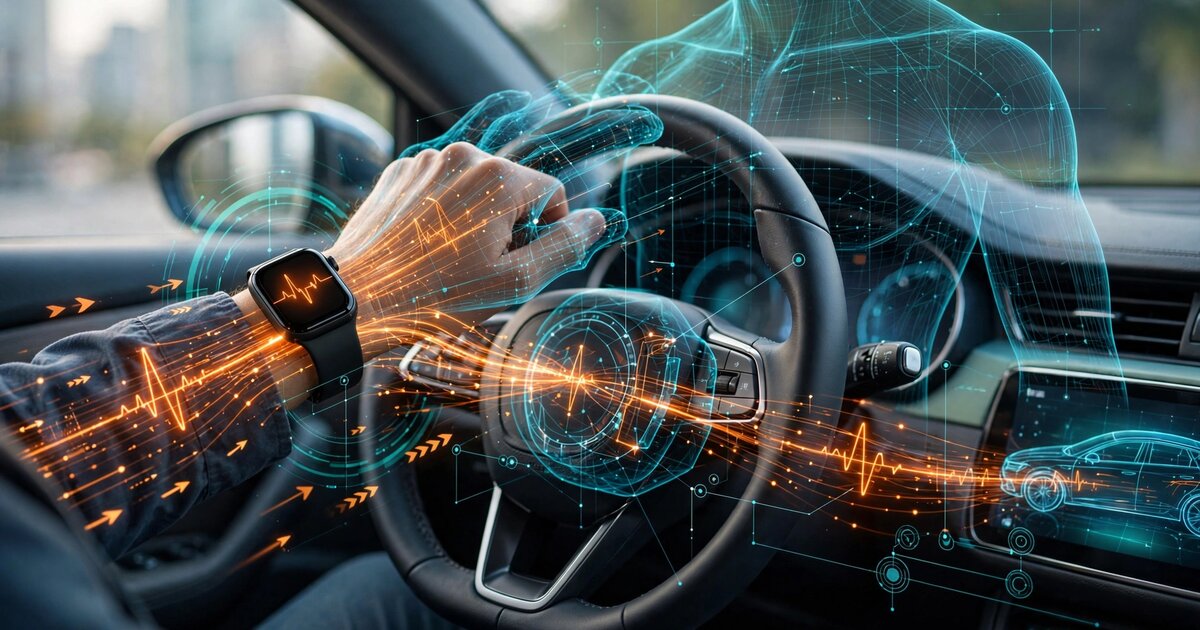
Disclosed is a system and method for reducing vehicle crash injury severity by fusing real-time biometric and biomechanical data from wearable devices worn by vehicle occupants with pre-crash vehicle dynamics data to compute individualized restraint deployment parameters. The system establishes a low-latency wireless data link (Bluetooth Low Energy 5.3 or Ultra-Wideband) between occupant wearable devices (smartwatches, fitness bands, smart rings) and a vehicle-side restraint optimization controller. Wearable sensors continuously stream occupant state vectors comprising: heart rate and heart rate variability from photoplethysmography (PPG), muscle tension proxy from electromyographic (EMG) or impedance-derived signals, body position and posture from inertial measurement unit (IMU) data, estimated body mass index from bioelectrical impedance analysis (BIA), blood oxygen saturation (SpO2), and wrist skin temperature. When the vehicle's advanced driver-assistance system (ADAS) detects an imminent collision (time-to-collision below a configurable threshold, typically 500 ms), the restraint optimization controller executes a pre-trained neural network that maps the occupant state vector, combined with vehicle-side crash severity prediction (impact angle, closing velocity, object classification), to individualized restraint parameters: frontal airbag inflation pressure and vent timing, side curtain deployment sequencing, seatbelt pretensioner force profile, active headrest advance distance, and seat bolster inflation pressure. The system accounts for occupant-specific injury risk factors that current restraint systems cannot detect: elderly occupants with reduced bone density (inferred from age-correlated BIA impedance patterns and low HRV), pregnant occupants (elevated resting heart rate plus characteristic BIA abdominal impedance shift), muscularly braced occupants (high EMG/impedance tension detected in the pre-crash startle response), and occupants in non-standard seating positions (leaning, reclined, turned, detected via wrist IMU orientation relative to the vehicle coordinate frame). A federated model training protocol enables cross-manufacturer restraint optimization improvement using anonymized crash outcome data without sharing proprietary vehicle or occupant biometric records.
Field of the Invention
This invention relates to automotive occupant protection systems, specifically to the integration of wearable biometric sensor data with vehicle pre-crash sensing to enable real-time individualization of restraint system deployment parameters for injury severity reduction.
Background
Vehicle restraint systems (airbags, seatbelts, active headrests) are the single most effective crash injury mitigation technology ever deployed. NHTSA estimates that frontal airbags saved 50,457 lives from 1987 to 2017 in the United States. Yet current restraint systems deploy with fixed or minimally adaptive parameters calibrated to a 50th-percentile male crash test dummy (Hybrid III, 78 kg, 175 cm). This one-size-fits-most approach produces systematic over-protection and under-protection for occupants who deviate from the reference anthropometry.
The consequences of this calibration mismatch are well-documented. A University of Virginia study (Forman et al., Accident Analysis & Prevention, 2019) found that adults over 65 sustain thoracic injuries at 2.5 to 3.4 times the rate of younger adults in equivalent-severity frontal crashes, partly because their more brittle rib cages fracture under airbag loading forces calibrated for younger bone. Bose et al. (Traffic Injury Prevention, 2011) showed that female occupants face 47% higher risk of serious injury in comparable crashes, with body size and composition differences contributing significantly. Pregnant occupants face unique risks from seatbelt-induced placental abruption, which occurs in 2-5% of minor crashes and up to 50% of severe crashes (Pearlman & Viano, American Journal of Obstetrics and Gynecology, 2005).
Existing adaptive restraint systems use limited in-vehicle sensing:
- Weight-sensing seat pads: Classify occupants into 2-4 weight categories (child, small adult, average adult, large adult). Used primarily for airbag suppression for small children, not for continuous parameter optimization. Cannot distinguish a muscular 75 kg 25-year-old from a frail 75 kg 80-year-old.
- Seat position sensors: Detect fore-aft seat track position and seatback recline angle. Provide a rough proxy for occupant size and seating posture. Cannot detect transient out-of-position conditions (leaning to reach the glovebox, turned to address rear passengers).
- Driver monitoring cameras: Euro NCAP mandated driver monitoring systems in 2024. These near-infrared cameras detect drowsiness and distraction but do not measure body composition, muscle tension, or physiological state. They cover the driver only, not other occupants.
- Pre-crash ADAS sensing: Radar, lidar, and camera systems detect imminent collisions and estimate crash severity. US11014523B2 (Ford, 2021) describes pre-crash airbag pressure adjustment based on predicted crash severity, but uses no occupant biometric data. US20200130619A1 (Toyota, 2020) adjusts restraint timing based on predicted impact angle but again relies solely on vehicle-side sensing.
Meanwhile, wearable devices have become ubiquitous biometric platforms. As of 2025, IDC estimates global smartwatch and fitness band shipments exceeded 250 million units annually, with approximately 30% of U.S. adults wearing a wrist-based device daily. Modern smartwatches (Apple Watch Series 10, Samsung Galaxy Watch 7, Google Pixel Watch 3) integrate PPG optical heart rate sensors (green + infrared LEDs), 6-axis IMUs (3-axis accelerometer + 3-axis gyroscope), barometers, skin temperature sensors, SpO2 sensors, and in some models bioelectrical impedance analysis circuits. Smart rings (Oura Ring 4, Samsung Galaxy Ring) carry similar sensor suites in a smaller form factor. These devices continuously sample biometric data at rates from 1 Hz (heart rate) to 100+ Hz (IMU) and maintain active BLE connections to paired devices.
The gap in the art is a system that: (a) establishes a real-time data link between occupant wearable devices and a vehicle restraint controller, (b) extracts an occupant biometric state vector relevant to crash injury risk from wearable sensor streams, (c) fuses this biometric state vector with vehicle-side pre-crash severity prediction in a latency-constrained inference pipeline, (d) computes individualized restraint deployment parameters that account for occupant-specific injury vulnerabilities not detectable by in-vehicle sensors alone, and (e) operates within the sub-200 ms decision window between collision detection and restraint deployment.
Detailed Description
1. Wearable-to-Vehicle Data Link Architecture
The system requires a persistent, low-latency wireless connection between each occupant's wearable device and the vehicle's restraint optimization controller (ROC). Two radio protocols are supported:
Bluetooth Low Energy 5.3 with Connection Subrating: BLE 5.3 introduced connection subrating (CSR), which allows a device to maintain a low-duty-cycle connection for power efficiency while switching to a high-duty-cycle mode when the vehicle's ADAS escalates threat level. In standby mode, the wearable transmits a compressed biometric summary packet (32 bytes) every 2 seconds at a connection interval of 500 ms. When the ROC receives an ADAS pre-alert signal (time-to-collision below 2 seconds), it sends a CSR mode-switch command, and the wearable transitions to burst mode: 128-byte packets at 7.5 ms connection intervals, achieving an effective data rate of approximately 136 kbit/s with a worst-case one-way latency of 7.5 ms. Total protocol overhead for the mode switch is under 15 ms.
Ultra-Wideband (UWB, IEEE 802.15.4z): UWB provides sub-nanosecond time-of-flight ranging and data transfer with inherently low latency (< 1 ms per frame). The Apple U2 chip (iPhone 15+, Apple Watch Ultra 2) and NXP SR150/SR040 modules support UWB data transfer alongside spatial positioning. The system uses UWB for simultaneous occupant localization within the cabin (10 cm accuracy) and biometric data transfer, eliminating the need for separate seat position sensors. UWB anchors are mounted at three or more locations in the vehicle cabin (headliner, B-pillars, dashboard).
Both protocols use AES-128-CCM encryption for biometric data in transit. Pairing is established via a one-time NFC tap between the wearable and a vehicle-side NFC reader embedded in the steering wheel or center console.
2. Occupant Biometric State Vector
The wearable device continuously computes and transmits an occupant biometric state vector (OBSV) comprising the following parameters:
Heart rate and HRV: Instantaneous heart rate from PPG waveform peak detection. Root mean square of successive differences (RMSSD) computed over a 30-second sliding window. Low RMSSD (below 20 ms) correlates with autonomic nervous system depression common in elderly and chronically ill populations, serving as a proxy for cardiovascular fragility.
Muscle tension state: Wearable devices with bioelectrical impedance analysis circuits (e.g., Samsung Galaxy Watch body composition feature) can detect changes in forearm muscle impedance. A 15-20% impedance decrease from the occupant's resting baseline indicates muscular bracing, which is the involuntary startle response that occurs when occupants perceive an imminent collision. Braced occupants experience different injury patterns than relaxed occupants: Ejima et al. (Annals of Biomedical Engineering, 2012) demonstrated that active muscle bracing increases cervical spine stiffness by 60% and shifts chest deflection patterns under frontal loading. The ROC uses this signal to adjust airbag vent timing for braced versus relaxed occupants.
Body composition estimate: BIA-equipped wearables provide segmental impedance measurements that yield estimates of lean mass, fat mass, and skeletal muscle mass. While wrist-based BIA is less accurate than clinical multi-frequency impedance analyzers, it provides a coarse body composition classification (lean/average/high-adiposity) sufficient for restraint parameter bucketing. Combined with estimated body weight from a seat-mounted load cell, the system constructs a 3-class occupant biomechanical model: small-frail, average, and large-robust.
Wrist IMU posture estimation: The 6-axis IMU in the wearable provides real-time wrist position and orientation at 100 Hz. By referencing the wrist vector against the vehicle coordinate frame (established during the UWB pairing phase), the system infers upper-body posture: seated upright (wrist on steering wheel or lap), leaning forward (wrist below dashboard plane), leaning laterally (wrist displaced more than 15 cm from neutral), reclined (wrist elevated relative to torso centerline estimated from UWB position), or turned rearward (gyroscope detects 90°+ yaw rotation sustained for more than 500 ms). Out-of-position detection triggers restraint parameter adjustments: reduced frontal airbag pressure for forward-leaning occupants (to avoid excessive facial loading), delayed side curtain deployment for laterally leaning occupants (to allow the occupant's head to clear the deployment zone), and modified pretensioner profiles for reclined occupants.
SpO2 and skin temperature: Continuously sampled. These parameters contribute to a fragility index: low SpO2 (below 94%) combined with elevated skin temperature may indicate cardiovascular compromise or fever, conditions that reduce the occupant's physiological reserve for absorbing impact forces. The fragility index biases restraint parameters toward lower deployment forces.
3. Vehicle-Side Pre-Crash Severity Prediction
The vehicle's ADAS sensor suite (forward-facing radar, lidar, stereo camera) feeds a pre-crash severity prediction module that estimates, at each time step within the 2-second pre-collision window: time-to-collision (TTC), predicted impact velocity (closing speed minus braking deceleration integrated over remaining TTC), predicted impact angle (frontal, offset frontal, side, oblique, rear), struck-object classification (vehicle, fixed barrier, pedestrian, pole), predicted delta-V (change in velocity experienced by the occupant compartment), and principal direction of force (PDOF) in 15-degree increments.
The severity prediction module outputs a crash severity vector (CSV) that is passed to the restraint optimization neural network alongside the occupant biometric state vector.
4. Restraint Optimization Neural Network
The core of the system is a restraint optimization neural network (RONN) deployed on a dedicated real-time inference accelerator (e.g., NXP S32Z or Infineon AURIX TC4xx with neural network co-processor) integrated into the vehicle's restraint control module. The RONN architecture is a multi-input feed-forward network:
Input layer: Concatenation of the OBSV (12 continuous features), the CSV (8 continuous features), and the occupant classification embedding (3-dimensional, from the BIA-derived body composition class). Total input dimensionality: 23.
Hidden layers: Three fully connected layers with 64, 32, and 16 neurons respectively, using GELU activation functions and batch normalization. Dropout is applied only during training (rate 0.2).
Output layer: 11 continuous outputs representing restraint deployment parameters: frontal airbag inflation pressure (kPa), frontal airbag vent opening delay (ms), frontal airbag vent orifice diameter (mm), side curtain airbag deployment delay from trigger (ms), side curtain inflation pressure (kPa), seatbelt pretensioner stage-1 force (N), seatbelt pretensioner stage-2 force (N), seatbelt pretensioner stage-2 delay (ms), load limiter engagement threshold (kN), active headrest forward displacement (mm), and seat bolster side inflation pressure (kPa).
Training data: The RONN is trained on a combination of: finite element crash simulation data from occupant models spanning the GHBMC (Global Human Body Models Consortium) family (5th-percentile female, 50th-percentile male, 95th-percentile male, elderly male, pregnant female), with each simulation sweeping restraint parameters and recording predicted injury metrics (HIC-15 head injury criterion, chest deflection, femur load, neck extension moment); physical crash test data from regulatory (FMVSS 208, Euro NCAP) and manufacturer test programs; and retrospective analysis of crash investigation data (NASS-CDS, CISS) correlated with occupant demographics and injury outcomes.
Loss function: Multi-objective loss combining predicted injury severity score (AIS scale, weighted by body region) with restraint deployment energy cost (to prevent over-aggressive deployments that themselves cause injury). An asymmetric penalty applies: under-protection errors (predicted AIS exceeding threshold) are penalized 5x more heavily than over-protection errors.
Inference latency: The RONN must execute within 10 ms on the target hardware. At 23 inputs, 3 hidden layers totaling 112 neurons, and 11 outputs, the total parameter count is approximately 4,000 (FP16), requiring under 200,000 multiply-accumulate operations per inference. On an NXP S32Z running at 800 MHz with a neural network accelerator, this completes in under 2 ms.
5. Deployment Sequencing and Fallback
The restraint optimization controller operates in three modes:
Full biometric mode: Wearable data link is active, OBSV is current (updated within the last 2 seconds), and the RONN outputs individualized restraint parameters. This is the preferred mode.
Degraded mode: Wearable data link is active but OBSV is stale (last update more than 2 seconds ago, possibly due to BLE interference). The RONN uses the last known OBSV with an uncertainty inflation factor: output parameters are blended 70/30 with default (non-individualized) parameters to reduce the risk of acting on outdated biometric data.
Fallback mode: No wearable device is paired, or the data link has been lost for more than 30 seconds. The system reverts to conventional restraint deployment using only vehicle-side sensing (seat weight, seat position, ADAS crash severity). This mode is functionally identical to current production restraint systems, ensuring no degradation of baseline safety when wearable data is unavailable.
The deployment sequencing timeline from ADAS collision detection to restraint firing is: T+0 ms, ADAS issues collision alert; T+0 to T+15 ms, BLE CSR mode switch and burst data reception (or UWB instant); T+15 to T+17 ms, RONN inference; T+17 to T+20 ms, restraint actuator command dispatch; T+20 to T+40 ms, pyrotechnic gas generator ignition and airbag inflation begins. Total latency from collision detection to individualized restraint deployment: under 40 ms, well within the 80-150 ms window between initial vehicle deformation contact and occupant contact with restraint surfaces in a typical 56 km/h frontal crash.
6. Pregnancy Detection and Specialized Protection
A specific pregnancy detection module uses longitudinal wearable data (requires at least 4 weeks of baseline data from the same wearable): elevated resting heart rate trending upward by 10-20 bpm over weeks (physiological response to increased blood volume during pregnancy), characteristic BIA impedance shift in the lower abdominal segment (where multi-frequency BIA is available), and user-confirmed pregnancy flag (optional explicit input through a wearable companion app).
When pregnancy is detected or confirmed, the ROC applies a specialized restraint profile: seatbelt pretensioner stage-1 force is reduced by 25% to lower abdominal compression, a 50 ms delay is added to frontal airbag deployment to allow the pretensioner to position the belt before airbag loading, and the load limiter engagement threshold is reduced by 30% to limit peak chest and abdomen forces. These adjustments are based on Moorcroft et al. (SAE Technical Paper 2010-22-0012) findings that restraint force redistribution reduces the probability of fetal injury by up to 45% in moderate-severity frontal crashes.
7. Federated Cross-Manufacturer Model Training
The RONN benefits from training on diverse crash outcome data spanning multiple vehicle types, crash configurations, and occupant populations. A federated learning protocol enables this without sharing proprietary data:
Each participating vehicle manufacturer trains a local RONN on its proprietary crash simulation and test data. Local model weight updates (gradients) are clipped and noise-injected using the Gaussian mechanism of differential privacy (epsilon = 1.0, delta = 10^-5) before transmission to a central aggregation server. The server performs federated averaging (FedAvg) across manufacturer updates and distributes the improved global model. Participating manufacturers receive a model that has learned from the combined crash experience of all participants while provably preventing reconstruction of any individual manufacturer's data or occupant records.
Anonymized real-world crash outcome data is incorporated through a post-crash data collection pipeline: when a vehicle equipped with the system is involved in a crash, the black-box event data recorder (EDR) captures the OBSV, CSV, RONN output parameters, and measured restraint system performance. This data is associated with injury outcomes (from insurance claims or hospital records, via anonymized linkage) and incorporated into the next training cycle. This closed-loop architecture enables the RONN to improve continuously from real-world outcomes rather than relying solely on simulation.
8. Figures Description
- Figure 1: System architecture showing the wearable device, BLE/UWB data link, vehicle ADAS sensors, restraint optimization controller, and restraint actuators with data flow and timing annotations.
- Figure 2: Occupant biometric state vector components with sensor sources, sampling rates, and derived features used as RONN inputs.
- Figure 3: Comparison of restraint deployment force profiles for three occupant archetypes (young athletic male, elderly female, pregnant female) in a 56 km/h frontal impact, showing how individualized parameters reduce predicted injury metrics compared to fixed-parameter deployment.
- Figure 4: Deployment sequencing timeline from ADAS collision detection through individualized restraint firing, with latency budgets for each processing stage.
- Figure 5: Federated learning architecture showing local manufacturer model training, differential privacy gradient clipping, central aggregation, and global model distribution.
Claims
- A vehicle occupant protection system comprising: a wireless data link between a wearable biometric device worn by a vehicle occupant and a vehicle-side restraint optimization controller; wherein the wearable device continuously transmits an occupant biometric state vector comprising heart rate, heart rate variability, body composition estimate, muscle tension proxy, and upper-body posture derived from an inertial measurement unit; and wherein the restraint optimization controller executes a neural network that maps the occupant biometric state vector, combined with a vehicle-side pre-crash severity prediction, to individualized restraint deployment parameters for at least one of: airbag inflation pressure, airbag vent timing, seatbelt pretensioner force profile, active headrest displacement, or seat bolster inflation pressure.
- The system of claim 1, wherein the wireless data link operates in a standby mode with low-duty-cycle biometric summary transmission and transitions to a burst mode with sub-10 ms latency when the vehicle's advanced driver-assistance system detects a time-to-collision below a configurable threshold.
- The system of claim 1, wherein muscle tension state is inferred from bioelectrical impedance changes at the wearable device's skin contact electrodes, and the restraint optimization controller adjusts airbag vent timing based on whether the occupant is in a muscularly braced or relaxed state at the moment of impact.
- The system of claim 1, wherein occupant upper-body posture is determined by comparing the wearable device's IMU orientation vector against the vehicle coordinate frame, and the controller classifies the occupant as in-position or out-of-position and adjusts restraint parameters to account for non-standard seating postures including forward lean, lateral lean, rearward recline, and body rotation.
- The system of claim 1, further comprising a pregnancy detection module that identifies pregnancy indicators from longitudinal wearable biometric data including trending resting heart rate elevation and bioelectrical impedance shifts, and applies a specialized restraint profile with reduced pretensioner force and modified airbag deployment timing.
- The system of claim 1, wherein the restraint optimization neural network is trained on finite element crash simulation data spanning multiple occupant body models of varying age, sex, body composition, and physiological state, with a multi-objective loss function that asymmetrically penalizes under-protection more heavily than over-protection.
- The system of claim 1, further comprising a fragility index computed from the occupant's SpO2, skin temperature, heart rate variability, and body composition estimate, wherein a high fragility index biases restraint deployment parameters toward lower forces and earlier load limiter engagement.
- A method for individualizing vehicle restraint deployment comprising: establishing a wireless connection between an occupant's wearable biometric device and a vehicle restraint controller; continuously receiving an occupant biometric state vector from the wearable device; upon detection of an imminent collision by the vehicle's pre-crash sensing system, executing an on-device neural network inference that combines the occupant biometric state vector with a crash severity prediction to compute individualized restraint deployment parameters; and commanding restraint actuators with the individualized parameters within a total latency budget of 40 ms from collision detection.
- The method of claim 8, further comprising operating in a degraded mode when wearable data is stale, wherein restraint parameters are computed as a weighted blend of the last known individualized parameters and default non-individualized parameters, and a fallback mode when no wearable device is connected, wherein the system reverts to conventional restraint deployment using only vehicle-side sensing.
- The system of claim 1, wherein occupant position within the vehicle cabin is simultaneously determined using ultra-wideband time-of-flight ranging between the wearable device and multiple UWB anchors mounted in the vehicle cabin, providing sub-10 cm occupant localization without reliance on seat-mounted sensors.
- A method for training the restraint optimization neural network of claim 1 across multiple vehicle manufacturers using federated learning with differential privacy, wherein each manufacturer trains on local proprietary crash simulation and test data, transmits noise-injected gradient updates to a central aggregation server, and receives an improved global model, enabling collaborative model improvement without sharing proprietary crash data or occupant biometric records.
- The system of claim 1, further comprising a post-crash data collection pipeline that captures the occupant biometric state vector, crash severity vector, restraint optimization neural network outputs, and measured restraint performance in a crash event data recorder, and incorporates anonymized crash outcome data into subsequent model training cycles for continuous improvement from real-world outcomes.
Implementation Notes
Prototype development can begin with commercial off-the-shelf components. The wearable side requires a BLE 5.3 or UWB-equipped smartwatch or fitness band with an open API for raw sensor data access (Samsung Galaxy Watch via Samsung Health SDK, Google Pixel Watch via Health Services API on Wear OS). The vehicle side requires an ADAS-equipped vehicle with an accessible CAN bus or Ethernet backbone for restraint module communication, plus a real-time inference accelerator. Initial validation can use hardware-in-the-loop simulation with a GHBMC occupant model driven by recorded wearable sensor traces from volunteer subjects wearing devices during controlled braking maneuvers.
Regulatory considerations: FMVSS 208 (occupant crash protection) specifies minimum performance requirements but does not prohibit adaptive systems that exceed those requirements. Euro NCAP has expressed interest in individualized restraint systems in its 2030 roadmap. The system should be designed so that fallback mode (no wearable connected) meets all current regulatory requirements, with individualized mode providing strictly additive benefit.
Prior Art References
- NHTSA Air Bag Safety — 50,457 lives saved by frontal airbags, 1987-2017
- Forman et al., Accident Analysis & Prevention, 2019 — Elderly thoracic injury rates 2.5-3.4x higher in equivalent crashes
- Bose et al., Traffic Injury Prevention, 2011 — Female occupants 47% higher serious injury risk
- Pearlman & Viano, AJOG, 2005 — Fetal injury from seatbelt loading in crashes
- Ejima et al., Annals of Biomedical Engineering, 2012 — Muscle bracing increases cervical stiffness 60%
- Moorcroft et al., SAE Technical Paper 2010-22-0012 — Restraint force redistribution reduces fetal injury probability 45%
- US11014523B2 (Ford, 2021) — Pre-crash airbag pressure adjustment from crash severity
- US20200130619A1 (Toyota, 2020) — Restraint timing from predicted impact angle
- Euro NCAP Driver Monitoring — 2024 mandate for driver monitoring systems
- IDC Wearables Market — 250M+ annual smartwatch/band shipments
- Bluetooth Core Specification 5.3 — Connection Subrating for adaptive latency
- IEEE 802.15.4z UWB — Ultra-Wideband time-of-flight ranging
- GHBMC — Global Human Body Models Consortium finite element occupant models
- NASS-CDS / CISS — National crash investigation databases