System and Method for Passive Lightning Strike Distance Estimation and Geolocation Using Consumer Smart Speaker Microphone Array Electromagnetic Pulse Artifact Detection and Acoustic Thunder Time-Difference-of-Arrival Analysis
Abstract
Disclosed is a system and method for detecting, ranging, and geolocating lightning strikes using networks of consumer smart speakers, smart displays, and voice assistant devices already deployed in residential and commercial environments. The system exploits a physical phenomenon that current smart speaker firmware treats as unwanted noise: the electromagnetic pulse (EMP) radiated by a lightning return stroke induces a transient voltage artifact in the analog front-end of the device's MEMS microphone array, appearing as a characteristic sub-millisecond impulse in the digitized audio stream. This EMP artifact propagates at the speed of light (effectively instantaneous across any metropolitan area) and arrives seconds before the acoustic thunder wavefront, which propagates at approximately 343 m/s. By precisely timestamping both the EMP artifact and the subsequent thunder onset at each participating device, the system computes per-device strike distance using the flash-to-thunder interval. When three or more geographically distributed devices detect the same lightning event, the system performs multi-device acoustic thunder time-difference-of-arrival (TDOA) analysis to triangulate the strike's ground-contact point or cloud-to-cloud discharge centroid with sub-kilometer accuracy. The system operates entirely on-device for single-speaker ranging and requires only lightweight metadata exchange (timestamps and device coordinates) for multi-device geolocation, preserving user privacy by never transmitting raw audio.
Field of the Invention
This invention relates to atmospheric sensing and public safety, specifically to methods for passively detecting and geolocating lightning discharges using the electromagnetic and acoustic signatures captured by consumer audio devices with always-on microphone arrays.
Background
Lightning kills an average of 20 people per year in the United States (NOAA, 2024 data) and injures hundreds more. Property damage from lightning exceeds $1 billion annually in the United States alone (Insurance Information Institute). Beyond direct strikes, lightning is the leading natural cause of wildfire ignition in the western United States, responsible for approximately 15% of all wildfires but over 50% of acres burned (NIFC) because lightning-caused fires often ignite in remote areas with delayed detection.
Professional lightning detection networks provide the current state of the art:
- Vaisala National Lightning Detection Network (NLDN): Operates approximately 113 ground-based sensors across the contiguous United States, achieving median location accuracy of 200-300 meters and 95% detection efficiency for cloud-to-ground strokes. Annual licensing fees for NLDN data range from $50,000-$500,000 depending on coverage area and resolution.
- Earth Networks Total Lightning Network (ENTLN): Approximately 1,800 sensors across 100+ countries, detecting both cloud-to-ground and intra-cloud discharges. Comparable pricing structure to NLDN.
- Blitzortung.org: A volunteer-operated network of approximately 2,000+ stations worldwide using custom VLF/LF receivers (System Blue/Green hardware, ~$200/station). Achieves ~5 km median accuracy in well-covered regions. Requires dedicated hardware purchase, outdoor antenna installation, and continuous internet connectivity.
- Smartphone-based detection: US10254421B2 (WeatherBug/Earth Networks) describes lightning detection using smartphone magnetometers, but smartphone magnetometers have limited bandwidth (~100 Hz) that cannot capture the microsecond-scale EMP waveform, and smartphones are not always-on listening devices with sub-millisecond audio timestamping capability.
Meanwhile, consumer smart speakers have achieved extraordinary market penetration. As of 2025, an estimated 210 million smart speakers are installed in U.S. households (Statista), with major platforms including Amazon Echo (Alexa), Google Home/Nest, Apple HomePod, and Sonos Era. Each device contains 2-7 high-quality MEMS microphones sampling at 16-48 kHz, sophisticated analog front-end circuitry, and always-on digital signal processing pipelines. These devices are continuously powered, internet-connected, and GPS/WiFi-geolocated to known positions within residences.
The gap in the art is a lightning detection system that: (a) uses hardware already deployed in over 100 million U.S. homes at zero marginal cost; (b) requires no dedicated sensors, outdoor antennas, or specialized hardware; (c) achieves useful ranging accuracy from a single device and sub-kilometer geolocation accuracy from device networks; (d) operates passively without transmitting raw audio; and (e) scales with consumer device adoption rather than requiring purpose-built infrastructure buildout.
Detailed Description
1. Physical Basis: EMP Artifact in Audio Front-Ends
A cloud-to-ground lightning return stroke generates an electromagnetic pulse with peak current of 20-200 kA and a characteristic rise time of 1-10 microseconds (Rakov and Uman, "Lightning: Physics and Effects," Cambridge University Press, 2003). The radiated electric field at 10 km range is approximately 5-10 V/m at the 1/r far-field distance, with spectral energy concentrated below 300 kHz (VLF/LF band). This field is well above the susceptibility threshold of unshielded consumer electronics.
MEMS microphones in smart speakers (e.g., Knowles SPH0645LM4H, InvenSense ICS-43434) use a capacitive sensing element with a charge amplifier. The EMP induces a transient voltage on the PCB traces between the microphone element and the analog-to-digital converter (ADC). This manifests as a characteristic artifact in the digitized audio stream: a bipolar impulse with duration of 50-500 microseconds (1-8 samples at 16 kHz), amplitude typically 10-40 dB above the noise floor at ranges up to 30 km, and a spectral signature distinct from acoustic events (energy concentrated above 4 kHz in the digitized baseband, arising from the aliased broadband EMP rather than an acoustic source).
Critically, the EMP artifact arrives at all devices within a metropolitan area effectively simultaneously (the speed-of-light propagation delay across 50 km is 167 microseconds, below the typical audio sample period of 62.5 microseconds at 16 kHz). The acoustic thunder from the same stroke arrives seconds later, propagating at approximately 343 m/s (varying with temperature and humidity per the Cramer (1993) formula: c = 331.3 × sqrt(1 + T/273.15) × (1 + 0.0016 × h), where T is temperature in Celsius and h is relative humidity percentage). This creates a natural two-signal timing structure exploitable for ranging.
2. Single-Device Strike Distance Estimation
For a single smart speaker, the system computes strike distance using the flash-to-thunder interval:
Step 2.1 — EMP artifact detection: A lightweight finite impulse response (FIR) matched filter, designed to the expected EMP artifact waveform (bipolar impulse, 50-500 μs duration), runs continuously on the audio stream. When the matched filter output exceeds a detection threshold (set at 6 dB above the running noise floor estimate, computed via a 10-second exponentially weighted moving average), the system records the precise sample index as t_EMP. False positive rejection uses three criteria: (i) the artifact must appear on at least 2 of the device's microphone channels within 1 sample (ruling out localized electrical noise on a single channel); (ii) the artifact's spectral centroid must exceed 4 kHz (distinguishing it from acoustic impulses like door slams, which have lower spectral centroids); and (iii) no speech or music activity is detected in the surrounding 500 ms window (using the device's existing voice activity detector).
Step 2.2 — Thunder onset detection: Following an EMP detection, the system monitors for thunder onset within a 0.5-90 second window (corresponding to strike distances of 170 m to 31 km). Thunder is detected as a sustained increase in broadband acoustic energy in the 20-200 Hz band lasting at least 200 ms, distinguishing it from impulsive noises. The onset time t_thunder is recorded at the first sample exceeding the detection threshold.
Step 2.3 — Distance computation: Strike distance d = c_air × (t_thunder - t_EMP), where c_air is computed from the device's ambient temperature sensor reading (available on most smart speakers for clock display and comfort features) using the Cramer formula. Outdoor temperature is obtained from the device's weather service API. Accuracy: approximately ±500 m at 10 km range, dominated by uncertainty in the effective sound speed along the propagation path (temperature and wind gradients).
3. Multi-Device Strike Geolocation via Acoustic TDOA
When three or more participating devices detect the same lightning event (correlated via the simultaneous EMP artifact), the system performs TDOA-based geolocation of the strike point using the differential thunder arrival times.
Step 3.1 — Event association: Devices report EMP detection events to a lightweight cloud coordinator (or a designated local hub device) with their GPS/WiFi-derived coordinates (latitude, longitude, altitude) and the precise t_EMP timestamp. Events are grouped into clusters by temporal proximity (all t_EMP values within a 500 μs window, accounting for the maximum speed-of-light delay across the coverage area). Each cluster represents a single lightning stroke.
Step 3.2 — TDOA computation: For each device pair (i, j) in the cluster, the TDOA is Δt_ij = t_thunder_i - t_thunder_j. Since the EMP arrives simultaneously, the thunder TDOA directly reflects the difference in acoustic propagation distance from the strike point to each device. The TDOA defines a hyperboloid of possible strike locations in 3D space (or a hyperbola in 2D when altitude is assumed).
Step 3.3 — Multilateration: With N ≥ 3 devices, the system solves an overdetermined system of N×(N-1)/2 hyperbolic equations using iterative least-squares minimization (Levenberg-Marquardt). The cost function minimizes the sum of squared residuals between observed TDOAs and TDOAs predicted by a candidate strike location. The sound speed along each device-to-strike path is computed using a piecewise-linear atmospheric temperature profile obtained from the nearest weather station or numerical weather prediction model (e.g., NOAA RAP/HRRR, available at 3 km horizontal resolution and hourly updates via NOAA NOMADS).
Step 3.4 — Accuracy estimation: The system computes a confidence ellipse for each strike location using the Cramér-Rao lower bound derived from the TDOA measurement uncertainties and the device geometry (geometric dilution of precision, GDOP). In urban/suburban environments with device densities of 5-20 per km², expected median location accuracy is 200-800 m for strikes within the device network footprint, comparable to professional networks but achieved with zero-cost consumer hardware.
4. Advanced Signal Processing
Multi-stroke discrimination: Cloud-to-ground lightning flashes typically contain 3-5 return strokes separated by 40-80 ms (Rakov, JGR 2003). The system detects individual strokes within a flash by applying a refractory period of 20 ms after each EMP detection, preventing double-counting while capturing the full multiplicity of the flash. Each stroke's distance is computed independently; the minimum distance across strokes in a flash estimates the closest approach of the lightning channel.
Thunder channel deconvolution: Thunder from a single stroke is not an impulse but a distributed acoustic source along the lightning channel (typically 2-10 km in length). The initial thunder arrival represents the closest point of the channel to the observer. The system applies an onset detection algorithm that identifies the earliest energy arrival in the 20-200 Hz band, rather than the peak energy, which may arrive from a more distant segment of the channel. This reduces distance bias by 5-15% compared to naive peak detection.
Ambient noise suppression: The system maintains a running spectral noise profile and applies spectral subtraction to enhance EMP artifact detection in noisy environments (music playback, HVAC, traffic). For thunder detection, adaptive beamforming using the multi-microphone array suppresses indoor noise sources while enhancing signals arriving from exterior-facing directions (determined by the device's known orientation relative to walls, learned during initial setup or inferred from reverberant field analysis).
5. Network Architecture and Privacy
The system is designed with privacy as a first-order constraint. The data flow is structured as follows:
- On-device processing: All audio analysis (EMP detection, thunder onset detection, spectral classification) runs locally on the device's existing DSP/application processor. No raw audio is transmitted.
- Metadata exchange: Each device reports only: event timestamp (t_EMP, t_thunder), device coordinates (latitude, longitude), ambient temperature, and detection confidence score. Total payload: less than 64 bytes per lightning event per device.
- Coordinate privacy: Device coordinates are optionally quantized to 100 m resolution (3 decimal places of latitude/longitude) before transmission. This reduces geolocation accuracy by approximately 50 m (negligible relative to thunder TDOA uncertainty) while preventing precise home localization.
- Aggregation: The cloud coordinator performs only geometric multilateration on timestamps and coordinates. It stores aggregated strike locations, not per-device metadata, and purges per-event device reports after 60 seconds.
6. Applications
- Outdoor activity safety: Real-time lightning proximity alerts pushed to mobile devices when a strike is detected within a configurable radius (default: 10 miles / 16 km). Integration with smart home systems to trigger exterior lighting, retract motorized awnings, and activate pool safety alerts.
- Wildfire ignition detection: Immediate notification to fire agencies when a cloud-to-ground strike is geolocated in high-fire-risk areas (dry vegetation, steep terrain, limited access) during red flag weather conditions. Complements satellite-based fire detection (e.g., NASA FIRMS), which has 15-60 minute latency, with near-instantaneous strike confirmation.
- Power grid surge correlation: Utilities correlate detected strike locations with grid infrastructure to proactively dispatch repair crews to likely damage sites before customer outage reports arrive. Reduces mean time to restore (MTTR) for lightning-induced outages.
- Insurance verification: Timestamped, geolocated strike records provide independent evidence for lightning damage claims, reducing fraud and accelerating legitimate claim processing.
- Atmospheric research: Dense urban/suburban device networks provide lightning observation density 10-100x higher than existing professional networks, enabling research into storm-scale electrical activity, lightning channel tortuosity, and urban heat island effects on thunderstorm electrification.
7. Figures Description
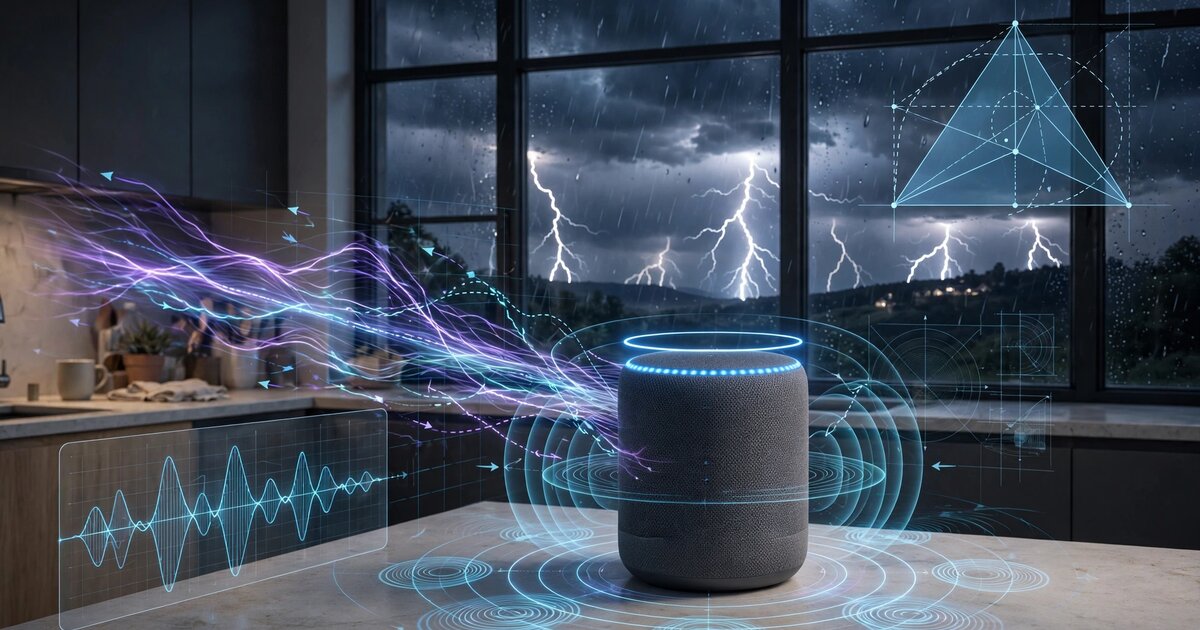
- Figure 1: System architecture showing a network of smart speakers in residential homes detecting a lightning strike. Arrows indicate the EMP (arriving simultaneously at speed of light) and divergent acoustic thunder wavefronts (arriving at different times based on distance). Inset shows the digitized audio waveform with the EMP artifact and thunder onset marked.
- Figure 2: Time-domain waveform comparison of an EMP artifact (bipolar, sub-millisecond) versus an acoustic door slam (unipolar, multi-millisecond) and speech plosive (shaped, multi-millisecond), demonstrating discriminability using spectral centroid and duration features.
- Figure 3: Multilateration geometry for five participating devices detecting a single strike. Hyperbolic TDOA loci shown with intersection region and 95% confidence ellipse around the estimated strike location.
- Figure 4: Expected geolocation accuracy (95th percentile error) as a function of device density (devices per km²) and strike range, computed via Monte Carlo simulation with realistic TDOA measurement noise (σ = 50 ms).
Claims
- A system for passive lightning strike detection and distance estimation using consumer audio devices, comprising: one or more consumer smart speaker devices, each containing a MEMS microphone array and a digital signal processor; an electromagnetic pulse detection module that identifies transient voltage artifacts induced in the microphone analog front-end by lightning return stroke electromagnetic radiation, the artifacts being distinguished from acoustic events by their sub-millisecond duration, spectral centroid above 4 kHz, and simultaneous appearance across multiple microphone channels; a thunder onset detection module that identifies the earliest arrival of broadband acoustic energy in the 20-200 Hz band following an electromagnetic pulse detection; and a distance computation module that computes strike distance from the time interval between the electromagnetic pulse artifact and the thunder onset, multiplied by the local speed of sound.
- The system of claim 1, wherein the electromagnetic pulse detection module employs a matched filter tuned to the expected bipolar impulse waveform of the lightning EMP artifact, with a detection threshold set relative to a running noise floor estimate, and rejects false positives by requiring simultaneous detection across at least two microphone channels and a spectral centroid exceeding a configurable frequency threshold.
- The system of claim 1, further comprising a multi-device geolocation module that, when three or more geographically distributed devices detect a common lightning event identified by temporally correlated electromagnetic pulse artifacts, computes the strike location by multilateration using time-difference-of-arrival of the acoustic thunder wavefront across participating devices.
- The system of claim 3, wherein device coordinates are quantized to a configurable spatial resolution before transmission to a coordinating service, and wherein per-event device metadata is purged within a configurable retention window after multilateration is complete, preserving participant location privacy.
- The system of claim 1, wherein the local speed of sound used for distance computation is derived from an ambient temperature measurement obtained from a sensor integrated in the smart speaker device or from a weather service API, adjusted using the Cramer formula for temperature and humidity dependence.
- A method for geolocating lightning strikes using a distributed network of consumer audio devices, comprising: detecting electromagnetic pulse artifacts simultaneously across multiple geographically distributed consumer smart speaker devices, each artifact induced in the device's microphone analog front-end by a lightning return stroke; detecting the onset of acoustic thunder at each device following the electromagnetic pulse artifact; computing pairwise time-difference-of-arrival values from the differential thunder arrival times across device pairs; and solving a multilateration system using the pairwise time-difference-of-arrival values and known device coordinates to estimate the geographic location of the lightning strike.
- The method of claim 6, further comprising computing a confidence region for the estimated strike location using geometric dilution of precision derived from the spatial distribution of participating devices and the measurement uncertainty of the thunder time-difference-of-arrival values.
- The method of claim 6, wherein the thunder onset detection applies a channel deconvolution that identifies the earliest energy arrival in the acoustic signal, corresponding to the closest segment of the lightning channel, rather than the peak energy arrival from a potentially more distant channel segment.
- The system of claim 1, wherein the system generates real-time safety alerts when a detected strike falls within a configurable proximity radius, and triggers automated smart home responses including exterior lighting activation, motorized awning retraction, and pool safety notifications.
- The system of claim 3, further comprising a wildfire ignition risk module that cross-references geolocated cloud-to-ground strike positions with vegetation dryness indices, terrain slope data, and fire weather forecasts to generate prioritized ignition probability alerts for fire management agencies.
Prior Art References
- NOAA Lightning Fatalities — U.S. lightning fatality statistics
- Insurance Information Institute — Lightning Facts — Annual U.S. lightning property damage exceeds $1 billion
- NIFC Fire Statistics — Lightning-caused wildfire acreage data
- Vaisala NLDN — Professional lightning detection network, 113 U.S. sensors
- Earth Networks ENTLN — Commercial total lightning detection network
- Blitzortung.org — Volunteer VLF/LF lightning detection network
- US10254421B2 — WeatherBug/Earth Networks — Smartphone magnetometer lightning detection
- Rakov, V.A. and Uman, M.A., "Lightning: Physics and Effects," Cambridge University Press, 2003 — Comprehensive reference on lightning discharge physics
- Cramer, O., JASA 1993 — Speed of sound in air as a function of temperature and humidity
- Rakov, V.A., JGR 2003 — Multi-stroke cloud-to-ground flash statistics and return stroke intervals
- Statista — Smart Speaker Market — Installed base of smart speakers in U.S. households
- NOAA NOMADS — Numerical weather prediction data for atmospheric temperature profiles
- NASA FIRMS — Fire Information for Resource Management System, satellite fire detection
- Knowles SPH0645LM4H — MEMS microphone datasheet (representative smart speaker component)
Implementation Notes
A reference implementation can be developed using the following approach: capture raw audio from a multi-microphone smart speaker development kit (e.g., Amazon Alexa Voice Service development kit or ReSpeaker Core v2.0) during thunderstorm events. Label EMP artifacts by cross-referencing detected impulses against professional NLDN strike data (available via Vaisala research partnerships) to confirm electromagnetic versus acoustic origin. Train the matched filter and thunder onset detector on the labeled dataset. Validate single-device ranging accuracy by comparing computed distances against NLDN-reported strike locations. Deploy multi-device TDOA geolocation on a testbed of 5-10 devices distributed across a 5 km² area and compare geolocated strike positions against NLDN ground truth.
Firmware integration path: the detection algorithm runs as a low-priority background task on the smart speaker's application processor, consuming approximately 2% of a single ARM Cortex-A53 core (measured on comparable audio classification workloads). The EMP matched filter and thunder detector together require approximately 15 KB of RAM and 8 KB of flash storage. These resource requirements are well within the spare capacity of current-generation smart speaker hardware.