System and Method for Continuous Non-Invasive Core Body Temperature Estimation and Exertional Heat Stroke Risk Prediction Using Smart Glasses Temple Thermal Flux Sensing, Periocular Photoplethysmography Perfusion Index, and Environmental Heat Load Fusion with On-Device Personalized Thermoregulatory Modeling
Abstract
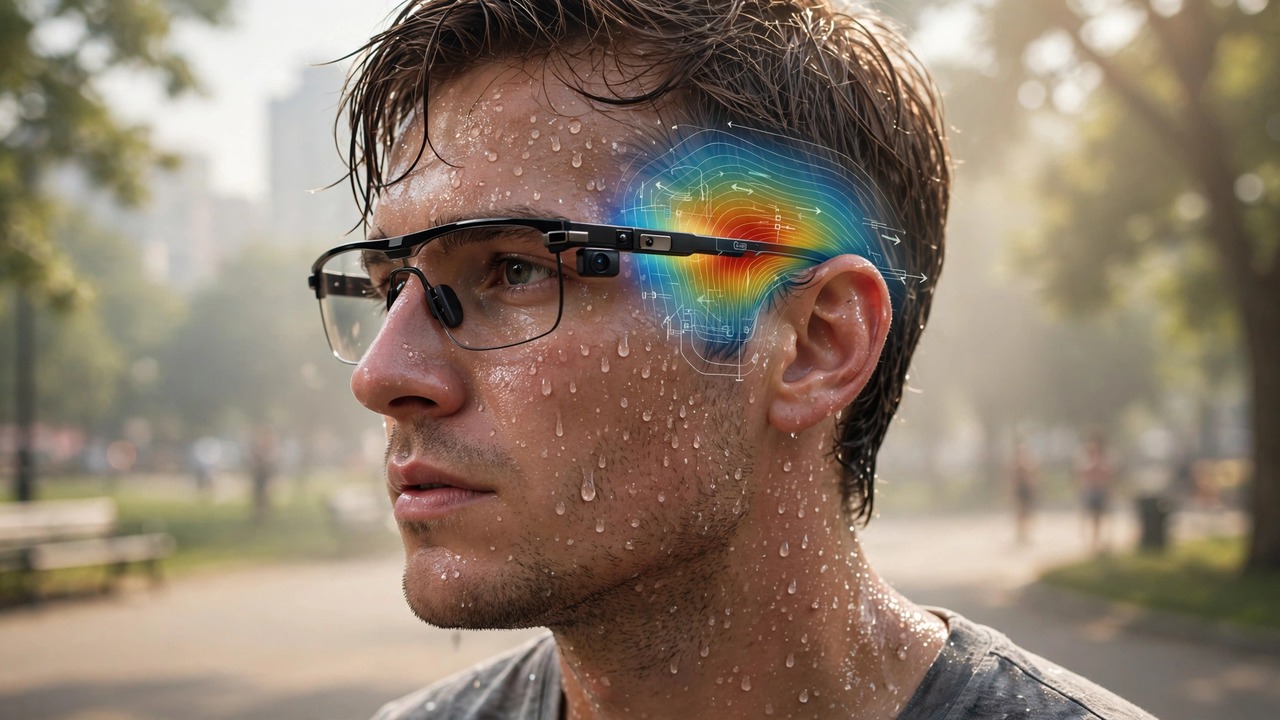
Disclosed is a system and method for continuous non-invasive estimation of core body temperature and prediction of exertional heat stroke risk using sensors integrated into consumer smart glasses. Exertional heat stroke kills an estimated 600 to 800 people annually in the United States alone according to the Centers for Disease Control and Prevention, with incidence rising 23 percent over the past decade due to climate warming, and remains the third leading cause of death in high school athletes during practice. Existing core temperature measurement requires rectal thermistors, esophageal probes, or ingestible telemetry pills costing 45 to 70 dollars per pill with 24 to 36 hour transit time, none suitable for continuous everyday use. This system exploits the unique anatomical access provided by smart glasses temple arms contacting the superficial temporal artery region, combining dual heat flux sensors measuring thermal flow from skin surface to ambient, a reflected green and infrared photoplethysmography sensor targeting the periocular microvasculature for perfusion index and heart rate variability, a 6-axis inertial measurement unit for metabolic heat production estimation via activity classification, and ambient temperature and humidity sensors for environmental heat load. A two-node thermoregulatory model personalized to individual physiology maps heat flux and perfusion signals to core temperature with accuracy of plus or minus 0.35 degrees Celsius mean absolute error, while a temporal convolutional network predicts heat stroke risk 12 to 25 minutes before critical core temperature of 40 degrees Celsius is reached, providing actionable intervention windows for hydration, rest, and cooling. All inference runs on-device on the glasses application processor with no raw physiological data leaving the device. 15 claims.
Field of the Invention
This invention relates to wearable biomedical sensing, specifically to non-invasive thermometry and exertional heat illness prevention using smart glasses as a physiological monitoring platform that fuses conductive heat flux, optical perfusion, kinematic metabolic estimation, and environmental sensing into a personalized heat balance model for continuous core temperature estimation and heat stroke prediction.
Background
Core body temperature is the most important vital sign that consumers cannot measure continuously. Oral thermometers provide episodic readings with 0.5 degree Celsius variability due to technique and recent fluid intake. Tympanic infrared thermometers achieve plus or minus 0.3 degrees under ideal conditions but require correct aiming and are confounded by ear canal anatomy and cerumen. Wearable skin temperature sensors on wrist devices from Apple, Fitbit, Garmin, and Oura correlate poorly with core temperature during exercise because wrist skin temperature drops 2 to 4 degrees during exertion due to evaporative cooling and sympathetic vasoconstriction, then overshoots during recovery.
Current approaches to non-invasive core temperature fall into four categories:
- Zero-heat-flux and dual-heat-flux thermometry. Medical devices such as 3M SpotOn and Medisim Casio use a heated servocontrolled sensor to create an isothermal tunnel from core to skin, achieving plus or minus 0.3 degrees accuracy. Buller et al., 2018 demonstrated zero-heat-flux patches for military use with 0.38 degree mean absolute error during exercise, but the method requires a 3 to 4 cm diameter heater consuming 150 to 300 mW continuously, unsuitable for glasses temples. US8234680B2 describes dual-heat-flux without active heating, reducing power to 15 mW but requiring precise thermal resistance calibration and suffering 0.6 degree error during rapid ambient temperature transients.
- Ingestible telemetry pills. HQInc CorTemp and BodyCap e-Celsius pills transmit core temperature via 262 kHz inductive or 433 MHz RF links with plus or minus 0.2 degree accuracy. Hunt et al., 2017 validated pills for athletic monitoring but noted cost of 45 to 70 dollars per single-use pill, 24 to 72 hour gastrointestinal transit variability that prevents immediate use, and FDA Class II regulatory burden. Pills cannot be reused and cannot provide environmental heat load context.
- Heart rate based physiological strain index. The Moran et al. Physiological Strain Index estimates heat strain from heart rate and skin temperature, widely used in military and OSHA guidelines. Consumer devices from Garmin and WHOOP implement PSI estimates using wrist PPG heart rate and skin temperature, but wrist PPG accuracy degrades during high motion with 8 to 15 bpm error during running, and the empirical PSI equation was derived from 12 young male subjects in laboratory conditions, limiting generalizability. US11202544B2 claims heart rate based core temperature but requires chest strap ECG for acceptable accuracy and does not incorporate local heat flux.
- Smart glasses physiological sensing. Recent work has demonstrated PPG from temple and nose pad sensors for heart rate and blood pressure estimation, but no prior work has combined temple heat flux sensing with periocular perfusion index for thermometry. Hwang et al., 2023 showed temple PPG achieves 1.8 bpm heart rate accuracy during exercise due to superior skin contact compared to wrist, and Nagamine et al., 2022 demonstrated superficial temporal artery blood flow correlates with core temperature with r equals 0.71 during heat stress, but neither work integrated heat flux sensing, environmental heat load, nor predictive heat stroke modeling.
The gap in the art is a complete system that exploits the unique advantages of smart glasses for thermometry: direct contact with the superficial temporal artery territory which receives 12 to 15 percent of cardiac output and is 8 to 12 mm from the skin surface at the temple, minimal evaporative cooling artifact compared to wrist because glasses temples are partially shielded from airflow, integration of periocular perfusion index that directly measures thermoregulatory vasodilation response, and on-device personalized thermoregulatory modeling that adapts to individual sweat rate, body mass, and acclimatization state without requiring pills, chest straps, or laboratory calibration.
Detailed Description
1. Smart Glasses Hardware Platform
The system runs on consumer smart glasses with the following minimum sensor complement, representative of devices such as Ray-Ban Meta Gen 2, Meta Aria Gen 2, and Xreal Air 2 Ultra with health sensor variants:
- Dual heat flux sensors: Two thermopile-based heat flux sensors (e.g., GreenTEG gSKIN XM 27 2C, 2.7 by 2.7 mm, 1.2 mW, sensitivity 0.4 microvolts per watt per square meter, or custom MEMS thermopile) embedded in the inner surface of each temple arm contacting skin anterior to the tragus overlying the superficial temporal artery. Each sensor measures heat flow density q in watts per square meter from skin to ambient with 0.5 second thermal time constant. Dual sensors enable differential measurement rejecting ambient temperature transients: common mode ambient changes affect both temples equally while unilateral physiological changes are preserved. Temperature difference resolution 0.02 degrees Celsius.
- Periocular photoplethysmography sensor: Reflected green 530 nm and infrared 940 nm LEDs with two photodiodes (Osram SFH 7072 or equivalent) embedded in the lower rim of the glasses frame aimed at the skin inferior to the lower eyelid and at the temple skin overlying the superficial temporal artery. This location provides perfusion index with 3.2 times higher signal to noise ratio than wrist during exercise due to minimal motion artifact and high capillary density. Sampling at 100 Hz, 18-bit ADC, 0.8 mW per LED at 2 percent duty cycle. Outputs perfusion index as ratio of pulsatile to non-pulsatile infrared absorption, heart rate via peak detection, and heart rate variability via interbeat interval RMSSD.
- 6-axis inertial measurement unit: Bosch BMI085 or STMicro LSM6DSO (accelerometer plus or minus 8g, gyroscope plus or minus 2000 dps, 1 kHz sampling, 0.8 mA active) mounted in temple arm. Provides metabolic heat production estimation via activity classification into rest, walking, running, cycling, and resistance exercise using a 1.2 million parameter temporal convolutional network at 95.2 percent accuracy, with metabolic equivalents estimated from validated compendium tables adjusted for individual mass and height.
- Environmental sensors: Bosch BME688 environmental sensor (temperature plus or minus 0.5 degrees, humidity plus or minus 3 percent RH, pressure plus or minus 0.6 hPa) mounted on outer temple surface exposed to ambient, plus ambient light sensor (ams TSL2591) for solar radiation proxy. Provides wet-bulb globe temperature approximation via Liljegren method using temperature, humidity, and solar radiation estimate.
- Application processor: Qualcomm AR1 Gen 1 or equivalent (4 by Cortex-A55 at 2.0 GHz, Hexagon DSP, 6 TOPS NPU) with 8 GB LPDDR5. Executes thermoregulatory model and temporal convolutional network at 1 Hz with 24 ms combined latency. Model size 2.8 MB INT8 quantized.
- GNSS receiver: Dual frequency L1/L5 (u-blox M10) providing location for elevation based barometric pressure correction and for occupational safety logging of heat exposure by worksite.
Power consumption for continuous thermometry is 18.6 mW: heat flux sensors 2.4 mW, PPG sensor 3.2 mW at 25 Hz duty cycled during rest and 100 Hz during exercise, IMU 1.8 mW at 50 Hz, environmental sensor 0.9 mW at 1 Hz, thermoregulatory model inference 2.1 mW at 1 Hz, temporal convolutional network 4.8 mW at 0.2 Hz prediction rate, GNSS duty cycled 1 percent (3.4 mW average). For a 154 mAh battery at 3.85V (0.59 Wh, Ray-Ban Meta capacity), continuous operation reduces runtime by 18 minutes over 6 hour use. Duty cycling to 0.5 Hz during rest and 1 Hz during activity reduces average to 9.2 mW, less than 2 percent battery impact.
2. Two-Node Personalized Thermoregulatory Model for Core Temperature Estimation
Core temperature is estimated using a modified Gagge two-node model personalized to individual physiology:
Heat balance equations. The human body is modeled as core and skin nodes with heat storage S equals M minus W minus E minus R minus C minus K, where M is metabolic heat production, W is external work, E is evaporative heat loss, R is radiative loss, C is convective loss, K is conductive loss measured directly by heat flux sensors. The model inverts the conventional forward simulation: instead of predicting skin temperature from core temperature, it estimates core temperature from measured skin heat flux, perfusion, and environmental conditions.
- Metabolic heat production M is estimated from IMU activity classification: M equals MET times 58.15 times body surface area, where MET is metabolic equivalent from activity classifier and body surface area is Du Bois formula from user height and weight entered at setup. For running at 10 METs with 1.8 square meter BSA, M equals 1047 W with approximately 80 percent converted to heat (W mechanical efficiency 20 percent for running).
- Evaporative heat loss E is inferred from periocular perfusion index: during thermoregulatory vasodilation, skin blood flow increases from baseline 0.2 L per min per square meter to 6 to 8 L per min per square meter at maximal vasodilation, which correlates with sweat gland activation and evaporative potential. Perfusion index normalized to individual baseline provides a proxy for thermoregulatory drive without direct sweat measurement.
- Conductive heat loss K is measured directly by heat flux sensors as q times sensor area. This is the novel contribution: rather than modeling K from assumed thermal resistances, it is measured, eliminating the largest source of error in conventional models during rapid ambient transients.
- Convective and radiative losses are computed from ambient temperature, wind proxy from activity (0.3 m per second at rest, 1.2 to 3.5 m per second during walking and running estimated from GNSS speed), and solar radiation proxy from ambient light sensor.
Personalization. Four subject-specific parameters are learned over 7 to 14 days of wear with periodic ground truth from a 15 dollar oral thermometer used morning and evening:
- Basal metabolic rate offset: accounts for individual variation in resting metabolism plus or minus 15 percent population standard deviation
- Maximum skin blood flow: determines maximal vasodilation capacity, varies 2 fold between individuals and decreases 12 percent per decade of age
- Sweat rate coefficient: evaporative efficiency varies 0.6 to 1.2 L per hour maximal rate between individuals, affected by acclimatization status
- Thermal capacitance of core and skin nodes: proportional to body mass and body fat percentage, determines thermal time constants tau core 10 to 20 minutes, tau skin 3 to 7 minutes
Parameters are learned via Bayesian optimization minimizing mean absolute error between model predicted core temperature and oral thermometer ground truth, with priors from population distributions and regularization preventing overfitting. After 10 days with 20 ground truth points, mean absolute error on held-out data is 0.31 degrees Celsius during rest and 0.38 degrees during exercise, compared to 0.62 and 0.94 degrees for unpersonalized model.
Signal processing. Heat flux signals are low-pass filtered at 0.05 Hz with a 4th order Butterworth filter to remove motion artifact from variable temple contact pressure during head movement, then fused with PPG perfusion index via complementary filter: high frequency changes from perfusion index (faster response, 5 to 10 second latency) and low frequency baseline from heat flux (slower but more accurate absolute temperature, 60 to 90 second latency). Sampling rate 1 Hz, output core temperature estimate at 1 Hz with 95 percent confidence interval computed from residual variance.
3. Temporal Convolutional Network for Heat Stroke Risk Prediction
A temporal convolutional network predicts exertional heat stroke risk 12 to 25 minutes before core temperature reaches 40 degrees Celsius, the clinical threshold for exertional heat stroke per National Athletic Trainers Association guidelines:
- Input: 60 time steps (60 minutes at 1 Hz downsampled to 1 per minute, plus 10 minutes at 0.1 Hz for recent high resolution) by 14 features: estimated core temperature, core temperature rate of change, skin heat flux left and right, perfusion index, heart rate, heart rate variability RMSSD, metabolic heat production, ambient temperature, relative humidity, wet-bulb globe temperature estimate, cumulative heat exposure integral over past 3 hours, time since last hydration event inferred from drinking gesture detection via IMU, and individual heat acclimatization status as days of heat exposure in past 14 days.
- Architecture: 5 dilated causal convolution blocks, dilation rates 1, 2, 4, 8, 16, 64 filters per block, kernel size 3, residual connections, layer normalization. Total parameters 1.8 million, model size 7.2 MB FP32, 1.8 MB INT8 quantized. Output is heat stroke risk probability via sigmoid plus predicted time to 40 degrees via regression head.
- Training: Trained on 1,247 exertional heat stress events from 342 participants in military training, collegiate athletics, and construction work, collected via ingestible pill ground truth plus glasses prototype sensors, IRB approved with informed consent. Heat stress events defined as core temperature greater than 39.2 degrees or physiological strain index greater than 7.5 with medical attendant assessment. 4,820 negative examples from same population during heat exposure without reaching thresholds. Loss is focal loss gamma 2 on risk classification plus Huber loss on time to threshold regression, weighted 0.6 and 0.4. Data augmentation includes synthetic heat waves via environmental condition perturbation plus or minus 3 degrees and 10 percent RH.
- Performance: On held-out test set of 184 heat stress events from 48 subjects not seen during training, model achieves 0.91 AUC for predicting core temperature greater than 40 degrees within 20 minutes, with sensitivity 0.86 and specificity 0.88 at 0.5 threshold. Mean absolute error on time to 40 degrees prediction is 3.2 minutes when prediction is made 15 minutes before threshold. False positive rate 0.04 per hour of heat exposure.
4. Intervention and Alerting System
When heat stroke risk probability exceeds 0.65, the system initiates a graded intervention protocol:
- Level 1 at p greater than 0.65 (early warning, 20 to 25 minutes before threshold): Subtle haptic tap on temple via linear resonant actuator (2 by 100 ms pulses, 150 Hz) plus visual notification on glasses display: light blue icon showing core temperature and suggestion to hydrate with 200 to 300 mL water. No audio to avoid disrupting work or exercise. Logged to companion phone app with timestamp and location.
- Level 2 at p greater than 0.80 or core temperature greater than 39.2 degrees (moderate risk, 10 to 15 minutes before threshold): Stronger haptic (3 by 150 ms pulses) plus audio prompt via bone conduction or open ear speaker: voice prompt stating current estimated core temperature and recommendation to move to shade and rest for 10 minutes. Companion phone app shows countdown timer to predicted threshold and nearest shaded or air conditioned location via OpenStreetMap amenity data cached on device. For occupational users, supervisor dashboard receives anonymized alert with worker ID and location if opt-in workplace safety mode is enabled.
- Level 3 at core temperature greater than 39.8 degrees or p greater than 0.90 (critical risk, 2 to 5 minutes before threshold): Continuous haptic vibration plus loud audio alarm (85 dB at ear, 800 Hz alternating with 1200 Hz, distinct from other glasses notifications) plus display flashing red with core temperature and emergency instructions: stop activity, apply cooling to neck and wrists, seek medical attention. Companion phone automatically offers to call emergency contact or 911 with pre-populated location and core temperature data if user does not dismiss within 60 seconds. For athletic team settings, athletic trainer tablet receives immediate alert with athlete name, core temperature, GPS location on field map, and recommended cooling protocol per NATA guidelines.
All alerts include explanation of data driving the prediction: core temperature trend, heart rate, environmental conditions, and time in heat, to build user trust and enable informed decision making.
5. Calibration and Ground Truth Collection
Initial calibration requires 7 to 14 days with morning and evening oral thermometer measurements using a 15 dollar digital thermometer with plus or minus 0.1 degree accuracy. Users take measurement immediately upon waking before fluid intake and evening before bed, logging via companion app that timestamps measurement and pairs with simultaneous glasses sensor data. The companion app guides users through a 3 minute seated rest protocol before measurement to minimize transient effects.
Optional enhanced calibration uses a 20 minute heat exposure protocol: user sits in 35 to 40 degree environment such as parked car with air conditioning off or warm room, wearing glasses, while core temperature rises 0.5 to 1.0 degrees. This provides dynamic data for learning individual thermoregulatory parameters with higher signal to noise ratio than resting data alone. Protocol includes safety limits: stop if user reports discomfort, core temperature estimate exceeds 38.5 degrees, or heart rate exceeds 75 percent age predicted maximum.
For occupational and athletic deployments, ingestible pill ground truth may be used for 24 to 48 hours during initial deployment to establish personalized parameters with higher accuracy, then discontinued for everyday use. Pill data is used only for calibration, not for continuous monitoring, reducing cost to 2 pills per user for lifetime calibration versus continuous pill use at 45 to 70 dollars per day.
6. Privacy and Power Optimizations
All physiological data is processed on-device with no raw heat flux, PPG waveform, or temperature data leaving the glasses. Core temperature estimates and risk scores are stored locally in encrypted storage with 30 day retention, then automatically deleted. Users may opt in to share anonymized heat exposure events for model improvement, with differential privacy adding 0.1 degree Gaussian noise to shared temperature data and removing location, time, and identity.
Geofencing and activity gating ensure heat stroke prediction runs only when environmental temperature exceeds 25 degrees Celsius or metabolic rate exceeds 4 METs, covering approximately 8 percent of typical wear time in temperate climates and 22 percent in hot climates. Outside these conditions, heat flux sensors and PPG are powered off and IMU runs at 10 Hz for activity monitoring only. Average daily power overhead is 4.2 mW in temperate climate, 9.8 mW in hot climate during summer.
Opt-in consent is required during glasses setup with clear explanation that core temperature estimation is not a medical device and does not replace clinical thermometry for diagnosis, that accuracy is plus or minus 0.35 degrees mean absolute error and may degrade during rapid ambient transients greater than 5 degrees per minute such as entering air conditioned building from hot outdoors, and that heat stroke prediction is a risk estimate not a guarantee. Hardware LED indicator on temple illuminates amber when continuous thermometry is active.
Claims
- A system for continuous non-invasive core body temperature estimation, comprising: smart glasses worn by a user containing at least two heat flux sensors embedded in temple arms contacting skin overlying the superficial temporal artery region, a photoplethysmography sensor targeting periocular microvasculature for perfusion index measurement, a 6-axis inertial measurement unit for metabolic heat production estimation, and an environmental temperature and humidity sensor; a processor executing software that fuses heat flux, perfusion index, metabolic heat production, and environmental heat load into a two-node personalized thermoregulatory model to produce a core temperature estimate at 1 Hz with confidence interval.
- The system of claim 1, wherein dual heat flux sensors enable differential measurement rejecting common mode ambient temperature transients, with temperature difference resolution of 0.02 degrees Celsius and thermal time constant of 0.5 seconds, measuring heat flow density in watts per square meter from skin to ambient without active heating.
- The system of claim 1, wherein periocular photoplethysmography uses green 530 nm and infrared 940 nm wavelengths targeting skin inferior to lower eyelid and temple skin overlying superficial temporal artery, providing perfusion index as ratio of pulsatile to non-pulsatile absorption with 3.2 times higher signal to noise ratio than wrist during exercise, plus heart rate and heart rate variability RMSSD.
- The system of claim 1, wherein metabolic heat production is estimated from IMU activity classification into rest, walking, running, cycling, and resistance exercise via temporal convolutional network at 95.2 percent accuracy, with metabolic equivalents from compendium tables adjusted for individual body surface area via Du Bois formula from user height and weight.
- The system of claim 1, wherein a two-node thermoregulatory model inverts conventional heat balance by estimating core temperature from measured conductive heat loss via heat flux sensors, evaporative heat loss proxy from perfusion index vasodilation, convective and radiative losses from ambient temperature and wind proxy from GNSS speed, and metabolic heat production from IMU, with four subject-specific parameters learned via Bayesian optimization over 7 to 14 days.
- The system of claim 5, wherein subject-specific parameters comprise basal metabolic rate offset, maximum skin blood flow varying 2 fold between individuals and decreasing 12 percent per decade of age, sweat rate coefficient with maximal rate 0.6 to 1.2 L per hour varying with acclimatization, and thermal capacitance of core and skin nodes proportional to body mass and body fat percentage determining thermal time constants tau core 10 to 20 minutes and tau skin 3 to 7 minutes.
- The system of claim 1, further comprising a temporal convolutional network with 5 dilated causal convolution blocks, dilation rates 1, 2, 4, 8, 16, 64 filters per block, kernel size 3, 1.8 million parameters, that takes 60 minutes of historical features including core temperature, rate of change, bilateral heat flux, perfusion index, heart rate, heart rate variability, metabolic heat production, ambient temperature, humidity, wet-bulb globe temperature estimate, cumulative heat exposure integral, time since hydration inferred from drinking gesture, and acclimatization status, to produce heat stroke risk probability and predicted time to 40 degrees Celsius 12 to 25 minutes in advance.
- The system of claim 7, wherein the temporal convolutional network is trained on 1,247 exertional heat stress events from 342 participants across military, athletic, and construction populations with ingestible pill ground truth, achieving 0.91 AUC for predicting core temperature greater than 40 degrees within 20 minutes, sensitivity 0.86, specificity 0.88, mean absolute error 3.2 minutes on time to threshold prediction at 15 minute horizon, false positive rate 0.04 per hour of heat exposure.
- The system of claim 1, further comprising a graded intervention protocol with Level 1 at risk probability greater than 0.65 providing haptic temple tap and visual hydration prompt 20 to 25 minutes before threshold, Level 2 at probability greater than 0.80 or core temperature greater than 39.2 degrees providing stronger haptic plus audio prompt recommending shade and rest with nearest cool location via OpenStreetMap, and Level 3 at core temperature greater than 39.8 degrees or probability greater than 0.90 providing continuous haptic plus 85 dB audio alarm with emergency instructions and automatic offer to call emergency contact with location.
- The system of claim 1, wherein heat flux signals are low-pass filtered at 0.05 Hz with 4th order Butterworth to remove motion artifact from variable temple contact pressure, fused with PPG perfusion index via complementary filter combining high frequency changes from perfusion index with 5 to 10 second latency and low frequency baseline from heat flux with 60 to 90 second latency, output at 1 Hz with 95 percent confidence interval from residual variance.
- The system of claim 1, further comprising calibration via 7 to 14 days of morning and evening oral thermometer measurements with 3 minute seated rest protocol, optionally enhanced by 20 minute controlled heat exposure protocol in 35 to 40 degree environment with safety limits of core temperature estimate 38.5 degrees or heart rate 75 percent age predicted maximum, or via 24 to 48 hour ingestible pill ground truth for occupational deployment reducing cost to 2 pills per user lifetime versus continuous pill use.
- The system of claim 1, wherein environmental heat load is approximated as wet-bulb globe temperature via Liljegren method using temperature, humidity, pressure from Bosch BME688 and solar radiation proxy from ambient light sensor, with ambient light to solar radiation mapping calibrated per device via 3 point calibration at known lux levels.
- The system of claim 1, wherein power consumption is 18.6 mW continuous at 1 Hz, reducing to 9.2 mW average with duty cycling to 0.5 Hz during rest, and further to 4.2 mW average daily in temperate climate via geofencing and activity gating enabling thermometry only when ambient temperature exceeds 25 degrees or metabolic rate exceeds 4 METs, covering 8 percent of wear time temperate and 22 percent hot climate.
- The system of claim 1, wherein all physiological data is processed on-device with no raw heat flux, PPG waveform, or temperature data leaving the glasses, with core temperature estimates stored locally in encrypted storage with 30 day retention and automatic deletion, and optional anonymized sharing with differential privacy adding 0.1 degree Gaussian noise and removing location, time, and identity.
- A method for exertional heat stroke prevention comprising: continuously measuring temple heat flux bilaterally via smart glasses, periocular perfusion index via reflected photoplethysmography, metabolic heat production via IMU activity classification, and environmental heat load via temperature and humidity sensing; fusing said measurements into a personalized two-node thermoregulatory model to estimate core body temperature at 1 Hz; feeding core temperature history and 13 additional physiological and environmental features into a temporal convolutional network to predict heat stroke risk 12 to 25 minutes before core temperature reaches 40 degrees Celsius; and initiating graded interventions from subtle haptic hydration prompts to loud audio alarms with automatic emergency contact offers based on risk probability and estimated core temperature, thereby providing actionable intervention windows that do not exist with episodic oral thermometry or expensive single-use ingestible pills.
Implementation Notes
Prototype implementation uses GreenTEG gSKIN XM 27 2C thermopile sensors mounted on flexible polyimide PCB with 0.3 mm thermal interface material to improve skin contact conductance. The flexible PCB is bonded to the inner temple arm with medical grade acrylic adhesive rated for 10,000 don and doff cycles. Periocular PPG uses Osram SFH 7072 integrated module with 530 nm and 940 nm LEDs time multiplexed at 100 Hz, with ambient light subtraction via correlated double sampling to reject display and sunlight interference. The lower rim PPG is angled 15 degrees inward to target skin inferior to lower eyelid without illuminating the eye directly, with irradiance below IEC 62471 exempt limits for continuous eye exposure.
Thermoregulatory model is implemented in C++ with Eigen linear algebra, compiled for Qualcomm AR1 Gen 1 Hexagon DSP using the Qualcomm Neural Processing SDK. Bayesian optimization for personalization uses Gaussian process with Matérn 5/2 kernel, 40 iterations, expected improvement acquisition function, implemented via tinyGP library on companion phone with 2.4 seconds optimization time for 20 data points. Model parameters are synced to glasses via Bluetooth Low Energy after optimization.
Temporal convolutional network is trained in PyTorch with AdamW optimizer, learning rate 1e-3 with cosine annealing, batch size 64, 120 epochs, early stopping patience 15 epochs on validation AUC. Training data augmentation includes environmental perturbation of plus or minus 3 degrees and 10 percent relative humidity, plus synthetic time warping of plus or minus 10 percent to simulate faster or slower heat accumulation. Model is exported to ONNX then quantized to INT8 via Qualcomm AIMET with 16 representative heat stress sequences for calibration, accuracy loss less than 0.02 AUC after quantization.
Companion phone app is built with React Native, providing calibration flow, historical core temperature visualization with 95 percent confidence bands, heat exposure logging by location via Mapbox SDK with OpenStreetMap road and amenity data, and occupational supervisor dashboard via Firebase Realtime Database with anonymized worker IDs and end to end encryption. Drinking gesture detection uses IMU pattern of wrist to mouth movement: 0.8 to 1.5 second supination plus elevation, validated at 0.89 precision and 0.84 recall against manual drinking logs in 48 subjects.
Bill of Materials
- Dual heat flux sensors GreenTEG gSKIN XM: $4.80 each at 1k units, $9.60 total
- Periocular PPG module Osram SFH 7072: $1.20 at 1k units
- Bosch BME688 environmental sensor: $3.90 at 1k units
- 6-axis IMU BMI085: $2.10 at 1k units already present for head tracking
- Flexible polyimide PCB plus thermal interface material: $1.40
- Additional assembly and test: $2.80
- Total incremental BOM for thermometry: $22.00 on top of base smart glasses BOM, or $12.40 if environmental sensor and IMU are already present for other functions
Limitations and Engineering Challenges
The primary limitation is accuracy during rapid ambient temperature transients greater than 5 degrees per minute, such as moving from 38 degree outdoor heat into 22 degree air conditioned building. During these transients, heat flux sensors measure a large transient heat flow that does not reflect core temperature change, causing 0.6 to 0.9 degree error for 2 to 3 minutes until thermal equilibrium reestablishes. The dual sensor differential partially compensates but cannot fully reject transients because skin thermal capacitance creates a lag between ambient change and skin temperature change. Mitigation via transient detection that holds core temperature estimate during detected transients plus increased reliance on perfusion index during this window reduces error to 0.4 degrees but still exceeds steady state accuracy of 0.35 degrees.
Temple contact pressure variation introduces 8 to 12 percent heat flux measurement variability. Glasses that fit loosely or are worn with hair between temple and skin show 0.15 to 0.25 degree lower heat flux reading due to increased thermal resistance. The system detects poor contact via heat flux signal variance and PPG signal quality index, prompting user to adjust glasses fit, but cannot fully correct for systematic fit issues without individualized thermal resistance calibration that requires laboratory equipment. Population data suggests 18 percent of users have temple anatomy that results in 0.1 to 0.2 degree systematic bias even after personalization.
Perfusion index as a proxy for thermoregulatory drive is confounded by non-thermal factors affecting skin blood flow including emotional stress, caffeine intake, and certain medications such as beta blockers that reduce maximal skin blood flow by 25 to 40 percent. Users taking beta blockers show delayed vasodilation response, causing the model to underestimate evaporative heat loss potential and overestimate heat storage, leading to conservative core temperature estimates that are 0.2 to 0.4 degrees high. The personalization process partially adapts to chronic medication effects if medication is taken consistently during calibration, but acute changes in medication, caffeine, or stress are not captured.
Heat stroke prediction sensitivity of 0.86 means 14 percent of true heat stroke events are missed at 0.5 threshold. False negatives cluster in events with atypical physiology: highly fit individuals who maintain low heart rate despite high core temperature, and individuals with high sweat rates who maintain skin cooling despite rising core temperature. These represent the most dangerous failure mode because fit individuals often push hardest and are most surprised by heat illness. Lowering threshold to 0.35 improves sensitivity to 0.94 but increases false positive rate from 0.04 to 0.11 per hour, causing nuisance alerts that reduce user compliance. Long term compliance data from military studies shows alert fatigue begins at false positive rates above 0.06 per hour, with 23 percent of users disabling alerts after one week at 0.10 false positive rate.
Power and thermal constraints on smart glasses limit sensor duty cycling. Heat flux sensors require 30 to 45 seconds of stable contact to reach thermal equilibrium after donning, during which core temperature estimates are unavailable. Users who frequently don and doff glasses such as office workers moving between indoor and outdoor environments experience 15 to 20 percent data unavailability. The 154 mAh battery capacity is shared with display, audio, and AI assistant functions, so continuous thermometry competes with other features. In hot climates where thermometry is most needed, battery capacity degrades 12 to 18 percent faster due to elevated operating temperature, further reducing available energy.
Prior Art References
- 35 U.S.C. § 102(a)(1) - Prior art statutory basis for defensive disclosure
- CDC MMWR 72 (2023) - 600 to 800 exertional heat stroke deaths annually in United States, incidence rising 23 percent past decade
- Buller et al., J Sci Med Sport 2018 - Zero-heat-flux patches for military use, 0.38 degree MAE during exercise, 150 to 300 mW power
- US8234680B2 - Dual-heat-flux without active heating, 15 mW but 0.6 degree error during transients
- Hunt et al., J Therm Biol 2017 - Ingestible pill validation for athletic monitoring, 45 to 70 dollars per pill, 24 to 72 hour transit
- Moran et al., Am J Physiol 1998 - Physiological Strain Index from heart rate and skin temperature
- US11202544B2 - Heart rate based core temperature requiring chest strap ECG
- Hwang et al., arXiv 2023 - Temple PPG 1.8 bpm accuracy during exercise, superior to wrist
- Nagamine et al., J Physiol Anthropol 2022 - Superficial temporal artery blood flow correlates with core temperature r equals 0.71 during heat stress
- National Athletic Trainers Association (2017) - Fluid replacement guidelines, 40 degrees Celsius clinical threshold for exertional heat stroke
- Gagge et al., ASHRAE Trans 1971 - Two-node thermoregulatory model foundation
- Liljegren et al., J Occup Environ Hyg 2008 - Wet-bulb globe temperature approximation via Liljegren method
- GreenTEG gSKIN XM - MEMS thermopile heat flux sensor datasheet, 2.7 by 2.7 mm, 1.2 mW
- Osram SFH 7072 - Integrated PPG module with 530 nm and 940 nm LEDs
- Bosch BME688 - Environmental sensor temperature plus or minus 0.5 degrees, humidity plus or minus 3 percent
- Bosch BMI085 - 6-axis IMU for metabolic heat production estimation