System and Method for Diagnosing Residential Swimming Pool Equipment Failure and Water Chemistry Drift Using Filter Pressure, Flow Rate, ORP, pH, and Pump-Current Fusion
A pool fails in eleven ways that all look the same: green water, a pump that hums, a bill that climbs. Six channels, read per run and across the season, would name the part that failed.
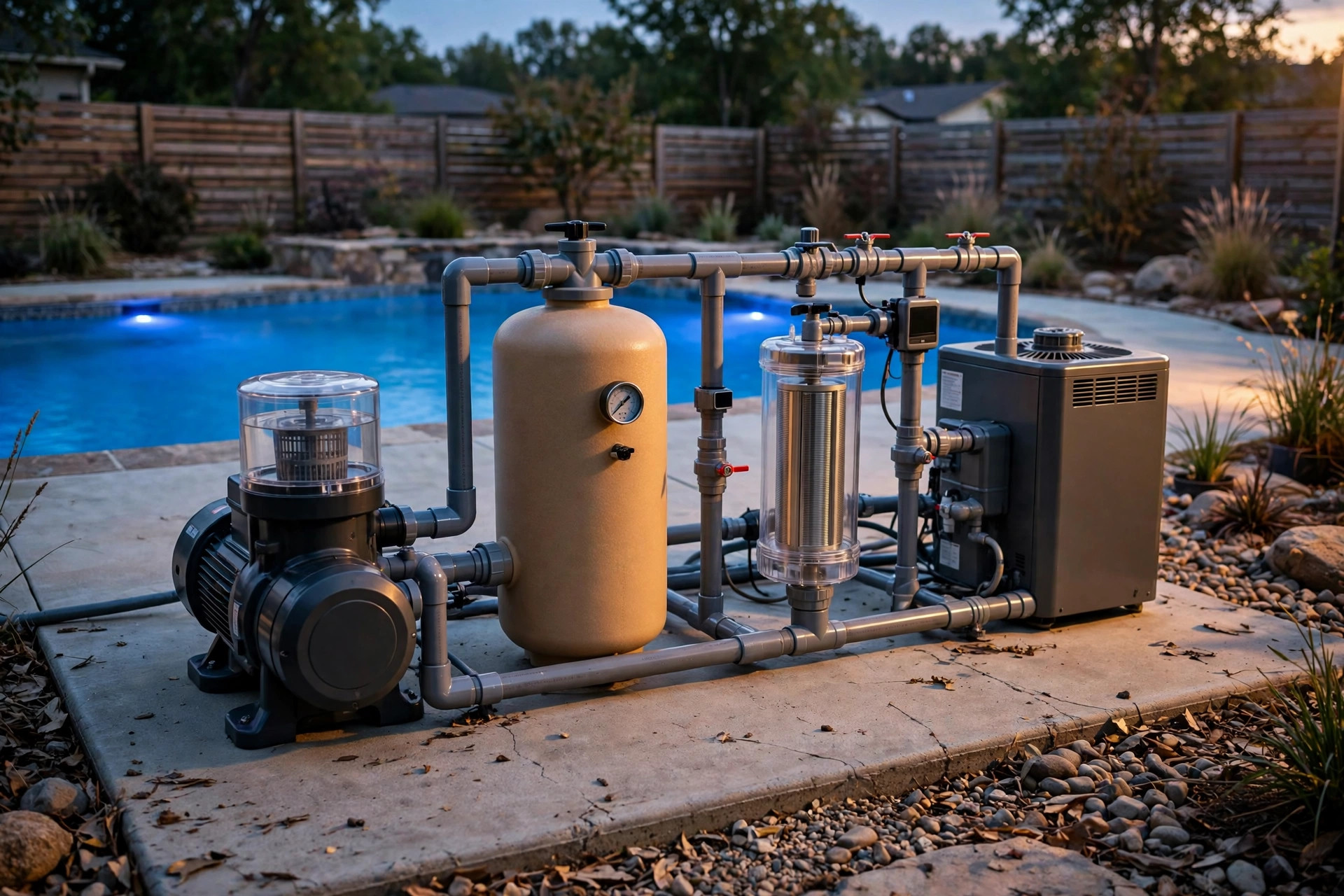
A residential pool can run all summer, sound fine, and sanitize nothing. The filter is loaded, the salt cell is scaled, or the chlorine is bound up by stabilizer, and the water turns green either way. This disclosure would give the pool a voice. Swapping to a variable-speed pump saves most owners about $340 a year in electricity, and the six sensors that would name a failing part cost about $200 in parts. November is the month to winterize it, while the equipment pad is dry and the pump basket is in your hand.
Abstract
Disclosed is a system and method for diagnosing failure modes in residential swimming pool circulation, filtration, heating, and sanitation equipment, and for detecting water chemistry drift before it becomes visible. Six sensor channels fuse on an edge processor: filter pressure, flow rate, oxidation-reduction potential (ORP), pH, water level with makeup flow, and pump motor current. Each channel is read per pump run and trended across the season against a per-pool learned baseline. A signature table maps combinations of channel deviations to eleven specific failure modes, distinguishing faults that present identically to a homeowner, such as a loaded filter versus a clogged skimmer basket, and a failed salt cell versus stabilizer-bound chlorine. The system computes a composite Pool Health Index, issues part-level diagnoses with confidence scores, and shares anonymized failure signatures across a fleet to detect bad production batches and regional water-chemistry patterns. The system is a retrofit: sensors clamp or tee into existing plumbing and wire into existing automation, with no change to the pool shell or the circulation loop.
Field of the Invention
This invention relates to residential swimming pool equipment diagnostics, specifically to multi-sensor fusion and edge inference for distinguishing mechanical, hydraulic, and water-chemistry failure modes in pool circulation and sanitation systems.
Background
How a Residential Pool Works
A backyard pool is a recirculating water system with five stages in a loop. Water leaves the pool through the skimmer and the main drain, passes through the pump strainer basket, and enters the pump. The pump pushes it through the filter, then through the heater and the sanitizer, and back to the pool through the return jets. One full pass of the whole volume through the filter is a turnover. A typical 20,000-gallon pool with a pump moving 60 gallons per minute turns over in about five and a half hours, so a daily run of six to eight hours covers one turnover with margin for skimming and heating. Every failure in the system shows up somewhere in that loop, and most of them show up in more than one place at once, which is exactly why a single gauge cannot name the fault.
Scale matters. The Pool and Hot Tub Alliance counts about 10.4 million residential pools in the United States, roughly 6.1 million inground and 4.3 million above-ground, with Florida alone holding about 1.59 million. The U.S. Energy Information Administration, using its 2024 Residential Energy Consumption Survey, puts the number at 9.60 million occupied primary residences reporting a pool. The two figures differ because they count different things, industry shipments and permits on one side, households answering a survey on the other, and the honest range is nine to ten and a half million pools. Either way, it is one of the largest installed bases of unsupervised water-handling machinery in the country, and almost all of it is diagnosed by a homeowner staring at green water and guessing.
The Chemistry Side: Chlorine, pH, Stabilizer, and Scale
Sanitation in a residential pool is almost always chlorine, delivered as liquid, tablets, or generated on site from salt. The Centers for Disease Control and Prevention recommends free chlorine of 1 to 3 parts per million and pH of 7.2 to 7.8. Those two numbers are not independent. At pH 7.2, about two-thirds of the free chlorine is hypochlorous acid, the form that kills pathogens; at pH 8.0, the share falls below a quarter. A pool can test at 3 parts per million free chlorine and still sanitize poorly if the pH has drifted high. That is the first way chemistry fails silently.
Cyanuric acid, the stabilizer in chlorine tablets and a separate additive for salt pools, is the second. It shields chlorine from sunlight, which otherwise destroys unstabilized chlorine in hours, but it also binds chlorine into a reserve that kills pathogens far more slowly. At 30 to 50 parts per million of stabilizer, the tradeoff is worth it. Above 80 to 100 parts per million, which happens routinely in pools fed tablets all season with no water replacement, the pool enters the condition service technicians call chlorine lock: the test strip reads plenty of chlorine, the water still grows algae, and adding more chlorine barely helps because the new chlorine binds to the excess stabilizer too. Dilution is the only fix, and it is the fix nobody wants to hear in a drought state.
Oxidation-reduction potential, ORP, measures what chlorine actually does rather than how much of it is present. An ORP reading of 650 to 750 millivolts generally indicates adequate sanitation, and ORP is the measurement commercial pool controllers have used for decades. ORP and free chlorine diverge exactly when it matters: when stabilizer is high, when pH is high, or when organic load is high, ORP falls while the chlorine reading stays put. Reading both, and watching the gap between them, is the cheapest chemistry diagnostic that exists, and almost no residential pool reads either one continuously.
Scale is the fourth chemistry problem, and it attacks the equipment rather than the water. The Langelier Saturation Index combines pH, alkalinity, calcium hardness, temperature, and total dissolved solids into one number; between negative 0.3 and positive 0.3 the water is balanced, above that it deposits calcium scale, below it the water turns aggressive and etches plaster and corrodes metal. Scale forms fastest where water is hottest, which means inside the heater and on the salt cell plates. A scaled salt cell produces less chlorine while drawing the same current, and a scaled heater transfers less heat while burning the same gas. Both failures look like "the pool is not keeping up" until the cell or the heat exchanger is ruined.
Pathogens set the stakes. Chlorine kills most bacteria and viruses in minutes, but Cryptosporidium, the parasite behind most recreational water outbreaks, survives chlorinated water for days. The CDC puts the contact-time value for a 3-log, or 99.9 percent, inactivation of Cryptosporidium at 15,300 milligram-minutes per liter, which at 1 part per million of free chlorine means more than ten days of continuous exposure. A pool with a failing sanitizer is not merely cloudy. It is a body of water that cannot clear the one pathogen chlorine is worst at killing.
The Energy Side: The Pump Is the Bill
After heating and cooling, the pool pump is usually the largest single electricity load in a house with a pool. A typical single-speed 1.5 horsepower pump draws about 1,700 watts. Run eight hours a day for a six-month season, it consumes about 2,482 kilowatt-hours, roughly $450 a year at $0.18 per kilowatt-hour. Pumps follow the affinity laws: flow falls in direct proportion to speed, but power falls with the cube of speed, so halving the speed cuts power to about an eighth. Run that same pump at half speed for sixteen hours instead of full speed for eight, moving the same water, and consumption drops to about 621 kilowatt-hours, about $113 a year. That 75 percent saving is why the Department of Energy's 2021 efficiency rule effectively ended the sale of new single-speed pumps above 0.75 horsepower for inground pool filtration, and why Pentair advertises up to 90 percent savings for its variable-speed models.
| Schedule, same water moved per day | Power | Hours | Energy per season | Cost per season at $0.18/kWh |
|---|---|---|---|---|
| Single-speed, full speed | 1,700 W | 8 | 2,482 kWh | about $450 |
| Variable-speed, half speed | 213 W | 16 | 621 kWh | about $113 |
| Saving | 1,861 kWh | about $340 |
It is also why pump current is such a revealing diagnostic channel: a variable-speed pump's current draw encodes its speed, its load, and its mechanical health in one number, and a single-speed pump's current encodes its load just as plainly.
A dirty filter taxes that bill directly. Filter pressure is the head the pump works against, and head is power. A filter that has risen 10 psi above its clean baseline, on a system that normally runs at 15 to 20 psi, has added roughly half again as much resistance, and the pump pays for it in watts every hour it runs, while moving less water per watt. Nobody notices, because the pressure gauge is a $12 dial on the filter tank that nobody reads, and the pump keeps humming at the same pitch. The energy waste is invisible until the electric bill arrives, and by then the filter has been dirty for a month.
How It Fails: Why Eleven Failures Feel Like One
Every pool owner knows the symptom. The water goes green, or cloudy, or the pump sounds wrong, or the bill climbs, and the service call starts with a guess. The eleven failure modes this disclosure distinguishes, in the order a technician usually meets them, are:
- Loaded filter: debris and oils accumulate in the media; pressure rises, flow falls, the pump works harder for less circulation. Sand, cartridge, and diatomaceous earth filters all load, on different schedules and with different signatures.
- Clogged basket or skimmer: leaves or debris choke the pump strainer basket or a skimmer; flow falls and pump current falls with it, because the pump is starved rather than loaded.
- Pump seal leak: the mechanical shaft seal weeps or drips; water appears under the pump, the pool level falls faster than evaporation explains, and air enters the system.
- Bearing wear: bearings degrade over seasons of heat and moisture; current creeps upward, a high-frequency ripple appears in the current waveform, and the pump grows louder before it seizes.
- Capacitor failure: the start or run capacitor dries out; the motor hums and will not start, or starts weakly and trips the overload, drawing a large inrush current and then nothing.
- Impeller clog or wear: debris wraps the impeller or erosion wears its vanes; flow and pressure both fall while current falls, a pattern that mimics a clogged basket until the basket is checked and found clean.
- Loss of prime: a suction-side air leak, a low water level, or a cracked fitting lets the pump lose its water column; flow collapses, current drops sharply, and air bubbles appear in the pump basket sight glass.
- Scaled or spent salt cell: calcium coats the cell plates or the plates reach end of life, typically after about 10,000 hours of generation; chlorine output falls while the cell draws normal current, and ORP drifts down over weeks.
- Heater scaling or failure: scale insulates the heat exchanger or a sensor fails; return-water temperature stops rising, gas consumption stays high, and the pool never reaches setpoint.
- Stuck autofill or slow leak: the autofill valve sticks open and the pool overflows, or a shell, plumbing, or light-niche leak drains it; water level and makeup flow move together in ways evaporation cannot explain.
- Chemistry drift: pH creeps up, stabilizer accumulates, or organic load spikes after a party or a storm; ORP falls while the free chlorine reading holds, the classic chlorine-lock pattern, and algae follows within days.
Notice the overlaps. A loaded filter and a clogged basket both cut flow. A clogged impeller and a clogged basket both cut flow and current. A scaled salt cell and chemistry drift both cut ORP. A leak and a stuck autofill both move the water level. Any one channel leaves the diagnosis ambiguous. Six channels, read together, do not. That is the whole argument of this disclosure: the sensors already exist, the failure modes already have distinct multi-channel signatures, and nobody has written down the table that turns the signatures into part-level diagnoses for a residential pool.
What Exists Already
Pool automation exists, and it is good at what it does, which is control rather than diagnosis. Pentair IntelliCenter, Hayward OmniLogic, and Jandy iAquaLink schedule pumps, switch valves, run heaters, and drive salt cells from a phone, and they report the numbers they already know: pump speed, water temperature, salt level, and cell percentage. None of them fuses pressure, flow, ORP, pH, level, and current into a failure diagnosis, because none of them measures most of those channels in a residential installation.
Water chemistry monitors exist too, and they are getting better. WaterGuru SENSE 3 sits in the skimmer and runs a reagent-based test every day, reporting free chlorine, pH, cyanuric acid, total alkalinity, calcium hardness, pump flow, and temperature for $399 with no subscription. Sutro floats in the pool and measures pH, free chlorine, and alkalinity with reagent cartridges for $499 plus $29 a month. AIPER HydroSync reads pH, ORP, total dissolved solids, and temperature hourly for about $280 with no reagents. All three report chemistry. None of them reads filter pressure or pump current, and none of them diagnoses equipment.
Commercial pool controllers have read ORP and pH and dosed acid and chlorine automatically since the 1990s, and the patent record shows it: US 5,422,014 (Allen and McLeod, 1995) describes a digital automatic chemical monitor and control system for pools and spas using ORP and pH sensors; US 6,125,481 (Siciliano, 2000) describes a pool management system with sensors downstream of the dispenser and a controller actuating it; US 9,776,888 (2017) describes a floating water monitoring device measuring pH, ORP, free chlorine, alkalinity, and conductivity; US 2020/0271635 A1 describes an in-line water quality monitor with a flow switch and cloud reporting. All four control or report chemistry. None fuses chemistry with hydraulics and motor current to diagnose the equipment that moves and treats the water.
Pool service itself is the incumbent diagnostic system, and it is expensive and episodic. Weekly full service typically runs roughly $100 to $200 a month by trade estimates, and the technician visits for twenty minutes, tests the water with a strip or a photometer, empties the baskets, and leaves. Between visits, the pool is on its own. CDC data shows the cost of that gap is not only green water: during 2015 to 2017, pool chemical injuries led to an estimated 13,508 emergency department visits in the United States, more than half of them at a residence, and about a third of the patients were children. Most of those injuries are preventable, and most of them trace to chemistry handled by hand, in bulk, by someone guessing at a dose.
The Search
Searches of the patent record, the Pool and Hot Tub Alliance standards, the CDC Model Aquatic Health Code, and the product literature for pool automation and pool chemistry monitoring found no system that combines filter pressure, flow rate, ORP, pH, water level with makeup flow, and pump motor current into a fused, per-pool-baselined diagnostic for residential pools. Commercial controllers fuse two chemistry channels. Consumer monitors report up to five chemistry channels. Automation platforms schedule and switch equipment. The combination, the per-pool baseline learning, the eleven-mode signature table, and the fleet-level sharing of failure signatures are not in the art. That combination is what this disclosure claims.
Detailed Description
1. System Overview
Six channels, one processor, one table. A pressure transducer tees into the filter tank or the pipe just downstream of the pump. A flow sensor, paddlewheel or ultrasonic clamp-on, sits in the return line. An ORP probe and a pH probe sit in a small flow cell on a bypass loop after the filter, where water moves steadily and bubbles do not collect. A level sensor, ultrasonic or pressure-based, watches the pool surface, and a flow totalizer on the autofill line records makeup water. A current transformer clamps around one leg of the pump supply, and on variable-speed pumps it also reads the drive's reported speed over the automation bus.
An edge processor, a microcontroller with a few megabytes of flash, samples the channels once a second during pump runs, computes per-run summaries, and compares them against a baseline learned during the first two weeks of operation. Results go to a small display on the equipment pad and to the homeowner's phone. Nothing in the loop changes: the sensors observe, they do not obstruct, and the system fails safe, meaning a dead sensor produces a "sensor fault" notice rather than a wrong diagnosis or a stopped pump.
Hardware cost is the reason this is a retrofit rather than a new product category. A pressure transducer is about $25, a paddlewheel flow sensor about $40, ORP and pH probes about $30 each in consumer grade, a level sensor about $20, a current transformer about $15, and the processor and radio about $30. The bill of materials lands near $200 before the enclosure and the flow cell, which puts the system in the same price band as a single service season, and far below the cost of one misdiagnosed repair. ORP and pH probes need recalibration every few months and replacement about once a year, which is the honest maintenance cost of any system that measures chemistry with electrodes, and the system says so plainly when a probe drifts.
2. Filter Pressure: The Loading Channel
Filter pressure is the most underused gauge on the equipment pad, and it is the only channel that sees the filter directly. The system records pressure at a fixed pump speed, because pressure depends on speed, and tracks the rise above the clean baseline recorded after a backwash or a cartridge cleaning. Standard guidance says to clean the filter when pressure rises 8 to 10 psi above the clean reading, and the system enforces that rule automatically, with the baseline relearned after every cleaning so the threshold follows the filter as it ages. A sand filter loads gradually over weeks; a cartridge filter loads faster after a heavy swim load or an algae event; a diatomaceous earth filter loads fastest of all and also shows the sharpest pressure rise when its grids tear and powder passes through. Pressure alone cannot distinguish loading from a partially closed valve, so the system pairs it with flow: loading raises pressure and cuts flow, while a closed valve raises pressure and cuts flow further and faster, and the signature table separates them by the ratio of the two changes. Pressure is sampled once a second and averaged over each run, which rejects the startup transient when the pump first comes up to speed.
3. Flow Rate: The Circulation Channel
Flow is the channel that turns a pressure reading into a diagnosis. The system computes turnover from measured flow and the pool volume entered at setup: a 20,000-gallon pool at 60 gallons per minute turns over in 333 minutes, and the system checks each day that the scheduled runtime actually delivers at least one turnover. Flow falls for four different reasons, and the system tells them apart by what else moves. A loaded filter cuts flow while pressure rises and current rises slightly. A clogged basket cuts flow while pressure falls and current falls, because the pump is starved on the suction side. A clogged impeller cuts flow while pressure and current both fall, and the basket is clean, which is the observation that separates it from a basket clog. Loss of prime cuts flow to near zero while current drops sharply and the pressure signal goes erratic, because the pump is moving air. One channel, four faults, four signatures, and the only way to confuse them is to look at flow alone.
Flow also carries the water-balance story. The autofill totalizer records every gallon that enters the pool, and the level sensor records where the surface sits each morning before the pump starts. Evaporation in a typical backyard pool runs about a quarter inch a day in summer, which on a 400-square-foot surface is about 62 gallons a day. A leak of one inch a day on the same pool is about 249 gallons a day, four times the evaporation rate, and the two are easy to separate once the level and the makeup flow are both recorded: evaporation is steady, weather-driven, and proportional to surface area and wind, while a leak is steady regardless of weather and grows slowly as a crack widens. The system runs the same test a pool technician runs with a bucket, except it runs it every day, with the bucket replaced by a level sensor and the evaporation estimated from local weather rather than from a bucket sitting on the step.
4. ORP and pH: The Sanitation Channel
ORP and pH are measured together because neither means much alone. The probes sit in a flow cell fed by a bypass loop, which keeps water moving across the probe faces at a steady rate and keeps the readings stable; probes dangling in still skimmer water read the skimmer, not the pool. ORP is reported in millivolts against the 650 to 750 millivolt band that indicates adequate sanitation, and pH against the 7.2 to 7.8 band. The system watches three things: the absolute values, the gap between ORP and the free chlorine level implied by the sanitizer setting, and the trend. A falling ORP with a steady chlorine reading is the chlorine-lock signature: stabilizer is high, pH may be high, the chlorine is present but bound, and algae is a few days away. A falling ORP with a falling chlorine reading is simpler, the sanitizer is exhausted or the cell is dead. A rising pH with a steady ORP is the early warning for scale, because the Langelier index rises with pH and the heater and cell are where scale lands first. Probes drift, so the system cross-checks: if ORP and pH both jump at the same moment the pump starts, the flow cell has an air bubble or a clog, not a chemistry event, and the reading is rejected rather than alarmed.
Chlorine dosing closes the loop. In a salt pool, the system reads the salt cell's generation setting and its runtime, and compares the chlorine the cell should have produced against the ORP trend. If the cell runs at full output and ORP still falls, the cell is scaled or spent. In a tablet or liquid chlorine pool, the system cannot dose by itself unless a peristaltic feeder is installed, so it reports the dose instead: add this much, then watch ORP recover over the next two pump cycles. Dosing advice is given in homeowner units, ounces of liquid chlorine or tablets, not in chemistry units, because a system that tells a homeowner to add 0.4 parts per million has not actually helped anyone.
5. Pump Current: The Mechanical Channel
Motor current is the stethoscope. A current transformer on the pump supply samples at 1 kilohertz, enough to see the waveform shape, and the edge processor computes the per-run mean current, the startup inrush profile, and the high-frequency ripple. Each failure has a current signature. Bearing wear raises the mean current slowly over weeks and adds ripple at the bearing defect frequencies; the trend matters more than the absolute value, because every pump has a different baseline. A failed start capacitor produces a large inrush, a hum, and then a trip: current spikes to locked-rotor levels for a second or two and collapses to zero when the thermal overload opens. A failed run capacitor produces a lower, unstable running current and a hot motor. A seal leak shows up indirectly, as a slow level fall plus air in the basket, and the current falls slightly as the pump begins to draw air. Cavitation, from a starved suction or a high-speed run against a loaded filter, adds a distinctive broadband noise to the current waveform, a hiss the processor can hear even when the homeowner cannot.
Variable-speed pumps add a second dimension, because the drive reports speed and the current at each speed follows the affinity laws. The system learns the current-versus-speed curve for the pool during the baseline period, then watches for deviations at each speed step: a pump that draws high current at low speed has a mechanical drag problem, usually bearings or a dragging seal, while a pump that draws low current at high speed has a hydraulic problem, usually a clog or a suction leak. Single-speed pumps get the same treatment with one speed step, which is still enough to catch bearing wear, capacitor failure, and loss of prime, the three failures that kill the most pumps.
6. Water Balance: Level and Makeup
Level and makeup flow are the quiet channels, and they catch the failures that cost the most water. The level sensor records the surface each morning before the pump starts, when the water is still, and the autofill totalizer records every gallon added. The system models expected evaporation from air temperature, humidity, wind, and water temperature, using the same weather data the freeze protection already uses, and compares the model against the measured level change and makeup volume. Three patterns emerge. Evaporation matches the model and makeup matches evaporation: the pool is healthy. Makeup exceeds the model by a growing margin while the level holds: there is a leak, and the autofill is hiding it, which is the most expensive pattern because the water bill climbs while the pool looks fine. Level falls while makeup stays near zero: the autofill is stuck closed or its float has failed, and the pump is at risk of running dry. Level rises while makeup runs: the autofill is stuck open, the pool is overflowing, and the overflow is carrying chlorinated water into the yard. A stuck-open autofill can waste more water in a week than a leak does in a month, because a leak is limited by the size of the crack and an open valve is limited by the supply line.
7. Heater and Salt Cell: The Secondary Channels
Heaters and salt cells get their health from the channels that already exist, plus one temperature reading each. The system reads return-water temperature at the heater outlet and compares it against the heater's firing state and the inlet temperature: a gas heater that burns gas without raising the return temperature has a scaled or failed heat exchanger, and a heat pump whose coefficient of performance has fallen by a third is either scaled or low on refrigerant. Scale risk is tracked continuously through the Langelier index computed from pH, alkalinity, calcium hardness, temperature, and total dissolved solids, and the system warns when the index crosses positive 0.3, before scale forms, rather than after the exchanger is coated. Salt cell health comes from the cell's own voltage and current: a scaled cell draws the same current at a higher voltage for less chlorine output, and a spent cell draws little current at any voltage. Cell life is tracked in generation hours against the roughly 10,000-hour rating, so the system can say the cell has about a season left instead of waiting for the pool to go green and blaming the cell afterward.
8. Edge Diagnostic: The Signature Table
Diagnosis happens on the equipment pad, not in the cloud, because a pool pump does not have reliable Wi-Fi and a diagnosis that needs the cloud is a diagnosis that arrives after the damage. The signature table is the core of the disclosure: eleven rows, six columns, and a confidence score per row computed from how many channels match and how far each has moved from baseline. A loaded filter scores high when pressure is up 8 psi or more, flow is down 15 percent or more, and current is up slightly, with ORP and level unchanged. A clogged basket scores high when flow is down, pressure is down, and current is down, with the basket itself the next thing to check. Loss of prime scores high when flow collapses, current drops sharply, and pressure fluctuates, and the system suppresses the alarm for the first thirty seconds of a run while the pump primes, because every pump looks like it lost prime for a moment at startup. Chemistry drift scores high when ORP falls while the chlorine reading holds and pH rises, and the system names the likely cause, stabilizer or pH, from which of the two moved first. Each row carries a "check this next" instruction, because a diagnosis that ends at the fault is only half the job: a loaded filter means backwash or clean the cartridge, a scaled cell means acid-wash the cell, a chlorine-lock reading means test stabilizer and dilute.
| Failure mode | Pressure | Flow | Current | ORP / pH | Level / makeup | Check this next |
|---|---|---|---|---|---|---|
| Loaded filter | up 8+ psi | down 15%+ | up slightly | unchanged | unchanged | Backwash or clean cartridge |
| Clogged basket / skimmer | down | down | down | unchanged | unchanged | Empty baskets |
| Pump seal leak | unchanged | down slightly | down slightly | unchanged | level falling | Look under pump; replace seal |
| Bearing wear | unchanged | down slowly | creeping up, ripple | unchanged | unchanged | Listen; plan motor service |
| Capacitor failure | no run | zero | inrush then trip | unchanged | unchanged | Test start / run capacitor |
| Impeller clog / wear | down | down | down | unchanged | unchanged | Basket clean? Open pump |
| Loss of prime | erratic | collapse | sharp drop | unchanged | low level | Check water level, suction leaks |
| Scaled / spent salt cell | unchanged | unchanged | cell voltage up | ORP falling | unchanged | Inspect cell; acid-wash |
| Heater scaling / failure | unchanged | unchanged | unchanged | unchanged | unchanged | Return temp flat? Check exchanger |
| Stuck autofill / leak | unchanged | unchanged | unchanged | unchanged | makeup above model | Bucket test; check autofill valve |
| Chemistry drift | unchanged | unchanged | unchanged | ORP down, pH up | unchanged | Test stabilizer; dilute if high |
9. Pool Health Index
Eleven signatures are too many for a homeowner to track, so the system collapses them into one number, the Pool Health Index, scored 0 to 100. Hydraulics contributes 40 points: filter pressure within band, flow delivering a full turnover, current on its baseline curve. Chemistry contributes 40 points: ORP in band, pH in band, Langelier index near zero. Water balance contributes 20 points: level stable, makeup matching evaporation. A pool at 90 or above is healthy. A pool at 70 to 89 has a developing problem, named in the app. A pool below 70 has a fault that needs action this week, and below 50 the system says so in plain language: the pump is failing, the water is not sanitizing, the pool is losing water. The index is a summary, not a substitute: every point lost names the channel that lost it, and tapping the number shows the signature that produced it. An index that hides its reasoning is a black box, and a black box in a backyard is a liability.
10. Baseline Learning: The First Two Weeks
Every pool is different, so the system learns the pool instead of assuming it. During the first two weeks after installation, with the filter clean, the chemistry balanced, and the pump running its normal schedule, the processor records the pressure, flow, current, ORP, and pH at each pump speed, and computes a mean and a standard deviation for each. Thresholds are set as deviations from that baseline, not as absolute numbers, which is what makes the system work on a 10,000-gallon above-ground pool with a 1 horsepower pump and on a 40,000-gallon inground pool with a 3 horsepower variable-speed pump without reprogramming. The baseline is relearned after any deliberate change: a filter cleaning, a pump replacement, a salt cell swap, or a drain and refill. A baseline relearned by accident is worse than no baseline, so the system asks before relearning and logs the event, and it refuses to learn a baseline while any channel is already in alarm.
11. Display, Gateway, and Fleet Learning
Results reach the homeowner three ways. A small weatherproof display on the equipment pad shows the Pool Health Index, the active diagnosis if any, and the next check, readable without a phone and without bending down to read a gauge. A phone app shows the same, plus the channel trends and the history. A gateway, Wi-Fi or cellular, uploads anonymized per-run summaries to a fleet service, which looks for patterns no single pool can see: a batch of salt cells failing early in one region, a filter model that loads twice as fast as its rating, a pump model whose bearings fail in the third season. Fleet learning feeds back as updated signature thresholds and as early warnings to owners of the affected equipment, and it does so without any pool's address, name, or chemistry history leaving the gateway in identifiable form. The fleet is the reason the eleventh pool with a given failure gets a better diagnosis than the first one did.
12. Scoring Rejection Rules
A diagnostic system that cries wolf gets ignored, so the disclosure includes explicit rejection rules, the conditions under which a signature is not scored. Rain dilutes the pool and drops the level reading, so level alarms are suppressed for 24 hours after measured rainfall above a quarter inch. Backwashing or cleaning the filter resets the pressure baseline, so pressure alarms are suppressed for one full run after a cleaning is logged. Shock dosing spikes free chlorine and ORP for a day, so chemistry alarms are suppressed for 24 hours after a shock dose is logged. A pool party or a storm adds organic load and debris, so the system expects a transient ORP dip and a basket clog after heavy bather load and says so instead of alarming. Freeze protection runs the pump continuously below about 38 degrees Fahrenheit, so runtime and flow expectations are suspended during freeze runs, and a flow alarm during a freeze run is treated as a possible ice blockage, which is the one freeze-related fault the system must not suppress. These rules are part of the claims, not an afterthought, because a signature table without rejection rules is a false-alarm generator.
Claims
- A system for diagnosing residential swimming pool equipment failure and water chemistry drift, comprising: a filter pressure sensor; a flow rate sensor in the return line; an oxidation-reduction potential (ORP) probe and a pH probe in a flow cell on a bypass loop; a water level sensor and an autofill flow totalizer; a pump motor current sensor; and an edge processor configured to sample the sensors during pump runs, compare readings against a per-pool learned baseline, and map combinations of channel deviations to failure-mode diagnoses using a signature table.
- The system of claim 1, wherein filter loading is diagnosed from a filter pressure rise of at least 8 psi above a clean baseline learned after a filter cleaning, combined with a flow rate decline, wherein the clean baseline is relearned after each cleaning event.
- The system of claim 1, wherein a suction-side obstruction is distinguished from a discharge-side obstruction by the direction of the pressure change: flow decline with pressure decline and current decline indicating a clogged basket, skimmer, or impeller, versus flow decline with pressure rise and current rise indicating a loaded filter.
- The system of claim 1, wherein pump mechanical faults are diagnosed from motor current signatures comprising per-run mean current trend, startup inrush profile, and high-frequency current ripple, wherein bearing wear is indicated by a rising mean current with increasing ripple, and capacitor failure is indicated by a locked-rotor inrush followed by thermal overload trip.
- The system of claim 1, wherein loss of prime is diagnosed from a flow collapse combined with a sharp current drop and erratic pressure, with diagnosis suppressed during the first thirty seconds of a pump run to allow priming.
- The system of claim 1, wherein water chemistry drift is diagnosed from divergence between ORP and free chlorine, wherein a falling ORP with a steady free chlorine reading indicates stabilizer-bound chlorine or high pH, and wherein a Langelier Saturation Index computed from pH, alkalinity, calcium hardness, temperature, and total dissolved solids indicates scale risk above positive 0.3 and corrosive risk below negative 0.3.
- The system of claim 1, wherein salt chlorine generator health is diagnosed from cell voltage and current relative to chlorine production inferred from ORP trend, wherein rising cell voltage at constant current with falling ORP indicates plate scaling, and low current at any voltage indicates end of cell life, tracked against a rated generation-hour life of about 10,000 hours.
- The system of claim 1, wherein heater faults are diagnosed from return-water temperature change relative to heater firing state and energy input, wherein a gas heater burning fuel without return temperature rise indicates heat exchanger scaling or failure, and a heat pump coefficient of performance decline indicates scaling or refrigerant loss.
- The system of claim 1, wherein a pool leak is distinguished from evaporation by comparing measured water level change and autofill makeup volume against a weather-modeled evaporation estimate, wherein makeup volume exceeding modeled evaporation by a growing margin indicates a leak, level rise with makeup flow indicates a stuck-open autofill valve, and level fall with near-zero makeup indicates a stuck-closed autofill valve.
- The system of claim 1, further comprising a freeze protection interlock that runs the pump continuously when air temperature falls below about 38 degrees Fahrenheit, wherein a flow alarm during a freeze run is treated as a possible ice blockage rather than suppressed.
- The system of claim 1, wherein the edge processor computes a composite Pool Health Index from hydraulic, chemistry, and water-balance subscores, and presents the index with the channel and signature responsible for each point lost.
- The system of claim 1, further comprising a gateway that uploads anonymized per-run summaries to a fleet service, wherein the fleet service updates signature thresholds and issues early warnings to owners of equipment batches exhibiting higher failure rates, without transmitting identifiable pool location or owner information.
- The system of claim 1, wherein diagnoses are suppressed under defined rejection rules comprising rainfall above a quarter inch in 24 hours for level alarms, one full pump run after filter cleaning for pressure alarms, 24 hours after shock dosing for chemistry alarms, and heavy bather load for transient ORP dips.
- A method for diagnosing residential swimming pool equipment failure and water chemistry drift, comprising: sampling filter pressure, flow rate, ORP, pH, water level, autofill flow, and pump motor current during pump runs; learning a per-pool baseline for each channel during an initial period with clean filter and balanced chemistry; comparing subsequent readings against the baseline; mapping combinations of channel deviations to one of eleven failure modes using a signature table; and presenting a part-level diagnosis with a confidence score and a next-check instruction.
Implementation Notes
Install the pressure transducer on the filter tank drain plug port or on a tee just downstream of the pump, never on the suction side, where pressure runs negative and a standard transducer reads nothing useful. Mount the flow sensor in a straight pipe run with at least ten pipe diameters of straight pipe upstream, because elbows distort paddlewheel readings and ultrasonic readings alike. Put the ORP and pH probes in a flow cell on a bypass loop after the filter, with a small needle valve setting the bypass flow, and keep the probes wet at all times; a dried pH probe is a dead pH probe, and the system will tell you it died by reading a flat line. Clamp the current transformer around one leg of the pump supply inside the automation panel, on the load side of the breaker, and never inside the motor terminal box, where heat and vibration kill electronics. Mount the level sensor where the water is calm, away from return jets and the skimmer weir, and shield it from direct sun if it is ultrasonic, because sun-heated air bends the reading. Calibrate the ORP and pH probes every two to three months with standard solutions, and replace them annually; the system tracks probe age and flags a probe that has stopped responding to calibration, which is how a dead probe announces itself before it lies to you. Budget about $200 in parts and an afternoon of plumbing for a retrofit on a standard pad, plus a flow cell and an enclosure. A pool service technician can install it during a routine visit, and the baseline period runs itself.
Data stays local by default. Per-run summaries, not raw waveforms, are what leave the gateway, and only when the homeowner opts into fleet sharing. The display on the pad works with no network at all, which matters in a backyard where the Wi-Fi reaches the patio and dies at the fence. Power comes from the automation panel's low-voltage supply, and the system draws less than 5 watts, about a dollar a year at residential rates. If the gateway loses connectivity for a week, nothing is lost: the edge processor holds ninety days of per-run summaries in flash and uploads them when the link returns.
Limitations
This disclosure does not claim to diagnose what it cannot see. It cannot see inside the pool shell, so a structural crack and a plumbing leak produce the same water-balance signature, and the system says "leak, location unknown" rather than guessing. It cannot measure cyanuric acid, calcium hardness, or total alkalinity directly, so the Langelier index uses homeowner-entered test results for those three inputs, updated monthly, and the scale warning is only as current as the last test. It cannot distinguish a failing pump from a failing pump drive on a variable-speed unit without the drive's own fault codes, so it reports both possibilities when the current signature is ambiguous. It has not been validated against a labeled dataset of pool failures, because no such dataset exists in the public record; the signature table is built from first-principles hydraulics, motor physics, and chemistry, and from the failure-order statistics in service literature, not from a controlled experiment. The worked examples use a 20,000-gallon pool with a 400-square-foot surface and a 1.5 horsepower pump, and the numbers scale with pool size but the thresholds do not transfer blindly to commercial pools, spas, or pools with attached water features, which change the hydraulics. ORP and pH probes drift and foul, and a system whose probes are neglected will produce confident wrong answers, which is why probe health is itself a monitored channel and why the system refuses to diagnose chemistry when the probes fail their own checks.
Strongest Case Against
The strongest case against this disclosure is that it solves a problem most pool owners do not know they have, with hardware they do not want to install, for failures a weekly service visit already catches. That case has real weight. A competent pool technician with a test kit, a pressure gauge, and ten minutes at the pad can diagnose most of these eleven modes, and does, every week, for about $150 a month. The system's advantage is timing, not capability: it sees the filter loading on Tuesday instead of the following Monday, and it sees the ORP falling on Wednesday instead of after the water turns green on Saturday. Whether that timing is worth $200 in parts and an afternoon of plumbing depends on how the owner values a green pool avoided, a pump saved from running dry, and a water bill that does not quietly double. There is also a fair objection that six sensors create six new failure modes of their own, and a neglected ORP probe is worse than no ORP probe, because it reports a number the owner trusts. The disclosure answers that objection with probe health monitoring and with fail-safe behavior, a dead sensor produces a sensor fault, not a diagnosis, but the objection stands as a design constraint: every sensor added is a maintenance obligation accepted, and the system earns its place only if the diagnoses it produces are worth the probes it consumes. Finally, the fleet learning claim depends on a fleet that does not exist yet, and a signature table that has never been tested against a labeled failure dataset is a hypothesis, not a proven diagnostic. The honest statement is that this disclosure makes the hypothesis precise enough to test, and testable is the bar for prior art, not proven.
What a Homeowner Can Do Now
None of this needs to be built before it helps. Run these checks at the end of the season, while the pool is still open and the equipment pad is dry, and the findings will be fresh for spring.
- Read the filter pressure gauge with the pump running at its normal speed, and write the number down. Clean or backwash the filter, run the pump again, and read it again. The difference is your baseline, and a rise of 8 to 10 psi from that number is the signal to clean, not the calendar.
- Empty the pump strainer basket and the skimmer baskets, then watch the pump basket sight glass with the pump running. A basket full of bubbles means the pump is drawing air, usually from a low water level, a cracked skimmer weir, or a suction-side leak.
- Check the water level against the middle of the skimmer opening, where it should sit. A level that falls an inch a day while the autofill runs means a leak, not evaporation, and the bucket test will confirm it: set a bucket of pool water on the step, mark both levels, and compare after 24 hours.
- Test pH and free chlorine with a liquid test kit, not a strip, and write both numbers down with the date. A pH above 7.8 with chlorine in range is the most common silent failure in a residential pool, and it costs nothing to catch.
- Ask your pool store for a stabilizer reading, or buy a test for it. Above 80 parts per million, plan a partial drain and refill; no amount of additional chlorine fixes a pool that is over-stabilized.
- Look at the salt cell, if you have one: pull it out, hold it to the light, and look for white crust between the plates. A scaled cell is a cell that is not producing chlorine, and a mild acid wash restores it. Note the install date; past about 10,000 hours of generation, plan for replacement.
- Listen to the pump at startup. A hum with no start is usually a capacitor, a $30 part, and a pump that grows louder month by month is usually bearings, which is a motor replacement if caught late and a bearing job if caught early.
- Check under the pump for water. A damp pad under the pump is a shaft seal weeping, and a seal replaced now is a $50 part and an hour; a seal ignored is a motor full of water.
- Feel the return jets with the heater running. Water that never warms while the heater fires means the heat exchanger is scaled or the bypass valve is stuck, and the heater is burning fuel for nothing.
- Test after every repair: a fix is confirmed by clear water, a steady level, and a pressure gauge back near its clean baseline, not by the sound of the pump running.
The checks above cost nothing but half an hour and a look at the pad. A service call that names the wrong part costs the same as one that names the right one, and a green pool costs a week of swimming plus the chemicals to recover it. A variable-speed pump alone saves most owners about $340 a year in electricity, which pays for the sensors in the first season.
Know a pool owner whose water goes green every August while the pump hums on the pad? Send them this.
Share: X · Facebook · WhatsApp · SMS · Copy link
What does not exist is a pool that says which part failed.
Prior Art References
- US 5,422,014, Automatic Chemical Monitor and Control System (Allen and McLeod, granted June 6, 1995): digital computer implementation of an automatic chemical monitoring and control system for pools and spas, using ORP and pH sensors to control acid and chlorine dosing; notes ORP setpoint chosen by stabilizing water at pH 7.5 and free chlorine 1.0 to 3.0; expired, fee related
- US 6,125,481, Swimming Pool Management System (Siciliano, granted October 3, 2000): sensor positioned downstream of a chemical dispenser, controller actuating the dispenser only when conditions are met, with displays for pH, chlorine in ppm or ORP in millivolts, temperature, and flow
- US 9,776,888, Water Monitoring Device and Method (granted October 3, 2017): floating water monitoring device for swimming pool chemistry, sensors for pH, air and water temperature, free chlorine, ORP, alkalinity, oxygen demand, water movement and velocity, and electrical conductivity, with accelerometer, solar power, and mobile and web applications
- US 2020/0271635 A1, Water Quality Monitor System and Method (published August 27, 2020): in-line water quality monitor mounted to the equipment pad, sensor probe measuring pH, ORP, and temperature, flow switch checking for water flow, wireless connection to a cloud-based storage system
- Vanden Esschert K, Haileyesus T, Tarrier AL, et al. Pool Chemical Injuries in Public and Residential Settings, United States, 2008-2017, and New York, 2018. MMWR 2019;68:433-438: during 2015-2017, pool chemical injuries led to an estimated 13,508 US emergency department visits; 36.4 percent of patients were under 18; at least 56.3 percent of injuries occurred at a residence; CDC estimates 3,000 to 5,000 such visits per year
- Hlavsa MC, et al. Pool Chemical-Associated Health Events in Public and Residential Settings, United States, 2003-2012. MMWR 2014;63:427-430: median estimated 4,247 emergency department visits per year for pool chemical injuries, 2003-2012; 4,876 in 2012 alone; most frequent diagnosis poisoning, 92 percent from inhalation of vapors
- CDC Model Aquatic Health Code (MAHC), cdc.gov/mahc: voluntary guidance for treated recreational water venues, covering disinfection, pH control, and pool chemical safety; updated every three years with the Council for the Model Aquatic Health Code
- CDC Healthy Swimming, Cryptosporidium: contact-time value of 15,300 milligram-minutes per liter for 3-log inactivation, meaning at 1 part per million free chlorine more than ten days of continuous exposure are required; the basis for treating Crypto as the pathogen chlorine handles worst
- Pool & Hot Tub Alliance market data, via Pool Founder: approximately 10.7 million swimming pools in the United States, including about 10.4 million residential pools and just over 300,000 public or commercial pools; about 6.1 million residential inground and 4.3 million above-ground; Florida holds about 1.59 million residential pools
- U.S. Energy Information Administration, 2024 Residential Energy Consumption Survey, Table HC2.1: an estimated 9.60 million occupied US primary residences reported a swimming pool in 2024, 7.24 percent of all occupied primary residences, with a 3.13 percent relative standard error; the widely repeated 10.4 million figure traces to a 2011 market report
- SmartPoolCalc, Variable-Speed Pool Pump Savings Calculator: pump affinity laws, flow proportional to speed and power to the cube of speed; worked example of a 1,700 watt single-speed pump running 8 hours a day for a 6-month season, 2,482 kWh and $451.72 a year, versus 621 kWh and $112.93 at 50 percent speed for 16 hours, a 75 percent saving; Department of Energy efficiency rules effective 2021 mean most new inground filtration pumps are variable-speed
- WaterGuru SENSE FAQ: SENSE 3 is a skimmer-mounted digital pool water tester using patented optical technology to measure free chlorine, pH, total alkalinity, cyanuric acid, and calcium hardness daily, plus pump flow and temperature; solar powered; works in salt pools up to 5,000 ppm; calibrated before every measurement
- Cyan Aqua, Pool Chemistry Monitoring Systems: Best Picks for 2026: WaterGuru SENSE 3 at $399 with reagent accuracy; AIPER HydroSync at $279.99 reading pH, ORP, total dissolved solids, and temperature hourly without reagents; Sutro at $499 plus $29 per month; pHin discontinued after Hayward acquisition; ORP of 650-750 millivolts generally indicates adequate sanitation
- Pentair IntelliCenter, Hayward OmniLogic, and Jandy iAquaLink automation platforms: schedule pumps, switch valves, run heaters and salt chlorine generators from a phone, and report pump speed, water temperature, salt level, and cell output percentage; control platforms, not diagnostic systems
- NSF/ANSI 50, Equipment for Swimming Pools, Spas, Hot Tubs and Other Recreational Water Facilities: turnover, filtration, and circulation requirements for public pools, including the six-hour turnover basis used for the worked examples
- Pool & Hot Tub Alliance, APSP-11 Standard for Water Quality in Public Pools and Spas: free chlorine 1 to 3 parts per million, pH 7.2 to 7.8, cyanuric acid 30 to 50 parts per million for stabilized pools, the chemistry bands used throughout this disclosure
- Langelier Saturation Index: combined index of pH, total alkalinity, calcium hardness, temperature, and total dissolved solids; balanced between negative 0.3 and positive 0.3, scaling above, corrosive below; the standard scale-risk calculation in pool water balance
- U.S. Department of Energy, Dedicated-Purpose Pool Pump efficiency rule, effective July 19, 2021: efficiency standards for dedicated-purpose pool pumps up to about 5 total horsepower, under which most single-speed pumps of 1 horsepower or more do not comply and most variable-speed pumps do
- Pool industry service pricing: weekly full pool service typically $100 to $200 per month; salt chlorine generator cell rated life about 10,000 generation hours, or roughly three to five years of seasonal service; replacement pump installed typically $700 to $1,500
- Filter pressure guidance: clean or backwash when filter pressure rises 8 to 10 psi above the clean-baseline reading; standard manufacturer and service guidance across sand, cartridge, and diatomaceous earth filters
- 35 U.S.C. § 102(a)(1): defensive prior art under the America Invents Act, printed publications as prior art