System and Method for Refrigerator Compressor Health Prognostics Using Ambient Smart-Speaker Microphone Arrays with Edge Acoustic Source Separation and Duty-Cycle Fused Differential Fault Diagnosis
Abstract
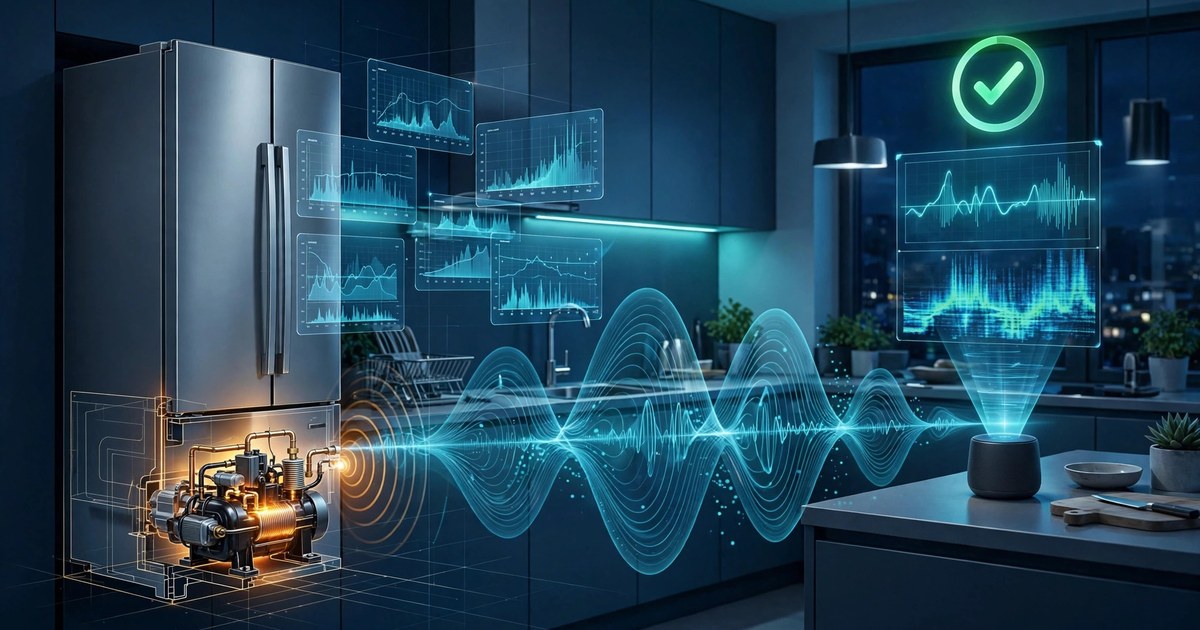
Disclosed is a system and method that repurposes the far-field microphone arrays already present in smart speakers as appliance prognostics sensors. The refrigerator compressor is the most acoustically prominent periodic machine in the typical kitchen, yet its failure, a leading cause of catastrophic food spoilage, arrives with almost no warning. An opt-in service on the smart speaker detects compressor on and off transients with a matched filter, isolates the compressor acoustically by beamforming toward the enrolled appliance location, and extracts mechanical health features on-device: hum harmonic structure, bearing sideband energy, rotational tone stability, and the startup transient envelope. In parallel, the system measures compressor duty cycle and normalizes it against ambient temperature from the home thermostat and acoustically detected door-open events, producing a duty residual that separates thermal load from machine health. A differential diagnosis engine combines the acoustic and duty-cycle evidence to distinguish bearing and mechanical wear, refrigerant loss, door gasket failure, evaporator fan failure, defrost system failure, and control relay short-cycling, each with a distinct signature in the joint feature space. Raw audio never leaves the device; only compact feature vectors are optionally shared for federated fleet learning, which clusters compressor platforms across homes and fits survival models that yield per-unit remaining-useful-life estimates and food-spoilage risk scores. Escalating alerts progress from watch to schedule-service to urgent food-relocation warnings, with an optional service-dispatch interface carrying the diagnostic code. The system requires no new hardware, no appliance modification, and no sensor installation.
Technical Field
This invention relates to appliance prognostics and smart home sensing, specifically to estimating refrigerator compressor health and remaining useful life from acoustic signals captured by ambient smart-speaker microphone arrays, fusing acoustic features with duty-cycle measurements for differential fault diagnosis, and performing the inference on-device to preserve privacy.
Background
Refrigerator compressor failure is discovered the worst possible way: as a warm fridge full of spoiled food, hours after the failure occurred. The compressor is a hermetically sealed unit that is rarely economical to repair, so failure usually means emergency replacement of the appliance. A household can lose hundreds of dollars of perishable food in a single event; the USDA Food Safety and Inspection Service advises that refrigerated food kept above 40°F for more than a few hours must be discarded, and a failed compressor in summer reaches that threshold quickly. Yet compressors give almost no advance warning that a homeowner can perceive. The acoustic changes that precede failure, rising bearing noise, lengthening startup transients, shifting harmonic balance, develop over weeks and are masked by the gradual nature of the change and the background noise of the kitchen.
Existing approaches to the problem are partial. Premium manufacturer smart refrigerators include onboard diagnostics, but they cover a small fraction of the installed base, depend on cloud connectivity, and report coarse fault codes rather than prognostics. Aftermarket temperature probes detect failure after it happens, which is too late for prevention. In industry, motor current signature analysis and sound-based predictive maintenance are mature: a published review surveys feature engineering through deep learning for acoustic fault detection in rotating machinery, and laboratory studies have applied wavelet denoising to refrigerator operating sounds to isolate fault frequencies. One published patent application, WO2014073427A1, describes determining refrigerator state from an acoustic signal using a dedicated measurement device positioned at the refrigerator, extracting time-series acoustic feature data and classifying the appliance state. These efforts share a common assumption: the sensor is placed at the machine by someone who decided to monitor it.
The sensing opportunity is the microphone array already sitting on the kitchen counter. Smart speakers with far-field microphone arrays are deployed in tens of millions of homes, positioned within a few meters of the refrigerator, idle for most of the day, and equipped with application processors capable of continuous audio inference. No existing system uses these ambient microphones for appliance prognostics. No existing system performs differential fault diagnosis that fuses acoustic mechanical features with thermally normalized duty-cycle measurements to distinguish the six dominant refrigerator failure modes. No existing system does this with raw audio confined to the device and fleet learning performed by federated updates. The gap in the art is the complete system disclosed here.
Detailed Description
1. Enrollment and Commissioning Baseline
The user opts in through the smart speaker companion app and indicates the refrigerator location relative to the speaker, either by selecting a room-layout position or by walking the phone near the fridge during a 30-second calibration tone emitted by the speaker. Alternatively, the system auto-discovers the refrigerator during the first week of operation as the loudest source of periodic 100 to 120 Hz tonal energy with a duty cycle between 20 and 80 percent, a signature essentially unique to refrigeration compressors in a home.
Following enrollment, the system enters a 14-day commissioning period. It records every compressor on and off event, builds the baseline distribution of cycle durations, extracts the baseline acoustic signature described in Section 3, and learns the thermal coupling between duty cycle and ambient temperature using temperature readings from the home thermostat or the speaker's own temperature sensor. The commissioning baseline is the reference against which all future drift is measured. If the home has no thermostat integration, the system falls back to weather-service outdoor temperature with an learned indoor offset, at reduced diagnostic confidence for the gasket-failure detector.
2. Compressor Event Detection and Acoustic Isolation
Compressor state transitions produce distinctive transients. Startup begins with a relay click, a broadband impulse under 50 ms, followed by an inrush hum that rises to steady state over 200 to 800 ms as the rotor comes up to speed. Shutdown is the reverse: an abrupt hum collapse with a brief mechanical shudder. A matched filter bank tuned to these transient templates runs continuously on the beamformed audio stream and timestamps on and off events with sub-second accuracy. Between events, the system knows the compressor state exactly, which gates all feature extraction: acoustic features are computed only during confirmed on-periods, eliminating contamination from silence.
Acoustic isolation uses the microphone array. With the enrolled refrigerator azimuth known from calibration, a minimum-variance distortionless-response (MVDR) beamformer steers a spatial null toward competing periodic sources, typically the HVAC air handler and the dishwasher, and a lobe toward the refrigerator. In homes with two or more smart speakers, time-difference-of-arrival across devices refines the source position and rejects reflections. A periodicity gate further suppresses interference: only signal components with the compressor's learned periodicity contribute to the feature stream, so a blender running for 30 seconds cannot corrupt a bearing-wear trend built over weeks.
3. On-Device Acoustic Feature Extraction
During each confirmed on-period, the system computes a short-time Fourier transform at 16 kHz sampling and extracts the following features, all on-device:
Hum harmonic structure. Single-speed reciprocating compressors driven from 60 Hz mains exhibit a strong 120 Hz hum (twice line frequency, from magnetostriction) with harmonics at 240, 360, 480 Hz and above, plus a mechanical rotational tone in the 45 to 60 Hz band. Inverter-driven compressors show a variable fundamental that tracks the drive frequency. The system records the amplitudes of the first six harmonics and the harmonic-to-noise ratio. A falling fundamental with preserved harmonics indicates reduced electromechanical conversion efficiency; a rising broadband floor indicates mechanical looseness.
Bearing sideband energy. Rolling-element bearing defects modulate the vibration at ball-pass frequencies, producing sidebands around the hum harmonics. The sideband energy ratio (SER), defined as the energy in ±15 Hz bands around the first three harmonics divided by the harmonic energy itself, is the primary mechanical-wear metric. Healthy compressors show SER below 0.05; the commissioning baseline sets the per-unit threshold, and sustained SER growth above 3 sigma of baseline variance is the earliest warning of bearing degradation, typically preceding functional failure by weeks to months.
Rotational tone stability. The instantaneous frequency of the mechanical rotational tone is tracked across each on-period. Increasing jitter or slow wandering of this tone indicates rotor imbalance or developing mechanical looseness. The metric is the coefficient of variation of the tracked frequency within on-periods, trended weekly.
Startup transient envelope. The time from relay click to 90 percent of steady-state hum amplitude, and the overshoot ratio of the inrush peak to steady state, are recorded per start. Lengthening start times indicate winding degradation or increased mechanical drag; a start that never reaches steady state, followed by a thermal-cutout click minutes later, is the signature of a locked rotor or failed start capacitor.
4. Duty-Cycle Measurement and Thermal Normalization
The event detector of Section 2 yields the compressor duty cycle D = t_on / (t_on + t_off) over rolling 24-hour windows. Raw duty cycle is confounded by weather and usage, so the system computes the expected duty from a thermal model: D_expected = a·(T_ambient − T_setpoint) + b·N_door + c, where T_ambient is the kitchen temperature, T_setpoint is the user-configured target (default 37°F fresh food), N_door is the count of door-open events, and the coefficients a, b, c are fit during commissioning. Door-open events are detected acoustically from the door thump and gasket suction transient, or taken from a smart refrigerator API where available. The duty residual ΔD = D − D_expected isolates machine behavior from thermal load: a healthy refrigerator holds ΔD near zero across seasons, while a developing fault drives ΔD persistently positive.
Crucially, the system also tracks the ambient coupling coefficient a over time. A rising a, meaning duty cycle becomes more sensitive to kitchen temperature, is the specific signature of declining insulation performance, which in practice means a failing door gasket: with acoustics unchanged and ΔD rising in proportion to ambient temperature, the diagnosis is gasket, not compressor.
5. Differential Fault Diagnosis
The diagnosis engine combines the acoustic features of Section 3 with the duty residual of Section 4. Each of the six dominant failure modes occupies a distinct region of the joint feature space:
Bearing and mechanical wear. SER rises above baseline with 3-sigma persistence; startup transient lengthens modestly; ΔD remains near zero until late stages. Action: schedule service within 30 days; the compressor still cools.
Refrigerant loss. ΔD rises steadily over weeks as the system runs longer to reach setpoint; hum fundamental amplitude falls as the reduced refrigerant charge lightens the compressor load; startup transient shortens slightly for the same reason. SER stays flat, which distinguishes this from mechanical wear. Action: schedule sealed-system service; the trajectory predicts the date ΔD crosses the no-longer-keeping-up threshold.
Door gasket failure. ΔD rises with a rising ambient coupling coefficient a; all acoustic features unchanged; door-close acoustic transients weaken as the gasket loses its suction seal. Action: inspect and replace the gasket, a homeowner-serviceable repair.
Evaporator or condenser fan failure. The fan blade-pass tonal component, typically 200 to 400 Hz depending on the model, disappears from the spectrum while the compressor hum persists; ΔD rises as heat exchange degrades. Action: schedule service; continued operation risks compressor overheating.
Defrost system failure. Ice accumulates on the evaporator; the fan blades begin striking ice, producing periodic scraping transients at the fan rotation rate; duty becomes irregular with abnormally long cycles as the iced coil loses capacity. Action: schedule service for the defrost heater, timer, or thermostat.
Control and relay faults. Short-cycling: on-periods under 3 minutes repeating rapidly, with startup transients that abort before reaching steady state. This is distinguished from normal thermostat cycling by the aborted transient envelope. Action: urgent; short-cycling destroys compressors, so the system advises minimizing use and calling service immediately.
The engine outputs a ranked differential with confidence scores rather than a single label, and every diagnosis cites the supporting features so a technician can verify it.
6. Edge Inference and Privacy Architecture
All audio processing runs on the smart speaker's application processor. The matched filter bank, beamformer, and feature extraction consume under 5 percent of a typical speaker SoC during on-periods and near zero during off-periods, since the transient detector gates the heavier stages. The diagnosis engine is a gradient-boosted tree over the engineered features plus a quantized convolutional network of approximately 200,000 parameters operating on mel-spectrogram patches for the bearing-wear classifier; both fit comfortably in the memory budget of current smart speaker hardware.
Raw audio never leaves the device. The only data transmitted off-device, and only with explicit opt-in, are 128-dimensional feature vectors per compressor cycle with the per-unit baseline subtracted, plus the diagnosis outcome. These vectors contain no speech content: they are computed exclusively from beamformed, periodicity-gated compressor on-periods, and a voice-activity detector suppresses feature computation whenever speech is present. Users can review and delete their feature history, and disabling the skill purges the on-device baseline.
7. Federated Fleet Learning and Remaining-Useful-Life Estimation
Opted-in devices participate in federated learning. Compressor platforms are clustered across the fleet without model numbers: units whose baseline acoustic signatures match within tolerance are assumed to share a platform, and a separate model is maintained per cluster. Federated averaging updates the bearing-wear classifier and the diagnosis thresholds from fleet data; no household's data is reconstructable from the updates.
For each platform cluster with sufficient fleet history, the service fits a Weibull survival model to the degradation trajectories, mapping the current feature state (SER level, ΔD trajectory, startup transient drift) to a remaining-useful-life distribution. The per-home output is a food-spoilage risk score: the probability of functional failure within 14 days multiplied by the estimated value of perishable food at risk, defaulting to a national average grocery value the user can adjust. This converts an abstract health metric into the number the homeowner actually cares about.
8. Alert Escalation and Service Integration
Alerts escalate in three tiers. Watch: a feature trend crosses its warning threshold; the user receives a monthly digest note with the trajectory. Schedule service: the differential diagnosis reaches 70 percent confidence on a specific fault, or the 14-day failure probability exceeds 10 percent; the user gets a push notification naming the likely fault, the evidence, and the recommended action. Urgent: short-cycling detected, or the failure probability exceeds 50 percent, or the compressor has stopped responding to thermostat demand (on-periods absent during high ambient temperature); the user is advised to check food safety immediately and relocate perishables, with the USDA guidance that refrigerated food above 40°F for more than a few hours should be discarded.
An optional service-dispatch interface exposes the diagnostic code, the supporting feature summary, and the compressor platform cluster to appliance repair networks, so the technician arrives with the correct parts. For property managers, a fleet dashboard aggregates anonymized health scores across units with k-anonymity of at least 10 units per reported statistic, enabling preventive maintenance scheduling across rental portfolios.
9. Multi-Appliance Extension
The same pipeline monitors additional periodic machines in the home without new enrollment. After the refrigerator is characterized, the system clusters remaining periodic tonal sources by azimuth and signature: a chest freezer in the garage (learned via a second speaker or the same speaker's weaker lobe), a wine cooler, a dehumidifier, or a window air conditioner each present a distinct duty cycle and harmonic structure. Each discovered appliance gets its own baseline, duty model, and diagnosis engine instance. The refrigerator remains the default priority because its failure carries the highest spoilage cost.
10. Figures Description
- Figure 1: System architecture: smart speaker with microphone array in the kitchen, beamformer lobes toward the refrigerator and nulls toward the HVAC vent and dishwasher, feature extraction and diagnosis engine on-device, optional feature-vector uplink to the federated fleet service, and alerts to the user phone and service network.
- Figure 2: Representative compressor startup transient: relay click impulse, inrush hum envelope rising to steady state, with healthy versus degraded (lengthened) transient overlays and the matched-filter template.
- Figure 3: Spectrum of a healthy compressor on-period showing the 120 Hz hum fundamental, harmonics, rotational tone, and fan blade-pass component, annotated with the ±15 Hz sideband bands used for the sideband energy ratio.
- Figure 4: Six-month trend plots for one unit developing a refrigerant leak: flat SER, steadily rising duty residual ΔD, and falling hum fundamental amplitude, with the diagnosis threshold crossings marked.
- Figure 5: Differential diagnosis decision regions in the joint space of sideband energy ratio versus duty residual, showing the six fault clusters and the healthy region with confidence contours.
Claims
- A system for refrigerator compressor prognostics, comprising: a smart speaker with a far-field microphone array positioned in the same dwelling as a refrigerator; a compressor event detector that detects compressor on and off transients with a matched filter; an acoustic feature extractor that computes mechanical health features from beamformed audio during confirmed compressor on-periods; a duty-cycle normalizer that measures compressor duty cycle and subtracts a thermally modeled expected duty to produce a duty residual; and a differential diagnosis engine that combines the acoustic features and the duty residual to classify the compressor into one of a plurality of fault modes.
- The system of claim 1, wherein the acoustic feature extractor applies a minimum-variance distortionless-response beamformer steered toward an enrolled refrigerator azimuth, with spatial nulls toward competing periodic sources, and refines source position by time-difference-of-arrival across multiple smart speakers in the dwelling.
- The system of claim 1, wherein the compressor event detector uses a matched filter bank tuned to the relay-click impulse and inrush hum envelope of compressor startup and the hum-collapse transient of shutdown, gating feature extraction to confirmed on-periods and suppressing interference via a periodicity gate matched to the learned compressor cycle.
- The system of claim 1, wherein the acoustic feature extractor computes a sideband energy ratio defined as the energy in sidebands around hum harmonics divided by the harmonic energy, and flags bearing degradation when the ratio exceeds a per-unit baseline by a statistical threshold with persistence.
- The system of claim 1, wherein the acoustic feature extractor records the startup transient envelope from relay click to steady-state hum amplitude, and detects winding degradation, mechanical drag, or locked-rotor conditions from lengthening, overshoot change, or failure to reach steady state.
- The system of claim 1, wherein the duty-cycle normalizer fits an expected duty model as a function of ambient temperature and door-open event count during a commissioning period, and the differential diagnosis engine diagnoses door gasket failure from a rising duty residual with a rising ambient coupling coefficient and unchanged acoustic features.
- The system of claim 1, wherein the differential diagnosis engine diagnoses refrigerant loss from a rising duty residual combined with falling hum fundamental amplitude and flat sideband energy ratio, distinguishing refrigerant loss from mechanical wear.
- The system of claim 1, wherein the differential diagnosis engine diagnoses evaporator or condenser fan failure from disappearance of the fan blade-pass tonal component with persisting compressor hum, and diagnoses defrost system failure from periodic ice-strike transients at the fan rotation rate combined with irregular duty cycling.
- The system of claim 1, wherein the differential diagnosis engine diagnoses control and relay faults from short-cycling on-periods with aborted startup transients, and generates an urgent alert advising immediate service.
- The system of claim 1, wherein all audio processing executes on the smart speaker processor, raw audio never leaves the device, feature computation is suppressed during voice activity, and only baseline-subtracted feature vectors are transmitted off-device with explicit opt-in.
- The system of claim 1, further comprising federated fleet learning that clusters compressor platforms across dwellings by baseline acoustic signature similarity, updates diagnosis models by federated averaging, fits per-platform Weibull survival models to fleet degradation trajectories, and outputs a per-unit remaining-useful-life estimate and food-spoilage risk score.
- A method for refrigerator compressor prognostics without appliance modification, comprising: enrolling a refrigerator location relative to a smart speaker microphone array; detecting compressor on and off transients with a matched filter; isolating the compressor acoustically by beamforming; extracting on-device acoustic features including hum harmonic structure, bearing sideband energy, and startup transient envelope during confirmed on-periods; measuring duty cycle and normalizing against a thermal model to produce a duty residual; classifying the compressor into a fault mode by differential diagnosis over the joint acoustic and duty-cycle feature space; and escalating alerts from watch to schedule-service to urgent based on diagnosis confidence and estimated failure probability.
Implementation Notes
Deployable as a software update to existing smart speakers with microphone arrays and application processors; no new hardware, no appliance modification, no sensor installation. Microphone requirements: 16 kHz sampling, far-field array of 4 or more microphones, satisfied by current-generation smart speakers. Compute budget: the transient detector runs continuously at negligible load; beamforming and feature extraction run only during compressor on-periods, under 5 percent of a typical speaker SoC; the quantized bearing-wear classifier is approximately 200,000 parameters.
Commissioning requires 14 days of normal operation to establish the acoustic baseline, duty model coefficients, and ambient coupling coefficient. Known limitations: open-plan homes where the HVAC air handler shares the refrigerator azimuth reduce beamformer separation and lower diagnostic confidence, reported explicitly; homes with two refrigerators on one speaker require the multi-appliance clustering of Section 9 and achieve separation only when the units differ in azimuth or signature; inverter-driven compressors with continuously variable speed use a tracked fundamental rather than fixed 120 Hz harmonics, with wider sideband bands. Voice privacy is enforced by construction: the periodicity gate and beamformer pass only compressor on-period audio to the feature extractor, and a voice-activity detector suppresses computation during speech.
Prior Art References
- WO2014073427A1, "Refrigerator status determination device and refrigerator status determination method": Determines refrigerator state from an acoustic signal acquired by a dedicated measurement device positioned at the refrigerator, extracting time-series acoustic feature data. Distinguished: the present disclosure uses ambient smart-speaker microphones already in the home rather than a dedicated positioned device, and adds duty-cycle fused differential fault diagnosis, edge-confined audio, and federated fleet learning, none of which the application describes.
- "Refrigerator Noise Source Identification Based on Wavelet Denoising" (Atlantis Press): Laboratory measurement of refrigerator nonstationary signals by microphone, comparing bandpass filtering with wavelet denoising to isolate fault frequencies at 400 Hz, 1250 Hz, and 8000 Hz. Distinguished: laboratory fault-frequency analysis with positioned microphones, not continuous in-home prognostics from ambient devices.
- European Acoustics Association, Forum Acusticum 2025: acoustic and psychoacoustic analysis of refrigerator compressor sounds at normal and maximum speed: Characterizes sound power and tonal content of modern compressors across operating modes. Supports the premise that compressor acoustic signatures carry operating-state information measurable at room distance.
- "Review on Sound-Based Industrial Predictive Maintenance: From Feature Engineering to Deep Learning" (MDPI Mathematics): Surveys acoustic feature engineering and neural approaches, including wavelet packet decomposition and Teager energy operators, for detecting bearing and machinery faults from sound. Establishes that sideband and transient acoustic features are valid prognostics signals for rotating machinery.
- IEC 60704 (series), Household and similar electrical appliances: Test code for the determination of airborne acoustical noise: Standardized microphone layouts and procedures for measuring appliance sound power, underpinning the acoustic characterization the present system performs in situ rather than in a laboratory.
- USDA Food Safety and Inspection Service, "Keep Food Safe During an Emergency": Refrigerated food held above 40°F for more than a few hours should be discarded; a refrigerator without power keeps food safe for about 4 hours if unopened. Establishes the spoilage cost that motivates early failure warning.