System and Method for Early Detection of Respiratory Disease in Commercial Poultry Flocks Using Distributed Acoustic Monitoring with On-Device Classification
Abstract
Disclosed is a system and method for detecting respiratory disease in commercial poultry flocks days before conventional observation-based diagnosis. A distributed array of microphone nodes mounted in each barn continuously monitors flock vocalizations and runs an on-device convolutional neural network classifier that distinguishes respiratory distress vocalizations (coughing, sneezing, rales, gasping) from normal flock sound (contented peeping, feeding clatter, fan and equipment noise). Per-zone event rates are fused with environmental telemetry (ammonia, temperature, humidity, water consumption, mortality) to produce a respiratory distress index per barn zone, localize the outbreak origin, and trigger a graduated biosecurity response that escalates from targeted inspection to ventilation adjustment, veterinary sampling, and quarantine preparation. The acoustic channel detects subclinical infection: respiratory vocalizations rise measurably before visible lethargy, reduced feed intake, or mortality. The system is designed to provide 24-72 hours of lead time for earlier veterinary-directed intervention. For reportable diseases such as highly pathogenic avian influenza, where depopulation of infected premises is mandatory regulatory policy, early detection does not avert culling; it accelerates the regulatory response and narrows the exposure window. The fused probability score is a triage signal, not a diagnosis.
Technical Field
This disclosure relates to animal health monitoring, specifically to continuous acoustic surveillance of commercial poultry flocks using distributed microphone arrays, on-device audio classification, and fusion with environmental and production telemetry for early detection of respiratory disease.
Background
Respiratory disease is the leading infectious threat to commercial poultry. Infectious bronchitis virus, Newcastle disease, infectious laryngotracheitis, and highly pathogenic avian influenza all present with respiratory signs, and the economics are severe: during the 2022-2024 highly pathogenic avian influenza epizootic, U.S. detections across commercial and backyard flocks exceeded 100 million birds (USDA APHIS, detections through 2024), with depopulation of entire barns and egg-supply shocks that reached consumer prices. For non-reportable respiratory diseases like infectious bronchitis, the losses are quieter but cumulative: degraded feed conversion, increased condemnation at processing, and chronic susceptibility to secondary bacterial infection.
Detection today depends on human observation. Barn walkers inspect flocks once or twice daily, looking for lethargy, huddling, reduced feed and water intake, and listening for abnormal sounds. The method has known limits: a single worker covers tens of thousands of birds, visits are brief and scheduled, and subclinical infection produces no visible signs. By the time mortality spikes or a worker hears widespread coughing during a walk-through, the pathogen has typically been circulating for days and shedding at high titer.
Commercial acoustic monitoring exists in limited form. SoundTalks, a KU Leuven spin-off that remains independent, built its reputation on a microphone-based respiratory distress monitor for swine (distributed in the animal-health channel by Boehringer Ingelheim), with a poultry variant (SOMO) field-tested on five Belgian broiler farms. SoundTalks swine deployments typically use three monitors per room, and each device co-senses humidity and temperature alongside audio. The SoundTalks pipeline transmits sounds to a gateway, where analysis happens in the cloud. Research groups have published classifier studies distinguishing broiler respiratory sounds from barn noise, including rale detection with extreme learning machines and support vector machines (Rizwan et al., IEEE GlobalSIP 2016), multi-disease acoustic diagnosis of Newcastle disease, infectious bronchitis, and avian influenza (Banakar et al., Computers and Electronics in Agriculture 2016), and deep-learning Newcastle disease detection from sound (Cuan et al., Computers and Electronics in Agriculture 2022). These efforts establish that respiratory vocalizations are machine-detectable.
The gap in the art is a complete deployable system that: (a) classifies respiratory distress vocalizations on-device at the edge rather than in the cloud, (b) fuses acoustic scores with production telemetry (water and feed consumption, mortality) and ammonia sensing to separate infectious patterns from irritant-driven vocalization, (c) maintains an adaptive per-flock baseline across the grow-out cycle, (d) localizes the outbreak origin to a barn zone, and (e) drives a graduated biosecurity workflow with zone-level response actions and explicit de-escalation criteria.
Detailed Description
1. Target vocalizations and barn acoustics
Respiratory distress in chickens produces several acoustically distinct vocalizations. Coughing is a short explosive expiratory sound with broadband energy and a rapid onset, typically 100-300 ms. Sneezing is a sharper, higher-frequency transient with a characteristic double-burst structure. Rales (tracheal rattling) are longer, lower-frequency periodic sounds caused by mucus in the airway, appearing as amplitude-modulated noise bursts at 2-8 Hz modulation rates. Gasping produces inspiratory stridor with harmonic structure in the 1-4 kHz band. All four rise in frequency during respiratory disease and are largely absent in healthy flocks, where the soundscape is dominated by contented peeping (narrowband, 2-5 kHz, rhythmic), feeding clatter, waterline nipple clicks, ventilation fan noise, and equipment sounds.
A broiler barn is a harsh acoustic environment. A 20,000-bird barn at market weight generates continuous broadband noise at 70-85 dB SPL (re 20 µPa) at bird height. Fans, feed lines, and water systems add tonal and impulsive confounders. The signal of interest is sparse: a single coughing bird in a healthy flock may cough a few times per hour. The design therefore works on event rates per zone rather than individual bird tracking, and relies on statistical elevation above a per-flock baseline rather than absolute detection counts.
2. Sensor node hardware
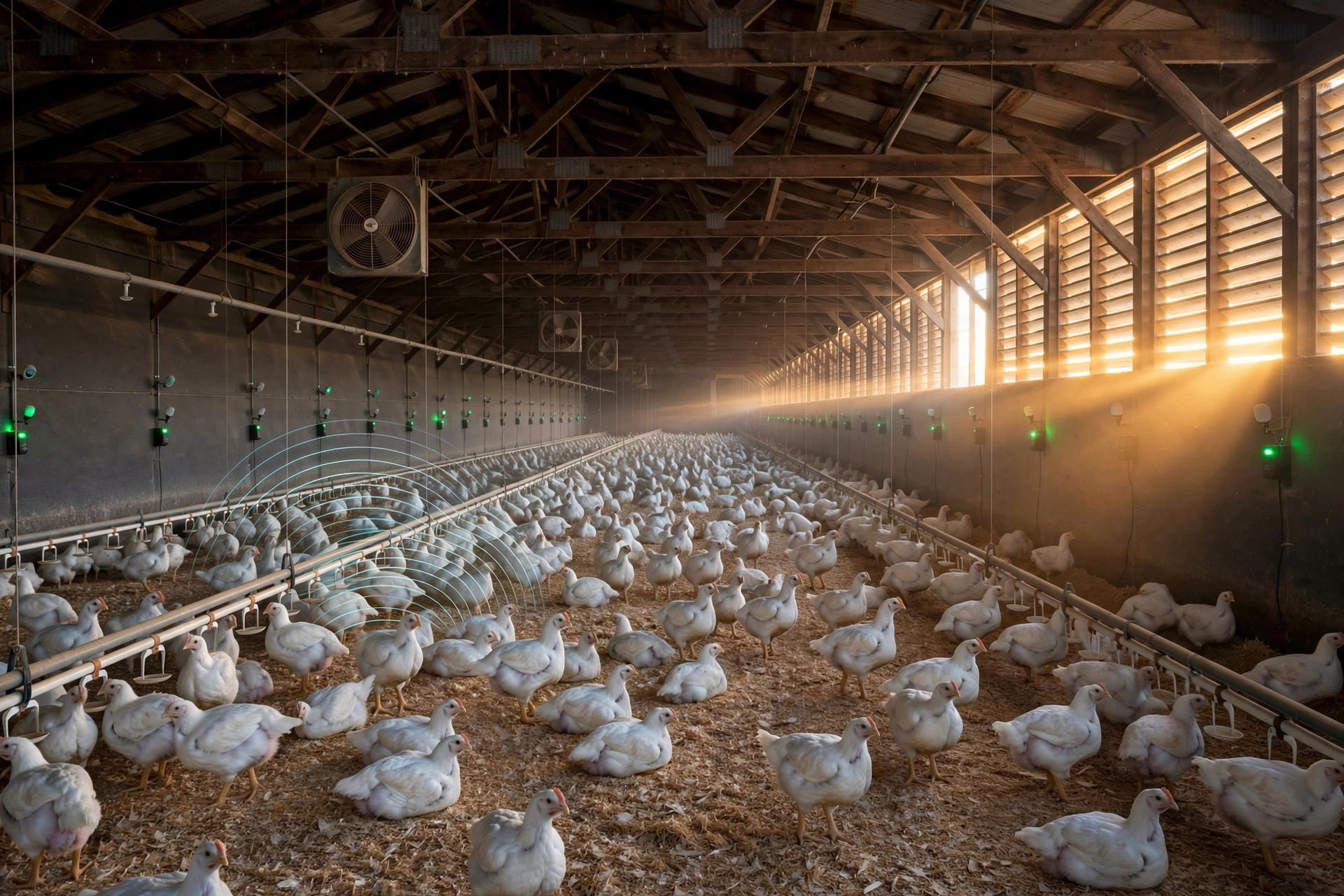
Each barn carries a distributed array of microphone nodes. In one embodiment, 7-11 nodes mount on side walls and ceiling trusses at 2-3 meters height, spaced 15-25 meters apart, covering a standard 150 x 15 meter broiler house (11 nodes at 15-meter spacing cover exactly 150 meters; 7 nodes at 25-meter spacing do the same). Every node contains a MEMS microphone (e.g., Knowles SPH0645LM4H, sensitivity -26 dBFS, unit cost approximately $1.50) in a conformal-coated weatherproof housing rated for barn conditions: ammonia exposure, dust, humidity, and pressure washing between flocks. A microcontroller with DSP capability (e.g., ESP32-S3 with vector extensions, unit cost approximately $3.00) runs acquisition and inference. The node connects to a barn gateway over a wired backhaul (RS-485 or power-line communication, preferred for robustness against barn RF interference from ventilation controllers) or wirelessly (WiFi or sub-GHz radio with store-and-forward during connectivity gaps).
Nominal per-node power draw is approximately 1 W average, dominated by the microcontroller during inference. Wired embodiments use barn mains or power-over-Ethernet; wireless embodiments use barn mains with battery backup. Continuous on-device inference is not a battery-primary application, and no battery-primary embodiment is claimed. Target bill-of-materials cost per node: $15-30, or $105-330 per barn for a 7-11 node array.
3. Acquisition and pre-detection
The microphone channel on every node samples continuously at 16 kHz with 16-bit resolution. Audio is processed in 1-second frames with 50% overlap. Processing per frame includes: bandpass filtering (300 Hz to 7 kHz, within the 8 kHz Nyquist limit) to isolate the vocalization band while rejecting fan low-frequency rumble and ultrasonic rodent-deterrent emissions; computation of a 64-bin log-mel spectrogram using a 512-point FFT with Hann windowing; and a short-time-average over long-time-average (STA/LTA) transient detector on the 1-4 kHz energy envelope, so detailed classification runs only on frames containing impulsive events.
Frames whose RMS energy in the vocalization band falls below the barn's quiescent floor are rejected by a noise gate, which prevents wasted inference during quiet periods. When the detector triggers, the node replays a ring buffer holding the preceding 3 seconds and captures the following 3 seconds, producing a 6-second event clip. Continuous raw audio is never stored; only triggered clips and aggregate features leave the node. A 6-second mono clip at 16 kHz and 16-bit resolution is approximately 192 KB; at a nominal 5-20 triggers per node per day in a healthy flock, daily uplink per node stays under 4 MB, which the store-and-forward backhaul is sized to carry.
Triggered clips can incidentally capture worker speech near the microphones, and the confounder library in Section 4 deliberately includes worker activity recordings, so the system is trained on human speech even though it classifies bird sounds. Deployments therefore carry stated design terms: workers are notified of audio monitoring at the barn, clip playback is restricted to authorized farm and veterinary staff through access controls, raw clips are retained for a bounded period (default 30 days) and then deleted, and the system is not intended for, and must not be used for, worker surveillance.
4. On-device vocalization classifier
The classifier is a lightweight CNN quantized to INT8 and deployed via TensorFlow Lite Micro. It receives each triggered clip and outputs probabilities over the following classes: cough, sneeze, rale, gasp, contented peeping, feeding clatter, equipment noise, and background. Training data combines labeled field recordings from commercial barns during confirmed respiratory outbreaks (with veterinary diagnosis as ground truth), healthy-flock recordings across the grow-out cycle, and a confounder library including feed auger runs, fan stage changes, waterline flush events, pressure-washer cleaning between flocks, and worker activity.
Thresholds are set per vocalization type to balance recall and precision. Coughing and sneezing use a lower default threshold (0.6) because early detection favors sensitivity; rales and gasping use a higher default (0.8) because these sounds indicate advanced disease and their presence alone justifies strong response. Per-node, per-hour counts of each distress vocalization aggregate into a zone event rate.
5. Adaptive per-flock baseline
The soundscape of a flock changes predictably across the grow-out cycle. Day-old chicks peep constantly; by week six, a healthy broiler flock is comparatively quiet. A fixed threshold would either miss early disease in noisy young flocks or false-alarm on healthy old flocks. The system therefore maintains an adaptive baseline per node: a 7-day rolling median of each distress vocalization rate, recomputed daily, with the first 72 hours after chick placement treated as a calibration period during which alerts are suppressed and the model learns the flock's acoustic fingerprint.
Alert logic operates on deviation from baseline, not absolute rates. A zone enters the Watch tier of Section 8 when its distress event rate exceeds the baseline by a configurable factor (default 3x) sustained over 6 hours, and the Alert tier at 5x sustained over 3 hours. The baseline adapts to gradual changes (seasonal fan schedules, feed formulation changes that alter vocalization) while remaining sensitive to the step changes characteristic of infectious onset. The nominal design target is fewer than one false alarm per barn per week; all thresholds are farm-tunable, and tuning is expected during the first two flocks on a new installation.
6. Environmental and production telemetry fusion
Acoustic scores alone cannot meet the false-positive budget of a working farm: a malfunctioning fan bearing can produce periodic sounds that mimic rales, and ammonia spikes irritate airways and increase sneezing without infection. The fusion module combines per-zone acoustic distress indices with ammonia concentration (default: electrochemical sensors per zone), temperature and relative humidity, water consumption per barn (measured at the main waterline, a leading indicator of reduced intake), feed consumption, and daily mortality counts. Declining feed intake typically lags water consumption by 12-24 hours and serves as a secondary confirmer rather than a leading signal.
The fusion logic weights signals by their disease specificity. Elevated distress vocalizations plus rising ammonia is discounted (irritant, not infectious) and answered with a ventilation recommendation. Elevated vocalizations plus declining water consumption plus rising mortality is a pattern consistent with infectious respiratory disease and drives immediate veterinary sampling. It is consistent with, not specific to, infection: the fused probability is a triage signal, not a diagnosis, and no tier of the response system substitutes for veterinary examination and laboratory confirmation.
Each signal contributes a likelihood term in a Bayesian update over a prior set from regional historical outbreak prevalence (default prior: 2% of flocks per grow-out experience a respiratory outbreak, farm-adjustable). Illustrative likelihood shapes: distress rate elevation above 5x baseline carries a likelihood ratio of approximately 8 for infectious versus non-infectious causes; ammonia above 25 ppm halves the infectious likelihood (irritant discount); water consumption down more than 10% over 24 hours carries a likelihood ratio of approximately 4. These are configurable defaults, not measured parameters; the posterior respiratory disease probability per zone is reported on a 0-100 scale with per-input contribution breakdowns so the farm manager can see which signals drove the score.
7. Zone localization
Because nodes are distributed along the barn length, the distress event rate per node maps directly to barn zones. The system computes a per-node distress index and interpolates across the array to identify the outbreak origin zone, typically resolved to within one 15-25 meter segment. This interpolation is the primary localization mechanism and works on all backhaul embodiments.
In the wired embodiment only, nodes share a common clock through the RS-485 backhaul (time synchronization to a nominal ±10 ms), which additionally enables time-difference-of-arrival refinement: when adjacent nodes timestamp the same distress burst, the arrival-time differences constrain the source position to approximately ±3.4 meters at the speed of sound in barn air. The wireless embodiment has no shared clock and does not attempt TDOA; it relies on coincidence-window interpolation (a 500 ms correlation window grouping detections across adjacent nodes, which is a coincidence test, not a time-difference measurement). Localization directs the farm worker to the correct zone for inspection and sampling, and defines the quarantine boundary when the response escalates.
8. Graduated biosecurity response
The response module maps the fused respiratory disease probability to tiered actions, using half-open intervals to avoid boundary ambiguity:
- Watch (probability 30 to 59): Push notification to the farm manager identifying the zone, the contributing signals, and a recommended inspection within 24 hours. Ventilation settings are reviewed against the ammonia and humidity data.
- Alert (probability 60 to 84): Immediate notification to the manager and the flock veterinarian. The system recommends targeted tracheal swab sampling from the identified zone, restricts worker movement between the affected zone and other barns (footbath and coverall change logged), and stages quarantine equipment.
- Emergency (probability 85 and above, or Alert sustained 48 hours): Escalation to the company veterinarian. For precautionary syndrome patterns (sudden-onset gasping with rapid mortality) that may indicate a reportable disease, the system prepares a pre-formatted draft reporting package (zone map, event timeline, contributing signals) for the attending veterinarian's review and submission. Regulatory reporting remains the legal responsibility of the veterinarian and the producer; the system assists with documentation, never with the reporting decision itself.
Every tier carries explicit de-escalation criteria: if the distress rate returns to baseline within the watch window and no corroborating production signals appear, the state clears automatically with a log entry. Alert fatigue is the failure mode that kills monitoring systems on real farms, and it is addressed here by three mechanisms: adaptive baselines that track the flock instead of a fixed line, automatic de-escalation, and per-input contribution breakdowns on every score so the manager can judge the evidence rather than the alarm.
9. Training data and model lifecycle
The classifier is retrained on a central schedule (default: quarterly) using newly labeled outbreak recordings contributed by participating farms under a data-sharing agreement. Labels come from veterinary-confirmed diagnoses with timestamps, which anchor the audio recordings to known disease windows. Recordings are anonymized before leaving the farm (farm identity stripped, barn geometry generalized), and the agreement states plainly: farms own their raw recordings, grant a license for model training, may withdraw future contributions at any time, and receive the improved per-farm adapted model at no additional cost. Updated models are pushed to nodes over the air between flocks (during barn cleanout) to avoid mid-flock behavior changes. Per-farm fine-tuning is supported: the node retains a small on-device buffer of the farm's own labeled events, and a lightweight adaptation layer adjusts the global model to the farm's specific barn acoustics (fan models, building materials, bird genetics).
10. Description of Figures
- Figure 1: System architecture showing microphone node positions along a broiler barn, the barn gateway, environmental sensors, and the cloud dashboard with per-zone distress indices.
- Figure 2: Log-mel spectrograms for the four distress vocalization classes (cough, sneeze, rale, gasp) compared with contented peeping and fan noise.
- Figure 3: Example outbreak timeline showing distress event rate elevation 24-72 hours before the mortality spike, with watch, alert, and emergency tier markers.
- Figure 4: Zone map of a barn showing interpolated distress indices and the localized outbreak origin with quarantine boundary.
Claims
- A system for early detection of respiratory disease in commercial poultry flocks, comprising: a distributed array of microphone nodes mounted within a poultry barn; wherein each node continuously acquires audio, computes time-frequency features, and classifies triggered audio segments using an on-device neural network; and wherein per-node distress event rates are aggregated into zone-level indices.
- The system of claim 1, wherein the classified distress vocalizations include coughing, sneezing, rales, and gasping, distinguished from normal flock sound including contented peeping, feeding clatter, and equipment noise.
- The system of claim 1, further comprising an adaptive per-flock baseline module that maintains a rolling statistical model of each node's distress vocalization rate across the grow-out cycle, with alerts triggered by deviation from baseline rather than absolute thresholds.
- The system of claim 1, further comprising an environmental and production telemetry fusion module that combines zone acoustic distress indices with ammonia concentration, temperature, humidity, water consumption, and mortality data into a posterior respiratory disease probability per zone.
- The system of claim 4, wherein the fusion module discounts distress vocalizations accompanied by elevated ammonia as irritant-driven and elevates distress vocalizations accompanied by declining water consumption and rising mortality as indicators consistent with infectious respiratory disease.
- The system of claim 1, further comprising a zone localization module that interpolates per-node distress indices across the array to identify the outbreak origin zone within the barn.
- The system of claim 1, further comprising a graduated biosecurity response module that maps the fused respiratory disease probability to tiered actions including manager notification, veterinary sampling recommendation, worker movement restriction, and preparation of a draft regulatory reporting package for veterinary review and submission.
- The system of claims 3 and 7, further comprising explicit de-escalation criteria that automatically clear the response tiers of claim 7 when distress vocalization rates return to the adaptive per-flock baseline of claim 3 without corroborating production signals.
- The system of claim 1, wherein the on-device classifier is quantized to INT8, executes on a microcontroller with DSP capability, and classifies triggered event clips replayed from a ring buffer, wherein continuous raw audio is not stored.
- The system of claim 1, further comprising a model lifecycle module that retrains the classifier on newly labeled outbreak recordings with veterinary-confirmed diagnoses, pushes updated models to nodes between flocks, and supports per-farm fine-tuning via an on-device adaptation layer.
- A method for early detection of respiratory disease in commercial poultry flocks, comprising: deploying a distributed array of microphone nodes in a poultry barn; continuously acquiring audio and classifying triggered respiratory distress vocalization segments at each node using on-device inference; maintaining an adaptive per-flock baseline of distress vocalization rates; fusing zone acoustic distress indices with environmental and production telemetry; localizing the outbreak origin zone; and executing a graduated biosecurity response proportional to the fused respiratory disease probability.
- The method of claim 11, wherein the graduated biosecurity response includes generating a zone map and event timeline formatted as a draft package for veterinary review and state animal health reporting submission when the fused probability exceeds a precautionary syndrome threshold.
Implementation Notes
Barn economics drive every design choice here. A 7-11 node array at $15-30 per node costs $105-330 per barn: a small fraction of one flock cycle's feed bill. Whether the hardware earns its keep depends on whether early warning shortens an actual outbreak response, which is an empirical question, not a marketing claim. Install nodes during barn cleanout between flocks, when pressure washing access is open and there are no birds to stress. Calibration across the first 72 hours after chick placement is essential; a model trained on week-six birds will misread day-old chicks.
Ammonia sensors drift and die in barn conditions; budget for annual replacement and treat stale ammonia readings as missing data rather than zero. The fusion module must handle partial telemetry gracefully, since a farm that loses its waterline meter should not lose its acoustic early warning. The no-continuous-storage design in Section 3 is both a storage decision and a privacy posture: only triggered clips exist, access is controlled, retention is bounded, and the system classifies bird sounds rather than monitoring workers.
Validation should start on farms with veterinary-confirmed outbreak history so labels are trustworthy; synthetic or crowdsourced labels are not ground truth. Nothing in this disclosure substitutes for veterinary diagnosis or laboratory confirmation, and no response tier is intended to replace the judgment of the attending veterinarian.
Prior Art References
- USDA APHIS: HPAI detections in commercial and backyard flocks (detections through 2024 exceeded 100 million birds)
- SoundTalks SOMO: poultry respiratory distress acoustic monitor (swine monitor is the established product; poultry variant field-tested on five Belgian broiler farms)
- Rizwan, M. et al.: "Identifying rale sounds in chickens using audio signals for early disease detection in poultry," Proc. IEEE GlobalSIP 2016, pp. 55-59
- Banakar, A. et al.: "An intelligent device for diagnosing avian diseases: Newcastle, infectious bronchitis, avian influenza," Computers and Electronics in Agriculture 127 (2016), 744-753
- Cuan, K. et al.: "Automatic Newcastle disease detection using sound technology and deep learning method," Computers and Electronics in Agriculture 194 (2022), 106740
- 35 U.S.C. § 102: prior art and public disclosure
- TensorFlow Lite for Microcontrollers: on-device ML runtime
- ESP32-S3 SoC: Espressif microcontroller with vector DSP extensions
- Knowles SPH0645LM4H-B: MEMS microphone datasheet (mirror; manufacturer page restructured)