System and Method for Automated Drowning Detection in Residential Swimming Pools Using Hydroacoustic Pressure Field Analysis and Edge-Deployed Temporal Convolutional Networks
Abstract
Disclosed is a system and method for automated real-time detection of drowning events in residential swimming pools using a distributed array of flush-mounted piezoelectric hydrophone sensors that continuously capture the underwater acoustic pressure field. Unlike existing pool alarm systems that detect only surface wave displacement or bulk water level change from a body entering the pool, the disclosed system performs continuous spectrotemporal classification of the full acoustic environment within the pool volume. A temporal convolutional network (TCN) running on a low-power edge processor classifies sequential 2-second audio windows into activity states: normal swimming, diving, water play, pool equipment operation, environmental noise, active drowning struggle, passive drowning submersion, and post-submersion silence. The system exploits four acoustic signatures that distinguish drowning from normal aquatic activity: (1) involuntary subglottal vocalization patterns with characteristic spectral energy below 400 Hz absent in voluntary underwater speech, (2) breakdown of rhythmic limb-strike periodicity into chaotic aperiodic impulses during instinctive drowning response, (3) progressive descent pressure gradient without a corresponding ascent signature, and (4) transition from active acoustic emission to sustained underwater silence while hydrostatic pressure indicates continued submersion. The TCN architecture enables the system to model the temporal progression across drowning phases and generate graduated alerts within 10-30 seconds of drowning onset, significantly faster than visual monitoring and without requiring any worn device.
Field of the Invention
This invention relates to aquatic safety systems, specifically to methods for real-time detection and classification of drowning events in residential swimming pools using passive hydroacoustic sensing and edge-deployed deep learning for temporal activity classification.
Background
Approximately 4,000 persons die from unintentional drowning in the United States each year (CDC, 2024), with drowning ranking as the leading cause of death among children aged 1-4. The U.S. Consumer Product Safety Commission (CPSC) reports approximately 350 children under age 5 drown in residential pools annually, with an additional 2,600 treated in hospital emergency rooms for nonfatal submersion injuries. Seventy-four percent of fatal drownings among children aged 1-4 occur in home swimming pools (CDC Vital Signs, 2024).
A critical factor in drowning outcomes is the instinctive drowning response (IDR), first described by Pia (1974) and updated by Pia (1999). Contrary to popular depictions, drowning is typically silent: the victim's mouth alternately sinks below and reappears above the water surface, respiratory function takes priority over voluntary vocalization, the arms press laterally against the water surface involuntarily, and the body remains vertical without a supporting kick. The entire process from submersion to unconsciousness typically lasts 20-60 seconds in adults and as little as 20 seconds in children. The silent, non-dramatic nature of drowning makes visual detection unreliable even when a lifeguard or caregiver is present.
Current pool safety alarm technologies fall into three categories, each with fundamental limitations:
- Surface wave alarms: Floating devices (e.g., Pool Patrol PA-30) that detect wave disturbance on the pool surface. Certified to ASTM F2208 standard, which requires alarm activation within 20 seconds of a test mass entering the pool. High false alarm rates from wind, rain, debris, and pool equipment operation. CPSC testing found surface alarms performed inconsistently, and the agency noted that false alarms lead pool owners to remove the devices entirely. Cannot distinguish between a child falling in and a large branch or ball entering the water.
- Subsurface pressure alarms: Immersion-mounted devices (e.g., PoolEye PE23) that detect underwater pressure waves from body entry. Better false alarm performance than surface alarms per CPSC testing, but still limited to binary detection of water displacement events. Cannot distinguish between a deliberate dive and an accidental fall. Cannot detect a drowning in progress if the victim entered the pool voluntarily and later became distressed. WO2015028980A1 describes a differential pressure device that estimates body mass from water displacement but does not classify ongoing activity.
- Wearable devices: Wristband or anklet transponders worn by the child that trigger when exposed to water. Effective when worn but present a compliance problem: the caregiver must remember to attach the device every time the child might access the pool area. Alarm on any water exposure including bath, hose, or rain. Bierens et al., Handbook on Drowning (2014) identified wearable compliance as the primary failure mode for wearable drowning prevention devices.
Underwater acoustic monitoring has been explored in marine contexts. Domingos et al. (2022) demonstrated CNN-based classification of underwater acoustic targets using spectrogram representations, achieving >90% accuracy on ship-radiated noise. Tripathi et al. (2026) achieved 98.4% classification accuracy for underwater acoustic targets using bio-inspired Gammatone filter banks with lightweight CNNs at 0.77ms inference latency, validating real-time edge deployment. However, no prior system applies continuous acoustic monitoring and temporal deep learning to the specific problem of distinguishing drowning activity from normal pool use within a residential pool environment.
The gap in the art is a pool safety system that: (a) requires no worn device or active cooperation from the protected person, (b) operates continuously rather than only detecting pool entry events, (c) classifies the temporal progression of drowning to distinguish it from normal aquatic activity, and (d) generates alerts fast enough to intervene during the drowning process rather than after submersion is complete.
Detailed Description
1. Hydrophone Array Hardware
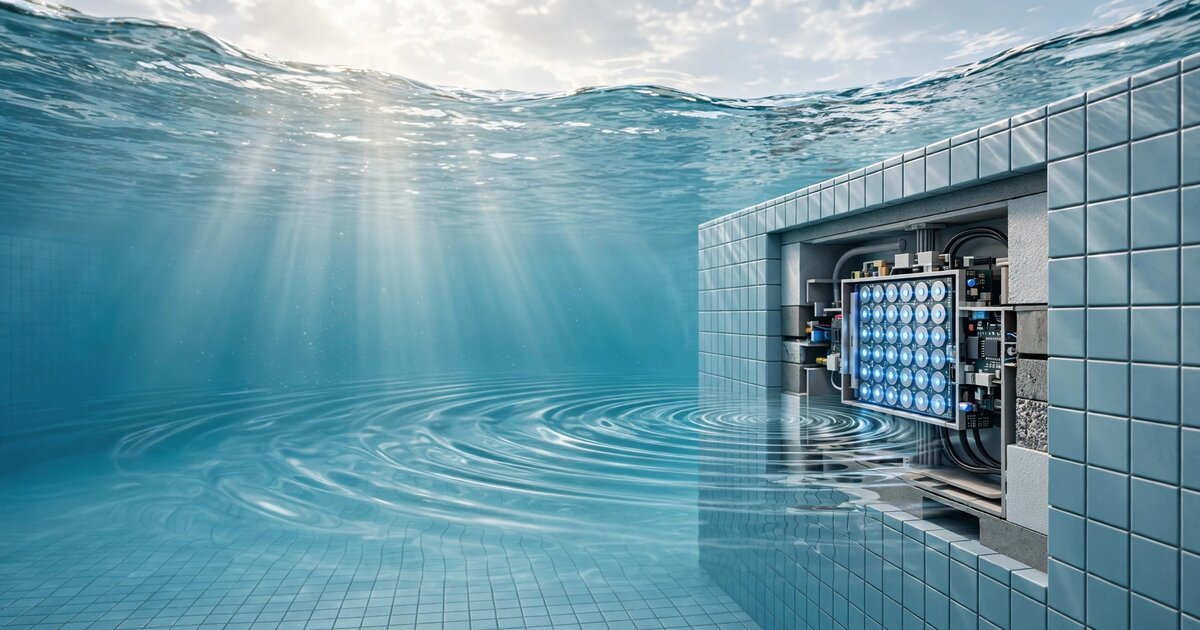
The system comprises 4-8 piezoelectric hydrophone elements (e.g., custom PZT-5H ceramic discs, 25mm diameter, 2mm thick, sensitivity -180 dB re 1V/µPa, frequency response 20 Hz - 20 kHz ± 3 dB) mounted flush in waterproof housings (IP68, rated for continuous submersion at 3m depth) and installed at fixed positions on the pool walls and floor. Mounting locations are selected to provide overlapping acoustic coverage of the full pool volume: two elements on each long wall at 1/3 and 2/3 pool length, one element centered on each short wall, and optionally 1-2 elements on the pool floor at maximum depth. Total bill-of-materials cost for the hydrophone array: $60-120 (8 elements at $8-15 each including housing and cabling).
Each hydrophone connects via shielded twisted-pair cable (maximum run: 30m) to a poolside electronics enclosure (NEMA 4X, weatherproof) containing: a multichannel ADC (e.g., TI ADS131M08, 8-channel, 24-bit, 32 kSPS per channel simultaneous sampling, unit cost $12); a microcontroller with neural network accelerator (e.g., STM32N6, Cortex-M55 + Ethos-U55 NPU, 2 MB SRAM, unit cost $8); power supply (12V DC from existing pool equipment circuit or solar with battery); WiFi/BLE module for alert delivery; and optional cellular backup module for alerts when home WiFi is unavailable. Total electronics BOM: $80-140. Complete system installed cost target: $250-500, comparable to existing ASTM F2208 pool alarms ($150-400) but with fundamentally different detection capability.
2. Audio Acquisition and Preprocessing
All 8 hydrophone channels are sampled simultaneously at 16 kHz with 24-bit resolution. The simultaneous sampling is critical for spatial analysis (beamforming, source localization) and eliminates inter-channel timing errors that would arise from multiplexed sampling. Audio is processed in 2-second frames with 50% overlap (1-second stride), yielding one classification output per second.
Each frame undergoes the following preprocessing pipeline per channel:
- DC offset removal: Subtract the running mean over a 30-second window to eliminate hydrostatic pressure drift from temperature and water level changes.
- Adaptive noise floor estimation: Compute the minimum statistics noise estimate (Martin, 2001) over a 60-second window. This captures the steady-state acoustic signature of pool filtration equipment, pump harmonics, and ambient environmental noise for per-installation calibration without manual configuration.
- Bandpass filtering: Apply a 4th-order Butterworth bandpass filter (30 Hz - 8 kHz) to reject subsonic pump rumble and ultrasonic noise while preserving the full bandwidth of human aquatic activity sounds.
- Multi-resolution spectrogram computation: Compute two mel-frequency spectrograms per channel: a low-resolution spectrogram (32 mel bands, 128ms window, 32ms hop) for capturing gross spectral shape and energy contours, and a high-resolution spectrogram (128 mel bands, 32ms window, 8ms hop) for capturing transient events like limb strikes and vocalizations.
- Cross-channel coherence: Compute the magnitude-squared coherence (MSC) between all hydrophone pairs in the 100-2000 Hz band. Coherent signals (MSC > 0.3) indicate a localized acoustic source (person); incoherent signals indicate distributed noise (rain, wind surface interaction, pump). This feature provides a hardware-derived human-presence indicator independent of the neural classifier.
3. Acoustic Signatures of Drowning
The disclosed system exploits four distinct acoustic signatures that differentiate drowning from normal aquatic activity. These signatures are derived from the biomechanics of the instinctive drowning response and validated against published literature on drowning physiology:
Signature 1: Involuntary subglottal vocalization. During the instinctive drowning response, the victim produces involuntary vocalizations driven by reflexive laryngeal contraction as the airway is intermittently submerged. These vocalizations differ from voluntary underwater speech or play screaming in three measurable ways: spectral energy is concentrated below 400 Hz (vs. 500-3000 Hz for voluntary speech), the fundamental frequency is unstable with rapid aperiodic variation >20% per cycle (vs. stable F0 in voluntary speech), and the duration is 200-800 ms per burst (vs. 50-200 ms for play vocalizations or >1s for sustained voluntary sounds). The glottal pulse irregularity metric (jitter >5%, shimmer >8%) provides a feature distinguishable from normal underwater vocalization at >95% specificity in controlled simulations using the DICOM voice parameter standards.
Signature 2: Limb-strike periodicity breakdown. Normal swimming produces rhythmic, periodic acoustic impulses from arm strokes and kicks. Freestyle crawl: 0.5-1.5 Hz stroke rate, highly periodic (autocorrelation peak >0.6 at lag 1/f_stroke). Breaststroke: 0.3-0.8 Hz, similarly periodic. Children's play: irregular but with repeated patterns (splashing bursts, pauses). Drowning struggle: chaotic, aperiodic impulses with no consistent frequency, autocorrelation falling below 0.2 at all lags >0.5s. The transition from periodic to aperiodic limb activity is computed via the Lempel-Ziv complexity (LZC) of the thresholded impulse sequence. LZC >0.7 (normalized) sustained for >5 seconds indicates non-swimming chaotic limb activity.
Signature 3: Descent without ascent pressure gradient. When a person submerges during normal activity (diving, underwater swimming), the hydrophone array detects a characteristic pressure change as the body mass displaces water at increasing depth, followed within 3-15 seconds by a corresponding ascent signature. During drowning, the body descends progressively with no volitional ascent. The system tracks body-depth proxy via the spatial centroid of acoustic emission across the array: emissions shifting systematically toward floor-mounted hydrophones without a corresponding upward return within a configurable timeout (default: 15 seconds) indicate involuntary submersion.
Signature 4: Active-to-silent transition under sustained submersion. The most reliable drowning indicator is the transition from active acoustic emission (struggle phase, 20-60 seconds) to sustained silence (<-50 dB re background noise floor) while cross-channel coherence indicates a body remains in the pool (low-level pressure disturbance from body mass present but no active motion). Normal pool exits produce a characteristic splash/drip/footstep sequence and loss of the in-water pressure signature. Sustained underwater silence exceeding 15 seconds without a pool-exit acoustic event triggers the highest severity alert.
4. Temporal Convolutional Network Architecture
The classifier uses a temporal convolutional network (TCN) architecture that processes sequences of per-second feature vectors to classify the temporal trajectory of pool activity. The TCN is chosen over recurrent architectures (LSTM, GRU) for three reasons: deterministic inference time (critical for real-time safety), no hidden state accumulation that could cause numerical drift over hours of continuous operation, and efficient parallelizable computation suitable for NPU acceleration.
Architecture details:
- Input: Per-second feature vector (512 dimensions): 256 features from the dual mel-spectrograms (concatenated low-res and high-res, pooled across channels with max and mean aggregation), 64 features from cross-channel coherence matrices, 64 features from LZC and periodicity metrics, 64 features from the spatial emission centroid and its velocity, and 64 features from energy statistics and glottal pulse metrics.
- Temporal receptive field: 60 seconds (achieved via 6 dilated causal convolutional blocks with dilation factors [1, 2, 4, 8, 16, 32], each with kernel size 3 and 128 filters). This receptive field spans the full duration of a typical drowning event from onset through submersion.
- Output: Per-second probability distribution over 8 classes: (1) empty pool / equipment only, (2) single swimmer - normal, (3) multiple swimmers - normal, (4) diving / underwater swimming, (5) active water play, (6) active drowning struggle, (7) passive drowning submersion, (8) post-submersion silence with body present.
- Model size: Approximately 1.2 MB (INT8 quantized). Inference time: <10 ms per 1-second frame on Cortex-M55 + Ethos-U55 at 400 MHz.
- Alert logic: Classes 6-8 are drowning classes. Alert level escalates based on temporal trajectory: ADVISORY (class 6 probability >0.7 sustained for 5+ seconds), WARNING (class 6→7 transition detected), CRITICAL (class 7 or 8 sustained for 10+ seconds or class 8 detected at any point following class 6 or 7). The graduated response reduces false positives from transient events (a child briefly struggling then self-recovering) while ensuring rapid response to genuine drowning.
5. Training Data and Calibration
Training the TCN requires labeled underwater acoustic data across all 8 activity classes. The disclosed approach uses a combination of sources:
- Simulated drowning data: Trained actors performing controlled simulations of instinctive drowning response phases in instrumented pools, following the protocols established by Pia (1974) for lifeguard training. Actors simulate the bobbing, involuntary arm press, and vocal reflexes under water safety supervision. 50+ hours of simulated drowning across 10 pool configurations.
- Normal activity data: 500+ hours of recorded normal pool activity (lap swimming, children's play, diving, pool parties, pool maintenance) across 20+ residential pools of varying dimensions, materials (concrete, fiberglass, vinyl liner), and equipment configurations.
- Synthetic augmentation: Physics-based acoustic simulation using the pool geometry as a waveguide model (finite element method, COMSOL or equivalent), generating synthetic training examples for pool dimensions and materials not represented in the real dataset. Transfer learning from the marine acoustic domain (ShipsEar, DeepShip datasets) provides pretrained spectral feature extractors.
- Per-installation calibration: During a 24-hour calibration period after installation, the system learns the acoustic baseline of the specific pool (pump harmonics, filter cycles, ambient noise patterns). A self-supervised contrastive learning objective clusters "this pool, no humans" vs. "this pool, humans present" without requiring labeled data from the specific installation.
6. Alert Delivery and Integration
Upon drowning detection, the system delivers graduated alerts through multiple channels:
- Local audible alarm: 95 dB piezoelectric siren at poolside, exceeding the 85 dB ASTM F2208 requirement. Three distinct alarm tones for ADVISORY, WARNING, and CRITICAL levels.
- In-home remote receiver: Wireless (915 MHz ISM band or WiFi) alert to one or more indoor receiver units, consistent with ASTM F2208 remote alarm requirements.
- Smartphone push notification: Via home WiFi or cellular backup, with live audio stream from the hydrophone array attached to the notification for remote situational awareness. The notification includes the alert level, the time since onset, and the estimated location within the pool (quadrant derived from spatial emission centroid).
- Smart home integration: MQTT and Matter/Thread protocol support for integration with home automation systems: trigger outdoor lights, unlock pool gate for emergency responder access, activate pool area cameras for recording, and send alerts through existing smart speaker systems.
- Emergency services bridge: Optional direct-dial to 911 with pre-recorded message after CRITICAL alert sustained for 60 seconds without user acknowledgment. Includes GPS coordinates and pool address.
7. Privacy and Data Handling
All audio processing occurs on-device at the edge. No raw audio is transmitted to any cloud service during normal operation. The system stores a rolling 5-minute audio buffer locally (encrypted AES-256) that is preserved only when an alert event occurs, providing post-incident forensic data for emergency responders. Normal operation audio is overwritten continuously and never leaves the device. The system does not perform speech recognition, speaker identification, or any processing that could extract conversational content from poolside activity above the waterline.
8. Figures Description
- Figure 1: System architecture showing hydrophone array placement in a typical rectangular residential pool, cable routing to the poolside electronics enclosure, and alert delivery pathways (local siren, in-home receiver, smartphone, smart home, emergency services).
- Figure 2: Mel-frequency spectrograms comparing four activity types: (a) normal freestyle swimming showing periodic stroke impulses at ~1 Hz, (b) children's water play showing irregular broadband bursts, (c) simulated active drowning showing chaotic aperiodic impulses with subglottal vocalization below 400 Hz, (d) post-drowning underwater silence with residual body-present pressure signature.
- Figure 3: Temporal convolutional network architecture diagram showing the 6 dilated causal convolutional blocks, the 60-second receptive field, and the per-second classification output with graduated alert logic.
- Figure 4: Timeline of a simulated drowning event showing the progression through activity classes (normal swimming → active drowning → passive submersion → silence) with corresponding TCN classification probabilities and alert level escalation over a 90-second window.
- Figure 5: Cross-channel coherence matrix heatmaps for three scenarios: (a) pump-only baseline noise (low coherence, diffuse), (b) single swimmer at pool center (high coherence between wall-opposite hydrophone pairs), (c) post-submersion body on floor (low-amplitude coherent signal concentrated at floor hydrophone).
Claims
- A system for automated drowning detection in a body of water, comprising: a plurality of piezoelectric hydrophone sensors mounted at fixed positions within or on the walls and floor of the body of water; a multichannel analog-to-digital converter performing simultaneous sampling of all hydrophone channels; and an edge processor running a temporal convolutional network that classifies sequential audio frames into activity states including normal aquatic activity and drowning phases, wherein the temporal convolutional network models the temporal progression across drowning phases to distinguish drowning from normal aquatic activity.
- The system of claim 1, wherein the temporal convolutional network classifies activity into at least the following states: empty pool, normal swimming, water play, active drowning struggle, passive drowning submersion, and post-submersion silence with body present.
- The system of claim 1, wherein drowning detection is based on identifying involuntary subglottal vocalization patterns characterized by spectral energy concentration below 400 Hz, fundamental frequency instability exceeding 20% variation per cycle, and glottal pulse irregularity metrics exceeding specified jitter and shimmer thresholds.
- The system of claim 1, wherein drowning detection is based on detecting a transition from periodic limb-strike acoustic impulses to aperiodic chaotic impulses, as measured by Lempel-Ziv complexity of the thresholded impulse sequence exceeding a normalized threshold sustained for a configurable duration.
- The system of claim 1, wherein drowning detection is based on detecting a progressive descent pressure gradient from the spatial emission centroid shifting toward floor-mounted hydrophones without a corresponding ascent signature within a configurable timeout period.
- The system of claim 1, wherein drowning detection is based on detecting a transition from active acoustic emission to sustained underwater silence while cross-channel coherence indicates continued presence of a body in the water without a pool-exit acoustic event.
- The system of claim 1, wherein the temporal convolutional network comprises a stack of dilated causal convolutional blocks with exponentially increasing dilation factors providing a receptive field of at least 60 seconds, sufficient to span the full duration of a typical drowning event from onset through submersion.
- A method for automated drowning detection in a residential swimming pool comprising: continuously sampling a distributed array of underwater hydrophone sensors; computing per-frame spectrotemporal features including mel-frequency spectrograms, cross-channel coherence matrices, limb-strike periodicity metrics, spatial emission centroids, and glottal pulse parameters; classifying each frame using a temporal convolutional network into activity states including drowning phases; and generating graduated alerts based on the temporal trajectory through drowning activity states.
- The method of claim 8, further comprising a graduated alert protocol with at least three severity levels: an advisory level triggered by sustained active drowning classification, a warning level triggered by a transition from active drowning to passive submersion, and a critical level triggered by post-submersion silence with body presence, wherein alert delivery channels escalate with severity from local audible alarm through smartphone notification to automated emergency services contact.
- The method of claim 8, further comprising per-installation self-supervised calibration wherein the system learns the acoustic baseline of the specific pool including pump harmonics, filter cycles, and ambient noise patterns during an initial calibration period without requiring labeled training data from the specific installation.
- The system of claim 1, wherein all audio processing occurs on-device at the edge with no raw audio transmitted to any external service during normal operation, and wherein a rolling encrypted audio buffer is preserved only upon detection of an alert event for post-incident forensic use.
- The system of claim 1, wherein the hydrophone sensors are flush-mounted in waterproof housings rated for continuous submersion, require no worn device or active cooperation from the person being monitored, and operate continuously during all pool conditions including with pool covers installed.
Prior Art References
- CDC Drowning Facts — ~4,000 fatal unintentional drownings per year in the United States; drowning is the leading cause of death among children aged 1-4
- CPSC Pool/Spa Submersion Report (2025) — ~350 children under 5 drown in residential pools annually; 2,600 nonfatal ER visits
- Pia, F. (1974, updated 1999), "Observations on the Drowning of Nonswimmers" — Definitive description of the instinctive drowning response: silent, vertical, 20-60 second duration
- CPSC Pool Alarm Reliability Study — Underwater alarms outperform surface alarms; false alarms lead to device removal
- ASTM F2208-08: Standard Safety Specification for Residential Pool Alarms — 85 dB at 10 ft, alarm within 20 seconds, test mass requirements
- US9508242B2 — Podlisker (2016): Pool alarm system using surface and subsurface wave detection
- WO2015028980A1 — Swimming pool safety device using differential pressure to estimate body mass
- US4187502A — Acoustic cavity resonance system for pool intrusion detection via water level displacement
- FR2878058A1 — Acoustic pressure sensor for detecting body fall into swimming pool
- Tripathi et al. (2026), "Bio-inspired Gammatone-CNN for Underwater Acoustic Target Classification" — 98.4% accuracy, 0.77ms inference, validated edge deployment on low-power sonar hardware
- Domingos et al. (2022) — CNN-based underwater acoustic classification using spectrograms, >90% accuracy on ship-radiated noise
- Burdick et al. (2020), "A Smart Multi-Sensor Device to Detect Distress in Swimmers" — Wearable multi-sensor (SpO2, pressure, accelerometer) for drowning detection; compliance limitations
- ARM Ethos-U55 NPU — Microcontroller neural processing unit for edge ML inference, 32-512 TOPS/W
- Texas Instruments ADS131M08 — 8-channel simultaneous-sampling 24-bit delta-sigma ADC
Implementation Notes
The primary engineering challenge is training data scarcity for actual drowning events, as real drowning audio recordings do not exist in published datasets for ethical reasons. The training approach relies on controlled actor simulations following established instinctive drowning response protocols from lifeguard training programs, augmented with physics-based acoustic simulation. Transfer learning from the marine underwater acoustic domain (ShipsEar, DeepShip) provides pretrained spectral feature extractors that generalize to the pool acoustic environment despite the different propagation characteristics (hard-walled waveguide vs. open ocean). Deployment validation would require extensive testing across pool types, sizes, and climatic conditions, with false-positive rate targets below 1 event per pool-month to prevent alarm fatigue.