System and Method for Piano Tuning Assessment and String Health Monitoring Using Smartphone-Based Inharmonicity Analysis
Abstract
Disclosed is a system and method that assesses the tuning of a piano and the health of its strings from recordings made with an ordinary smartphone microphone, with no strobe hardware, no contact sensor, and no muting of individual strings. A piano note is usually sounded by two or three strings tuned to the same pitch, a unison, and today a technician finds which string in a unison has drifted by muting the others one at a time with felt wedges and listening to each string alone. This disclosure identifies the drifting string from the composite sound of all the strings together, because each string carries a distinct inharmonicity fingerprint: the partials of a stiff steel string run sharp of exact harmonic multiples by an amount set by that string's inharmonicity coefficient B, and the partials of the strings in a unison separate from each other as the partial number rises, so a joint fit across the partials recovers a separate fundamental frequency and a separate B for each string in the group.
It also separates a genuinely detuned string from a false beat, the beating that comes from a loose bridge pin, a cracked bridge, or a failing pinblock rather than from any string being off pitch. Detuning produces beat rates that grow in proportion to the partial number, while a false beat comes from one string vibrating in two nearly identical modes at once and produces a beat rate that stays roughly constant across partials, so the pattern of beat rates across partials tells the two apart. Per-string cents deviation is tracked across visits and tagged with temperature and humidity, which turns a single tuning check into a drift forecast, and a slow drift of the B map across the scale is flagged as a possible soundboard crown problem for a technician to inspect rather than as a tuning problem to chase with a wrench.
Output is a per-note, per-string verdict: which string in each unison has moved, by how many cents and in which direction, whether the beating on a note is detuning or a false beat, and a string health index for the instrument with a drift forecast. A piano owner gets an honest answer to the only question that matters between tuner visits, which notes are actually out of tune and why, and a technician arrives knowing which strings to touch instead of re-measuring the whole instrument by ear.
Field of the Invention
This invention relates to assessment of piano tuning and string condition, specifically to identifying which string in a unison has drifted in pitch, distinguishing detuning from false beats caused by bridge or pinblock faults, and tracking per-string tuning drift over time, from audio recorded with a smartphone microphone using per-string inharmonicity fingerprints, for piano owners, technicians, schools, and institutions that maintain pianos.
Background
A piano is a large piece of wood and steel held in tension, and it never stays in tune on its own. A modern grand carries about 230 strings for its 88 keys, with a combined pull of roughly 18 to 20 tons, and the lowest ten notes use one string each, the next eighteen use two strings per note, and the last sixty use three strings per note. All strings of one note are struck together by one hammer and tuned to the same pitch, so most of the keyboard sounds in unisons of two or three strings. When one string in a unison drifts flat or sharp by a few cents, a cent being one hundredth of a semitone, the note beats: the strings interfere and the loudness throbs at a rate equal to the frequency difference between them. At A4, 440 hertz, one cent is a frequency difference of about 0.25 hertz, so a string 4 cents flat beats about once per second against its in-tune partners, slow enough to hear as a gentle throb and fast enough to spoil the note.
Drift is driven mostly by weather. Wood swells as it absorbs humidity and shrinks as it dries, and the soundboard, the large spruce panel under the strings, pushes up on the bridge as it swells and tightens the strings, raising pitch, then relaxes as it dries and lets pitch fall. One published account of deep humidity cycling records that a 5 percent rise in relative humidity can raise pitch by 2 cents within 24 hours. Ideal conditions for a piano are about 68 degrees Fahrenheit and 42 percent relative humidity, and a home that swings between dry winter heating and damp summer air will move a piano by several cents twice a year, which is why most home pianos are tuned once or twice a year at a cost of roughly 150 to 250 dollars per visit. Concert pianos are tuned before every performance. Between visits, an owner has no measurement at all: the piano sounds a little wrong, nobody can say which notes or why, and the tuner is booked on a calendar rather than on evidence.
Underneath the weather sits a piece of physics that makes piano tuning unlike tuning any other instrument. A piano string is a stiff steel wire under high tension, not an ideal flexible string, and its stiffness pushes each partial sharp of its exact harmonic multiple by an amount that grows with the square of the partial number. Partial frequencies follow f_n = n times f_0 times the square root of (1 + B times n squared), where f_n is the frequency of the nth partial, f_0 is the fundamental, n is the partial number, and B is the inharmonicity coefficient, a dimensionless number set by the string's length, diameter, tension, and stiffness. B is tiny, roughly 0.0001 to 0.001 across a piano, with plain midrange wire typically 50 to 300 parts per million and wound bass strings 100 to 800 parts per million or more, yet it matters enormously: the fourth partial of a note with B of 0.0005 sits about 7 cents sharp of four times the fundamental. Because octaves are tuned by matching partials rather than fundamentals, a piano tuned to exact equal temperament sounds wrong, and tuners stretch the tuning instead, flattening the bass and sharpening the treble by roughly 20 to 30 cents at the extremes. O. L. Railsback measured this stretch in 1938 and the curve still carries his name, with a concert grand running from about 22 cents flat at the lowest A to about 46 cents sharp at the top C. R. W. Young measured the inharmonicity of plain wire piano strings in 1952, and Schuck and Young had measured spectral inharmonicity in piano tones in 1943.
Electronic tuning aids already use inharmonicity, and the gap this disclosure fills is specific. PianoMeter measures the inharmonicity of each note from a phone microphone and computes a stretch curve for the piano, and the Entropy Piano Tuner records each note to compute an entropy-minimizing tuning, but both work per note and both still need the strings of a unison muted to measure one string at a time: Entropy Piano Tuner users are advised to record only a single string, muting the others in bichord and trichord sections. Professional devices such as TuneLab at 300 dollars and Verituner and CyberTuner at 600 dollars do the same work at a professional price. Patents cover the same ground at the note level: US5285711A measures inharmonicity on two or more notes and calculates an 88-note tuning curve from them, US6613971B1 considers multiple partials of each and every note, and US10475428B2 records an audio sample for each string and models the beating of combined strings, but it records each string separately, which in practice means muting. US5065660 takes a different route entirely, clamping a probe to the string and driving its tension with a motor until the frequency is correct.
No cited tool or patent identifies which string in an unison has drifted from the unmuted composite sound alone, separates detuning from false beats by the pattern of beat rates across partials, or tracks per-string drift against temperature and humidity to forecast the next tuning. The pairs are not new: per-note inharmonicity measurement is established, and per-string recording with muting is established. The novelty claimed is the joint per-string fit from one unmuted recording, the beat-rate signature test that separates detuning from bridge and pinblock faults, and the longitudinal per-string drift record, not inharmonicity measurement alone and not electronic tuning alone. That is what this disclosure provides.
Detailed Description
1. Inputs and System Architecture
Three embodiments cover the range from a piano owner with a phone to a technician with a kit. In the preferred embodiment, the user places a smartphone on the music stand or on a small tripod about 1 meter from the strings with the lid open, opens the app, and plays the notes the app asks for, one at a time, holding each for 4 to 8 seconds while the phone records at its native sample rate, 44.1 or 48 kilohertz on current phones, with the microphone pointed at the strings. Room temperature and relative humidity come from the phone's sensors where present, from a small Bluetooth hygrometer clipped inside the case, or from a local weather feed where neither exists, and every recording is tagged with both. In a second embodiment, a technician kit adds a clip-on measurement microphone with a known frequency response, which replaces the phone microphone for the recording while the phone still runs the analysis, and a felt mute is carried but used only as a check, never as part of the measurement. In a third embodiment, a fleet aggregator for a school district, a conservatory, or a dealer collects per-string drift records across many pianos of the same model, which sets model-specific drift expectations, spots a batch of pianos whose pinblocks are failing faster than their class, and schedules tuner visits by measured need rather than by calendar.
Every recording is processed on the device. Audio is cut into frames of 1 second with 50 percent overlap, each frame is windowed and transformed, and only derived features leave the phone: partial frequencies, amplitudes, fitted f_0 and B values per string, beat rates, and temperature and humidity tags, never audio recordings of the room. A recording made while someone is talking, while a television is on, or while another note is still ringing is flagged by its broadband noise floor and the note is asked for again, because a piano assessment that accepts a dirty recording will blame the piano for the room.
Two capture modes serve different questions. A single-note capture, one note struck once and held, is the assessment mode and the default. A scale capture, all 88 notes struck in sequence with 4 seconds each, takes about 6 minutes and produces the full B map and drift record for the instrument in one pass. A scale capture is the mode a technician runs on arrival and an owner runs once a season.
2. The Inharmonicity Model
Before any verdict, the system fits the physics to the piano in front of it. Each string is modeled by two numbers: its fundamental frequency f_0, the pitch the string would sound if it were perfectly flexible, and its inharmonicity coefficient B, which bends every partial sharp according to f_n = n times f_0 times the square root of (1 + B times n squared). B itself follows from the string's material and geometry, B = pi cubed times E times d to the fourth power, divided by 64 times T times L squared, where E is Young's modulus of the wire, d is the wire diameter, T is the tension, and L is the speaking length, but the system never computes B from those quantities. It measures B from the sound, because a piano's actual strings differ from their factory specifications after decades of tension, corrosion, and restringing, and a table value would be wrong in exactly the cases that matter.
Measurement uses a straight-line fit. Squaring the model and dividing by n squared gives (f_n divided by n) squared = f_0 squared times (1 + B times n squared), which is a straight line in n squared with intercept f_0 squared and slope f_0 squared times B. Measuring the frequencies of six or more partials and fitting that line by least squares yields f_0 and B together, with no iteration and no initial guess, and the residuals of the fit say how much to trust it: a clean fit with residuals under 0.05 hertz means the partials were measured well, while scattered residuals mean the recording was noisy or two strings were confused for one. Partial frequencies are located with Goertzel filters evaluated at predicted partial frequencies rather than with a plain FFT peak search, because the partials sit off the FFT grid and a peak search quantizes them to the bin spacing, while a Goertzel filter measures magnitude at any frequency named. An 8-second recording gives a plain FFT bin spacing of 0.125 hertz, about half a cent at A4, and the Goertzel plus least-squares fit across six partials tightens the effective f_0 precision to about 0.1 cent as an engineering estimate, which is the precision the verdict in section 5 needs.
Per-note B is mapped across the whole keyboard before any string is judged. B rises geometrically across the scale, often several-fold inside one treble octave, and it jumps at the scale breaks where string design changes from wound bass strings to plain steel, so the map is stored as log B against note number and interpolated in log B, never in B itself, because interpolating B directly sags badly across a wide gap. A smooth log B map is the signature of a healthy scale design. A single note whose B sits far off the smooth curve is flagged for the checks in section 8, because a wrong B usually means a replaced string of the wrong gauge, a string seated badly on its bridge pin, or a measurement error, and none of those is a tuning problem.
3. Identifying One String Inside a Unison
Per-string identification is the core of this disclosure, and it works because the strings in a unison separate as the partial number rises. Three strings of one note are nominally identical in gauge and length, so their B values are close, but their f_0 values differ by exactly the detuning under investigation, and each string's partials sit at n times its own f_0 times its own inharmonicity factor. At the fundamental the three partials sit within a hertz of each other and merge into one broad peak with a beat. At partial 4 the same detuning is multiplied by four, and at partial 8 it is multiplied by eight, so the cluster splits into resolvable peaks. For a string 4 cents flat at A4, the fundamental sits 1.0 hertz below its partners, partial 2 sits 2.0 hertz below, and partial 4 sits 4.1 hertz below, and the worked example in section 9 shows the arithmetic. Separation grows with n, which is why the fit uses partials up to 8 where the string still has measurable energy, and why the treble, where partials run out of the audible range sooner, is harder than the tenor.
Implementation fits one, two, or three ladders jointly to the same spectrum. For a trichord, the system proposes three (f_0, B) pairs, predicts the partial frequencies of each ladder up to the highest partial with energy above the noise floor, and adjusts all six numbers together by least squares until the predicted peaks match the measured peaks. Model order is chosen by evidence, not assumed: a one-ladder fit is tried first, then two, then three, and each added ladder must reduce the residual by at least 20 percent to be kept, because a phantom third string fitted to noise would invent a detuned string that does not exist. Where two strings are so close that even partial 8 cannot split them, the fit reports a single ladder with an enlarged residual and a confidence flag, and the verdict is reported as a range rather than as a false precision. A unison whose strings agree to within 0.5 cent reads as one ladder, which is correct, because strings that close are in tune with each other by any standard a listener cares about.
Two cross-checks sharpen the assignment. First, the una corda pedal on a grand shifts the action sideways so the hammer strikes one fewer string, turning a trichord into a bichord, and the same note recorded with the pedal down gives a second composite with a different string missing, which constrains which ladder belongs to which string when the free fit is ambiguous. Second, a repeat strike of the same note a minute later must return the same per-string f_0 values within 0.3 cent, or the recording is rejected as unstable and the note is asked for again, because a string that changes pitch between two strikes a minute apart is either still settling from the hammer blow or the room moved, and neither case supports a verdict.
4. Beat-Rate Signatures: Detuning Against False Beats
Beating alone cannot say why a note throbs, and this section is the test that separates the two causes. When two strings sit at different pitches, the beat rate at partial n is n times the fundamental frequency difference, so it grows in proportion to the partial number: a 4-cent gap at A4 beats at about 1.0 hertz at the fundamental, 2.0 hertz at partial 2, and 4.1 hertz at partial 4. When a single string beats against itself, the cause is different: the string vibrates in two nearly identical modes at once, usually a vertical and a horizontal polarization with slightly different termination stiffness at the bridge, and the two modes interfere. That beat rate is set by the difference between the two modes of one string, not by a pitch gap between strings, so it stays roughly constant across partials instead of scaling with n. A beat near 3 hertz at the fundamental that is still near 3 hertz at partials 2 and 4 is a false beat, and chasing it with a tuning wrench will never fix it, because no string is off pitch.
False beats have known mechanical causes, and the signature test sorts them into three buckets. A loose bridge pin, where the pin hole has enlarged at the bottom while the top still looks sound, produces a false beat localized to one string, often with a faint metallic edge in the tone, and the beat rate changes when the pin is pressed at different angles, which is the test a technician uses with a brass rod. A cracked bridge, where the string has cut into the wood or the bridge cap has come loose, produces false beats across several adjacent notes that share the cracked section, with vague pitch and weak partials. A failing pinblock, where the laminated hardwood no longer grips the tuning pins, produces notes that will not hold pitch at all: the string goes flat the moment the wrench is released, or holds for days and then slips suddenly, and the torque needed to turn the pin falls below the healthy range of roughly 80 to 120 inch-pounds. Dry winter air makes loose pins show up first, because wood shrinks as humidity falls and the grip loosens.
Thresholds for the signature test are engineering estimates, stated here so they can be tested rather than trusted. A note is classified as detuning when the measured beat rates across partials 1, 2, and 4 fit a straight line through the origin with slope equal to the fitted fundamental gap and residuals under 15 percent. A note is classified as a false beat when the beat rates across the same partials vary by less than 25 percent from their mean while the fitted per-string fundamentals agree within 0.5 cent. Notes that fit neither pattern, including notes where both detuning and a false beat are present at once, are reported as mixed and referred to a technician with both numbers shown, because a mixed note is common on an old piano and a single label would mislead.
5. The Tuning Verdict and the Target Curve
Each fitted string is compared against where it should be, and the target is measured from the piano itself rather than read from a table. Once the B map from section 2 is known, the system computes a stretch curve for this piano by matching partials between neighboring notes, the same partial-matching aural tuners do, with the target for each note set by the measured B of its own strings and its neighbors. A spinet needs roughly double the stretch of a nine-foot concert grand, and a published average curve would be wrong for both, so the curve is solved per instrument and shown to the user beside the verdicts. Deviation is reported in cents from that target, per string, with a sign: negative is flat, positive is sharp.
Verdict bands are proposed thresholds, not measured psychoacoustic limits. A string within 2 cents of target reads as in tune. A string 2 to 5 cents off reads as audible drift, worth correcting at the next visit. A string more than 5 cents off reads as out of tune, worth correcting now. A unison whose strings spread more than 3 cents from each other reads as beating whatever the absolute pitch, because the ear hears the interference between the strings before it hears the absolute pitch of the note. Every verdict shows the number, so a musician who hears 2 cents and a school that only cares at 6 cents can each apply their own threshold to the same measurement.
Pitch raises get their own rule. A piano more than 10 cents flat overall cannot be brought to pitch in one pass, because raising one section pulls the soundboard and drops the sections already tuned, and tuners handle that with a rough pitch raise followed by a fine tuning weeks later. Where the median deviation across the temperament octave sits below minus 10 cents, the system reports a pitch raise needed and refuses to issue per-string fine-tuning verdicts, because fine verdicts on a piano that far flat would be obsolete before the tuner finished the first pass.
6. Longitudinal Drift, Weather, and the Soundboard
One measurement is a snapshot, and a series of them is a forecast. Each visit stores per-string cents deviation against temperature and relative humidity at the time of recording, and the record for a string becomes a small time series: deviation today, deviation last season, deviation at the same humidity last year. Drift rate is fitted as cents per month after removing the humidity effect, because a string that moves 1 cent a month in a stable room is a different problem from a string that moves 4 cents between a dry January and a humid July and then comes back. A linear fit over at least three visits spanning at least 90 days is the minimum for a forecast, and the forecast reports the date the string is expected to cross the 5-cent band in section 5, with the humidity at that date assumed equal to the seasonal average, so the owner can book the tuner before the piano sounds wrong rather than after.
Weather correction matters because the piano and the room move together. Soundboard swell raises pitch as humidity rises and lets it fall as humidity drops, and the whole instrument can move several cents with the seasons while no single string is at fault. Comparing deviations across visits without the humidity tag would blame strings for weather, so every drift record carries its tag and the fit removes the common seasonal movement before judging any one string. A string that drifts against the seasonal tide, flat while its neighbors go sharp in July, is the one that needs attention, and the record shows it plainly.
Soundboard crown is inferred from the B map, and the inference is flagged as unvalidated, not as a diagnosis. Crown is the upward arch of the soundboard, built in by compression crowning and held by the ribs, and it carries the downbearing that couples string energy into the board. As crown is lost with age, drying, and rib separation, coupling weakens and tone goes dull and unresponsive, and a soundboard that has lost its crown is a rebuild decision, not a tuning decision. B itself is a property of the string, so crown loss should not change B directly, but the effective termination stiffness at the bridge, which shapes the higher partials and their decay, can shift as downbearing falls, and a slow, smooth drift of fitted B across many notes over years, in the same direction and larger than the measurement noise of about 0.1 cent in f_0, is the signal this system watches for. Where that drift appears, the system reports a possible soundboard or bridge coupling change and refers the piano to a technician for a physical inspection, with the B map printed beside the report. It does not diagnose crown loss, because no experiment in this disclosure ties B drift to crown height, and the Limitations section says so plainly.
7. The String Health Index and Thresholds
Per-string numbers are fused into one string health index H on a 0 to 1 scale, where 0 is a new string holding pitch and 1 is a string that will not hold pitch at all. H combines three components: the largest absolute cents deviation among the strings of a note, the presence and strength of a false beat, and the drift rate from section 6. Weights are proposed, not measured: deviation carries 0.50, false-beat strength carries 0.25, and drift rate carries 0.25. Deviation is normalized by 10 cents, so a 10-cent error alone contributes 0.50. False-beat strength is normalized by the strongest false beat in the instrument's own history, so the scale is relative to what this piano has shown before. Drift rate is normalized by 2 cents per month, so a string losing 2 cents a month contributes the full 0.25. Each component is capped at its weight, and the index is the sum.
Three thresholds govern action. At H of 0.3, the system issues a watch notice: the note is measurable but playable, and the forecast names when it will cross the next band. At H of 0.6, the system issues a schedule-tuning notice: the note should be corrected at the next visit. At H of 0.85, the system issues a technician-inspection notice: the note shows a false beat or a drift rate that tuning alone will not fix, and the piano needs hands on it. A single threshold crossed on deviation alone never triggers the inspection notice, because a large deviation with no false beat and no drift is a tuning job, while a small deviation with a strong false beat is a repair job, and confusing the two wastes a visit.
Thresholds are provisional and to be calibrated from fleet data. Different pianos fail in different ways: a school piano played eight hours a day drifts faster than a living-room piano played on Sundays, and a concert grand is judged to a tighter tolerance than a practice upright. Weights and scales are shown to the user with the score, because a black-box score that cannot be audited will not be trusted at the moment it tells an owner their piano needs a rebuild.
8. Separating Detuning from Its Mimics
Six mimics make these measurements hard, and each one has a signature that separates it from detuning. First is room noise: traffic, voices, and air conditioning raise the noise floor and can create phantom peaks near a partial, so a frame whose broadband noise floor sits more than 50 percent above the quiet-room baseline is rejected and the note is asked for again. Second is sympathetic resonance: striking one note sets other strings ringing, and the undamped top octave, where the highest eighteen or so notes have no dampers, rings on its own, so a partial that matches a neighboring note's fundamental within 0.5 hertz is flagged as sympathetic and excluded from the fit.
Third is hammer voicing: a hard or worn hammer excites higher partials more strongly and a soft hammer excites them less, which changes partial amplitudes but not partial frequencies, so amplitude is never used as evidence of pitch, only frequency is. Fourth is a rusted or false string: corrosion adds mass unevenly along the string and scatters the higher partials, which shows up as large fit residuals in section 2 rather than as a clean detuned ladder, and the verdict is a string-condition flag, not a cents number. Fifth is the una corda pedal left engaged: a grand with the soft pedal down sounds two strings instead of three, which would read as a missing string, so the app asks the user to confirm the pedal is up before a scale capture and flags any trichord that fits as a clean bichord for re-check. Sixth is a piano with a practice mute or a silent system engaged, where a rail drops felt between hammers and strings: partial amplitudes collapse and the fit fails outright, and the system reports an unusable recording rather than a verdict.
9. Worked Example: The A4 Trichord with One Flat String
Consider a grand piano in a living room, temperature 20 degrees Celsius, relative humidity 45 percent, and the note A4, which should sit at 440 hertz. Its three strings are plain steel with B of 0.0004, a typical midrange value. Under the model of section 2, the in-tune strings sound partials at 440.09 hertz for the fundamental, 880.70 hertz for partial 2, 1765.62 hertz for partial 4, 2658.94 hertz for partial 6, and 3564.77 hertz for partial 8. Those partials sit sharp of their exact harmonic multiples by 0.35, 1.38, 5.52, 12.38, and 21.88 cents respectively, because stiffness bends each partial upward and the bend grows with the square of the partial number. A tuner app that ignored inharmonicity and aimed the fourth partial at exactly 1760 hertz would tune the string about 5.5 cents flat.
Suppose the left string of the trichord has drifted 4 cents flat while its two partners hold pitch. Its fundamental is 438.99 hertz, 1.01 hertz below its partners, and the beat rates tell the story plainly: about 1.0 beat per second at the fundamental, 2.0 beats per second at partial 2, where the flat string sounds 878.67 hertz against 880.70 hertz, and 4.1 beats per second at partial 4, where it sounds 1761.55 hertz against 1765.62 hertz. Beat rate doubles with partial number, which is the detuning signature of section 4, and the joint fit of section 3 returns three ladders: two at f_0 of 440.00 hertz and one at f_0 of 438.99 hertz, each with B near 0.0004. Verdict: left string, minus 4 cents, audible drift, correct at the next visit, and the technician knows which tuning pin to turn before touching the piano.
Now suppose instead that all three strings fit to the same f_0 within 0.5 cent, yet the note throbs at about 3 beats per second, and the beat rate measures 3.1 hertz at the fundamental, 2.9 hertz at partial 2, and 3.2 hertz at partial 4. Beat rate does not scale with partial number, which is the false-beat signature, and the numbers are illustrative rather than measured. Verdict: no string is off pitch, do not tune this note, and the likely cause is a loose bridge pin or a cracked bridge under that note, which needs a technician's hands and a brass-rod test, not a wrench. A tuner who trusted the throb alone would have chased a string that was never wrong.
Scale the same arithmetic to the whole instrument. A scale capture of 88 notes at 4 seconds each takes about 6 minutes of playing, and the app returns a per-string map of the piano in that time, against a tuning visit that costs roughly 150 to 250 dollars and is booked weeks ahead. That arithmetic is illustrative, not measured, and it assumes a quiet room and a cooperative piano. Where the room is noisy or the piano is a spinet with short stiff strings and closely spaced partials, the fit degrades and the app says so instead of inventing verdicts. Index values, beat rates, and cents figures in this example are outputs of the method applied to the stated B and detuning, not measurements from any real piano.
10. Figures Description
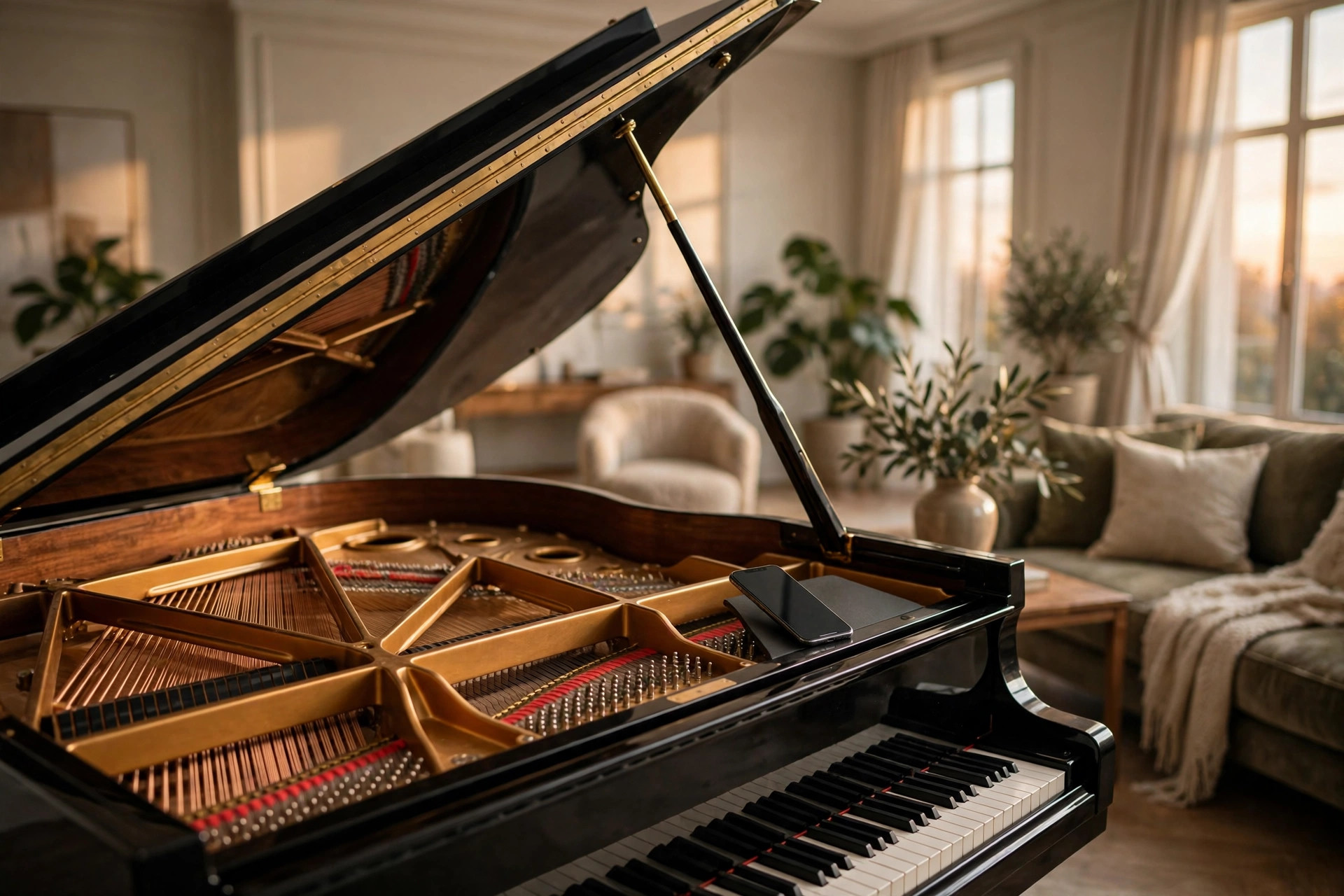
- Figure 1: System block diagram, in three columns: on the left, a grand piano with lid open and a smartphone on the music stand, with temperature and humidity tags; in the middle, the capture, Goertzel partial measurement, and joint ladder fit modules; on the right, the per-string verdict, the false-beat classifier, and the drift forecast.
- Figure 2: Inharmonicity diagram: partial number on the horizontal axis and cents sharp of the harmonic multiple on the vertical axis, with curves for B of 0.0001, 0.0004, and 0.001, showing the bend rising with the square of the partial number, and the measured partials of one string plotted as points on its curve.
- Figure 3: Unison separation diagram, in two panels: on the left, the spectrum near the fundamental of a trichord, where three peaks merge into one broad hump with a beat; on the right, the spectrum near partial 4, where the same three strings resolve into three separate peaks, one sitting 4.1 hertz below the other two.
- Figure 4: Beat-rate signature diagram: beat rate on the vertical axis against partial number on the horizontal axis, with a rising line through the origin for a detuned string and a flat line for a false beat, and the measured beat rates of the worked example plotted on each.
- Figure 5: Worked example dashboard, in three panels: on the left, the three fitted ladders for A4 with per-string f_0 and B; in the middle, the verdict card naming the flat string and its minus 4 cent deviation; on the right, the false-beat counter-example with a flat beat-rate line and a repair referral.
- Figure 6: Longitudinal drift view: per-string cents deviation on the vertical axis against date on the horizontal axis, with one line per string of a trichord, humidity shown as a shaded band behind the lines, and a dashed forecast extension to the 5-cent band.
Claims
- A system for assessing piano tuning and string health, comprising: a microphone of a smartphone, or a clip-on measurement microphone connected to a smartphone, positioned to record a piano note sounded with all strings of its unison unmuted; and a processor configured to measure partial frequencies of the recorded note, fit one, two, or three inharmonicity ladders jointly to the measured partials, each ladder defined by a fundamental frequency f_0 and an inharmonicity coefficient B under f_n = n times f_0 times the square root of (1 + B times n squared), and report, for each string in the unison, its fitted f_0, its fitted B, and its cents deviation from a target pitch computed from a per-piano stretch curve, thereby identifying which string in the unison has drifted without muting any string.
- The system of claim 1, wherein the processor fits each ladder by least squares on the straight-line form (f_n divided by n) squared = f_0 squared times (1 + B times n squared), using partial frequencies measured with Goertzel filters evaluated at predicted partial frequencies, and wherein model order is chosen by evidence, with each added ladder required to reduce the fit residual by at least 20 percent to be kept, and wherein a unison whose strings agree within 0.5 cent is reported as a single ladder.
- The system of claim 1, wherein the processor maps log B against note number across the keyboard, interpolates in log B, and computes the per-piano stretch curve by matching partials between neighboring notes from the measured B map, and wherein the target pitch for each note is set by that curve rather than by a published average curve.
- The system of claim 1, wherein the processor measures beat rates at partials 1, 2, and 4 of a note and classifies the note as detuning when the beat rates fit a straight line through the origin with slope equal to the fitted fundamental frequency gap and residuals under 15 percent, and as a false beat when the beat rates vary by less than 25 percent from their mean while the fitted per-string fundamentals agree within 0.5 cent, and as mixed when the note fits neither pattern.
- The system of claim 4, wherein the processor further classifies a false beat as a loose bridge pin where it is localized to one string, as a cracked bridge where false beats appear across several adjacent notes sharing a bridge section, and as a failing pinblock where a string will not hold pitch after adjustment or where tuning pin torque falls below the healthy range, and reports the classification with a referral for physical inspection.
- The system of claim 1, wherein the processor stores per-string cents deviation tagged with temperature and relative humidity at the time of recording, fits a drift rate in cents per month after removing the common seasonal movement, and forecasts, from at least three visits spanning at least 90 days, the date a string is expected to cross a 5-cent deviation band.
- The system of claim 1, wherein the processor tracks the fitted B map across visits and reports a possible soundboard or bridge coupling change, for physical inspection by a technician, where fitted B drifts smoothly across many notes in the same direction by more than the measurement noise, without diagnosing soundboard crown loss.
- The system of claim 1, wherein the processor computes a string health index on a 0 to 1 scale as the weighted sum of largest absolute cents deviation normalized by 10 cents with weight 0.50, false-beat strength normalized by the strongest false beat in the instrument's history with weight 0.25, and drift rate normalized by 2 cents per month with weight 0.25, and issues a watch notice at 0.3, a schedule-tuning notice at 0.6, and a technician-inspection notice at 0.85, wherein a large deviation alone never triggers the inspection notice.
- The system of claim 1, wherein the processor separates detuning from its mimics by rejecting frames whose broadband noise floor sits more than 50 percent above the quiet-room baseline, by excluding partials that match a neighboring note's fundamental within 0.5 hertz as sympathetic resonance, by using partial frequency rather than partial amplitude as evidence of pitch, and by reporting an unusable recording rather than a verdict where a practice mute or silent system is engaged.
- The system of claim 1, wherein the processor records the same note with the una corda pedal engaged, so the hammer strikes one fewer string, and uses the resulting second composite spectrum as a cross-check on the assignment of fitted ladders to strings.
- The system of claim 1, wherein the processor reports a pitch raise needed and withholds fine-tuning verdicts where the median deviation across the temperament octave sits below minus 10 cents, and wherein a repeat strike of the same note must return the same per-string f_0 values within 0.3 cent or the recording is rejected and the note is requested again.
- The system of claim 1, implemented as a smartphone application using the phone microphone, or as a technician kit with a clip-on measurement microphone, or as a fleet aggregator collecting per-string drift records across many pianos of the same model, and wherein audio is processed on the device and only derived features, comprising partial frequencies, fitted f_0 and B values, beat rates, and temperature and humidity tags, leave the device.
Prior Art References
- Railsback, O. L., "Scale Temperament as Applied to Piano Tuning," Journal of the Acoustical Society of America, 9(3):274 (1938): First measurement of the stretch tuning curve, bass flat and treble sharp of equal temperament
- Young, R. W., "Inharmonicity of Plain Wire Piano Strings," Journal of the Acoustical Society of America, 24(3):267-273 (May 1952): Measured inharmonicity of plain wire piano strings; Schuck and Young measured spectral inharmonicity in piano tones in 1943, and Fletcher, Blackham, and Stratton studied piano tone quality in 1962
- CMUSE, "Inharmonicity Calculator": B formula B = pi cubed times E times d to the fourth divided by 64 times T times L squared; midrange plain wire B 50 to 300 parts per million, tenor and bass wound strings 100 to 800 parts per million or more; partial frequency formula f_n = n times f_1 times the square root of (1 + B times n squared)
- Hirras, N., "Three Constants Dressed Up as Measurements" (2026): B roughly 0.0001 to 0.001 across a piano; partial 4 of a note with B of 0.0005 is about 7 cents sharp; (f_n divided by n) squared is a straight line in n squared for least-squares fitting; TuneLab 300 dollars, Verituner and CyberTuner 600 dollars; a five-foot spinet needs roughly double the stretch of a nine-foot concert grand
- HyperPhysics, "The Piano": A grand piano has about 230 strings for 88 keys, the ten lowest pitches with one wirewound string, the next 18 with two, and the last 60 with three; lowest notes tuned up to about 30 cents flat and the extreme upper end up to 30 cents sharp
- PianoMeter, "Piano Tuner: Professional Piano Tuning App for Android and iOS": Measures the inharmonicity of each note and automatically calculates the ideal stretch from equal temperament; samples inharmonicity for notes from A0 to C7
- Piano Street, "Trying out Entropy Piano Tuner": Entropy Piano Tuner requires recording every note and recommends recording only a single string, muting in the bichord and trichord sections; remaining strings tuned aurally
- US5285711A: Method and apparatus for tuning musical instruments, measuring inharmonicity on two or more notes and calculating an 88-note tuning curve from them (1994)
- US6613971B1: Electronic tuning system considering multiple partials of each and every note, with inharmonicity measured between partials (2003)
- US10475428B2: Electronic measuring device capturing an audio sample for each string, calculating an optimal tuning curve from the frequency components of each sample, and modeling the beating of combined strings (2019)
- Spiel, C., "String Termination Points," Seattle Piano Technicians Guild (2006): False beats from loose bridge pins and cracked bridges; a loose bridge pin tested by pressing the pin at different angles while playing the note; cracked bridges and loose bridge caps make a piano hard to tune
- Deptula, W. A., "The Effects of Deep Cycling of Humidity on Pianos," Piano Technicians Guild Journal: Soundboard swell raises pitch and drying lowers it; a 5 percent rise in humidity can raise pitch by 2 cents within 24 hours; drying relaxes the crown and can loosen soundboard joints and ribs
- Classic Pianos Portland, "Cost of Owning a Piano": A standard piano tuning costs roughly 150 to 250 dollars and most home pianos benefit from one or two tunings each year
Limitations
The method in this disclosure has not been validated against measurements from real pianos. Joint per-string fitting from an unmuted composite has not been demonstrated on a trichord with closely spaced strings, and the 0.1 cent effective precision, the 20 percent residual-reduction rule for adding a ladder, and the 15 and 25 percent beat-rate classification thresholds are engineering estimates, stated so they can be tested, not measured results. Strings in a unison are nominally identical in gauge and length, so their B values are close and separation rests mostly on f_0 differences at high partials; where partials above 4 have little energy, as in the top treble and on short spinets, the fit may fail and the system must say so rather than invent a verdict. Phone microphone placement, room acoustics, and the phone's own frequency response are untested variables, and a clip-on measurement microphone may be needed where the phone microphone proves inadequate. The soundboard crown inference is a hypothesis: no experiment here ties fitted B drift to crown height, and B drift could equally reflect string aging, bridge wear, or measurement drift. Nothing here should be read as evidence that any particular piano will drift at any particular rate or that any particular false beat has any particular cause without a technician's physical inspection.
The strongest case against this approach is that a trained tuner with felt mutes does this work by ear in seconds per note, and that PianoMeter and the Entropy Piano Tuner already measure inharmonicity and compute stretch curves, so the marginal value of automating per-string identification is small for anyone who already owns a tuning hammer. That case is fair for the professional, who is not the user here. It fails for the owner, the school, and the institution, who have no tuner on staff and no measurement between visits, and who today book tuning on a calendar and discover a loose bridge pin only after paying for a tuning that could not hold. A second fair objection is that beat-rate signatures may not separate cleanly in practice, because a detuned string and a false beat can coexist on the same note and because room reflections can distort measured beat rates, and the mixed classification in section 4 exists precisely because that objection may prove right. The fusion of per-string fitting, beat-rate classification, and longitudinal drift exists to give an owner an honest answer with a stated confidence, not to replace the tuner, and where the confidence is low the system must say so.
Implementation Notes
Build notes for whoever implements this. Ship the B map before the verdict. A per-string cents number without a measured B map for that piano is a guess with a decimal point, and the first owner who gets a verdict that contradicts what their tuner hears will never trust the second one. Require the scale capture, show the fitted B curve beside every verdict, and refuse a verdict where the fit residuals are large, reporting "insufficient separation" instead of a number. Do not ship a single-partial version. A fundamental-only pitch reading cannot tell a detuned string from a false beat, and it cannot separate three strings at all, so the multi-partial fit is not a nicety. It is the product. Calibrate the phone microphone against a reference tone at install, because phone microphones vary by model and a systematic frequency error would shift every verdict the same way and look like a piano-wide pitch problem. Present the false-beat verdict as the headline result whenever it fires, not as a footnote, because a false beat is the result that saves a wasted tuning visit, and an owner who sees "do not tune this note, call a technician" will believe the next verdict. Keep the on-device processing rule in every embodiment, because a piano recording made in a living room will not be adopted if it leaves the home, and it should not be. Never add a motor that turns the tuning pin: this disclosure assesses tuning, it does not perform it, and an automated wrench is a different product with different risks. Finally, validate on real pianos before claiming any threshold in this document: record trichords with known single-string detunings set by a technician with mutes, record notes with known loose bridge pins, and publish the confusion matrix, because the classification thresholds here are proposals until measured.