System and Method for Mobile Negative Pressure Ventilation Integrated with Powered Exoskeleton Locomotion for Ambient-Pressure Diving, Extreme Environment Operation, and Neuromuscular Respiratory Assistance
Abstract
Disclosed is a wearable mobile system integrating negative pressure ventilation (NPV) with a powered exoskeleton locomotion frame, enabling human operation in ambient-pressure underwater environments and low-atmosphere conditions with reduced respiratory muscle workload and enhanced physical endurance. The system, designated NPLX (Negative Pressure Locomotion Exoskeleton), comprises: (1) a segmented cuirass-style NPV torso assembly that creates localized negative pressure cycles around the thorax to drive pulmonary ventilation without requiring positive-pressure airway intubation; (2) a load-bearing powered exoskeleton frame distributing structural loads and providing actuated joint assistance for lower-limb and upper-limb movement; (3) an adaptive pressure-regulated interface layer between the NPV chambers and the body that maintains vacuum seal integrity during full-range torso articulation; (4) a closed-loop respiratory controller that monitors end-tidal CO₂, pulse oximetry, and ambient pressure to modulate NPV cycle frequency, inspiratory depth, and inspiratory-to-expiratory ratio in real time; and (5) a hybrid gas management system that delivers breathing gas at ambient pressure while the NPV chambers perform the mechanical work of chest wall expansion, decoupling gas delivery pressure from respiratory muscle effort. The NPLX system enables three operating modes: Mode A (ambient-pressure diving), where the suit operates at water depth pressure with NPV-assisted breathing and exoskeleton-enhanced seafloor locomotion; Mode B (low-atmosphere / contaminated environment), where the suit provides counter-pressure and NPV-assisted respiration in marginal atmospheres; and Mode C (terrestrial medical mobility), where the NPV torso and exoskeleton frame function as a wearable ventilator-mobility aid for patients with neuromuscular respiratory compromise.
Field of the Invention
This invention relates to wearable life support systems, specifically to the integration of negative pressure ventilation mechanics with powered exoskeleton locomotion frames for application in ambient-pressure diving, extreme environment operation, and terrestrial medical mobility assistance.
Background
The intersection of respiratory support and physical mobility has been addressed by three distinct technology lineages, none of which have been integrated into a unified wearable system.
Negative Pressure Ventilation (NPV) was the first mechanical ventilation technology, pioneered by the Drinker-Shaw iron lung (1928). NPV works by creating sub-atmospheric pressure around the patient's torso, causing the chest wall to expand passively and drawing air into the lungs through the natural airway — mimicking the physiology of spontaneous breathing. NPV was largely superseded by positive pressure ventilation (PPV) in the 1960s due to PPV's compatibility with anesthesia and easier airway management. However, NPV retains physiological advantages: it preserves natural airway humidification and mucociliary clearance, requires no intubation, and produces lower mean intrathoracic pressure, preserving cardiac preload. Modern NPV devices include the Hayek Paxippel cuirass ventilator, the exovent wearable NPV (developed during COVID-19, 2020), and the Breathe Global wearable system. All existing NPV devices are designed for stationary or limited-mobility terrestrial medical use. None are rated for underwater operation, none are integrated with powered locomotion, and none operate against ambient water pressure.
Atmospheric Diving Suits (ADS) maintain the suit interior at one atmosphere regardless of external depth, eliminating decompression requirements and pressure-related physiological effects. The Nuytco Exosuit (2010) and US Navy's Hard Suit 2000 represent the state of the art, with articulated rotary joints and thruster-based mobility. ADS suits solve the breathing problem by eliminating pressure differential — the occupant breathes normally because the entire suit is a 1-atm pressure vessel. This approach requires massive structural rigidity (the Exosuit weighs 530 lb), limits mobility, and costs $1-3M per unit. More fundamentally, the ADS approach scales poorly: containing 1 atm against increasing depth requires progressively heavier structures, making deep ADS suits heavier and less mobile.
Powered Exoskeletons have matured for terrestrial applications (Ekso Bionics, ReWalk, Sarcos Guardian XO) and have recently been adapted for underwater use. In November 2025, researchers demonstrated the first portable underwater exoskeleton for diving performance enhancement (TechXplore, 2025). However, existing underwater exoskeletons are force-amplification devices that do not integrate with life support or respiratory systems. The exoskeleton enhances movement but the diver still breathes through conventional SCUBA or surface-supplied gas, with respiratory muscles performing all chest expansion work against ambient water pressure.
The gap in the art is clear: no existing system combines NPV respiratory mechanics with powered exoskeleton locomotion. The three lineages remain separate. Iron lungs are stationary or limited-mobility. ADS suits eliminate breathing difficulty through brute-force pressure containment. Exoskeletons enhance movement but ignore breathing. The NPLX system closes this gap by recognizing that NPV mechanics and exoskeleton frames share a common structural requirement — a rigid or semi-rigid chassis adjacent to the torso — and that combining them creates a synergistic system lighter and more capable than either approach alone.
Core Insight
The NPLX system is founded on a non-obvious insight: the structural frame required to maintain NPV chamber geometry against ambient pressure is the same structural frame required to mount exoskeleton actuator joints. In isolation, a wearable NPV cuirass needs rigid torso plates to resist deformation under negative pressure cycles. In isolation, an exoskeleton needs a rigid torso frame to mount hip and shoulder actuator joints and to distribute payload loads. These are the same structure. By integrating them, the NPLX achieves two functions with one set of structural mass — a weight efficiency that neither system can achieve alone.
This insight resolves the fundamental limitation of both ADS and SCUBA approaches:
- ADS limitation: Maintaining 1 atm requires a pressure vessel. Weight scales linearly with depth. At 300m, the Exosuit weighs 530 lb. The NPLX operates at ambient pressure (like SCUBA), so the suit shell only needs to resist differential pressure from the NPV chambers (0.5-2 kPa), not the full 30+ atm ambient pressure. This reduces structural requirements by two orders of magnitude.
- SCUBA limitation: At depth, respiratory muscles must expand the chest against ambient water pressure. Work of breathing increases with depth, eventually limiting dive duration even when gas supply remains. The NPLX's NPV chambers perform this mechanical work, reducing or eliminating respiratory muscle fatigue.
Detailed Description
1. Segmented NPV Torso Assembly
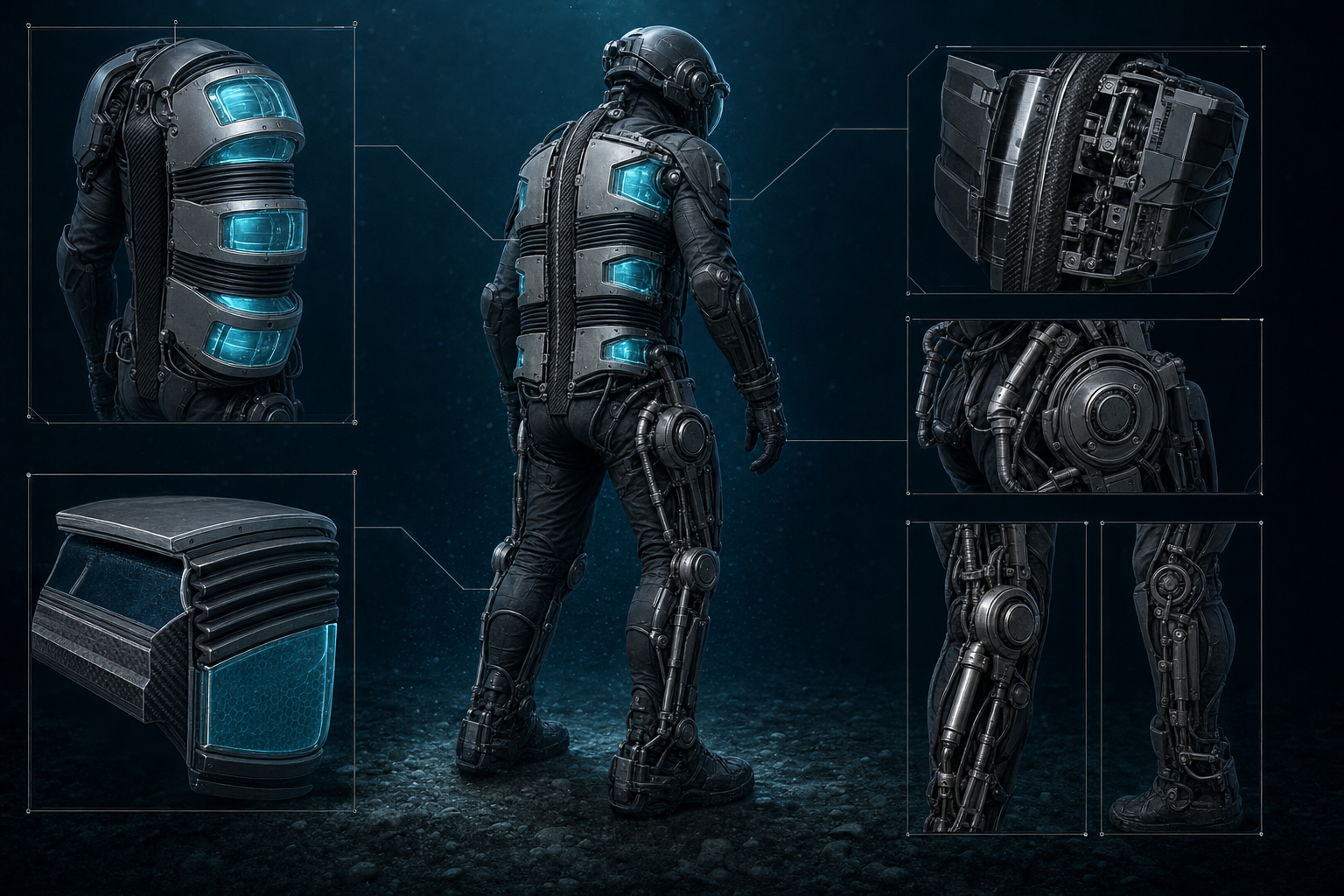
The NPV torso assembly consists of four overlapping rigid polymer-composite segments (designated S1-S4) arranged circumferentially around the thorax and upper abdomen:
- S1 (Upper Thoracic): Covers clavicle to T4 vertebra. Hinged bilaterally at the mid-axillary line to allow shoulder rotation. Contains primary NPV bellows chamber.
- S2 (Mid-Thoracic): Covers T4-T8. Largest chamber volume. Rigid posterior plate serves as the primary mounting interface for the exoskeleton spinal column member.
- S3 (Lower Thoracic / Upper Abdominal): Covers T8-L1. Contains secondary NPV bellows chamber. Hinged anteriorly to allow forward flexion.
- S4 (Lumbar Interface): Covers L1-L4. Non-NPV structural segment that transfers exoskeleton hip loads to the torso frame. Contains battery compartment and NPV pump assembly.
Each NPV segment is separated from its neighbor by a flexible bellows joint (rated for 0.5-3.0 kPa differential pressure cycling at 8-30 cycles/min for >100,000 cycles). The bellows allow segment-to-segment angular displacement of ±22° in the sagittal plane and ±12° in the coronal plane, permitting the torso articulation needed for walking, reaching, and climbing.
Negative pressure is generated by a dual-chamber rotary vane pump (designated NP-PUMP) mounted in the S4 lumbar segment, drawing 0.5-2.0 L of air per cycle from the sealed NPV chambers at 0.5-3.0 kPa below ambient. Pump speed is variable (800-4000 RPM) and controlled by the respiratory controller (Section 4). Exhaust air is routed to the buoyancy compensator bladder, recovering pump work for buoyancy control — a secondary efficiency unique to the integrated design.
2. Powered Exoskeleton Frame
The exoskeleton frame uses the NPV torso assembly as its structural core. No additional chassis members are required for torso mounting — the NPV segments S2 and S4 serve this role directly. The exoskeleton consists of:
- Spinal column member: A carbon-fiber spine running posteriorly along S2-S4, providing the load path between upper and lower limb actuator mounts. Cross-section: 40mm × 20mm elliptical, 180g.
- Hip actuator assemblies (L/R): Brushless DC rotary actuators (200 W peak, 60 W continuous per hip) mounted at the S4-limb interface. 3-DOF (flexion/extension, abduction/adduction, internal/external rotation) with 90:1 harmonic gear reduction. Provides 40 Nm peak assistive torque per joint.
- Knee actuator assemblies (L/R): 150 W peak BLDC rotary actuators with series elastic elements (SEA) for compliant ground contact. 1-DOF (flexion/extension). 60:1 planetary reduction. Provides 30 Nm peak torque.
- Shoulder actuator assemblies (L/R, optional Mode A/C): 100 W peak BLDC, 2-DOF (flexion/extension, abduction/adduction). 50:1 harmonic reduction. 25 Nm peak torque. Can be omitted for diving-only configurations.
- Foot assemblies: Rigid-soled boots with force-sensing insoles (four load cells per foot) providing ground reaction force data to the locomotion controller. For diving mode, integrated fins fold down from the ankle segment.
For diving applications (Mode A), the exoskeleton is configured for lower-limb only, with hip and knee actuators providing seafloor walking assistance against current drag and water resistance. The system is not designed for swimming — it is designed for bottom traversal, climbing, and heavy object manipulation at depth. Estimated locomotion assist: 60-70% reduction in metabolic cost of walking compared to unassisted diving at equivalent depth.
3. Adaptive Pressure Interface Layer
The critical engineering challenge is maintaining NPV chamber seal integrity during full torso articulation. The interface layer between the rigid NPV segments and the body is a three-layer composite:
- Layer 1 (Body Contact): 2mm medical-grade silicone with contoured rib geometry matching intercostal spacing. Provides biocompatible skin interface and partial compression of soft tissue to reduce NPV chamber volume dead space.
- Layer 2 (Active Seal): 0.5mm thermoplastic polyurethane (TPU) membrane with embedded resistive heating trace (2W, 37°C setpoint). Body warmth maintains TPU flexibility. The membrane is tensioned across segment gaps by micro-actuated cable tendons (nitinol SMA wires, 0.3mm diameter) that adjust tension in response to segment angular displacement — maintaining 0.5N seal compression force per cm of gap edge at all articulation angles.
- Layer 3 (Pressure Distribution): 3mm closed-cell neoprene foam that distributes localized pressure points from segment edges across a wider skin contact area, preventing pressure ulcers during extended wear (>4 hours).
The adaptive seal system accommodates the full range of human torso motion: forward flexion 40°, extension 20°, lateral flexion 25° per side, axial rotation 30°. Seal integrity is monitored by differential pressure sensors at each segment gap; loss of seal >0.3 kPa triggers automatic pump speed increase and cable tension adjustment within 200ms.
4. Closed-Loop Respiratory Controller
The respiratory controller (designated RC-1) is the system's safety-critical component. It monitors the user's ventilation status and adjusts NPV parameters in real time.
Sensor inputs:
- End-tidal CO₂ (EtCO₂) via nasal cannula micro-sensor (40-60 mmHg normal range)
- Pulse oximetry (SpO₂) via wrist-mounted reflectance sensor (>95% normal)
- Ambient pressure via piezoresistive transducer (0.1-100 atm absolute)
- NPV chamber pressure via differential pressure sensors (±5 kPa, ±0.01 kPa resolution)
- Respiratory rate via impedance pneumonography electrodes on S1 inner surface
- Tidal volume estimation via NPV chamber displacement calculation (chamber volume change per cycle)
Control algorithm: The RC-1 uses a model-predictive controller with a 5-second prediction horizon. The controller adjusts:
- Negative pressure depth: 0.5-3.0 kPa below ambient, proportional to target tidal volume (6-12 mL/kg ideal body weight)
- Inspiratory time: 0.8-1.5 seconds (adjustable based on EtCO₂)
- Expiratory time: 1.2-3.0 seconds (I:E ratio 1:1.5 to 1:2.5)
- Respiratory rate: 8-20 breaths/min (adaptive based on EtCO₂ with 2 mmHg deadband)
In diving mode (Mode A), the controller increases target tidal volume by 15% per 10m depth to compensate for increased gas density (Boyle's law effects on airway resistance). In low-atmosphere mode (Mode B), the controller adjusts for reduced ambient oxygen partial pressure by increasing respiratory rate proportionally.
Safety layer: The RC-1 includes hardware watchdog timers, dual-redundant pressure sensors, and a mechanical fail-open valve that vents NPV chambers to ambient if chamber pressure exceeds 3.5 kPa differential or if electronic control is lost. The fail-open valve is passive — it requires no power to activate and defaults to the open (safe) position.
5. Hybrid Gas Management System
For diving (Mode A), the NPLX does not replace traditional gas delivery — it supplements it. The diver still breathes ambient-pressure gas via regulator (open-circuit SCUBA or rebreather). The innovation is that the NPV chambers perform the mechanical work of breathing, reducing the respiratory muscle effort required to expand the chest against ambient pressure.
This decoupling of gas delivery from breathing mechanics has several consequences:
- Reduced work of breathing (WOB): At 30m depth, typical SCUBA WOB is 1.5-3.0 J/L due to gas density and regulator resistance. The NPV chambers can provide 1.0-2.5 J/L of assistive work, reducing effective WOB to 0.5-1.0 J/L — comparable to surface breathing.
- Extended dive duration: Respiratory muscle fatigue is a primary limiting factor in extended dives. By offloading this work, the NPLX extends the physiological dive limit independently of gas supply.
- Reduced CO₂ retention: CO₂ retention is a major risk in deep diving, driven by increased breathing effort. By reducing WOB, the NPLX improves CO₂ elimination and reduces hypercapnia risk.
- Gas mixture compatibility: The NPV system is gas-agnostic. It works with air, nitrox, trimix, or heliox. For deep diving, heliox compatibility is significant — the low density of helium reduces turbulent airway resistance, and the NPV system further reduces the remaining laminar-flow work.
6. Power System
The NPLX is powered by a modular battery system in the S4 lumbar segment:
- Primary batteries: Two interchangeable 48V, 20Ah lithium-ion packs (960 Wh each, 1920 Wh total). Hot-swappable via waterproof connectors. Each pack: 2.4 kg.
- Endurance: At typical operating load (NPV pump + exoskeleton walking assist), total system draw is approximately 180W continuous (60W pump + 120W locomotion). 1920 Wh provides ~10 hours of operation. In NPV-only mode (stationary breathing assist), draw drops to 60W, providing ~32 hours.
- Underwater charging (Mode A): Optional tethered power for saturation dive operations or surface-supplied configurations. Umbilical provides 48V DC at 10A, maintaining charge indefinitely.
- Emergency reserve: 10% battery capacity is reserved in a separate circuit for fail-safe NPV operation (minimum 30 minutes of breathing support after main battery depletion).
Operating Modes
Mode A: Ambient-Pressure Diving
In diving mode, the NPLX suit operates at ambient water pressure. The suit is NOT a pressure vessel — water pressure is transmitted to the body through the suit (as in standard wetsuit/drysuit diving). The NPV chambers create localized negative pressure around the thorax to assist breathing, while the exoskeleton provides powered locomotion for bottom traversal.
The diver wears a standard dive mask or full-face mask with regulator. Gas is supplied via SCUBA cylinders (back-mounted, integrated with the S4 frame), rebreather, or surface supply. The NPV chambers are sealed against the body by the adaptive interface layer, with exhaust air from the NPV pump routed to the buoyancy compensator.
Depth rating: 0-50m (recreational/technical limit with NPV assist). The NPV system is depth-limited by the pump's ability to generate sufficient negative pressure against increasing ambient pressure. At 50m (6 atm), the pump must generate 3.0 kPa differential against 600 kPa ambient — well within the pump's 5 kPa rating, but chamber seal integrity becomes the limiting factor at greater depths.
Mode B: Low-Atmosphere / Contaminated Environment
For low-atmosphere operation (high altitude, marginal-oxygen environments, contaminated atmospheres), the NPLX is configured with a full-body pressure garment overlay. The NPV chambers provide respiratory assist while the exoskeleton provides locomotion in challenging terrain. Gas is supplied from a backpack-mounted life support system (oxygen bottles with CO₂ scrubber). This mode is relevant for:
- High-altitude operations (>5000m) where reduced atmospheric pressure impairs spontaneous ventilation
- Firefighting in smoke-filled environments where respiratory protection and physical exertion are both required
- Hazmat response requiring both mobility and extended-duration respiratory support
Mode C: Terrestrial Medical Mobility
For medical applications, the NPLX functions as a wearable ventilator-mobility aid. The NPV torso provides non-invasive ventilation for patients with neuromuscular conditions (ALS, muscular dystrophy, post-polio syndrome, high cervical spinal cord injury) who require respiratory support but wish to remain mobile. The exoskeleton frame provides powered walking assistance for patients with concurrent mobility impairment.
This mode eliminates the need for the heavy underwater-rated components. The medical configuration weighs approximately 8 kg total (NPV torso + lower-limb exoskeleton), compared to 22 kg for the diving configuration. The NPV pump runs on battery power for 8+ hours, and the exoskeleton provides partial weight-bearing and propulsion assistance during activities of daily living.
The medical mode represents a significant advance over existing NPV devices (which are stationary or limited-mobility) and existing exoskeletons (which provide no respiratory support). For the approximately 50,000 ALS patients in the US alone — 80% of whom experience respiratory compromise during disease progression — the NPLX medical mode could extend independent mobility duration by months to years.
Novelty Analysis
The NPLX system differs from all existing prior art in combining three previously separate capabilities into a unified wearable platform:
- vs. Iron Lung / wearable NPV (exovent, Breathe Global, Hayek Paxippel): Existing NPV devices are not rated for ambient-pressure underwater operation, are not integrated with powered locomotion, and cannot operate against water pressure. The NPLX's adaptive seal system and depth-rated pump are novel.
- vs. Atmospheric Diving Suits (Nuytco Exosuit, WASP, HARD): ADS suits maintain 1 atm internally and solve breathing by eliminating pressure differential. They do not use NPV mechanics. They are far heavier (530 lb vs. ~22 kg NPLX diving configuration) and are not wearable in the conventional sense — the occupant is supported by the suit's structure, not by their own legs. The NPLX's ambient-pressure operation with NPV breathing assist is fundamentally different.
- vs. Underwater exoskeletons (2025 portable diving exoskeleton): Existing underwater exoskeletons provide force amplification but no respiratory support. The diver still performs all breathing work. The NPLX's integration of NPV breathing mechanics into the exoskeleton frame is novel.
- vs. Medical exoskeletons (Ekso, ReWalk, Sarcos): Medical exoskeletons provide mobility assistance but no ventilation. Medical ventilators provide ventilation but no mobility. The NPLX's combination in Mode C is novel for the medical device space.
Non-Obviousness
The integration of NPV with exoskeleton locomotion is non-obvious for several reasons:
1. Different technical communities. NPV research is conducted in respiratory medicine and critical care. Exoskeleton research is conducted in robotics and rehabilitation engineering. Diving life support is conducted in marine engineering and hyperbaric medicine. These communities do not overlap, and the insight that their structural requirements could be unified has not been proposed.
2. NPV was abandoned for diving. The diving community adopted positive-pressure breathing (regulators) in the 1940s and has never revisited NPV for underwater use. The assumption is that NPV requires a rigid sealed chamber incompatible with mobility — an assumption that persisted because nobody considered that the exoskeleton frame could serve double duty as the NPV chamber structure.
3. Exoskeleton frames were not recognized as pressure vessels. The structural requirement of an exoskeleton torso mount (rigid, load-bearing, form-fitting to the body) is functionally identical to the structural requirement of a cuirass NPV chamber (rigid, sealed, form-fitting to the thorax). This functional equivalence has not been recognized in either the exoskeleton or NPV literature.
Claims
- A wearable mobile system integrating negative pressure ventilation with a powered exoskeleton locomotion frame, comprising: a segmented cuirass-style NPV torso assembly creating localized negative pressure around the thorax; a powered exoskeleton frame using said NPV torso assembly as structural mounting interface; an adaptive pressure interface layer maintaining NPV chamber seal during torso articulation; a closed-loop respiratory controller modulating NPV parameters based on physiological feedback; and a hybrid gas management system compatible with ambient-pressure diving gas delivery.
- The system of claim 1, wherein said NPV torso assembly comprises four overlapping rigid segments separated by flexible bellows joints, allowing torso angular displacement of ±22° sagittal and ±12° coronal while maintaining chamber seal.
- The system of claim 1, wherein said adaptive pressure interface layer comprises a three-layer composite of medical-grade silicone, thermoplastic polyurethane membrane with embedded nitinol cable-tension micro-actuators, and closed-cell neoprene foam, maintaining seal integrity across the full human torso range of motion.
- The system of claim 1, wherein said closed-loop respiratory controller adjusts negative pressure depth, inspiratory time, expiratory time, and respiratory rate based on end-tidal CO₂, pulse oximetry, ambient pressure, and estimated tidal volume, using a model-predictive controller with a 5-second prediction horizon.
- The system of claim 1, wherein NPV pump exhaust air is routed to a buoyancy compensator bladder, recovering pump work for buoyancy control.
- The system of claim 1, configured for ambient-pressure diving at 0-50m depth, wherein the suit operates at ambient water pressure and the NPV chambers perform mechanical work of breathing against ambient pressure, reducing effective work of breathing by 50-70% compared to unassisted SCUBA at equivalent depth.
- The system of claim 1, configured for low-atmosphere operation with a full-body pressure garment overlay, providing respiratory assist and powered locomotion in environments with reduced oxygen partial pressure or atmospheric contamination.
- The system of claim 1, configured for terrestrial medical mobility assistance, weighing less than 8 kg total, providing non-invasive ventilation and powered walking assistance for patients with neuromuscular respiratory compromise.
- The system of claim 1, wherein the structural frame serving as NPV chamber reinforcement and exoskeleton actuator mounting is a single integrated carbon-fiber chassis, achieving structural weight efficiency that neither an NPV-only nor exoskeleton-only system can achieve independently.
- The system of claim 4, further comprising a passive fail-open mechanical valve that vents NPV chambers to ambient pressure upon loss of electronic control or chamber overpressure, requiring no electrical power to activate.
Acknowledgments: The core concept — combining iron lung mechanics with exoskeleton movement in a mobile platform — was proposed by Ray during a JC Dream group discussion (July 9, 2026). This disclosure formalizes the engineering analysis and extends the concept across diving, extreme environment, and medical applications. The observation that NPV chamber structural requirements and exoskeleton mounting requirements are functionally identical is, to our knowledge, original.
Prior art search keywords: mobile iron lung, wearable negative pressure ventilator, atmospheric diving suit, underwater exoskeleton, cuirass ventilator diving, NPV exoskeleton, ambient pressure breathing assist, respiratory support diving, neuromuscular ventilator mobility.