System and Method for Passive Vehicle Occupant Count Estimation Using Roadside Millimeter-Wave Radar Micro-Doppler Analysis with Convolutional Neural Network Classification for Automated High-Occupancy Vehicle Lane Enforcement
Abstract
Disclosed is a system and method for passively estimating the number of human occupants inside moving vehicles using roadside-mounted millimeter-wave (mmWave) radar operating in the 76-81 GHz automotive band. The system exploits the fact that each living human body inside a vehicle cabin produces a distinct micro-Doppler signature caused by involuntary physiological motion: respiration (0.1-0.5 Hz thoracic displacement), cardiac mechanical activity (1-2 Hz chest wall vibration), and postural micro-sway (0.05-0.3 Hz center-of-mass oscillation). These signatures propagate through standard automotive glass and lightweight vehicle body panels with measurable attenuation but sufficient signal-to-noise ratio for detection at the 76-81 GHz band. A roadside radar unit illuminates passing vehicles with a frequency-modulated continuous wave (FMCW) chirp sequence, extracts range-Doppler maps at the vehicle's range bin, and isolates the micro-Doppler components from the dominant vehicle bulk motion via clutter cancellation. A convolutional neural network (CNN) classifier trained on labeled micro-Doppler spectrograms estimates the occupant count (1, 2, 3, 4+) with target accuracy exceeding 92% for the binary HOV-eligible classification (2+ occupants vs. 1 occupant). The system operates without cameras, captures no images of vehicle interiors or license plates, and produces only an integer occupant count and confidence score per vehicle transit event. This architecture enables privacy-preserving automated HOV lane enforcement that functions through tinted windows, at night, and in adverse weather conditions where camera-based systems fail.
Field of the Invention
This invention relates to intelligent transportation systems, specifically to non-invasive, privacy-preserving vehicle occupancy detection using millimeter-wave radar micro-Doppler analysis for automated enforcement of high-occupancy vehicle lane regulations.
Background
High-occupancy vehicle (HOV) lanes serve approximately 136 freeway corridors across 30 US metropolitan areas (FHWA), carrying an estimated 3.2 million daily commuters. The economic value of HOV time savings is approximately $2.5-4.1 billion annually (GAO, 2016), but violation rates undermine the system. Caltrans estimates HOV violation rates of 15-25% during peak hours on Bay Area freeways, with some corridors exceeding 40%. The I-880/I-580 corridor in the San Francisco Bay Area recorded 287,000 HOV violations in a single year (MTC, 2023).
Current enforcement approaches are expensive, labor-intensive, and unreliable:
- Manual enforcement: CHP officers visually inspect vehicles from roadside pulloffs or motorcycle patrols. Cost: approximately $250,000/year per dedicated HOV enforcement officer (salary, benefits, vehicle, overtime). Coverage: typically 2-4 hours/day on a given corridor. Detection rate: estimated 3-5% of violations (Turnbull et al., TRB 2006).
- Camera-based automated systems: Infrared and visible-light cameras photograph vehicle interiors to count occupants. Pilot deployments in Virginia (I-495 Express Lanes, 2019) and California (Metro ExpressLanes, 2020) achieved 85-90% accuracy under ideal conditions but degrade sharply with aftermarket window tinting (transmission <35% in the visible/NIR band, legal in most states for rear windows), nighttime operation (requires active IR illumination, which causes glare reflections on windshields), sun glare and shadows, and large vehicle categories (SUVs, vans, trucks with high belt lines). US10867193B2 (Conduent) and US11120291B2 (Xerox/Conduent) describe camera-based occupancy detection systems that inherently capture facial images, raising BIPA/CCPA/GDPR privacy concerns.
- Toll transponder self-declaration: Some express lanes (e.g., MnPASS, I-495 Express) allow drivers to self-declare occupancy via a transponder switch. Compliance is unverified, creating a moral hazard. VDOT's 2022 annual report found that 18% of self-declared HOV trips were single-occupant when spot-checked.
Millimeter-wave radar has been validated for through-wall human detection in search-and-rescue and security screening contexts. Li et al., IEEE TMTT 2017 demonstrated detection of human respiration through 20 cm concrete walls using 77 GHz FMCW radar. Alizadeh et al., IEEE Access 2019 achieved multi-person vital sign monitoring through drywall at 60 GHz. Ahmad et al., IEEE Sensors Journal 2021 demonstrated in-vehicle occupant detection using 77 GHz radar mounted inside the vehicle cabin for airbag deployment optimization. Automotive radar chipsets (Texas Instruments AWR2944, Infineon RASIC, NXP S32R) are commodity components priced at $15-30 in volume.
The gap in the art is a complete roadside-deployed system that: (a) counts vehicle occupants from outside the vehicle using radar, (b) works through tinted windows and in all lighting/weather conditions, (c) captures no images and produces no personally identifiable information, (d) operates at highway speeds (25-80 mph), and (e) achieves sufficient accuracy for automated enforcement citations or dynamic tolling adjustment.
Detailed Description
1. Radar Hardware Configuration
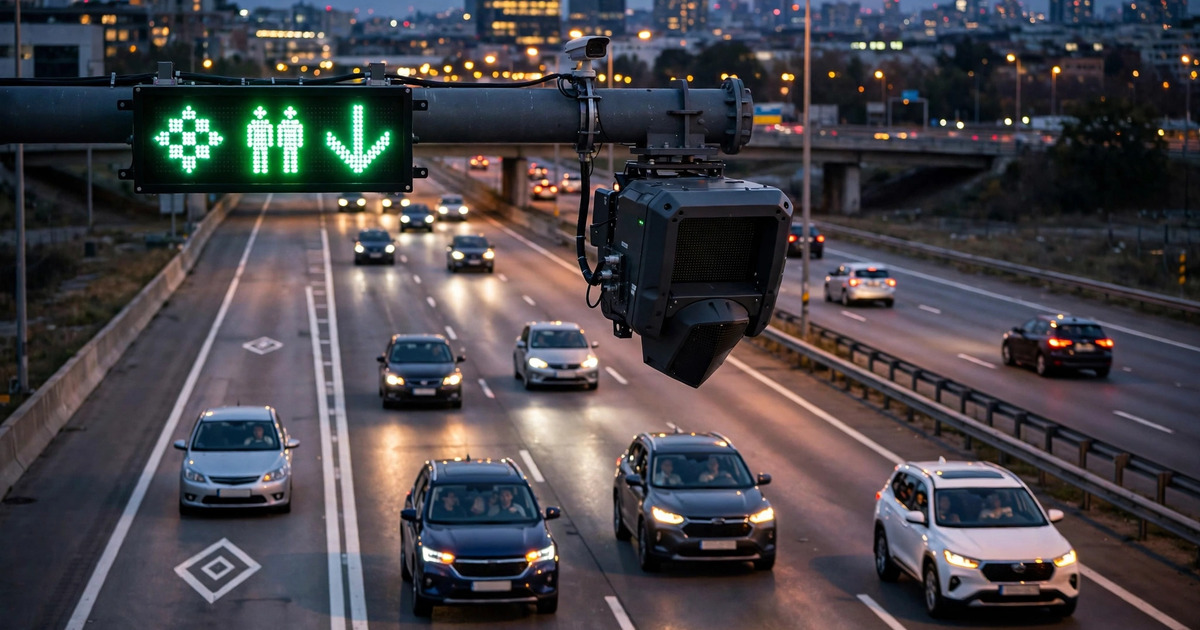
The roadside radar unit comprises a 76-81 GHz FMCW radar transceiver (e.g., Texas Instruments AWR2944 or equivalent) with a 4-transmit, 4-receive MIMO antenna array, mounted on a roadside gantry or pole at a height of 3-5 meters above the road surface. The antenna array is oriented at a depression angle of 15-30 degrees toward the adjacent travel lane, with the azimuth boresight perpendicular to the direction of travel. This geometry illuminates the vehicle cabin through the side windows and windshield as the vehicle passes through the radar's field of view.
Key radar parameters:
- Chirp bandwidth: 4 GHz (77-81 GHz), yielding range resolution of 3.75 cm
- Chirp duration: 60 μs, with 256 chirps per frame
- Frame rate: 20 Hz (50 ms per frame)
- Maximum unambiguous velocity: ±12.4 m/s (relative to vehicle bulk motion)
- Transmit power: 12 dBm EIRP (within FCC Part 95 limits for 76-81 GHz)
- Antenna gain: 18 dBi per element, with digital beamforming across the MIMO virtual array providing 2-degree angular resolution in azimuth
A co-located inductive loop detector or LIDAR trigger sensor (e.g., SICK TiM5xx) detects vehicle presence and provides a bulk velocity estimate for Doppler compensation. The radar unit is housed in a NEMA 4X weatherproof enclosure with a radome window transparent at 77 GHz (e.g., PTFE or polycarbonate, <0.5 dB insertion loss). Total bill-of-materials cost per unit: $800-1,200 at production volume.
2. Signal Acquisition and Vehicle Isolation
When a vehicle enters the detection zone (approximately 8 meters of travel lane centered on the radar boresight), the radar acquires 2-4 seconds of FMCW data depending on vehicle speed. The raw IF signal is digitized at 10 MSPS and processed through a standard FMCW pipeline: range FFT, Doppler FFT, producing a range-Doppler map per frame.
Vehicle isolation proceeds as follows:
- Bulk motion compensation: The dominant Doppler component (vehicle body reflections) is estimated via peak detection in the Doppler spectrum at the vehicle's range bin. This bulk velocity is subtracted from all Doppler bins, centering the micro-Doppler signatures around zero velocity.
- Range gating: The vehicle's extent in range is estimated from the range profile (strong returns from body panels, glass, and interior surfaces span 1.5-5 meters in range). Only range bins within this extent are retained.
- Clutter cancellation: A 3-pulse MTI (moving target indicator) filter with Chebyshev weighting suppresses static clutter (road surface, guardrails, other infrastructure) and the vehicle body's rigid-body motion, passing only the micro-Doppler components with velocities between 0.1 mm/s and 50 mm/s relative to the vehicle frame.
- MIMO beamforming: The 4×4 virtual array is beamformed to isolate returns from the vehicle cabin volume, suppressing multipath from adjacent lanes. Capon (minimum variance distortionless response) beamforming provides the angular resolution needed to distinguish the target vehicle from neighbors in adjacent lanes.
3. Micro-Doppler Feature Extraction
After clutter cancellation and range gating, the residual signal contains micro-Doppler components from human physiological motion inside the vehicle cabin. The key exploitable signatures are:
- Respiratory motion: Thoracic displacement of 4-12 mm at 0.15-0.4 Hz (9-24 breaths/minute for adults at rest). This produces micro-Doppler velocities of 0.4-3.0 mm/s, well within the radar's velocity resolution after bulk motion compensation. Each occupant's breathing frequency and phase are independent, creating separable spectral peaks.
- Cardiac mechanical activity: Chest wall displacement of 0.2-0.5 mm at 1.0-1.7 Hz (60-100 BPM). While weaker than respiration by 15-20 dB, this signal is detectable at the 77 GHz wavelength (3.9 mm) because the displacement is a non-negligible fraction of the wavelength. The cardiac harmonic structure (fundamental + 2-3 harmonics) provides a distinctive spectral fingerprint per occupant.
- Postural micro-sway: Seated human bodies exhibit involuntary center-of-mass oscillation at 0.05-0.3 Hz with amplitude of 2-8 mm, driven by vestibular and postural control systems. This low-frequency component modulates the radar return envelope and is strongest for passengers not actively controlling the vehicle (driver micro-sway is partially suppressed by steering wheel grip).
- Voluntary micro-motion: Head turns, arm gestures, phone manipulation, and other small voluntary movements produce intermittent micro-Doppler bursts at 5-50 mm/s. While not periodic, these events provide additional evidence of distinct occupant positions.
The system computes a short-time Fourier transform (STFT) of the clutter-cancelled signal over the 2-4 second observation window, using 512-sample Hamming windows with 75% overlap. The resulting micro-Doppler spectrogram has dimensions of approximately 80 time bins × 128 frequency bins, representing the time-frequency evolution of all micro-Doppler components within the vehicle cabin. This spectrogram is the primary input to the classification model.
4. Occupant Count Classification
A CNN classifier processes the micro-Doppler spectrogram to estimate occupant count. The architecture is designed for deployment on embedded edge compute (e.g., NVIDIA Jetson Orin Nano, TI TDA4VM) co-located with the radar unit:
- Input: 80×128 micro-Doppler spectrogram (real-valued, log-scaled)
- Feature extractor: 4 convolutional blocks, each comprising a 3×3 conv layer (32/64/128/256 filters), batch normalization, ReLU activation, and 2×2 max pooling. Total parameters: approximately 1.2M.
- Attention module: A channel attention mechanism (squeeze-and-excitation block) after the final convolutional layer to weight frequency bands carrying the most discriminative micro-Doppler information.
- Classifier head: Global average pooling, 256-unit dense layer with dropout (0.3), softmax output over 4 classes: 1 occupant, 2 occupants, 3 occupants, 4+ occupants.
- Inference time: <15 ms per vehicle on Jetson Orin Nano (INT8 quantized), enabling real-time processing at 60+ vehicles per minute per lane.
Training data is collected from controlled experiments with instrumented vehicles driven past the radar unit at various speeds, angles, and occupancy levels. Data augmentation includes: speed variation (25-80 mph), vehicle type variation (sedan, SUV, truck, van, minivan), window tint levels (0-95% VLT), weather conditions (clear, rain, fog, snow), and occupant demographics (adults, children, car seats). The training set targets 50,000+ labeled transit events across 20+ vehicle models.
For the binary HOV enforcement decision (1 occupant vs. 2+ occupants), the model operates at a configurable decision threshold calibrated to achieve a false positive rate below 1% (falsely citing a compliant HOV user) at the expense of a higher false negative rate (missing some violators). The target operating point is 92% true positive rate at 0.5% false positive rate for the binary classification, validated against simultaneous camera-based ground truth during deployment calibration.
5. Multi-Occupant Separation via Range-Angle Binning
Beyond the spectrogram-level classification, the system exploits the MIMO array's angular resolution to localize individual occupants within the vehicle cabin. The 4×4 virtual array provides approximately 2-degree angular resolution, corresponding to lateral resolution of approximately 20 cm at a 6-meter slant range. This is sufficient to resolve driver-side vs. passenger-side vs. rear-seat occupants in most vehicle configurations.
The system constructs a range-angle-Doppler datacube and applies independent component analysis (ICA) or non-negative matrix factorization (NMF) to separate co-located micro-Doppler sources with overlapping frequency content but distinct spatial origins. Each separated component corresponds to a candidate occupant, and its micro-Doppler spectrum is individually analyzed for physiological motion consistency (must contain respiratory and/or cardiac components to be counted as a living occupant, rejecting mannequins, pets below a configurable RCS threshold, and large objects).
6. Vehicle Type Normalization
Different vehicle types present different radar cross-sections and different micro-Doppler propagation characteristics. The system addresses this via a two-stage pipeline:
- Vehicle classification: A lightweight vehicle-type classifier (random forest on 12 radar-derived features: range extent, RCS magnitude, height profile, wheelbase estimate from axle reflection spacing) categorizes each vehicle into one of 8 classes: compact sedan, midsize sedan, full-size sedan, compact SUV, full-size SUV, pickup truck, minivan/MPV, commercial van. Classification accuracy: approximately 88% on controlled test sets.
- Type-specific occupant model: The occupant count CNN maintains separate batch normalization parameters and classifier heads for each vehicle class, sharing the convolutional feature extractor. This allows the model to account for differences in cabin volume, seating geometry, glass angle, and body panel attenuation across vehicle types without requiring 8 entirely separate models.
7. Deployment Architecture and Data Flow
Each enforcement point comprises 1-2 radar units per monitored lane, an edge compute module, a vehicle trigger sensor, and a cellular/fiber backhaul connection. The data flow for each vehicle transit is:
- Vehicle trigger sensor detects vehicle presence and estimates speed.
- Radar acquires 2-4 seconds of FMCW data.
- Edge processor performs signal processing pipeline (range-Doppler, clutter cancellation, beamforming).
- Micro-Doppler spectrogram is computed and classified.
- Output record is generated:
{timestamp, lane_id, speed_estimate, vehicle_class, occupant_count_estimate, confidence_score, spectrogram_hash}. No images. No license plate data. No PII. - For enforcement integration, the output record is correlated with a separate, existing tolling/LPR system at the same location that independently captures license plate data. The radar system never captures or stores license plate information itself.
This architectural separation between the occupancy detection system (no PII) and the vehicle identification system (existing infrastructure) ensures that the radar data alone cannot identify any individual, providing a privacy firewall that camera-based systems cannot offer.
8. Calibration and Validation Protocol
Initial deployment calibration uses a "shadow mode" operation period of 30-90 days during which the radar system operates alongside manual enforcement officers and/or a temporary camera system providing ground-truth occupancy labels. The system's accuracy, precision, and recall are computed daily and reported via an automated dashboard. The model is fine-tuned on the deployment-specific data (local vehicle mix, mounting geometry, environmental conditions) before transitioning to active enforcement mode.
Ongoing validation uses two mechanisms:
- Random audit sampling: A random 0.1-1% of flagged violations are manually reviewed (CHP officer visual verification) to estimate the live false positive rate.
- Known-occupancy calibration runs: Instrumented vehicles with known occupant counts traverse the system weekly during off-peak hours to verify continued accuracy.
9. Applications Beyond HOV Enforcement
- Dynamic tolling: Express lanes with occupancy-based pricing (e.g., I-405 Express Lanes, I-10 ExpressLanes) can automatically verify occupancy declarations and adjust tolls in real time.
- Emergency vehicle occupancy: Ambulance, fire, and police vehicle occupancy can be passively monitored for fleet management and response capacity tracking.
- Parking garage occupancy: Entrance-mounted radar units can count occupants for ride-share pickup zone management.
- Traffic planning: Aggregate, anonymized occupancy statistics (vehicle occupancy rates by time of day, day of week, corridor) provide transportation planners with data currently unavailable from loop detectors or probe data.
- Child left in vehicle detection: A stationary-vehicle variant of the system can detect the presence of a living occupant (child, pet) in a parked vehicle by monitoring for respiratory micro-Doppler in the absence of bulk vehicle motion. This application requires a different radar mounting geometry (parking lot overhead or adjacent-vehicle side-mounted) and a lower detection threshold.
10. Figures Description
- Figure 1: System deployment geometry showing roadside radar unit, vehicle detection zone, and MIMO antenna beam pattern covering the target travel lane.
- Figure 2: Signal processing pipeline from raw FMCW data through range-Doppler map, clutter cancellation, and micro-Doppler spectrogram extraction.
- Figure 3: Representative micro-Doppler spectrograms for 1-occupant (driver only), 2-occupant (driver + front passenger), and 3-occupant (driver + front + rear) vehicle transits, showing distinct respiratory frequency peaks at different spatial angles.
- Figure 4: CNN classifier architecture with vehicle-type-specific batch normalization branches and shared convolutional feature extractor.
- Figure 5: ROC curves for binary (1 vs. 2+) and multi-class (1/2/3/4+) occupant classification across vehicle types, demonstrating the accuracy-false-positive tradeoff at configurable decision thresholds.
Claims
- A system for passive estimation of vehicle occupant count, comprising: a roadside-mounted millimeter-wave FMCW radar transceiver operating in the 76-81 GHz band with a MIMO antenna array; a signal processing module that extracts micro-Doppler spectrograms from radar returns after compensating for vehicle bulk motion and cancelling static clutter; and an on-device neural network classifier that estimates the number of living human occupants inside a moving vehicle based on physiological micro-Doppler signatures including respiratory thoracic displacement, cardiac chest wall vibration, and postural micro-sway.
- The system of claim 1, wherein the micro-Doppler signatures are extracted by subtracting the dominant Doppler component corresponding to vehicle rigid-body motion and applying a moving target indicator filter to isolate velocity components between 0.1 mm/s and 50 mm/s relative to the vehicle reference frame.
- The system of claim 1, wherein the MIMO antenna array provides angular resolution sufficient to localize individual occupants within the vehicle cabin, and the system applies independent component analysis or non-negative matrix factorization to separate co-located micro-Doppler sources with overlapping frequency content but distinct spatial origins.
- The system of claim 1, further comprising a vehicle type classifier that categorizes each detected vehicle and selects type-specific classification parameters for the occupant count estimator, accounting for differences in cabin geometry, glass angle, and body panel attenuation across vehicle categories.
- The system of claim 1, wherein the neural network classifier is a convolutional neural network processing a time-frequency micro-Doppler spectrogram with a channel attention mechanism to weight frequency bands carrying discriminative physiological motion information, quantized to INT8 for deployment on embedded edge compute hardware.
- A method for automated high-occupancy vehicle lane enforcement comprising: detecting a vehicle entering a monitoring zone via a trigger sensor; acquiring millimeter-wave FMCW radar data from a roadside radar unit for a duration of 2-4 seconds as the vehicle traverses the monitoring zone; compensating for vehicle bulk motion in the radar data; extracting a micro-Doppler spectrogram containing physiological motion signatures of vehicle occupants; classifying the spectrogram to estimate occupant count; and outputting a timestamped occupancy record containing only an integer occupant count and confidence score, with no image data, no license plate information, and no personally identifiable information captured by the radar system itself.
- The method of claim 6, wherein the occupancy record is architecturally separated from vehicle identification, such that the radar-derived occupancy data is correlated with a separate, independently operated vehicle identification system at the enforcement point, maintaining a privacy firewall wherein the radar system alone cannot identify any individual or vehicle.
- The method of claim 6, further comprising a living-occupant validation step that verifies each detected occupant exhibits respiratory and/or cardiac micro-Doppler signatures consistent with a living human, rejecting inanimate objects, mannequins, and animals below a configurable radar cross-section threshold.
- The method of claim 6, further comprising a calibration protocol in which the system operates in shadow mode alongside ground-truth occupancy data for a calibration period, during which the classifier is fine-tuned on deployment-specific data including local vehicle mix, mounting geometry, and environmental conditions before transitioning to active enforcement.
- The system of claim 1, adapted for detection of living occupants remaining in stationary vehicles in parking environments, wherein the absence of bulk vehicle motion simplifies micro-Doppler extraction and enables detection of child or pet presence in unattended vehicles via respiratory signature monitoring.
- The system of claim 1, wherein the system operates through aftermarket window tinting with visible light transmission as low as 5%, through standard automotive safety glass and tempered glass, in nighttime conditions without active illumination, and in precipitation and fog conditions, by exploiting the transparency of automotive glazing materials at millimeter-wave frequencies.
Implementation Notes
The 76-81 GHz band is allocated for vehicular radar under FCC Part 15.253 and ETSI EN 302 264 with a maximum mean power density of -3 dBm/MHz EIRP. The roadside application fits within these limits. The 77 GHz wavelength (3.9 mm) provides the sensitivity needed to detect sub-millimeter chest wall displacements from respiratory and cardiac motion at ranges up to 10 meters through automotive glass.
Automotive glass (laminated windshields, tempered side windows) attenuates 77 GHz signals by approximately 3-8 dB per surface (Yamada et al., IEEE VTC 2020), with the higher losses for laminated windshields containing PVB interlayers. Factory-tinted and aftermarket window films operating on visible/IR absorption do not significantly affect mmWave transmission. This is the core advantage over camera-based systems: radar sees through what cameras cannot.
The primary technical challenge is separating multiple occupants' micro-Doppler signatures when their respiratory frequencies overlap (two adults breathing at similar rates). The MIMO spatial separation addresses this for driver vs. passenger side occupants, but co-located rear-seat passengers may require longer observation windows or higher angular resolution. The claimed accuracy targets (92% for binary, ~85% for 4-class) reflect this limitation.
The privacy advantage of this approach is structural, not policy-based. A camera system that promises not to store facial images still captures them; a radar system physically cannot capture images. The output is an integer and a confidence score. There is no raw data to subpoena, no facial recognition to misuse, and no database of vehicle interior photographs to breach. This distinction matters for BIPA (740 ILCS 14), CCPA, and equivalent privacy regulations that restrict biometric data collection.
Prior Art References
- FHWA: HOV Facilities Overview: 136 HOV corridors across 30 US metro areas
- GAO-16-781: Economic analysis of HOV lane utilization and enforcement
- Caltrans HOV Program: HOV violation rate estimates for California corridors
- Li et al., IEEE TMTT 2017: Through-wall human respiration detection using 77 GHz FMCW radar
- Alizadeh et al., IEEE Access 2019: Multi-person vital sign monitoring at 60 GHz through building materials
- Ahmad et al., IEEE Sensors Journal 2021: In-vehicle occupant detection using 77 GHz radar for airbag systems
- US10867193B2 (Conduent): Camera-based vehicle occupancy detection system
- US11120291B2 (Xerox/Conduent): Automated occupancy verification for managed lanes
- Texas Instruments AWR2944: 76-81 GHz automotive radar transceiver SoC
- FCC Part 15.253: Regulations for vehicular radar systems in 76-81 GHz
- Yamada et al., IEEE VTC 2020: mmWave propagation loss through automotive glass materials
- Illinois BIPA (740 ILCS 14): Biometric Information Privacy Act
- California Consumer Privacy Act (CCPA): Consumer data privacy regulations