System and Method for Feline Renal and Urinary Health Screening Using Multisensor Litter Box Monitoring with Load, Acoustic, and Volatile Organic Compound Fusion
Your cat's kidneys fail quietly. The litter box sees it first. A cat with kidney disease drinks more and pees more, often before an owner notices a change. The litter box is where that change first shows up, and nobody measures it. This disclosure measures it: a scale under the box, a microphone listening to the visit, and a gas sensor watching the air above the litter, fused into one per-cat baseline that may flag the change earlier than a yearly blood test. That lead time is a hypothesis, not a measured result.
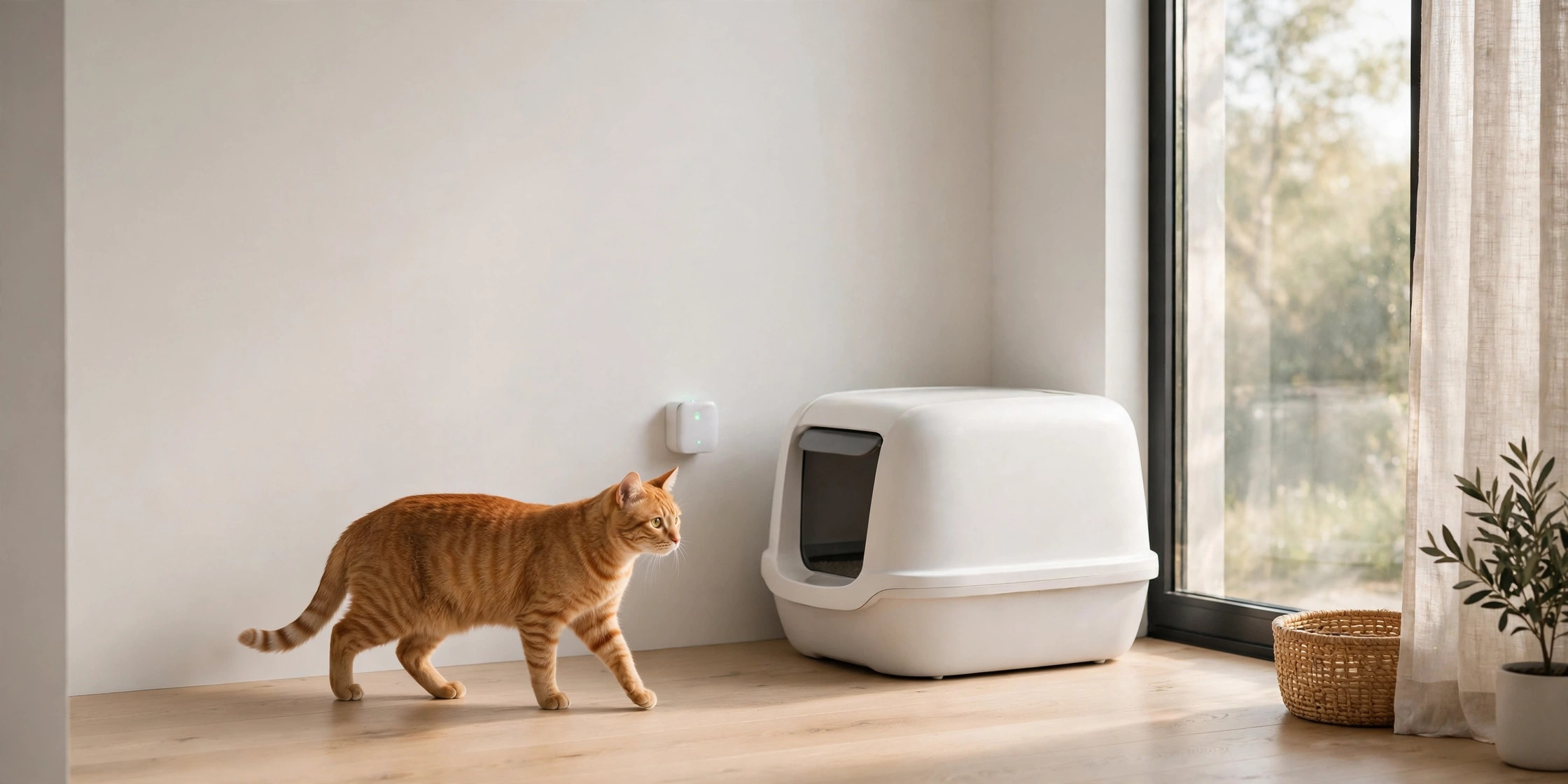
Milo is 13. He is an invented cat, not a real one. He started peeing twice as much, and his owner noticed only because the clumps got bigger and the litter ran out faster. Nothing else looked wrong. He ate, he slept, he purred. By the time the blood test caught it, three quarters of his kidney function was gone.
Abstract
Chronic kidney disease is a leading cause of death in cats (refs 1, 2), and it is usually found late. Creatinine, the standard blood marker, does not rise until about 75 percent of kidney function is gone (ref 1). The newer marker SDMA rises earlier, when about 40 percent is lost, but it still requires a blood draw, a vet visit, and an owner who suspected something. Cats with kidney disease use the litter box differently from healthy cats. In the kidney-disease study, cats visited more often, passed more urine per visit, spent longer eliminating, and covered less, while total time in the box was shorter because covering collapsed. In the elimination-disease study, diseased cats instead stayed shorter per visit, so the direction of the stay change depends on the disease (refs 6, 7). A 2026 study of 136 cats with a load-cell litter box monitor found cats with kidney disease urinated about twice as often, passed substantially more urine by weight, spent longer eliminating, and covered less forcefully afterward. A machine learning model separated sick from healthy cats with a weighted F1 of 92.7 percent in training and 89.9 percent in validation, though it caught only 57.1 percent of the kidney disease cats in validation, 4 of 7 validation cats with the disease (ref 7). The signal is real. The recall is not good enough, which is why this disclosure adds three more channels to the load cell.
Disclosed is a system and method for screening feline renal and urinary health from the litter box itself, using four channels that no existing product combines. A load cell under the box measures the mass of urine passed per visit, one gram standing in for about one milliliter, and weighs the cat on entry for identity and for the per-kilogram normalization the clinical thresholds require. A microphone classifies the sounds of a visit: digging, the urine stream, straining vocalization, and post-elimination covering. A metal-oxide semiconductor gas sensor tracks ammonia and total volatile organic compounds above the litter, read as change from a per-box baseline, not against an absolute threshold, because no feline litter-box ammonia threshold exists in the citable literature. A visit-pattern channel records frequency, duration, and time of day per cat, and runs a change-point detector over a learned per-cat baseline, so the system flags a change in the cat rather than a crossing of a population threshold whose value the veterinary literature has not settled.
Four channels combine into a screening score with four tiers, and a classifier maps channel patterns to renal, urinary, and behavioral explanations. The claimed combination is the load-mass-delta plus acoustic-visit-classification plus relative-VOC plus per-cat change-point fusion, not any one sensor alone and not the four-channel screening score as a whole. The system screens. It does not diagnose. Every Vet Visit alert says what veterinary test to ask for, and every Urgent alert directs the owner to veterinary care immediately. Whether the screen flags disease earlier than bloodwork is unproven: the cited study states its system does not prove pre-diagnosis detection, and no lead time over bloodwork is claimed here.
No new sensor needs inventing. Load cells cost a few dollars, MEMS microphones are in every phone, metal-oxide gas sensors are commodity parts, and passive infrared motion sensors are in every hallway. What does not exist is the system that puts them under a litter box, learns what normal looks like for one specific cat, and says, in plain language, that this cat started peeing twice as much three weeks ago.
Not the sensors, not the score, but the decision to compare the cat to itself.
- 43% missed: the best load-cell model caught only 57.1% of kidney-disease cats in validation, 4 of 7 validation cats with the disease, even while its weighted F1 ran 92.7% in training and 89.9% in validation (ref 7). That miss rate is the reason this disclosure adds three more channels.
- 75% of kidney function is lost before creatinine rises; SDMA rises when about 40% is lost (ref 1). Caught at IRIS stage 2, mean survival is 2 to 3 years; at stage 4, under 6 months (refs 1, 3). IRIS staging applies to a stable hydrated cat confirmed on at least two occasions (ref 3).
- Up to 40% of cats over 10 years old have chronic kidney disease, and 80% of cats over 15, per the Cornell Feline Health Center, with subclinical disease in 8% of apparently healthy older cats in screening studies (refs 1, 2).
- 24 to 48 hours is how fast an untreated urethral obstruction can kill, by clinical consensus, not a measured trial endpoint. More than 90% survive to discharge with treatment, up to 85% arrive with azotaemia, and recurrent obstruction runs about 36% (ref 9).
- 18 to 28 mL/kg/day is normal adult cat urine output (ref 4), and more than 40 mL/kg/day is polyuria by the veterinary primary source (ref 5); a looser figure of 50 appears in some clinical summaries (ref 18).
- 2 to 4 times a day is how often healthy cats urinate by owner report, averaging about 2, while a sensor-measured study found a median of 3 visits a day (refs 4, 6).
- 3 visits a day is the median for healthy cats in a 2024 motion-sensor study of 37 cats, with a reference interval of 1.0 to 7.0 visits, a median total stay of 192 seconds a day, about 3 minutes, and a mean stay of 59 seconds per elimination. Cats with elimination disease visited significantly more often and stayed significantly less time per visit (ref 6). Median total and mean per-visit are different measures and do not multiply out exactly.
- 45 to 100 mL/kg/day: the polydipsia threshold is not settled, with sources in live use ranging from above 45 (ref 5) to above 100 (ref 19). Normal total intake runs about 40 to 60 mL/kg/day (ref 19), so the 45 line sits inside the normal range. For a 4 kilogram cat, 160 to 240 mL a day is the normal total (ref 19).
- 2× is about how much more often kidney-disease cats urinated in the 2026 load-cell study of 136 cats, from roughly 2 to roughly 4 visits a day, with substantially more urine by weight and longer elimination duration (refs 4, 7).
- 1.5 to 4.5% of the whole feline caseload is feline lower urinary tract disease, and feline idiopathic cystitis accounts for 55 to 67% of it, about 0.8 to 3.0% of caseload in absolute terms, while bacterial urinary tract infection causes only about 2% of lower urinary tract signs in cats under 10 (ref 8). Urethral obstruction incidence is 0.54 to 3.4% (ref 9).
- 50 ppm is the OSHA 8-hour ammonia exposure limit (ref 10). No feline litter-box ammonia level or feline safe threshold was found, so the gas channel in this disclosure is relative, not absolute. 0 published studies of acoustic classification of cat litter-box sounds were found in the searches behind this disclosure. The nearest analogue is a dairy-cattle acoustic urine sensor with F1 of 0.91 in calibration and 0.87 in validation (ref 17).
- $40 to $80 in parts is the retrofit kit, an estimate. The test it prompts is a senior blood panel with SDMA, creatinine, and urine specific gravity.
For a cat owner reading this: count your cat's litter box visits for one week, and weigh the clumps if you use clumping litter. Wear gloves and wash your hands after handling litter. A healthy adult cat typically visits 2 to 4 times a day, with a measured reference interval up to 7 visits a day, so a single busy day means little. If visits double over days, or clumps get much bigger, call your vet the same day. For any cat over 10, ask for twice-yearly bloodwork with SDMA and a urine specific gravity, which is the validated screen this device is meant to prompt, not replace. If your cat stops covering after it eliminates, note it. It is a small change, and in the 2026 study it tracked with kidney disease. Count the visits. Weigh the clumps. If they double, call the vet.
Send this to someone with a cat over 10.
One pattern is an emergency, not a same-day appointment. If the cat strains, cries in the box, or visits every few minutes and passes almost nothing, go to emergency veterinary care now. Do not wait for your regular vet to open, and do not wait to see if it passes. Obstruction is most common in male cats, but any straining cat needs emergency care now, because a blocked urethra can kill within 24 to 48 hours if untreated, by clinical consensus. A cat can strain silently, so the absence of crying is not reassurance. Seek vet care promptly for not eating, vomiting, lethargy, or hiding even if litter habits look normal.
An untreated blockage can kill in 24 to 48 hours. Straining with almost no urine is an emergency.
Field of the Invention
This invention relates to companion animal health screening: continuous, non-invasive monitoring of feline renal and urinary health from a litter box. A load-cell urine-volume proxy, acoustic visit classification, relative volatile organic compound sensing, and per-cat change-point detection fuse into a screening score. A classifier separates a chronic kidney disease pattern, a urinary straining pattern, a urethral obstruction pattern, a litter-aversion pattern, and a dehydration pattern, with a diabetes or hyperthyroid pattern reported as a competing explanation and a gas-only pattern reporting no diagnosis.
Background
Chronic kidney disease kills cats slowly and quietly. It is a leading cause of death in cats (refs 1, 2), and by the time a cat looks sick the disease is advanced. The standard blood marker, creatinine, does not rise until about 75 percent of kidney function is gone, and SDMA, the newer marker, rises when about 40 percent is lost (ref 1). Both require a blood draw. Between vet visits, which for a healthy cat may be a year apart, nobody measures anything. The disease progresses in the gap.
The litter box shows the change. A failing kidney cannot concentrate urine, so the cat passes more dilute urine, drinks more to compensate, and visits the box more often. The 2026 iCatCare consensus guidelines record screening prevalences of 28 to 81 percent in cats over 12, with subclinical disease in 8 percent of apparently healthy older cats, the wide range reflecting different populations and screening methods (ref 2). The clinical picture is polyuria and polydipsia: too much urine, too much drinking. The veterinary primary source defines polyuria in cats as more than 40 mL/kg/day (ref 5) against a normal 18 to 28 mL/kg/day (ref 4), and polydipsia as more than 45 mL/kg/day of water intake (ref 5). But the thresholds are not settled. A looser polyuria figure of 50 mL/kg/day appears in some clinical summaries (ref 18), and the polydipsia figure in live use runs from 45 to 100 mL/kg/day depending on the source (refs 5, 19), with normal total intake about 40 to 60 mL/kg/day including water in food (ref 19). A wet-fed cat may drink only about 30 mL a day from a bowl while a dry-fed cat of the same weight drinks over 200 mL (ref 5). For a 4 kilogram cat, total intake of 160 to 240 mL a day reconciles both figures, since food water counts toward the total (ref 19), and the 45 line sits inside the normal 40 to 60 range, which is itself evidence the threshold is unsettled. Any screen built on a single absolute threshold inherits that argument. A screen built on the cat's own history does not.
The lower urinary tract has a different signature and a sharper deadline. Feline lower urinary tract disease is 1.5 to 4.5 percent of the whole feline caseload, and feline idiopathic cystitis, inflammation with no identified cause, accounts for 55 to 67 percent of it, about 0.8 to 3.0 percent of caseload in absolute terms (ref 8). Bacterial infection, the cause owners most often assume, causes only about 2 percent of lower urinary tract signs in cats under 10. The signs are pollakiuria, frequent urination of small amounts, stranguria, straining, and dysuria, painful urination, each distinct from polyuria, which is large volume.
The emergency form is urethral obstruction, mostly in male cats, with neutered males at increased risk, and an incidence of 0.54 to 3.4 percent (ref 9). A blocked cat strains, visits repeatedly, and passes little or nothing. More than 90 percent survive to discharge with treatment, but up to 85 percent arrive with azotaemia, waste products building in the blood, and the clinical consensus is that an untreated obstruction can kill within 24 to 48 hours. That consensus is stated as consensus, not as a measured median, because no survival-time trial exists. Recurrent obstruction runs about 36 percent. The difference between a cat that needs a vet visit next week and a cat that needs one tonight is written in the litter box, in visit frequency, in volume per visit, and in sound.
Owners are poor instruments for reading it. Most owners cannot say how many times their cat used the box yesterday, and clump size is judged by eye, if at all. A 2024 motion-sensor study of 37 healthy cats and 19 cats with elimination disease gives the measured baseline: healthy cats made a median of 3 visits a day, with a reference interval of 1.0 to 7.0, a median total stay of 192 seconds a day, and a mean stay of 59 seconds per elimination, while diseased cats visited significantly more often and stayed significantly less time per visit (ref 6). The study used motion sensors, not weight, and it measured visits, not volume. It shows the pattern exists and can be counted. It does not show what the urine weighed.
The closest published work is Langenfeld-McCoy and colleagues, 2026 (ref 7), a retrospective study of 136 cats using a load-cell litter box monitor with supervised machine learning over hundreds of thousands of video-labelled events. Cats with kidney disease urinated about twice as often, passed substantially more urine by weight, spent longer eliminating, and covered less forcefully afterward, while total time in the box was shorter because covering collapsed. The model reached a weighted F1, weighted by class support, of 92.7 percent in training and 89.9 percent in validation. Kidney-disease recall in validation was 57.1 percent, on 7 validation cats with the disease, and the authors state plainly that the system is not a diagnostic tool and does not prove pre-diagnosis detection. That paper is the load-cell leg of this disclosure, demonstrated. It is also the gap this disclosure addresses: load alone misses nearly half the sick cats in validation, and it says nothing about straining, about obstruction, or about what the air above the litter is doing.
Smart litter boxes already exist, and they define the boundary of what this disclosure adds. The Litter-Robot 4 weighs the cat per visit on a base scale, watches the box with laser curtain sensors, and tracks visit frequency, litter level, and waste-drawer level (ref 11). It does not measure urine volume, it has no ammonia or volatile organic compound sensor, and it has no acoustic sensor. The PETKIT Purobot Max Pro 2 adds an AI camera with facial recognition for up to 15 cats, photographs clumps after each cycle, infers urine pH from the image, and detects yowling (ref 12). Its pH is image-based, not chemical sensing. It states no load-cell urine-mass measurement and no gas sensor. Neither of the two products reviewed states an ammonia sensor, a urine-volume proxy, or acoustic classification of digging, stream, and straining. The yowling detection in the Petkit line is a commercial feature, not a published study, and yowling is not straining: a cat can strain without a sound, and a cat can yowl for other reasons.
Acoustic classification of feline litter-box sounds has no published study behind it. No peer-reviewed work on acoustic detection of cat digging, urine stream, or straining in a litter box was found in the searches behind this disclosure. The nearest analogue is livestock: an acoustic urine sensor strapped to the rear leg of dairy cattle reached F1 of 0.91 in calibration and 0.87 in validation, with a urination-duration model at R squared of 0.87 in validation (ref 17), and patents cover acoustic urination detection for livestock (ref 13) and human urination sound to flow and volume prediction (ref 14). A negative search is not proof of absence, and a patent-class search before filing is still warranted, but the feline acoustic gap is real as far as the citable literature reaches. Change-point detection has likewise not been verified as applied to feline litter-box data. The 2026 load-cell paper uses supervised classification, not change-point methods, so the per-cat change-point leg is claimed here as method, not as known practice.
Adjacent disclosures in this series cover parts of this ground. LITF-PA-2026-029 (ref 16) screens companion animal health from smartphone video of gait and behavior, a camera on the animal, not sensors in the box, and it measures movement, not elimination. No disclosure in the series measures urine volume, litter-box acoustics, or litter-box gas, and none runs a per-cat change-point detector on elimination behavior. The claimed combination is the fusion of a load-cell urine-mass proxy with acoustic visit classification, relative volatile organic compound sensing, and per-cat change-point detection, applied to feline renal and urinary screening, with the classifier that separates a chronic kidney disease pattern, a urinary straining pattern, a urethral obstruction pattern, a litter-aversion pattern, and a dehydration pattern, with a diabetes or hyperthyroid competing explanation and a gas-only pattern reporting no diagnosis.
What is missing is a litter box that knows its cat: one baseline per cat, learned over weeks, watched for the specific changes that mean kidney disease, urinary disease, or obstruction, built from commodity sensors and stated openly as a screen, not a diagnosis.
Detailed Description
1. System Architecture
Two parts make up the system, a sensing node at the litter box and a fusion service that can run on a hub in the house or in the cloud. The node sits under or beside an ordinary litter box and needs no modification to the box beyond a load platform beneath it. It reports four channel scores and a screening tier, and it keeps reporting when a channel is absent, with the remaining weights renormalized to sum to 1 and the tier thresholds unchanged, since a renormalized score already sits on the same 0 to 1 scale. All numeric thresholds, weights, action levels, and timing values in this disclosure are estimates unless stated otherwise.
Inside the node, seven subsystems share one board, counting the passive infrared and radar sensors as one presence subsystem. The optional connected water fountain is separate and does not share the board. Four load cells in a platform under the box, 20 kilogram range each with 1 gram resolution, read total box mass at 10 Hz. A passive infrared sensor and a low-power radar presence sensor watch the box entrance and mark visit start and end. A digital MEMS microphone, ICS-43434 class, mounted on the box rim or the wall behind it, captures visit audio at 16 kHz. A metal-oxide semiconductor gas sensor, MQ-137 ammonia class plus a total volatile organic compound element, samples the air above the litter once per second. A temperature and humidity sensor records the air around the box, because gas sensor response drifts with humidity and the fusion corrects for it. An RFID reader at the box entrance reads collar tags where fitted, and an optional connected water fountain may report water intake to the fusion service. Powered from a wall adapter, the node draws under 3 watts and reports over Wi-Fi or Bluetooth Low Energy to the hub. No camera is used anywhere in the system, by design: the box is a private place, and the acoustic and mass channels carry the signal without a lens.
The microphone hears the house, not only the box, and the disclosure states what happens to that audio. Raw audio is processed on the node and discarded immediately after feature extraction. It is never stored and never transmitted in any deployment mode, including cloud fusion, and human speech is not retained or transcribed. The owner can mute the microphone at any time, which leaves the acoustic channel absent with the weights renormalized and the tier thresholds unchanged. The node shows a visible indicator while the microphone is live. The owner should tell everyone in the household, and guests, that a microphone is live in the room. Where a collar tag is fitted, the collar must be a breakaway collar, so it releases if it snags, and cats that will not tolerate a collar use mass and pattern attribution instead.
Identity matters, because most multi-cat homes have one box per cat plus one, and a household baseline is not a per-cat baseline. The node identifies the cat three ways, in order of reliability. First, an RFID reader at the box entrance reads a collar tag where the owner has fitted one, which is the reliable route and the recommended install, on a breakaway collar. Second, entry mass: the load platform weighs the cat as it steps in, and cats in one home usually differ by more than the 100 gram identification margin, so a stable entry mass identifies the cat where tags are absent. The 100 gram margin is an estimate, and what share of multi-cat pairs fall within it is unmeasured. Third, visit pattern: where two cats are within 100 grams and neither wears a tag, the owner is asked to fit tags, and until tags are fitted the classifier attempts attribution over entry mass, visit duration, and time-of-day habit. A visit is attributed only where the classifier is confident; a visit it cannot attribute confidently is flagged as unattributed rather than assigned to the wrong cat. A visit the system cannot attribute is counted in the household totals and excluded from every per-cat baseline. A single-cat home skips all of this.
Installation takes about ten minutes by the owner and no tools beyond a level. The platform goes under the box, the box goes back on top, the microphone clips to the rim, the gas sensor mounts on the wall behind the box at litter height, and the node plugs into the nearest outlet. On first power-up the node enters a 14 day learning period, during which it records the per-cat baseline: daily urine volume by mass, visit frequency, mean visit duration, covering duration, and the gas baseline across the litter cycle from fresh litter to change day. Learned baselines replace fixed thresholds after the learning period, because every cat has a different normal and every litter has a different smell. During the 14 day learning period no non-urgent tier is reported; the system reports a learning status, and the obstruction pattern of section 7, repeated unproductive visits, still alerts immediately, because an obstruction cannot wait two weeks for a baseline, and so does the straining pattern on absolute criteria, frequent short visits passing little urine, because cystitis cannot wait two weeks either. Absolute-value flags still fire during the learning period, such as crossing the published polyuria line, since they need no baseline; they are shown as notices, not tiers, and only non-urgent tier reporting is suppressed.
A baseline learned from a sick cat is a sick baseline, and the disclosure mitigates that failure at install rather than leaving it in Limitations alone. The owner is recommended to get a baseline vet visit with SDMA, creatinine, and urine specific gravity before or during the learning period, and the device warns at install that it cannot detect disease already present when learning starts and that it is blind during the 14 day learning period except for the obstruction pattern. Where the baseline vet visit finds disease, the learned baseline is a diseased baseline, the absolute-value flags still apply, and the owner is told the screen cannot catch what is already there. The owner should also watch for box avoidance after install: keep a plain second box available during the first weeks, so the cat always has an unmonitored option, and if the cat avoids the box once the platform, microphone, and sensor are fitted, the device is removed, and elimination outside the box is never punished.
One rule governs missing channels throughout the system. Any channel that is unavailable, a gas sensor warming up, a microphone saturated by a nearby washing machine, an RFID reader with a dead tag battery, a muted microphone, is excluded from the fusion, and the remaining channel weights are renormalized to sum to 1, with the tier thresholds unchanged. No channel ever defaults to a numeric value that silently shifts the score.
2. Load-Cell Urine Volume Channel
Mass is the channel that turns a guess into a number. The load platform reads total box mass continuously. A visit is marked by the presence sensor: entry when the cat steps in, exit when it steps out. The mass delta across a visit is the urine passed, plus feces where the cat defecates, minus litter kicked out, with one gram standing in for about one milliliter of urine, an approximation typically good to about 3 to 4 percent at specific gravity near 1.035, up to about 6 percent at the concentrated end of the feline range, and running lower in dilute kidney-disease urine. Feces are separated by mass and by sound: a fecal event adds 10 to 40 grams in a single step with no stream sound, an estimate, unvalidated, while urination adds mass gradually over the stream duration the acoustic channel measures, so the load channel and the acoustic channel corroborate each other on every visit. The ranges overlap, since a 4 kilogram cat passes roughly 18 to 56 grams of urine per visit against 10 to 40 grams for feces, so separation rests on the acoustic corroboration, not on mass alone. Litter kicked out is a small negative drift across the visit, corrected by the pre-visit and post-visit stable masses. Where the cat digs vigorously, the mass trace oscillates, and the visit delta is read from the stable masses before entry and after exit, not from the noisy middle.
Per-visit volume is normalized by the cat's body mass, read at entry, so the channel speaks the language of the clinical thresholds: milliliters per kilogram per day, summed across the day's visits. A 4 kilogram cat passing 120 mL in a day is at 30 mL/kg/day, above the normal 18 to 28 range (ref 4) and below the 40 polyuria line (ref 5). The channel does not claim the 40 line as a tripwire. It claims the change: the 7-day mean daily volume against the learned per-cat baseline, with a change-point detector described in section 5. The absolute line is reported alongside, as context, with the 40 versus 50 disagreement stated wherever it appears.
Scoring uses a clamp on the volume change: L = clamp((change minus 0.25) / (0.75 minus 0.25), 0, 1), where change is the fractional rise of the 7-day mean daily urine volume above the learned per-cat baseline, so a 25 percent rise scores zero and a 75 percent rise scores one. A rise that crosses the 40 mL/kg/day line adds a named flag, not extra score: the flag says the cat has crossed the published polyuria line, and the score says how far the cat has moved from its own normal. Both are shown. The load channel also carries a floor: where daily volume falls by more than 50 percent from baseline for 3 days, the channel scores on the falling side instead, because a cat that stops passing urine may be obstructed, dehydrated, or avoiding the box, and each of those needs a vet, not a shrug. The falling-side score is L_fall = clamp((0.50 minus ratio) / (0.50 minus 0.10), 0, 1), where ratio is the 3-day mean volume divided by baseline, so a ratio of 0.10 or below scores one. L is the maximum of the rising and falling scores. For the obstruction pattern, the falling formula is applied per visit rather than on a 3-day mean: a visit passing under 5 grams against the cat's normal per-visit volume scores the falling side, since an obstruction unfolds over hours, not days.
Load cells drift, and litter is the drift. Fresh litter is dry and light; used litter absorbs urine and gains mass; a full litter change drops the box mass by kilograms in a minute. The node handles this by re-taring on every litter change, detected as a mass drop of more than 500 grams while no cat is present, and by tracking the slow upward drift of used litter as background, subtracted from the visit deltas. A litter change mid-visit is impossible to miss: the cat leaves, the owner dumps the box, the mass falls, the node re-tares. Where the owner tops up litter instead of changing it, the added mass is a step while no cat is present and is likewise excluded from visit deltas. The platform is calibrated at install with a 1 kilogram test mass, passing within plus or minus 5 grams, else the platform is re-leveled or replaced.
3. Acoustic Visit Classification Channel
Sound is the channel that says what the cat was doing, not just that it was there. Every visit is captured at 16 kHz and classified into four event types, in order. Digging is broadband scratching noise, 1 to 4 kHz, in bursts of 0.5 to 3 seconds, usually before elimination. The urine stream is a continuous noise, 2 to 6 kHz, lasting 5 to 30 seconds, with a steady envelope, the sound of liquid hitting litter. Straining vocalization is a low-frequency cry, 300 to 900 Hz fundamental with harmonics, occurring during the elimination posture, distinct from ordinary meowing by its timing inside the visit and its repetition. Covering is broadband scratching after elimination, usually shorter and less forceful than digging, and its duration is the feature the 2026 study found tracks with kidney disease (ref 7). These frequency bands and durations are proposed, unmeasured values: no published feline data fixes them, and they are estimates to be measured on real cats.
The classifier is a small convolutional model running on the node, trained on labelled litter-box audio, with the four event types plus a silence class. Each visit produces an event sequence with timestamps: digging duration, stream duration, straining vocalization count, covering duration. From these the channel derives three features. Stream duration estimates urine volume independently of the load cell, and the two estimates are compared on every visit. Each is expressed as a fractional deviation from its own baseline, stream duration against its baseline and load mass against its baseline. Where the two deviations differ by more than 50 percentage points, the visit is flagged as discordant and both estimates are reported. A long stream with no mass delta means the sensors disagree: the microphone heard liquid and the scale saw none, so the visit is flagged rather than trusted. A mass delta with no stream means the cat passed urine silently or the microphone missed it. Straining vocalization count is one obstruction signal, and its absence is not evidence of absence, since a cat can strain without a sound. Covering duration is the renal signal: a fall in covering duration against baseline, sustained over 7 days, is the behavioral change the 2026 study measured.
Scoring uses a clamp on the largest feature deviation. A_stream = clamp((stream_rise minus 0.25) / 0.50, 0, 1) for a rise in mean stream duration against baseline. A_strain = clamp((strain_count minus 1) / 3, 0, 1) for straining vocalizations per day above one, so two a day scores 0.33 and four a day scores one. A_strain is coarse-grained, stepping in thirds with each additional vocalization per day, while the other sub-scores are continuous. A_cover = clamp((cover_fall minus 0.25) / 0.50, 0, 1) for a fall in mean covering duration against baseline. A is the maximum of the three. A straining vocalization is counted only when it occurs inside a visit, between entry and exit, so a cat crying at the box from outside does not count. The acoustic channel is confounded by the house: a washing machine, a television, a dog barking. The microphone is directional toward the box, the classifier is trained with household noise as a negative class, and a visit whose audio is dominated by non-box noise is flagged as noisy and excluded from the acoustic features, though the visit itself still counts in the load and frequency channels.
Nothing validates acoustic classification in cats yet, stated plainly because the rest of this section depends on it. The livestock analogue reaches F1 of 0.91 in calibration and 0.87 in validation for cattle urination (ref 17), which shows the signal class is learnable in animals, not that it is learned in cats. The acoustic features in this disclosure are estimates that need measurement on real cats in real homes, and the acoustic channel never opens the Urgent tier alone. An obstruction call requires the load and frequency pattern of section 7. That means four or more visits in each of two consecutive hours, each with a mass delta below 5 grams, with straining vocalization as corroboration and not as a requirement. Or it means no urine passed in 12 hours with repeated visits. Or it means four or more unproductive visits, each passing under 5 grams, in 2 hours followed by no visits at all for the next 6 hours.
4. Volatile Organic Compound and Ammonia Channel
Gas is the weakest channel and the disclosure says so. A metal-oxide semiconductor sensor above the litter reads ammonia and total volatile organic compounds once per second. Cat urine contains urea, which bacteria convert to ammonia as litter ages, and the smell of a box rises over the days between litter changes. The channel measures two things: the spike after each visit, as fresh urine adds ammonia to the headspace, and the slow baseline rise across the litter cycle, as the litter loads. The spike size tracks the volume passed, weakly, and the baseline rise tracks litter age, strongly. Neither is a clinical number.
The reason the channel is relative is that no absolute number exists to compare against. The OSHA 8-hour ammonia limit is 50 ppm and the NIOSH recommended limit is 25 ppm, with a short-term limit of 35 ppm and an immediately dangerous level of 300 ppm (ref 10), but those are worker-exposure limits, not feline health thresholds. No published feline litter-box ammonia level and no feline safe threshold was found in the citable literature, and figures circulating in product marketing that claim specific litter-box parts-per-million values trace to unverifiable sources and are not cited here. The disclosure therefore claims no ppm threshold. It claims the relative pattern. The post-visit spike divided by the visit volume the load cell measured gives a spike per milliliter that tracks urine concentration, rising against the cat's own history, which is consistent with more concentrated urine. The baseline ammonia across the litter cycle rising faster than the litter-age model predicts is consistent with a change in urine composition or volume.
Scoring uses a clamp on the relative spike: V = clamp((spike_ratio minus 1.25) / (2.0 minus 1.25), 0, 1), where spike_ratio is the mean post-visit ammonia spike per milliliter over 7 days divided by the learned per-cat baseline spike per milliliter, corrected for litter age and humidity. A 25 percent rise scores zero and a doubling scores one. The gas sensor is corrected for humidity from the temperature and humidity sensor on the node, and the litter-age model is a learned curve of baseline ammonia against days since litter change, fitted per household. A litter change resets the model. The gas channel is weighted lowest in the fusion, 0.15, because it is the least specific: diet, litter brand, and room ventilation all move it, and the sensor drifts with age. It corroborates. It never leads.
5. Visit Pattern and Change-Point Detection
Frequency is the channel the 2026 study validated, and the change-point detector is the method that makes it per-cat. Per cat per day, the visit-pattern channel records visit count, mean visit duration, mean stay per elimination, and the time-of-day distribution. Mean stay per elimination means time in the box per elimination visit, as the motion-sensor study measured it, not the voiding duration alone: in the kidney-disease study the voiding duration was longer while total time in the box was shorter, because covering collapsed. Baselines come from the 14-day learning-period median for each quantity, and the detector is a cumulative sum, CUSUM, over daily values, run in both directions. The rising side is S_t = max(0, S_{t-1} + (x_t minus baseline minus k)), and the falling side is a mirror, S-_t = max(0, S-_{t-1} + (baseline minus k minus x_t)), so falling patterns, dehydration and obstruction, get a change-point date just as rising patterns do. The tuning constant k is set to half the shift the system is tuned to detect: 0.5 visits a day for frequency, 15 percent of baseline for volume, and 15 percent of baseline for covering duration, all estimates. When either sum crosses the alarm threshold h, set to 5 times the daily standard deviation of the baseline period, the detector fires, and the fire date is the change point. The detector runs separately on frequency, volume, and covering duration, and the earliest fire among them is the reported change point. A fire requires the shift to persist: a single bad day moves the sum but does not cross h, and the sum resets to zero when the daily value returns below baseline plus k on the rising side or above baseline minus k on the falling side.
The cat's own baseline is what makes this channel defensible where absolute thresholds are not. The polydipsia threshold in live use runs from above 45 (ref 5) to above 100 mL/kg/day (ref 19), and the polyuria line is argued between 40 (ref 5) and 50 (ref 18). A cat whose normal is 20 mL/kg/day and rises to 35 has changed by 75 percent and is still below every published line, and a screen built on the line would miss it. A cat whose normal is 38 and rises to 42 has crossed the 40 line on a 10 percent change, and a screen built on the line would flag noise. The change-point detector flags the first cat and not the second, and reports the absolute value alongside, so the vet sees both the change and the number. That is the method contribution of this disclosure: not the sensors, not the score, but the decision to compare the cat to itself.
Scoring uses a clamp on the frequency change: F = clamp((freq_rise minus 0.25) / (0.75 minus 0.25), 0, 1), where freq_rise is the fractional rise of the 7-day mean visit frequency above baseline. A second term covers the diseased pattern the 2024 study measured, more visits with shorter stays: F_short = clamp((stay_fall minus 0.25) / 0.50, 0, 1), where stay_fall is the fractional fall in mean stay per elimination against baseline. F is the maximum of the two. The change-point fire and the score are independent: the score is a magnitude, the fire is a timing, and the alert carries both. In the Early kidney row of section 6, for example, the 7-day mean frequency sits about 53 percent above baseline and daily volume about 55 percent above it, and the change-point fire dates that rise, so the owner learns not only that visits rose but when the rise began.
6. Fusion Scoring, Tiers, and Worked Examples
The four channel scores fuse into a single screening score. With all four channels present, H = 0.35 × L + 0.25 × A + 0.15 × V + 0.25 × F, where L is the load score, A the acoustic score, V the gas score, and F the visit-pattern score. An absent channel leaves the weights renormalized and the tier thresholds unchanged. Weights reflect how directly each channel measures the disease: load is the most direct measure of urine volume, frequency is the most validated pattern, acoustics carry the straining signal, and gas is the least specific. Weights and thresholds are unvalidated estimates until measured against real cats with confirmed diagnoses, and the formula is stated so the table below can be checked by hand.
Scores contribute to the tier only after their persistence requirement is met: 3 days for L, A, and F, and 7 days for V, with the obstruction pattern and the straining pattern of section 7 bypassing persistence entirely. Tiers run: No change detected below 0.30, Watch from 0.30 to below 0.55, Vet Visit from 0.55 to below 0.75, and Urgent at 0.75 and above, where Urgent by score alone is reported as Vet Visit unless the section 7 obstruction pattern holds or no urine has been passed in 12 hours. In other words, H at or above 0.75 is Urgent only for the obstruction pattern or the no-urine-in-12-hours rule; every other H at or above 0.75 reports as Vet Visit. Section 7 pattern tiers override the H band wherever they conflict, and the pattern tier governs. Watch sends a quiet weekly summary to the owner, naming the channel and the change, and escalates immediately if the score crosses into Vet Visit territory mid-week. Vet Visit tells the owner to book a vet appointment within the week for a chronic pattern, and to seek veterinary care the same day for a straining or cystitis pattern, and says what to ask for: bloodwork with SDMA and creatinine, urine specific gravity, and a urine protein to creatinine ratio. Urgent tells the owner to go to emergency veterinary care now, for any cat meeting the obstruction pattern, regardless of sex. Every alert names its evidence: which channels fired, what the change point was, and what would change the conclusion.
| Case | L | A | V | F | H | Tier |
|---|---|---|---|---|---|---|
| No-change pattern, 6-year-old cat | 0.05 | 0.05 | 0.05 | 0.05 | 0.05 | No change detected |
| Early kidney pattern, 13-year-old cat | 0.60 | 0.40 | 0.30 | 0.55 | 0.49 | Watch |
| Established kidney pattern | 0.90 | 0.60 | 0.50 | 0.90 | 0.77 | Vet Visit (H 0.77 would be Urgent by score alone; held per section 6 rule) |
| Straining pattern, frequent short visits | 0.10 | 0.67 | 0.10 | 0.85 | 0.43 | Vet Visit (by section 7 straining pattern; 0.43 is Watch by score alone) |
| Obstruction pattern, 2 hours in | 0.90 | 1.00 | 0.20 | 1.00 | 0.85 | Urgent |
| New litter brand, healthy cat | 0.05 | 0.10 | 0.70 | 0.05 | 0.16 | No change detected |
| Summer heat, drinking more | 0.15 | 0.05 | 0.10 | 0.10 | 0.11 | No change detected |
| Two-cat home, visits unattributed | 0.40 | 0.30 | 0.20 | 0.40 | 0.35 | Watch (household-level scores only; no per-cat tier) |
The established kidney pattern shows the limit of a score without a rule. Its H is 0.77, above the Urgent line, but the cat is not an emergency: it is a chronic disease progressing over weeks, and the right action is a vet visit within the week, not an emergency trip tonight. The tier rules therefore hold a non-obstruction Urgent score at Vet Visit, with the alert saying the pattern is chronic and the appointment should be within the week, and Urgent is reserved for the obstruction pattern, including no urine passed in 12 hours. A score alone cannot tell a chronic disease from an emergency. The classifier can, and the tier rules encode that.
From the other side, the straining pattern hits the same limit. Its H is 0.43, Watch on score alone, but the cat is visiting every few minutes, passing almost nothing, and crying in the box, or straining silently with the same frequent short visits. The section 7 straining rule escalates it to Vet Visit by pattern, not by score, with same-day vet contact, because a straining cat can obstruct while waiting, and the cost of waiting is a dead cat. The new-litter-brand case shows why the gas channel is weighted lowest: a litter change can push V to 0.70 alone, and H stays 0.16, No change detected, because no other channel agrees. Summer heat is the same lesson for load: hot weather raises drinking and urine volume together, but the rises are modest, about a third on volume and about 30 percent on frequency, the acoustic channel is quiet, and no change point has fired, so the tier stays No change detected. In the two-cat case, the attribution rule works as designed: the household score reaches Watch, but no per-cat tier is reported, because the system does not know which cat changed.
7. Failure-Mode Classification
The classifier maps channel patterns to explanations with a decision tree, and it reports its confidence with each explanation. Each row states numeric conditions on the 0 to 1 channel scores where they exist, read on the released scores after their persistence requirements, except the obstruction and straining patterns, which bypass persistence; where a row names a feature without a numeric threshold, the feature is qualitative and noted as such. The classifier names patterns, not diseases: it says the pattern resembles kidney disease, it does not say the cat has kidney disease. Only a vet with bloodwork and urine tests says that, and every alert says so. No-urine-in-12-hours always wins: a cat that has passed no urine in 12 hours with repeated visits is Urgent via the obstruction row, even where the dehydration row would also match.
| Pattern | Conditions |
|---|---|
| Chronic kidney disease pattern | L at or above 0.55 with a change-point fire on volume, F at or above 0.30 with a change-point fire on frequency, A_stream at or above 0.30, A_cover at or above 0.30, and no straining signature, where a straining signature is A_strain at or above 0.30. The gas channel may corroborate but is not required. |
| Diabetes or hyperthyroid pattern (competing explanation) | The same pattern as the kidney row, with body mass falling against baseline where the entry mass shows a fall of more than 5 percent over 30 days, and water intake up where a connected water fountain reports it; where no fountain is connected, the water-intake condition is waived and the row rests on the mass fall alone. This row is reported as a competing explanation alongside the kidney row, never alone, because the box cannot separate these diseases and the vet must. |
| Urinary straining pattern (cystitis) | F_short at or above 0.55, frequent short visits with falling stay per elimination, and L below 0.30, because the cat passes small amounts often, with either A_strain at or above 0.30, or, without vocalization, a mean per-visit mass delta down at least 50 percent against baseline, since a cat can strain silently. Bypasses persistence. During the 14-day learning period the row alerts on absolute criteria: four or more short visits in a day, each passing under 10 grams, with or without vocalization. Reported at Vet Visit, with same-day veterinary care, and with the note that bacterial infection causes only about 2 percent of such signs in cats under 10, so antibiotics are not the default expectation. |
| Urethral obstruction pattern | Four or more visits in each of two consecutive hours, each with a mass delta below 5 grams, with or without a straining vocalization, or no urine passed in 12 hours with repeated visits, or four or more unproductive visits, each passing under 5 grams, in 2 hours followed by no visits at all for the next 6 hours. A mass delta below 5 grams is roughly 4 to 11 times below the normal per-visit volume of roughly 18 to 56 grams for a 4 kilogram cat. Bypasses persistence and scores Urgent immediately. Straining vocalization corroborates the pattern but is not required, since straining can be silent. Any cat meeting this pattern is flagged for emergency care, regardless of sex. Females rarely obstruct, but sex informs the differential, never the triage speed. |
| Litter aversion or behavioral pattern | F at or above 0.30 with digging duration up at least 50 percent against baseline and covering duration at or near zero, L below 0.30, and the pattern starting within 24 hours of a litter change, a new box, a house move, or a new pet. Reported at Watch with the behavioral explanation first and the medical explanation listed as competing, because a cat that hates its litter looks, to the load cell, like a cat that uses the box differently. |
| Dehydration or reduced intake pattern | L_fall at or above 0.55, volume down at least 72 percent for 3 days, with frequency down, not up, and no straining signature. Reported at Vet Visit, because a cat that stops passing urine may be dehydrated, may be avoiding the box, or may be obstructed, and the box alone cannot tell which. Where no urine has been passed in 12 hours, the obstruction row governs instead and the tier is Urgent. |
| Gas-only pattern | V at or above 0.55 with L, A, and F all below 0.30. No diagnosis is reported. The system reports a gas change only, with litter age, litter brand, diet change, and ventilation listed as the likely causes, and the tier follows the H band, staying below Vet Visit on gas evidence alone, since with the other channels below 0.30 the score cannot reach 0.55. |
Classification confidence is explicit. A row score is the minimum of the lower-bounded channel scores the row names; quantities named only with an upper bound do not enter the row score, and a row that names no lower-bounded quantity has no score. On a branch that substitutes a feature for a channel score, the row score is the minimum of the channel scores the branch names. A pattern is reported as high confidence only when at least two channels corroborate it, the pattern matches one row of the tree with no competing row within 0.1 below its row score, and the learned baseline has been stable, measured as a 14 day standard deviation of daily urine volume within 15 percent of the baseline mean. Only the kidney-disease row and the vocalized-straining row name two or more lower-bounded channel scores, so only those two patterns, and the diabetes pattern reported alongside the kidney row, can be reported as high confidence, except for the obstruction row, which is reported as high confidence by exception, because its conditions are time-bounded and its cost of delay is death, and this is a deliberate safety trade-off, not a measurement: the alert must say the pattern is unvalidated and the vet must confirm. The silent-straining variant, which substitutes a mass-delta condition for the straining vocalization score, is reported as low confidence. A single-channel pattern is reported as low confidence with the competing explanations listed. The system is configured not to report a diagnosis it cannot defend from its own channels, and not to hide a low-confidence call behind a confident tier: a Watch tier with a low-confidence pattern says Watch and says why it is unsure.
Where two rows match, both are reported, with the higher-scoring row first and the other listed as competing. The obstruction row names no lower-bounded channel score and has no row score; it outranks every scored row by rule, not by score. A kidney pattern with a falling body mass reports the kidney row first and the diabetes or hyperthyroid row as competing, because the box measures the mass fall but cannot measure blood glucose or thyroid hormone. A straining pattern in a male cat with a falling volume reports the straining row first and the obstruction row as competing until the obstruction conditions are met, at which point the obstruction row takes over and the tier jumps to Urgent. The classifier never suppresses a competing explanation to make the report cleaner.
8. Privacy and Deployment
The system is local first. Load, acoustic, gas, and temperature data never need to leave the house: the fusion runs on the hub, the tiers are computed on the hub, and in local mode the only data that leaves is the tier and the pattern, sent to the owner and, with the owner's consent, to the veterinarian. In cloud mode, acoustic features are also transmitted, encrypted, but never raw audio. Acoustic captures are processed on the node and discarded immediately after the features are extracted; no audio leaves the node in any deployment mode, including cloud fusion, where only features are transmitted, encrypted. Features are kept for 90 days and tiers for one year, and both are deleted within 30 days of an owner request. Visit times and per-visit volumes are kept with the features, for 90 days, and the learned baselines derived from them are kept with the tiers, for one year. Load traces are reduced to per-visit volumes on the node and discarded. Visit times are recorded per cat and can reveal household routines; nothing else about the owner is tracked, and no camera watches the box. The litter box is a private place, and the owner should remove the device if the cat avoids the box.
Deployment has three paths. First is a retrofit kit sold with or after a vet visit, placed under the existing box in about ten minutes by the owner. Second is a factory-integrated box with the load platform, microphone, and gas sensor built into the base, which is the path that reaches every new box once one manufacturer adopts it. The third is a veterinary clinic service: the clinic loans nodes to owners of senior cats and cats with known kidney disease, watches a dashboard of screening scores across its patient base with each owner's opt-in consent, and calls owners in when a change point fires, which turns an annual blood test into continuous screening for the cats most likely to need it. Pooling across the clinic's patients for regional comparison is opt-in and de-identified: pooled data never contains visit times, cat identity, or owner identity, and retention and deletion follow the same 90-day and one-year limits stated above, with deletion within 30 days of a request.
Cost is a small sensor node and a software service, not a new vet practice. The retrofit kit is about 40 to 80 dollars in parts, an estimate. A factory-integrated box adds less than 30 dollars to the box cost at volume, an estimate. Hub software is a small service that can run on the same hub that already runs the home automation system. The expensive part is not the hardware. It is the first year of data across a first fleet of a thousand cats with confirmed diagnoses, an illustrative size, which is a measurement exercise that turns the estimated thresholds and weights in this disclosure into measured ones, and the first vet clinic fleet that runs it is the one that produces that data.
Adoption has a cold-start problem, and the disclosure states it plainly. Owners do not think about their cat's urine volume, which is the problem, and they will not buy a monitor for a number they do not think about. The bootstrap is the vet clinic path: vets already see every senior cat, they already run the bloodwork, and a dashboard that tells them which ten cats changed this month is a triage tool that turns ten routine visits into ten targeted ones. Consumer adoption follows the factory-integrated path, which needs one decision by one litter-box manufacturer, not a million decisions by a million owners. The retrofit kit is the bridge between the two, sold at the vet visit when the owner is already thinking about kidney disease and already paying for the bloodwork.
9. Figures Description
- Figure 1: System architecture: load platform under the litter box, presence sensors and RFID reader at the entrance, microphone on the box rim, gas sensor on the wall behind the box, hub or cloud running the fusion service, and the owner and veterinarian as consumers of tiers and patterns.
- Figure 2: Load trace of a single visit: total box mass against time, showing entry, digging oscillation, gradual mass gain during the urine stream, stable post-exit mass, and the visit delta read from the stable masses before entry and after exit.
- Figure 3: Acoustic event sequence of a visit: digging bursts, continuous urine stream, straining vocalization, and post-elimination covering, with the four event types classified from the 16 kHz audio.
- Figure 4: Per-cat change-point chart: daily urine volume and visit frequency against the learned baseline, with the rising-side and falling-side CUSUM sums and the fire date marking the change point.
- Figure 5: The decision tree mapping channel patterns to renal, straining, obstruction, aversion, and dehydration patterns, with confidence rules and the recommended veterinary action attached to each leaf.
Implementation Notes
The installed base is covered by the retrofit kit, and the retrofit kit is deliberately boring hardware. Four load cells in a platform under the box, 20 kilogram range each with 1 gram resolution, a passive infrared presence sensor, a low-power radar presence sensor, an RFID reader at the box entrance, a digital MEMS microphone, ICS-43434 class, a metal-oxide semiconductor gas sensor, MQ-137 ammonia class plus a total volatile organic compound element, a temperature and humidity sensor, and an ESP32-S3 microcontroller with Wi-Fi, assembled on one small board. The board is powered from a wall adapter. Load sampling at 10 Hz and acoustic sampling at 16 kHz are both within the capability of that microcontroller class, and the audio classification runs on the node, so the hub receives features and per-visit volumes, not raw audio. A node that loses its network connection keeps scoring locally and stores tiers until the connection returns, because a health monitor that stops monitoring when the Wi-Fi drops is a scale with extra steps.
Calibration follows a fixed procedure, not a hope. Step one, at install, the owner records the cat's body mass from the entry weighing, the litter brand and type, the number of cats and boxes in the home, and whether each cat wears an RFID collar tag, on a breakaway collar. The owner is recommended to get the baseline vet visit described in section 1 before or during the learning period. Each sensor check at install carries a pass limit and a stated action on failure. Load platform zero is recorded with the empty box on the platform, passing within plus or minus 5 grams, and span is checked with a 1 kilogram test mass within plus or minus 5 grams, else the platform is re-leveled or replaced. Microphone noise floor is recorded with the house quiet, the reference for the noisy-visit exclusion. Gas sensor baseline is recorded with fresh litter, the reference for the litter-age model. Step two, the 14 day learning period collects at least 28 visits, each with a mass delta and an acoustic classification, spanning at least one litter change, plus baseline gas readings across the litter cycle. Where the 28-visit or one-litter-change requirement is not met in 14 days, the learning period extends by 7 days, and if the extension also fails, the affected channel is left unscored and flagged for a vet or installer visit. Step three, acceptance. Daily urine volume is stable within 20 percent over the last 7 days. Stable means the maximum minus the minimum daily volume over the 7 days is within 20 percent of the mean. Visit frequency is stable within 30 percent over the same period. If the stability criterion fails, the learning period extends by 7 days, and if the extension also fails, the affected channel is left unscored and flagged for a vet or installer visit. This stability test is a different test from the 14-day standard-deviation test used for classification confidence in section 7, which measures baseline stability over 14 days within 15 percent of the mean. Step four, seasonal re-baselining: when the daily mean household temperature moves outside the learned range by 5 degrees Celsius, the node opens a new 7 day learning window and re-fits the baselines, keeping the old baseline for comparison, and keeps scoring against the old baseline during the window. Step five, after a litter brand change, the node discards the gas baseline and repeats a 7 day gas learning period, because litter brand moves the gas channel more than any disease does, and the gas channel is unscored during that period.
A multi-cat home needs one more install step: attribution. Where cats wear RFID tags, attribution is automatic. Where they do not, the owner weighs each cat once at install, and the node uses entry mass with a 100 gram margin. Where two cats fall within that margin, the owner is asked to fit tags, and until tags are fitted the classifier attempts attribution over entry mass, visit duration, and time-of-day habit, attributing only where it is confident. A visit it cannot attribute confidently is household-level only. The system never guesses a cat to make its numbers look complete. An unattributed visit is reported as unattributed, and a household that cannot attribute is a household that gets household-level screening, not per-cat screening, until it fixes the attribution.
Claims
- A system for screening feline renal and urinary health, comprising: a load platform configured to measure the mass of a litter box and its contents, wherein the platform measures the mass delta across a visit as a urine volume proxy, one gram standing in for about one milliliter, and weighs the cat on entry for per-kilogram normalization and for identity; at least one presence sensor configured to mark visit start and end; an acoustic sensor configured to capture visit audio and to classify digging, urine stream, straining vocalization, and post-elimination covering, and to measure a digging duration and a covering duration for each visit; a gas sensor configured to measure ammonia and total volatile organic compounds above the litter as change from a per-box baseline; a fusion module configured to compute a screening score from the load, acoustic, gas, and visit-pattern channels, with tiers No change detected below 0.30, Watch from 0.30 to below 0.55, Vet Visit from 0.55 to below 0.75, and Urgent at 0.75 and above, all estimated thresholds, wherein a score at or above 0.75 reports as Urgent only for the urethral obstruction pattern, including no urine passed in 12 hours, and otherwise reports at the Vet Visit tier, and with the weights renormalized over the available channels and the tier thresholds unchanged when a channel is absent, wherein the load score, the falling-side load score, the visit-pattern score, the short-visit score, the stream sub-score, the covering sub-score, the gas score, and the straining signature are the channel scores computed by the fusion module from the load, acoustic, and visit-pattern channels, the straining signature being a straining vocalization score at or above 0.30, and wherein the visit-pattern channel measures a visit frequency; a change-point detector configured to compare each cat to its own learned baseline by cumulative sum over daily urine volume, visit frequency, and covering duration, in both rising and falling directions; and a classifier configured to map channel patterns to at least a chronic kidney disease pattern, a urinary straining pattern, a urethral obstruction pattern, a litter aversion pattern, and a dehydration pattern, including a diabetes or hyperthyroid pattern reported as a competing explanation and a gas-only pattern reporting no diagnosis, wherein the claimed combination is the load-mass-delta plus acoustic-visit-classification plus relative volatile organic compound plus per-cat change-point fusion, not any one sensor alone and not the four-channel screening score as a whole, and wherein the system reports screening patterns and not diagnoses, Vet Visit alerts name the veterinary tests to request, and Urgent alerts direct the owner to emergency veterinary care now.
- The system of claim 1, wherein the load platform separates urine from feces by mass step and by acoustic corroboration, wherein a fecal event adds mass in a single step with no stream sound and urination adds mass gradually over the measured stream duration, and wherein the visit delta is read from the stable masses before entry and after exit, and wherein the platform re-tares on a litter change detected as a mass drop of more than 500 grams while no cat is present.
- The system of claim 1, wherein the acoustic sensor classifies the urine stream by a continuous noise in the 2 to 6 kHz band lasting 5 to 30 seconds, digging by broadband scratching bursts of 0.5 to 3 seconds in the 1 to 4 kHz band, straining vocalization by a low-frequency cry with a 300 to 900 Hz fundamental occurring inside a visit, and covering by post-elimination scratching, the bands and durations being proposed, unmeasured values, and wherein stream duration and load mass are each expressed as a fractional deviation from its own baseline and compared on every visit, and a difference of more than 50 percentage points between the two deviations flags the visit as discordant.
- The system of claim 1, wherein the gas sensor reads ammonia and total volatile organic compounds relative to a learned per-box baseline corrected for litter age and humidity, wherein no absolute parts-per-million threshold is claimed, and wherein the gas score is V = clamp((spike_ratio minus 1.25) / (2.0 minus 1.25), 0, 1), with spike_ratio the mean post-visit spike over 7 days divided by the learned baseline spike.
- The system of claim 1, wherein the change-point detector is a cumulative sum over daily values with S_t = max(0, S_{t-1} + (x_t minus baseline minus k)), wherein k is half the shift the system is tuned to detect, and wherein the alarm threshold h is 5 times the daily standard deviation of the baseline period, and wherein a fire requires the shift to persist and the sum resets to zero when the daily value returns below baseline plus k, and wherein the falling side is S-_t = max(0, S-_{t-1} + (baseline minus k minus x_t)), with the sum resetting to zero when the daily value returns above baseline minus k.
- The system of claim 1, wherein the classifier reports a chronic kidney disease pattern when the load score is at or above 0.55 with a change-point fire on volume, the visit-pattern score is at or above 0.30 with a change-point fire on frequency, the stream sub-score is at or above 0.30, the covering sub-score is at or above 0.30, and no straining signature is present, and wherein a diabetes or hyperthyroid pattern is reported as a competing explanation alongside the kidney pattern, never alone, where entry mass shows a fall of more than 5 percent over 30 days and water intake is up where a connected water fountain reports it, and where no fountain is connected the water-intake condition is waived.
- The system of claim 1, wherein the classifier reports a urethral obstruction pattern when four or more visits occur in each of two consecutive hours, each with a mass delta below 5 grams, with or without a straining vocalization, or when no urine is passed in 12 hours with repeated visits, repeated visits meaning four or more visits in that period, or when four or more unproductive visits in 2 hours are followed by no visits at all for the next 6 hours, and wherein the obstruction pattern bypasses persistence and scores Urgent immediately, with any cat meeting the pattern flagged for emergency care regardless of sex, and wherein straining vocalization corroborates the pattern but is not required, and wherein an unproductive visit is a visit with a mass delta below 5 grams.
- The system of claim 1, wherein the classifier reports a urinary straining pattern when the short-visit score is at or above 0.55 with falling stay per elimination and the load score is below 0.30, with either a straining signature or a mean per-visit mass delta down at least 50 percent against baseline, reported at Vet Visit with same-day veterinary care, and wherein the straining pattern bypasses persistence, and wherein the classifier reports a litter aversion pattern when the visit-pattern score is at or above 0.30 with digging duration up at least 50 percent against baseline and covering duration at or near zero and the load score is below 0.30, and the pattern starting within 24 hours of a litter change, a new box, a house move, or a new pet, reported at Watch, and wherein the classifier reports a dehydration pattern when the falling-side load score is at or above 0.55 with volume down at least 72 percent for 3 days and frequency down and no straining signature is present, reported at Vet Visit, and wherein the fusion module holds a non-obstruction Urgent score at Vet Visit, because a chronic disease progressing over weeks needs a vet visit within the week and not an emergency trip, and wherein a straining pattern escalates by pattern and not by score, and wherein a gas-only pattern reports no diagnosis and the tier follows the screening score, staying below Vet Visit on gas evidence alone.
- The system of claim 1, wherein cat identity is determined by an RFID collar tag where fitted, by entry mass with a 100 gram identification margin where tags are absent, and by a classifier over entry mass, visit duration, and time-of-day habit where neither suffices, the classifier attributing a visit only where it is confident, and wherein a visit the system cannot attribute is counted in household totals and excluded from every per-cat baseline, and wherein no per-cat screening pattern is reported where attribution is unavailable.
- A method for screening feline renal and urinary health, comprising: measuring the mass delta of a litter box across a visit as a urine volume proxy and weighing the cat on entry; capturing visit audio and classifying digging, urine stream, straining vocalization, and post-elimination covering; measuring ammonia and total volatile organic compounds above the litter relative to a per-box baseline; recording per-cat visit frequency, duration, and stay per elimination; running a cumulative-sum change-point detector in both rising and falling directions over the learned per-cat baselines for daily urine volume, visit frequency, and covering duration; fusing the load, acoustic, gas, and visit-pattern scores into a screening score with the tiers of claim 1, renormalizing weights over the available channels and leaving the tier thresholds unchanged when a channel is absent; classifying the pattern by the conditions of claims 6, 7, and 8 and the patterns of claim 1, wherein the claimed combination is the load-mass-delta plus acoustic-visit-classification plus relative volatile organic compound plus per-cat change-point fusion, not any one sensor alone and not the four-channel screening score as a whole; and alerting the owner with the pattern, the change point, and, for a Vet Visit alert, the veterinary test to request, or, for an Urgent alert, direction to emergency veterinary care now.
Prior Art References
- Cornell Feline Health Center, "Chronic Kidney Disease": up to 40 percent of cats over 10 years old and 80 percent over 15 affected; creatinine does not rise until about 75 percent of renal function is lost, SDMA when about 40 percent is lost; stage 2 mean survival 2 to 3 years, stage 4 under 6 months
- Taylor, S., et al., "2026 iCatCare consensus guidelines on the diagnosis and management of chronic kidney disease in cats," Journal of Feline Medicine and Surgery, 2026;28(9): 28 to 81 percent of cats over 12 affected across screening studies; subclinical disease in 8 percent of apparently healthy older cats; renal death in 13.6 percent of cats over 5, median age at death 15 years
- International Renal Interest Society staging, as reproduced in the 2026 iCatCare guidelines, Table 1: stage 1 creatinine under 1.6 mg/dL and SDMA under 18 µg/dL; stage 2 creatinine 1.6 to 2.8 mg/dL and SDMA 18 to 25 µg/dL; stage 3 creatinine 2.9 to 5.0 mg/dL and SDMA 26 to 38 µg/dL; stage 4 creatinine above 5.0 mg/dL and SDMA above 38 µg/dL, on a stable hydrated cat confirmed on at least two occasions
- Yadav, S. N., et al., "Urinalysis in dog and cat: A review," Veterinary World, 2020;13(10):2133-2141: normal adult cat urine output 18 to 28 mL/kg/day; healthy cats urinate 2 to 4 times a day, averaging about 2
- Osborne, C. A., "The ins and outs of polyuria and polydipsia in veterinary practice," dvm360, 2014: polyuria above 40 mL/kg/day in cats; normal water consumption not exceeding about 45 mL/kg/day; maintenance requirement 80 times body mass in kilograms to the power 0.75 mL per day; wet-fed cats drink about 30 mL a day from a bowl while dry-fed cats drink over 200 mL
- Shin, J., et al., "Comparison of Frequency and Stay Time between Normal and Abnormal Elimination Behavior of Cats Using a Litter Box with Automatic Sensor," Journal of Veterinary Clinics, 2024;41:71-78: healthy cats, 37 animals, median 3 visits a day, reference interval 1.0 to 7.0, median total stay 192 seconds a day, mean stay 59 seconds per elimination; diseased cats, 19 animals, significantly more frequent visits and shorter stays per elimination
- Langenfeld-McCoy, N., et al., "Enhancing Detection of Feline Chronic Kidney Disease Through Smart Litter Box Monitoring," Animals, 2026;16(9):1319: retrospective study of 136 cats with a load-cell litter box monitor and supervised machine learning over hundreds of thousands of video-labelled events; kidney disease cats urinated about twice as often, passed substantially more urine by weight, spent longer eliminating while total time in the box was shorter because covering collapsed, and covered less forcefully; weighted F1, weighted by class support, 92.7 percent training and 89.9 percent validation, kidney disease recall 57.1 percent in validation, 4 of 7 validation cats with the disease; authors state the system is not a diagnostic tool and does not prove pre-diagnosis detection
- He, C., et al., "Prevalence, Risk Factors, Pathophysiology, Potential Biomarkers and Management of Feline Idiopathic Cystitis: An Update Review," Frontiers in Veterinary Science, 2022;9:900847: feline lower urinary tract disease 1.5 to 4.5 percent of the feline caseload; feline idiopathic cystitis 55 to 67 percent of it; bacterial urinary tract infection about 2 percent of lower urinary tract signs in cats under 10
- Skinner, V. J., Zhong, M., Hall, E. J., Eramanis, L. M., and Thompson, M. F., "Azotaemia and outcomes in male cats with initial and recurrent urethral obstruction: a multicentre, retrospective study of 601 cats (2020-2024)," Journal of Feline Medicine and Surgery, 2026: urethral obstruction incidence 0.54 to 3.4 percent, with neutered males at increased risk; survival to discharge above 90 percent with treatment; azotaemia in up to 85 percent of presenting cats; recurrent obstruction about 36 percent; resolution of azotaemia within 48 hours in 70.1 percent of azotaemic cats
- US Occupational Safety and Health Administration, Chemical Data, "Ammonia": permissible exposure limit 50 ppm as an 8-hour time-weighted average; NIOSH recommended exposure limit 25 ppm, short-term exposure limit 35 ppm, immediately dangerous to life or health 300 ppm
- Whisker, "Litter-Robot 4 sensors and functions": OmniSense laser curtain sensors, base weight scale weighing the cat per visit, visit frequency, litter level, and waste-drawer level logging; no urine volume measurement, no ammonia sensor, no acoustic sensor
- PETKIT, "Purobot Max Pro 2 Automatic Cat Litter Box with AI Camera": weight sensors plus AI camera with facial recognition for up to 15 cats, per-cat frequency and duration, urine pH inferred by camera analysis of clumps, yowling detection; no load-cell urine-mass measurement and no gas sensor stated
- AU2019322780A1 / WO2020/036496, acoustic urination detection for livestock: acoustic sensing of urination events in cattle
- US12198679B2, human urination sound to flow and volume prediction: estimating urine flow and volume from urination sound in humans
- 35 U.S.C. § 102(a)(1): prior art; printed publications available to the public before the filing date
- LITF-PA-2026-029: companion animal health screening via smartphone video-based gait kinematics and longitudinal behavioral anomaly detection
- Acoustic urine sensor for dairy cattle, AgResearch, New Zealand, as abstracted in Computers and Electronics in Agriculture: classifier F1 0.91 in calibration and 0.87 in validation; urination-duration model R squared 0.87 in validation and 0.92 in calibration, sensor strapped to the rear leg, 100 cows
- Pet Expert, "Cat Peeing Frequently in Small Amounts": owner-facing summary noting the looser polyuria figure of 50 mL/kg/day used in some clinical summaries
- Del Paso Veterinary Clinic, "Signs of Kidney Disease in Cats": clinic summary reporting the International Cat Care position that polydipsia is drinking more than 100 mL/kg/day, and normal total intake of 40 to 60 mL/kg/day
Limitations
Nothing in this disclosure has been validated against real cats with confirmed diagnoses. Fusion weights, channel thresholds, the change-point tuning constants, the 14 day learning period, the clamp action levels, and the tier boundaries are engineering estimates stated so they can be tested. No sensitivity analysis of the screening score to the weights or thresholds has been performed, so a small change in a weight can move a tier-boundary case across a threshold. The worked examples in section 6 are illustrative inputs, not measurements. No false-positive or false-negative rates are known for any tier, and the costs cut unevenly: a false Vet Visit is an unnecessary vet appointment, bloodwork panel, and bill, repeated across false alarms, with stress to the cat and the owner, while a false No change detected can mean a missed obstruction and a dead cat, or a missed window for kidney disease management and months of lost treatment time.
Eight limitations follow. First, the acoustic channel is unvalidated in cats. No published study classifies feline digging, stream, or straining sounds, and the livestock analogue proves the signal class is learnable in cattle, not that it is learned in cats. A straining classifier trained on a few dozen cats in quiet homes may fail in a home with a washing machine, a dog, and a television, and the noisy-visit exclusion may throw away the very visits that matter. Second, the load channel confounds urine with feces and litter. The mass-step plus stream-sound separation is a rule, not a measurement, and a cat that urinates and defecates in one visit, or kicks out a large mass of litter, will bias the volume estimate. Third, multi-cat attribution is fragile. Entry mass with a 100 gram margin fails where two cats are close in weight, the pattern classifier is a fallback, and a household that will not fit RFID tags gets household-level screening only, which is the weakest form of the system.
Fourth, the gas channel is the least specific channel in the system. Diet, litter brand, room ventilation, and sensor drift all move it, and the litter-age correction is a learned curve that can absorb a real change as easily as it absorbs litter aging. The gas score is weighted lowest for this reason, and a gas-only pattern reports no diagnosis. Fifth, the per-cat baseline needs 14 days of normal behavior, and a cat that arrives already sick has no healthy baseline to learn from. The system would learn the sick state as normal and flag nothing, which is the worst failure mode for a screening device. The disclosure mitigates it two ways: a baseline vet visit with SDMA, creatinine, and urine specific gravity is recommended at install, and absolute-value flags, such as crossing the published polyuria line, still fire during the learning period, since they need no baseline. But a vet visit is a recommendation, not a guarantee, and an owner who skips it gets a screen that cannot catch what is already there. Sixth, the change-point detector is tuned, not proven. The constants k and h are estimates, the detector has no measured false-alarm rate on real cats, and a cat whose habits change with the seasons, a new pet, a move, or a litter change will fire the detector for reasons that have nothing to do with disease.
Seventh, the system screens for the diseases that change elimination, and only those. A cat with kidney disease that drinks from the tap instead of the box, a cat that eliminates outside, and a cat whose disease progresses without changing its litter habits are all invisible to this system. The box sees the box. Eighth, the obstruction rule is time-bounded and therefore brittle: it needs four or more unproductive visits in each of two consecutive hours, or no urine in 12 hours with four or more visits, or four or more unproductive visits in 2 hours followed by six hours of silence. A cat that strains three times in two hours and then stops because it is exhausted fails every prong, not because it got better but because it stopped visiting, and looks, to the rule, like a cat that got better.
Strongest case against this approach is that a 15 dollar kitchen scale, an estimate, under the box, a notebook, and a vet visit every six months already catch the disease that matters, and the marginal value of automating the notebook is small. The 2026 load-cell study is the evidence for the other side of that case. Even with machine learning over hundreds of thousands of labelled events, the best model caught only 57.1 percent of the kidney disease cats in validation, 4 of 7 validation cats with the disease. The load signal alone misses nearly half the sick cats, and this disclosure adds three unvalidated channels to a validated one and calls the combination a screen. A twice-yearly senior blood panel with SDMA is the validated screen, and it measures the kidney directly instead of inferring it from clump weight. On that case, the four-channel fusion is engineering theater around a problem a scale and a calendar already solve, and the money would be better spent getting more owners to bring senior cats in for bloodwork at all, where the gap is certain and the device is not even installed.
That case has real force, and the disclosure answers it in three parts, with two concessions. First, the blood panel is the better test, and this disclosure says so in every alert: the device prompts the blood test, it does not replace it, and a home that buys the kit and skips the bloodwork is worse off than a home that does neither. Second, the recall problem is the reason for the fusion, not an argument against it: load alone misses 43 percent of sick cats in validation, and the acoustic covering change, the straining signature, and the change-point timing are three independent signals that could, if validated, raise recall where load alone cannot, though none of them has been validated and the claim that they will is a hypothesis, not a result. Third, the scale and the notebook fail the same way the manometer fails in the radon disclosure: they work only if someone looks, and the retest interval shows looking is not enforced on any schedule. A cat owner who weighs clumps every day for a year is a rare owner. The device watches every day whether the owner remembers or not. The concessions stand: the kit costs more than the scale, the thresholds are estimates, and until a thousand cats with confirmed diagnoses are run through it, the honest statement is that this is a promising screen with an unproven recall, not a proven one. An unsure system must say Watch, not Vet Visit, and with only one channel of evidence, it must say so and name the competing explanation.
Send this to someone with a cat over 10.