System and Method for Identifying Lead Water Service Lines Using Water-Hammer Transient Analysis with Consumer Mobile Devices and Records Fusion
Abstract
Disclosed is a system and method for identifying lead water service lines without excavation, using a consumer smartphone or tablet coupled to an exposed section of the water service pipe. When a faucet or fixture is closed abruptly, the moving water column decelerates and produces a water-hammer pressure transient that propagates through the service line and rings down in the pipe wall. The transient's propagation speed and damping are functions of the pipe wall material: lead's low elastic modulus (approximately 16 GPa, versus approximately 117 GPa for copper and 200 GPa for steel) slows the pressure wave per the Korteweg relation, and lead's high internal damping extinguishes the ring-down far faster than copper or galvanized steel, which ring with a metallic sustain. The mobile device records the transient with its microphone and accelerometer, extracts wave-speed, damping, and spectral features, and classifies the service line material with a trained model. The acoustic result is fused in a Bayesian update with parcel-level priors (build year, utility inventory status, neighborhood-level verified results) to produce a per-address lead probability score with a confidence interval. High-confidence results route directly to utility replacement scheduling; low-confidence results route to professional inspection or laboratory water testing. Aggregated across many addresses, the scores produce block-level lead service line maps that utilities use to prioritize replacement under federal inventory and replacement mandates.
Technical Field
This invention relates to water infrastructure asset identification, specifically to non-destructive, consumer-deployable acoustic identification of water service line pipe material using water-hammer transients generated by ordinary fixture operation, machine-learned material classification, and Bayesian fusion with parcel and utility records for population-scale lead service line triage.
Background
An estimated 9.2 million American homes are served by lead water service lines, the pipe connecting the water main to the building, and federal rules require utilities to inventory service line materials and replace lead lines on a mandated schedule (Drexel University, 2024). Lead service lines are the dominant source of lead in drinking water, and there is no safe level of lead exposure in children. Identifying which homes have lead lines is the gating step for the entire replacement effort.
Current identification methods are slow, manual, and incomplete. The standard homeowner procedure is the scratch, magnet, and tap test: scratch the exposed pipe with a screwdriver to check for shiny silver metal, test whether a magnet sticks, and tap the pipe with a coin to judge whether the sound is dull (lead) or rings (copper, galvanized steel) (City of DeKalb pipe identification procedures). This requires the homeowner to locate the pipe, expose bare metal, and make a subjective acoustic judgment. Utility-side methods include records review (records are missing or unreliable for the oldest neighborhoods, which are exactly the neighborhoods most likely to have lead), and excavation or vacuum potholing to visually inspect the line, which costs thousands of dollars per address and cannot scale to millions of unknown lines.
Acoustic identification of buried lead lines has been demonstrated in research. A Drexel University team led by Ivan Bartoli, working with Seaflower Consulting Services, showed that striking an accessible portion of a pipe and monitoring the sound waves that reach the surface can distinguish buried lead lines from other materials, offering utilities a non-destructive verification method before excavation (TechXplore, March 2024). That method requires an operator to strike the pipe and dedicated monitoring equipment to capture the propagating wave: it is a utility-crew procedure, not a consumer procedure.
Water hammer is the standard pressure transient of plumbing systems. When a valve closes abruptly, the water column's kinetic energy converts to a pressure wave that propagates at a speed set by the fluid bulk modulus and the pipe wall elasticity (the Korteweg wave speed), reflecting at impedance discontinuities such as the curb stop, meter, and fittings, and decaying as wall friction and material damping dissipate energy. Pipe material enters the physics twice: through the elastic modulus, which sets wave speed, and through the material loss factor, which sets how fast the transient rings down. Lead differs from copper and steel on both axes by large margins, yet no existing method uses the water-hammer transient from ordinary fixture operation, captured by hardware the homeowner already owns, as a material identification signal.
The gap in the art is a method that: (a) uses passive excitation, the water hammer from a normal faucet closure, requiring no striking, no dedicated transducers, and no trained operator; (b) runs on a consumer mobile device coupled to an exposed pipe section; (c) separates the buried service line's signature from interior plumbing via reflection timing; (d) fuses the acoustic classification with build-year, utility inventory, and neighborhood data into a per-address lead probability score; and (e) aggregates scores across addresses into replacement-priority maps at utility scale.
Detailed Description
1. Guided Test Protocol
A mobile application guides the user through a three-minute test. The user locates the water service line where it enters the building (typically the basement wall or floor, upstream of the water meter and main shutoff valve) and exposes a short section of bare pipe if it is painted or wrapped. The user presses the phone against the pipe, preferably with a compliant interface (a rubber pad, a folded cloth, or a supplied silicone sleeve), so that the phone's accelerometer and rear microphone couple to structure-borne vibration. The app then instructs the user to open a designated faucet fully and close it abruptly, generating a water-hammer transient. The app detects the transient onset from the audio stream automatically and records a 5-second window. Before the test, the app performs a coupling quality check: it asks the user to tap the pipe once with a knuckle and verifies that the recorded tap exceeds a signal-to-noise threshold, rejecting the test if coupling is poor and prompting the user to reposition the phone.
2. Signal Acquisition
The device records two synchronized channels: the microphone at 44.1 or 48 kHz (airborne and structure-borne sound conducted through the phone body) and the triaxial accelerometer at the highest available rate (typically 200 to 500 Hz on consumer phones, capturing low-frequency wall flexure). Recording starts on transient onset detection (short-time energy exceeding an adaptive background threshold in the 200 Hz to 8 kHz band) and continues for 5 seconds to capture the full ring-down. No audio is recorded outside the test window, and the test is user-initiated, so the system never performs ambient listening.
3. Feature Extraction
From each recorded transient the system computes:
- Wave speed estimate: The water-hammer wave travels from the closed fixture down the service line, reflects at the curb stop (the valve at the property line, a strong impedance discontinuity), and returns. The arrival time of this reflection, identified by matched filtering against the direct transient, gives the round-trip time. With the service line length estimated from parcel data (street-to-building distance) or entered by the user, the round-trip time yields the pressure wave speed. Lead service lines produce markedly slower wave speeds than copper or steel lines of the same diameter per the Korteweg relation, because wave speed falls as wall elasticity falls.
- Ring-down damping: Per-band exponential decay constants fitted to the spectral energy envelope in octave bands from 200 Hz to 8 kHz. Lead's high internal damping produces fast decay across bands; copper and galvanized steel sustain narrowband resonances for hundreds of milliseconds longer.
- Resonance quality factor: The dominant flexural resonance of the pipe wall segment is identified in the spectrum, and its quality factor (Q, center frequency divided by half-power bandwidth) is computed. Lead pipe segments exhibit low Q (broad, dull resonances); copper and steel exhibit high Q (sharp, ringing resonances). This is the quantitative form of the traditional coin-tap dullness judgment.
- Spectral centroid trajectory: The spectral centroid of the transient as a function of time. In lead lines the centroid drops rapidly as high frequencies damp first; in copper and steel lines the centroid persists at higher frequencies through the ring-down.
- High-to-low frequency energy ratio: The ratio of energy above 2 kHz to energy below 500 Hz, integrated over the ring-down. This single scalar separates lead from copper with wide margin in controlled testing and serves as a fast screening feature.
4. Service Line Versus Interior Plumbing Discrimination
A common confounder is that interior plumbing is frequently copper even when the buried service line is lead. The system discriminates the two by reflection timing. The water meter, main shutoff valve, and the transition from interior piping to the buried service line each produce impedance reflections at distinct arrival times. The classifier is trained to weight features derived from the late-arriving energy (the curb-stop reflection and the reverberation tail that has traversed the buried line twice) more heavily than the early-arriving energy from interior fittings. The app also instructs the user to perform the test with the phone coupled to the pipe segment between the building entry point and the meter, which is the service line itself or directly coupled to it, minimizing interior-plumbing contamination.
5. Material Classifier
The feature vector feeds a classifier (gradient-boosted decision trees, or a small convolutional network operating on the transient spectrogram, under 1 MB for on-device inference) trained on labeled recordings from homes with verified service line material. Ground-truth labels come from the scratch and magnet test performed by trained staff, utility excavation records, and laboratory verification of removed pipe sections. The classifier outputs calibrated probabilities over three classes: lead, copper, and galvanized steel (with a fourth, unknown/low-confidence output when the feature vector falls outside the training distribution). Training data collection prioritizes the housing stock where lead is prevalent: pre-1950 urban neighborhoods, where service lines were commonly lead.
6. Bayesian Records Fusion
The acoustic classification is fused with parcel-level priors in a Bayesian update. The prior probability of a lead service line is set from: the building's construction year (homes built before 1986, when the federal lead plumbing ban took effect, carry elevated prior probability; homes built before 1950 carry high prior probability); the utility's existing service line inventory status for the address (unknown, non-lead, lead, or galvanized-requiring-replacement); and a spatial prior from verified results at neighboring addresses, since service lines in a subdivision were typically installed by the same crews in the same era with the same material. The posterior is reported as the per-address lead probability score with a credible interval. Where the acoustic evidence is strong, it dominates the prior; where the acoustic evidence is weak (poor coupling, unusual geometry), the score falls back toward the records-based prior and the confidence interval widens.
7. Triage and Utility Integration
Scores route to action by band: high lead probability (posterior above 0.8) schedules the address for utility verification and replacement planning; medium probability (0.4 to 0.8) recommends professional inspection (scratch test by utility staff) or laboratory water testing; low probability (below 0.4) is recorded in the utility's service line inventory as screened non-lead, reducing the excavation verification backlog. With the homeowner's consent, results upload to the utility's inventory system in a standard schema (address, test date, acoustic class probabilities, posterior score, confidence, device model, coupling quality flag). Aggregated across addresses, the system produces block-level lead probability maps that utilities use to sequence replacement work: contiguous high-probability blocks are replaced together, which is cheaper per line than scattered individual replacements and matches how utilities actually deploy crews.
8. Lead Goosenecks and Partial Lead Lines
Many service lines are mixed material: a lead gooseneck (a short flexible lead connector at the main) joined to copper or galvanized pipe, or a partially replaced line where only the public-side or private-side segment was previously replaced. The classifier's training set includes partial-lead configurations, and the reflection-timing analysis in section 4 can localize a lead segment along the line: a lead gooseneck near the main produces a distinctive slow, highly damped reflection arriving at the round-trip time of the full line length, distinct from a full-length lead line's uniformly slow propagation. Partial lead lines are reported as a separate class (partial lead detected) because federal rules treat partial lead service lines as requiring replacement.
9. Privacy Architecture
All feature extraction runs on the device. Recording is user-initiated and limited to the 5-second test window around a deliberate faucet closure; the app does not listen continuously. Only the feature vector and classification result leave the device, with the homeowner's consent, to the utility inventory system. Raw audio buffers are overwritten within seconds of feature extraction. The analysis band and windowing are tuned to impulsive hydraulic transients, and the recording contains only pipe-conducted vibration, not room audio.
10. Figures Description
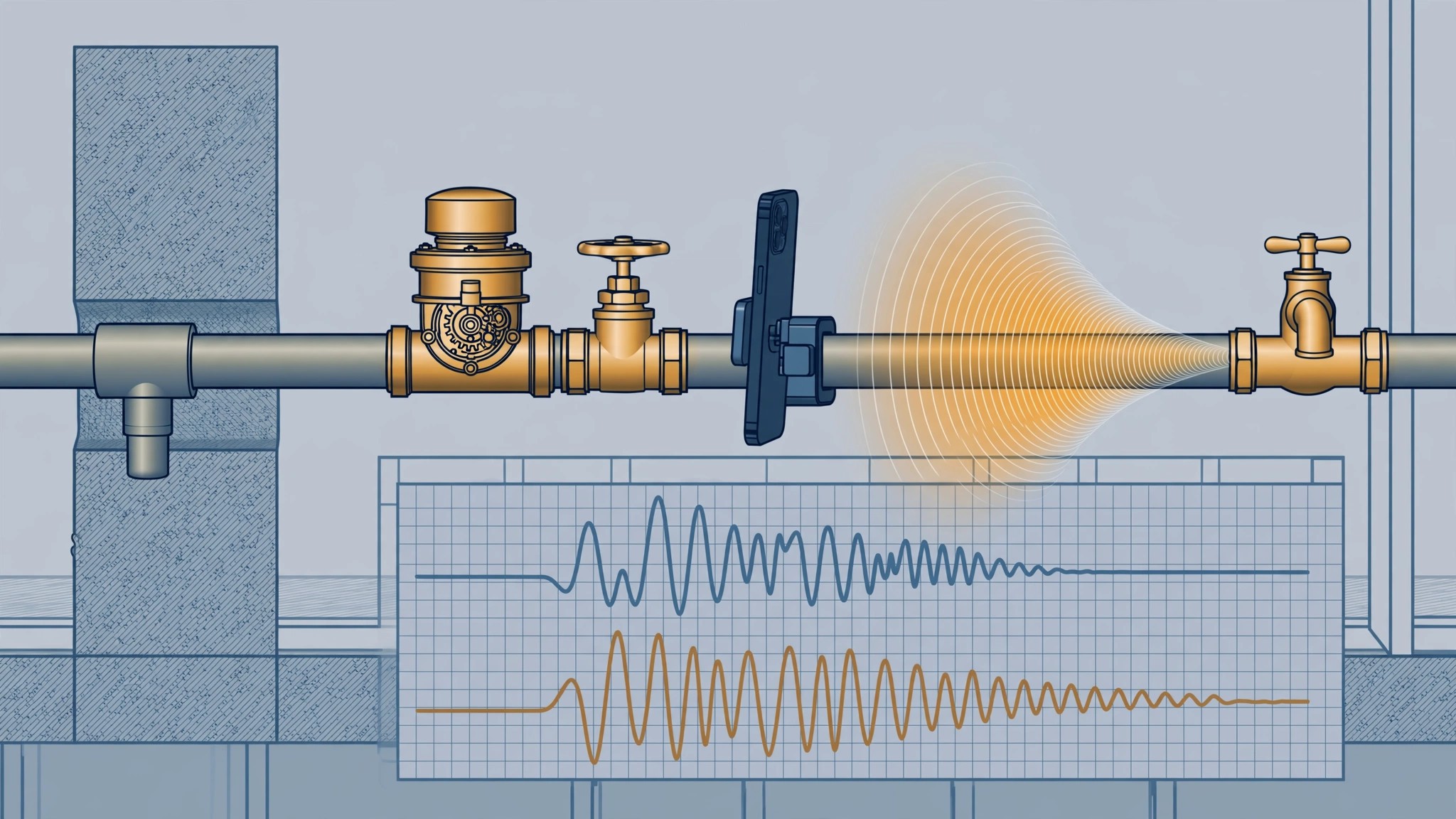
- Figure 1: System overview: basement cutaway showing the water service line entering through the foundation wall, the water meter and main shutoff valve, a smartphone coupled to the exposed pipe, and a user closing a faucet to generate the water-hammer transient.
- Figure 2: Water-hammer propagation diagram: the pressure wave traveling from the closed fixture to the curb stop and reflecting back, with the direct transient, meter reflection, and curb-stop reflection marked on a time axis.
- Figure 3: Example ring-down waveforms and spectra for lead, copper, and galvanized steel service lines, showing lead's faster decay, lower wave speed, and lower resonance Q.
- Figure 4: Bayesian fusion diagram: acoustic classifier output combined with build-year prior, utility inventory status, and neighborhood spatial prior into the per-address lead probability score with credible interval.
- Figure 5: Block-level lead probability map for a utility service territory, with high-probability blocks highlighted for sequenced replacement.
Claims
- A system for identifying lead water service lines, comprising: a consumer mobile device with a microphone and an accelerometer; a guided test protocol that instructs a user to couple the mobile device to an exposed section of a water service pipe and to close a water fixture abruptly to generate a water-hammer pressure transient; a feature extraction module that computes, from the recorded transient, a pressure wave speed estimate, per-band ring-down decay constants, a resonance quality factor, and a spectral centroid trajectory; and a material classifier that outputs a probability that the service line is lead based on the extracted features, wherein lead is distinguished from copper and galvanized steel by slower wave speed per the Korteweg relation and faster damping from higher material loss factor.
- The system of claim 1, wherein excitation of the pipe is passive, comprising the water-hammer transient from ordinary fixture closure, and wherein no striking, tapping, or dedicated excitation transducer is required.
- The system of claim 1, wherein the wave speed estimate is derived from the arrival time of a reflection of the water-hammer transient from a curb stop or other impedance discontinuity on the service line, identified by matched filtering against the direct transient, combined with a service line length from parcel data or user entry.
- The system of claim 1, wherein the resonance quality factor is computed for the dominant flexural resonance of the pipe wall segment as center frequency divided by half-power bandwidth, and wherein a low quality factor indicates lead and a high quality factor indicates copper or galvanized steel.
- The system of claim 1, further comprising a service-line discrimination module that separates the buried service line's acoustic signature from interior plumbing by weighting late-arriving reflection energy, including the curb-stop reflection, more heavily than early-arriving energy from interior fittings.
- The system of claim 1, further comprising a coupling quality check that records a user-generated tap on the pipe before the test, verifies the tap exceeds a signal-to-noise threshold, and rejects the test with repositioning guidance when coupling is poor.
- The system of claim 1, further comprising a Bayesian fusion module that combines the material classifier output with a prior probability derived from building construction year, utility service line inventory status, and verified results at neighboring addresses, producing a per-address lead probability score with a credible interval.
- The system of claim 7, wherein the per-address lead probability score routes to action by band: high probability schedules utility verification and replacement planning, medium probability recommends professional inspection or laboratory water testing, and low probability is recorded as screened non-lead in the utility inventory.
- A utility-scale lead service line triage system, comprising: a plurality of per-address lead probability scores according to claim 7, each with homeowner consent uploaded to a utility inventory system; and a mapping module that aggregates the scores into block-level lead probability maps used to sequence contiguous replacement work.
- The system of claim 1, further configured to detect partial lead service lines, wherein reflection-timing analysis localizes a lead segment along the line and reports partial lead as a separate class requiring replacement.
- The system of claim 1, wherein all feature extraction occurs on the mobile device, recording is limited to a user-initiated test window around the fixture closure, raw audio buffers are overwritten within seconds, and only the feature vector and classification result leave the device with user consent.
Implementation Notes
Any modern smartphone suffices: the accelerometer channel captures the low-frequency wall flexure that carries most of the material discrimination, so devices with limited microphone low-frequency response still work. A compliant coupling interface (silicone sleeve or rubber pad) improves structure-borne transfer by an order of magnitude over a bare phone pressed to the pipe; the app's coupling check rejects tests below threshold. Calibration is performed on homes with verified material across the three classes and across common diameters (3/4-inch and 1-inch service lines dominate residential stock), water pressures (40 to 80 psi), and soil conditions, since each shifts the absolute wave speed and must be absorbed by the classifier rather than assumed away.
Known limitations, stated plainly. The method screens for pipe material; it does not measure lead concentration in water. A home with a copper service line can still have elevated lead from lead solder or brass fixtures, and a home with a lead service line may have low tap lead if corrosion control (orthophosphate treatment) is effective, so acoustic screening complements rather than replaces laboratory water testing. Homes with no accessible exposed pipe (finished basements, slab-on-grade construction with buried entry) cannot be tested with this method and default to records-based screening. Pressure-reducing valves, water softeners, and expansion tanks between the fixture and the service line attenuate the transient and are flagged by the app during setup; the protocol prefers a hose bibb or laundry faucet on the cold line closest to the entry point. Mixed-material lines with short lead segments near the detection limit of reflection timing may be misclassified as full non-lead; the partial-lead class carries a wider confidence interval for this reason. The quantitative wave-speed and damping models are fit to limited field data, and the highest-priority validation step is a blinded trial against excavation-verified material across at least several hundred addresses before scores are used for replacement scheduling.
Prior Art References
- TechXplore, March 2024: Drexel University (Bartoli) and Seaflower Consulting: striking an accessible pipe and monitoring surface sound waves to identify buried lead service lines without excavation
- Drexel University, March 2024: Research summary: approximately 9.2 million American homes served by lead water lines; acoustic wave propagation distinguishes buried pipe composition
- City of DeKalb pipe identification procedures: Scratch, magnet, and coin-tap test for homeowner identification of lead, copper, and galvanized service lines
- Wylie, E. B. and Streeter, V. L., Fluid Transients in Systems, Prentice Hall, 1993: Water-hammer theory, Korteweg wave speed in elastic pipes, and reflection at impedance discontinuities
- U.S. EPA Lead and Copper Rule Improvements (2024): Service line material inventory requirements and mandated lead service line replacement schedules for water utilities