System and Method for Ice Maker Health Monitoring and Water Filter Depletion Estimation Using Fill-Valve Electrical Signatures, Fill Acoustic Analysis, and Harvest-Cycle Event Tracking
Abstract
Disclosed is a non-invasive system and method for monitoring refrigerator ice maker health and estimating water filter depletion without modifying the appliance or its plumbing. A current sensor on the refrigerator power feed detects fill-valve solenoid actuations by their electrical signature, while a microphone captures fill acoustics and harvest-cycle cube-drop transients. On-device inference fuses four measurement channels: (1) the solenoid inrush and hold current envelope, which reveals valve coil degradation and plunger stiction; (2) fill-duration-normalized acoustic energy of the water jet striking the ice mold, which tracks actual flow rate through the filter; (3) the water-hammer pressure transient generated at valve closure, whose decay signature reflects upstream flow restriction; and (4) harvest-cycle cube-drop counting and harvest cadence, which expose the underfill signature of a starved ice maker. A filter loading index is computed from the fused channels and auto-baselines when a filter replacement is detected as a step change in flow metrics. Outputs include replace-soon and replace-now filter alerts keyed to measured restriction rather than elapsed time, ice maker mechanical health scoring, and dispenser auger jam precursors.
Field of the Invention
This invention relates to appliance diagnostics, specifically to non-invasive monitoring of refrigerator ice makers and water filtration systems using electrical signature analysis, acoustic sensing, and edge computing for predictive maintenance and consumable replacement timing.
Background
No part of the modern refrigerator fails more often than the automatic ice maker. In Consumer Reports' 2026 member survey of more than 71,000 refrigerators with ice makers, an estimated 31 percent developed a problem by the end of the fifth year of ownership, and ice makers together with water and ice dispensers were the two most commonly reported problem categories, ahead of broken compressors and loss of cooling (Consumer Reports, 2026). An earlier survey found refrigerators with ice makers twice as likely to need repair as those without (Consumer Reports 2011 survey, via I-Fix Appliances). French-door ice maker service calls routinely run $500 to $1,200.
Nearly every refrigerator with an ice maker also contains a replaceable water filter, typically a carbon block cartridge certified to NSF/ANSI 42, 53, and 401 for taste, odor, particulate, lead, and emerging contaminant reduction. Rated service capacities run 200 to 300 gallons (Whirlpool everydrop EDR4RXD1; Samsung DA29-00003 class). Replacement guidance is almost universally time-based: change the cartridge every six months. Elapsed time does not measure what actually degrades a filter, which is accumulated particulate loading and the resulting flow restriction. A vacation home with a 200-gallon filter might push 30 gallons in six months and discard a nearly new cartridge; a large family on well water with high sediment can choke the same cartridge in eight weeks and then run for four months on a filter that no longer flows. Manufacturers acknowledge the gap in their own manuals: KitchenAid instructs owners to replace the cartridge more often than six months "if the water flow to the water dispenser or ice maker decreases noticeably" (KitchenAid Use & Care Guide), and LG specifies replacement "every six months, at the rated capacity or if a noticeable reduction in flow rate occurs" (LG LMXS30746S Owner's Manual). Noticeable to a human means the filter has been badly clogged for a while; the ice maker noticed weeks earlier.
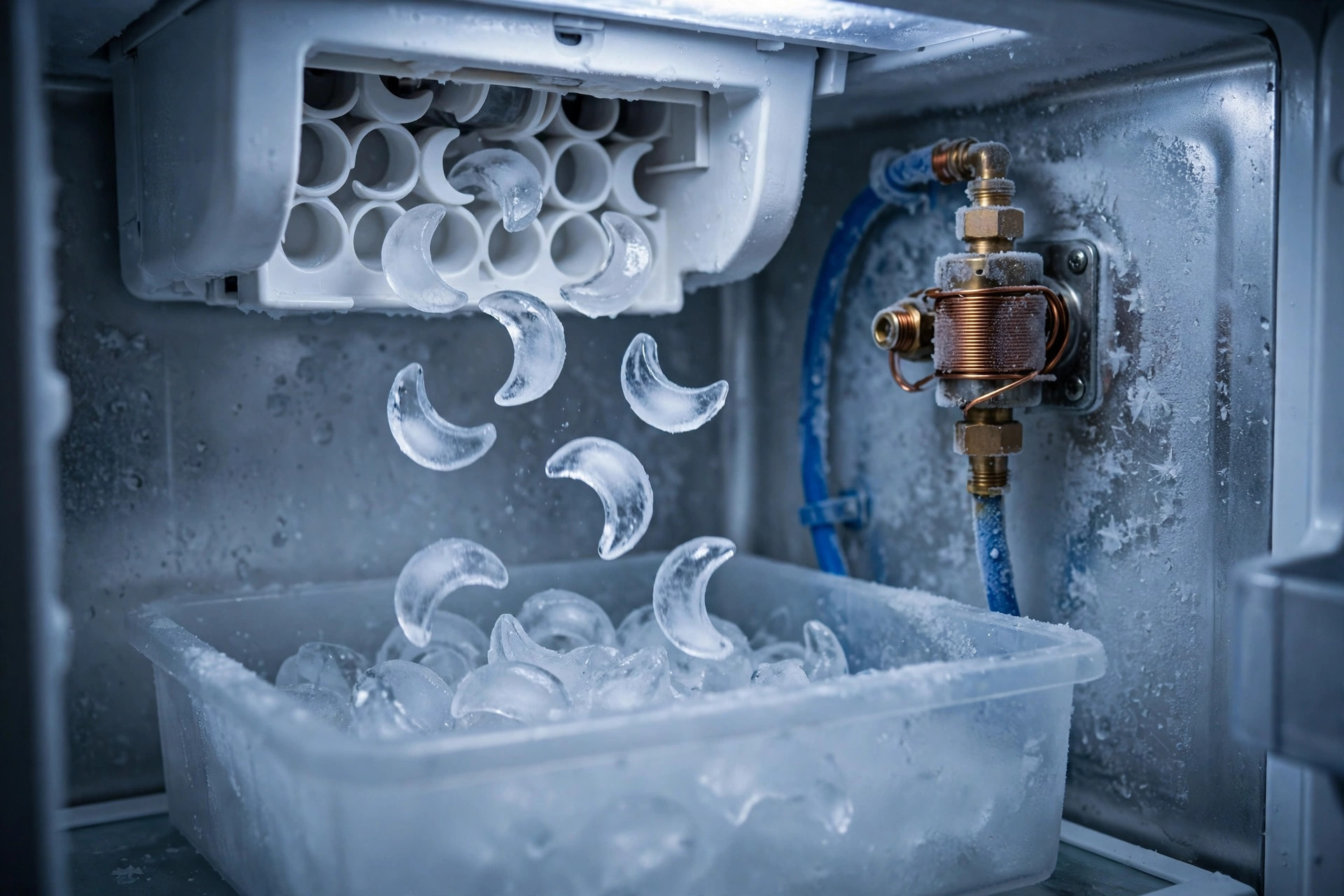
An automatic ice maker runs a repeating cycle with three observable phases. First, the fill phase: a solenoid valve opens for a fixed time (typically 5 to 10 seconds, set at the factory or by a fill adjustment screw) and water jets into the ice mold. Fill is time-based, not volume-based, so any upstream flow restriction directly reduces the water delivered per cycle. Second, the freeze phase: the mold sits in the freezer until a thermostat or thermistor signals the cubes are frozen. Third, the harvest phase: a mold heater loosens the cubes and a motor-driven ejector rakes them into the storage bin. Each phase produces electrical and acoustic signatures accessible from outside the sealed refrigeration system.
Two established diagnostic principles apply. Solenoid current signature analysis, long used for industrial valves, reads coil and mechanism health from the current waveform: inrush peak and pull-in time reflect plunger motion against spring and friction forces, while hold current reflects coil resistance. Deviations reveal stiction, partial shorts, and mechanical wear. Separately, the Joukowsky water-hammer relation (pressure rise proportional to fluid density, wave speed, and velocity change) predicts that every solenoid valve closure launches a pressure transient into the supply line; the transient's decay is shaped by upstream impedance, so a progressively clogging filter measurably changes the ring-down of a transient the appliance generates on its own several times a day.
Current filter-life indicators, where they exist, count elapsed time or estimate dispensed volume. Neither measures restriction. No consumer system infers filter loading from the hydraulic and electrical behavior of the ice maker it serves, and no consumer system tracks ice maker mechanical health (valve stiction, ejector wear, auger jam precursors) from passive sensing. What the art lacks is a complete non-invasive system that turns the ice maker's own fill and harvest events into a continuous diagnostic stream for both the consumable filter and the mechanism.
Detailed Description
1. Sensing Hardware
In the preferred retrofit embodiment, a self-contained puck installs without tools, plumbing changes, or electrical work. A split-core current transformer clamps around the refrigerator's power cord and samples total current at 4 kHz or better. A MEMS microphone (SNR 64 dB or better) mounts on the refrigerator's rear or side panel near the water inlet valve, coupled with a removable adhesive pad. An ESP32-S3-class microcontroller performs event detection and feature extraction on device; only extracted features and classification results leave the device, never raw audio. WiFi or BLE carries alerts to a phone app and optional cloud dashboard. Target bill of materials is under $30 at volume.
An OEM embodiment integrates the same functions into the appliance control board: the board's existing current sense resistor or Hall sensor provides the electrical channel, a $0.50 MEMS microphone is added near the valve, and the diagnostic runs as firmware on the existing application processor. A third embodiment places both sensors in a smart outlet or energy monitor that already measures the refrigerator's power draw, adding only the microphone.
2. Event Detection and Segmentation
Fill valve actuations are detected in the current waveform by their unmistakable signature: a rapid inrush as the solenoid energizes, a steady hold plateau for the fill duration, and a sharp drop at de-energize. During a 48-hour calibration period the detector learns the refrigerator's background load profile (compressor cycles, defrost heater, fans), then flags valve events by template matching against the learned solenoid envelope. Harvest events are detected acoustically: the mold heater produces no sound, but ejector motor rotation followed by a burst of cube-drop impact transients forms a recognizable sequence. A dispense event (user pressing the ice paddle) is detected by the dispenser motor current combined with the sustained rattle of cubes in the chute. Each detected event is timestamped and segmented into analysis windows: pre-fill baseline, inrush (first 100 ms), hold (valve open), closure transient (200 ms after de-energize), fill acoustics (valve open interval), and harvest sequence.
3. Solenoid Electrical Signature Analysis
From each fill event the system extracts the solenoid current envelope: inrush peak current, pull-in time (energize to current settling), hold current mean and ripple, and release time. Two degradation modes are tracked. Plunger stiction, caused by scale buildup or seal swelling, lengthens pull-in time and superimposes chatter (100-300 Hz ripple) on the inrush as the plunger hesitates. A stiction index is computed from pull-in time normalized to the learned baseline plus ripple energy in the inrush window. Coil degradation, from insulation aging or partial turn shorts, reduces winding resistance and raises hold current; a 10 percent upward drift in temperature-compensated hold current sustained over 30 days flags the valve for replacement before it fails open (flooding risk) or fails closed (no ice). Because the measurement is comparative against the unit's own baseline, absolute calibration of the current sensor is unnecessary.
4. Fill Acoustic Flow Estimation
During the hold window, water jetting into the empty mold produces broadband acoustic energy concentrated between 1 and 8 kHz as the jet strikes plastic. As the mold fills, the impact surface changes from hard plastic to water, and the spectrum softens measurably; this transition provides an independent fill-progress marker. The system integrates acoustic energy in the jet band over the fill interval and normalizes by the measured valve-open duration, producing a flow index proportional to actual volumetric flow rate. Tracking the flow index across weeks yields a restriction trend immune to day-to-day pressure fluctuations, because municipal supply pressure variations average out while filter loading is monotonic. A 25 percent decline in the flow index from the post-replacement baseline indicates significant loading; a 40 percent decline indicates the filter is restricting flow below the ice maker's design minimum.
5. Water-Hammer Transient Analysis
Valve closure is a built-in hydraulic step test the appliance performs for free. When the solenoid de-energizes, the water column's momentum converts to a pressure spike per the Joukowsky relation, and the resulting pipe ring is captured by the microphone as a decaying transient. The system extracts the transient's initial amplitude, dominant resonant frequency (set by the supply line length, typically 40-120 Hz for residential runs), and exponential decay time constant. As the filter clogs, upstream impedance rises and the transient decays faster with reduced low-frequency content; as a supply-line restriction develops elsewhere (kinked line, failing saddle valve), the resonant frequency shifts. The hammer decay index is the most pressure-independent of the restriction channels because it measures the system's impulse response rather than steady flow, making it valuable in homes with pressure regulators or variable municipal pressure.
6. Harvest-Cycle Cube Yield Tracking
Each cube dropping from the mold into the bin produces a short impact transient (2-5 ms, energy concentrated 2-4 kHz) as crescent ice strikes ice or plastic. A lightweight edge classifier counts these transients during each harvest sequence, producing a cube yield per harvest. The expected yield is learned per unit (mold cavity count, typically 7-8 for crescent molds) during the calibration period. Declining yield with constant harvest frequency indicates bridging (cubes fusing and releasing as clumps), ejector finger wear (incomplete raking), or mold coating degradation (cubes sticking). The classifier also timestamps the harvest sequence duration; a lengthening ejector phase with falling yield is the specific signature of ejector mechanism wear.
7. The Underfill Signature
Filter starvation produces a counterintuitive but reliable signature. Because fill is time-based, a clogged filter delivers less water per cycle, producing thinner cubes. Thinner cubes freeze faster, so the mold thermostat calls for harvest sooner: harvest cadence increases while cube yield per harvest decreases. This inverse relationship (more frequent harvests, fewer cubes each) distinguishes filter starvation from low demand (fewer harvests, full yield) and from a full bin (no harvests at all). The system computes a starvation score from the joint movement of cadence and yield, which responds within days of significant restriction, well before a human notices smaller cubes.
8. Filter Loading Index and Auto-Baseline
The flow index, hammer decay index, and starvation score fuse into a single filter loading index scaled 0-100, where 0 is a fresh filter and 100 is fully blocking. Fusion weights are learned per unit during calibration, defaulting to equal weight. Two alert thresholds are defined: advisory at 70 ("order a replacement; flow down about 25 percent") and replace-now at 85 ("flow down about 40 percent; ice production degraded"). A critical threshold at 95 indicates flow below the manufacturer's minimum inlet pressure equivalent and triggers a same-day alert.
Baseline management is automatic. A filter replacement appears in the data as a step increase in the flow index and a step decrease in the hammer decay time within a single day, a signature no other household event produces. On detecting this step, the system re-baselines all indices and logs the replacement date, building a per-household history of actual filter service life. Over multiple replacement cycles the system learns the household's true consumption rate (gallons per month inferred from fill counts times per-fill volume estimates) and predicts the next replacement date, converting the fixed six-month timer into a measured schedule.
9. Dispenser Auger and Crusher Health
Through-the-door dispensers add a motor-driven auger and, on crushed-ice models, crusher blades. During dispense events the system monitors motor current: a healthy auger shows a steady draw with the periodic ripple of cubes passing; an incipient jam shows current spikes as cubes wedge, followed by either clearing (spike resolves) or stall (sustained high current, thermal protector trip). A jam precursor alert fires when spike frequency exceeds the learned baseline, giving the user a chance to clear the chute before a stall. Crusher blade wear appears as a gradual shift in the rattle spectrum toward lower frequencies as blades dull and fracture cubes less cleanly. These channels reuse the same current sensor and microphone, adding no hardware.
10. Figures Description
- Figure 1: System block diagram showing the retrofit puck (split-core CT, MEMS microphone, MCU, radio), its placement on the refrigerator power cord and rear panel, and data flow to the phone app and optional cloud service.
- Figure 2: Annotated solenoid current waveform for one fill event, marking inrush peak, pull-in time, hold plateau with ripple, and release, with overlaid traces showing healthy, stiction-affected, and coil-degraded envelopes.
- Figure 3: Fill acoustic spectrogram showing the jet-on-plastic phase, the fill-completion spectral transition, and valve-closure water-hammer transient, for a fresh filter versus a loaded filter.
- Figure 4: Harvest sequence timeline with cube-drop impact transients marked, showing full-yield, partial-yield (bridging), and extended-ejector (finger wear) cases.
- Figure 5: The underfill signature plot: harvest cadence versus cube yield per harvest over a filter service life, showing the characteristic migration toward high-cadence, low-yield operation and the recovery step at replacement.
- Figure 6: OEM embodiment schematic showing control-board current sense, added microphone placement near the inlet valve, and firmware module boundaries.
Claims
- A system for monitoring a refrigerator ice maker, comprising: a non-invasive current sensor coupled to the refrigerator's power feed; an acoustic sensor positioned to capture fill valve and ice mold sounds; and a processor configured to detect fill-valve solenoid actuations from the current waveform, segment each actuation into inrush, hold, and closure windows, extract a solenoid health metric from the inrush and hold current envelope, extract a flow index from fill acoustic energy normalized by valve-open duration, and compute a filter loading index from the flow index trend.
- The system of claim 1, wherein the processor further extracts a water-hammer decay signature from a 200 ms acoustic window following valve de-energize, and wherein the filter loading index fuses the flow index with the hammer decay signature as independent restriction channels.
- The system of claim 1, wherein the processor counts cube-drop impact transients during harvest sequences to compute cube yield per harvest, tracks harvest cadence, and computes a starvation score from increasing cadence combined with decreasing yield, the starvation score indicating time-based underfilling caused by upstream flow restriction.
- The system of claim 1, wherein the solenoid health metric comprises a stiction index derived from pull-in time and inrush ripple energy relative to a learned baseline, and a coil degradation index derived from temperature-compensated hold current drift.
- The system of claim 1, further comprising an automatic re-baselining module that detects a filter replacement event as a step increase in the flow index within a 24-hour window and resets the filter loading index baseline without user input.
- The system of claim 5, further comprising a replacement-date predictor that estimates per-fill water volume from the flow index, accumulates estimated gallons across fill events, and predicts the next replacement date from the household's measured consumption rate.
- The system of claim 1, further comprising a dispenser monitoring module that detects dispense events from dispenser motor current, computes a jam precursor score from current spike frequency relative to baseline, and issues a pre-stall alert when the score exceeds a threshold.
- The system of claim 1, wherein the current sensor is a split-core current transformer clamped around the refrigerator power cord and the acoustic sensor is a surface-mounted MEMS microphone, the system requiring no modification to the appliance, its wiring, or its plumbing.
- The system of claim 1, wherein the current sensor is an existing current sense element on the appliance control board and the acoustic sensor is a microphone integrated into the appliance, the monitoring functions executing as firmware on the appliance's application processor.
- A method for timing refrigerator water filter replacement by measured restriction rather than elapsed time, comprising: passively detecting ice maker fill events via electrical signature; estimating per-fill flow rate from normalized fill acoustic energy; estimating upstream impedance from valve-closure water-hammer decay; tracking harvest cadence and cube yield for an underfill signature; fusing the estimates into a filter loading index; and issuing a replace-now alert when the index indicates flow restriction below the ice maker's design minimum.
Prior Art References
- Consumer Reports, "Most and Least Reliable Refrigerator Brands of 2026" — 31% of refrigerators with ice makers develop a problem by end of year five; ice makers and dispensers are the two most reported problem categories
- Consumer Reports 2011 repair-history survey (via I-Fix Appliances) — Refrigerators with ice makers twice as likely to need repair as those without
- KitchenAid Refrigerator Use & Care Guide — 200-gallon rated filter capacity; replace more often than six months if flow to dispenser or ice maker decreases noticeably
- LG LMXS30746S Owner's Manual — 0.5 gpm service flow, 20-120 psi supply range, 200-gallon capacity; replace every six months, at rated capacity, or on noticeable flow reduction
- Whirlpool everydrop EDR4RXD1 Performance Data Sheet — NSF/ANSI 42, 53, and 401 certification; 200-gallon rated capacity; six-month replacement interval
- Samsung DA29-00003-class filter specifications — 300-gallon / six-month rated service life for NSF 42/53 carbon block cartridges
- Joukowsky water-hammer relation — pressure transient magnitude proportional to fluid density, wave speed, and velocity change at sudden valve closure; standard fluid-transient theory
- Solenoid current signature analysis — inrush peak, pull-in time, and hold current as established indicators of plunger stiction and coil degradation in industrial valve diagnostics
Implementation Notes
Build notes for whoever implements this. The 48-hour calibration period is not optional. Every refrigerator has a different compressor duty profile, valve timing, and mold geometry, and the template matcher needs clean examples of each before it can separate valve events from defrost heater cycles. Defrost is the most common false positive, distinguished by the heater's slow resistive ramp versus the solenoid's sharp inrush. Audio never leaves the device in the retrofit embodiment; the microphone stream is reduced to band energies and transient counts within a 250 ms rolling buffer, which also keeps the bill of materials honest since no cloud inference is needed. The single largest confound is an upstream reverse-osmosis system or whole-house filter, both of which add restriction the system will attribute to the refrigerator cartridge; the phone app asks about these once at setup and applies a fixed offset. Homes with a pressure regulator set below 40 psi will show a lower absolute flow index, which is why every threshold is relative to the post-replacement baseline rather than absolute. The system measures restriction, not water quality: a cartridge can be chemically exhausted while still flowing freely, so the replace-now alert means "this filter is choking the ice maker," not "this water is unsafe." That distinction belongs in the product messaging, stated plainly. Dual ice maker models (door plus freezer bin) are handled by clustering fill events into two timing groups; craft-ice and slow-melt models with longer freeze phases shift the underfill signature's cadence baseline but not its direction, so the starvation score survives with per-unit calibration.