System and Method for Predicting Roof Eave Ice Dam Formation and Meltwater Intrusion Risk Using Roof-Deck Temperature Gradient, Attic Humidity, Snow-Depth, and Meltwater Sensing
One winter in Massachusetts produced 125,631 ice dam claims and $1.27 billion in payouts. Five readings, taken on the roof and in the attic, could in principle flag the houses at risk before the first ceiling stain appeared, once the thresholds are validated against real houses.
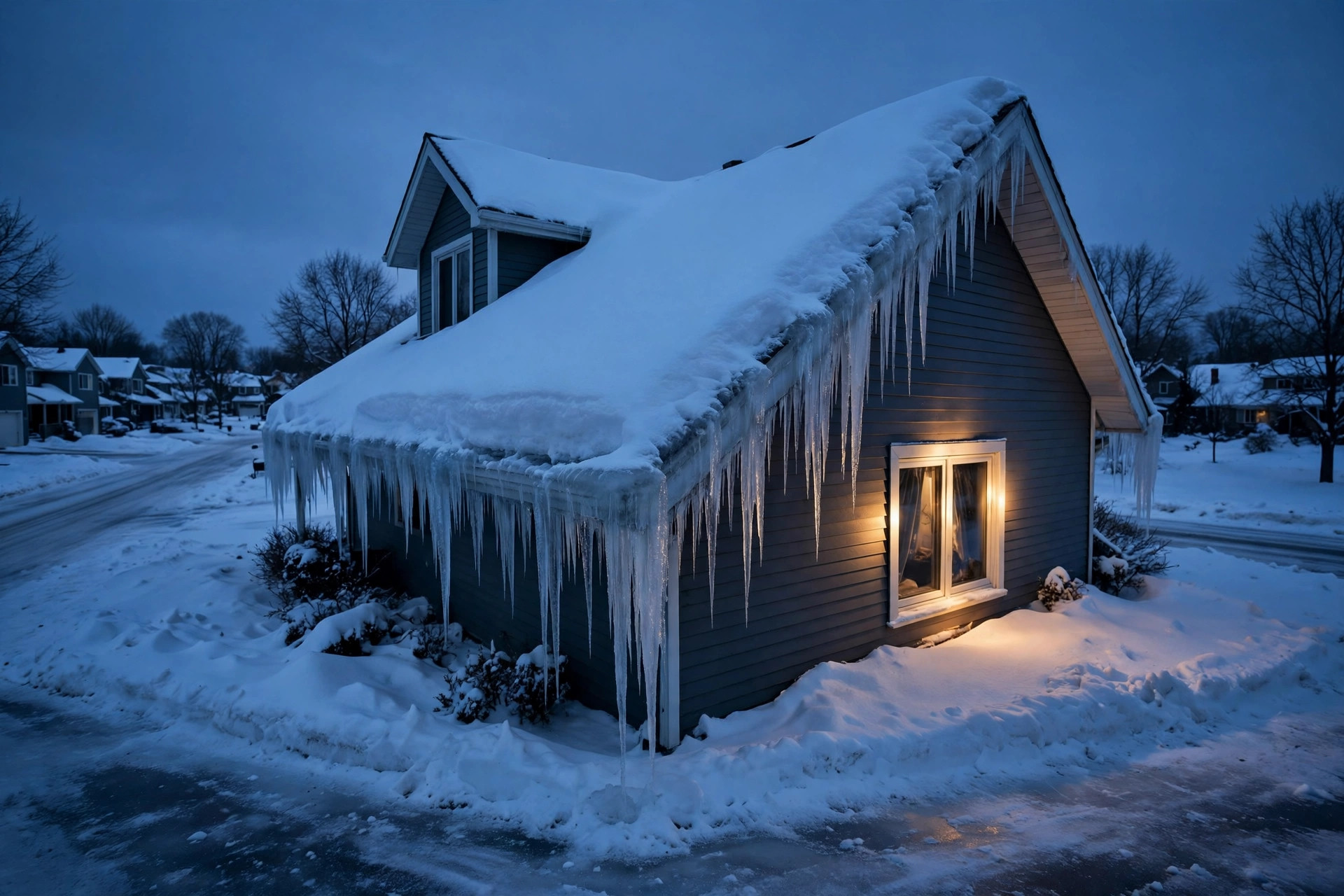
Your roof is melting snow it should not melt. An ice dam is a leak that announces itself as decoration. Icicles along the eave look like a postcard, and behind them a pond of meltwater is sitting on the shingles, working its way under them, into the attic, and down through the ceiling. Nobody sees the pond. A stain on the ceiling is the first sign, and by then the insulation is wet, the drywall is stained, and the mold clock is running. Five channels of data, read through the winter and trended against the house they belong to, can often name the roof likely to dam weeks before it does, and name the reason, which is usually a specific air leak or a blocked vent rather than the weather. Parts cost about $250 to $400, and fitting them takes an afternoon with the attic hatch open. Late November, before the snow season starts, is the practical season to fit it.
"An ice dam is the only roof leak that decorates the house while it happens."
Abstract
Disclosed here is a system that predicts ice dam formation at roof eaves and estimates meltwater intrusion risk before water reaches the attic. Five channels fuse on an edge processor. Roof-deck temperature is measured at the ridge, mid-slope, and eave, giving a temperature gradient along the slope. Attic air temperature and relative humidity give dew point and the risk of condensation on the sheathing. Snow depth and snow water equivalent are measured on the roof. Meltwater presence is sensed at the eave and the wall plate line. A weather-data feed supplies air temperature, snowfall, and rain-on-snow forecasts. Each channel is read continuously through the snow season and trended against a per-house learned baseline. A heat-loss model converts ceiling heat flow into a meltwater production rate in gallons per day. A signature table maps combinations of channel deviations to ten specific failure modes. It distinguishes faults that present identically from the street, such as a bypass air leak versus blocked soffit ventilation, and a sun-driven melt versus a heat-loss melt. It computes a composite Ice Dam Risk Index and issues part-level diagnoses with confidence scores. It controls a heat cable only when meltwater is actually present. And it shares anonymized failure signatures across a fleet to detect bad production batches and regional storm-driven patterns. All thresholds, scores, and projections in this disclosure are reasoned starting points, not measured results: the system has not been built, and none of it has been validated against a fleet of houses. As a retrofit, sensors mount under the eaves and inside the attic, with no change to the roof covering, the structure, or the heating system.
Technical Field
This disclosure covers diagnostics for residential roofs in cold climates: multi-sensor fusion and edge inference that tell apart the heat-loss, ventilation, moisture, and drainage faults that form ice dams, before meltwater intrudes.
Background
How an Ice Dam Forms
An ice dam needs three things at once, and the University of Minnesota Extension states them plainly: snow on the roof, the upper part of the roof surface above 32 degrees Fahrenheit, and the lower part below 32 degrees, with outside air below freezing too. Meltwater runs down the warm upper slope, reaches the cold eave, and freezes. Fed by melting snow above it, the dam grows, and it limits itself to the part of the roof that averages below freezing, so the water above it backs up behind the dam and stays liquid. That pond finds cracks and openings in the roof covering, flows into the attic, and from there into exterior walls or through the ceiling insulation to stain the ceiling. Heat from the house is what warms the upper roof. It travels by conduction through the ceiling and insulation, by convection as warm air leaks through gaps and rises to the roof, and by radiation from the warm top surface of the insulation to the sheathing. Three defects feed it: inadequate insulation, poor air sealing of the ceiling plane, and inadequate attic ventilation. Building Science Corporation puts airtightness first, ahead of insulation, and its classic control is a vented roof: an airtight ceiling lid, heavy insulation on top of it, and ventilation that flushes whatever heat still reaches the deck with cold outside air. Done well, no ice dams. Done badly, which describes most existing houses, the roof melts its own snow and refreezes it at the edge.
It does not take much snow. Building America Solution Center notes that ice dams can form with as little as 2 inches of snow on a roof. They are likely anywhere the ground snow load exceeds 30 pounds per square foot, and prevalent where it exceeds 60, according to Joseph Lstiburek. Snow itself makes the problem worse: a snow blanket insulates at about R-1 to R-2 per inch, so the snow that is melting on top is also trapping the heat that melts it. Valleys, dormers, chimneys, and skylights make it worse again, because every intersection is a place where air sealing, insulation, and ventilation are harder to do well, and where meltwater collects. A simple gable roof with a tight ceiling and clear soffit vents is the roof least likely to dam. A complex roof is a set of dams waiting for a cold week.
The Numbers
Water damage and freezing account for roughly a quarter of all homeowners insurance claims in the United States, and the Insurance Information Institute puts the average water damage and freezing claim at $13,954 for 2018 through 2022, rising to $17,240 for 2020 through 2024. Averages differ by window: $13,954 for 2018-2022, $15,400 for 2019-2023, and $17,240 for 2020-2024. No ice dam event is better measured than the Massachusetts winter of 2014 to 2015. After that winter, the state Division of Insurance surveyed the top 25 home insurers plus the FAIR Plan and counted 125,631 ice dam claims, with $1,268,460,937 paid, an average of $11,050 per paid claim. Dividing the same total by all 125,631 filed claims gives about $10,100, since about 10,800 claims went unpaid. Against about 3.0 million Massachusetts housing units in the 2020 Census, 125,631 claims is roughly 1 claim for every 24 homes in a single winter. One winter, one state, more than a billion dollars, and that figure counts only insured losses that were claimed. Professional ice dam removal runs $400 to $4,000, averaging about $1,200, and removal is usually not covered: the policy pays for the interior damage, not for taking the ice off the roof. A minor roof leak repair runs about $900, extensive damage with mold remediation reaches $25,000 or more, and mold remediation alone runs $20 to $25 per square foot. Prevention is cheaper than any of it, and it is also the part nobody does, because a roof that has not dammed yet looks fine from the driveway.
Housing stock is the reason the numbers stay high. ENERGY STAR reports that 9 out of 10 homes in the United States are under-insulated. Federal guidance puts attic insulation at R-49 to R-60 in cold climates, and the 2021 International Energy Conservation Code sets R-60 for new attics in climate zones 4 through 8, which covers most of the northern United States. A house built to R-19 in the attic, which was common for decades, leaks about three times the heat of a house built to R-60, and every extra unit of heat is meltwater waiting for a cold night. Ventilation is no better. The 2015 International Building Code, Section 1203.2, requires 1 square foot of net free vent area for every 150 square feet of attic floor. That drops to 1 in 300 only where ventilation is balanced between upper and lower openings and, in climate zones 6 through 8, a Class I or II vapor retarder sits on the warm side of the ceiling. Lstiburek argues the code's 1-inch minimum airspace under the sheathing is wrong in ice dam regions, where ground snow loads exceed 30 pounds per square foot, and that 2 inches is the minimum that actually moves air. Soffit vents get buried by insulation in house after house, and a vent that is buried is a vent that does not exist.
The Heat-Loss Math: How Much Meltwater a Ceiling Makes
The melt rate follows directly from the heat flow, and the arithmetic is short enough to check by hand. Heat flow through a ceiling is area times temperature difference divided by R-value. Start with a 1,000 square foot ceiling insulated to R-19, with 70 degrees inside and 20 degrees in the attic, a 50 degree difference. Heat flow is 1,000 times 50 divided by 19, about 2,632 Btu per hour. Over 24 hours that is about 63,200 Btu. Melting ice takes 144 Btu per pound, the latent heat of fusion, so 63,200 Btu melts about 439 pounds of ice a day, which is about 53 gallons of water a day. Not all of that heat reaches the roof deck, and not all of the melt runs to the eave, so call the real figure half that and it is still about 26 gallons a day, every day, for as long as the cold snap lasts. Insulated to R-60 instead of R-19, the same house makes a third as much meltwater from the same temperature difference, about 17 gallons a day before the same halving, or about 8 gallons a day after it, which is the entire argument for insulation stated as a water bill.
| Ceiling | Gross melt | After halving allowance |
|---|---|---|
| R-19 | 53 gallons a day | 26 gallons a day |
| R-60 | 17 gallons a day | 8 gallons a day |
Conduction is only one path. Air leakage is the other, and Lstiburek's point is that it is usually the bigger one: warm air leaking through a single unsealed plumbing stack chase or a set of recessed can lights can carry more heat into an attic than the whole ceiling conducts, and it carries moisture with it.
Moisture is the second half of the problem, and it follows its own arithmetic. Indoor air at 70 degrees and 35 percent relative humidity has a dew point near 40 degrees. Roof sheathing on a cold night sits well below 40 degrees, often near the outdoor temperature, so any house air that reaches the sheathing condenses on it. That condensation freezes, and the frost that builds up on rafters and sheathing melts in the spring, which is when attic mold starts. That same air leak melts snow on the roof and wets the attic from the inside, and a system that only watches the roof misses half the damage. Dew point is computed from attic temperature and humidity, two cheap readings, and the gap between the dew point and the sheathing temperature is a direct measure of how much condensation is happening tonight.
Snow Weight and Ponding: What the Roof Is Carrying
Snow depth is not the load. Water content is. As a rule of thumb, 10 inches of snow holds 1 inch of water, but real ratios run wide: fresh light snow holds about 8 percent water, settled snow a few days old about 25 percent, wet heavy snow about 40 percent, and packed snow with ice layers about 50 percent. One inch of water spread over one square foot weighs about 5.2 pounds, since a cubic foot of water weighs 62.4 pounds. Twelve inches of settled snow at 25 percent water holds 3 inches of water, which is 15.6 pounds per square foot, and across a 1,200 square foot roof that is about 18,720 pounds, over nine tons. Those same 12 inches as wet heavy snow at 40 percent water weigh 25 pounds per square foot, about 30,000 pounds on the same roof. Ice is heavier still at about 57 pounds per cubic foot. An ice dam 4 inches thick, 12 inches wide, running 40 feet along an eave holds about 13.3 cubic feet of ice, about 760 pounds, sitting exactly where the gutter and the fascia are weakest. None of this is the load the roof was designed for in the usual sense: the dam is a concentrated load at the edge, plus a pond behind it. A pond 1 inch deep over an 80 square foot band behind the dam holds about 50 gallons of water, and that water is sitting on shingles that were designed to shed water running downhill, not to hold a pond.
| Snow type | Water content | Load |
|---|---|---|
| Fresh, light | 8 percent | 5.0 pounds per square foot, about 6,000 pounds |
| Settled, a few days old | 25 percent | 15.6 pounds per square foot, about 18,720 pounds |
| Wet, heavy | 40 percent | 25 pounds per square foot, about 30,000 pounds |
| Packed, with ice layers | 50 percent | 31.2 pounds per square foot, about 37,400 pounds |
"Shingles are a watershed, not a bathtub."
What Exists Already
Homeowners are not without tools, and the gap this disclosure fills is specific, not total. Naming what exists is part of the disclosure, because the new contribution sits in the space between these products.
Heat cable is the fix people reach for after the first leak. Constant-wattage kits, such as the EasyHeat ADKS, put out about 5 watts per foot whenever they are plugged in: a 120-foot run draws 600 watts, 14.4 kilowatt-hours a day if left on around the clock, about $1.60 to $2.15 a day at Minnesota electricity rates, or $144 to $194 over a 90-day season. Self-regulating cable, such as WarmlyYours Ice Shield or nVent Raychem IceStop, varies its output with temperature and costs $2 to $5 a foot installed against $1 to $3 for constant-wattage. Professional installation averages about $981, and hardwired controllers with snow and temperature sensors run $900 to $3,900. Heat cable melts a drain path through a dam so trapped water can escape. It does not stop dams from forming, it does not fix the heat loss that causes them, and the Minnesota Center for Energy and Environment recommends against it. Left on all winter, a cable can add roughly $40 to $200 or more a month to the electric bill, depending on cable length and local rates; the 120-foot run priced above runs about $48 to $65 a month. When a cable trips its ground-fault protection, which the National Electrical Code requires on snow and ice melting circuits, it stops working silently, and the dam comes back.
An ice and water shield is the membrane that saves the house when the dam wins. Where the local code designates a history of ice damming, code requires a self-adhering polymer-modified bitumen membrane from the lowest roof edge to a point at least 24 inches inside the exterior wall line, or two cemented layers of underlayment as an alternative, and it seals around nail penetrations so ponded water cannot reach the deck. It is a second line of defense, not a prevention measure, and it only exists if the roof was replaced after the code applied or the roofer installed it. Millions of roofs have felt paper instead, or a membrane that stops short of the wall line, and a pond that reaches past the membrane reaches the attic. A roof rake, a long-handled blade that pulls snow off the lower roof from the ground, works and costs little, and it also risks damaging shingles and gutters, and it requires someone to use it after every storm. Steam removal, which melts the dam with low-pressure steam, costs $400 to $4,000 a visit and is what professionals do when the leak is already active.
Patents cover pieces of this too, and all of them heat. US 6,184,495, granted in 2001, describes a heating apparatus placed between the roof and the outside wall, under the roof surface, that melts snow on the outer edge and is not visible from outside. US 6,215,102, granted to Jones in 2001, describes a heating apparatus for preventing ice dams with an automatic controller and a ground-fault circuit interrupter that detects ground faults in the heating device. US 7,071,446, granted to Bench in 2006, describes a de-icing and snow melting system using heatsink strips with a heating cable in a gap, a low-voltage transformer, and controls with self-diagnostics that detect anomalies. Every one of these patents is a heater with a controller. None of them senses the roof-deck temperature gradient, none measures attic humidity or dew point, none measures snow depth or water equivalent, none estimates meltwater production from heat loss, and none diagnoses which fault is causing the dam. In the Jones patent, the controller interrupts the heater on a ground fault condition. It does not predict anything. Two more filings narrow the gap further. US 6,036,102, granted to Pearson in 2000, pairs ambient and roof temperature sensors with a thermostatic controller that runs a power ventilator to cool the roof when ice dam conditions are present, which is sensing plus control, though it ventilates rather than predicting. Published application US 2022/0243474, from Clardy and colleagues in 2022, goes further: a sensor detects the state of water near a heating element and switches heater power based on it, turning the heater on when it detects an ice dam and off when a snow bridge covers the element. That is meltwater-gated cable control, and it narrows the cable-control claim below to the fusion around it: Clardy gates a heater on water state alone, with no deck gradient, no dew point, no snow water equivalent, no learned baseline, and no failure-mode diagnosis.
Smart home sensors cover the edges of the problem and miss the middle. Leak detectors under sinks and behind washing machines are common, and a few homeowners put one in the attic, but a leak detector in the attic reports water that has already arrived, and by then the insulation is wet. Temperature and humidity sensors for attics exist as standalone gadgets, and some weather stations report roof snow depth, but no product found in this search combines the roof-deck gradient, the attic dew point, the snow water equivalent, and meltwater presence into a single prediction, and no product tells the owner which fault to fix. Clardy comes closest on control, sensing water state at the heater, but it senses one point, not the roof, and it diagnoses nothing. Of existing products, the nearest relative is the hardwired heat cable controller with a snow and temperature sensor, which turns the cable on when it snows and the temperature is near freezing. It reacts to weather. It does not know whether the roof is melting its own snow, whether the attic is wet, or whether the cable it controls is still working.
Detailed Description
1. System Overview
As a retrofit package, it mounts under the eaves and inside the attic, and it wires into the house without cutting the roof covering or changing the heating system. Five channels feed an edge processor, a low-power microcontroller with a Wi-Fi radio, mounted in the attic in a sealed enclosure. Three thermistors on the roof deck, one near the ridge, one at mid-slope, and one at the eave, read the temperature gradient along the slope. On houses with valleys, a valley temperature probe instruments the valley, and on houses where the sun-driven row matters, a north-slope probe instruments the shaded slope. An attic temperature and humidity sensor reads the air the roof breathes, and a sheathing temperature probe reads the surface that condensation forms on. An ultrasonic snow depth sensor on a mast above the roof, or a pressure-based snow load pad under a representative section, measures snow depth, and the weather feed supplies snowfall totals so the depth reading can be checked against what fell. Conductivity strips at the eave, in the gutter, along the wall plate line, and in the valley where the roof has one, detect liquid water where only ice and snow should be. A weather-data feed supplies air temperature, snowfall, and rain-on-snow forecasts over the radio link.
Deck thermistors are sampled every 5 minutes, the attic sensor every 5 minutes, the snow depth sensor every hour and after each snowfall, and the meltwater strips continuously, logging a meltwater event with a timestamp whenever a strip goes wet. All diagnosis runs on the edge processor, so the system works when the internet is down, and the radio is used for alerts, for fetching weather, and for sharing anonymized signatures with the fleet service. Parts cost for the five channels is about $250 to $400 at retail quantities: three deck thermistors and probes near $45, an attic temperature and humidity sensor near $25, an ultrasonic snow depth sensor near $60, conductivity strips and gutter sensors near $40, a microcontroller board with radio near $25, and a sealed enclosure, cabling, and mounting hardware near $75. The valley probe and strip add about $20 where the roof has valleys, and the north-slope probe about $15 where the sun-driven row matters. Installation is about an afternoon for a competent homeowner, and about three hours billed at a roofer or electrician, with no re-roofing required. Nothing here replaces the ice and water shield, the insulation, the air sealing, or the ventilation. It watches them.
2. Roof-Deck Temperature Gradient: The Melt Line
The gradient is the channel that turns a roof from a surface into a diagnostic instrument. One temperature reading on a roof means little. Three readings along the slope give a line, and where that line crosses 32 degrees is the melt line. When the ridge probe reads above 32 and the eave probe reads below 32, with snow on the roof, the dam condition is met: snow is melting up high and refreezing down low. A mid-slope probe locates the melt line between the two, and the melt line moves as the day warms and the night cools. A melt line that sits above the eave for hours each afternoon and drops to the eave each night is a dam in the making. When the ridge probe stays above 32 and the melt line never descends past the ridge, the upper roof keeps melting all day and the whole slope feeds the eave. A melt line that sits at the eave all day means the roof is cold and uniform, which is what a good roof does.
Gradient measurement needs two guards against false readings. First, the probes must read the deck, not the sun. A thermistor taped to a dark shingle in direct sun reads the sun, not the deck. Each probe is shielded under a small white radiation cover. It mounts on the underside of the deck from inside the attic where the roof allows it, or under the shingle at the deck surface with a sun shield where it does not. Second, the gradient must be read as a sustained average, not an instant. Reading each probe as a 60-minute rolling mean removes the noise of a passing cloud, while preserving the slow movement of the melt line across the day. Probes are calibrated once at installation against a known reference, and the calibration is rechecked automatically whenever all three probes read the same temperature on a mild, snow-free night, which happens often enough in the shoulder seasons to keep drift visible.
3. Attic Temperature and Humidity: The Dew Point Channel
Attic air temperature and relative humidity give the dew point, and the dew point against the sheathing temperature gives the condensation risk. Indoor air at 70 degrees and 35 percent relative humidity has a dew point near 40 degrees. When the sheathing sits at 25 degrees on a cold night, any house air reaching it condenses, and the condensate freezes. Dew point is computed from the attic sensor every 5 minutes and compared with the sheathing probe. A gap of more than 5 degrees between dew point and sheathing temperature, sustained for more than 6 hours, means condensation is happening tonight, and the system logs the hours of condensation as a running total for the season. That total is the mold risk number: a few dozen hours a season is normal for a tight house, and hundreds of hours means the attic is being wetted from the inside every cold night.
Attic temperature also diagnoses the bypass leaks that melt the roof. A tight attic on a 20 degree night sits a few degrees above outdoor temperature, warmed only by conduction through the ceiling. An attic with a bypass leak, an unsealed plumbing stack chase, a set of recessed can lights, an open attic hatch, runs 10 to 20 degrees above outdoor temperature, and the excess tracks the indoor-outdoor temperature difference, which is the signature of house air entering the attic rather than sun or a warm day. Across the season, the attic-outdoor temperature difference is recorded against the indoor-outdoor difference, and a ratio that stays high across cold nights points at air leakage, while a ratio that falls when the house is set back points at the heating system itself. Ventilation is read from the same channel: an attic with working soffit-to-ridge airflow cools toward outdoor temperature overnight, while an attic with blocked soffits stays warm and humid, and the overnight cooling rate separates the two.
4. Snow Depth and Water Equivalent: The Load Channel
Snow depth is measured, and water equivalent is estimated from depth, density, and weather, because depth alone does not say how much water the roof holds or how much meltwater the dam will have to hold back. An ultrasonic sensor on a mast measures depth every hour. Density is estimated from the weather feed: fresh snow falling below 20 degrees is light, about 8 percent water; snow that has sat for days is settled, about 25 percent; snow falling near freezing is wet, about 40 percent; and old snow with ice layers is packed, about 50 percent. Water equivalent is depth times density, and load is water equivalent times 5.2 pounds per square foot per inch of water. Snowfall totals from the weather feed check the estimate, and when the two disagree by more than 30 percent, the system flags the depth sensor for a manual check, because wind drifts snow and a single point measurement can be fooled by a drift.
Heat loss becomes a meltwater production rate in the melt model. Ceiling heat flow is area times the indoor-attic temperature difference divided by the ceiling R-value, using the R-value entered at installation or the default for the house's age band. That heat flow, in Btu per hour, divided by 144 Btu per pound, gives pounds of ice melted per hour, and pounds divided by 8.34 gives gallons per hour. Run twice, the model first uses ceiling conduction alone, and once with an air leakage allowance added, because air leakage is usually the larger heat path and the conduction-only figure understates the melt. The canonical house from the Background derivation, a 1,000-square-foot R-19 ceiling with a 50 degree indoor-attic difference, makes about 53 gallons a day by conduction alone, and the model reports that figure with the leakage allowance alongside it, so the owner sees both the floor and the likely reality. For the signature table, the meltwater forecast is the deciding number: a house making about 53 gallons a day gross with a cold eave is a house at high risk of damming, and a house making 5 gallons a day, the halved figure for an R-60 ceiling with a 30 degree indoor-attic difference, is not, whatever the snow depth says.
5. Meltwater Sensing: The Intrusion Channel
Conductivity strips detect liquid water where only ice and snow should be, and they are the channel that catches the leak rather than the conditions for one. At the eave, a strip under the first course of shingles goes wet when meltwater ponds behind the dam. A strip along the wall plate line, inside the attic at the top of the exterior wall, goes wet when ponded water gets under the shingles and past the ice and water shield. A strip in the gutter goes wet when the gutter holds liquid water behind a frozen downspout, and a flow sensor in the downspout confirms whether water is actually leaving the roof. Each strip is a pair of stainless conductors on a flexible backing, read as a resistance that falls from megohms to kilohms when water bridges them, and the strips are specified with a self-test that applies a small voltage once a day and confirms the strip still responds.
False readings are the risk here, and temperature is the guard. A strip that reads wet while the eave probe reads below 28 degrees is almost certainly reading frost or condensation, not liquid water, and the system holds the reading as a watch item until the eave warms above freezing. A strip that reads wet while the eave is above 32 degrees and the melt model says water is being produced is a real event. Most important of the four is the plate line strip: water at the eave is a dam, and water at the plate line is a leak into the house, and the two can be hours apart or the same hour, depending on the membrane. A house whose plate line strip goes wet may have hours, not days, before the ceiling stains, and the alert says so.
6. Weather: The Forecast Channel
Weather data arrives over the radio link from a forecast service, or from a small temperature and precipitation sensor mounted on the house. It serves three purposes: the melt forecast, the rain-on-snow warning, and the freeze-thaw count. Forecast air temperature and snowfall set the expected meltwater production for the next 72 hours, so the system can warn on Tuesday about a dam that will form on Friday, while there is still time to rake the lower roof or call a roofer. Rain on snow is the sharpest event in the season. Warm rain falling on a snowpack melts it from above while the eave stays frozen. A rain-on-snow forecast with more than a quarter inch of rain triggers a watch even when the deck gradient looks calm, because the rain supplies meltwater the house did not have to make. Freeze-thaw cycles are counted across the season, and a house that has been through twenty cycles with a warm ridge and a cold eave has had twenty chances to dam, which is why the count is part of the baseline. Expected snow depth for the depth sensor check described above also comes from the forecast, and a forecast that says 8 inches fell while the sensor says 3 means the sensor is drifted or buried, not that the roof is clear.
7. Edge Diagnostic: The Signature Table
The diagnostic is a signature table, not a black-box model. Rows are failure modes, columns are channels, and each cell states which way that channel should deviate from the house's own baseline. Scoring counts how many cells match what the house is actually doing, weighted by how distinctive each cell is, and the best-matching rows come back with a confidence score. Three matching channels with high distinctiveness is a diagnosis; one matching channel is a watch item. Nothing is diagnosed on a single channel alone, because every single-channel reading has a benign explanation.
| Failure mode | Deck gradient | Attic temp / dew point | Snow / melt model | Meltwater strips |
|---|---|---|---|---|
| Ridge melt, cold eave (classic dam) ⚠ | Ridge above 32, eave below 32 | Attic warm, ratio high | Melt forecast high | Eave strip wet |
| Bypass air leak (stack, can lights) | Warm zone mid-slope | Attic hot spot, dew point high | Melt above conduction model | Eave strip wet near leak |
| Blocked soffit ventilation | Gradient flat, deck warm | Attic stays warm overnight, no hot spot | Melt steady, no overnight reset | Eave strip wet |
| Valley dam | Valley probe warm, eave cold | Normal | Melt concentrated in valley | Valley strip wet first |
| Gutter and downspout freeze | Gradient normal | Normal | Melt forecast normal | Gutter wet, downspout dry |
| Ice barrier missing or short ⚠ | Gradient dam pattern | Normal or warm | Melt forecast high | Plate line wet with small eave pond |
| Attic frost and moisture | Gradient mild | Dew point above sheathing for hours | Melt low | Strips dry |
| Heat cable failed | Eave below 32 with cable on | Normal | Melt forecast high | Eave strip wet, cable current zero |
| Sun-driven melt (south slope) | South slope warm, north cold | Attic near outdoor | Melt only on sunny days | South eave wet only |
| Rain-on-snow event | Gradient collapses, all above 32 | Humidity spikes | Rain in forecast, melt jumps | All strips wet at once |
Two marked rows deserve emphasis because they are the ones that put water in the house. A classic ridge-melt dam shows up first as a gradient, not as water. The pond forms before it intrudes. That pattern gets flagged when the ridge stays above 32 while the eave stays below 32 for more than 6 hours a day on three consecutive snow days, days before the pond reaches the plate line. A missing or short ice barrier shows up as the opposite pattern, a plate line strip going wet while the eave pond is still small, and the system treats that combination as an urgent alert rather than a watch item, because the membrane that was supposed to be the second line of defense is not there, and the water has a clear path to the ceiling.
Time-to-intrusion projection is the output that turns a diagnosis into a decision. Meltwater production comes from the heat-loss model, pond volume from the eave strip and the deck geometry, and the time until the pond reaches the plate line from the melt rate and the distance the water must travel back up the slope. If the plate line strip is already wet, the projection is measured in hours and the alert says so. If the pond behind a dam on a low-slope roof is growing at about 26 gallons a day, the halved melt figure for a 1,000-square-foot R-19 ceiling, the projection is the number of days until the pond reaches the wall line, and the alert names the likely day. After every meltwater event, the projection is recomputed, and it is labeled as an estimate with the melt rate and pond volume it was computed from, so the owner can see the reasoning instead of trusting a number.
8. Ice Dam Risk Index
Five channels combine into a single Ice Dam Risk Index from 0 to 100, presented with the channel and signature responsible for each point lost. Starting at 100, the thermal subscore loses points for a ridge-eave gradient that straddles 32 degrees, for a melt line that sits above the eave for hours each day, and for an attic temperature ratio that points at air leakage. Moisture subscore loses points for dew point above sheathing temperature, for condensation hours accumulating across the season, and for attic humidity that stays high overnight. Snow subscore loses points for snow water equivalent above the house's seasonal norm, for meltwater production above the conduction model, and for a freeze-thaw count that keeps climbing. Intrusion subscore loses points when a meltwater strip goes wet, and more points when the plate line strip goes wet. Sensor subscore loses points when the snow depth reading and the weather feed disagree, which indicates a drifted or buried sensor rather than a failing roof.
Each subscore is shown separately. The point deductions in the worked example below are illustrative weights, chosen to show how the index moves, not measured values. An index below 80 triggers a service warning, below 60 triggers an urgent alert, and below 40 triggers a critical alert with a time-to-intrusion estimate. Those 80/60/40 thresholds are unvalidated starting points, and every index is labeled as an estimate. No index replaces manual checks: looking in the attic for frost, checking the soffit vents, and raking the lower roof after a storm. Thresholds are defaults, and the owner can tighten them.
9. Baseline Learning: The First Snow Season
Every house is different, and a fixed threshold that fits a 1950s Cape Cod will false-alarm on a new house with R-60 and a sealed ceiling, and miss a dam on a 1920s house with no insulation at all. So the baseline is learned from the house it is installed on. For the first snow season after installation, it records without diagnosing: deck gradient by hour of day, attic-outdoor temperature ratio, dew point against sheathing temperature, snow depth and water equivalent, meltwater production, and condensation hours. One season is long enough to include several snow events, and on a house that sees regular snow it is long enough to collect at least 14 snow days, and short enough that the owner gets diagnoses in the same winter the system is installed. In a mild snow year, a house may not see 14 snow days in one season, so the learning period stretches across seasons until it does. The requirement is at least 14 snow days and at least 3 freeze-thaw cycles in that window.
Baselines are stored as a mean and a standard deviation for each metric, and a deviation is counted only when it exceeds two standard deviations from the mean, which keeps ordinary variation from generating alerts. With only a few dozen snow days in the learning window, the sample spread is itself uncertain, and snow data are skewed rather than normal, so the two-standard-deviation rule will need tuning against fleet data before its false-alarm rate is known.
Baselines are relearned after a known change. When the owner air seals the attic, adds insulation, clears the soffit vents, or replaces the roof, they press a button in the app or on the module, and the system starts a new learning period for the affected channels. When the roof is re-shingled, the system pauses diagnosis for 48 hours, because a new roof has no snow load yet and the deck probes were just disturbed. Seasonal drift is handled by a slow update: the baseline mean moves by 1 percent of the difference between the old mean and the new week's mean each week, which tracks gradual changes like settling insulation without absorbing a sudden failure into the baseline. Drift is bounded on purpose: the baseline moves 1 percent of the gap per week, while the dam flag in §7 trips at a gradient sustained over three consecutive snow days. A leak growing by a fraction of a percent a week could be absorbed into the baseline, and at that rate it would take years to double; anything growing faster outruns the drift and trips the flag.
10. Display, Gateway, and Fleet Learning
The owner sees the system in three places. A small display near the thermostat shows the Ice Dam Risk Index, the deck gradient, the snow depth, and the attic dew point. A phone app shows the same, plus the signature table with the matching rows highlighted, the time-to-intrusion projection, and the season trend charts for each channel. An alert goes out by text message and push notification when the index crosses a threshold or when a signature matches with high confidence, and the alert names the suspected fault, not just the symptom: "Bypass air leak near the plumbing stack, ridge melting while the eave stays frozen," rather than "Roof alarm."
Where one is installed, the system also controls the heat cable, and it does so only when meltwater is actually present. A cable controller that runs on a timer wastes electricity all winter, about $1.60 to $2.15 a day for a 120-foot run, and a cable that runs on a snow sensor alone runs whenever it snows, whether the roof is melting or not. This system switches the cable on only when the eave strip is wet and the gradient straddles 32 degrees, and off when the strip dries or the eave rises above freezing, which cuts the run time to the hours that matter. Cable current is monitored, and a cable drawing zero current while commanded on is flagged as a failed cable or a tripped ground fault, which is the heat cable failure mode in the signature table.
Fleet learning is the part that helps houses the system has never seen. Anonymized signatures, with no house identity, no location finer than a town, and no owner information, are shared with a fleet service. When a batch of heat cable from one maker starts failing in its second season across dozens of houses, the service can warn every owner with that cable before theirs fails. When a town's houses all show a gradient spike after the same storm, the service can separate a weather event from a house problem for each house individually. When a roof design shows a characteristic valley dam pattern before intrusion, the service can publish that pattern as a signature update, and every installed system learns to watch for it. Participation is opt-in, and a house that never connects to the radio still gets the full local diagnostic, just without the fleet updates.
11. Scoring Rejection Rules
A diagnostic that cries wolf gets ignored, and a roof diagnostic that cries wolf gets uninstalled. Diagnosis is therefore held back in conditions the system knows are not faults:
- Solar gain: when the south slope is warm and the north slope is cold on a sunny day, with the attic near outdoor temperature, the melt is sun-driven, not house-driven, and the diagnosis is held back until the sun sets and the gradient is read again.
- Rain-on-snow: when warm rain is falling on the snowpack, the gradient collapses and all strips go wet at once, and the system reports the event as weather, not as a house fault.
- After a storm: for 24 hours after a snowfall of more than 6 inches, because wind drifts snow and the depth sensor reads the drift, not the roof, and because a fresh snowpack has not yet settled into its density.
- After re-roofing: 48 hours, because a new roof has no snow load yet and the deck probes were just disturbed.
- Vacation setback: when the house is set back below 55 degrees for more than 48 hours, because the heat-loss model assumes normal occupancy, and a cold house melts less snow for a reason that is not a fault.
A diagnosis held back in these conditions is logged, not discarded, so the owner can see what was held back and why. A pattern of repeated hold-backs is itself reported, because a house that needs its diagnosis held back for solar gain every sunny day has a south slope that dams every sunny day, which is a real problem with a real fix, not a sensor artifact.
Claims
The thresholds in the claims below are illustrative starting points, not measured values.
- A system for predicting roof eave ice dam formation and meltwater intrusion risk, comprising: a plurality of roof-deck temperature sensors measuring temperature at the ridge, at mid-slope, and at the eave of a south-facing roof slope, giving a temperature gradient along the slope; an attic temperature and humidity sensor measuring attic air temperature and relative humidity; a sheathing temperature sensor measuring roof sheathing temperature; a snow depth sensor measuring snow depth on the roof; a downspout flow sensor measuring water flow out of the downspout; a north-facing slope temperature sensor measuring roof-deck temperature on a north-facing slope; a plurality of meltwater sensors comprising conductivity strips at the eave, in the gutter, and along the wall plate line, and, where the roof has a valley, in the valley; a weather-data input receiving air temperature, snowfall, and rain-on-snow forecasts; a communication link for transmitting alerts and receiving weather data; an edge processor configured to compute dew point from attic temperature and humidity, estimate snow water equivalent from snow depth and weather data, estimate meltwater production rate from ceiling heat flow using ceiling area, indoor-attic temperature difference, and ceiling R-value divided by the latent heat of fusion, compare readings against a per-house learned baseline, map combinations of channel deviations to failure-mode diagnoses using a signature table, compute a composite Ice Dam Risk Index from thermal, moisture, snow, intrusion, and sensor subscores, and project time to meltwater intrusion from meltwater production rate and pond volume.
- The system of claim 1, wherein a classic ice dam is diagnosed from a ridge temperature above 32 degrees Fahrenheit combined with an eave temperature below 32 degrees Fahrenheit sustained for more than 6 hours a day on three consecutive snow days, and wherein the diagnosis is reported as an urgent alert.
- The system of claim 1, wherein a bypass air leak is diagnosed from an attic temperature ratio that stays high across cold nights combined with a meltwater production rate above the conduction-only heat-loss model, and wherein the diagnosis indicates air leakage rather than the weather.
- The system of claim 1, wherein blocked soffit ventilation is diagnosed from an attic temperature that stays warm overnight with no overnight cooling reset, combined with a roof-deck gradient that stays warm across the slope, and wherein the diagnosis is distinguished from a bypass air leak by a uniformly warm attic with no localized warm zone.
- The system of claim 1, wherein a missing or short ice barrier is indicated by a wall plate line meltwater sensor going wet while the eave meltwater pond is small, and wherein the diagnosis is reported as an urgent alert.
- The system of claim 1, wherein attic frost and moisture risk are diagnosed from a computed dew point above the sheathing temperature sustained for more than 6 hours, and wherein condensation hours are accumulated across the season as a mold risk total.
- The system of claim 13, wherein a heat cable failure is diagnosed from a meltwater sensor going wet at the eave while a commanded heat cable draws zero current, and wherein the system reports the failure as a tripped ground fault or a dead cable.
- The system of claim 1, wherein sun-driven melt is distinguished from heat-loss melt by comparing the south slope temperature with the north slope temperature and the attic temperature with the outdoor temperature, wherein a warm south slope with an attic near outdoor temperature indicates solar gain, and wherein the diagnosis is held back until after sunset.
- The system of claim 1, wherein a rain-on-snow event is diagnosed from a rain forecast combined with a collapse of the roof-deck temperature gradient and simultaneous wetting of all meltwater sensors, and wherein the event is reported as weather rather than as a house fault.
- The system of claim 1, wherein a gutter and downspout freeze is diagnosed from a gutter meltwater sensor reading wet while a downspout flow sensor reads no flow, and wherein the diagnosis is distinguished from a roof dam by a normal roof-deck gradient.
- The system of claim 1, wherein the edge processor computes a composite Ice Dam Risk Index from thermal, moisture, snow, intrusion, and sensor subscores, and presents the index with the channel and signature responsible for each point lost.
- The system of claim 1, wherein the per-house learned baseline is established over a first snow season requiring at least 14 snow days and at least 3 freeze-thaw cycles, wherein a deviation is counted only when it exceeds two standard deviations from the baseline mean, and wherein the baseline is relearned after air sealing, insulation, ventilation, or roofing work.
- The system of claim 1, further comprising a heat cable controller that switches a roof heat cable on only when an eave meltwater sensor is wet and the roof-deck gradient straddles 32 degrees Fahrenheit, and off when the sensor dries or the eave rises above freezing.
- The system of claim 1, further comprising a fleet service receiving anonymized failure signatures, wherein the fleet service detects a production batch defect from correlated failures across houses and distributes a signature update to installed systems.
- The system of claim 1, wherein diagnosis is suppressed during solar gain, rain-on-snow, for 24 hours after a snowfall of more than 6 inches, for 48 hours after re-roofing, and during a vacation setback below 55 degrees Fahrenheit lasting more than 48 hours, and wherein suppressed diagnoses are logged with the reason for suppression.
- A method for predicting roof eave ice dam formation and meltwater intrusion risk, comprising: measuring roof-deck temperature at the ridge, at mid-slope, and at the eave, giving a temperature gradient along the slope; measuring attic air temperature and relative humidity and computing dew point therefrom; measuring sheathing temperature; measuring snow depth on the roof and estimating snow water equivalent from snow depth and weather data; measuring water flow out of the downspout; measuring roof-deck temperature on a north-facing slope; sensing meltwater presence at the eave, in the gutter, and along the wall plate line, and, where the roof has a valley, in the valley; receiving air temperature, snowfall, and rain-on-snow forecasts through a weather-data input; estimating meltwater production rate from ceiling heat flow using ceiling area, indoor-attic temperature difference, and ceiling R-value divided by the latent heat of fusion; comparing readings against a per-house learned baseline; mapping combinations of channel deviations to failure-mode diagnoses using a signature table; computing a composite Ice Dam Risk Index from thermal, moisture, snow, intrusion, and sensor subscores; and projecting time to meltwater intrusion from meltwater production rate and pond volume.
Implementation Notes
Installation follows building and electrical practice throughout. Deck probes mount on the underside of the sheathing from inside the attic where the roof allows it, which avoids penetrating the roof covering, and under the shingle at the deck surface with a sun shield where it does not, sealed with roofing sealant at the penetration. Attic sensor mounts near the ridge, away from the hatch and away from any ductwork, because a sensor next to a leaky duct reads the duct, not the attic. Snow depth sensor mounts on a mast above the ridge, clear of drifts against dormers and chimneys, because a sensor in a drift reads the drift. Meltwater strips adhere to the deck under the first course of shingles at the eave, to the gutter floor, and to the top plate inside the attic, and each strip is tested after installation by wetting it with a spray bottle and confirming the reading. Wiring runs in the attic, clear of the insulation where it would be buried, and the module enclosure is sealed and mounted above the attic floor, because an enclosure that sits in insulation overheats and a cable that runs through insulation gets buried by the next top-up.
Electrical safety matters. A heat cable controller switches a resistive load on a dedicated circuit, and the circuit carries ground-fault equipment protection, as NEC 426.28 requires for fixed outdoor deicing and snow-melting equipment; 30 milliamps is the standard ground-fault equipment protection trip level. That is a different device from a Class A ground-fault circuit interrupter, which trips at 4 to 6 milliamps for personnel protection and is not what the snow-melting rule calls for. A cable that trips its protection stops working silently, which is why the system monitors cable current and flags zero current while commanded on. Sensor package draws under 5 watts, about the same as a night light, so the monitor does not become a load that matters. Sensor batteries, where used instead of wired power, are specified as lithium cells rated to minus 40 degrees, because an alkaline cell in a cold attic dies in January, which is exactly when the system is needed. Roof work carries leak and warranty risk: strips and probes that sit under shingles should be fitted by a roofer, electrical work by an electrician, and the work should not be done on an icy roof. Houses with several bad slopes need several probe sets, which adds about $35 per extra slope for the additional probe and strip, on top of the headline parts cost.
Integration with existing house systems is through Wi-Fi for alerts to the owner's phone, and through the thermostat for occupancy and setback state, so the vacation setback rule in §11 reads the actual setback rather than guessing from temperature. A house with no network still gets the full local diagnostic and a display near the thermostat. That display shows the Ice Dam Risk Index, the deck gradient, the snow depth, and the attic dew point, in plain language, because a number that needs a manual is a number that gets ignored.
Limitations
This system diagnoses the conditions that form ice dams, not the roof. It cannot detect a leak that does not reach the eave or the plate line, such as a leak at a chimney flashing or a skylight curb, and it cannot detect roof damage that admits water faster than any dam can hold it back. Failed flashing leaks in the rain, with or without snow, and no sensor on the deck changes that. All it can do is report that meltwater is present where it should not be, and report it early.
Of all channels, the snow depth sensor is most vulnerable to wind. A single point measurement on a roof reads the drift at that point, and wind piles snow deeper below ridges and against walls, and scours it thin on exposed slopes. Large disagreements get caught by the weather feed check, and the density estimate is a starting point, not a measurement, but a drifted sensor and a real snow load can mask each other for a time, and the output says so rather than pretending certainty it does not have.
Complex roofs confound the gradient. Many valleys, dormers, and skylights mean many melt lines, not one, and three probes on one slope do not describe the slope behind the dormer. As disclosed, the system instruments the worst slope, the one that has dammed before, and a house with several bad slopes needs several probe sets. That is a cost question, not a physics question, and the disclosure should not pretend one probe set covers a complex roof.
No measurement in this system has been validated against a fleet of real houses, because the system has not been built yet. Thresholds in the claims, the 6-hour gradient rule, the three consecutive snow days, the two-standard-deviation rule, are reasoned starting points from the physics and the published building science, not measured results. A builder would need to instrument a few dozen houses across a season, record the dams that actually occur, and tune the thresholds against those outcomes before the confidence scores mean what they claim to mean.
Strongest Case Against
Strongest case against this disclosure is that most of it already exists in pieces, and the pieces are close enough that a skeptic could call the combination obvious. Heat cable with a snow and temperature sensor already exists, and the Jones patent already puts a controller on a roof heater with ground-fault detection. Attic temperature and humidity sensors already exist, and any homeowner can buy one for $25. Snow depth sensors already exist, and the weather feed already forecasts rain on snow. New material here is the gradient, the dew point against sheathing temperature, the melt model from heat loss, the per-house learned baseline, and the signature table. A patent examiner could reasonably say that adding a thermometer to a heat cable controller is an ordinary engineering step, and that the Lstiburek and University of Minnesota guidance plus a few sensors gets most of the way there. That is a fair objection, and the claims are drawn to the fusion and the prediction precisely because the individual pieces are not new.
Second objection is practical. Air sealing and insulation are the fix, and they are also the diagnosis: a blower door test and an infrared camera find the bypass leaks in an afternoon, and a roofer with a rake finds the dam. A homeowner who air seals the attic, insulates to R-49 or R-60, clears the soffit vents, and rakes the lower roof after each storm will not dam, and will not need a sensor to tell them so. That price is worth paying only for houses that keep damming after the obvious fixes, for owners who cannot get into the attic, and for dams that form on slopes nobody watches. That is a real population, it includes most older houses in snow country, but it is not every house, and the disclosure should not pretend otherwise.
Third objection is that roof temperatures are messier than the table suggests. A deck temperature depends on the shingle color, the sun angle, the wind, the snow depth, and the insulation below it, and the gradient moves with the weather in ways that vary between houses and even between slopes on the same house. A signature table with clean rows is a design document, not a measurement, and the first fleet deployment would find rows that overlap and signatures that do not separate as cleanly as written. Two-standard-deviation rule and first-season learning period are the honest answer to that objection, and they are also an admission that the thresholds are a starting point, not a result.
What a Homeowner Can Do Now
Attic safety first: walk only on joists or on boards laid across them, never on the drywall between joists, and do not go into the attic alone.
None of this requires buying anything, and the checks below take about 30 minutes on a cold day, plus a look in the attic. Here is what you can do now, before the snow season. They are the manual version of what the system does automatically, and doing them once before the snow season covers most of the risk.
- Take the attic temperature. On a cold night, put a thermometer in the attic and one outside. A tight attic sits a few degrees above outdoor temperature. An attic running 10 to 20 degrees above outdoor, with the house at 70, is leaking house air, and the leak is the dam. Find it before the snow comes.
- Look for frost in the attic. On a cold morning, look at the underside of the roof sheathing and the rafters. Frost on the wood means moist house air is condensing and freezing up there, and that frost melts in the spring and grows mold. Frost is the attic telling you the ceiling leaks air.
- Check the soffit vents from outside. Walk around the house and look at the soffit vents. A vent buried by insulation, painted shut, or blocked by a bird nest is a vent that does not exist. Clear them, and fit baffles so the next insulation top-up does not bury them again.
- Rake the lower roof after each storm. A roof rake pulls snow off the bottom 3 to 4 feet of the slope from the ground, which removes the snow that would have melted and refrozen at the eave. Work from the ground, pull down the slope, and stop if the rake catches a shingle edge.
- Look at the recessed lights from the attic. Recessed can lights are the most common bypass leak in the ceiling. From the attic, look for light fixtures that are not airtight and not covered by insulation, and for gaps around plumbing stacks, chimneys, and the attic hatch. Seal them with caulk or foam, and keep insulation off non-IC-rated fixtures.
- Test the heat cable before the snow. If the house has heat cable, plug it in on a cold day and feel whether it warms, and check whether its ground-fault protection holds. A cable that trips its protection in November will not work in January, and January is when the dam forms.
- Clear the gutters and downspouts. A gutter full of leaves holds water, and a downspout frozen shut holds it longer. Clean both before the first snow, and confirm water runs out the bottom of each downspout with a hose.
- Check the ice barrier at the next re-roof. When the roof is replaced, confirm the roofer installs a self-adhering ice and water shield from the lowest edge to at least 24 inches inside the exterior wall line. It is the second line of defense, and it only exists if someone puts it there.
Know a homeowner who has not looked in their attic since summer? Send them this page. Those checks take about thirty minutes.
The Search
Before writing this disclosure, the existing corpus was checked for overlap. This site's 249 prior disclosures include rooftop snow load estimation, pipe freeze detection by acoustic velocity thermometry, attic hail impact assessment, roof drainage acoustic monitoring, roof shingle granule loss analysis, and heat pump frost accumulation and demand defrost, and none of them covers ice dam formation. Distinguishing facts are the operating physics and the failure economics: an ice dam is a slow, seasonal failure driven by the house itself, in which the roof melts its own snow and refreezes it at the edge, and the cost of a missed diagnosis is a wet attic and a stained ceiling, not a failed machine. No disclosure in that corpus combines roof-deck temperature gradient sensing with attic dew point computation, snow water equivalent measurement, meltwater presence sensing at the eave, and a heat-loss melt model for a residential roof. Heat cable patents come nearest, and the boundary drawn in the claims above is drawn against them on purpose: this disclosure claims the sensing, the fusion, the learning, and the prediction, not the bare act of heating a roof edge.
Prior Art References
- University of Minnesota Extension, Dealing with and preventing ice dams: an ice dam is a ridge of ice at the roof edge that prevents melting snow from draining; formation requires snow on the roof with the upper roof surface above 32 degrees Fahrenheit and the lower surface below 32 degrees; heat from the house travels by conduction, convection, and radiation; causes are inadequate insulation, poor air sealing, and inadequate attic ventilation
- Lstiburek JW, De-Icing Ice Dams, Building Science Insight 97, October 2018: the best strategy is not to have an ice dam; control is airtight ceilings, insulation, and under-deck ventilation with outside air; airtightness most of all; a 2-inch minimum airspace under the sheathing in ice dam regions where ground snow loads exceed 30 pounds per square foot
- Building America Solution Center, Construct Roofs and Attics for Ice Dam Prevention: ice dams are prevalent where ground snow load exceeds 60 pounds per square foot and likely where it exceeds 30; snow insulates at about R-1 to R-2 per inch; complex roofs with valleys, dormers, and projections are harder to air seal, insulate, and ventilate
- Building America Solution Center, Attic Air Sealing, Insulating, and Ventilating for Ice Dam Prevention: ice dams can form with as little as 2 inches of snow; the three best countermeasures are fully air sealing the ceiling plane, thoroughly insulating the attic, and ventilating the roof; common air leakage paths include recessed lights, plumbing stacks, attic hatches, and top plates
- Lstiburek JW, Understanding Attic Ventilation, Building Science Digest 102, 2006: in cold climates the primary purpose of attic ventilation is to maintain a cold roof temperature to control ice dams created by melting snow; vent area ratios range from 1:150 to 1:600 depending on code, with 1:300 most common
- International Building Code 2015, Section 1203.2: net free ventilating area not less than 1/150 of the ventilated area, reducible to 1/300 where both conditions are met, a Class I or II vapor retarder installed in climate zones 6, 7, and 8, and 40 to 50 percent of venting in the upper portion of the attic; the same 1/150 rule appears in IRC R806.2 for residential construction
- US 6,184,495, Method and heating apparatus for preventing ice dams on a roof (issued February 6, 2001): heating device placed between the roof and the outside wall, extending beyond the outside wall, melting frozen precipitation on the outside roof surface, not visually detectable from outside
- US 6,215,102 B1, Heating apparatus for preventing ice dams on a roof (Jones, granted April 10, 2001): heating device below the roof with an automatic controller including a ground-fault circuit interrupter that detects ground faults in the heating device and selectively controls operation
- US 7,071,446 B1, De-icing, snow melting and warming system (Bench, granted July 4, 2006): heatsink strips with a heating cable in a gap, low-voltage transformer, controls with self-diagnostics that regulate power and detect anomalies, installed between exterior and interior surfaces
- iSolar, Heat Tape for Roof: Does It Stop Ice Dams in Minnesota?: typical cable draws about 5 watts per foot, so a 120-foot run costs roughly $1.60 to $2.15 a day at Minnesota rates; heat cable melts drain paths but does not prevent ice dams; hardwired systems need a dedicated ground-fault-protected circuit
- RoofScour, Roof and Gutter Heat Cables: Do They Work? Cost, Kits and Safety: constant-wattage cable about 5 watts per foot; professional installation $466 to $1,502, about $981 on average; hardwired controllers with snow and temperature sensors $900 to $3,900; cable life about 2 to 10 years
- Roof Heat Cable Price: Kits, Install and Running Costs (prices checked November 22, 2026): plug-in constant-wattage kits about $78 to $122 for 100 to 200 feet; self-regulating cable about $317 for 100 feet; running a 100-foot 500-watt cable costs about 9.5 cents an hour at the October 2026 US average electricity price
- Massachusetts Division of Insurance 2015 market report, via BMN Boston: after the record 2014-2015 winter, the top 25 home insurers plus the FAIR Plan counted 125,631 ice dam claims and $1,268,460,937 paid; the same article cites Insurance Information Institute data putting the average water damage and freezing claim at $17,240 over 2020 to 2024
- Insurance Information Institute, via Smith Davis Insurance: water damage and freezing claims averaged about $15,400 per claim from 2019 through 2023, and about 1 in every 67 insured homes files one each year; US winter storms caused about $3.9 billion in insured losses in 2024
- Insurance Information Institute, via US Insurance Portal: water damage and freezing made up about 27.6 percent of homeowners losses nationally in 2022; from 2018 to 2022 the average claim in that category was about $13,954
- HazardHub, via Carrier Management, 7 Top Winter Weather Risks to Home and Property: insurance claims due to water damage caused by ice dams average around $11,100, while preventative ice dam removal costs between $400 and $4,000
- West Virginia Department of Environmental Protection, How to measure snowfall: snow water equivalent is the water in the snow once melted; the 10-to-1 ratio is only an average, and real ratios run widely; one inch of water spread over one square foot weighs about 5.2 pounds
- West Virginia Department of Environmental Protection, Roof snow load calculator: fresh light snow about 8 percent water, settled snow about 25 percent, wet heavy snow about 40 percent, packed snow about 50 percent; 12 inches of settled snow on a 1,200 square foot roof is about 15.6 pounds per square foot, about 18,720 pounds total
- CraftedCalcs, How Much Insulation Do I Need in My Attic?: Department of Energy recommended attic R-values by climate zone, R-49 to R-60 in zones 4 through 8; ENERGY STAR reports 9 out of 10 US homes are under-insulated
- EffectiveAgents, Types of House Damage from Snow: winter storms cause nearly $6 billion in insured losses annually; water and ice damage accounts for 20 percent of all homeowner insurance claims, according to the Insurance Institute for Business and Home Safety; average water damage claim $10,849
- Lemonade, How to Prepare Your Home for a Winter Storm?: the average freeze-related insurance claim runs about $15,400 according to the Insurance Information Institute, and about one in 60 insured homes has a claim caused by water damage or freezing
- 35 U.S.C. § 102(a)(1): defensive prior art under the America Invents Act, printed publications as prior art
- US 2022/0243474 A1, Efficient Control of a Heating Element (Clardy et al., published August 4, 2022): a sensor detects the state of water near a heating element and switches heater power based on it, turning the heater on when it detects an ice dam and off when a snow bridge covers the element
- US 6,036,102 A, Method and apparatus for ice dam prevention (Pearson, granted March 14, 2000): ambient and roof temperature sensors with a thermostatic controller driving a power ventilator to cool the roof when ice dam conditions are present
- HomeInsureGuide, Ice Dam Coverage (2026): professional ice dam removal $400 to $4,000, averaging about $1,200; minor roof leak repair about $900; extensive damage with mold remediation $25,000 or more; mold remediation $20 to $25 per square foot
- Three Rivers, Ice Dam Heat Cables: Worth It?: heat cable treats the symptom, not the cause; the Minnesota Center for Energy and Environment recommends against them; added monthly electric bill about $40 to $200 or more while running, depending on length
- 2020 Census, Massachusetts Profile: total housing units 2,998,537