System and Method for Predicting Gas Oven Hot-Surface Igniter Failure and Delayed-Ignition Hazard Using Smart Plug Current Signature Trend Analysis and Acoustic Ignition Transient Classification
Abstract
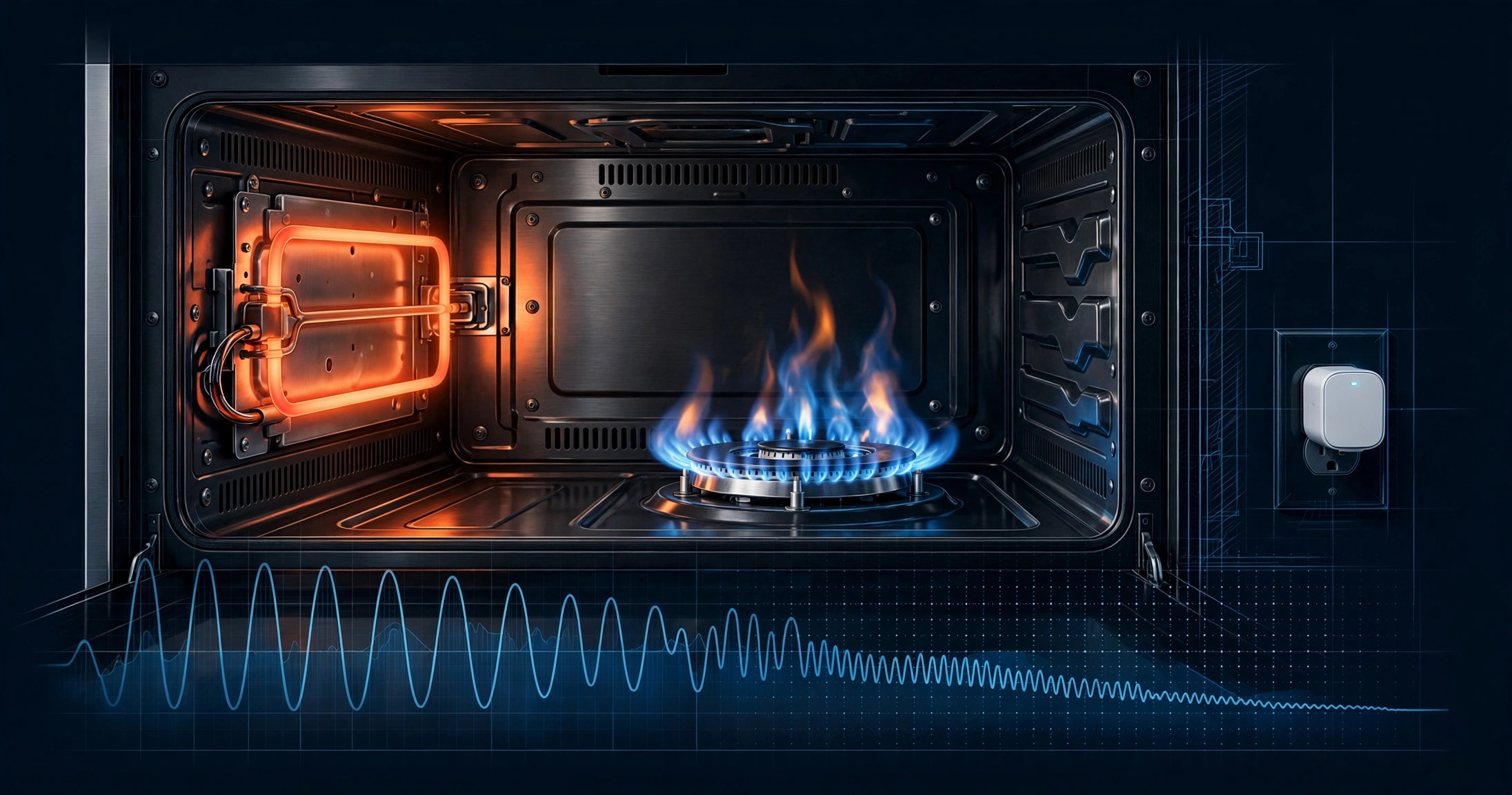
Disclosed is a system that predicts failure of hot-surface (glow bar) igniters in residential gas ovens using only a commodity energy-monitoring smart plug on the range's 120V outlet, optionally fused with acoustic ignition transient classification from a kitchen smart speaker. A healthy silicon carbide igniter draws 3.2 to 3.6 A, and the series-wired gas safety valve requires approximately 3.0 A to open. As the igniter ages its resistance rises and current falls; below roughly 2.9 A the valve opens intermittently, admitting unburned gas that ignites seconds later in a delayed-ignition event audible as a low-frequency whoomp. The system samples RMS current at 1 Hz, extracts per-cycle features including steady-state current, preheat-to-ignition time, valve-open current dip, and re-strike count, fits a degradation trend that forecasts the 3.0 A crossing 2 to 8 weeks in advance, and classifies ignition acoustics to distinguish normal soft ignition from delayed-ignition pressure transients concentrated at 40 to 120 Hz. Differential diagnosis separates igniter wear (declining current trend) from safety-valve or control-board faults (normal current with no ignition), directing replacement of the correct $15 to $40 part instead of a misdiagnosed $150+ service call. Deployment requires no electrician and no gas line work: the range plugs into a standard outlet through the smart plug.
Field of the Invention
This invention relates to residential appliance prognostics, specifically to non-invasive prediction of gas oven hot-surface igniter end of life and detection of the delayed-ignition safety hazard, using external electrical current signature analysis and acoustic event classification without disassembly of the appliance.
Background
Most residential gas ovens built since the 1980s use a hot-surface (glow bar) igniter rather than a standing pilot. The igniter is a silicon carbide or silicon nitride element wired in series with the oven gas safety valve. When the control calls for heat, line voltage is applied to the igniter; it must heat to incandescence and simultaneously pass enough current to warp the bimetal element inside the safety valve open. Gas flows only when the valve opens, and the glowing igniter lights it. This series arrangement is itself the safety mechanism: no adequate igniter current means no gas flow.
The igniter is the most frequently replaced part in gas ovens according to appliance repair trade sources. Its failure mode is gradual: thermal cycling and oxidation raise the element's resistance over 3 to 7 years of service, so current draw declines from a healthy 3.2 to 3.6 A toward the valve's operating threshold near 3.0 A. Trade references state the test procedure explicitly: a properly working igniter draws 3.0 to 3.4 A, and any igniter drawing under 3.0 A is considered weak and should be replaced. Ignition should occur within 60 seconds of the igniter energizing.
The dangerous regime is the marginal band around 2.8 to 3.0 A. There the valve opens intermittently: it admits a charge of gas, the weakened igniter fails to light it promptly, more gas accumulates, and ignition finally occurs seconds late as a single explosive event. Technicians describe the signature precisely: the igniter teeters at the threshold, gas builds up with an audible whooshing, and each delayed cycle ends in a loud whoomp that can rattle the oven door. Repeated delayed ignition stresses door glass and hinges and exposes users standing nearby to a fireball from the oven cavity.
Current practice detects none of this in advance. Homeowners discover igniter wear only when the oven stops heating, at which point diagnosis requires a service visit ($150+) or a multimeter with a clamp probe used on live 120V wiring inside the appliance, a procedure most owners will not attempt. Smart plugs with energy monitoring ($15 to $25 retail) already measure the exact signal a technician measures, RMS current at the outlet, but no existing system interprets that signal as an igniter degradation trend, and no system fuses it with acoustic delayed-ignition detection.
The gap in the art is a system that: (a) measures igniter current externally with no appliance disassembly and no contact with live internal wiring, (b) converts per-cycle current signatures into a wear trend that forecasts the failure threshold weeks ahead, (c) detects delayed-ignition acoustic events as an independent safety confirmation, and (d) distinguishes igniter wear from valve and control faults so the right part is replaced.
Detailed Description
1. System Architecture Overview
The system comprises two sensing paths feeding a prognostics engine that runs on a home hub, smartphone, or cloud service. Path A is electrical: a commodity energy-monitoring smart plug (rated 15 A / 1800 W, 1 Hz or faster RMS current reporting, local MQTT or equivalent API) installed between the wall outlet and the range's 120V power cord. Gas ranges use 120V only for the igniter, controls, and igniter electronics; the heating energy comes from gas, so the plug's current waveform is dominated by the igniter during bake and broil cycles. Path B is acoustic and optional: an existing kitchen smart speaker or smartphone microphone that captures the 2 to 5 second ignition transient at the start of each oven cycle. The prognostics engine extracts per-cycle features from Path A on every bake/broil event, maintains a longitudinal wear trend per igniter (bake and broil igniters tracked separately), classifies each ignition acoustic event via Path B, and issues tiered alerts.
2. Igniter Physics and the Current Threshold
A new silicon carbide glow bar presents roughly 35 to 45 ohms cold, falling as it heats, and draws 3.2 to 3.6 A at 120V in steady state. The safety valve's bimetal actuator is calibrated to deflect and open the gas port only when series current exceeds approximately 2.9 to 3.1 A (nominal 3.0 A design point across major valve suppliers). Aging mechanisms include silicon carbide oxidation at grain boundaries, which raises bulk resistance, and micro-cracking from thermal cycling between ambient and incandescent operating temperature, which reduces effective cross-section. Both push steady-state current downward over the igniter's service life, at a rate that depends on usage intensity, with an accelerating tail as cracking propagates. A design embodiment assumes 0.05 to 0.25 A per year for forecasting purposes; the trend estimator itself is agnostic to the rate.
Three operating regimes follow directly. Above 3.1 A: normal operation, valve opens within 20 to 60 seconds of energizing, ignition is prompt. Between 2.8 and 3.1 A: marginal operation, valve opens late or intermittently, preheat-to-ignition time lengthens, and delayed-ignition events begin. Below 2.8 A: the valve never opens, the oven does not heat, and the igniter still glows, which misleads owners into suspecting the gas supply rather than the igniter.
3. Current Signature Acquisition and Feature Extraction
The smart plug reports RMS current at 1 Hz (preferred) or faster. A bake cycle presents a stereotyped signature: a near-zero baseline (controls draw under 0.3 A), a sharp rise to the igniter plateau within 2 seconds of the relay closing, a flat preheat plateau at the igniter's steady-state current lasting 20 to 90 seconds, a small downward step of 0.1 to 0.3 A when the safety valve opens (the valve coil's impedance entering the series path changes total current), followed by burner-on cycling where the igniter re-energizes for 20 to 45 seconds per thermostat cycle. Broil cycles show the same morphology with a longer initial preheat.
Per-cycle features extracted by the engine:
- Steady-state igniter current (I_ss): median current over the preheat plateau, excluding the first 3 seconds of inrush. This is the primary wear indicator and the direct analog of the technician's clamp-meter reading.
- Preheat-to-ignition time (T_ign): seconds from relay close to the valve-open current dip. Lengthens from a healthy 20 to 45 seconds toward 60+ seconds as the igniter weakens.
- Valve-open dip magnitude: the step change at valve opening. Disappears entirely when the valve fails to open, marking no-ignition cycles.
- Re-strike count: number of igniter re-energizations within a single bake session beyond the thermostat's normal cadence, indicating flame-outs or failed first ignitions.
- Plateau variance: elevated current noise during the plateau indicates threshold teetering, the valve chattering near its operating point.
Cycle detection uses a current threshold of 1.5 A sustained for at least 15 seconds to reject control-board and display loads. Self-clean cycles are identified by extended high-current duration and excluded from the wear trend, since their thermal profile differs.
4. Degradation Trending and Remaining Useful Life
The engine maintains a per-igniter time series of I_ss across cycles, applying a 7-cycle median filter to suppress measurement noise (smart plug current accuracy is typically 1 to 3%, or 0.03 to 0.1 A at these levels, adequate against a 0.3 to 0.6 A wear band). A piecewise-linear fit over the trailing 60 days estimates the wear rate dI/dt. Remaining useful life is computed as (I_current minus 3.05 A) divided by the wear rate, with the alert threshold set at 3.05 A to provide margin above the 2.9 A hazard band.
Forecast horizons follow from the assumed wear-rate band: at 0.05 A/year the system warns roughly 8 weeks before threshold crossing once I_ss reaches 3.15 A; at 0.25 A/year it warns roughly 2 weeks out. A secondary rule fires on T_ign: three consecutive cycles with preheat-to-ignition exceeding 60 seconds triggers inspection advice regardless of the current trend, since lengthening ignition delay is itself the hazard precursor. Trend confidence requires a minimum of 10 bake cycles over at least 14 days before RUL estimates are shown, preventing single-outlier false alarms.
5. Acoustic Delayed-Ignition Detection
Normal ignition produces a soft, short (under 0.5 second) low-amplitude pressure event as the burner lights. Delayed ignition produces a markedly different acoustic signature: a 1 to 3 second gas-flow hiss or whoosh as unburned gas accumulates, terminated by a sharp low-frequency pressure transient (the whoomp) with peak energy at 40 to 120 Hz, sometimes accompanied by a metallic rattle as the oven door vibrates. The acoustic path captures audio only during a 10-second window opened by the electrical path's relay-close detection, so no continuous kitchen audio is recorded.
Classification uses a compact convolutional network (under 200 KB, INT8 quantized) operating on 64-bin mel spectrograms of the 10-second window, trained to separate three classes: normal ignition, delayed ignition, and non-ignition background (door closes, cookware clatter). The classifier runs on the smart speaker's application processor or on the phone. A confirmed delayed-ignition event immediately escalates the alert tier regardless of the current trend, since the hazard is already occurring, and the event is logged with timestamp for the service technician.
6. Differential Diagnosis
The fusion of electrical and acoustic evidence separates three fault classes that present identically to the owner as "oven not heating":
- Igniter wear: I_ss trending downward across weeks, T_ign lengthening, acoustic events progressing from normal to delayed. Corrective part: igniter, $15 to $40, owner-replaceable without touching gas fittings.
- Safety valve failure: I_ss steady in the healthy band but no valve-open dip and no ignition acoustics across multiple cycles. Corrective part: gas safety valve, technician repair.
- Control board / relay failure: no current rise at all on bake command, or erratic relay chatter visible as sub-second current pulses. Corrective action: control board diagnosis.
This discrimination is the economic core of the disclosure: the most common misdiagnosis path today replaces the valve or calls for service when a $25 igniter was the fault, or replaces the igniter when the valve was the fault. The system's diagnosis arrives with the evidence attached.
7. Alerting Tiers and User Experience
Four tiers map to action. Healthy (I_ss above 3.2 A, normal acoustics): silent, trend visible in app. Monitor (I_ss 3.05 to 3.2 A or wear rate projecting threshold crossing within 8 weeks): in-app notice naming the estimated weeks remaining and the replacement part number for the specific range model. Replace soon (I_ss 2.9 to 3.05 A, or T_ign repeatedly over 60 seconds): push notification advising igniter replacement within 2 weeks and describing the delayed-ignition hazard in plain terms. Hazard (any acoustically confirmed delayed-ignition event, or I_ss below 2.9 A): urgent alert advising the owner to stop using the oven until the igniter is replaced, with the logged event timestamps available to show a technician. Setup is a 5-minute procedure: plug the range through the smart plug, run one bake cycle for baseline calibration, and optionally enable the acoustic path on the kitchen smart speaker.
Claims
- A system for predicting hot-surface igniter failure in a residential gas oven, comprising: an energy-monitoring smart plug connected between a wall outlet and the gas range's power cord, the plug reporting RMS current at 1 Hz or faster; and a prognostics engine that detects bake and broil cycles from the current waveform, extracts per-cycle steady-state igniter current, and fits a longitudinal degradation trend that forecasts crossing of a valve-opening current threshold.
- The system of claim 1, wherein the valve-opening current threshold is set between 2.9 and 3.1 A, corresponding to the series-wired gas safety valve operating point, and wherein the engine issues a replacement advisory when the trended steady-state current is projected to cross the threshold within 8 weeks.
- The system of claim 1, wherein the engine extracts preheat-to-ignition time from the interval between relay closure and a valve-open current dip of 0.1 to 0.3 A, and triggers an inspection advisory after three consecutive cycles exceeding 60 seconds.
- The system of claim 1, further comprising an acoustic sensor that captures a time-bounded audio window opened by electrical relay-close detection, and a classifier that distinguishes normal ignition transients from delayed-ignition events characterized by a gas-accumulation hiss followed by a pressure transient with peak energy at 40 to 120 Hz.
- The system of claim 4, wherein a classified delayed-ignition event escalates the alert to a hazard tier advising discontinuation of oven use until igniter replacement, independent of the current trend value.
- The system of claim 1, wherein the engine performs differential diagnosis among igniter wear indicated by declining steady-state current, safety-valve failure indicated by healthy current with absent valve-open dip and absent ignition acoustics, and control-board failure indicated by absent current rise on heat command.
- The system of claim 1, wherein bake and broil igniters are tracked as separate degradation trends, and self-clean cycles are identified by duration and excluded from trend fitting.
- The system of claim 1, wherein remaining useful life is computed as the difference between current trended steady-state current and the threshold divided by the trailing wear rate, and is displayed only after a minimum of 10 cycles over at least 14 days.
- The system of claim 1, wherein the engine detects threshold teetering from elevated plateau current variance during preheat, indicating safety-valve chatter near its operating point.
- A method for non-invasive gas oven igniter prognostics comprising: measuring externally, at the range power cord, the RMS current waveform of bake and broil cycles without disassembly of the appliance; extracting per-cycle steady-state igniter current and preheat-to-ignition time; maintaining a per-igniter wear trend; forecasting the date at which the trend crosses the gas safety valve operating current; and issuing a tiered alert culminating in a hazard advisory upon acoustic confirmation of delayed ignition.
- The method of claim 10, further comprising capturing a relay-triggered bounded audio window at ignition and classifying it with an on-device neural network under 200 KB to confirm delayed-ignition hazard events without continuous audio recording.
Prior Art References
- Fred's Appliance Academy — How to test a gas range ignitor — Proper test is amp draw: 3.0 to 3.4 A good, under 3.0 A weak and should be replaced, ignition within 60 seconds
- Fred's Appliance Academy — Hot surface ignition in gas ranges — Igniter teetering at 2.9 A fails to open the gas valve; gas buildup with audible whooshing ends in delayed ignition events
- Bob Vila — How to replace an oven igniter — Good igniter pulls 3.0 to 3.4 A; the igniter doubles as the gas safety switch and must draw enough current to open the valve
- InspectApedia — Gas cooktop and stove igniter repair diagnostics — Gas burner ignition diagnostics and supply pressure specifications
- EIA Residential Energy Consumption Survey — Natural gas cooking fuel prevalence across US housing units