System and Method for Estimating Limescale Accumulation in Electric Kettles from Boil Acoustics, Heating Time, and Current Signatures
Abstract
Disclosed is a system and method that estimates how much limescale has accumulated on the heating element of an electric kettle, using signals the kettle already produces while it boils. Hard water leaves calcium carbonate on the element. That crust insulates the element from the water, so the kettle takes longer to boil, uses more electricity per boil, runs its element hotter than designed, and changes the sound of the boil itself. Today's kettles handle this with nothing at all: descaling is left to a calendar reminder or to the owner noticing a white crust, and neither one measures the element. This disclosure replaces both with measurement. It listens to the boil with a microphone and extracts the acoustic signature of bubble formation and collapse, it times the boil at a matched fill volume and starting temperature, and it records the element current and temperature trajectory from switch-on to automatic switch-off. Those three channels are fused into a scale index on a 0 to 1 scale, with a watch notice and a descale notice at fixed thresholds. Every verdict is corrected for the mimics that fake it: fill volume, starting water temperature, altitude, water hardness, and kettle model. After a descale, the system re-measures and reports whether the index actually fell, so a failed descale is caught instead of assumed to have worked.
Output is a date to descale, a scale index with its supporting channels shown, and a verification that the descale worked, so the element is cleaned on evidence instead of on a calendar, and a kettle that still boils slowly after descaling is flagged as a failing element rather than blamed on scale that is no longer there.
Field of the Invention
This invention relates to predictive maintenance of electric kettles and other domestic water heating appliances, specifically to estimating limescale accumulation on a heating element from boil acoustics, heating time, and electrical and thermal signatures, with confound separation and post-descale verification, for descaling scheduling and element health assessment in household use.
Background
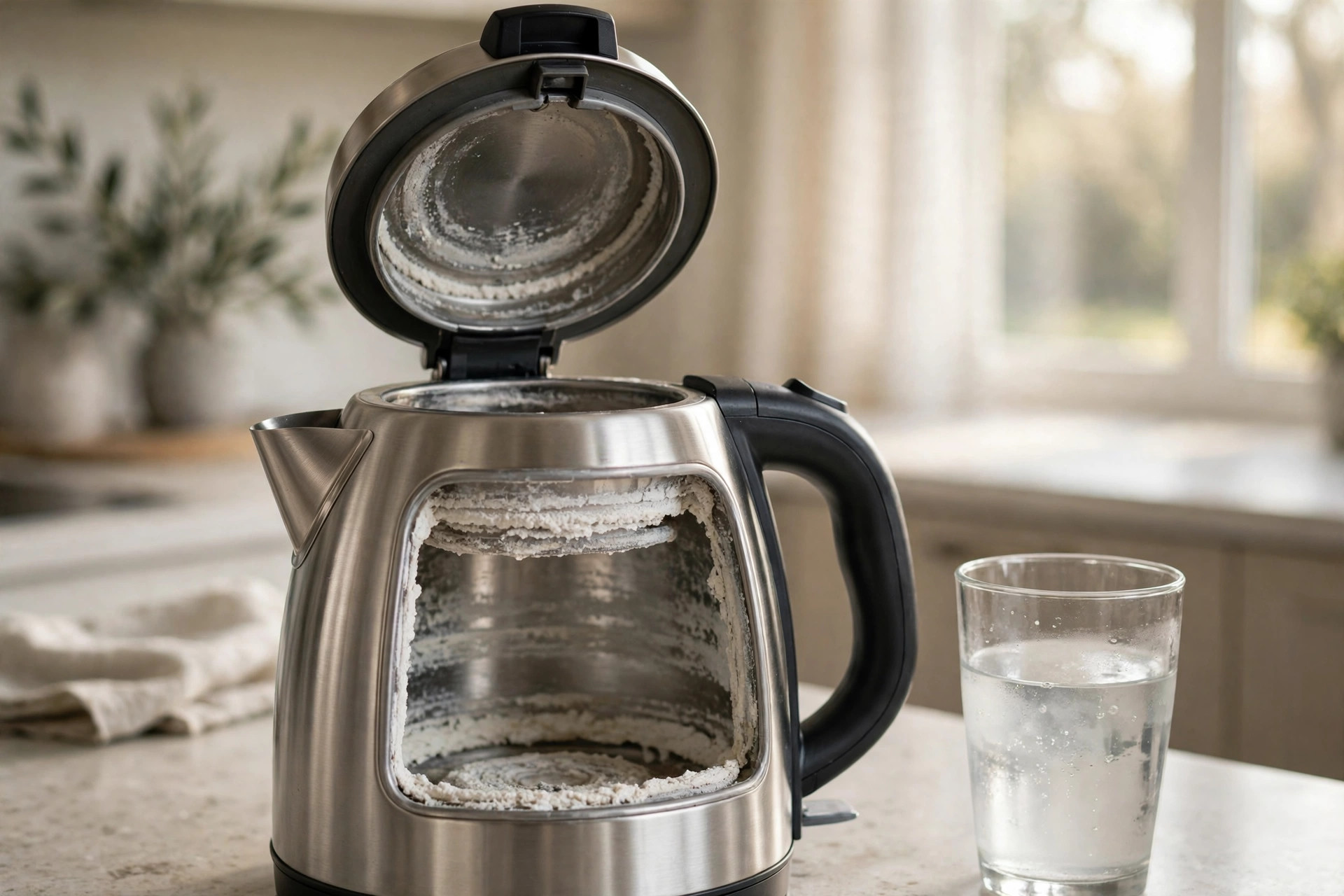
Limescale is calcium carbonate, CaCO3, precipitated when water carrying dissolved calcium bicarbonate is heated. Above roughly 60 degrees Celsius the bicarbonate decomposes, Ca(HCO3)2 becomes CaCO3 plus CO2 plus H2O, and the carbonate drops out of solution onto the hottest surface available, which in a kettle is the heating element. In hard water areas, above 200 milligrams per liter as CaCO3, a kettle used daily can accumulate a visible crust within weeks. That crust is the whole problem. Calcium carbonate has a thermal conductivity near 2 watts per meter-kelvin, roughly two hundred times lower than copper and an order of magnitude below stainless steel, so even a thin layer insulates the element from the water it is supposed to heat.
Insulation has three costs. First, energy. Reported measurements put the penalty at about 10 percent more energy per boil for a 1.6 millimeter layer, and 10 to 45 percent longer boil times for noticeable deposits, with a clean 3 kilowatt kettle needing roughly 0.11 kilowatt-hours to bring one liter from tap temperature to the boil. Second, element life. Heat that cannot reach the water stays in the element, so the element runs hotter than designed, its thermal cut-out trips earlier, and in the worst case the element burns out. Third, sound. Scale changes the boil itself, and that change is audible.
Boiling is noisy for a physical reason. Before water reaches a rolling boil, small vapor bubbles form on the hot element, rise into cooler water above, and collapse, a process called nucleate boiling. Each collapse is a tiny pressure event, and millions of them per second add up to the crackling and rumbling every kettle owner knows. Scale changes that sound in two ways. It adds nucleation sites, because its rough porous surface seeds bubbles unevenly, so bubble formation turns erratic and the crackle gains high-frequency pops. And it causes local superheating, because water trapped under or inside the crust flashes to steam against metal far above 100 degrees Celsius, then collapses violently when it meets cooler water. Heating engineers call the boiler version of this kettling: scale on a heat exchanger causes localized overheating, steam pockets flash and collapse, and the result is banging and rumbling loud enough to be a diagnostic symptom on its own. A scaled kettle is a small kettling boiler, and it sounds like one.
Current practice measures none of this. Owners descale on a calendar, every four to six weeks in hard water areas, or when the crust becomes visible, or never. Kettle makers print descaling instructions and fit thermal cut-outs, but no mainstream kettle reports scale state. Existing art comes closer than the market does, and the gap this disclosure fills is specific. GB2228634A describes an electronic kettle control using a thermistor at the element head to detect boil and dry-boil, and it contemplates a descale warning from the temperature rise at switch-on, but it is a single-channel temperature warning with no acoustic measurement, no time-to-boil measurement, no confound separation, and no verification that a descale worked. EP4057875B1 describes a method and device for detecting the amount of limescale in liquid heating devices, aimed at flow-through heaters and coffee machines, and it notes that the common practice of setting a descaling reminder from a one-time water hardness measurement is approximate and gives no feedback on whether the descale worked, but its detection is thermal and its target is a flow-through heater, not a kettle boil. EP0144111B1 indicates scale in a beverage apparatus by flow restriction through a measuring chamber, a mechanical method that does not apply to a kettle with no flow path. US20080317091 detects scale on a water heating element by comparing temperature signals to find a temperature decrease greater than a set value over a set interval, again a single thermal channel with no acoustic or time channel and no confound model. No published system fuses boil acoustics with heating time and current signatures, corrects for fill volume, starting temperature, altitude, and hardness, and verifies the descale by re-measurement. That is what this disclosure provides.
Detailed Description
1. Inputs and System Architecture
Three embodiments cover the range from no new hardware to a built-in sensor set. In the preferred embodiment, a smart plug with current sensing sits between the kettle and the wall outlet, and a smartphone microphone records the boil from the kitchen counter. The plug reports power draw at 1 hertz, the phone records audio at 16 kilohertz, and the kettle itself is unmodified. In a second embodiment, the kettle is instrumented: a MEMS microphone inside the housing, a current sensor on the element leads, and an NTC thermistor at the element head, all sampled by the kettle controller. In a third embodiment, a fleet aggregator for a kettle maker or a facilities operator collects anonymized scale curves per kettle model across many households, used to set model-specific descaling thresholds and to spot a batch of elements that scale faster than their class. In all embodiments only derived features leave the home: boil times, acoustic summaries, current summaries, and temperature timing, never audio recordings of the kitchen.
Every boil is tagged with the variables that move it. Fill volume in liters, starting water temperature class, altitude or local boiling point, water hardness where the user has entered it or where a municipal hardness lookup provides it, kettle model and rated wattage, and ambient temperature where a sensor reports it. A boil without its fill volume tag is not used for scale verdicts. It is logged as untagged and excluded from the index, because an untagged boil is how a half-full kettle becomes a false descale alarm.
2. Baseline Learning
Before any verdict, the system learns the kettle's clean behavior. The baseline is taken over the first two stable weeks after a descale, or after first use for a new kettle, and it stores four fingerprints as functions of fill volume: time to boil from switch-on to automatic switch-off, energy per boil in watt-hours, the acoustic profile of the boil, and the element temperature trajectory from switch-on to switch-off. Scale is defined strictly as drift away from this baseline at matched volume and matched starting temperature, never as an absolute number, because two healthy kettles of different wattage differ more from each other than a new element differs from a scaled one of the same model. A change of kettle re-baselines everything. A change of water source re-baselines the acoustic channel only, because hardness moves the acoustic signature faster than it moves the time channel.
3. The Boil Acoustics Channel
Acoustics is the channel that hears the scale itself, and it is the channel no prior system uses. A clean kettle has a characteristic acoustic arc: a quiet start, a rising crackle as nucleate boiling begins, a peak of broadband rumbling as the boil rolls, and a sharp stop at switch-off. A scaled kettle distorts that arc in four measurable ways. First, pre-boil crackle starts earlier and louder, because the rough scale surface seeds bubbles at lower bulk water temperatures. Second, the high-frequency share rises, because erratic bubble formation and collapse on a rough surface produces sharper transients than smooth boiling on clean metal. Third, low-frequency rumble energy rises, because steam pockets flashing under the crust and collapsing produce the kettling bangs described in the Background. Fourth, the acoustic onset of the rolling boil shifts later relative to switch-on, because the insulated element takes longer to bring the bulk water to a full boil even while its own surface is already superheated.
Implementation is deliberately modest. The microphone samples at 16 kilohertz, audio is processed in 1 second frames with 50 percent overlap, and each frame yields three features: RMS energy in the 200 hertz to 2 kilohertz band for the crackle, RMS energy in the 2 to 8 kilohertz band for the sharp transients, and RMS energy below 200 hertz for the kettling rumble. Features are summarized per boil as the time course of each band from switch-on to switch-off, plus the onset times of crackle and of rolling boil. No absolute decibel calibration is needed, because the features are ratios and shapes, not levels, and the baseline is taken on the same phone in the same kitchen. A boil recorded with a dishwasher running is flagged by its broadband noise floor and excluded from the acoustic vote.
4. The Heating Time Channel
Heating time is the channel that sees the energy penalty directly. A clean kettle boils one liter in a consistent interval at a given starting temperature. As scale thickens, the same boil takes longer, because heat that should reach the water is instead stored in the crust and the element. The system measures time from switch-on to automatic switch-off, and energy from the smart plug over the same interval, and it reports both normalized by fill volume and by starting temperature class. A rise of 10 percent or more in normalized time to boil, sustained over at least five boils, is a scale vote, not a verdict. One slow boil is a cold tap. Five slow boils are a trend.
Energy per boil is the more robust of the two, because it is insensitive to the exact switch-off moment, which varies with the steam switch. Where the plug reports energy directly, the system uses watt-hours per liter at matched starting temperature as the primary time-channel feature, and time to boil as the secondary. A sustained energy rise of 10 percent or more is a scale vote on the same terms as the time rise.
5. The Current and Element Temperature Channel
Current and element temperature are the channels that see the element running hotter than designed. A resistive element draws nearly constant current for a given mains voltage, so current is a weak channel on its own: the temperature coefficient of nichrome is small, and mains voltage varies more than scale moves the current. The system therefore uses current as a supporting channel, reporting RMS current over the boil and flagging a sustained sag of more than 2 percent at matched mains voltage as a weak scale vote, while treating a single-boil sag as a mains event.
Element temperature is the stronger channel in this pair. Where a thermistor sits at the element head, the system records the temperature trajectory from switch-on to switch-off and the cool-down time after switch-off. A scaled element heats faster at switch-on, because its surface is insulated from the water, and cools slower after switch-off, because the crust stores heat. A rise of 15 percent or more in the switch-on temperature slope, or a lengthening of 20 percent or more in cool-down time, at matched volume and starting temperature, is a scale vote. Where no thermistor exists, this channel is absent and the index is computed from the remaining two, with the weights renormalized and the absence shown to the user.
6. Separating Scale from Its Mimics
Five mimics make these measurements hard, and each one has a signature that separates it from scale. The first is fill volume. More water takes longer to boil for innocent reasons, so every channel is compared only within matched volume, and the system refuses a verdict when the volume tag is missing. The second is starting temperature. Cold tap water in winter takes longer than warm tap water in summer, so boils are compared only within starting temperature class, and a boil whose starting temperature is unknown is excluded from the time channel. The third is altitude. Water boils near 95 degrees Celsius at 1,500 meters, so the boil is shorter and quieter for reasons that have nothing to do with scale; the system corrects the expected time and acoustic profile by the local boiling point and never compares a mountain boil against a sea level baseline. The fourth is water hardness itself. Harder water scales faster, which is a rate difference, not a measurement error, and the system uses hardness only to set the expected rate of index growth, never to adjust the index. The fifth is a failing element or a failing steam switch. An element with a partial break draws less current and boils slowly without any scale, and a steam switch that trips early cuts the boil short; both are separated by the acoustic channel, because a failing element produces a quiet boil with a weak acoustic arc, while a scaled element produces a loud boil with a distorted arc, and by the post-descale check in section 8, because a failing element does not recover after descaling.
7. The Scale Index and Thresholds
The three channels are combined into a single scale index S on a 0 to 1 scale, where 0 is the clean baseline and 1 is an element so scaled that the kettle cannot boil a full liter without tripping its thermal cut-out. Each channel contributes a normalized drift, its current value minus its baseline divided by a channel scale set from the fleet distribution for that kettle model or, where no fleet data exists, from a default scale published with the system. The channels are weighted: heating time and boil acoustics carry the most weight because they measure the energy penalty and the scale directly, and element temperature carries medium weight where a thermistor exists. Current carries the least, since it is the weakest channel. The weights and the scales are shown to the user with the score. A black-box score that cannot be audited will not be trusted at the moment it recommends spending money on descaler, and it should not be.
Two thresholds govern action. At S of 0.5, the system issues a watch notice: scale is measurable, the kettle is not yet wasting much energy, and the next descale window is named. At S of 0.75, the system issues a descale notice: the kettle is measurably wasting energy and running its element hot, and a descale is scheduled. A threshold crossed on a single channel alone does not trigger a descale notice. At least two channels must agree, because a single-channel verdict is how a cold winter tap becomes a descale order.
8. Descale Verification
Verification is the feature the existing art lacks, and it is the reason the index exists. After the user descales, the system runs a verification boil at a matched volume and starting temperature class and recomputes the index. If the index falls back below the watch threshold, the descale is reported as verified and the baseline is refreshed. If the index stays above the descale threshold, the system reports a failed descale and suggests a second treatment or a stronger descaler, rather than assuming the job is done. If the index falls partway, the system reports partial recovery with the remaining drift shown per channel. A kettle whose index does not recover after two verified descales is flagged as a possible failing element or steam switch, not as scale, and the notice says so explicitly. No other system in the cited art closes this loop.
9. Worked Example: The Hard Water Kettle That Took Four Minutes
Consider a 3 kilowatt kettle in a hard water area, above 200 milligrams per liter as CaCO3, used four times a day at a one liter fill. At baseline, two weeks after a descale, the kettle boils one liter in 2 minutes 50 seconds, uses 0.11 kilowatt-hours, and shows the clean acoustic arc: crackle onset at 55 seconds, rolling boil onset at 2 minutes 20 seconds, and a modest low-frequency rumble. Six months later the picture has changed on every channel at once. Time to boil has grown to 3 minutes 35 seconds, a rise of 26 percent. Energy per boil is up 22 percent. Crackle onset has moved earlier to 38 seconds, the high-frequency share is up sharply, and the low-frequency rumble band has doubled, the sound of steam pockets flashing under the crust. Element temperature slope at switch-on is up 18 percent. No mimic explains it: fill volume is matched at one liter, starting temperature is matched, altitude is unchanged, and the kettle is the same model. The fused scale index reads 0.82, past the 0.75 descale threshold, with the acoustic and time channels in agreement. The user descales with citric acid, and the verification boil the next morning reads 2 minutes 55 seconds with the acoustic arc restored, so the descale is reported as verified and the baseline is refreshed. That is the entire value proposition in one paragraph: a descale ordered by measurement, and a check that it worked. The index value, boil times, and energy figures in this example are illustrative outputs of the method, not measured results.
10. Figures Description
- Figure 1: System block diagram showing the kettle, heating element, smart plug with current sensing, smartphone microphone, and the three measurement channels feeding the scale index, the descale notice, and the verification module.
- Figure 2: Acoustic arc of a clean boil versus a scaled boil: crackle onset, high-frequency share, and low-frequency rumble plotted against time from switch-on, with the scaled boil showing earlier crackle, higher transients, and stronger rumble.
- Figure 3: Heating time and energy per boil against cumulative boils since descale, with the 0.5 watch and 0.75 descale thresholds marked and the verification boil after descaling returning the index to baseline.
- Figure 4: Confound separation diagram: fill volume, starting temperature, altitude, and water hardness as matched or corrected variables, with a failing element shown as a quiet boil that does not recover after descaling.
- Figure 5: Worked example dashboard: baseline versus current values for all three channels, the fused scale index at 0.82 against the 0.5 watch and 0.75 descale thresholds, and the verification boil result after descaling.
- Figure 6: Fleet view for a kettle maker: scale index growth curves for many kettles of the same model plotted against boils since descale, showing model-specific scaling rates and an outlier kettle flagged as a failing element rather than scale.
Claims
- A system for estimating limescale accumulation in an electric kettle, comprising: a sensor set reporting at least one of boil audio, heating time, energy per boil, element current, and element temperature; and a processor configured to compute a baseline fingerprint for a reference fill volume and starting temperature after a stabilization period, measure drift from the baseline under matched fill volume and starting temperature conditions, and convert the drift into a scale index.
- The system of claim 1, wherein the processor computes acoustic features of the boil comprising pre-boil crackle onset time, high-frequency band share, low-frequency rumble energy, and rolling-boil onset time, and wherein an earlier crackle onset with a rising high-frequency share and rising low-frequency rumble energy contributes to the scale index as a scale signature.
- The system of claim 1, wherein the processor measures time to boil from switch-on to automatic switch-off and energy per boil, normalized by fill volume and starting temperature class, and wherein a sustained rise in normalized time to boil or normalized energy per boil contributes to the scale index.
- The system of claim 1, wherein the processor measures element temperature trajectory from switch-on to switch-off and cool-down time after switch-off, and wherein a rising switch-on temperature slope or a lengthening cool-down time at matched volume and starting temperature contributes to the scale index.
- The system of claim 1, wherein the processor measures RMS element current over the boil, and wherein a sustained current sag at matched mains voltage contributes to the scale index as a supporting channel.
- The system of claim 1, wherein the processor combines at least two measurement channels into a single scale index on a fixed scale, issues a watch notice at a first threshold and a descale notice at a second higher threshold, and requires agreement of at least two channels before issuing a descale notice.
- The system of claim 1, wherein the processor separates fill volume, starting water temperature, altitude, water hardness, and kettle model from limescale by comparing measurements only within matched fill volume and starting temperature class, correcting expected boil time and acoustic profile by local boiling point, and using water hardness only to set the expected rate of scale index growth.
- The system of claim 1, wherein the processor separates a failing heating element or steam switch from limescale by the acoustic arc of the boil, wherein a quiet boil with a weak acoustic arc indicates element failure, and by post-descale recovery, wherein an index that does not recover after descaling indicates element or switch failure rather than scale.
- The system of claim 1, wherein the processor performs a verification boil after a descaling treatment at a matched fill volume and starting temperature class, recomputes the scale index, and reports the descaling treatment as verified, partially recovered, or failed according to the recomputed index.
- The system of claim 9, wherein the processor refreshes the baseline fingerprint after a verified descaling treatment, and flags a kettle whose scale index does not recover after two verified descaling treatments as a possible failing element or steam switch.
- The system of claim 1, wherein the processor excludes from the acoustic vote any boil whose broadband noise floor indicates competing kitchen noise, and excludes from scale verdicts any boil lacking a fill volume tag.
- The system of claim 1, implemented as a smart plug with current sensing plus a smartphone microphone with no kettle hardware modification, or as a kettle-embedded system with a microphone, current sensor, and element thermistor, or as a fleet aggregator producing model-specific scale curves and descaling thresholds across many kettles.
Prior Art References
- Wikipedia, "Limescale": Calcium carbonate precipitation from heated hard water and its insulating effect on heating elements
- EngineerFix, "Why Is My Boiler So Loud? Common Causes and Fixes": Kettling: scale causes localized superheating, steam flashing, and collapse as a banging sound
- Hometree, "Boiler Noises Explained": Kettling characterized by whistling, rumbling, and bubbling from limescale on the heat exchanger
- Domestic Wizard, "Kettle Limescale: Causes, Effects, and Removal": 1.6 mm of limescale increases kettle energy consumption by about 10 percent; longer boil times and element damage
- Sofeminine, "Your Kettle Taking 45% Longer and Costing 38 Pounds a Year?": Noticeable scale deposits push boil times up by 10 to 45 percent; clean 3 kW kettle needs about 0.11 kWh per liter
- GB2228634A: Liquid heater controller with boil and dry-boil detection; contemplates a descale warning from element-head temperature rise at switch-on
- EP4057875B1: Method and device for detecting the amount of limescale in liquid heating devices, noting hardness-based descaling reminders are approximate and give no feedback on the descale result
- EP0144111B1: Apparatus for preparing beverages comprising scale indication means, via flow restriction in a measuring chamber
- US20080317091: Scale detection on water heating elements by comparing temperature signals for a temperature decrease over a set interval
Limitations
The thresholds in this disclosure have not been validated against measured kettles. The channel weights and scales that produce the scale index are to be calibrated from fleet data, and the worked example uses illustrative values, not measurements from any real kettle. Acoustic performance in real kitchens, with dishwashers, extractor fans, and varying phone placement, is untested, and the acoustic features have not been tested against ground-truth scale thickness. The reported energy penalties are drawn from the cited consumer sources, not from a controlled study, and the 10 to 45 percent boil time range reflects reported variation across deposit thickness and coverage, not a single measured population. Nothing here should be read as evidence that any particular kettle will scale at any particular rate.
Implementation Notes
Build notes for whoever implements this. Ship the baseline before the score. A scale index without a two-week clean baseline is a random number with a decimal point, and the first user who gets a descale notice on a week-old kettle will never trust the second notice. Require the stabilization period, show the baseline values next to every current value, and refuse a verdict when the fill volume tag is missing, reporting "insufficient matched data" instead of a number. Do not ship a single-channel version. Time alone will blame every cold winter tap, acoustics alone will blame every dishwasher, and element temperature alone will blame every voltage sag. The two-channel agreement rule is not a nicety. It is the product. Calibrate the channel scales per kettle model from fleet data as soon as the fleet exists, because kettles with different wattages and element geometries scale on different clocks and a single global scale will either nag one owner or neglect the other. Present the verification boil as the headline result after every descale, not as a footnote, because the verification is the feature that earns trust: a user who sees the index fall after descaling will believe the next notice, and a user who sees it stay high will descale again instead of assuming the job is done. On a flagged failing element, tell the user to stop using the kettle and inspect it before the next boil. A partially broken element is a fire risk, not a maintenance schedule. Finally, the acoustic features must be computed on the device, with only the summaries leaving the home. A kitchen microphone that streams audio to a server will not be adopted, and it should not be.