System and Method for Dishwasher Spray Arm and Filtration Health Assessment Using Passive Acoustic Rotation Signatures Fused with Drain Hydraulics Telemetry
Abstract
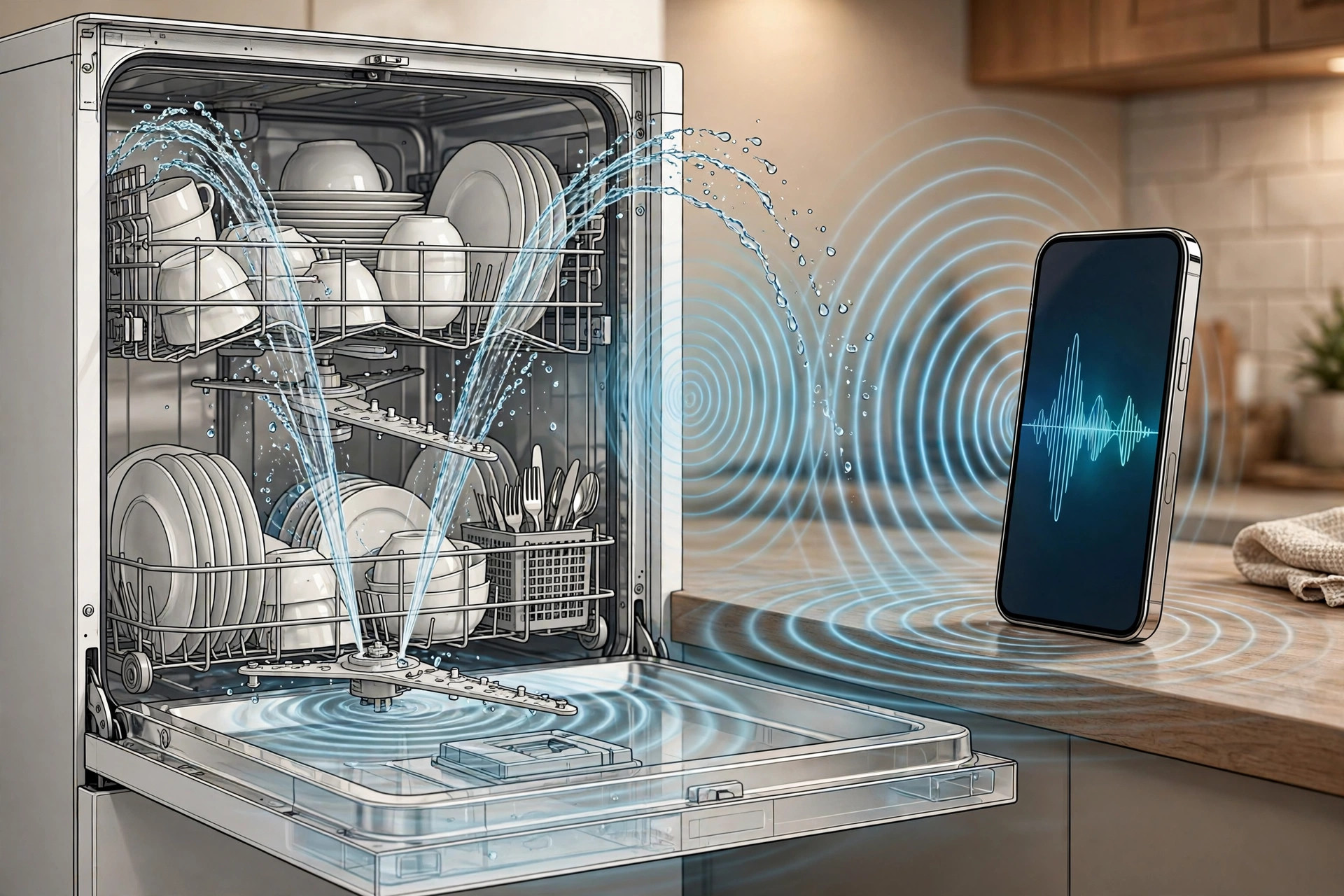
Disclosed is a system and method for assessing the mechanical health of a residential dishwasher's spray arms and filtration system using passive acoustic sensing from outside the machine, fused with drain-phase hydraulics telemetry. A microphone placed near the dishwasher (a smartphone on the countertop, an adhesive-mounted piezoelectric sensor on the cabinet panel, or a built-in microphone in smart models) captures the wash cycle's acoustic signature. Rotating spray arms imprint a periodic amplitude modulation on the broadband spray noise at each arm's rotation frequency; the system estimates per-arm rotation rates from this modulation, derives a jet clogging index from modulation depth and high-frequency spectral balance, and derives a filter loading index from drain-phase acoustic signatures, drain duration, and drain pump current draw. An on-device classifier fuses these features with cycle telemetry (fill volume inferred from fill-phase acoustics, heater duty cycle, total cycle duration drift) to produce tiered maintenance advisories: clean the filter, clear the spray arm jets, or schedule service. Raw audio is processed on-device and never transmitted.
Technical Field
This disclosure relates to kitchen appliance maintenance, specifically to passive acoustic condition monitoring of dishwasher spray arm rotation and filtration loading, fused with hydraulic telemetry from the drain and fill phases of the wash cycle.
Background
A residential dishwasher cleans by pumping heated water through rotating spray arms. The arms spin because their jets are angled: water pressure both sprays the dishes and drives rotation, typically 10 to 60 revolutions per minute depending on the arm, pump pressure, and load. Cleaning performance depends on every jet firing at full pressure. When jets clog with food particles, mineral scale, or detergent residue, the affected arm slows or stalls, and the dishes in its spray shadow come out dirty.
Filtration is the other half of the system. Modern dishwashers use a removable fine-mesh filter assembly at the sump to trap food debris before it reaches the pump. Every major manufacturer instructs owners to clean this filter regularly, typically monthly. In practice, almost nobody does. A loaded filter restricts flow to the wash pump, starves the spray arms of pressure, extends cycle times, and forces the drain pump to work against higher resistance. The failure mode is silent: cleaning degrades gradually over weeks, and the owner notices only when dishes are visibly dirty, by which point the machine has been underperforming for many cycles.
Existing in-machine sensing is limited. Higher-end dishwashers carry turbidity sensors (for example, the AquaSensor in Bosch models) that measure soil in the wash water and adjust cycle length, but these sensors report water clarity, not mechanical health: they cannot tell a clogged spray arm from a lightly soiled load. No consumer system continuously monitors spray arm rotation or filter loading, and there is no standard diagnostic for either condition short of opening the machine mid-cycle or removing and inspecting parts by hand.
Acoustic and vibration condition monitoring is established practice for rotating machinery: acoustic emission analysis detects bearing faults from characteristic frequencies (Hidle et al., Sensors 2022), and audio-based inspection with machine learning reaches high fault detection accuracy on industrial equipment (MDPI Sensors review, 2023). A dishwasher is, mechanically, a small pump driving rotating arms through a water circuit: exactly the kind of machine whose acoustic signature carries its health state.
The gap in the art is a passive, zero-installation health assessment that: (a) captures dishwasher acoustics with hardware the owner already has, (b) separates the spray arms' rotation signatures from pump, fill, drain, and ambient kitchen noise, (c) quantifies jet clogging and filter loading as trackable indices rather than binary alarms, and (d) converts the result into the specific maintenance actions owners already understand: clean the filter, clear the jets, call for service.
Detailed Description
1. Sensing Configuration
The system captures audio with a microphone positioned outside the dishwasher tub. Three configurations are disclosed. In the preferred zero-installation configuration, the owner's smartphone rests on the countertop within 2 meters of the dishwasher during the cycle; the phone's microphone samples at 16 kHz. In the semi-permanent configuration, an adhesive-mounted piezoelectric contact sensor attaches to the dishwasher's outer cabinet panel or an adjacent cabinet, capturing structure-borne vibration with better signal-to-noise ratio and no airborne kitchen noise. In the integrated configuration, a microphone built into a smart dishwasher's control panel or door captures the same signals with fixed geometry. All processing runs on-device: on the phone's processor, on a microcontroller in the sensor module, or on the appliance's control board. Raw audio is discarded after feature extraction; only feature vectors and indices leave the device, and then only with the owner's consent for fleet-level model improvement.
2. Cycle Phase Segmentation
A dishwasher cycle is a sequence of acoustic phases, and each health feature is meaningful only within its phase. The system segments the cycle automatically. The fill phase is identified by the sustained narrowband hiss of the inlet valve (typically 2-6 kHz) lasting 30-120 seconds. The wash phase is identified by the broadband roar of the circulation pump plus spray noise, lasting 20-90 minutes, with the spray arms' modulation riding on top. The drain phase is identified by the drain pump's distinctive lower-frequency tone plus gurgling as the sump empties, lasting 1-4 minutes. The dry phase is comparatively quiet with periodic fan or heating-element relay clicks. Segmentation uses a hidden Markov model over short-time spectral features, trained once per dishwasher model family and adapted to the specific machine during a two-cycle calibration period. Phase boundaries gate all downstream feature extraction: rotation features come only from wash-phase audio, filter features only from drain-phase audio.
3. Spray Arm Rotation Rate Estimation
Each rotating spray arm modulates the broadband spray noise at its rotation frequency. As an arm sweeps, the distance and angle between its jets and the tub walls change periodically, producing an amplitude modulation of the spray noise envelope at the arm's rotation rate (typically 0.15-1.0 Hz, i.e., 10-60 RPM) and its harmonics. The system computes the Hilbert envelope of the wash-phase audio in the 1-8 kHz spray band, then takes the power spectrum of that envelope over 60-second windows. Peaks in the 0.1-1.2 Hz band correspond to arm rotation rates. Most residential dishwashers have two or three arms (lower, middle, upper); the arms rotate at different rates because they differ in diameter, jet count, and the pressure available at their height, so their modulation peaks are separable. The system tracks each detected peak across the wash phase and across cycles, producing a per-arm rotation rate time series. A healthy arm holds a stable rate for a given cycle program and load; a clogged or obstructed arm shows a depressed rate, erratic rate wandering, or a missing peak (stalled arm).
4. Jet Clogging Index
Clogged jets change the spray noise in two measurable ways. First, fewer open jets means less total high-frequency spray energy: the spectral balance of the wash-phase audio shifts, with energy in the 4-8 kHz band falling relative to the 1-4 kHz band as jets clog. Second, clogging is rarely uniform: a partially clogged arm produces an asymmetric spray pattern, which deepens the amplitude modulation (the loud-quiet contrast per revolution grows as the working jets cluster on one side). The jet clogging index combines three normalized features: (a) rotation rate depression relative to the machine's calibrated baseline for the same cycle program, (b) modulation depth increase at the arm's rotation frequency, and (c) high-frequency spectral balance shift. Each feature is z-scored against the calibration baseline; the index is the weighted sum, scaled 0-100. An index above 60 sustained across three consecutive cycles triggers a "clear the spray arm jets" advisory naming the affected arm (lower, middle, or upper) based on which modulation peak degraded. The advisory includes the standard remediation: remove the arm, rinse under running water, and clear jet openings with a soft brush or toothpick, per manufacturer guidance.
5. Filter Loading Index from Drain Hydraulics
The filter assembly sits between the sump and the pumps, so its loading affects both wash and drain phases, but the drain phase gives the cleanest measurement. A loaded filter restricts flow: the drain pump runs longer to empty the sump, and the pump's acoustic signature shifts as it works against higher resistance, with increased cavitation noise (broadband energy in the 2-5 kHz band with a rough, crackling character distinct from normal pump tone). The filter loading index combines: (a) drain phase duration relative to the calibrated baseline for the same cycle program, (b) drain pump current draw where available (integrated configuration, or a smart plug measuring the dishwasher's power in the phone configuration), and (c) cavitation band energy during the drain phase. The index is scaled 0-100 against the calibration baseline. An index above 60 sustained across three consecutive cycles triggers a "clean the filter" advisory with the manufacturer's recommended procedure: twist out the filter assembly, rinse under running water, and remove trapped debris. Because the index is tracked per cycle, the system also projects the date the filter will reach the advisory threshold, so the owner gets a "clean the filter within the next week" heads-up rather than a surprise.
6. Wash Performance Degradation Fusion
Spray arm and filter health interact: a loaded filter starves all arms of pressure, depressing every arm's rotation rate simultaneously, while a clogged arm affects only its own modulation peak. The fusion layer uses this distinction to separate root causes. If all arms slow together and the filter index is elevated, the advisory leads with filter cleaning. If one arm's peak degrades while the others hold, the advisory names that arm's jets. Secondary telemetry sharpens the picture: fill volume inferred from fill-phase duration (a lengthening fill suggests inlet valve or pressure issues rather than spray problems), heater duty cycle inferred from the power signature (extended heating suggests the machine compensating for poor spray coverage), and total cycle duration drift (the machine's own turbidity-driven extensions, which lengthen as cleaning efficiency falls). These signals feed a wash performance score, also 0-100, that the owner can watch trend downward weeks before dishes start coming out dirty.
7. On-Device Classifier and Advisories
A lightweight gradient-boosted decision tree (under 200 KB, runnable on a phone processor or appliance microcontroller) takes the per-cycle feature vector: per-arm rotation rates and modulation depths, jet clogging indices, filter loading index, drain duration, fill duration, heater duty estimate, and cycle duration drift. It outputs the advisory tier: none, filter cleaning due, spray arm jet clearing due, or service recommended (for patterns matching pump bearing wear or inlet valve failure, which the acoustic features also reveal but which are outside owner-serviceable scope). Advisories are delivered as phone notifications or appliance display messages, each naming the specific part and the specific action. Trend projection uses linear extrapolation of the indices over the trailing 30 cycles to estimate cycles-until-threshold, presented as "about N more washes." A fleet mode (opt-in) aggregates anonymized indices by dishwasher model to establish model-specific baselines and to detect design-level issues, such as a model family whose upper arm clogs at twice the fleet rate.
8. Figures Description
- Figure 1: System overview showing the three sensing configurations (countertop smartphone, adhesive cabinet sensor, integrated appliance microphone) capturing wash-cycle audio, with on-device processing producing maintenance advisories.
- Figure 2: Cycle phase segmentation example: spectrogram of a full wash cycle with fill, wash, drain, and dry phases labeled, showing where rotation and filter features are extracted.
- Figure 3: Spray arm modulation analysis: Hilbert envelope spectrum of wash-phase audio showing separable rotation peaks for lower, middle, and upper arms, with a degraded peak indicating a clogged arm.
- Figure 4: Advisory flow: feature extraction to per-arm clogging and filter loading indices, fusion logic distinguishing filter-caused from jet-caused degradation, and the tiered advisory output with trend projection.
Claims
- A system for assessing dishwasher spray arm health, comprising: a microphone positioned outside the dishwasher tub; a cycle phase segmentation module that identifies wash-phase audio; and a rotation estimation module that computes the amplitude modulation spectrum of the wash-phase audio envelope and identifies rotation-rate peaks corresponding to individual spray arms.
- The system of claim 1, wherein the microphone is a smartphone microphone, an adhesive-mounted piezoelectric contact sensor on the dishwasher cabinet, or a microphone integrated into the dishwasher control panel or door.
- The system of claim 1, further comprising a jet clogging index module that combines spray arm rotation rate depression, amplitude modulation depth increase, and high-frequency spectral balance shift into a per-arm clogging score normalized against a calibration baseline.
- The system of claim 3, wherein the jet clogging index identifies the affected spray arm as lower, middle, or upper based on which rotation-rate peak degraded.
- A system for assessing dishwasher filter loading, comprising: a microphone positioned outside the dishwasher tub; a cycle phase segmentation module that identifies drain-phase audio; and a filter loading index module that combines drain phase duration, drain pump current draw, and drain-phase cavitation band energy into a loading score normalized against a calibration baseline.
- The system of claim 5, further comprising a trend projection module that extrapolates the filter loading index over trailing wash cycles to estimate the number of cycles remaining before a filter cleaning threshold is reached.
- A method for diagnosing dishwasher wash performance degradation, comprising: estimating per-arm spray arm rotation rates from passive acoustic amplitude modulation; computing a per-arm jet clogging index; computing a filter loading index from drain-phase hydraulics; and applying a fusion rule that attributes simultaneous multi-arm rotation depression with elevated filter loading to filter restriction, and single-arm rotation degradation to jet clogging of the affected arm.
- The method of claim 7, further comprising inferring fill volume from fill-phase acoustic duration, heater duty cycle from the power signature, and cycle duration drift, and combining these into a wash performance score tracked across cycles.
- The system of claim 1, wherein all acoustic processing runs on-device, raw audio is discarded after feature extraction, and only feature vectors and health indices are retained or transmitted.
- The system of claim 1, further comprising an advisory module that issues tiered maintenance advisories (filter cleaning due, spray arm jet clearing due naming the affected arm, or service recommended) when a health index exceeds a threshold across a configurable number of consecutive cycles.
- The system of claim 10, further comprising an opt-in fleet mode that aggregates anonymized health indices by dishwasher model to establish model-specific baselines and detect model-family-level spray arm or filtration issues.
Implementation Notes
This disclosure describes a design proposal. No prototype has been built and no field validation has been performed; all quantitative parameters (rotation rate bands, index thresholds, cycle counts) are untested design choices that would need calibration against real machines. Several practical points follow.
Calibration matters more than the model. Dishwasher models differ in pump power, arm geometry, insulation, and cycle programs, so the two-cycle calibration period is not optional: baselines must be learned per machine and per cycle program. A baseline learned on "Normal" does not transfer to "Heavy" or "Quick."
Phone placement affects the phone configuration. The microphone should have a clear acoustic path to the dishwasher: on the countertop above or beside the machine, not inside a drawer or under a towel. The system should verify placement during calibration by checking wash-phase signal level, and warn if the phone is moved mid-cycle.
What this system does not do: it does not measure actual soil removal or dish cleanliness, only the mechanical conditions that enable cleaning. It cannot distinguish a clogged jet from a jet blocked by a tall dish loaded in front of it; the three-consecutive-cycle rule exists partly to average out loading variation, but owners should still check loading before assuming a clog. It does not detect leaks, heating element failure beyond duty-cycle inference, or detergent dosing problems.
Privacy is structural, not promised. Kitchen audio can contain speech. The on-device processing requirement means speech never needs to leave the device; feature extraction should run on short frames that are discarded immediately, and the fleet mode must transmit indices only, never audio or spectrograms.
Prior Art References
- 10 CFR Part 430, Subpart B, Appendix C2 — U.S. DOE uniform test method for measuring the energy consumption of dishwashers
- Bosch Home Appliances — AquaSensor turbidity-based wash water soil measurement in dishwasher auto cycles
- ENERGY STAR Dishwashers — U.S. EPA dishwasher efficiency program and maintenance guidance
- Hidle et al., Sensors 2022 — Acoustic emission analysis for bearing fault detection from characteristic frequencies
- MDPI Sensors review, 2023 — Audio-based fault inspection with machine learning for industrial equipment
- TensorFlow Lite for Microcontrollers — On-device ML runtime for microcontroller-class processors