System and Method for Deadbolt Alignment Diagnostics and Predictive Lockout Prevention via Actuator Current Signature Analysis with Seasonal Frame-Movement Compensation
Abstract
Disclosed is a diagnostic system for motorized deadbolt locks that predicts lock failure from the actuator's own electrical signature before the bolt jams. Each time the lock throws or retracts its bolt, the system samples the drive motor's current waveform and records bolt position from the lock's position sensor, producing a per-cycle current-versus-travel trace. From a baseline learned in the weeks after installation, the system tracks the energy consumed per lock cycle and the position-resolved friction profile across bolt travel. Drift in these quantities is decomposed into a reversible seasonal component, correlated with outdoor temperature and humidity, and a monotonic progressive component. Seasonal drift comes from wood doors and frames swelling and shrinking with humidity, which shifts the door relative to the strike plate by millimeters, enough to close the small clearance between bolt and strike bore. Progressive drift comes from hinge sag, loosening screws, and foundation settling. The friction profile localizes the drag: a late-travel spike indicates the bolt tip striking the strike-plate lip (vertical misalignment), uniform elevation indicates bore friction or mechanism wear, and throw/retract asymmetry indicates directional binding. When projected friction approaches the motor's stall margin, the system issues a predictive lockout warning with estimated lead time, and generates directional strike-plate adjustment guidance specifying which way to move the plate and by how much. The lock controller can also adapt its drive within thermal limits, raising the torque budget during high-friction seasons instead of failing without warning. Secondary functions include battery end-of-life prediction from the per-cycle energy trend, separated from mechanical load by voltage-normalized current analysis, and classification of forced-entry attempts from uncommanded torque transients that differ from gradual misalignment in timescale and signature.
Field of the Invention
This invention relates to electromechanical door locks, specifically to diagnostic systems that use actuator motor current signature analysis for alignment monitoring, failure prediction, and maintenance guidance in motorized deadbolt locks, and to methods for separating reversible environmental effects from progressive mechanical degradation in door hardware.
Background
Motorized deadbolt locks are installed in millions of homes. The core mechanism is simple: a small DC gearmotor drives a bolt, typically with about 25 mm (1 inch) of throw, into a strike bore in the door frame. For the bolt to travel freely, the clearance between the bolt and the strike bore, on the order of 1 to 2 mm per side in a typical installation, must be preserved. Anything that shifts the door relative to the frame by more than that clearance causes the bolt to drag, and if the drag exceeds the motor's torque capability, the lock fails to throw: the familiar deadbolt jam.
Doors move. Wood is hygroscopic: it absorbs moisture from humid air and releases it in dry conditions, swelling and shrinking across the grain with each cycle. The USDA Forest Products Laboratory documents this dimensional change as a fundamental property of wood in service, and Purdue Extension notes that moisture-content changes of only a few percent produce significant dimensional change, with tangential movement roughly twice radial movement. A solid wood door or frame cycling between summer humidity and winter dryness routinely shifts by millimeters, which is exactly the scale that closes a 1 to 2 mm bolt clearance. This is why doors stick in August and swing free in January, a pattern confirmed by homeowner surveys and contractor guidance alike. Beyond seasonal movement, doors drift monotonically: hinges sag under the door's weight, screws loosen in softened wood, and foundation settling skews the frame. Structural engineers note that sticking which is predictable and seasonal points to moisture, while sticking that appears suddenly or persists through all seasons points to movement below, a distinction this disclosure operationalizes in a lock's own telemetry.
Existing smart locks handle misalignment reactively and coarsely. August's Smart Lock Pro reports whether the lock is open, closed, or jammed, and its DoorSense frame sensor detects when the door itself stands ajar. Schlage's connected deadbolts expose a lock status of Locked, Unlocked, or Jammed. Yale's locks raise jam alarms when the mechanism cannot complete travel. These are binary, after-the-fact reports: the lock tells the homeowner it has already failed, typically at the moment they are trying to secure the door for the night or leave for work.
The patent literature contains the building blocks but not the diagnostic system. WO2013168114A1 discloses a motor current detection circuit that compares current against a fixed threshold and, on detecting a clash, reverses the motor and retries a set number of times before registering a fault. US10233672B2 discloses monitoring motor current to determine a stall condition. US10140828B2 and US20160343188A1 disclose a current or power sensor that determines how hard the motor is working, using the current to estimate friction experienced by the door and reporting that friction information to the user, with provision for adjusting the drive current. US20200372738A1 discloses stall detection via an accelerometer or knob position monitor, disengaging the motor to prevent overcurrent damage. What none of this art discloses is a system that records current signatures longitudinally, learns a per-door baseline, separates reversible seasonal frame movement from progressive mechanical misalignment, localizes the drag source along bolt travel, predicts lockout weeks in advance, or tells the homeowner which way to move the strike plate and by how much.
The gap in the art is a complete diagnostic layer that: (a) captures the actuator current waveform and bolt position on every lock cycle with no new external sensors, (b) builds a position-resolved friction map of bolt travel, (c) decomposes friction drift into a weather-correlated reversible component and a monotonic progressive component, (d) converts the decomposition into predictive lockout warnings and directional strike-plate adjustment guidance, (e) adapts drive parameters to keep the door lockable through seasonal extremes, and (f) separates battery aging from mechanical load so that neither masks the other.
Detailed Description
1. The Failure Mode: Bolt, Bore, and Clearance
A deadbolt lock succeeds or fails in the last millimeters of bolt travel. The bolt, typically a hardened steel cylinder or rectangular bar about 25 mm in throw, must enter a strike bore cut into the frame and covered by a metal strike plate with a lip that guides the bolt in. In a correct installation the bolt travels its full stroke with only the friction of its own mechanism. When the door shifts vertically relative to the frame, the bolt tip strikes the strike-plate lip instead of entering the bore cleanly. When the door shifts laterally (in the plane of the door), the bolt binds against the side of the bore. When the door sits too deep or too shallow in the frame, the bolt face drags across the strike plate surface. Each geometry produces a different drag signature along the travel, which is why position-resolved sensing matters: the location of the friction within the stroke identifies the direction of the misalignment.
The motor driving the bolt is a small brushed DC gearmotor. Its current draw is proportional to the torque it delivers: I = (V − ke·ω) / R, where V is the applied voltage, ke the back-EMF constant, ω the shaft speed, and R the winding resistance. Increased mechanical load slows the motor, back-EMF falls, and current rises. A current waveform of a healthy lock cycle therefore has a recognizable shape: an inrush spike as the stalled rotor begins to turn, a steady travel current as the bolt moves through free air, and a small rise at seating as the bolt reaches full extension and the controller cuts drive. Drag anywhere in the travel raises the current in that region of the stroke, and a stall drives current toward its maximum while the bolt stops moving. The waveform is the mechanism's confession, recorded every cycle for free.
2. Sensing Hardware
The system adds one sensing channel to the lock's existing electronics: motor current. A low-side shunt resistor (illustrative value: 50 mΩ) in series with the motor's ground return develops a voltage proportional to current, amplified by a current-sense amplifier (of the INA180 class, gain 50–100 V/V) and sampled by the lock microcontroller's ADC at 1 to 5 kHz during the 1 to 2 second actuation window. Illustrative BOM cost at volume is under one US dollar. No continuous monitoring is required: the ADC wakes only while the motor driver is enabled, so the sensing adds negligible energy cost per cycle.
Bolt position comes from sensing the lock already carries or can carry cheaply. Many motorized deadbolts include a Hall-effect or optical encoder on the gear train, or a potentiometer on the thumbturn shaft, for closed-loop position control (position sensing for stall detection is disclosed in US20200372738A1). Where no encoder exists, position is estimated from integrated motor rotation using back-EMF zero-crossing counting, or coarsely from elapsed time normalized by the cycle's total duration. The preferred embodiment uses a true position sensor with at least 20 counts across the bolt stroke, giving roughly 1 mm position resolution.
An onboard temperature sensor, present in most connected locks for battery management, timestamps each cycle's thermal context. Outdoor temperature and humidity are obtained from a weather service via the lock's companion app or hub, keyed to the installation's location.
3. Per-Cycle Feature Extraction
For each lock and unlock cycle, the firmware captures the current waveform i(t) and position trace x(t), then extracts:
- Peak inrush current: the maximum current in the first 100 ms, reflecting breakaway torque.
- Travel RMS current: the root-mean-square current over the middle 80% of the stroke, the primary friction indicator.
- Cycle energy: the time integral of V·i over the cycle, the battery-cost metric.
- Travel time: stroke duration, which lengthens as friction rises even when current is capped by the driver.
- Seat current: current in the final 10% of travel, sensitive to strike-lip interference.
- Throw/retract asymmetry: the difference between lock-direction and unlock-direction travel current, which reveals directional binding (a bolt that drags going in but not coming out is striking the lip on entry).
- Voltage-normalized current: each current feature divided by the contemporaneous battery voltage, separating mechanical load changes from battery sag.
Only these features leave the lock. Raw waveforms are discarded after extraction, keeping the radio payload to tens of bytes per cycle and preserving privacy: no audio, no occupancy inference, nothing beyond the lock's own operation.
4. Position-Resolved Friction Map
The most diagnostic representation is the friction map: travel current plotted against bolt position, averaged over a rolling window of recent cycles (illustrative: 50 cycles) to suppress single-event noise. The map's shape localizes the drag source:
- Late-travel spike: current rises sharply in the final 20% of the stroke. The bolt tip is striking the strike-plate lip: vertical misalignment. This is the classic seasonal signature.
- Uniform elevation: current is raised across the whole stroke. The bolt binds along the bore or the mechanism itself is wearing: lateral misalignment, bore too tight, or gearbox degradation.
- Early-travel hump: drag concentrated at the start of the stroke. The bolt tail or latch mechanism binds before the bolt reaches the frame: mechanism-side issue, not alignment.
- Mid-travel notch: a narrow band of elevated current. A burr, paint buildup, or debris in the bore at a specific depth.
The map is computed separately for throw and retract. Their difference is itself diagnostic: symmetric elevation means the bore is uniformly tight, while throw-only elevation means the bolt enters at an angle and wedges, pointing to hinge-side sag.
5. Baseline Learning
Every door is different: bore clearances, strike plate placement, mechanism friction, and battery chemistry vary across installations. The system therefore learns a per-door, per-direction baseline during a commissioning period (illustrative: the first 200 cycles or 30 days, whichever comes first), recording the median and spread of each feature. All subsequent drift is measured against this baseline, so a door that was always slightly tight does not generate false alarms, and a door that was perfect at install shows even small degradations clearly. If the lock is reinstalled or the strike plate is serviced, the companion app offers a re-baseline action, and the system also auto-detects the step-change improvement described in Section 9.
6. Seasonal Versus Progressive Decomposition
This is the analytical core. Friction drift has two causes with different signatures, and they demand different responses:
- Seasonal (reversible): wood doors and frames track outdoor humidity. Friction rises through the humid season and falls as dry air returns. The component correlates with a trailing average of outdoor relative humidity and temperature, reverses direction annually, and affects the late-travel region of the friction map most strongly (lip strikes from vertical shift).
- Progressive (monotonic): hinge sag, screw loosening, and foundation settling do not reverse. The component trends in one direction across seasons, persists through the dry months when seasonal friction subsides, and often shows in uniform map elevation or growing throw/retract asymmetry.
The system fits a two-component model to the friction history: F(t) = S(H(t), T(t)) + P(t) + noise, where S is the seasonal component modeled as a function of trailing humidity H and temperature T (a low-order polynomial or a small regression fit per door), and P(t) is the progressive component constrained to be monotonic (isotonic regression). The decomposition is what turns a rising friction trend into an actionable diagnosis: if the rise is seasonal, the guidance is to wait or to apply a temporary drive adaptation; if the rise is progressive and persists after the seasonal component is removed, the guidance is to adjust the strike plate or inspect the hinges. This mirrors the established practice of structural engineers, who distinguish seasonal sticking from settling by exactly this reversibility test, now performed continuously by the lock itself.
7. Predictive Lockout Warning
The motor stalls when required torque exceeds what the driver can deliver at the present battery voltage. The system knows the stall current threshold (from the driver's current limit or from commissioning stall tests) and tracks the margin between the cycle's peak travel current and that threshold. The progressive component P(t) is extrapolated linearly (or with the fitted trend) to estimate when the margin closes: the predicted lockout date. Warnings are tiered:
- Advisory (margin below 50%): the app notes rising friction and shows the trend, with the seasonal/progressive split.
- Action (margin below 30% or predicted lockout within 60 days): the app issues the directional adjustment guidance of Section 8.
- Urgent (margin below 15%): push notification advising immediate adjustment, with the adaptive drive of Section 9 engaged as a stopgap.
Because the seasonal component is modeled, the system does not cry wolf every August: a door whose friction rises every summer and falls every winter generates an advisory with the explanation attached, and only the progressive residual drives action-level warnings.
8. Directional Strike-Plate Adjustment Guidance
When action is warranted, the system converts the friction map into a concrete repair instruction. The geometry is invertible: a late-travel spike on throw means the bolt tip hits the lip, and the throw/retract asymmetry indicates which side. From the position of the spike within the stroke and the magnitude of the asymmetry, the system estimates the vertical offset between bolt centerline and bore centerline, and renders guidance of the form: "Move the strike plate 2 mm toward the hinge side" or "Move the strike plate 1.5 mm up," accompanied by a diagram showing the plate, the screw holes, and the direction of movement. Standard strike plates allow a few millimeters of adjustment by loosening the screws, shifting the plate, and retightening, or by filing the lip; the guidance stays within what a homeowner can do with a screwdriver.
An installer mode provides live feedback: while the user adjusts the plate, each manual bolt throw (or each motorized test cycle) updates a real-time friction readout, so the user can see the late-travel spike shrink as the plate moves into position. When the spike falls below the action threshold across a confirmation window of cycles, the system closes the work order and re-baselines.
9. Adaptive Drive and Automatic Re-Baselining
While the homeowner gets around to the screwdriver, the lock keeps working. Within the motor's thermal limits, the controller raises the drive torque budget (higher PWM duty cycle or current limit) in proportion to measured friction, trading a small amount of battery life and motor heating for continued reliable locking through the worst weeks of the humid season. Unlike the blind retry of WO2013168114A1, which repeats the same failed attempt, the adaptation is informed by the friction map: the controller applies extra torque specifically through the high-drag region of the stroke and can also slow the bolt through that region, since lower speed at the same PWM increases available torque in a DC gearmotor.
When the strike plate is adjusted, the friction map shows a step-change improvement within a few cycles. The system detects this discontinuity, attributes it to the completed adjustment, notifies the user that the fix worked, and establishes a new baseline from post-adjustment cycles. If no improvement appears, the system says so plainly and escalates the guidance (check hinge screws, inspect for settling).
10. Battery End-of-Life Prediction Separated from Mechanical Load
Rising current can mean a dragging bolt or a dying battery, and confusing the two causes both false lockout alarms and surprise battery deaths. The system separates them with voltage-normalized features: mechanical drag raises current at a given voltage, while battery aging shows as voltage sag under load with current roughly unchanged. Cycle energy per lock, tracked against the battery's rated capacity and the observed self-discharge, yields a remaining-cycle estimate. The app reports a single battery gauge whose decline is attributed: "battery at 30%, mechanical load normal" versus "battery at 60% but friction is doubling its drain." This prevents the common failure where a lock with a dragging bolt burns through batteries every few weeks and the homeowner keeps replacing batteries instead of fixing the alignment.
11. Forced-Entry Attempt Classification
A secondary classifier watches for torque transients that do not fit the gradual-misalignment model. A pry attack on a locked door produces large, rapid torque reversals on the bolt without any motor command, on a timescale of seconds, often with impact-like spikes. Gradual misalignment produces slow drift over weeks with the motor commanded. The classifier distinguishes three cases: (a) commanded-cycle anomalies, which feed the alignment diagnostics; (b) uncommanded transients with impact signatures, flagged as suspected forced entry and reported immediately; (c) uncommanded slow drift, such as someone leaning on the door, which is logged but not alerted. The classification is deliberately conservative: the system reports "unusual force event" rather than asserting a break-in, and the feature is presented as a complement to, not a replacement for, dedicated intrusion sensing.
12. Fleet Learning Across Installations
With user consent, anonymized friction histories (features only, no location finer than climate zone, no identifiers) are aggregated to learn priors: how fast friction rises per humidity-season for wood versus metal versus fiberglass doors, which misalignment geometries dominate in which climates, and how much adjustment a given map signature typically needs. A new installation in a humid climate with a wood door starts with an informed prior instead of a blank baseline, shortening the commissioning period and catching fast-moving misalignment earlier. No raw waveforms or household-identifying data participate.
13. Figures Description
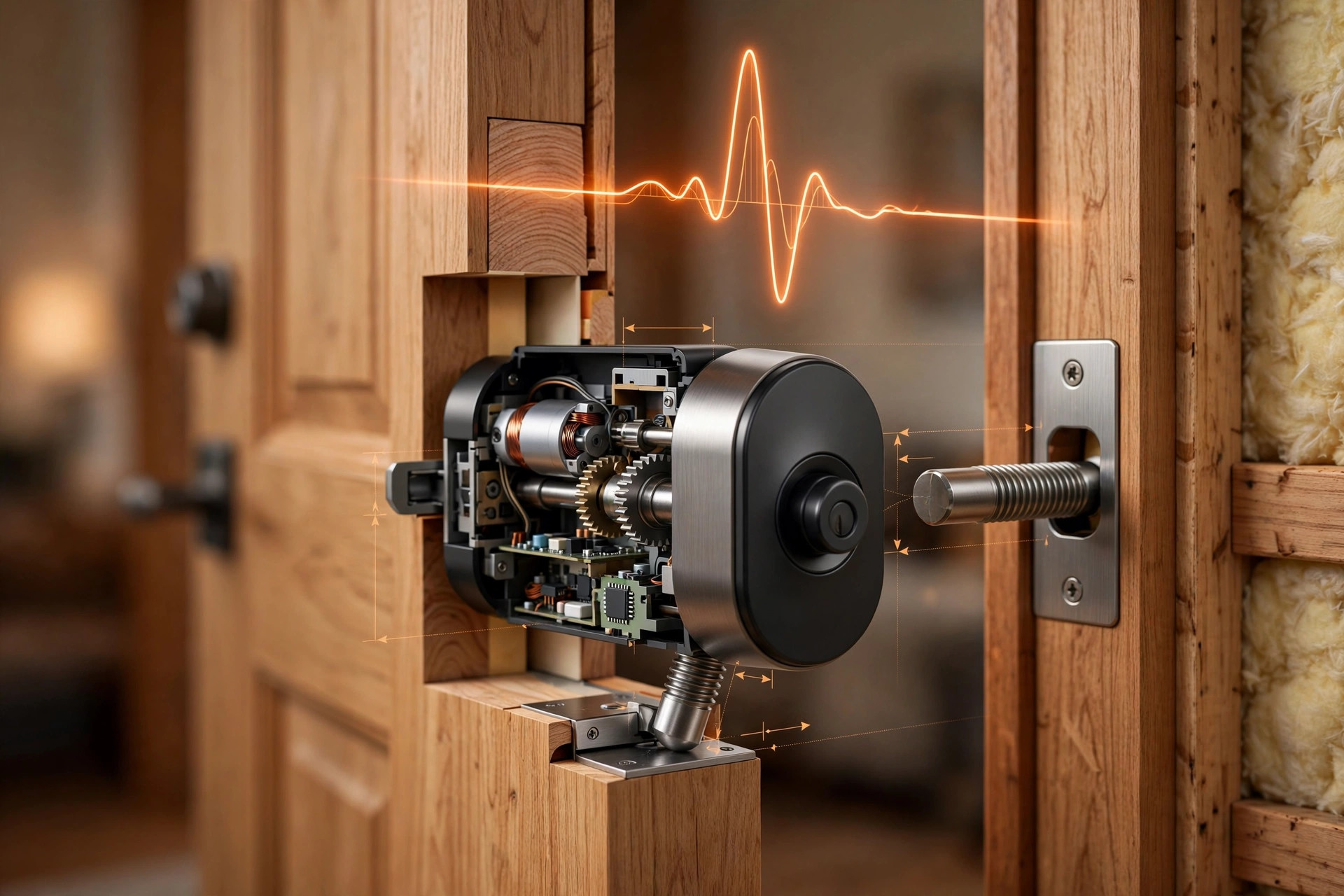
- Figure 1: Cross-section of a deadbolt and strike assembly showing the bolt at three positions (retracted, mid-travel, seated), with the strike-plate lip and bore labeled, and an exaggerated vertical misalignment illustrating the lip-strike geometry.
- Figure 2: Representative motor current waveforms for a healthy cycle (inrush spike, steady travel current, seat rise) versus a dragging cycle (elevated travel current with late-travel spike) versus a stall (current driven to the driver limit with no position advance).
- Figure 3: Position-resolved friction maps for the four canonical signatures: late-travel spike, uniform elevation, early-travel hump, and mid-travel notch, each annotated with the inferred drag source.
- Figure 4: Two-year friction history for an example wood door showing the seasonal component tracking outdoor humidity and the monotonic progressive residual revealed after seasonal removal, with warning thresholds marked.
- Figure 5: Companion-app screen showing the directional strike-plate adjustment guidance: a diagram of the strike plate with an arrow indicating adjustment direction and magnitude.
- Figure 6: System block diagram: shunt resistor and current-sense amplifier, position sensor, microcontroller with per-cycle feature extraction, local baseline store, weather-data input, and the companion app / cloud analytics path carrying features only.
- Figure 7: Adaptive drive illustration: torque budget raised through the high-drag region of the stroke, with the friction map overlaid on the drive profile.
Claims
- A diagnostic system for a motorized deadbolt lock, comprising: a current sensor arranged to measure current drawn by the lock's bolt actuator motor during lock and unlock cycles; a position sensor arranged to indicate bolt position along its travel; a processor that records, for each cycle, a current-versus-position trace; a baseline store holding per-door baseline statistics of the trace learned during a commissioning period; and an analyzer that decomposes drift of the trace away from the baseline into a reversible seasonal component correlated with outdoor temperature and humidity and a monotonic progressive component, and that issues a predictive lockout warning when the progressive component extrapolated toward the motor's stall margin crosses a warning threshold.
- The system of claim 1, wherein the analyzer computes a position-resolved friction map of average current versus bolt position over a rolling window of cycles, and localizes a drag source along the bolt stroke from the map's shape, distinguishing at least a late-travel spike indicative of strike-plate lip interference, a uniform elevation indicative of bore friction or mechanism wear, and an early-travel hump indicative of mechanism-side binding.
- The system of claim 1, wherein the seasonal component is modeled as a function of trailing outdoor relative humidity and temperature, the progressive component is constrained to be monotonic via isotonic regression, and warnings at the action level are driven by the progressive residual after removal of the seasonal component, suppressing false alarms from annual humidity-driven friction cycles.
- The system of claim 2, further comprising a guidance generator that converts the friction map into directional strike-plate adjustment guidance specifying an adjustment direction and magnitude, derived from the position of a late-travel current spike within the stroke and from throw/retract current asymmetry.
- The system of claim 1, further comprising an adaptive drive controller that raises the actuator torque budget within motor thermal limits in proportion to measured friction, applying increased torque selectively through high-drag regions of the stroke identified in the friction map, rather than repeating identical failed attempts.
- The system of claim 1, further comprising a battery estimator that tracks per-cycle electrical energy and battery voltage sag under load, and that attributes rising energy consumption to mechanical load versus battery aging using voltage-normalized current features, producing a remaining-cycle estimate with an attributed cause.
- The system of claim 1, further comprising a forced-entry classifier that detects uncommanded torque transients on the bolt, distinguishes impact-like rapid transients from gradual misalignment drift by timescale and by absence of a motor command, and reports suspected forced-entry events separately from alignment diagnostics.
- A method for diagnosing deadbolt lock alignment, comprising: measuring actuator motor current and bolt position during each lock and unlock cycle of a motorized deadbolt; extracting per-cycle features including travel RMS current, cycle energy, travel time, and throw/retract asymmetry; learning a per-door baseline of the features during a commissioning period; fitting a two-component model to feature drift comprising a reversible seasonal component as a function of outdoor humidity and temperature and a monotonic progressive component; and issuing a predictive lockout warning with an estimated lead time when the progressive component approaches the actuator's stall margin.
- The method of claim 8, further comprising an installer mode that presents a real-time friction readout during manual strike-plate adjustment, detects a step-change improvement in the friction map attributable to the adjustment, and re-baselines the per-door baseline from post-adjustment cycles.
- The system of claim 1, further comprising a fleet-learning module that aggregates anonymized per-door friction histories by climate zone and door material to produce priors for seasonal friction behavior, the priors being applied to shorten the commissioning period of newly installed locks.
- The system of claim 1, wherein all current features are normalized by contemporaneous battery voltage before baseline comparison, separating mechanical-load drift from battery-aging drift.
- The system of claim 4, wherein the guidance generator renders a diagram of the strike plate with an arrow indicating the adjustment direction and a numeric adjustment magnitude, the magnitude being bounded by the mechanical adjustment range of a standard strike plate.
Implementation Notes
The primary deployment target is the retrofit smart deadbolt market: battery-powered locks that replace the interior thumbturn of a standard deadbolt while keeping the existing bolt, strike, and key cylinder. These locks already contain a microcontroller, a radio, and usually a position sensor; the incremental hardware is a shunt resistor and a current-sense amplifier, well under one US dollar at volume, plus firmware. The analytics can run on the lock's own processor for the baseline and warning tiers, with the seasonal decomposition running in the companion app or cloud where the weather data and longer history live.
The approach has inherent limitations. First, locks without a true position sensor get a coarser friction map from time-normalized waveforms; the four canonical signatures blur, though the seasonal/progressive decomposition still works on scalar features. Second, manual operation with a physical key bypasses the motor entirely and contributes no data; households that primarily use keys will build baselines slowly. Third, the adjustment guidance assumes a standard strike plate with slotted screw holes; mortise locks, multi-point locking systems, and some high-security strikes need a locksmith regardless, and the system should say so rather than overreach. Fourth, renters generally cannot modify strike plates; for them the value is the documented diagnosis to hand to a landlord, plus the adaptive drive keeping the door lockable in the meantime.
The strongest counterargument is that binary jam detection plus a "call a locksmith" message is cheaper to build and covers the same event. It covers the same event but not the same cost: a predicted misalignment fixed with a screwdriver in daylight is a different outcome from a 2 a.m. lockout, a locksmith bill of $150 to $300, or a door left effectively unlocked because the auto-lock failed silently while the homeowner assumed it succeeded. The diagnostic layer earns its keep on lead time and on the specificity of the fix, not on detecting the jam itself.
Prior Art References
- SlashGear. "August's New Smart Locks Know If Your Door's Ajar." August Smart Lock Pro reports open/closed/jammed lock states; DoorSense frame sensor detects door-ajar condition. Binary, reactive state reporting; no longitudinal diagnostics.
- mase1981. "Schlage Devices integration for Unfolded Circle." Documents Schlage connected deadbolts exposing lock status of Locked / Unlocked / Jammed. Binary jam status; no friction trending or prediction.
- WO2013168114A1. "A lock." Motor current detection circuit with fixed threshold; on detecting a clash with the door, frame, or strike plate, reverses the motor and retries a set number of times before registering a fault. Threshold-based reactive jam handling; no baseline learning, no seasonal decomposition, no adjustment guidance.
- US10233672B2. "Lock devices, systems and methods." Microcontroller monitors motor current to determine a stall condition. Stall detection; no longitudinal signature analysis or failure prediction.
- US10140828B2. "Intelligent door lock system with camera and motion detector." Current sensor determines how hard the motor is working; current used to determine friction experienced by the door/lock, with friction information provided to the user and provision for current adjustment. Reports friction; does not disclose per-door baselines, position-resolved friction maps, seasonal versus progressive decomposition, or predictive lockout warnings.
- US20200372738A1. "Smart lock system." Accelerometer and knob position monitor used to detect a stall condition during electronic operation; motor disengaged to prevent overcurrent damage. Stall detection via motion sensing; no current-signature diagnostics.
- Edens Structural Solutions. "Why Is My Door Sticking, and What Does the Crack Beside It Mean?" Seasonal humidity is the most common cause of sticking doors; sticking that is predictable and seasonal points to moisture, while sudden or persistent sticking points to foundation movement. The reversibility test this disclosure operationalizes in lock telemetry.
- USDA Forest Products Laboratory. "Wood Handbook" (FPL-GTR-118). Dimensional change of wood with moisture content; tangential shrinkage approximately twice radial; the physical basis for seasonal door and frame movement.
- Purdue Extension. "EMC's by Region" (FNR-163). Equilibrium moisture content varies by US region and season; moisture-content changes of a few percent produce significant dimensional change (about 2.5% for a 6-point MC change in sugar maple).
- Angi. "How To Fix A Door That Sticks." Doors stick more in humid seasons; documents the seasonal pattern and homeowner remediation steps.
- Homes & Gardens. "How to fix a door that sticks." Adjusting the strike plate position as a standard remedy for a door sticking against it; the manual procedure this disclosure's guidance automates the diagnosis for.
- Yale. "Assure Lever Troubleshooting Guide" (via Manuals.Plus). Documents jam alarms when the lock cannot complete electronic operation. Reactive jam alarming; no predictive diagnostics.