System and Method for Determining Compost Maturity Using Fused Gas, Thermal, and Moisture Sensing with Edge Inference
Nobody knows when compost is done. The lab test takes days, the jar test takes four hours, and the smell test is wrong in both directions. What this disclosure would claim instead is a narrower combination that measures maturity where the compost actually is: a probe left in the pile that reads the gases, the temperature curve, and the moisture together, and scores maturity continuously against the laboratory band values, so a facility knows a batch is finished the day it finishes instead of the week after.
Abstract
A proposed system would determine the maturity of compost in place, without removing samples. A sensor probe left in the pile would fuse four channels: headspace gas composition (carbon dioxide, ammonia, hydrogen sulfide, oxygen, and volatile organics), a vertical temperature string, and moisture, processed by edge inference in the probe. A gas sampling head at the probe tip would draw pore gas from the pile interior and measure carbon dioxide by nondispersive infrared sensing, ammonia and hydrogen sulfide by electrochemical sensing, and oxygen by galvanic sensing, while thermistors spaced along the probe would record the temperature profile from the pile core to the surface and a capacitance sensor would read moisture. An on-device model would convert the fused signals into a maturity index that uses the California Compost Quality Council band values as reference thresholds, with a carbon dioxide evolution proxy, a Solvita-equivalent maturity index from the intersection of carbon dioxide and ammonia scores, a Dewar self-heating proxy, and a curing-phase temperature signature, each reported separately so a single channel cannot declare a batch mature. A laboratory carbon-to-nitrogen ratio of 25 or less would gate any maturity declaration, as the California index requires. The system would also predict odor events from rising ammonia and hydrogen sulfide against wind and atmospheric conditions, and would recommend turning and aeration from the same signals. All scoring would run on the probe, with no cloud connection needed to read the maturity of a pile in the moment.
Field of the Invention
This invention relates to composting and organic waste processing. It covers an in-situ combination of pore-gas sensing, vertical temperature profiling, moisture sensing, and edge inference for continuous compost maturity determination, with odor-event prediction and turning guidance, for windrows, aerated static piles, in-vessel systems, and home composters.
Background
Maturity is the property that decides whether compost helps plants or harms them, and it is the property nobody can measure in the field. Maturity is not the same as stability. Stability is the level of residual microbial activity, measured by oxygen uptake or carbon dioxide evolution. Maturity is the absence of phytotoxicity and the suitability of the material for plant growth. An immature compost can look finished, smell earthy, and still kill seedlings, because it contains free ammonia, volatile organic acids, or other water-soluble compounds that limit seed germination and root development. The California Compost Quality Council maturity index states the rule plainly: maturity is not described by a single property, so it is best assessed by measuring two or more parameters. The index requires a carbon-to-nitrogen ratio of 25 or less before any other test counts, then at least one test from Group A (stability) and one from Group B (toxicity) to rate a batch very mature, mature, or immature. The Hong Kong Organic Resource Centre applies the same TMECC methods with matching limits: carbon dioxide evolution of 2 grams of carbon per kilogram of volatile solids per day or less, oxygen demand of 0.4 grams of oxygen per kilogram of total solids per hour or less, and ammonium nitrogen of 500 milligrams per kilogram or less.
Gas sensing for maturity is not a new idea, and this disclosure concedes the art. López and co-workers (Waste Management, 2016) sampled pore gas from industrial windrows of different ages and showed that electronic-nose patterns classified piles by aerobic or anaerobic condition and gave a rough estimate of composting time, with three or four sensor signals accounting for 97 to 98 percent of the variance. Sánchez-Artero and co-workers (Microchemical Journal, 2025) built an optoelectronic nose of metal-oxide and optical sensors that distinguished composting phases and predicted process parameters with relative errors of 1 to 5 percent. Naser and co-workers (Sustainability, 2025) field-validated a real-time gas sensor network measuring oxygen, carbon dioxide, and methane under tropical windrow conditions with adaptive feedback control of aeration. In-pile gas probes are patented art too: US 20040259233 (2004) discloses discontinuous measurement of oxygen or carbon dioxide in composting platforms with gas-sampling rods and a single intake pump, and EP 2167446 A2 discloses a mobile probe inserted into the organic mass that measures physico-chemical parameters and drives sequential aeration. A 1984 paper in the Japanese Journal of Soil Science and Plant Nutrition describes a gas sensor for continuous monitoring of compost maturity. None of these systems maps pore-gas readings to the California Compost Quality Council band values and the Solvita maturity index as separate sub-scores in a single windrow probe, none of them derives a Dewar-equivalent score from reheating after turning, and none of them gates maturity on a laboratory carbon-to-nitrogen ratio with an all-sub-scores agreement rule. That narrower combination is the gap this disclosure addresses.
The tests the index accepts are all laboratory or bench tests, and every one of them requires removing a sample and waiting. Carbon dioxide evolution is measured by respirometry over days. Oxygen uptake is measured in a laboratory respirometer. The Dewar self-heating test puts a sample in an insulated flask and watches the temperature rise over days. The Solvita test, the fastest accepted field method, seals a sample in a jar with two colorimetric gel paddles and reads them after four hours: one paddle for carbon dioxide on a scale of 1 to 8, one for ammonia on a scale of 1 to 5. The maturity index is read from the intersection of the two paddle values, not from either paddle alone: an index of 7 to 8 is very mature, 5 to 6 mature, and below 5 immature, so a sample with a carbon dioxide paddle of 8 but an ammonia paddle of 1 scores a combined index of 4. Changa and co-workers (Compost Science and Utilization, 2003) compared the Solvita test against the three-day carbon dioxide evolution procedure on dairy and hog manure composts and found correlations of r = -0.82, -0.78, and -0.87 between Solvita carbon dioxide values and measured evolution rates, and confirmed the Solvita ammonia paddle tracked ammoniacal nitrogen. A germination bioassay, the most direct test of phytotoxicity, incubates seeds in compost extract for 24 to 48 hours; a germination index above 80 percent relative to a water control indicates phytotoxins have disappeared (Tiquia et al., 1996), while values above 60 percent are taken as mature by some standards. None of these tests runs continuously, none of them measures the pile itself, and a facility that wants a maturity reading on a Tuesday ships a sample on a Monday and reads the answer on a Thursday.
What exists in the field measures temperature and little else. Green Mountain Technologies' Windrow Manager, in use since the mid-2000s, uses a wireless temperature and moisture probe with a handheld data logger to document windrow conditions for pathogen-reduction compliance. Quanturi and Periskop sell the Tango XN probe, a stainless steel wireless temperature lance in 100 or 200 centimeter lengths that reports pile temperature about once an hour and logs it to a cloud dashboard, marketed for compliance with pathogen-reduction rules and for fire prevention from spontaneous combustion. IRYS IoT sells a similar temperature and humidity probe system with a cellular gateway, readings every 5 to 15 minutes, starting at 99 dollars a month for five sensors. Banner Engineering documents the same pattern with wireless thermocouple nodes in windrows. Every one of these systems is a thermometer with a radio. Temperature alone cannot score maturity: a pile can sit at 30 degrees Celsius because it is finished, because it is too dry to decompose, because it is waterlogged and anaerobic, or because it is winter. The temperature trace cannot tell those apart, and none of these systems tries.
The gas channels that would tell them apart exist as instruments but not as a fused in-pile system scored against the laboratory bands. Nondispersive infrared carbon dioxide sensors, electrochemical ammonia sensors, galvanic oxygen sensors, and metal-oxide volatile organic compound sensors are all commodity parts. What no product or publication combines is continuous pore-gas sampling inside the pile with the temperature curve and moisture, scored on the device as separate sub-scores mapped to the laboratory maturity bands, with the gas ratios doing the work the lab tests do: carbon dioxide evolution as the stability signal, ammonia as the toxicity signal, and the temperature curve as the phase signal. The search behind this disclosure covered US and European patent art through the Justia and Google Patents databases, the electronic-nose compost literature, and commercial compost monitoring products through manufacturer documentation, as cited in the references.
A search of US and European patent art, the electronic-nose literature, and commercial compost monitoring products found no system combining these elements in a single windrow probe. The combination has seven elements:
- continuous in-situ pore-gas sampling from inside the pile, measuring carbon dioxide, ammonia, oxygen, and volatile organics at the probe;
- a vertical temperature string recording the pile core-to-surface profile, not a single point;
- moisture sensing at the same location, used to correct the gas and temperature channels rather than reported alone;
- an on-device maturity model that maps the fused signals to the California Compost Quality Council maturity bands, reporting a carbon dioxide evolution proxy, a Solvita-equivalent score, and a Dewar self-heating proxy as separate sub-scores;
- temperature-curve shape features, including time above 55 degrees Celsius, cooling rate after the thermophilic peak, and reheating after turning, as a phase signal;
- odor-event prediction from rising ammonia and hydrogen sulfide fused with wind speed, wind direction, and atmospheric stability; and
- turning and aeration recommendations derived from the same fused signals, with scoring rejection rules for bad data.
One concession is needed on scope. Wireless compost temperature probes are an established product, the Solvita jar test is an established method, electronic-nose maturity assessment is published art, and in-pile gas sampling with aeration control is patented art. This disclosure does not claim temperature monitoring of a compost pile, a colorimetric gel test, an electronic nose, or a gas-sampling probe that drives aeration. The distinction rests on the narrower combination: the fused gas channels scored continuously in place as separate sub-scores mapped to the California band values and the Solvita maturity index, the Dewar-equivalent score from reheating after turning, the laboratory carbon-to-nitrogen gate, and the all-sub-scores agreement rule, with odor prediction and turning guidance following from the fusion. A thermometer with a radio cannot score maturity, a jar test cannot run continuously, and an electronic nose does not report the laboratory bands. The combination is the gap this disclosure addresses.
Detailed Description
This section describes a proposed system. No prototype exists. Every threshold, rate, and cost figure in it is a design target, not a measured result. Conditional language is used deliberately throughout.
1. System Overview
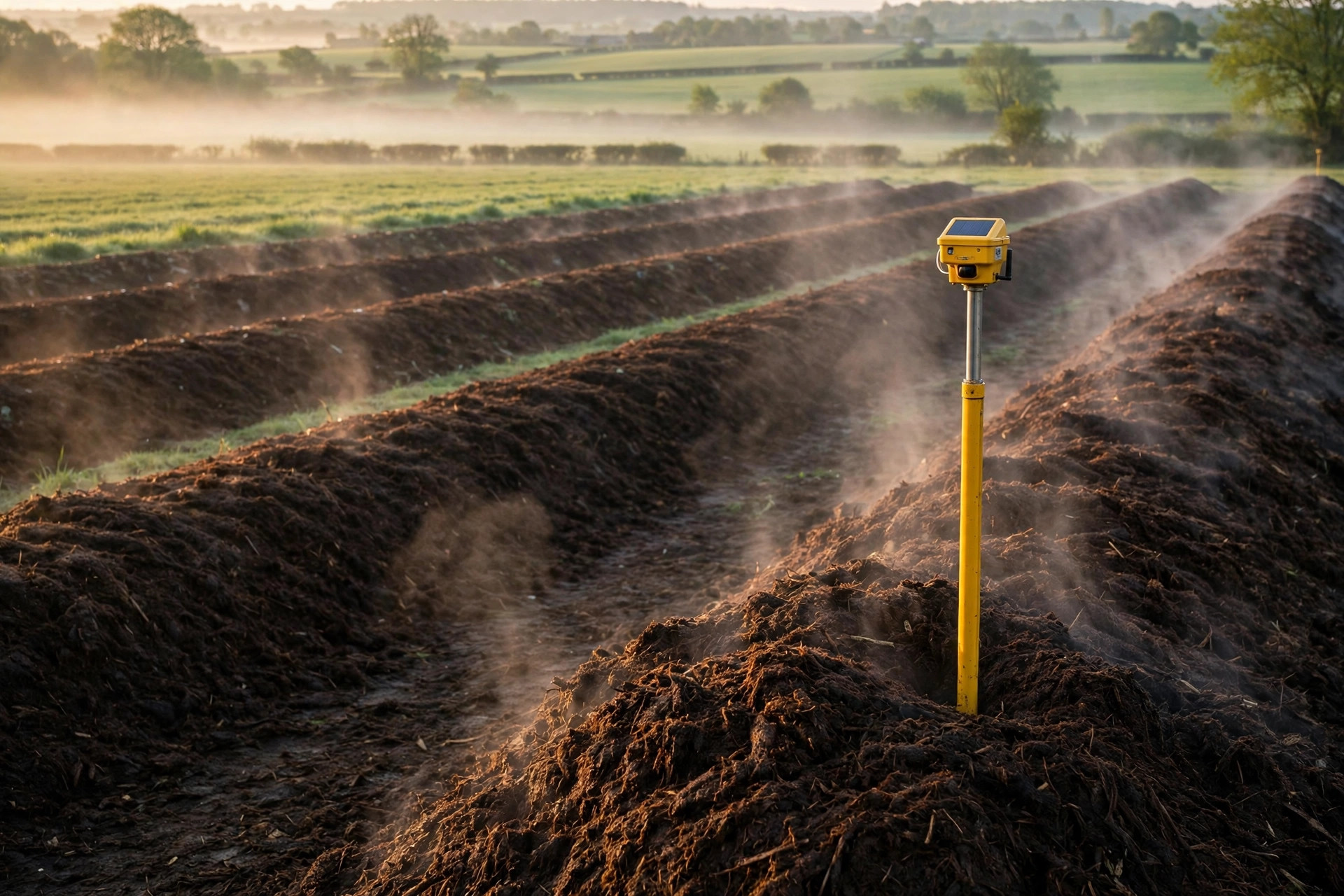
Four parts would make up the system. A probe lance would sit in the pile and carry the gas sampling head, the temperature string, and the moisture sensor. A sensing unit in the probe head would measure the gas channels and convert the raw signals into a maturity index. A gateway would collect maturity indices from the probes across a facility, show each pile on a map, and keep the batch record. A display would show each pile as a single maturity state with the sub-scores behind it. No sample would leave the pile, no laboratory would be involved in the routine reading, and no cloud connection would be needed to read the maturity of a pile in the moment. The gateway would add the cross-pile view and the batch history, and only with the facility's own network.
2. Probe Hardware: The Lance
The probe would be a stainless steel lance, 100 or 200 centimeters long to match the Periskop and Quanturi lengths that already meet windrow depth practice, with a beveled tip for insertion and a head that sits above the pile surface. The gas sampling head at the tip would draw pore gas through a sintered stainless filter that excludes solids and liquid while passing gas, with a small pump that samples for 30 seconds every 15 minutes and then purges with ambient air, so the sensors see fresh pile gas on each cycle and do not sit in a stagnant headspace. The temperature string would carry thermistors at five depths: the tip, the quarter, the midpoint, the three-quarter point, and just below the surface, so the profile shows the core temperature, the gradient to the surface, and whether the pile is heating uniformly or has a cold shell around a hot core. A capacitance moisture sensor would sit at the midpoint. The head would carry a small solar panel and a battery sized for 72 hours without sun, and a LoRa radio for the mesh to the gateway. Target bill-of-materials cost per probe: 180 to 250 dollars in volume, against 400 dollars or more for a laboratory maturity panel per sample.
Corrosion sets the materials. Compost pore gas carries ammonia, hydrogen sulfide, and organic acids, and the leachate is corrosive to ordinary electronics. The lance would be 316 stainless steel, the gas path would use PTFE tubing, and the sensors would sit in a sealed chamber behind the sintered filter, with the filter replaced on a maintenance schedule the probe itself tracks by counting pump cycles. Condensation is the failure mode the design must survive: warm saturated pile gas meets a cooler probe head and condenses, and liquid water on an electrochemical ammonia sensor destroys its calibration. The sampling head would include a hydrophobic membrane vent and a heater that holds the sensor chamber 3 degrees Celsius above the pile gas temperature during sampling, both design targets, and the scoring rules in section 10 would reject readings taken while the chamber humidity sensor reports condensation.
3. Gas Channels: Carbon Dioxide, Ammonia, Oxygen, Volatiles
Carbon dioxide is the stability signal. The California Compost Quality Council bands are the reference: carbon dioxide evolution below 2 milligrams of carbon per gram of volatile solids per day is very mature, 2 to 8 is mature, and above 8 is immature. A pore-gas carbon dioxide concentration is not an evolution rate, and the disclosure does not pretend it is. The probe would convert concentration to an evolution proxy by combining the measured carbon dioxide concentration with the oxygen depletion measured in the same sample and the temperature at that depth, using a diffusion model of the pile calibrated per feedstock during the first days of the batch. The proxy would be reported in the same units as the laboratory band, milligrams of carbon per gram of volatile solids per day, so the operator reads it against the same thresholds the lab uses, and the proxy would carry its calibration status: uncalibrated until the first laboratory sample for that batch anchors it, calibrated after. The Solvita carbon dioxide paddle runs 1 to 8 and the ammonia paddle 1 to 5, and the maturity index is read from their intersection: 7 to 8 very mature, 5 to 6 mature, below 5 immature. The probe would report a Solvita-equivalent maturity index on that same combined scale, derived from its carbon dioxide and ammonia readings, so an operator who knows the jar test reads the probe without learning a new scale.
Ammonia is the toxicity signal. Free ammonia in compost inhibits seed germination and root development, and the Solvita ammonia paddle reads it on a scale of 1 to 5, combined with the carbon dioxide paddle into the maturity index. The probe would measure ammonia by electrochemical sensor in the sampled pore gas, in parts per million, and feed it into the Solvita-equivalent maturity index through the carbon dioxide by ammonia intersection. The ammonia channel also carries the odor signal: ammonia is detectable by smell at about 5 parts per million, and the US Occupational Safety and Health Administration sets the permissible exposure limit at 50 parts per million as an 8-hour average. Hydrogen sulfide, measured by a second electrochemical sensor, is detectable by smell below 1 part per million, and its ceiling limit is 20 parts per million. A pile that reads 40 parts per million ammonia at the probe tip is a pile whose neighbors will smell it before the operator does, and section 7 turns that reading into a prediction.
Oxygen is the aeration signal. Aerobic composting needs oxygen in the pore space; below about 10 percent oxygen the pile goes anaerobic, produces hydrogen sulfide and volatile fatty acids, and the maturity clock stops even while the temperature stays high. The probe would measure oxygen by galvanic sensor in the same sampled gas, and the model would treat oxygen below 10 percent as a veto on any maturity declaration: a pile cannot be called mature while it is anaerobic, whatever the carbon dioxide proxy says. Volatile organics would be measured by a metal-oxide sensor as a single total-volatile-organic-compound index, used as a corroborating channel for the curing phase, where the volatile acid load falls as the pile finishes. No single gas channel would declare maturity alone.
4. Thermal Channel: The Curve, Not the Point
Temperature is the phase signal, and the curve matters more than any single reading. A composting batch moves through phases: a mesophilic rise, a thermophilic peak at 55 to 65 degrees Celsius where pathogen reduction happens, a cooling phase as easily degraded material is exhausted, and a curing phase near ambient temperature where the pile stabilizes. The US Environmental Protection Agency's Process to Further Reduce Pathogens requires holding 55 degrees Celsius for 3 days in aerated static piles and in-vessel systems, and the probe would track time above 55 degrees Celsius per depth as a compliance record, not as a maturity score. Above about 70 degrees Celsius microbial activity falls off, so a pile that spikes past 70 is a pile that has stalled itself, and the model would flag it.
Three curve features would feed the model. Time above 55 degrees Celsius, per depth, would establish that the batch completed its thermophilic phase. Cooling rate after the peak, measured as degrees Celsius per day at the core, would indicate the exhaustion of degradable material: a fast-cooling pile has finished its active phase, while a pile that holds 50 degrees for weeks still has fuel. Reheating after turning would test whether the pile is truly done: turning a finished pile reintroduces oxygen and mixes material, and a finished pile reheats little or not at all, while an unfinished pile reheats by more than 20 degrees. That reheating test is proposed as the in-pile analogue of the Dewar self-heating test, in which a sample in an insulated flask is watched for temperature rise over days, with a rise of 10 to 20 degrees Celsius rated mature and above 20 degrees immature under the California index. The bands are borrowed as a starting point, not a validated equivalence: pile reheating and flask self-heating are different quantities, and the probe would report the Dewar-equivalent proxy with that caveat. The probe would report a Dewar-equivalent self-heating proxy in degrees Celsius of reheating after turning, on the same bands. The temperature string would also catch the failure modes a single probe cannot see: a cold shell around a hot core means the surface never reached pathogen-reduction temperature, and a hot spot at one depth with cold readings elsewhere means the pile was built unevenly.
5. Moisture Channel: The Correction, Not the Score
Moisture would be measured and used to correct the other channels, not scored on its own. Composting works in a moisture window of roughly 40 to 60 percent by weight: below 40 percent microbial activity slows and the pile looks mature because nothing is happening, above 60 percent the pore space fills with water, oxygen cannot move, and the pile goes anaerobic. The capacitance sensor at the probe midpoint would read moisture continuously, and the model would apply three corrections from it. First, the carbon dioxide evolution proxy would be scaled by a moisture factor, since a dry pile evolves little carbon dioxide for lack of water rather than lack of degradable material. Second, the ammonia reading would be corrected for moisture, since wet piles hold ammonia in solution and read low in the gas phase while still carrying a phytotoxic load. Third, moisture outside the 40 to 60 percent window would suspend the maturity score and report the pile as moisture-limited instead, with a watering or drying instruction. A pile that reads mature while sitting at 25 percent moisture is a pile that dried out, not a pile that finished, and the model would say so.
6. Edge Maturity Model: Four Sub-Scores, One State
The maturity index would combine the channels by sub-score, each on its own scale, so a failure in one channel cannot be hidden by the others. The carbon dioxide evolution proxy would map to the California bands: below 2 milligrams of carbon per gram of volatile solids per day scores very mature, 2 to 8 mature, above 8 immature. The Solvita-equivalent maturity index would combine the carbon dioxide and ammonia readings on the jar test's own scales, 1 to 8 and 1 to 5, through their intersection, into the same maturity index the jar test produces. The Dewar-equivalent self-heating proxy would map reheating after turning to the California bands: under 10 degrees Celsius of reheating scores very mature, 10 to 20 mature, above 20 immature, with the caveat from section 4 that the bands are borrowed, not validated for pile reheating. The curing signature would score the temperature curve: a core within 5 degrees Celsius of ambient for 7 consecutive days scores very mature, a core 5 to 10 degrees above ambient for 7 consecutive days scores mature, and a core more than 10 degrees above ambient scores immature, with oxygen above 10 percent and moisture inside the 40 to 60 percent window required in all cases. The pile would be declared mature only when the carbon dioxide proxy, the Solvita-equivalent, the Dewar-equivalent, and the curing signature all read mature or better, the oxygen veto in section 3 is satisfied, and a laboratory carbon-to-nitrogen ratio for the batch is 25 or less. That all-sub-scores rule is stricter than the California index, which requires one test from Group A and one from Group B. Any single sub-score reading immature would hold the batch, and the display would show which sub-score is holding it and why.
The carbon dioxide evolution proxy would use an explicit diffusion model, so the conversion is inspectable rather than a black box. The proxy equals a feedstock coefficient k, times the difference between pore-gas carbon dioxide and ambient carbon dioxide, times a temperature factor, times a moisture factor: proxy = k × (C_pore − C_ambient) × f(T) × f(M). The temperature factor f(T) would be 1.0 at 55 degrees Celsius and halve for each 10 degree drop, reflecting slower microbial respiration at lower temperature. The moisture factor f(M) would be 1.0 inside the 40 to 60 percent window and fall linearly to 0.5 at 25 percent moisture, reflecting water-limited respiration. The coefficient k would be fitted per feedstock from paired probe readings and laboratory evolution measurements on the first batches, then fixed. A worked example, with illustrative numbers: a food waste pile with pore carbon dioxide of 12 percent against ambient 0.04 percent, core temperature 55 degrees, moisture 50 percent, and a fitted k of 0.14 milligrams of carbon per gram of volatile solids per day per percent of carbon dioxide, gives a proxy of 0.14 × 11.96 × 1.0 × 1.0, about 1.7 milligrams, in the very mature band. The same pile at 30 degrees would carry a temperature factor of about 0.18 and read about 0.3, which is why the proxy is meaningless without the temperature correction and why the model reports the correction factors alongside the proxy. Those numbers are design targets, pending measurement.
Figure 4: Maturity sub-score bands. All four sub-scores must read mature or better, and the laboratory carbon-to-nitrogen ratio must be 25 or less, before a batch is declared mature.
| Sub-score | Very mature | Mature | Immature |
|---|---|---|---|
| CO2 evolution proxy | < 2 mg C / g VS / day | 2 to 8 | > 8 |
| Solvita-equivalent maturity index (CO2 × NH3) | 7 to 8 | 5 to 6 | < 5 |
| Dewar-equivalent reheating | < 10 °C | 10 to 20 °C | > 20 °C |
| Curing signature | Core within 5 °C of ambient, 7 days | Core 5 to 10 °C above ambient, 7 days | Core above ambient by > 10 °C |
The model would be a small gradient-boosted tree ensemble, under 200 kilobytes, running on the probe's microcontroller in under 100 milliseconds per scoring cycle, both targets, with scoring every 15 minutes on each gas sampling cycle. Training data would come from paired probe readings and laboratory maturity panels on the same batches: carbon dioxide evolution, oxygen uptake, Dewar rise, Solvita scores, germination index, and carbon-to-nitrogen ratio, labeled per batch and per feedstock. The labeled dataset does not exist yet at scale, and collecting it is the largest barrier to building this system, as the Limitations section states. The model would also learn per-feedstock baselines: food waste, green waste, manure, and biosolids compost on different curves, and a food waste pile judged against a green waste baseline would be mis-scored. The probe would key its baseline by the feedstock declared at batch start, and would refuse to score a batch whose feedstock is undeclared, reporting it as unrated rather than mature.
7. Odor Event Prediction
Odor is the complaint that closes composting facilities, and it arrives as an event, not a trend. A pile that has been quiet for weeks can release a burst of ammonia and hydrogen sulfide when it is turned, when it is wetted after drying, or when a rain soaks the surface and drives gas out. The probe would predict those events from the gas channels fused with weather. Rising ammonia above 25 parts per million at the probe tip, or hydrogen sulfide above 0.5 parts per million, combined with a turning event scheduled within 24 hours, would raise an odor warning. The warning would be graded by wind: a warning under a wind blowing toward the nearest homes at under 3 meters per second with a stable atmosphere, the conditions that carry odor farthest, would rank higher than the same reading under a wind blowing away from homes. The gateway would hold the turning schedule and the wind forecast, and would recommend turning in the morning when the atmosphere is mixing rather than in the evening when it settles, or delaying a turn by a day when the wind points at the neighborhood. Those recommendations are design targets, pending measurement of the actual relationship between probe-tip gas readings and fence-line odor complaints.
8. Turning and Aeration Guidance
The same signals that score maturity would tell the operator when to turn and when to leave the pile alone. A pile whose core oxygen has fallen below 10 percent while its temperature is still above 55 degrees Celsius needs turning or forced aeration now, since the microbes are active but starved of air. A pile whose temperature has fallen below 40 degrees Celsius while its carbon dioxide proxy still reads immature needs turning to redistribute moisture and material, since the pile has gone cold with fuel left. A pile whose Dewar-equivalent reheating after the last turn was under 10 degrees Celsius needs no further turning, since turning it again would only release odor and lose heat. A pile whose moisture has fallen below 40 percent needs water before it needs turning, since turning a dry pile makes it drier. The display would show one instruction per pile: turn, aerate, water, or leave alone, with the sub-score behind it. The instruction would be a recommendation, and the operator would always be able to override it, with the override logged against the batch record.
9. Facility Dashboard and Fleet Learning
The gateway would collect maturity indices from every probe at a facility, show each pile on a site map with its maturity state, and keep the batch record: feedstock, start date, turning log, moisture log, temperature history, gas history, and the laboratory panels used to calibrate the proxy. Across facilities, an opt-in fleet service would correlate probe readings with laboratory outcomes by feedstock, so a food waste batch in one city benefits from the calibration of food waste batches in another. The fleet service would receive only feature vectors and laboratory outcome labels, with facility identity replaced by a rotating pseudonym, and records retained for 24 months. That claim needs a qualifier: batch start dates and feedstock types can still identify a facility to someone who knows the local market, so pseudonymity means no facility name or coordinates, not no information about the facility. The batch record would also serve the compliance case: the time-above-55-degrees record per depth, the turning log, and the moisture log together document the pathogen-reduction process for regulators, replacing the handwritten temperature log that most facilities still keep.
10. Scoring Rejection Rules
Scoring would be suspended when the data cannot support it. The model would reject readings taken while the sensor chamber humidity sensor reports condensation, while the gas sampling pump reports a flow fault, while the probe has been out of the pile for more than 30 minutes, and while the moisture sensor reads outside 15 to 75 percent, which indicates a sensor fault rather than a pile condition. It would reject the carbon dioxide proxy until the first laboratory sample for that batch anchors the calibration, reporting the proxy as uncalibrated rather than mature. It would reject maturity declarations for batches whose feedstock is undeclared, for piles that have been turned within the last 24 hours while the gas channels are still settling, and for any pile whose oxygen reads below 10 percent, which vetoes maturity as section 3 states. Each rejection would be logged with its reason, and the display would show scoring as paused rather than mature. These rejection rules are part of the claimed system, because a maturity score produced from bad data is worse than no score: an immature batch sold as mature kills the seedlings it was sold to feed.
11. Figures Description
- Figure 1: System architecture showing the probe lance in a windrow with the gas sampling head, the five-depth temperature string, and the moisture sensor, the LoRa link to the facility gateway, and the dashboard showing each pile as a maturity state with its sub-scores.
- Figure 2: Gas sampling head cross-section showing the sintered stainless filter, the PTFE gas path, the sensor chamber with carbon dioxide, ammonia, oxygen, and volatile organic compound sensors, the hydrophobic vent, and the chamber heater.
- Figure 3: Temperature curve for a composting batch showing the mesophilic rise, the thermophilic peak at 55 to 65 degrees Celsius, the cooling phase, and the curing phase near ambient, with time above 55 degrees marked and the reheating after turning shown as the Dewar-equivalent test.
- Figure 4: Maturity sub-score table mapping the carbon dioxide evolution proxy, the Solvita-equivalent score, the Dewar-equivalent reheating, and the curing signature to the very mature, mature, and immature bands, with the rule that all four must read mature or better.
- Figure 5: Odor event prediction diagram showing rising ammonia and hydrogen sulfide at the probe tip, a scheduled turning event, wind speed and direction, and the graded warning issued to the operator.
- Figure 6: Turning decision diagram showing the four instructions, turn, aerate, water, or leave alone, with the sub-score and threshold behind each one.
In patent language, that system is:
Claims
- A system for determining maturity of compost in place, comprising: a probe lance configured for insertion into a compost pile, the lance carrying a gas sampling head at its tip with a sintered filter, a sampling pump that samples pore gas for 30 seconds every 15 minutes and purges with ambient air between samples, a sensor chamber with a heater holding the chamber 3 degrees Celsius above pile gas temperature during sampling and a chamber humidity sensor, a temperature string with thermistors at a plurality of depths along the lance, a moisture sensor, an ambient temperature sensor, and a display; a sensing unit in the probe configured to draw pore gas from the pile interior through the gas sampling head and measure carbon dioxide, ammonia, hydrogen sulfide, oxygen, and volatile organics in the sampled gas; and an edge inference unit in the probe; wherein the edge inference unit computes a carbon dioxide evolution proxy from the measured carbon dioxide and oxygen, a Solvita-equivalent maturity index from the intersection of a carbon dioxide score on a scale of 1 to 8 and an ammonia score on a scale of 1 to 5, a Dewar-equivalent self-heating proxy from reheating after turning, the Dewar-equivalent sub-score being evaluated only after a turning event, and a curing signature from the temperature string; maps each of the carbon dioxide evolution proxy, the Solvita-equivalent maturity index, the Dewar-equivalent self-heating proxy, and the curing signature to a maturity band of very mature, mature, or immature; and declares the compost mature only when all of the carbon dioxide evolution proxy, the Solvita-equivalent maturity index, the Dewar-equivalent self-heating proxy, and the curing signature read mature or better, oxygen in the sampled gas is above 10 percent, and a laboratory carbon-to-nitrogen ratio for the batch is 25 or less.
- The system of claim 1, wherein the carbon dioxide evolution proxy is reported in milligrams of carbon per gram of volatile solids per day and mapped to the bands below 2 for very mature, 2 to 8 for mature, and above 8 for immature, and wherein the proxy is calibrated against a laboratory carbon dioxide evolution measurement for the batch and reported as uncalibrated until that laboratory measurement anchors it.
- The system of claim 1, wherein the Dewar-equivalent self-heating proxy is measured as reheating in degrees Celsius after turning and mapped to the bands below 10 for very mature, 10 to 20 for mature, and above 20 for immature.
- The system of claim 1, wherein the curing signature requires a pile core temperature within 5 degrees Celsius of ambient temperature for 7 consecutive days for very mature, 5 to 10 degrees Celsius above ambient temperature for 7 consecutive days for mature, and more than 10 degrees Celsius above ambient temperature for immature, with oxygen above 10 percent and moisture inside a 40 to 60 percent window in all cases.
- The system of claim 1, wherein the edge inference unit computes temperature-curve shape features from the temperature string, the features comprising time above 55 degrees Celsius per depth as a pathogen-reduction record, cooling rate after the thermophilic peak, the thermophilic peak being the maximum core temperature during the phase in which the pile core is between 55 and 65 degrees Celsius, and reheating after turning, and wherein a pile that exceeds 70 degrees Celsius is flagged as stalled.
- The system of claim 1, wherein the edge inference unit corrects the carbon dioxide evolution proxy and the ammonia measurement by the moisture sensor reading, and suspends the maturity score and reports the pile as moisture-limited when moisture is outside a 40 to 60 percent window.
- The system of claim 1, further comprising an odor-event predictor that receives wind speed, wind direction, atmospheric stability, and a turning schedule from a gateway, and raises a graded warning when ammonia in the sampled gas rises above 25 parts per million or hydrogen sulfide rises above 0.5 parts per million combined with a turning event scheduled within 24 hours, the grading depending on wind speed, wind direction relative to the nearest homes, and atmospheric stability, and that recommends a turning time based on the grading.
- The system of claim 1, further comprising a turning and aeration advisor that recommends turning or forced aeration when oxygen in the sampled gas falls below 10 percent while pile temperature is above 55 degrees Celsius, recommends turning when pile temperature falls below 40 degrees Celsius while the carbon dioxide evolution proxy reads immature, recommends watering before turning when moisture falls below 40 percent, and recommends no further turning when the Dewar-equivalent self-heating proxy after the last turn is below 10 degrees Celsius.
- The system of claim 1, further comprising a gateway that collects maturity indices from a plurality of probes across a facility, displays each pile on a site map with its maturity state and sub-scores, and maintains a batch record comprising feedstock, start date, turning log, moisture log, temperature history, gas history, and laboratory calibration panels.
- The system of claim 9, further comprising a fleet service that receives feature vectors, the feature vectors being the measured gas, temperature, and moisture values with their correction factors, and laboratory outcome labels from a plurality of facilities, only with explicit opt-in from each facility, correlates probe readings with laboratory maturity outcomes by feedstock, and returns per-feedstock calibration updates to the probes, the probe keying its baseline by the feedstock declared at batch start and refusing to score a batch whose feedstock is undeclared.
- The system of claim 1, further comprising scoring rejection rules that suspend scoring while a sensor chamber humidity sensor reports condensation, while a gas sampling pump reports a flow fault, while the probe has been out of the pile for more than 30 minutes, while the moisture sensor reads outside 15 to 75 percent, indicating a sensor fault rather than a pile condition and distinct from the moisture-limited pause of claim 6, until the first laboratory sample for the batch anchors the carbon dioxide proxy calibration, for 24 hours after turning while gas channels settle, and for any pile whose oxygen reads below 10 percent, and that log each suspension with its reason and report scoring as paused in the display.
- A method for determining maturity of compost in place, comprising: inserting a probe lance into a compost pile, the lance carrying a gas sampling head, a temperature string with thermistors at a plurality of depths, and a moisture sensor; drawing pore gas from the pile interior through the gas sampling head and measuring carbon dioxide, ammonia, hydrogen sulfide, oxygen, and volatile organics in the sampled gas; computing, in an edge inference unit in the probe, a carbon dioxide evolution proxy from the measured carbon dioxide and oxygen, a Solvita-equivalent maturity index from the intersection of a carbon dioxide score on a scale of 1 to 8 and an ammonia score on a scale of 1 to 5, a Dewar-equivalent self-heating proxy from reheating after turning, the Dewar-equivalent sub-score being evaluated only after a turning event, and a curing signature from the temperature string; mapping each of the carbon dioxide evolution proxy, the Solvita-equivalent maturity index, the Dewar-equivalent self-heating proxy, and the curing signature to a maturity band of very mature, mature, or immature; and declaring the compost mature only when all of the carbon dioxide evolution proxy, the Solvita-equivalent maturity index, the Dewar-equivalent self-heating proxy, and the curing signature read mature or better, oxygen in the sampled gas is above 10 percent, and a laboratory carbon-to-nitrogen ratio for the batch is 25 or less.
Implementation Notes
Bill of materials for the probe targets 180 to 250 dollars in volume: a 316 stainless steel lance, a sintered stainless filter, a nondispersive infrared carbon dioxide sensor, two electrochemical sensors for ammonia and hydrogen sulfide, a galvanic oxygen sensor, a metal-oxide volatile organic compound sensor, five thermistors, a capacitance moisture sensor, a small sampling pump, a microcontroller, a LoRa radio, a solar panel, and a battery. The edge model targets under 200 kilobytes and under 100 milliseconds per scoring cycle, with scoring every 15 minutes on each gas sampling cycle. The gateway is a commodity single-board computer with a LoRa concentrator. The display shows each pile as a single maturity state with the four sub-scores behind it, the instruction for that pile, and the reason any score is paused. The probe tracks its own filter maintenance by counting pump cycles and flags the filter for replacement on a schedule set by the facility.
Calibration discipline matters more than sensor quality. The carbon dioxide evolution proxy must be anchored by a laboratory measurement for each batch, because pore-gas concentration is not an evolution rate and the diffusion model between them depends on feedstock, pile geometry, and moisture. The probe enforces this by reporting the proxy as uncalibrated until the laboratory sample lands. Per-feedstock baselines must be learned separately, because food waste, green waste, manure, and biosolids compost on different curves, and the probe enforces this by refusing to score a batch whose feedstock is undeclared. The scoring unit must also enforce the rejection rules in section 10.
Limitations
This disclosure describes an unbuilt system. No prototype has been constructed, no accuracy figure has been measured, and every threshold in it is a proposed value. The 2 and 8 milligram carbon dioxide evolution bands, the 10 and 20 degree Dewar-equivalent bands, the 25 parts per million ammonia and 0.5 parts per million hydrogen sulfide odor thresholds, the 10 percent oxygen veto, the 40 to 60 percent moisture window, the 200 kilobyte model size, the 100 millisecond inference time, the 15 minute scoring interval, and the 180 to 250 dollar bill of materials are design targets, not measured results. The California Compost Quality Council bands themselves are laboratory bands, and the mapping from pore-gas concentration to those bands through a diffusion model is unvalidated.
No false-positive or false-negative rate is known, because no system has been built and no batches have been scored against laboratory panels under observation. The carbon dioxide proxy is the weakest channel in the system: pore-gas concentration depends on diffusion, pile geometry, and ambient pressure as well as on microbial activity, and a pile with a crusted surface can read low on carbon dioxide while still actively decomposing underneath. The ammonia channel is confounded by moisture, since wet piles hold ammonia in solution and read low in the gas phase. The Dewar-equivalent reheating test needs a turning event to run at all, so a pile that is never turned never gets that sub-score, and a pile turned on a cold day reheats less for reasons that have nothing to do with maturity. The labeled training dataset the model needs does not exist yet at scale. Collecting it requires instrumenting piles, running laboratory maturity panels on the same batches, and labeling the outcomes by feedstock. Maturity is a slow label: a batch takes weeks to months to finish, so the dataset grows one batch at a time. That collection effort is the largest barrier to building this system.
Sensor error is unbudgeted. Electrochemical ammonia sensors drift in the presence of hydrogen sulfide and organic acids, and no drift, cross-sensitivity, or replacement interval figures exist for the sensors in this design. Condensation in the sampling head is a failure mode the heater and membrane must prevent, and a failed heater would flood the sensor chamber. The oxygen veto can misfire: a pile that reads below 10 percent oxygen because the probe tip sits in a wet pocket is not an anaerobic pile, and the system would hold a finished batch for a sensor placement error. The odor prediction has no validated relationship between probe-tip gas readings and fence-line complaints, and wind forecasts are wrong often enough that a graded warning based on them will sometimes warn on a calm day and stay quiet on a bad one. Finally, the system predicts maturity, not safety. A mature compost can still carry heavy metals, persistent herbicides, or physical contaminants from its feedstock, and no maturity gauge detects those.
Strongest Case Against
The honest objection is that the Solvita jar test already solves this problem for the cost of a test kit and four hours, and a 200 dollar probe with a diffusion model is an elaborate workaround for a test that works. The jar test measures the gases the compost actually evolves, in a sealed jar, against a calibrated color chart, with published correlations to laboratory evolution rates. This system measures gas concentrations inside a pile and converts them through an unvalidated model into the same numbers the jar test reads directly. A model that needs a laboratory sample to calibrate its proxy is a model that still needs the laboratory, and a facility that has already sent the sample has already paid for the answer. No test of this system exists, so that objection stands as a reason not to build it. The argument for building it is a hypothesis: that continuous readings change behavior in a way a weekly jar test cannot, because a pile finishes on a Tuesday and a facility that learns it on a Friday has lost three days of curing space, and because a probe that watches every pile catches the one batch that went anaerobic while nobody was looking. No data in this disclosure tests that.
A second objection is the thermometer. A 40 dollar compost thermometer and a calendar already tell an experienced operator most of what this system claims to tell them: the pile heated up, held temperature, cooled down, and stayed cool. The gas channels add numbers to a judgment the operator already makes by temperature curve and smell, and the operator's nose is a hydrogen sulfide detector with a threshold below 1 part per million that needs no calibration. A third objection is behavioral: a green maturity score could give false confidence, and false confidence in compost maturity is worse than no gauge at all, because the compost that kills seedlings is the compost somebody was sure was finished. That objection also stands. If a gauge caught some immature batches early, it would beat a gauge that only works in a laboratory. But that is conditional on the gauge working, which is unproven, and on nobody mistaking the gauge for a laboratory result, which nothing in this disclosure can guarantee.
What a Composter Can Do Now
None of this needs to be built before it helps. Buy the Solvita test kit and run it on every batch before the compost leaves the site: a combined maturity index below 5 means the batch is not ready, whatever the calendar says, and the index is read from the intersection of the carbon dioxide and ammonia paddles, not from either paddle alone. Keep a 36-inch stem dial probe thermometer (about 40 dollars) in the pile and log the temperature every day: the batch needs 55 degrees Celsius for 3 days in an aerated static pile or in-vessel system, or 15 days with at least 5 turnings in a windrow, for pathogen reduction, and a pile that never gets there is a pile that was built too small, too dry, or too low in nitrogen. Turn the pile when the core drops below 40 degrees while the material still smells sharp, and turn it again when it reheats past 50: a pile that stops reheating after turning is a pile that is nearly done. Wear a respirator and gloves when turning a pile that smells sharply of ammonia, and never put your face over a steaming pile. Water to the squeeze test: a handful should feel like a wrung-out sponge, a few drops when squeezed hard, none when squeezed gently, which corresponds roughly to the 40 to 60 percent moisture window the pile needs. Below that the pile is too dry to finish, above it the pile goes anaerobic and starts to smell. Do not apply compost to seedlings or seed beds until a germination test clears it: make a 1 to 10 compost-to-water extract, incubate cress or radish seeds in it for 2 to 3 days, count germination and measure root length, and compute the germination index as the germination rate times the root length in the extract, divided by the same product in a plain-water control, times 100. Below 80 percent of the control, the compost is not mature. And keep immature compost out of the garden entirely: spread it back on the pile, not on the beds, because the pile is the one place an unfinished batch can finish. A batch that fails the test goes back for another two weeks of curing and a retest, not onto a truck.
Know someone who composts and has spread a batch that killed their seedlings? Send them this.
Prior Art References
- California Compost Quality Council, Compost Maturity Index (June 2001): maturity requires a carbon-to-nitrogen ratio of 25 or less, then at least one Group A stability test and one Group B toxicity test; carbon dioxide evolution below 2 mg C per g volatile solids per day is very mature, 2 to 8 mature, above 8 immature; oxygen uptake below 0.4 mg O2 per g total solids per hour is very mature; Dewar temperature rise 10 to 20 degrees Celsius is mature, above 20 immature; Solvita carbon dioxide index 7 to 8 very mature, 5 to 6 mature, below 5 immature
- Oklahoma State University Extension, Compost Quality: the California Compost Quality Council maturity index, the Solvita test as a four-hour sealed-jar test of carbon dioxide and ammonia, and the requirement for at least two analyses to rate maturity
- Changa et al., Compost Science and Utilization, 2003: Solvita carbon dioxide values correlated with measured carbon dioxide evolution rates at r = -0.82, -0.78, and -0.87 across dairy manure-straw, dairy manure-sawdust, and hog manure composts; Solvita ammonia values correlated with ammoniacal nitrogen; the combined maturity index tracked both evolution rate and ammoniacal nitrogen
- The Evaluation of Compost Maturity and Ammonium Toxicity Using Different Plant Species in a Germination Test (Agronomy, 2024): germination index combines relative seed germination and relative root elongation; a germination index above 80 percent indicates disappearance of phytotoxins (Tiquia et al., 1996); compost is considered mature when the germination index is higher than 60 percent compared with a distilled water control
- BioCycle, Composting Site Remediation Success (May 2007): Green Mountain Technologies Windrow Manager uses a wireless temperature and moisture probe with a handheld data logger to document windrow conditions for pathogen-reduction and vector-attraction-reduction compliance
- Periskop, Tango XN Compost Pile Thermometer Probes: wireless stainless steel temperature probes in 100 or 200 centimeter lengths, temperature range 0 to 100 degrees Celsius, readings about once an hour, marketed for sanitization through maturation monitoring and spontaneous combustion prevention
- Quanturi Compost Temperature Monitoring: wireless continuous temperature monitoring of windrows and in-vessel systems, cloud dashboard, RC 12 ventilation controller for automated aeration, compliance with pathogen-reduction rules
- Banner Engineering, Monitoring Temperature During Composting: wireless thermocouple nodes monitor temperature at two depths in a windrow, transmitting readings to a gateway for logging
- Hong Kong Organic Resource Centre, Compost and Soil Conditioner Quality Standard 2021: seed germination index above 50 percent, carbon-to-nitrogen ratio 20 or less, carbon dioxide evolution 2 g C per kg volatile solids per day or less, oxygen demand 0.4 g O2 per kg total solids per hour or less, ammonium nitrogen 500 mg per kg or less, with test methods from TMECC 04.02, 04.10, 05.08-A, and 05.08-B
- López et al., Waste Management 48 (2016), 174-180: assessment of compost maturity by using an electronic nose; pore-gas samples from industrial windrows of different ages, electronic-nose patterns classified piles by aerobic or anaerobic condition and gave a rough estimate of composting time, with three or four sensor signals accounting for 97 to 98 percent of the variance
- Sánchez-Artero et al., Microchemical Journal 216 (2025), 114762: optoelectronic nose for monitoring and modeling composting dynamics; metal-oxide and optical sensors distinguished composting phases and predicted process parameters with relative errors of 1 to 5 percent
- Naser et al., Sustainability 17 (2025), 10152: real-time gas sensor network with adaptive feedback control for automated composting management; low-cost sensors measuring oxygen, carbon dioxide, and methane under tropical windrow conditions, field-validated
- Published application US 20040259233: optimized device for the regulation and measurement of gas content in composting platforms; discontinuous measurement of oxygen or carbon dioxide with gas-sampling rods and a single intake pump
- EP 2167446 A2: mobile probe composting method and corresponding device; a probe inserted in the organic mass measures physico-chemical parameters and aeration comprises sequential blowing as a function of the measurement
- A new gas sensor for the systems of continuous monitoring of compost maturity, Japanese Journal of Soil Science and Plant Nutrition 55 (1984), 23-28: gas sensor for continuous monitoring of compost maturity
- 40 CFR Part 503, Appendix B: Processes to Further Reduce Pathogens; composting in-vessel or in a static aerated pile at 55 degrees Celsius or higher for three days; windrow composting at 55 degrees or higher for 15 days or longer with a minimum of five turnings
- IRYS IoT Compost Temperature Monitoring: wireless temperature and humidity probes with a cellular gateway, readings every 5 to 15 minutes, platform access from 99 dollars a month for five sensors
- 29 CFR 1910.1000, Table Z-2: ammonia permissible exposure limit 50 parts per million as an 8-hour time-weighted average; hydrogen sulfide ceiling 20 parts per million
- 35 U.S.C. § 102(a)(1): defensive prior art under the America Invents Act, printed publications as prior art