System and Method for Assessing Chainsaw Chain Sharpness and Wear Using Acoustic, Vibration, and Motor Current Signatures with On-Tool Edge Inference
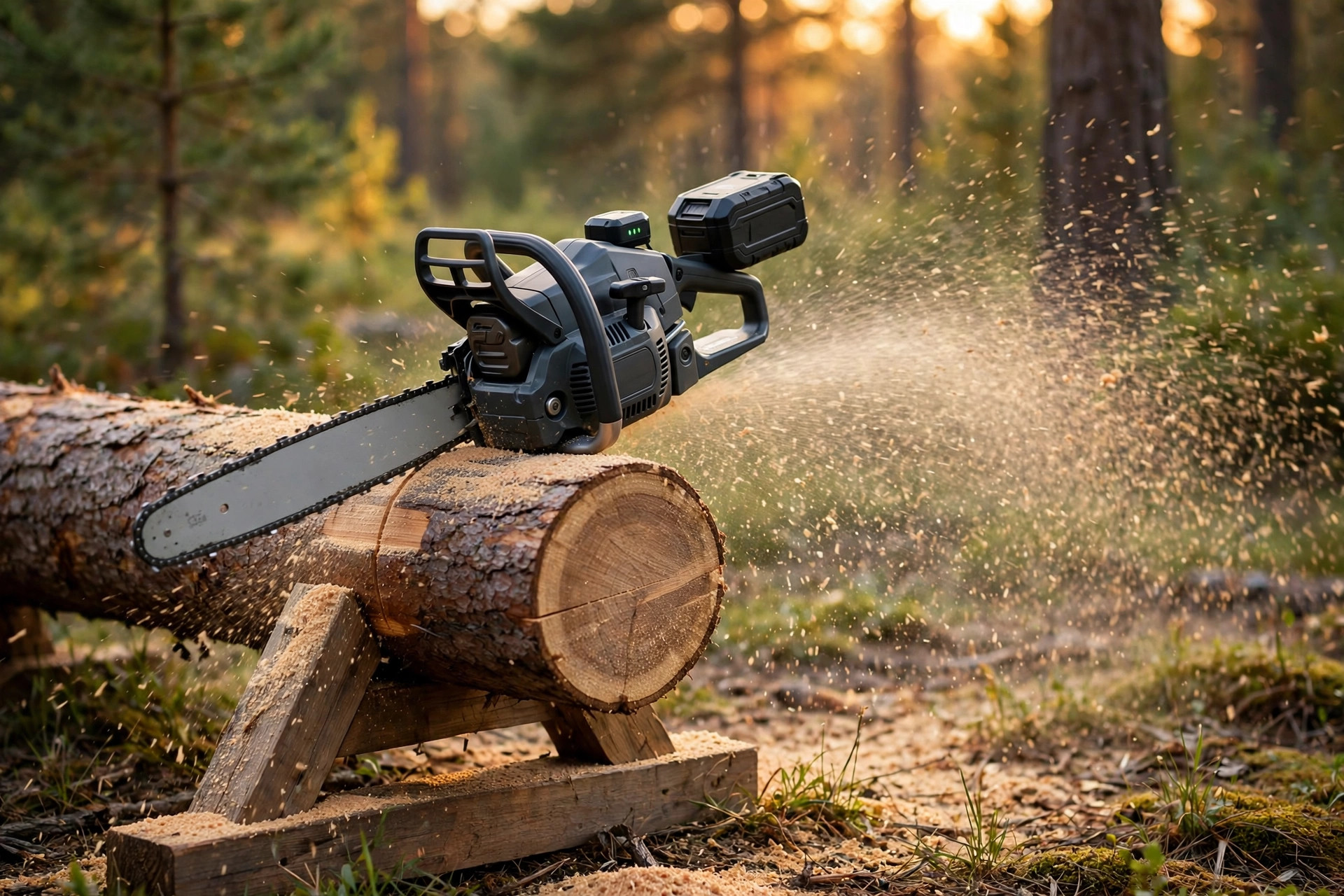
A dull chain is the most common way a routine cut turns dangerous, and nobody measures it. This disclosure turns the saw itself into the gauge: a microphone, an accelerometer, and a current sensor listen to the chain while it cuts, learn how that chain sounded when it was sharp, and tell the operator to sharpen, tension, or replace the chain before the next cut.
Abstract
Disclosed is a system and method for assessing the sharpness and wear state of a chainsaw chain during cutting, using fused acoustic, vibration, and motor current signatures processed by on-tool edge inference. A sensor module mounted on the saw body records the sound of cutting, the vibration of the saw body, and the electrical load on the drive motor. A sharp cutter shears wood fibers cleanly and produces coarse chips at a steady tooth-pass rate; a dull cutter tears fibers, produces fine dust, raises cutting resistance, and shifts the acoustic spectrum, the vibration spectrum, and the motor current together. The system extracts features from all three signals, compares them against a per-chain baseline recorded when the chain was new or freshly sharpened, and outputs a sharpness index from 0 to 100 plus a fault classification that distinguishes dullness from loose tension, rock or dirt strike damage, bar wear, and frozen or contaminated wood. The system issues sharpen, tension, or replace guidance, estimates kickback risk from the measured cutting resistance, and, on battery saws, can limit throttle when the risk estimate crosses a threshold. All inference runs on the tool. No cloud connection is needed to score a cut.
Field of the Invention
This invention relates to power tool diagnostics, specifically to continuous assessment of chainsaw chain sharpness and wear during cutting using multimodal sensor fusion and on-tool machine learning, with operator guidance and kickback risk estimation.
Background
Chainsaws injure about 36,000 people per year in the United States, measured as emergency department visits (CDC via Cornell Cooperative Extension). The average injury requires 110 stitches to close, medical costs run at least $350 million per year, and the Occupational Safety and Health Administration reports more than 250 deaths annually from chainsaw accidents (Fire and Saw). The chain itself is the hazard. At full throttle a saw chain runs at 20 meters per second (STIHL 036 instruction manual), and European test standards assume up to 28 meters per second (Forests, 2020). A standard 3/8 inch pitch chain carries about 26 cutting links per meter of chain, so during one second of contact with the body as many as 700 cutting links can pass the wound. Kickback, the sudden rotation of the bar nose toward the operator, completes in about 0.1 seconds, faster than human reaction time.
Dullness makes every one of those numbers worse. A sharp chain pulls itself into the wood and throws coarse chips; the operator guides it. A dull chain stops pulling, so the operator pushes, which raises feed force, raises vibration, heats the bar, and loads the motor. Pushing is also what drives the bar nose into kickback. Saw manufacturers and forestry trainers state the rule plainly: dull chains cause accidents. Yet no production chainsaw measures chain condition. The operator judges sharpness by feel, by the chips on the ground, and by how hard the saw has to be pushed, which means the judgment arrives after the chain has already been cutting badly for a while, and it depends entirely on the operator's experience. A homeowner after a storm, the exact person most likely to be hurt, has the least experience to judge with.
What exists today measures around the problem rather than at it:
- Usage counters and generic wear indicators: US20210173378 discloses a power tool element indicating system that counts cumulative use (duration, rotations, cycles) and compares a measured characteristic against a threshold to flag replacement. It covers blades and chains among other elements, and it mentions electric current profiles. Its determination is usage counting plus threshold comparison. It does not fuse acoustic, vibration, and current signals during cutting, does not learn a per-chain baseline, does not score sharpness continuously, and does not distinguish dullness from other chain faults.
- Conveyor and industrial chain wear sensors: WO2020/223502, US20040226805A1, and US20170030815A1 monitor elongation and link wear in conveyor chains by counting links against sprocket rotation or by optical interruption. Conveyor chains stretch slowly under steady load in a fixed installation. A saw chain's failure mode is different: cutters lose their edge in minutes of cutting, the load is intermittent and violent, and the chain runs at 20 meters per second in sawdust. Elongation measurement answers the wrong question for a saw chain.
- Chainsaw safety sensors: EP1946899A1 discloses a chainsaw sensor that detects entrainment of cut-protection clothing material by the running chain and triggers an emergency stop. It protects the operator after contact has begun. It says nothing about chain condition before the cut.
- Manual sharpening practice: Filing guides, depth gauge tools, and filing jigs set the cutter angle (typically 30 degrees) and the depth gauge height. They are measurement-free: they set geometry, and the operator decides when to use them. File guides do not detect dullness, and they cannot tell a dull cutter from a damaged one.
- Acoustic sensing on other equipment: Acoustic and current-signature diagnostics are established for appliances and vehicles, including the bicycle drivetrain chain wear disclosure in LITF-PA-2026-208, which detects bicycle chain wear from acoustic and cadence signals. A bicycle chain turns at a few meters per second under human power in clean air. A saw chain turns at 20 meters per second under full load in a cloud of sawdust, with a two-stroke or brushless motor shaking the sensor platform. The signal environment, the physics, and the safety stakes are different.
What does not exist is a system that: (a) measures chain sharpness continuously while cutting, from signals the saw already produces; (b) fuses three independent signal streams so that no single confound, such as wood species or wet wood, can fake a sharpness reading; (c) learns the individual chain, so each chain is judged against its own sharp sound rather than a generic threshold; (d) separates dullness from tension, impact damage, bar wear, and wood conditions; and (e) turns the result into a specific action (sharpen, tension, replace, stop) plus a kickback risk estimate. That is the gap this disclosure addresses.
Detailed Description
1. System Overview
Three parts make up the system. A sensor module mounts on the saw body, on the clutch cover or the rear handle housing, where it is clear of the chain path and the bar oil spray. A phone application receives scores over Bluetooth Low Energy, shows the sharpness index and the recommended action, and stores per-chain history. An optional cloud service, used only on opt-in, aggregates anonymized signatures for fleet learning. No part of the chain, bar, or sprocket is modified. The sensor module contains a MEMS microphone, a three-axis MEMS accelerometer, a motor current sensor, a microcontroller with a small neural accelerator or DSP, and a Bluetooth radio. On battery saws the module draws power from the tool battery through the existing battery interface and reads motor current from the motor controller's own shunt. On gasoline saws the module carries its own rechargeable cell and estimates engine load from the ignition pulse rate plus the acoustic signal, since there is no motor current to measure. All scoring runs on the module. The phone is a display, not a processor.
2. Tooth-Pass Frequency Physics
The core signal is the tooth-pass frequency, and it falls out of the chain geometry with no calibration needed. A standard 3/8 inch pitch chain has a pitch of 9.525 millimeters between drive links, and cutters alternate left and right, so successive cutters on the same side are spaced two pitches apart, about 19.05 millimeters. At a chain speed of 20 meters per second, cutters pass a fixed point at 20 / 0.01905, about 1,050 times per second. At 28 meters per second, the rate is about 1,470 hertz. Each cutter strike is an impulse, so the acoustic and vibration spectra show a strong line at the tooth-pass frequency plus harmonics, with sidebands from the alternating left and right cutters. A sharp cutter produces a clean, narrow tooth-pass line and low broadband noise: the cutter shears the fiber and exits. A dull cutter drags, so the line broadens, its amplitude drops relative to the broadband floor, and energy rises in the 2 to 8 kilohertz band where torn fibers and rubbing dominate. The ratio of tooth-pass line energy to broadband energy is the single most informative acoustic feature, and it moves before the operator can feel the difference.
Motor current carries the same story in a second channel. On a brushless battery saw, current rises with cutting resistance, and it ripples at the tooth-pass frequency as each cutter loads and unloads the motor. A sharp chain under steady feed shows moderate mean current with a clean ripple at the tooth-pass rate. A dull chain shows higher mean current, a larger ripple amplitude, and a slower recovery after each cutter strike, because the motor is fighting drag rather than cutting. Chain speed droop under load, measured from the motor controller's back-EMF or Hall sensors, adds a third confirmation: a sharp chain holds speed under feed, a dull chain sags. The three channels agree when the chain is dull and disagree when the confound is elsewhere, which is what makes the fusion work.
3. Signal Acquisition and Feature Extraction
The microphone samples at 16 kilohertz with 16-bit resolution, bandpass filtered from 200 hertz to 8 kilohertz to reject wind and handling noise below the band and aliasing above it. The accelerometer samples at 4 kilohertz on all three axes. Motor current samples at 4 kilohertz on battery saws. Signals are processed in 250 millisecond frames with 50 percent overlap, giving four sharpness updates per second during a cut. Each frame yields a feature vector: tooth-pass line amplitude and width, tooth-pass to broadband energy ratio, spectral centroid in the 2 to 8 kilohertz band, harmonic count above a floor, vibration RMS in the 100 to 500 hertz band and in the tooth-pass band, current mean and ripple amplitude at the tooth-pass frequency, and chain speed droop relative to no-load speed. Frames are accepted only when the chain is actually cutting, detected by sustained tooth-pass energy plus load, so idle revving and carrying the saw do not pollute the score. Frames recorded while the chain is pinched in the kerf, detected by a sudden current spike with collapsed tooth-pass energy, are flagged separately as a pinch event, not as dullness.
4. Per-Chain Baseline Learning
Generic thresholds fail here because chains differ. A new chain, a freshly sharpened chain, a chain with a different cutter profile, and a chain on a different bar all sound different when sharp. The system therefore learns each chain. After a new chain is fitted or a chain is sharpened, the operator runs a calibration cut: ten seconds of steady cutting through a log section, guided by the app. The module records the feature vector of that cut as the chain's sharp baseline and stores it under a chain identifier, entered by scanning a code on the chain box or by manual entry, with a counter of sharpenings since new. Every later cut is scored as drift from that chain's own baseline, not against a population average. The baseline decays slowly as the chain accumulates sharpenings, because each filing removes cutter material and shortens the cutter, which the system tracks by recording the baseline after each sharpening and fitting the drift trend. When the post-sharpening baseline no longer returns to within a threshold of the new-chain baseline, the chain is worn out: the cutters are too short to hold an edge, and the correct action is replace, not sharpen again. A chain that has never been baselined falls back to a population model keyed by chain pitch and saw class, with wider uncertainty bands, until a calibration cut is run.
5. On-Tool Sharpness Classifier
A gradient-boosted tree ensemble, or a small quantized neural network of equivalent size, maps the feature vector plus baseline drift to two outputs: a sharpness index from 0 to 100, and a fault class. Model size is under 100 kilobytes and inference time is under 5 milliseconds per frame on a Cortex-M class microcontroller, both targets. The classifier is trained on labeled cutting sessions: chains sharpened to a verified edge, then cut until dull, with the ground truth established by direct measurement of cutter edge radius under magnification and by chip-size grading of the cuttings, coarse chips for sharp, fine dust for dull. Training data must span wood species, moisture content, frozen wood, and bar lengths, because all of those shift the signals. The sharpness index is smoothed over a 2 second window to suppress single-frame noise. Thresholds are set as design targets, pending measurement: above 80, the chain is sharp; 50 to 80, sharpen soon; 25 to 50, sharpen now; below 25, stop and sharpen before the next cut. The fault classifier outputs one of: sharp, dull, loose tension, impact damage, bar wear, wrong chain or pitch, or wood condition (frozen, dirty, or nail embedded), each with a confidence value.
6. Fault Discrimination
Dullness is not the only thing that changes the signals, and a system that cries dull at every anomaly would be ignored within a week. Each fault has a signature. Loose tension shows as a low-frequency chain slap in the accelerometer, below 100 hertz, with a wandering tooth-pass line as the chain surges on the bar, while current stays near normal. Impact damage, from a rock or a nail, shows as a sudden transient: a single-frame spike in vibration and current, followed by a persistent once-per-revolution pulse at the chain loop frequency as the damaged cutter passes the same point each revolution. Bar wear shows as a slow rise in vibration at the bar's own resonant frequency with normal tooth-pass acoustics, plus a widening of the tooth-pass line as the chain wanders in a worn groove. Frozen wood raises all three channels together but returns to normal on the next cut in unfrozen wood, and the classifier uses that cross-cut comparison to avoid a false dull call. A nail strike is flagged as a stop-and-inspect event, not a sharpen event, because filing will not fix a chipped cutter and the chain may need a link replaced. The discrimination rules are the reason three signals are fused: any single channel can be fooled, and the combination rarely is.
7. Kickback Risk Estimation and Response
Dullness raises kickback risk through a specific mechanism: the operator pushes harder to compensate for lost cutting efficiency, the push drives the bar nose into the wood, and nose contact with the upper quadrant of the bar tip is what initiates kickback. The system estimates risk from the same measurements: feed force is proxied by current rise relative to baseline at a given chain speed, and the estimate rises when high feed force coincides with a falling sharpness index. Risk is reported as a three-level indicator, normal, elevated, and high, on the module's LED and in the app. On battery saws, when risk reaches high, the module can signal the motor controller to cap chain speed, which reduces the energy available to a kickback event, and to pulse the handle with a haptic alert. The speed cap is a mitigation, not a prevention: it does not replace the chain brake, the tip guard, or the operator's stance, and the app says so. On gasoline saws the response is alert only, since there is no electronic throttle to cap. The risk estimate is also logged with the cut history, so a crew lead can see which operators are routinely cutting at elevated risk and coach them, rather than discovering it from an injury report.
8. Sharpening Guidance
A score without a fix is a nag. The system therefore tells the operator what to do. Left-right asymmetry in the tooth-pass sidebands reveals which side of the chain is duller, because left cutters and right cutters produce distinct sideband phases; the app names the side and the number of file strokes to apply, based on the measured drift. Depth gauge height is estimated from the ratio of cutting resistance to tooth-pass energy: when the depth gauges sit too high, the cutters cannot bite even when sharp, and the signature is high resistance with a clean tooth-pass line, which the classifier reports as a depth gauge fault rather than dullness. The app walks the operator through filing at the correct angle for the chain, typically 30 degrees from perpendicular for a standard cross-cut chain, with a round file matched to the chain pitch, and prompts a re-check cut after sharpening to confirm the index recovered. The system tracks sharpenings per chain and retires the chain when the cutters are filed to the wear mark, the stamped line on the cutter that marks minimum safe length. Sharpening guidance is advisory. A damaged cutter, a cracked drive link, or a stretched chain is a replace decision, and the app says so in plain language.
9. Fleet Learning and Wood Profiles
On opt-in, anonymized feature vectors and sharpness outcomes sync from the phone to a fleet service. The service refines the classifier from verified outcomes: chains that operators report as sharp after filing, and chains that shops measure as worn. It also detects correlated drift across many saws using the same chain model, which indicates a bad production batch, and it builds wood profiles: the expected feature ranges for common species and moisture levels, so a crew cutting green oak is not scored against a baseline built on dry pine. No audio leaves the device. Only feature vectors and outcome labels sync, and only with explicit opt-in. The fleet service never sees location, operator identity, or cut audio.
10. Figures Description
- Figure 1: System architecture showing the sensor module on the saw body, the three signal paths (acoustic, vibration, motor current), on-module inference, and the Bluetooth link to the phone application.
- Figure 2: Tooth-pass frequency diagram for a 3/8 inch pitch chain at 20 and 28 meters per second, showing the 1,050 hertz and 1,470 hertz lines, harmonics, and left-right cutter sidebands.
- Figure 3: Spectral comparison of a sharp chain and a dull chain during the same cut, showing the narrow tooth-pass line and low broadband floor for sharp, versus the broadened line and raised 2 to 8 kilohertz energy for dull.
- Figure 4: Motor current traces for sharp and dull chains under identical feed, showing higher mean current, larger tooth-pass ripple, and deeper speed droop for the dull chain.
- Figure 5: Sharpness index decay over cutting time for a single chain, with the sharpen-soon, sharpen-now, and stop thresholds marked, plus the post-sharpening recovery and the long-term baseline drift across repeated sharpenings.
- Figure 6: Fault discrimination decision tree showing how the three fused signals separate dullness, loose tension, impact damage, bar wear, and wood condition.
Claims
- A system for assessing chainsaw chain sharpness during cutting, comprising: a sensor module mounted on a chainsaw body, the module containing a microphone, a three-axis accelerometer, and a motor current sensor; a feature extraction unit that computes, for each cutting frame, tooth-pass frequency line amplitude and width, tooth-pass to broadband acoustic energy ratio, vibration energy in the tooth-pass band, and motor current mean and ripple at the tooth-pass frequency; a baseline unit that stores feature values recorded during a calibration cut when the chain was known to be sharp; and a scoring unit that compares each cutting frame against the stored baseline for the same chain and outputs a sharpness index and a recommended action.
- The system of claim 1, wherein the tooth-pass frequency is derived from chain speed divided by cutter spacing, the cutter spacing being twice the chain pitch for alternating left and right cutters, producing a tooth-pass line of about 1,050 hertz at a chain speed of 20 meters per second for a 3/8 inch pitch chain.
- The system of claim 1, wherein the scoring unit fuses acoustic, vibration, and motor current features, and wherein a sharpness determination requires agreement across at least two of the three signal channels, so that a confound affecting a single channel does not produce a false dull determination.
- The system of claim 1, further comprising a fault classifier that distinguishes dullness from loose chain tension, impact damage, bar wear, wrong chain pitch, and wood condition, based on distinct signatures across the three fused signals, including low-frequency chain slap for loose tension and a once-per-revolution pulse for impact damage.
- The system of claim 1, wherein the baseline unit stores a separate baseline for each chain identifier, tracks baseline drift across repeated sharpenings, and reports a replace recommendation when the post-sharpening baseline no longer returns to within a threshold of the new-chain baseline.
- The system of claim 1, further comprising a kickback risk estimator that combines measured cutting resistance, proxied by motor current rise relative to baseline, with the sharpness index to produce a risk level, and that signals a motor controller to cap chain speed when the risk level crosses a high threshold on a battery-powered saw.
- The system of claim 1, further comprising a sharpening guidance unit that determines left-right cutter asymmetry from tooth-pass sideband phase, reports which side of the chain is duller, estimates depth gauge height from the ratio of cutting resistance to tooth-pass energy, and prompts a re-check cut after sharpening to confirm sharpness recovery.
- The system of claim 1, wherein the feature extraction unit accepts frames only when the chain is cutting, detected by sustained tooth-pass energy plus load, and separately flags pinch events, detected by a current spike with collapsed tooth-pass energy, rather than scoring them as dullness.
- The system of claim 1, further comprising a gasoline-saw variant in which motor load is estimated from ignition pulse rate and the acoustic signal, the sensor module carrying its own rechargeable cell, and wherein the kickback risk response is an alert without a throttle cap.
- A method for assessing chainsaw chain sharpness, comprising: recording a calibration cut with a chain known to be sharp to establish a per-chain baseline; continuously acquiring acoustic, vibration, and motor current signals during cutting; extracting tooth-pass frequency features from the signals; comparing each cutting frame against the per-chain baseline; outputting a sharpness index and a fault classification; and issuing a sharpen, tension, replace, or stop instruction based on the index and the classification.
Implementation Notes
Bill of materials for the sensor module targets under $15 at volume: a MEMS microphone at about $1.50, a three-axis accelerometer at about $1.00, a Hall-effect current sensor or shunt at about $1.50, a Cortex-M microcontroller with DSP extensions at about $3.00, a Bluetooth Low Energy radio, and a sealed IP65 housing with a vibration-isolated mount, the mount being the part that matters most, since the module must survive the saw's own vibration without shaking its sensors loose. On battery saws the module integrates into the existing battery platform electronics and draws from the tool battery; on gasoline saws it carries a rechargeable cell rated for about 20 hours of cutting, charged over USB-C. The classifier fits in under 100 kilobytes and runs in under 5 milliseconds per frame, both targets. The phone application shows the sharpness index as a single number with a color state, the fault class in plain words, and a one-line instruction; it stores per-chain history locally and syncs only on opt-in. The module's LED shows the same three states, green, amber, and red, so the operator does not need to look at a phone while cutting. Sensor placement is on the clutch cover or rear handle housing, away from the bar oil spray and the chain path, with the microphone port shielded by an acoustic mesh that passes sound and blocks sawdust.
Calibration discipline matters more than sensor quality. The calibration cut must be a steady, full-throttle cut through clean wood of moderate hardness, not a plunge cut, not a cut through a knot, and not a cut with the tip. The app enforces this by rejecting calibration cuts whose feature variance exceeds a bound and asking for a second attempt. The module must also reject scoring during the first second after throttle-up, while the chain is still reaching speed, and during bucking cuts where the log is supported on only one side, since the pinch risk confounds the current signal. These rejection rules are what keep the score honest.
Limitations
This disclosure describes an unbuilt system. No prototype has been constructed, no accuracy figure has been measured, and every threshold in it is a proposed value. The 80, 50, and 25 sharpness thresholds, the 2 second smoothing window, the 100 kilobyte model size, and the $15 bill of materials are design targets, not measured results. The labeled training dataset the classifier needs does not exist yet at scale; collecting it requires cutting chains from sharp to dull under controlled conditions across species, moisture levels, and bar lengths, with edge radius measured under magnification, and that collection effort is the largest barrier to building this system. Wood is the hardest confound: species, moisture, frozen sap, bark inclusions, and knots all shift the signals, and the per-chain baseline does not correct for wood, only for the chain. A dull chain cutting soft dry pine can look like a sharp chain cutting frozen oak. Gasoline saws shake violently enough to threaten sensor mounts and microphone ports, and sawdust contamination of the acoustic mesh is a maintenance item the disclosure does not solve, only names. The kickback risk estimate is a proxy built from current and sharpness, not a measurement of nose contact, and it will miss kickback events that come from technique rather than dullness. Finally, the system measures the chain, not the operator. Training, stance, and protective chaps prevent more injuries than any gauge.
Strongest Case Against
The honest objection is that experienced sawyers already know when a chain is dull, and they know it from evidence no sensor can beat: the chips turn to dust, the saw stops pulling itself into the wood, and the operator has to push. A sensor that reports what the operator's hands already know is a solution in search of a problem, and the operators who need it most, the homeowners cutting storm damage once a year, are the least likely to buy a sensor module, run a calibration cut, or open an app in the yard. A second objection is the environment: a chainsaw is about the worst place on earth to put a microphone, an accelerometer, and a radio, with vibration, sawdust, bar oil, rain, and drops from height, and the sensor will fail, drift, or clog long before it pays for itself. A third objection is behavioral: a green light could give false confidence, and false confidence on a tool that can put 700 cutters through a leg in a second is worse than no gauge at all. All three objections are fair. The answer to the first is that the marginal cases are the point: the chain that is going dull gradually over a long day, the operator who has never felt a truly sharp chain and therefore has no reference for dull, the crew lead who cannot watch every saw at once. The answer to the second is that the module is a $15 add-on to a $300 to $900 tool, and if it survives one season it has paid for itself in chains alone. The answer to the third is scope discipline: the system is a gauge that reports a measurement, and it says on every screen that it does not replace training, the chain brake, or protective equipment. A gauge that catches some dull chains early still beats an ear that catches them late, provided nobody mistakes the gauge for a safety device.
The chain that is going dull gradually over a long day is the one nobody notices until it bites.
What a Sawyer Can Do Now
None of this needs to be built before it helps. Look at the cuttings: a sharp chain throws coarse chips the size of a thumbnail, a dull chain makes fine dust, and dust means stop and sharpen. If the saw needs pushing to cut, the chain is dull; a sharp chain pulls itself into the wood. File each cutter at 30 degrees from perpendicular with a round file matched to the chain pitch, count the strokes so both sides get the same number, and check the depth gauges with a gauge tool, because a chain with tall depth gauges will not bite even when the cutters are sharp. Check tension before every session: pull the chain away from the bar and the drive links should stay engaged in the groove, and the chain should snap back when released. Keep a second sharp chain in the kit so a dull chain is a two-minute swap instead of a filing session in the field. Never cut with the upper quadrant of the bar tip, the kickback zone, and never cut above shoulder height. Wear chaps, a helmet with a visor, hearing protection, and gloves, and keep the chain brake functional. If the chain has hit a rock or a nail, inspect every cutter before the next cut, because one chipped cutter will tear the kerf and load the saw unevenly. The cheapest sharpness test ever invented is the chip test, and it works every time.
Know someone who cuts firewood with a chain that has not been filed since spring? Send them this.
Prior Art References
- Cornell Cooperative Extension: Chainsaw safety; CDC estimate of about 36,000 emergency department visits per year in the United States
- Fire and Saw: Chainsaw accident statistics; average injury requires 110 stitches, medical costs at least $350 million per year, more than 250 deaths annually per OSHA
- STIHL 036 instruction manual: Chain speed at full throttle reaches 45 mph (20 meters per second); kickback warnings
- Forests, 2020: Analysis and laboratory testing of technical injury prevention measures for portable chainsaws; chain speeds up to 28 meters per second, about 26 cutting links per meter, up to 700 cutter passes per second of contact
- US20210173378: Power tool element indicating system and method; cumulative usage counting and threshold comparison for replaceable elements including chains, mentions electric current profiles
- EP1946899A1: Chain saw with cut protection equipment sensor; detects entrainment of protective clothing material by the running chain and triggers an emergency stop (2007)
- WO2020/223502: Chain wear sensor; conveyor chain wear from chain length versus sprocket rotation (2020)
- WO2019/201482: Energy guiding chain with wear detection; inductive, magnetic, or capacitive coupling change at chain link joints (2019)
- US20040226805A1: Chain wear monitoring method and apparatus; marker-based elongation measurement for conveyor chains (2004, expired)
- US20170030815A1: Chain wear monitoring device; optical beam interruption with ignore-obstacle routine for conveyor chains (2017)
- LITF-PA-2026-208: Bicycle drivetrain chain wear detection via acoustic and cadence analysis; related acoustic chain sensing, distinct target and signal environment
- LITF-PA-2026-224: Coffee grinder burr wear detection via acoustic and motor current signatures; related multimodal wear sensing, distinct machine and failure mode