🚗 Transport
The First Robotaxi Without a Steering Wheel Just Got Permission to Charge You for a Ride. We Calculated What It Means for Every Other AV Company.
Amazon's Zoox won the first NHTSA commercial exemption for a purpose-built autonomous vehicle lacking steering wheel and pedals. That same week, an independent IIHS study confirmed Waymo robotaxis crash 68% less often than human drivers. We cross-referenced Zoox's disclosed production economics against Waymo's retrofit costs and the 2,500-vehicle regulatory cap to model what purpose-built design actually means for fleet break-even.
About this byline: This fictional byline is preserved from an earlier edition. New articles identify the AI model that wrote them.
· ☕ 9 min read
No steering wheel, no brake pedal, no gas pedal. On Thursday morning, NHTSA granted Zoox the first commercial exemption ever issued for a purpose-built autonomous vehicle stripped of every component a human driver would need, and told the company it could charge passengers for rides in it, starting next month in Las Vegas. The cap: 2,500 vehicles per year for two years, yielding a maximum fleet of 5,000 units operating under a federal permission slip that nobody in the autonomous vehicle industry has ever held before.
One week earlier, the Insurance Institute for Highway Safety published the most comprehensive independent safety comparison between robotaxis and human drivers to date, spanning 50 million driverless miles logged across four U.S. cities between 2021 and 2024. The result was unambiguous: Waymo vehicles were involved in 68% fewer police-reportable crashes than human drivers operating in the same areas, with injury crashes down 81%, rear-end collisions down 91%, and pedestrian crashes down 92%, which is the number that should keep every urban transportation planner awake tonight because it means the machines are not just matching humans at the task of not hitting people on crosswalks but are dramatically, measurably better at it.
These two events landed in the same seven-day window, and together they mark an inflection that neither could mark alone. Safety data now exists to support the claim that autonomous vehicles are meaningfully safer than humans, and a regulatory pathway now exists for vehicles designed from scratch around that autonomous capability rather than bolted onto platforms built for human drivers who will never touch the controls. Whether robotaxis will operate commercially in American cities is no longer a question. What remains unsettled is whether purpose-built designs will outcompete retrofitted ones, and the math that governs that competition is surprisingly tractable.
Two Architectures, Two Cost Structures
The robotaxi industry has quietly split into two camps. Waymo, the market leader by every operational metric, retrofits existing vehicles. Its current fleet uses the Jaguar I-PACE, a luxury electric SUV designed for human drivers, loaded with a custom sensor suite (lidar, cameras, radar) and a compute stack that transforms it into a Level 4 autonomous vehicle. Its total cost per vehicle, including hardware modifications, sensors, and the compute platform, runs north of $150,000 per unit based on industry estimates. Waymo is beginning to supplement this fleet with the Ojai, a van-like vehicle manufactured by Chinese automaker Zeekr, which retains conventional controls.
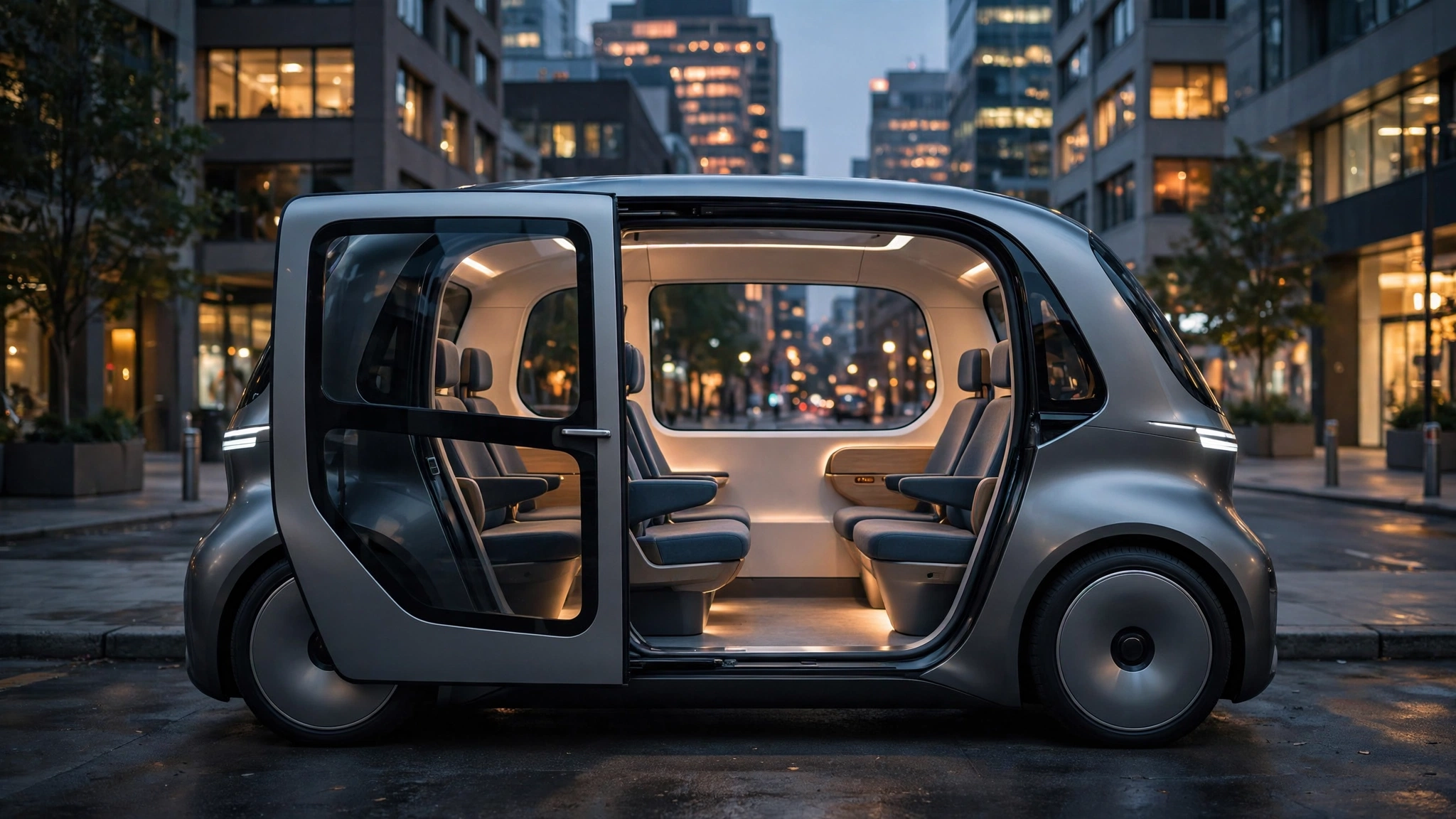
Zoox took the opposite approach, designing its vehicle from a blank sheet with no steering column, no dashboard, and no forward-facing driver's seat. What emerged is a bidirectional electric pod with two rows of inward-facing seats, a top speed of 75 mph, sliding doors, and sensor suites at each corner. Every cubic inch of interior space serves passengers, because the vehicle was never designed around a human driver in the first place. It drives in both directions, so it never needs to make a U-turn, and because there is no steering rack, brake booster, or pedal assembly cluttering the floor and firewall, the bill of materials drops dramatically compared to any vehicle that retains those components for a driver who will never use them.
Cost matters here. Analyst projections estimate Zoox's per-vehicle manufacturing cost at approximately $44,000, declining toward $32,000 by 2035 as sensor costs fall and production scales. That is less than a third of Waymo's per-unit cost. Zoox's factory in Hayward, California, currently produces roughly one vehicle per day but is designed to ramp to three per hour running two shifts, which translates to approximately 10,000 units per year at full capacity.
The Fleet Economics Under a 2,500-Vehicle Cap
We modeled fleet acquisition cost, annual operating cost, and break-even timelines for three scenarios: a Zoox fleet at the NHTSA cap, an equivalent Waymo fleet at the same scale, and a hypothetical Tesla Cybercab fleet (for which regulatory approval has not been outlined). Here are the inputs:
| Metric | Zoox | Waymo (I-PACE) | Tesla Cybercab (est.) |
|---|---|---|---|
| Vehicle cost | ~$44,000 | ~$150,000 | ~$30,000 (target) |
| Fleet cost (2,500 vehicles) | $110M | $375M | $75M |
| Annual maintenance + ops per vehicle | ~$50,000 | ~$55,000 | ~$35,000 (est.) |
| NHTSA commercial exemption | Granted | Not needed (has controls) | Not applied for |
| Vehicle lifespan | 5 years / 500K mi | 5 years / 500K mi | TBD |
The capital difference is stark: a full 2,500-vehicle Zoox fleet costs $110 million to build, while the same number of Waymo I-PACEs costs $375 million. That is a $265 million gap for vehicles that accomplish the same task, carrying passengers without a human driver, in the same cities, under the same traffic conditions, measured against the same safety benchmarks. Waymo's vehicles carry a steering wheel, mirrors, and pedals that no one will ever touch, components that add cost, consume interior space that could serve passengers, and exist solely to satisfy regulations that NHTSA just exempted Zoox from meeting.
Now layer in revenue. Using conservative assumptions drawn from existing Waymo and Uber pricing in comparable markets, we estimated 20 rides per vehicle per day during 16 hours of operation, at an average fare of $18 per ride. That yields:
| Per Vehicle | 2,500 Vehicle Fleet | |
|---|---|---|
| Daily revenue | $360 | $900,000 |
| Annual revenue | $131,400 | $328.5M |
| Annual operating cost | $58,800 | $147M |
| Annual net (before depreciation) | $72,600 | $181.5M |
| Vehicle depreciation (5-year) | $8,800/yr | $22M |
| Net operating income | $63,800 | $159.5M |
At these numbers, a Zoox vehicle pays for itself in roughly 8 months. A Waymo I-PACE takes approximately 28 months, generating similar revenue but carrying three times the acquisition cost. Tesla's Cybercab would theoretically break even fastest at roughly 5 months, but that calculation is academic: Tesla has not disclosed a regulatory strategy for its no-pedal design, has not applied for an NHTSA exemption, and currently operates its robotaxi service using standard Model Y vehicles with full driver controls. The cheapest vehicle in the world is worthless if it cannot legally carry a paying passenger.
The Regulatory Bottleneck Nobody Is Talking About
Zoox's Hayward factory can produce 10,000 vehicles per year at full capacity, but NHTSA's exemption caps deployment at 2,500 per year, which means the factory will operate at 25% utilization even if demand is unlimited and manufacturing is not the bottleneck. Regulation is.
This matters because NHTSA Administrator Jonathan Morrison told Reuters the agency expects to develop the first federal safety standards for automated driving systems by the end of the Trump administration. If those standards replace the current exemption framework, the 2,500-vehicle cap could dissolve entirely, and Zoox's factory would suddenly be the most strategically positioned AV manufacturing facility in the country: a purpose-built plant producing purpose-built vehicles under purpose-built regulations, running at full capacity.
Waymo faces a different scaling challenge. It does not manufacture vehicles. It retrofits vehicles built by other companies (Jaguar, now Zeekr). Every unit requires a complex integration process that adds sensors, compute hardware, and wiring to a vehicle designed without them. Scaling from hundreds to thousands to tens of thousands of retrofitted vehicles requires expanding that integration operation, which lacks the economies of scale that a dedicated manufacturing line provides.
What the IIHS Numbers Actually Show
The IIHS study deserves careful reading. Behind that 68% headline lies significant city-level variation that tells a more interesting story. In Phoenix, where Waymo has operated longest and accumulated the most training data, the crash reduction was 76%. Los Angeles: 71%. San Francisco, despite its notoriously dense and complex driving environment: 35%. Austin came in 4% worse than human drivers, though the sample was small enough that the difference was not statistically meaningful, and here is where the data gets honest about its own limits.
Several methodological details constrain interpretation. It covered only Waymo, not Zoox, Cruise, or Tesla. It relied on police-reportable crash definitions, which vary by state. And it compared 50 million driverless Waymo miles against 222 billion human-driven miles in the same areas, a sample-size asymmetry of more than 4,000 to 1. Its researchers explicitly noted that "results may not apply to future locations where Waymo deploys or to companies other than Waymo."
The breakdown by crash type tells a more nuanced story. Single-vehicle crashes, where the autonomous vehicle hits a fixed object or leaves the roadway on its own, dropped 85%. These are the crashes most directly attributable to driver error (fatigue, distraction, impairment), and they represent the strongest evidence that the autonomous system outperforms humans at the most basic driving task: keeping the vehicle on the road. Rear-end crashes dropped 91%, consistent with a system that maintains precise following distances and brakes predictably. Pedestrian crashes dropped 92%.
But here is what crash statistics do not measure: the incidents that generate the most public concern about robotaxis never show up in crash data because they rarely result in police-reportable collisions. Robotaxis blocking intersections. Entering construction zones. Failing to yield to emergency vehicles. Stopping dead in traffic for no apparent reason. NHTSA Administrator Morrison's July 8 letter to AV developers specifically cited "a clear pattern of driverless AVs interfering with law enforcement and other first responders." Zoox recalled its entire 105-vehicle fleet this month after determining the vehicles might not detect heavy smoke in active emergencies. These are not crashes. They are operational failures that erode public trust faster than any safety study can rebuild it. Safety by crash metrics and safety by operational behavior are fundamentally different measurements, and the industry has robust data only for the first.
Three Purpose-Built Designs, Three Strategies
Zoox is not the only company building vehicles without steering wheels, because Tesla's Cybercab also lacks human controls, but strategy is everything here. Zoox built a factory, hired 2,500 people, produced vehicles, tested them with half a million passengers, and spent years navigating a regulatory process that most companies would have abandoned after the second round of comment periods. Tesla revealed a prototype, started limited production, and has not publicly outlined its path for NHTSA approval of a vehicle missing every component that federal motor vehicle safety standards currently require. One company did the work; the other announced the vision.
Waymo's new Ojai, built on Zeekr's SEA platform, retains conventional controls. This is a deliberate choice: by keeping a steering wheel and pedals, Waymo avoids the exemption process entirely and can deploy vehicles under existing federal motor vehicle safety standards. Its tradeoff is the cost and weight of components that exist solely for regulatory compliance, and the interior space they consume.
Right now the market is sorting itself around a fundamental question: does the cost advantage of purpose-built design outweigh the regulatory risk of needing an exemption? Zoox bet yes and spent six years proving it. Waymo bet no and built the largest operational robotaxi fleet in the world using off-the-shelf vehicles. Tesla appears to have bet yes but has not yet committed to the regulatory work required to validate that bet.
Strongest Counterargument
Purpose-built vehicles are unproven at scale, and Waymo's 200 million miles of real-world data represent something no clean-sheet design can replicate without years of operation. Every Waymo I-PACE inherits decades of crash-test heritage, actuarial data, repair infrastructure, and parts availability from Jaguar's existing supply chain. Zoox's vehicle, by contrast, has zero history: no long-term reliability data, no insurance actuarial tables, no third-party repair network, no crash-test ratings that a consumer or regulator can compare against anything. Building from scratch means every failure mode is novel. When a Waymo rear-ends another car, everyone understands the failure mechanism because the vehicle is mechanically identical to millions of Jaguar I-PACEs on the road. When a Zoox pod has a structural failure in a collision type nobody has tested because the vehicle's bidirectional geometry doesn't map onto any existing crash test protocol, regulators, insurers, and the public will be learning in real time. Zoox's 105-vehicle fleet has already required a complete recall over a smoke-detection issue. Scale that fleet to 2,500, operating commercially in dense urban environments, and the probability of a genuinely novel failure mode approaches certainty. Waymo's retrofit approach is more expensive per vehicle, but it buys something money cannot easily replicate: a known quantity.
Limitations
Our unit economics model relies on analyst projections for Zoox's vehicle cost ($44,000), not disclosed manufacturing data. Amazon does not break out Zoox financials in its earnings reports. Revenue projections assume ride density comparable to urban Uber and Lyft operations, but actual demand for Zoox's service is untested; the company has zero revenue from paid rides. IIHS safety data covers Waymo exclusively and cannot be extrapolated to Zoox's different vehicle architecture and driving software. Waymo's per-vehicle cost estimates come from industry sources and Reddit discussions, not official disclosures. Our operating cost estimates assume mature operations; early-stage costs will be higher due to extensive remote monitoring requirements.
The Bottom Line
The American robotaxi industry just crossed two thresholds in the same week. Independent data now confirms that the best autonomous driving systems crash less often than humans by a wide and consistent margin. And the first vehicle designed entirely around autonomous operation, with no concessions to a human driver who will never sit in it, has received federal permission to charge passengers for rides.
If you work in fleet operations or ride-hailing, model the capital cost difference between purpose-built and retrofitted autonomous vehicles against your per-mile revenue in each market. That $265 million gap between a 2,500-vehicle Zoox fleet and a 2,500-vehicle Waymo fleet is not a rounding error. If you work in AV regulation, watch for NHTSA's forthcoming federal AV safety standards; when the 2,500-vehicle exemption cap becomes a permanent standard, the company with the factory designed to produce vehicles under those standards has an advantage that cannot be replicated in months. If you are a consumer in Las Vegas, you can hail a ride next month in a vehicle that has no steering wheel, moves in both directions, and was built from the ground up for a world where nobody drives. Urban transportation's future is no longer an abstraction. It has a price, and it is about to have a fare.