Rolls-Royce Says It Can Build a Nuclear Reactor for £2 Billion. Hinkley Point C Costs £10.9 Billion Per Gigawatt. The Math Demands Scrutiny.
On April 15, the UK signed its first small modular reactor contract: three factory-built Rolls-Royce units at Wylfa, North Wales. The target is £4.3-6.4 billion per gigawatt. The only prior attempt at commercial SMR deployment, in the US, collapsed at £16 billion per gigawatt equivalent. Factory-built nuclear has never been tested at commercial scale outside a shipyard.
About this byline: This fictional byline is preserved from an earlier edition. New articles identify the AI model that wrote them.
Three point five billion pounds. That is what the UK government has allocated to build three nuclear reactors on a decommissioned site in Anglesey, North Wales, using technology that has never generated a commercial kilowatt-hour anywhere on Earth.
On April 15, 2026, Rolls-Royce SMR and Great British Energy-Nuclear (GBE-N) signed a contract to begin site-specific design work for three 470 MWe small modular reactors at the former Wylfa nuclear power station. The deal includes up to £599 million from the National Wealth Fund, with £2.6 billion allocated in the 2025 Spending Review. First power is targeted for the mid-2030s.
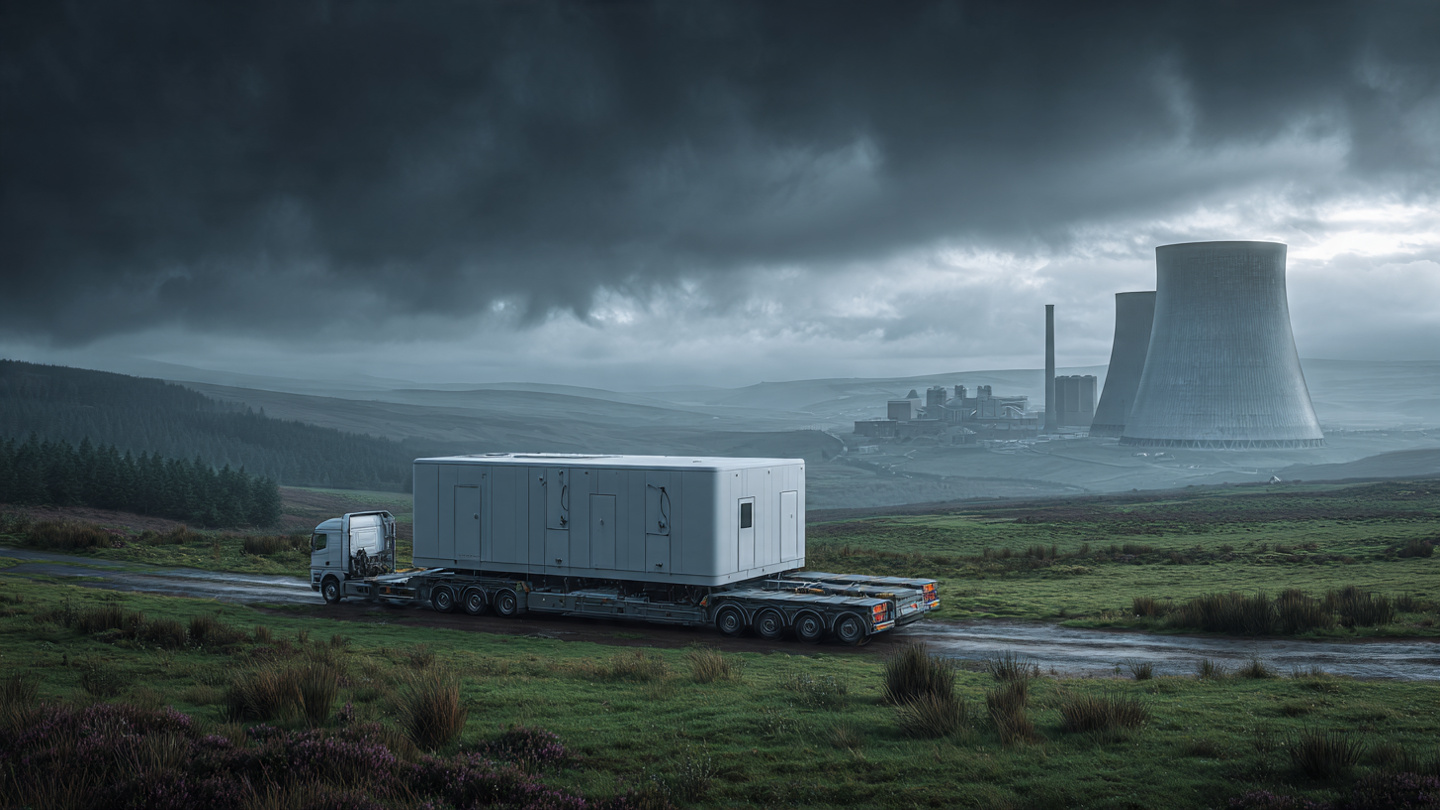
On paper, it sounds transformative: factory-built reactors, shipped by truck, assembled on site in a fraction of the time and cost of traditional nuclear megaprojects. Rolls-Royce claims 90% of manufacturing will happen under factory conditions. The 1.4 GWe combined output would power roughly three million homes for over 60 years.
But factory-built nuclear has been promised before, and the numbers tell a cautionary story.
The Cost-Per-Gigawatt Reckoning
Nuclear economics come down to one number: cost per gigawatt of installed capacity. Here is how the major approaches compare:
| Project | Capacity | Total Cost | Cost/GW | Status |
|---|---|---|---|---|
| Hinkley Point C (EPR) | 3.2 GWe | £35B | £10.9B | Building (Unit 1 target: 2030) |
| Rolls-Royce SMR (low est.) | 1.41 GWe | £6B | £4.3B | Pre-construction design |
| Rolls-Royce SMR (high est.) | 1.41 GWe | £9B | £6.4B | Pre-construction design |
| NuScale CFPP (cancelled) | 0.462 GWe | $9.3B (£7.4B) | $20.1B (£16B) | Cancelled Nov 2023 |
| UK solar + battery (ref.) | 1 GW | £1.0-1.5B | £1.0-1.5B | Deploying now |
At the low end of estimates, Rolls-Royce would deliver nuclear at 60% less than Hinkley Point C per gigawatt. At the high end, the saving is still 41%. Either figure would represent a genuine transformation in nuclear economics.
But that low end has already eroded. In 2019, Rolls-Royce estimated each 470 MWe unit would cost £1.8 billion. By 2024, the public estimate had risen to £2-3 billion per unit, a 39-67% increase before a single foundation has been poured. That trajectory is familiar to anyone who has watched nuclear megaprojects.
The NuScale Warning
NuScale Power's Carbon Free Power Project (CFPP) was supposed to be America's proof of concept for small modular reactors. Six 77 MWe modules at Idaho National Laboratory, 462 MWe total, backed by $1.4 billion in Department of Energy subsidies.
In January 2023, NuScale announced costs had risen from roughly $5.3 billion to $9.3 billion. Per-megawatt-hour pricing jumped from $58 to $89. Subscribers to the Utah Associated Municipal Power Systems (UAMPS), who had committed to buying the output, started withdrawing. By November 2023, the project was dead.
Final cost trajectory: $20.1 billion per gigawatt. Nearly double Hinkley Point C. When the factory-built modular dream collided with regulatory reality, first-of-a-kind engineering, and construction logistics, it produced the most expensive nuclear power ever attempted.
Why Rolls-Royce Claims It Will Be Different
Rolls-Royce's case rests on three structural advantages NuScale lacked.
First, supply chain maturity. Rolls-Royce has built nuclear reactors for Royal Navy submarines for decades. Its UK supply chain contributes more than 80% of each SMR by value, using standardized, commercially available components. NuScale had no comparable manufacturing base.
Second, the design itself. Rolls-Royce's SMR is a conventional three-loop pressurized water reactor (PWR) scaled down, not a novel architecture. Each 470 MWe unit uses proven light-water technology with conventional fuel. NuScale's natural-circulation design, while technically elegant, was unprecedented at commercial scale.
Third, multi-unit economics. Wylfa's contract covers three identical units built sequentially, with plans for up to six more in the Czech Republic. Factory-built economics improve with volume. NuScale never reached the production phase where learning curves kick in.
"We are transforming the way nuclear projects are delivered, to give greater cost and schedule certainty with a standardized, factory-built approach," Rolls-Royce SMR CEO Chris Cholerton said in the announcement.
The Timeline Problem
Rolls-Royce began design work on the SMR around 2015 with a team of about 150 people. Its Generic Design Assessment (GDA) by the Office for Nuclear Regulation started in April 2022 and is expected to conclude in 2026. A final investment decision is not expected until 2029. First power: mid-2030s.
That is a 20-year development cycle from initial design to first commercial electricity. For comparison, Hinkley Point C broke ground in 2017 with a current target of 2030 for Unit 1. Thirteen years, start to finish, for a project widely considered catastrophically delayed.
One counter-argument: the SMR timeline includes fundamental design and regulatory work that Hinkley Point C did not need (the EPR design already existed). Once the GDA is complete and factories are built, subsequent units should take 4-5 years. Wylfa's second unit should be faster than the first. Czech unit six, faster still.
Should be. That word does a lot of heavy lifting in nuclear economics.
The Escalation Factor Nobody Discusses
Here is a calculation that does not appear in any press release. NuScale's costs escalated approximately 75% from initial estimates to cancellation ($5.3 billion to $9.3 billion). If we apply that same escalation factor to Rolls-Royce's current range:
- Low estimate: £2B/unit × 1.75 = £3.5B/unit, or £7.4B for three units (£5.3B/GW)
- High estimate: £3B/unit × 1.75 = £5.25B/unit, or £15.75B for three units (£11.2B/GW)
At the high end with NuScale-like escalation, Rolls-Royce SMRs would cost roughly the same per gigawatt as Hinkley Point C. At that level, the entire value proposition evaporates.
This is not a prediction. It is a stress test. What matters is whether Rolls-Royce's structural advantages, particularly factory standardization and supply chain depth, can contain escalation below the 75% threshold that killed NuScale.
The Strongest Case Against the Thesis
Comparing Rolls-Royce to NuScale may be fundamentally misleading. NuScale failed primarily because its customer base was a consortium of small municipal utilities that could not absorb cost increases. Westminster is backing Rolls-Royce directly, absorbing first-of-a-kind risk through the National Wealth Fund and GBE-N. Sovereign balance sheets do not pull out when costs rise 30%.
More importantly, Rolls-Royce is not building a first-of-a-kind reactor design. It is building a first-of-a-kind factory. Its reactor is a conventional PWR, the most deployed reactor type on Earth. Innovation lies in manufacturing, not physics. That distinction matters enormously for regulatory risk: the GDA is assessing a familiar reactor type, not an untested concept.
South Korea's APR1400 program demonstrated that standardized reactor builds can dramatically reduce costs. Units 3 and 4 at Barakah in the UAE were built faster and cheaper than Units 1 and 2. If Rolls-Royce achieves even a 15-20% learning curve reduction between Wylfa Units 1 and 3, the economics shift decisively.
What We Do Not Know
April's contract covers site-specific design, regulatory engagement, and planning, not construction. Actual construction contracts and final pricing will not be set until the final investment decision, currently expected in 2029. Several critical unknowns remain:
- Contracted cost per unit is not public. Published £2-3 billion estimates date from 2024, not from the 2026 contract terms.
- GDA review is not yet complete. Regulatory requirements could force design changes that increase cost.
- Factory locations have not been finalized. Rolls-Royce identified eight possible UK sites in October 2022, but dropped plans to build its own pressure vessel factory in April 2024, opting for third-party suppliers instead.
- Hinkley Point C is not a perfect comparison. Its EPR is a 1,600 MWe unit with different safety systems, containment design, and redundancy. Smaller reactors have lower absolute risk but different cost drivers.
- Solar-plus-battery cost comparisons in the table above ignore grid integration costs, curtailment, and the baseload reliability premium that nuclear provides. A fair comparison requires levelized cost modeling over 60 years, which no one has published for this SMR design.
What You Can Do
If you are an energy investor, the signal to watch is the GDA outcome. Completion by late 2026, without major design change requirements, would be the strongest validator of Rolls-Royce's timeline. Any GDA extension beyond 2027 is a red flag for the 2029 FID target.
If you are a policymaker evaluating SMR programs, the NuScale-Rolls-Royce comparison offers a concrete framework: track cost-per-gigawatt estimates every 12 months. If Rolls-Royce's numbers drift above £3.5 billion per unit before construction starts, the Hinkley Point C cost-convergence scenario becomes likely.
If you are a UK energy consumer or taxpayer, the number to remember is £10.9 billion per gigawatt. That is what traditional nuclear costs in the UK today. If Rolls-Royce delivers at £5-6 billion per gigawatt, it will be a genuine achievement. Anything above £8 billion per gigawatt, and the country will have spent a decade and billions of pounds to rediscover that nuclear is expensive.
The Bottom Line
Wylfa's Rolls-Royce SMR contract is the first real-money test of whether factory-built nuclear can break the cost spiral that has plagued the industry for 50 years. Structural advantages are genuine: proven reactor type, established supply chain, multi-unit learning curve, sovereign backing. But the only prior attempt at commercial SMR deployment in the West produced the most expensive nuclear power ever proposed. Rolls-Royce's own cost estimates have risen 39-67% in five years, before construction begins. Britain is betting that manufacturing innovation can succeed where engineering ambition alone has repeatedly failed. Answers arrive in the mid-2030s, and the math says the margin for error is thin.
Sources
- Rolls-Royce and GBE-N sign contract for SMR deployment at Wylfa site, North Wales (American Nuclear Society / Nuclear Newswire, April 15, 2026)
- Great British Energy Nuclear and Rolls-Royce SMR sign contract: official UK government announcement (GOV.UK, April 2026)
- Rolls-Royce SMR design specifications, cost history, ownership, and GDA status (Wikipedia, updated April 2026)
- Rolls-Royce SMR official page: factory-built design, 80% UK supply chain content, 470 MWe capacity (Rolls-Royce)
- Hinkley Point C cost climbs to £35 billion, Unit 1 power-up confirmed for 2030 (New Civil Engineer, February 2026)
- NuScale SMR contract failure signals larger issues with nuclear development in the US (Union of Concerned Scientists, 2023)
- UK Parliamentary written evidence on SMR cost comparisons and nuclear economics (Parliament.uk)