This Tin Flow Battery Hits 205 Wh/L. I Ran the Tank Math: a 400 MWh Plant Fits in One Olympic Pool.
Researchers in China just unlocked tin's full four-electron capacity inside a flow battery, and the numbers are startling: 205 watt-hours per liter of electrolyte, nearly seven times the density of commercial vanadium systems, at 89% round-trip efficiency, with a kilowatt-scale stack that ran for over 1,000 hours.
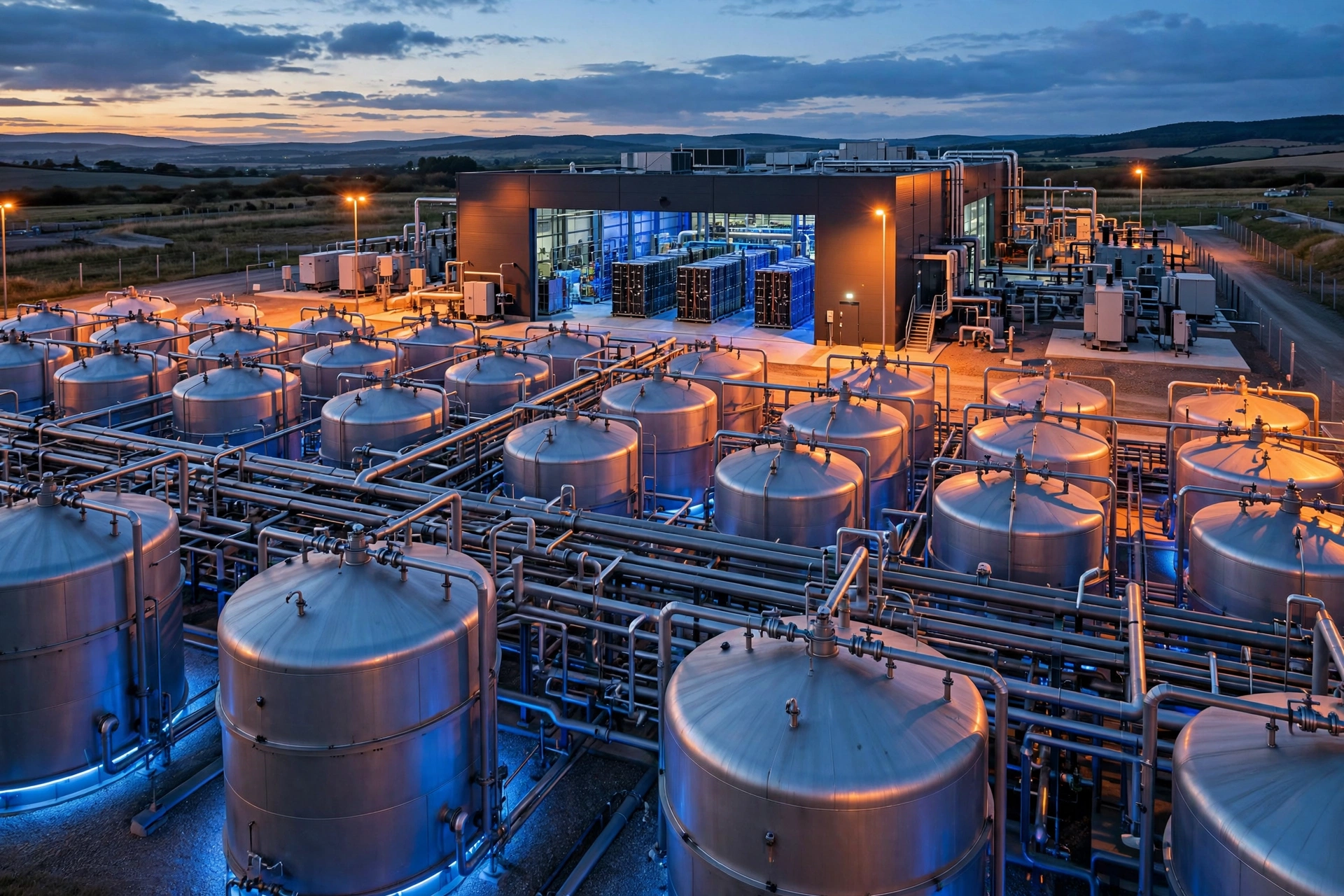
Less than one Olympic swimming pool. That is all the electrolyte a 400-megawatt-hour flow battery would need if the chemistry in a paper published last week in Nature Chemistry lives up to its numbers. Run the same calculation with the vanadium chemistry that dominates flow batteries today and you need more than five pools. A team led by Prof. Li Xianfeng at the Dalian Institute of Chemical Physics (Chinese Academy of Sciences), working with Prof. Chen Shengli of Wuhan University, has solved the problem that kept tin flow batteries weak for decades: getting tin to reversibly trade all four of its electrons, Sn4+ down to metallic Sn0, inside a working battery. Their anode electrolyte reaches 227 amp-hours per liter of capacity, or 205 Wh/L of energy density. At 40 mA/cm2, the tin-bromine cell delivered 89% energy efficiency.
Flow batteries always had the safer, longer-lived design. They park energy in liquid electrolytes held in external tanks, so power and capacity scale independently: bigger tanks mean longer duration, with no redesign. Utilities never bought in at scale anyway: density was the knock. Commercial vanadium systems manage only 25 to 35 Wh/L, which means enormous tank farms for meaningful amounts of energy, and vanadium itself is expensive with a price that swings wildly. Lithium-ion won grid storage on density and a mature supply chain. Tin changes the density argument, because 205 Wh/L of anolyte reaches the volumetric territory of lithium-ion while keeping water as the solvent and all the intrinsic safety of an aqueous system.
Why four electrons matter more than the headline number
205 Wh/L sounds like a lab-spec trophy, but behind it sits the more interesting chemistry, because the mechanism explains where the number came from and why nobody got there before. Tin was always attractive on paper: high theoretical capacity, high solubility, dendrite-free metal deposition. Standing in the way was a two-step reaction. Sn4+ converts to Sn2+ first, then Sn2+ to metallic Sn0, and the first step suffered from high reorganization energy and sluggish kinetics, which kept the full four-electron capacity locked away. Earlier attempts never got clean, reversible access to both steps.
Their move was coordination chemistry: dissolving tin tetrachloride (SnCl4) and adding iodide ions to build a mixed environment of SnCl62- and SnI62- complexes. Here the iodide-bearing complex lowers the reorganization energy for the Sn4+/Sn2+ electron transfer, making that step fast and reversible, while the chloride-bearing complex preserves tin's high solubility in the electrolyte. Measured directly, the gap between the Sn4+/Sn2+ redox peaks collapses from 978 millivolts in the chloride-only system to 97 millivolts in the mixed-halide system. That tenfold reduction in kinetic overpotential is the paper's real achievement, stated as a number.
Paired with a bromide/bromine cathode, the cell becomes a tin-bromine aqueous flow battery. And here the team did something unusual: they refused to stop at coin cells, the scale where most promising chemistries stall. Instead they built a kilowatt-scale stack and ran it continuously for more than 1,000 hours with stable operation. That is the kind of engineering evidence that separates a chemistry result from a battery result.
Three checks on the paper's numbers
Start with internal consistency. 227 Ah/L of volumetric capacity against 205 Wh/L of energy density implies an average discharge voltage of 0.90 volts. Now check that against theory: the Sn4+/Sn2+ standard potential sits near +0.15 V and Sn2+/Sn0 near -0.14 V, so the four-electron anode averages close to zero; the Br2/Br- cathode sits at +1.07 V, giving a theoretical cell of roughly 1.06 V. A real cell running at 40 mA/cm2 should land about 15% below theory after kinetic, ohmic, and polarization losses, which is exactly where 0.90 V sits. Headline figures, freshman electrochemistry: they agree.
Next, the molarity, straight from Faraday's law. 227 Ah/L equals 817,200 coulombs per liter; each tin atom moves four electrons, so divide by 4 times Faraday's constant (96,485 C/mol) and the electrolyte carries about 2.1 moles of active tin per liter. Vanadium systems are typically capped at 1.5 to 2.0 M vanadium, so the two chemistries sit in the same molarity neighborhood. Tin simply hands over four electrons per atom where vanadium's practical couples hand over one. One line of arithmetic, and it is the whole explanation for the density jump. No engineering trick, just electrochemistry.
Finally, the pool: a 100 MW, 4-hour grid plant stores 400 MWh, or 400,000 kWh. At 205 Wh/L of anolyte, required electrolyte volume is 400,000,000 / 205 = 1.95 million liters, about 1,951 cubic meters, or 0.78 of an Olympic swimming pool (2,500 m3). At 30 Wh/L, the midpoint of commercial vanadium performance, the same plant needs 13.3 million liters, about 13,333 cubic meters, or 5.3 pools. That is a 6.8-to-1 ratio. One honest caveat belongs here, and it is real: 205 Wh/L describes the anode electrolyte alone, and a complete system needs the catholyte tank too, so system-level density will be lower. Even after both tanks, though, the order-of-magnitude advantage survives. That is the number that should worry vanadium vendors.
| Metric | Sn-Br (new, anolyte) | Commercial vanadium | Li-ion (grid) |
|---|---|---|---|
| Electrolyte energy density | 205 Wh/L | 25-35 Wh/L | 250-400 Wh/L (cell) |
| Round-trip efficiency | 89% (at 40 mA/cm2) | 75-90% | 85-95% |
| Electrons per active atom | 4 | 1 | 1 (per Li) |
| Active species molarity | ~2.1 M | 1.5-2.0 M | n/a |
| Proven durability | >1,000 h (kW stack) | >12,000 cycles, 20-yr warranties | 10-15 yr warranties |
| Safety profile | Aqueous, but bromine cathode | Aqueous, acidic | Thermal runaway risk |
| Maturity | Lab + kW demo | Commercial | Commercial |
Sources: CAS release and Nature Chemistry paper (Oct 2026) for Sn-Br figures; industry benchmarks for vanadium and lithium-ion. Sn-Br density is anolyte-only, not system-level.
The strongest case against this article
Now the objections, at full strength, because they are serious. A kilowatt stack running 1,000 hours is a genuine engineering milestone and also two to three orders of magnitude from a grid plant, while vanadium vendors ship systems with 20,000-cycle demonstrations and 20-year warranties. Note that the 205 Wh/L headline is an anolyte-only figure; no full-system energy density was reported, and the 6.8x tank comparison is an illustration, not an engineering specification. Bromine is volatile, corrosive, and toxic, so the cathode inherits the handling headaches that have dogged zinc-bromine systems for decades. Nowhere does the paper report dollars per kilowatt-hour or a levelized cost of storage, and membranes and electrodes, not electrolyte, dominate flow-battery capital cost. Tin is cheap relative to vanadium, but iodide is not free, and the full bill of materials is unknown. Six weeks of continuous operation is not a cycle-life claim: the grid buys decades, not demos. Chemistry this good has died on cost and durability before. This one has not earned the benefit of the doubt yet.
What this does not prove
Honest boundaries on the claims. Because the full paper text sits behind a paywall, the quantitative claims here come from the Chinese Academy of Sciences release and the paper's verified metadata; stack details beyond the reported 1,000 hours are not publicly described. No cost figures exist anywhere in the public record, so nothing in this article is a $/kWh claim. My vanadium comparison uses industry-typical 25-35 Wh/L electrolyte figures, and system-level tin numbers were not reported, so treat the pool math as an order-of-magnitude illustration, not a design estimate. No cycle count, no calendar-life data, and no performance numbers at grid-relevant current densities or extreme temperatures were disclosed. As for the 0.90 V implied-voltage and 2.1 M tin calculations, those are mine, derived from the paper's reported figures. They check out internally, but they are sanity checks, not independent measurements.
What you can do
For procurement teams and storage engineers, the watch item is not 205 Wh/L. It is whether an independent group replicates the stack result and publishes a techno-economic analysis with real $/kWh numbers, because that decides whether this leaves the lab. For capital allocators, the signal is a megawatt-scale pilot announcement; count on two to three years from this paper to that press release. For researchers, the portable insight is the method itself: tuning halide ligands to collapse reorganization energy is a general strategy, and expect it tried on other multielectron couples within a year. And for everyone watching the transition, the structural takeaway is that aqueous flow batteries were written off as too bulky for grid duty, and the density ceiling just moved roughly sevenfold. Multi-day storage gets cheaper every time that ceiling rises.
The bottom line
A decade of flow-battery research assumed tin's four electrons were unreachable in practice. A ligand trick from coordination chemistry just reached them, and the resulting battery stores energy at a density that makes vanadium look like the incumbent it is. Stack data, internal consistency of the numbers, and the plain arithmetic of four electrons per atom all point the same direction. Unproven is everything that turns chemistry into infrastructure: cost, decades of cycling, megawatt scale, and a bromine cathode that needs taming. Watch for the pilot, because if it comes, the tank farms of 2030 will be a seventh the size of today's.