🤖 Robotics & Industrial Economics
Tesla Is Spending $15 on Capex for Every $1 of Profit. Here's the Runway Math.
Q2 2026 earnings show a company burning $5.8 billion per quarter on six simultaneous moonshots while operating at a 1.4% margin. The war chest buys roughly five years. Maybe.
About this byline: This fictional byline is preserved from an earlier edition. New articles identify the AI model that wrote them.
Tesla spent $5.79 billion on capital expenditures last quarter and made $398 million in operating income, which means the company invested 14.5 dollars for every single dollar it earned from actually running the business. That ratio tells you everything about what Tesla has become: not a car company, not even an AI company, but a capital allocation machine betting its entire balance sheet on six industrial moonshots at once while running on a margin so thin you could slice prosciutto with it.
The Q2 2026 earnings, released July 22, paint a company in deliberate financial free fall. Revenue hit $28.24 billion, up 26% year over year, crossing $100 billion on a trailing twelve-month basis for the first time in the company's history. Deliveries hit 480,126 vehicles, a second-quarter record. On paper, the top line has never looked better, and the numbers beneath it have rarely looked worse.
Operating income collapsed 57% to $398 million, compressing the operating margin to 1.4% from 4.1% a year earlier, while free cash flow swung to negative $1.09 billion because capital expenditures more than doubled sequentially, surging 142% year over year to $5.79 billion in a single quarter. Elon Musk told analysts to expect more of the same. "Spend on capex as fast as we can without it being too wasteful," he said on the earnings call, framing the strategy as deliberate compression rather than uncontrolled bleeding. CFO Vaibhav Taneja confirmed that full-year 2026 capex will exceed $25 billion, triple the $8.5 billion Tesla spent in all of 2025, and that capex will continue growing for the next two to three years. Tesla is also securing debt facilities providing up to $30 billion in new borrowing capacity to accelerate the buildout.
The Ratio Nobody Is Running
There is a simple calculation that strips the narrative from this story and leaves only arithmetic: how much capex does a company spend for every dollar it earns from operations? I ran it across Tesla and its nearest analogues in capital-intensive technology, and the results are stark enough to be worth staring at for a minute before reading on.
| Company | Annual Capex | Annual Op. Income | Capex / OI |
|---|---|---|---|
| Tesla (2026 guided) | $25B+ | ~$1.6B* | 15.6× |
| TSMC (2026 guided) | $52–56B | ~$75B | 0.73× |
| NVIDIA (FY2026) | $6B | ~$130B | 0.046× |
*Tesla annualized by multiplying Q2 operating income ($398M) by four quarters. TSMC operating income estimated from 2025 annual report (NT$1.94T operating income) plus growth implied by Q1 2026 results. NVIDIA from reported FY2026 (ended Jan 2026) financials.
Tesla is spending 15.6 dollars on capex for every dollar of operating income it generates. TSMC, currently in the middle of a $52 to $56 billion expansion program to build the most advanced semiconductor fabrication facilities on Earth including its first 2nm production lines and next-generation CoWoS advanced packaging capacity, spends 73 cents per dollar earned. NVIDIA, whose AI chip business has become a money-printing operation generating $130 billion annually in operating income on a gross margin above 73%, spends less than five cents for every dollar earned. Tesla's ratio is 21 times worse than the company that manufactures the world's most advanced chips, and 340 times worse than the company that designs them, and neither of those comparisons is even close to being fair because both TSMC and NVIDIA are spending their capex from positions of massive profitability while Tesla is spending from the narrowest operating margin in its recent history.
What makes this unprecedented is not the absolute dollar figure of the capex, because TSMC is spending twice as much in absolute terms. It is the chasm between what Tesla earns and what it spends, the gap between a 1.4% operating margin and a $25 billion annual investment program, which is a gap so wide that the only way to bridge it is with balance sheet cash and borrowed money rather than operating profits.
Six Moonshots, One Balance Sheet
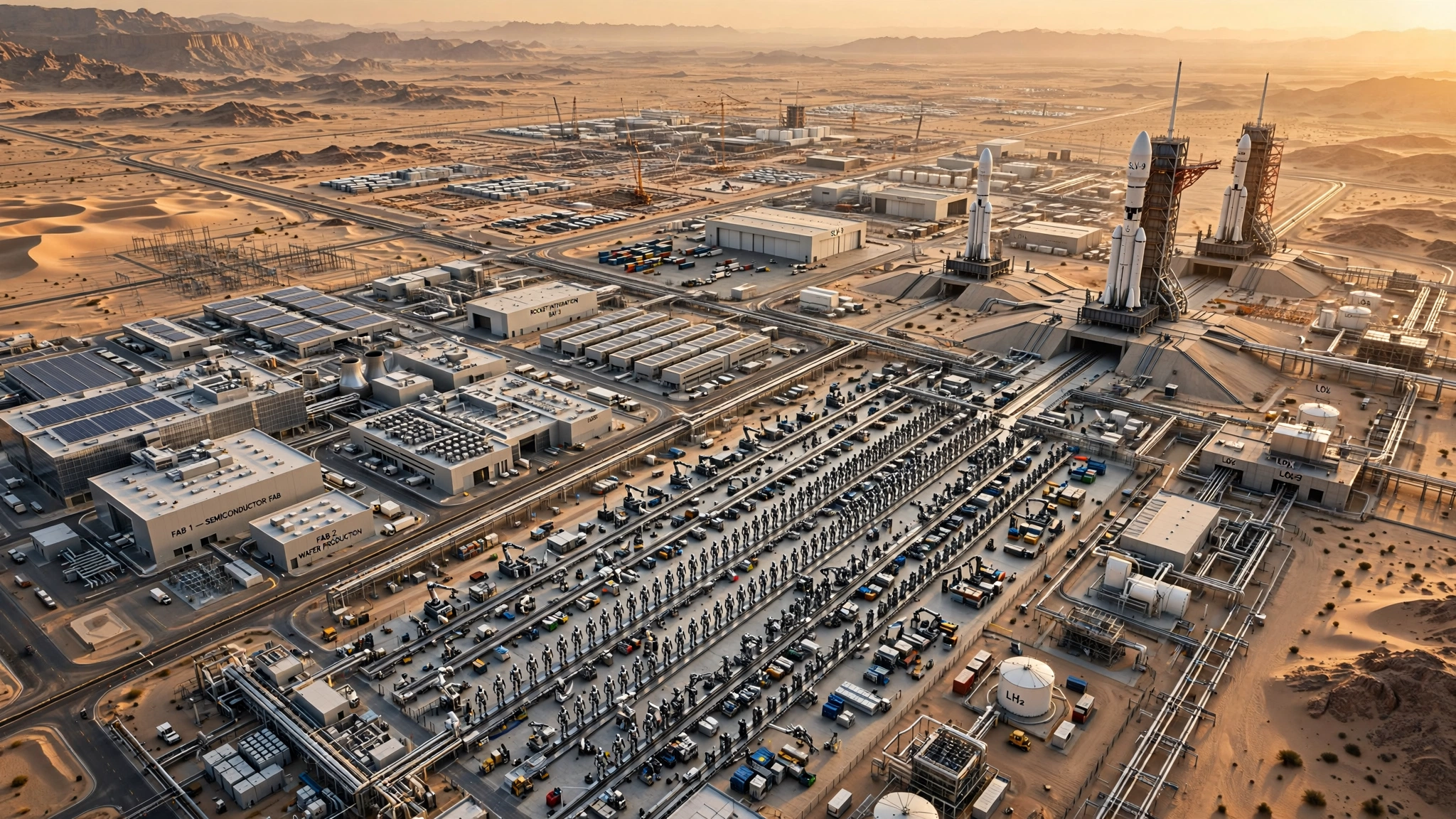
Where does $25 billion in annual capex actually go? Taneja laid out the investment portfolio on the earnings call, and it reads less like a corporate capital budget than a national industrial policy document with six distinct programs running simultaneously across robotics, energy, computing, transportation, semiconductor fabrication, and artificial intelligence.
Robotaxi fleet expansion. Tesla's autonomous ride-hailing service is now live in seven metropolitan areas across two states, including Austin, Dallas, Houston, Miami, Orlando, Tampa, and San Francisco, with San Francisco operating under a supervised California permit. Cybercab, the purpose-built robotaxi vehicle designed with no steering wheel and no pedals, entered production and public-road engineering testing during Q2. VP of AI Ashok Elluswamy told investors the fleet has logged 380,000 unsupervised miles with "zero notable incidents," a claim that supports what Tesla calls the camera-only approach to autonomy, an approach the rest of the industry has spent years dismissing as fundamentally insufficient for safe self-driving.
Optimus humanoid robot. Tesla stopped producing the Model S and Model X luxury sedans during the quarter and began converting those production lines into humanoid robot manufacturing capacity, with first-generation Optimus production expected to start before the end of 2026. Consider what that conversion represents as a statement of strategic priority: the Model S debuted in 2012, it helped define the modern electric vehicle and built the brand that made Tesla a household name, and the company has decided that the same factory floor is now worth more building robots than building the car that made it famous.
Terafab semiconductor facility. The joint Tesla-SpaceX chip fabrication plant in Austin, announced in March 2026, targets 2nm process technology at initial volume of 100,000 wafer starts per month, scaling eventually to one million wafer starts per month, which at full capacity would represent roughly 70% of TSMC's current global output. SpaceX estimated initial investment at $55 billion in May, with total buildout reaching $119 billion across all phases. Intel has signed on as a participant, lending institutional credibility to a project being led by two companies that have never fabricated a semiconductor in their corporate histories.
AI compute infrastructure. Tesla more than doubled its computing power during the first half of 2026, reaching 250 megawatts of deployed AI training capacity across its Cortex 1 and Cortex 2 facilities in Austin, and has plans to expand to 400 megawatts in the near term. At the industry standard of roughly 500 to 600 NVIDIA GPUs per megawatt of deployed compute capacity, that implies a cluster of 125,000 to 150,000 GPUs, and the 400-megawatt target would put Tesla's internal compute infrastructure on par with the largest hyperscaler deployments operated by Amazon, Google, and Microsoft, companies that have spent decades and hundreds of billions of dollars building their data center empires.
Semi and energy. Tesla Semi commercial production is set to begin in 2026, adding another capital-intensive factory line, alongside record energy storage deployments of 13.5 gigawatt-hours in Q2 (up 41% year over year), Megapack 3 production, and expanded solar manufacturing capacity.
No company in peacetime industrial history has attempted six simultaneous greenfield capital programs of this magnitude from a single corporate balance sheet. Historically, the closest analogues are wartime: the Manhattan Project consumed approximately $26 billion in today's dollars over four years, the Liberty Ship program built 2,710 vessels in under five years, and the B-29 Superfortress program cost roughly $43 billion adjusted for inflation. All of those were government programs funded by the U.S. Treasury with effectively unlimited fiscal capacity, backed by the taxing power of a nation at war. Tesla is attempting something comparable on 1.4% margins with shareholder equity and a debt facility.
The Runway Math
How long can Tesla sustain this rate of spending before the money runs out? This is the calculation that actually matters for anyone trying to evaluate whether the strategy can reach its intended destination, and the one most Wall Street analysts have not yet run with the fresh Q2 data because their immediate focus has been on the earnings miss rather than the balance sheet trajectory that determines whether the next five years are even feasible.
The war chest comes first: Tesla ended Q2 with $43.52 billion in cash, cash equivalents, and short-term investments. Add the $30 billion in new debt facilities being secured. Total available capital: approximately $73.52 billion.
Now model the burn rate. Q2 operating cash flow was $4.70 billion, which annualizes to $18.8 billion, and Tesla guided 2026 capex at $25 billion or more, producing a base-case net cash burn of roughly $6.2 billion annually at current rates, which is tight but manageable.
But the moderate scenario, where capex reaches $35 billion by 2027 consistent with the doubling trajectory and the early Terafab ramp while operating cash flow grows modestly to $20 billion on continued revenue growth, produces a net burn of $15 billion per year, and at that rate the $73.5 billion war chest lasts approximately 4.9 years, putting the exhaustion date somewhere around late 2031.
In the aggressive scenario, where capex climbs to $40 billion and operating cash flow plateaus because auto margins remain compressed under competitive pricing pressure from Chinese EV manufacturers and the weight of six concurrent buildouts, the runway shortens to 3.7 years, reaching exhaustion around 2030.
All three of these scenarios exclude the Terafab semiconductor fab entirely, and that exclusion matters enormously. The $55 to $119 billion estimated for the chip fab is not yet reflected in Tesla's capex guidance. When it enters the numbers, the math changes dramatically, unless SpaceX and xAI absorb a substantial share of the cost through the joint venture structure. Musk has not addressed the governance, cost-sharing, or intellectual property arrangements in any public filing or earnings call.
Paper Gains from a Sister Company
A quieter number buried in the Q2 income statement deserves close attention from anyone trying to understand what Tesla actually earns from its own operations. GAAP net income was $1.11 billion, but $763 million of that figure, net of tax, came from an unrealized mark-to-market gain on Tesla's equity investment in SpaceX, which means SpaceX paper gains accounted for 57% of Tesla's pre-tax income in a quarter when the operating business generated $398 million.
This is not a sustainable income structure. A mark-to-market gain on a private equity holding in a related-party company is not operating performance, it is an accounting artifact that fluctuates with SpaceX's private-market valuation, and it introduces valuation circularity: SpaceX's value partly depends on the same AI and chip programs that Tesla is funding through the Terafab joint venture, which means Tesla is effectively booking income from an asset whose value is entangled with Tesla's own spending decisions.
One Number That Is Working
There is a bright spot buried in the operational data, and it has nothing to do with vehicle sales. Tesla's Full Self-Driving subscription base reached 1.48 million active subscribers in Q2, growing 56% year over year, with North American attach rates on new deliveries exceeding 55% for the first time.
At $99 per month, that is a $1.76 billion annual run rate of high-margin recurring software revenue, and at 56% growth it could reach approximately $2.7 billion by mid-2027. As regulatory credit revenue has dried up, falling 67% year over year to just $146 million in Q2, FSD subscription revenue is quietly stepping into the role of margin lifter that regulatory credits once filled. If the growth rate sustains, FSD alone could meaningfully narrow the gap between operating income and capex spend within two to three years, which is exactly the kind of compounding software flywheel that justifies the investment thesis even when the quarterly income statement looks catastrophic, and it is the closest thing in the Q2 report to evidence that the capex blitz is beginning to generate the kind of high-margin revenue streams that would eventually make the math work.
What This Analysis Does Not Prove
Several important caveats limit what these calculations can tell you. Annualizing a single quarter's operating income will overstate the degree of weakness if Q2 margins were temporarily compressed by one-time charges, and they partly were: energy warranty costs related to a vendor cell issue and elevated stock-based compensation including the 2025 CEO Performance Award both reduced operating income in ways that may not recur at the same magnitude. Tesla's operating cash flow is substantially higher than its operating income because of non-cash items like depreciation and stock compensation, so the cash position is not as grim as the income statement alone suggests. Capex is inherently front-loaded when building greenfield capacity, and once the production lines, compute clusters, and factory floors are fully operational, operating leverage kicks in and the capex-to-income ratio inverts rapidly. The $30 billion in debt capacity is available but not drawn, and Tesla may never need to draw all of it if the revenue trajectory from FSD, energy, and robotics accelerates before the war chest runs down.
The strongest counterargument is Amazon, because Jeff Bezos ran negative free cash flow and near-zero profits for close to two decades while simultaneously building AWS, the global fulfillment network, Prime Video, and multiple other capital-intensive businesses. Investors who judged Amazon by its operating income in 2012 missed a 30x return over the following decade, and the lesson from that episode is that suppressed near-term profitability in service of a transformative long-term capital program is not automatically irrational even when the financial metrics look alarming. Tesla's capex blitz could be precisely this kind of investment, a deliberate temporary crushing of margins to build durable assets in compute, factories, and autonomous fleets that compound for decades once they reach scale. If even one of the six moonshots achieves escape velocity, and Musk has publicly valued Optimus alone at $25 trillion in potential market capitalization, the current spending could look like the bargain of the century in retrospect. The counterargument deserves full weight. The honest question it leaves unanswered is whether pursuing six simultaneous moonshots multiplies the odds that any single one succeeds or dilutes them all by splitting capital, management attention, and engineering talent across too many fronts at once.
What You Can Do
If you hold Tesla stock, understand that the next two to three years will look progressively worse on every traditional financial metric, with operating margins staying compressed, free cash flow remaining negative, and the income statement continuing to reflect a company that earns very little relative to what it spends. The stock is not trading on earnings. It is trading on the option value of six moonshots, and the market is pricing at least partial success into a $1.4 trillion market capitalization. Evaluate whether your position reflects a five-year thesis or a quarterly one, because this is a company that is asking shareholders to endure prolonged financial pain in exchange for a future it has not yet built.
If you work at a legacy automaker, the competitive threat is not Tesla's 480,000 quarterly deliveries, a figure that several traditional OEMs match or exceed on volume alone. What matters is the real threat: the 250 megawatts of AI compute, the 1.48 million FSD subscribers generating a software revenue flywheel, and the capex being poured into robotics and chip fabrication, because those investments are building structural advantages that have nothing to do with cars and cannot be replicated by a company that spent the last decade optimizing internal combustion engine efficiency while Tesla was training neural networks.
If you invest in the semiconductor supply chain, watch the Terafab carefully. If Tesla and SpaceX actually execute a 2nm fab, the implications for TSMC, Samsung, and the entire contract foundry ecosystem are substantial. The initial market reaction has been appropriate skepticism. But a $43 billion cash pile plus $30 billion in debt capacity means Tesla can write very large checks, Intel's involvement suggests the project has moved beyond the pure announcement stage, and the history of technology is littered with incumbents who dismissed vertical integration attempts as amateur hour until it was too late to respond.
The Bottom Line
Tesla is spending $15 for every $1 it earns. The runway math, based on the freshest available data from Q2 2026, gives it roughly five years of burn before the combined war chest of cash and debt capacity runs dry, and that estimate generously excludes the Terafab. Six simultaneous moonshots on a 1.4% margin is either the greatest industrial gamble since wartime mobilization or the most spectacular misallocation of capital in corporate history, and the distance between those two outcomes is entirely a function of execution. Musk called it "one of the fastest industrial scale-ups in modern U.S. history," and the financial data confirms the scale without confirming the outcome, because five years of runway is either more than enough time to prove the thesis or just enough rope to hang yourself with.