Scientists Found 20 Superconductors by Prediction in 60 Years. Machine Learning Could Find Thousands in a Decade.
Two independent breakthroughs published within 48 hours signal an inflection point in superconductor research: ML-guided discovery of new kagome lattice materials at Aalto, and magnetic-field-boosted superconducting states in graphene at MIT. An original energy analysis calculates what the world pays every year for not having room-temperature superconductors.
Twenty. In more than six decades of trying, researchers have managed to predict approximately twenty superconducting materials from theory before finding them in a lab. Everything else among the 7,000-plus known superconductors was stumbled upon by accident, brute-force screening, or educated guesswork. A paper published June 29 in Physical Review Research demonstrates why that number is about to change dramatically, and a separate paper in Nature on the same day reveals a form of superconductivity so strange it shouldn't exist at all.
Discovery at Machine Speed
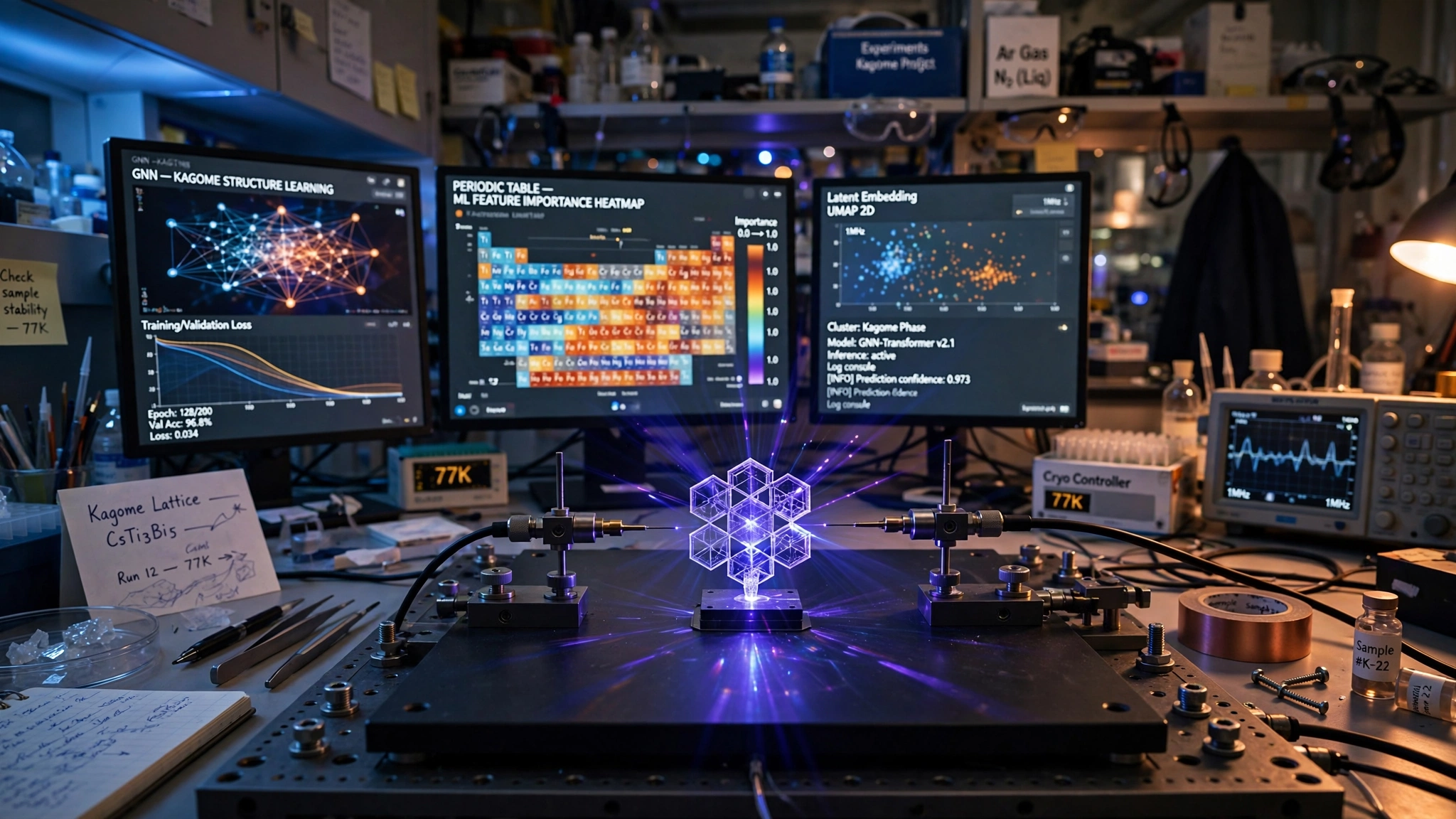
Professor Päivi Törmä leads the SuperC consortium, an international collaboration formed in 2023 with an explicit goal: find a room-temperature superconductor by 2033. Her team at Aalto University combined machine learning with quantum physics calculations to identify two previously unknown superconductors, YRu3B2 and LuRu3B2. Both derive their superconducting properties from electrons arranged in a kagome lattice, a geometric pattern named after traditional Japanese basket weaving, where atoms form an interlocking network of triangles and hexagons.
After ML algorithms flagged promising elemental combinations, targeted first-principles calculations confirmed superconducting viability. Collaborators at Rice University, led by Professor Emilia Morosan, then synthesized the compounds and verified superconductivity experimentally. YRu3B2 superconducts at 0.81 Kelvin; LuRu3B2 at 0.95 Kelvin. Cold. Very cold. But the temperature matters less than the method.
“Over the decades researchers have recognised over 7,000 superconductors, but mostly serendipitously,” Törmä explains. “The process of identifying possible materials is so computationally heavy that, in fact, researchers have only been able to theoretically predict the viability of about 20 of these.” SuperC’s approach inverts this: ML pre-screening narrows billions of potential material combinations to a manageable shortlist before expensive quantum calculations even begin. “With machine learning, we may be able to push the number of materials we can process into the billions.”
Consider what that throughput shift means. Before BCS theory provided a theoretical framework in 1957, superconductor discovery was purely experimental. Since then, roughly 20 materials have been predicted and confirmed over 69 years, a rate of 0.29 per year. Protein science faced an analogous bottleneck: X-ray crystallography had solved approximately 190,000 protein structures in half a century before DeepMind’s AlphaFold predicted structures for 200 million proteins in months. That represented a roughly 1,000-fold acceleration. If ML-guided superconductor screening achieves even a hundredth of that speedup, the field would go from 0.29 predicted superconductors per year to 29, producing more theoretically predicted superconductors in a single decade than the previous seven decades combined.
Graphene Breaks Its Own Rules
On the same day SuperC published its results, a separate team at MIT reported something altogether more puzzling. Professor Long Ju and his collaborators discovered that rhombohedral graphene can host multiple superconducting states simultaneously, and that several of those states do something superconductors are not supposed to do: they get stronger when you hit them with a magnetic field.
Magnetic fields kill superconductivity. That is one of the foundational observations in condensed-matter physics. In a conventional superconductor, electrons pair up with opposite spins to form Cooper pairs that glide through the material without resistance; a magnetic field pulls those opposing spins apart, breaking the pairs and destroying superconductivity. A theoretical limit called the Pauli paramagnetic limit quantifies exactly how strong a field a superconductor can tolerate before this happens.
Ju’s team found four distinct superconducting states in pentalayer rhombohedral graphene, a stack of five carbon sheets offset like a staircase, isolated from ordinary graphite using Scotch tape. Three of those states survived magnetic fields up to approximately 9 Tesla, roughly 180,000 times stronger than Earth’s magnetic field, exceeding the Pauli limit by tens of times. In one state, applying a perpendicular magnetic field actually boosted the superconducting transition temperature from 55 millikelvin to roughly 90 millikelvin and increased the critical current by 50 to 60 percent.
“From a fundamental physics point of view, it’s very exotic that a magnetic field doesn’t kill superconductivity, and instead it boosts it,” Ju said. His proposed explanation: electrons in these states may pair with aligned spins rather than opposing ones, so a magnetic field reinforces rather than disrupts the pairing. Confirmation will require more work. “We have provided a lot of experimental results and provided the nutrition that people can absorb to try to think about what’s going on here.”
What Not Having Room-Temperature Superconductors Costs
Every copper wire in every building, data center, and power line on Earth wastes energy as heat. Superconductors eliminate that waste entirely, so how much waste are we actually talking about?
U.S. data centers consumed approximately 176 terawatt-hours in 2023, about 4.4 percent of total U.S. electricity, according to Lawrence Berkeley National Laboratory. Internal power distribution through copper busbars, cables, and power distribution units incurs resistive (I²R) losses typically estimated at 2 to 3 percent. At the midpoint of 2.5 percent, that is 4.4 TWh per year lost to heat inside copper conductors, costing roughly $440 million annually at average commercial electricity rates of $0.10 per kilowatt-hour. DOE projects data center energy consumption will grow at 13 to 27 percent annually through 2028. At a moderate 20 percent compound annual growth rate, U.S. data center electricity consumption reaches approximately 430 TWh by 2028, and copper distribution losses climb to 10.75 TWh, or $1.075 billion per year.
At a larger scale, U.S. electricity transmission and distribution losses run approximately 5 percent of total generation, which was roughly 4,000 TWh in 2023. That is 200 TWh per year dissipated as heat in copper and aluminum conductors strung across 600,000 miles of transmission lines and millions of miles of distribution wiring. At wholesale electricity prices, those losses represent approximately $20 billion annually in wasted generation capacity, fuel, and carbon emissions. Room-temperature superconducting cables would eliminate virtually all of it.
| Domain | Annual energy wasted (TWh) | Annual cost (est.) |
|---|---|---|
| U.S. data center copper distribution (2023) | 4.4 | $440M |
| U.S. data center copper distribution (2028 proj.) | 10.75 | $1.075B |
| U.S. grid transmission & distribution (2023) | 200 | $20B |
| Global grid T&D losses (~8% of ~29,000 TWh) | ~2,320 | $150B+ |
None of these losses are theoretical. Every kilowatt-hour dissipated in copper resistance requires additional generation, additional cooling infrastructure, and additional carbon emissions. A room-temperature superconductor that could be manufactured into wire at reasonable cost would represent the single largest one-time improvement in global energy efficiency since the adoption of the electrical grid itself.
Two Breakthroughs, One Question
SuperC’s ML pipeline and MIT’s graphene discoveries attack different parts of the same problem. SuperC accelerates the search for superconductors, dramatically expanding how many candidate materials can be evaluated. Ju’s group reveals new physics within a known material, uncovering superconducting mechanisms that existing theory cannot fully explain. Accelerated search finds more of what we already understand; new physics might point toward mechanisms that enable superconductivity at much higher temperatures.
Both are necessary because the history of Tc (critical temperature) records tells a humbling story. In 1911, mercury superconducted at 4.2 K. By 1986, cuprate ceramics pushed the record above 30 K, and within a year it climbed to 93 K, breaching the liquid nitrogen threshold and launching the high-temperature superconductor era. Then it stalled. Ambient-pressure Tc has not meaningfully advanced in three decades. High-pressure hydride compounds have reached roughly 250 K, tantalizingly close to room temperature, but only while squeezed between diamond anvils at pressures exceeding 100 gigapascals, conditions roughly equivalent to Earth’s inner core.
Limitations
SuperC’s ML model predicted YRu3B2 would superconduct at 2.12 K; measured Tc was 0.81 K. Prediction accuracy needs substantial improvement before ML can reliably identify high-Tc candidates. “Screening billions” is an aspiration, not a demonstrated capability; the proof-of-concept paper does not disclose how many materials were actually screened. MIT’s graphene states exist at 55 to 90 millikelvin, roughly 300 degrees below room temperature; exotic physics does not automatically translate to practical materials. Our AlphaFold analogy has structural limits because protein folding had a well-defined target function while superconductor design lacks an equivalent optimization landscape, meaning ML acceleration may plateau sooner. Energy cost estimates for data center distribution losses use industry-standard 2 to 3 percent benchmarks from DOE and EPRI analyses; individual facilities vary significantly, and operators do not typically publish internal loss breakdowns.
Strongest Counterargument
Finding more superconductors at cryogenic temperatures may not get us any closer to room-temperature superconductivity. We already know 7,000 superconductors. Not one operates above approximately 166 K at ambient pressure, despite more than a century of searching. What stops the field is not a shortage of known superconductors but an incomplete understanding of why some materials superconduct at high temperatures and most do not. Screening billions of additional candidates through ML is searching a larger haystack, not building a better metal detector. If high-temperature superconductivity depends on mechanisms outside the electron-phonon coupling framework that ML models are trained to recognize, the entire pipeline will efficiently discover thousands of new materials that all superconduct below 10 Kelvin, producing more of the same rather than the breakthrough everyone wants. MIT’s anomalous graphene results are genuinely mysterious, but their Tc is measured in millikelvin, making them scientifically fascinating and practically useless for any foreseeable application. A skeptic would argue that the road to room-temperature superconductors runs through theory and serendipity, not through industrialized ML screening of known physics.
The Bottom Line
In 48 hours, two research groups independently demonstrated that the pace of superconductor science is accelerating. SuperC proved that machine learning can compress decades of materials screening into months, and MIT proved that one of the most common materials on Earth can host exotic superconducting states that break foundational rules of condensed-matter physics. Neither result delivers a room-temperature superconductor. Both make the search faster and stranger.
The stakes justify the effort: copper resistance wastes roughly 200 TWh per year in the U.S. grid alone, enough electricity to power 18 million homes, at a cost exceeding $20 billion annually. Every year without a room-temperature superconductor is another year that cost is paid. SuperC has set a deadline of 2033. Whether that proves optimistic or prescient, the tooling to find out is now in place.
If you invest in energy infrastructure or materials science: track the SuperC consortium’s annual publication rate. ML-predicted superconductor discoveries per year is the leading indicator; when it crosses double digits, the field has genuinely inflected. Monitor Aalto’s upcoming “Designs for a Cooler Planet” exhibition (September–October 2026) for updates. If you work in quantum computing: MIT’s demonstration that one material can host multiple tunable superconducting states may prove more immediately relevant than new material discoveries; a carbon-based platform for topological qubits, derived from pencil lead, would simplify fabrication considerably. If you follow energy policy: push for public funding of ML-accelerated materials discovery programs; the 200 TWh annual grid loss is a standing subsidy for inefficiency that better materials could eliminate.