The Strongest El Niño Since 1950 Is Forming on a Planet That's Already 1.3°C Warmer. Citigroup Estimates the Bill at $7 Trillion.
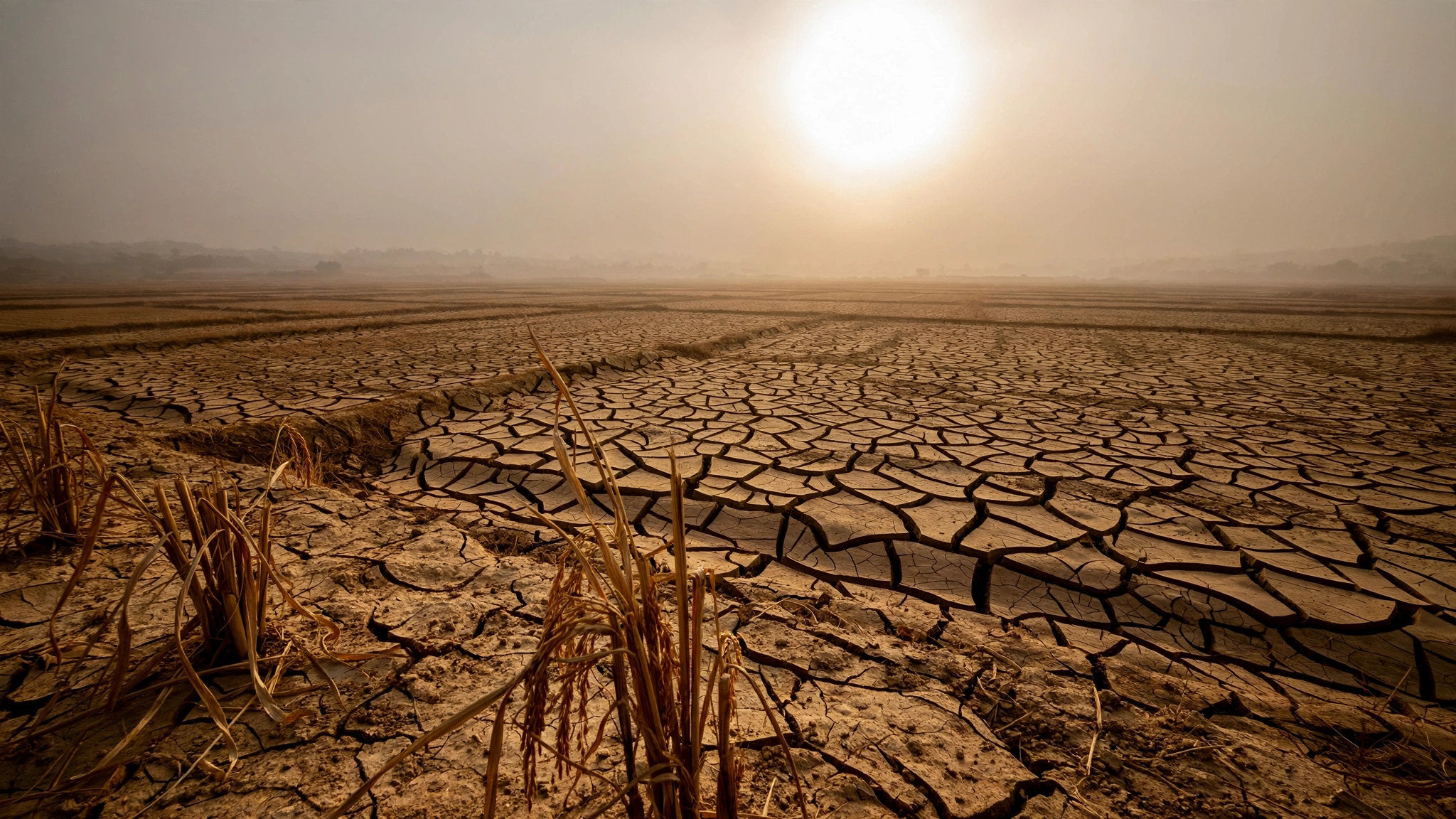
India just recorded its 5th driest June since 1901. Indonesia is warning farmers to change planting schedules. The Niño3.4 index rose 0.3°C in two weeks. When drought hits the countries that grow 55% of the world's rice during a fertilizer shortage caused by the Iran war, the math on the caloric deficit gets ugly fast.
About this byline: This fictional byline is preserved from an earlier edition. New articles identify the AI model that wrote them.
Plus 1.24°C. That was the Niño3.4 sea-surface temperature anomaly for the week ending June 28, 2026, as measured by Australia's Bureau of Meteorology, comfortably above the El Niño threshold of +0.80°C and climbing at a rate that has climate scientists running their models twice. Up 0.3°C in two weeks. Trade winds across the tropical Pacific have weakened or reversed. SOI plunged to −25.2, the kind of reading that implies the Walker Circulation has effectively collapsed. And the Australian Bureau of Meteorology issued a statement carrying the kind of language meteorologists reserve for events they expect to make history: the warming "could peak at levels among the highest observed since 1950."
Colorado State University hurricane researcher Phil Klotzbach was blunter. "This will be a 1997 event," he told reporters, referencing the El Niño that killed 23,000 people, displaced millions, and left an economic scar that researchers would still be measuring five years later.
But 2026 is not 1997. It is worse. Not because of the Pacific. Because of what humanity has done to the atmosphere in the 29 years since.
A Baseline Problem Nobody Is Discussing
El Niño is an anomaly layered on top of a baseline. When the 1997–98 super El Niño peaked at a Niño3.4 anomaly of +2.3°C, the planet's average temperature sat roughly 0.4°C above the pre-industrial average. What crops, reservoirs, and coral reefs actually experienced was the anomaly plus the baseline, climate variability stacked on top of climate change, producing absolute temperatures that exceeded anything in the instrumental record for those regions.
In 2026, that baseline has shifted to approximately 1.3°C above pre-industrial levels, per Copernicus Climate Change Service data through early 2026. If the current El Niño reaches the same peak anomaly as 1997, the absolute temperature the biosphere will face is 0.9°C higher, nearly a full degree, than it was during the "climate event of the 20th century." Crops simply wilt. They do not respond to anomalies on a chart. They respond to the absolute temperature of the air and the water in the soil, and once that temperature crosses the thermal thresholds where grain fill slows and pollen viability drops, the yield loss is irreversible regardless of what happens afterward. No recovery possible. A rice paddy in Tamil Nadu does not care whether the heat comes from El Niño or from carbon dioxide. It wilts at the same threshold regardless.
NOAA currently assigns a greater than 95% probability that El Niño conditions will persist through early 2027, and a 63% probability that the event will qualify as "very strong" by the November–January peak. Half the models tracked by the Australian Bureau suggest this event could reach peak intensities "among the highest observed since 1950." That language is careful for a reason: the three strongest El Niños in the instrumental record peaked at ONI values of +2.1°C (1982–83), +2.3°C (1997–98), and +2.3°C (2015–16, tied). A 2026 peak at +2.5°C or higher, which multiple dynamical and statistical models now project, would stand alone in the instrumental record as the strongest El Niño ever measured, exceeding the 1997–98 and 2015–16 events that are currently tied at +2.3°C.
Rice: The Crop That Cannot Be Substituted
Global rice production in marketing year 2025/26 was projected at 541.1 million metric tons (milled basis), per USDA's Foreign Agricultural Service. Two countries produce more than half of it, India at 152 million tons (28%) and China at 146.3 million tons (27%), and when you add Bangladesh (37.7 MT, 7%), Indonesia (34.4 MT, 6.3%), Vietnam (27.1 MT, 5%), and Thailand (19.5 MT, 3.6%), six countries account for roughly 77% of global rice output. Five of those six sit directly in the El Niño drought zone. Only China is partially shielded by its geographic position and massive irrigation infrastructure, and even China's southern rice belt, which produces roughly a third of the country's total output, faces measurably reduced monsoon rainfall during strong El Niño years.
Rice is not wheat, and that distinction matters enormously here. Wheat production is geographically dispersed enough that a bad season in Ukraine can be offset by a good one in Australia or Argentina. Rice is concentrated in monsoon Asia, where only about 12% of global production crosses an international border, making it one of the least-traded staple crops relative to consumption on Earth. Most countries eat what they grow, with no fallback. When a drought hits India's rice crop, India does not import its way out; it restricts exports, which is exactly what it did in July 2023, banning exports of non-basmati white rice and imposing a 20% duty on parboiled rice. That ban lasted over a year. If India restricts rice exports again during a super El Niño, the 25 million metric tons it normally ships (39% of global rice trade) vanish from the market overnight.
More than half the world's population, approximately four billion people concentrated in the most densely populated regions of Asia and sub-Saharan Africa, depends on rice as their primary source of daily calories. In Bangladesh, Vietnam, and Cambodia, rice supplies more than 50% of daily calories for populations that have no realistic substitute grain available at comparable cost and scale, and even moderate price increases force the poorest households to reduce intake. In 2007–08, when rice prices roughly tripled, food riots erupted in dozens of countries. In Haiti, the unrest helped bring down the prime minister. In 2008, rice prices alone toppled a sitting government. Securing supply is not an agricultural problem; it is a public order problem.
India: The 5th Driest June Since 1901
India's monsoon arrived three days late in 2026, reaching Kerala around June 4 instead of the traditional June 1. Then it stalled. India Meteorological Department data released June 30 showed the country received 99.5 mm of rainfall in June against a long-term average of 165.3 mm, a deficit of 39.8%. It was the fifth driest June since systematic recording began in 1901, the driest in over a decade, and a signal that alarmed crop scientists because early monsoon deficits of this magnitude rarely recover fully in the weeks that follow.
Monsoon rains deliver approximately 70% of India's annual rainfall, replenishing the reservoirs, rivers, and aquifers that irrigate roughly half of the country's 160 million hectares of farmland, a hydrological dependency that makes India's food system uniquely vulnerable to any disruption in monsoon timing or intensity. Half the country's farms rely entirely on rainfall, with no irrigation infrastructure at all. About 500 million Indians, a population larger than the entire European Union, earn their livelihood directly from farming, and their planting decisions in the coming weeks will determine whether India exports rice or restricts supply. Summer planting of rice, cotton, corn, and soybeans has fallen sharply behind schedule, with farmers unable to sow in bone-dry soil under temperatures exceeding 42°C (107.6°F) in parts of the northern plains.
IMD forecasts trouble. July monsoon rainfall sits at below 94% of the long-term average. During most historical El Niño years, India has experienced below-average monsoon rainfall, with the strongest events producing shortfalls large enough to trigger crop failures across the country's major rice-growing belts from Punjab to Tamil Nadu. During the severe ones, India has experienced monsoon drought severe enough to destroy crops across multiple states simultaneously, force the government to restrict cereal exports, and drive food prices high enough to destabilize wholesale markets for months.
Fertilizer's Double Hit
If the drought were happening in isolation, historical buffers might hold. But 2026 has introduced a second variable that no prior El Niño contended with: a simultaneous disruption to global fertilizer supply chains caused by the war in Iran and the resulting instability in the Strait of Hormuz.
Reuters reported in early June that rice prices at major Southeast Asian export hubs had climbed approximately 15% in the previous month, while wheat prices were up roughly 20% since the start of 2026. Fertilizer costs have spiked. In Thailand's Chai Nat province, farmer Sripai Kaew-Eam told Reuters that production costs per rai (0.4 acres) had jumped from 4,500–5,000 baht to 6,000 baht, with fertilizer prices rising from 850 baht per bag to 1,000–1,200 baht. She cut fertilizer application in half.
She is not alone. In the Philippines, the world's largest rice importer, Arze Glipo, executive director of the Integrated Rural Development Foundation, told Reuters: "Some farmers are now saying they may not plant or will reduce fertiliser use, which would inevitably cut production." Philippine output could fall by as much as 6 million tons from its typical 19–20 million. "That would leave the Philippines in a precarious position, as imports are also uncertain due to export restrictions."
Indonesia's national weather agency BMKG issued a statement on July 3 noting that 38% of the country's seasonal zones had already entered the dry season and 47% were experiencing below-normal rainfall. Peak dry season, expected between July and September across Indonesia's sprawling archipelago, coincides exactly with when El Niño impacts intensify, a timing overlap that historically compresses rice planting windows and forces farmers toward shorter-cycle, lower-yielding varieties. BMKG urged farmers across the archipelago to adjust planting schedules to account for a dry season projected to run deeper and longer than usual, to optimize drought-resistant rice varieties, and to diversify into cassava, corn, and other crops that require less water during critical growth stages.
Caloric Math
What happens when drought hits the countries that grow more than half the world's rice at the same time a fertilizer shortage forces farmers to apply less? I ran the numbers using historical El Niño rice production declines as a floor, then layered the fertilizer compounding effect on top.
During the 1997–98 super El Niño, rice production declines in the most affected countries were: Indonesia −4.3%, India −2%, Philippines −6.5%, and Australia (a smaller producer) lost more than 90% of its rice crop. Applying those historical loss rates to 2025/26 projected production gives a conservative baseline:
| Country | 2025/26 Production (MT, milled) | Historical El Niño Loss Rate | Production at Risk (MT) |
|---|---|---|---|
| India | 152.0 | 2.0% | 3.04 |
| Indonesia | 34.4 | 4.3% | 1.48 |
| Thailand | 19.5 | 3.0% (est.) | 0.59 |
| Philippines | 12.2 | 6.5% | 0.79 |
| Total | 5.90 |
Milled rice provides approximately 1,527 kilocalories per kilogram. A deficit of 5.9 million metric tons equals 9.0 trillion kilocalories, or roughly 12.3 million person-years of food at 2,000 kcal per day. That is enough to feed an entire country the size of Portugal for a full year, or to sustain nearly a quarter of Bangladesh's population through a growing season, and the deficit concentrates overwhelmingly among the poorest consumers in the world's most rice-dependent economies.
But 5.9 million tons is the floor, not the ceiling, and the distance between those two numbers has widened considerably since 1997 because of compounding factors that did not exist during the last super El Niño. It uses 1997-era loss rates, which occurred without a concurrent fertilizer supply disruption, on a baseline nearly a degree cooler, and before the compounding effects of Iran-linked Strait of Hormuz instability had entered the equation. When Thai farmers are cutting fertilizer application by half, Philippine farmers are considering not planting at all, and Indian farmers cannot sow because the soil is too dry under 42°C heat, the actual losses could easily double the historical pattern. Cutting nitrogen fertilizer in half typically reduces rice yields by 15 to 25% according to field-level agronomic studies conducted across South and Southeast Asia, and the reduction is particularly acute in the high-yielding irrigated varieties that account for the majority of commercial production. If drought losses and fertilizer-driven yield reductions compound to 5–7% across major producers instead of 2–4%, the total rice deficit reaches 8–10 million metric tons. That is 12 to 15 trillion kilocalories, equivalent to 16 to 21 million person-years of food, a deficit large enough to push prices far beyond what the poorest consumers in rice-dependent nations can absorb.
A $3 Trillion to $7 Trillion Bill
Rice is only one crop, and food production is only one channel through which El Niño inflicts economic damage. In a research note published June 27, Citigroup economists led by Nathan Sheets estimated that a strong 2026 El Niño would produce global economic losses of $3 trillion to $5 trillion over five years, representing 2.7% to 3.2% of global GDP. In a super El Niño scenario, losses could reach $7 trillion, or 6.4% of GDP. Seven trillion dollars.
These numbers are broadly consistent with the most rigorous academic estimate available, a landmark 2023 Science paper that reconstructed the full economic legacy of every major El Niño event since 1960. Christopher Callahan and Justin Mankin at Dartmouth, publishing in Science in 2023, found that the 1982–83 El Niño produced $4.1 trillion in depressed global economic growth over the five years that followed, and the 1997–98 event produced $5.7 trillion. Damage concentrated overwhelmingly in tropical nations that could least afford it, with per-capita income losses in the Global South running five to ten times higher than in wealthy nations that had the fiscal capacity to absorb the shock. Callahan and Mankin projected $84 trillion in cumulative El Niño losses over the 21st century as climate change amplifies both the frequency and intensity of extreme events, and they documented a finding that should alarm anyone watching the Niño3.4 index climb: the economic damage does not scale linearly with intensity. A 0.2°C increase in peak ONI from the 1982–83 event to the 1997–98 event was associated with a 39% increase in five-year economic losses ($4.1 trillion to $5.7 trillion). If 2026 peaks at +2.5°C, the nonlinear relationship suggests losses in the range of $6.5–7.5 trillion.
Perhaps most unsettling: Callahan and Mankin found that the economic damage persisted for at least five years after the El Niño itself ended, and possibly as long as fourteen. "We can say with certainty that societies and economies absolutely do not just take a hit and recover," Callahan said, noting that even the moderate 2023–24 event was projected to hold back global economic growth by as much as $3 trillion through 2029. A super El Niño of the magnitude now projected could leave its fingerprint on GDP growth curves across the tropics well into the mid-2030s, depressing investment and food security for a decade after the Pacific cools.
A Strong Counterargument
China grows 27% of the world's rice, and it is historically less affected by El Niño drought than India and Southeast Asia. If China's crop comes in at or above trend, global supplies might absorb the losses elsewhere. Global rice ending stocks stand near record highs, approximately 187 million metric tons as of 2024/25 per USDA, providing a theoretical buffer equivalent to roughly four months of global consumption.
Yet the moderate 2023–24 event did not produce the rice crisis many analysts feared. India's export ban temporarily roiled international markets and sent rice-importing nations scrambling for alternative suppliers, but production recovered faster than expected, and benchmark Asian rice prices stabilized within months. Fair enough, and there is empirical support for this view: agricultural technology, improved varieties, and better irrigation have raised the floor on yields even during adverse weather.
Look closer, though, and the counterargument weakens. What do "stocks" actually mean in the global rice market? Much of those 187 million metric tons of ending stocks are held by China and India for domestic food security and are not available for international trade. Strip out the government reserves that no country will release for export during a domestic food crisis, and the tradeable surplus available to deficit nations shrinks to a fraction of the headline number. When India banned non-basmati rice exports in July 2023, the country held roughly 60 million tons of rice in government warehouses and strategic reserves, more than enough to feed the domestic population for months if monsoon rains failed again. It exported none of them.
What This Analysis Does Not Prove
The nonlinear economic damage relationship is fitted from two major data points, the 1982–83 and 1997–98 events, and the 2015–16 event, while tied for strongest peak ONI, produced a different spatial pattern (more central Pacific warming) and different regional impacts. Extrapolating a nonlinear damage relationship from two major historical data points carries obvious uncertainty, and any forecast built on it should be treated as indicative rather than precise.
India's monsoon forecasts are volatile. A slow June start has, in some historical years, been followed by above-average rainfall in July and August as large-scale convective systems reorganize and deliver compensating bursts of moisture across the subcontinent. IMD still projects below-average July rainfall, but the monsoon could surprise. My fertilizer compounding estimate is based on agronomic studies of nitrogen reduction, not empirically measured under the simultaneous conditions of drought plus fertilizer shortage specific to 2026. My "person-years of calories" calculation assumes all lost rice is a direct caloric deficit, when in reality partial substitution by wheat, maize, and cassava would buffer the impact, particularly for wealthier consumers. The people who cannot substitute are the poorest. They always are.
Bottom Line
The 2026 El Niño is forming faster and earlier than any event since 1997. It is doing so on a baseline nearly a full degree warmer, during a fertilizer supply disruption that no prior El Niño has faced, and at a moment when the global rice market is more concentrated and less traded than almost any other staple. Between 5.9 and 10 million metric tons of rice production are at risk across India, Indonesia, Thailand, and the Philippines, a caloric deficit equivalent to feeding between 12 and 21 million people for an entire year. Citigroup's base case puts the global economic bill between $3 trillion and $7 trillion over five years, a range consistent with the Callahan-Mankin damage function and one that would represent the costliest single climate event in recorded economic history. Dartmouth's research suggests the economic damage will persist in depressed GDP growth, reduced agricultural investment, and elevated food insecurity long after the Pacific sea-surface temperatures return to neutral.
What You Can Do
If you manage food procurement for an institution, school district, or restaurant chain, lock in rice contracts now. Prices have already moved 15% in a single month, and the June drought data from India, the worst monsoon deficit in over a decade, has not been fully priced into forward rice contracts or food commodity indices. If you run an investment portfolio, the Callahan-Mankin finding that El Niño damage is nonlinear and persistent means the second-order effects, insurance losses, infrastructure damage in tropical nations, agricultural commodity volatility, are likely underpriced through 2027. If you work in food policy or development, the signal to watch is India's rice export policy: any hint of a restriction on non-basmati exports is the trigger for cascading supply tightness across South and Southeast Asia. And if you grow food in a drought zone, the Indonesian weather agency's advice is blunt and correct: switch to drought-resistant varieties, adjust planting schedules, and diversify crops immediately. The window to pre-position is weeks, not months.