⚡ Energy
Two Labs Just Solved Why Solid-State Batteries Keep Dying. $30 Billion in Bets Now Depends on Materials Engineering, Not Miracles.
Independent teams at the Max Planck Institute and MIT have cracked different halves of the dendrite puzzle that has plagued solid-state batteries for decades. One group's fix already improves critical current density by 300%. The global auto industry's $30+ billion in SSB commitments just shifted from science gamble to engineering race.
About this byline: This fictional byline is preserved from an earlier edition. New articles identify the AI model that wrote them.
Three hundred percent. That is how much MIT researchers improved the critical current density of a solid-state battery electrolyte by understanding a mechanism that had eluded the field for thirty years. And they did it by adjusting processing conditions on a material that already existed.
Solid-state batteries are not a new idea. They promise roughly double the energy density of today's lithium-ion cells, charging times under ten minutes, no fire risk from liquid electrolyte leaks, and cycle lives measured in decades. Every major automaker on Earth has bet money on them. Honda has spent $280 million on a full production line in Sakura City, Japan. Toyota is targeting commercial deployment between 2027 and 2028. Samsung SDI plans mass production by 2027. QuantumScape, which went public via SPAC in 2020, currently carries a $3.6 billion market cap on approximately zero revenue. Factorial Energy listed on Nasdaq in June 2026 at a $1.3 billion valuation. All of these companies and a dozen more were making billion-dollar decisions on a technology whose fundamental failure mode nobody could fully explain.
That changed in July, when two independent research teams published answers to different halves of the same problem.
What Keeps Killing Them
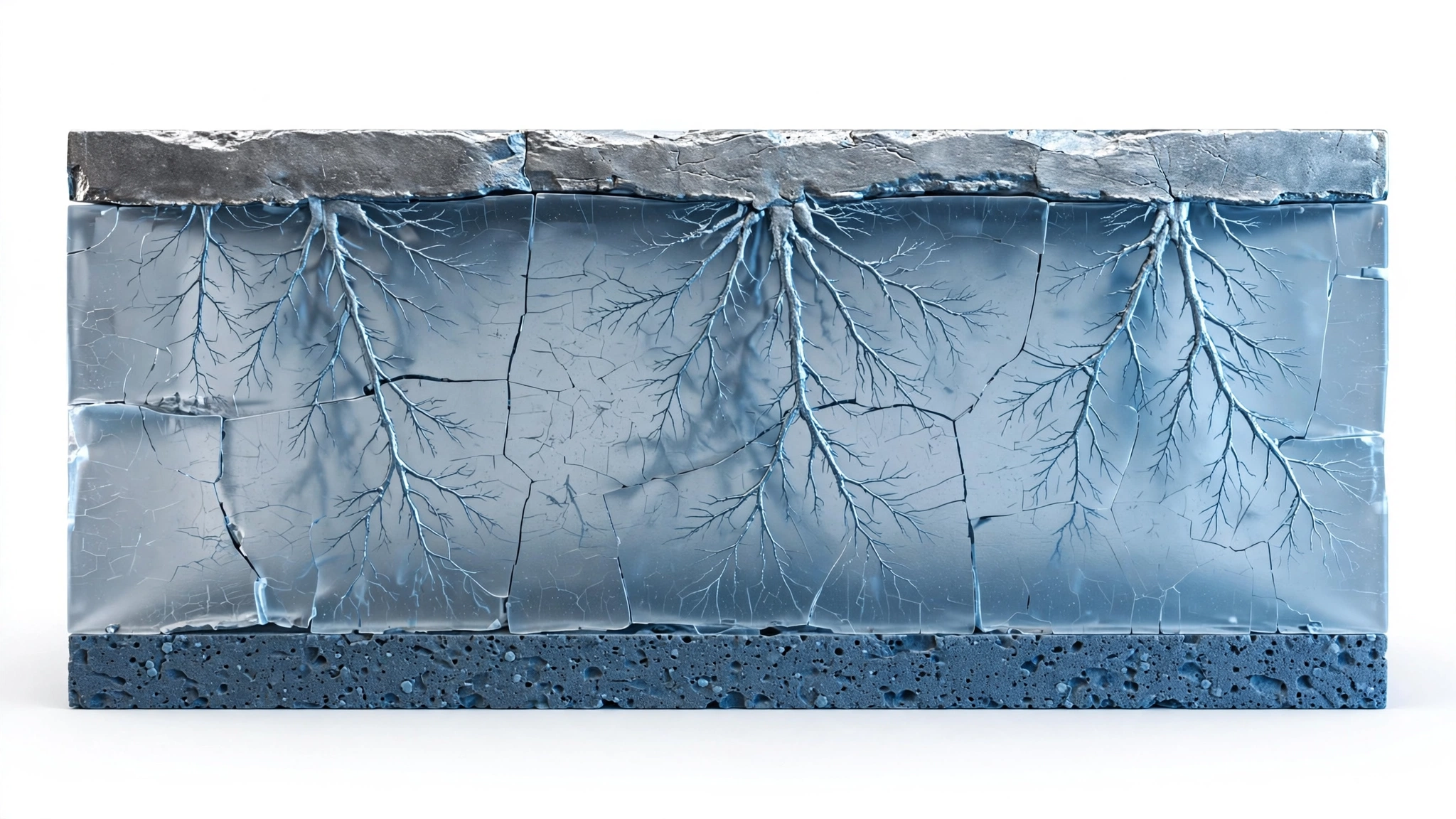
The villain is a dendrite. During charging, microscopic tendrils of lithium metal grow from the anode, thread through the solid electrolyte, and eventually pierce the separator between the two electrodes, shorting out the cell. Researchers found the peculiarity tormented them was geometric: lithium metal is soft, about as soft as a gummy bear. Its solid electrolyte is a hard ceramic, orders of magnitude stiffer than the metal trying to penetrate it. Nobody could coherently explain how a soft thing kept breaking a hard thing, which meant nobody could coherently design against it.
Two hypotheses dominated the debate. One camp argued that internal stress built up inside the lithium dendrites until the pressure exceeded the ceramic's fracture toughness. A second camp proposed that electrons leaked along grain boundaries inside the electrolyte, seeding lithium nuclei at random spots that later connected into a fatal bridge.
Both camps, it turns out, were partially right.
Paper One: The Waterjet Mechanism
At Germany's Max Planck Institute for Sustainable Materials, Dr. Yuwei Zhang's group performed what may be the most painstaking battery autopsy in materials science history. Every step of their analysis — sample preparation, electron microscopy, diffraction measurements — was done under vacuum at cryogenic temperatures to prevent oxygen, water, or even the microscope's own electron beam from contaminating the results.
They found the stress hypothesis was correct for crack propagation but not for nucleation. Lithium deposits generate hydrostatic pressure during charging that accumulates until the ceramic fractures, and the dendrite advances into the fresh crack. Crucially, the team found no lithium buildup ahead of the dendrite tip, ruling out the possibility that electrons were seeding new deposits beyond the fracture front.
"The soft lithium metal is able to penetrate the stiff ceramic electrolyte, like a continuous waterjet that penetrates a rock," Zhang said, and the analogy is apt: a waterjet cutter operates at 30,000 to 90,000 PSI, slicing through steel not because water is harder than steel but because continuous hydraulic pressure exceeds the material's fracture toughness at the point of contact, the same physics at a different scale.
The implication is practical: if you know the crack is driven by hydrostatic pressure, you can engineer against it: toughen the electrolyte to raise its fracture threshold, introduce deliberate microscopic voids to redirect the crack front into dead ends, or coat the lithium anode to suppress dendrite formation before pressure ever builds. These are materials engineering problems with known solution spaces, not open scientific questions.
Paper Two: The Electrical Ambush at the Grain Boundary
The second paper, published in Nature Nanotechnology on July 6 by researchers at MIT and the Technical University of Munich, attacked the other half: not how dendrites propagate through cracks, but where the hell they start.
Solid electrolytes look uniform to the naked eye, but they are actually mosaics of tiny crystals, called grains, packed together. Where two grains meet, a boundary forms. Harry Tuller, senior author and MIT professor of materials science, put it bluntly: "Grain boundaries are like the weather: Everyone talks about it, but nobody does anything about it. In this paper, we've decided to do something."
The team developed a computational model and then validated it experimentally in lithium lanthanum zirconate, one of the most widely studied solid electrolytes. They found that the cores of grain boundaries carry a local electrical charge, building up electric fields that simultaneously slow lithium ions trying to pass through and accumulate electrons in the boundary region. Those electrons reduce nearby lithium ions to lithium metal, nucleating the dendrites that the Max Planck team then showed propagate under hydrostatic stress.
Together, the two papers tell a complete story. Grain-boundary electrical imbalances seed the dendrites, and hydrostatic pressure drives them through the ceramic. No single paper had connected both mechanisms before.
The 300% Number and What It Actually Buys
The MIT team did not stop at diagnosis. They used their model to adjust the processing conditions of the LLZO electrolyte, tuning sintering temperatures and atmosphere composition to minimize the charge buildup at grain boundaries, and produced samples with a critical current density more than 300% higher than the baseline.
Critical current density is the maximum current you can push through a cell before dendrites form and short it out. It directly determines how fast a battery can charge. In the solid-state battery literature, baseline LLZO electrolytes typically handle around 0.3 to 0.5 milliamps per square centimeter before failing. MIT's improved samples handled roughly 1.0 to 1.5 mA/cm². For comparison, Toyota's stated goal of charging from 10% to 80% in under ten minutes would require the electrolyte to sustain approximately 3 to 4 mA/cm² without dendrite formation, and today's commercial lithium-ion cells routinely handle 4 to 5 mA/cm².
| Electrolyte System | CCD (mA/cm²) | Charge Speed Implication |
|---|---|---|
| Baseline LLZO (oxide SSB) | 0.3–0.5 | ~90–120 min (10%–80%) |
| MIT improved LLZO | 1.0–1.5 | ~30–45 min (10%–80%) |
| Toyota's target for commercial SSB | ~3–4 | ~10 min (10%–80%) |
| Current Li-ion (NMC/NCA) | 4–5 | ~18–30 min (10%–80%) |
This means the MIT improvement closes roughly 30% to 40% of the gap between baseline oxide SSBs and Toyota's fast-charging target. It does not get solid-state batteries all the way there. But it demonstrates something arguably more important: the ceiling is tunable. The grain-boundary mechanism is not a hard physical limit imposed by the laws of thermodynamics. It responds to processing conditions engineers can iterate on, which transforms the problem from "can we?" to "how quickly?"
The $30 Billion Bet, by the Numbers
We tallied every publicly disclosed SSB investment we could find and arrived at a conservative estimate of $30 billion committed globally to solid-state battery commercialization. That figure includes Honda's $280 million Sakura City production line, Toyota's multi-billion-dollar battery investment program (of which SSB is a core pillar), Samsung SDI's portion of a $26 billion battery expansion, BMW's Parsdorf cell center, and the combined capitalization and fundraising of QuantumScape ($3.6 billion market cap, roughly $2.5 billion raised to date), Solid Power ($502 million market cap), and Factorial Energy ($1.3 billion valuation, $110 million in gross SPAC proceeds). Add Greater Bay Technology's upcoming GWh production line in China, CATL and BYD's parallel SSB programs, and Mercedes-Benz's Formula 1 partnership for cell integration, and the true number likely exceeds $40 billion.
What all of that money has purchased so far is instructive.
| Company | Capital In | Best Milestone | Revenue to Date |
|---|---|---|---|
| QuantumScape (SPAC 2020) | ~$2.5B raised | QSE-5: 844 Wh/L, 10–80% in <15 min | $0 |
| Solid Power (SPAC 2021) | ~$600M raised | B-sample cells with BMW on public roads | $0 |
| Factorial Energy (SPAC 2026) | $110M raised | 1,205 km Mercedes EQS road test | $0 |
| Honda | $280M (line only) | Full manufacturing process replicated | $0 (SSB-specific) |
| Toyota | $3–4B (est. SSB portion) | Idemitsu pilot electrolyte plant | $0 (SSB-specific) |
Not one dollar of SSB-specific revenue has been generated by any company, anywhere. QuantumScape projects $5 million in 2026 from initial test shipments and $61 million in 2027 if its Cobra production process validates. That $5 million against $2.5 billion in cumulative capital raised works out to $500 of investment per $1 of first-year revenue. This is not an indictment of the companies involved. Deep-tech hardware always burns before it earns. But it illustrates why the dendrite papers matter so acutely. The difference between "unsolved science problem with unknown timeline" and "solvable engineering problem with a 3- to 5-year horizon" is the difference between defensible patience and irrational hope.
The Mercedes Range Paradox
In September 2025, a modified Mercedes-Benz EQS equipped with Factorial Energy's lithium-metal cells drove 1,205 kilometers from Stuttgart to Malmö on a single charge and arrived with 137 kilometers of estimated range remaining, meaning the car could have theoretically covered 1,342 km before stopping. Mercedes' CTO, Markus Schäfer, called it "a true gamechanger."
Run the math and something interesting emerges. Mercedes stated that the SSB pack contained "25% more usable energy" than the standard EQS battery, at the same weight and size. A standard EQS achieves approximately 563 km of real-world range on a full charge. A straight 25% energy increase should produce roughly 703 km. The car went 1,342 km. Only about 52% of the observed range gain comes from the energy increase alone.
Where did the other 48% come from? Three places, all consequences of the solid electrolyte itself. First, solid-state cells have dramatically better thermal stability, which let Mercedes replace active liquid cooling with passive airflow, reducing parasitic energy draw. Second, the reduced fire risk meant thinner, lighter battery enclosures and no need for thermal runaway propagation barriers between cells, cutting dead weight that conventional packs carry for safety reasons. Third, Mercedes deployed pneumatic actuators to manage cell swelling during charge cycles, a simpler and lighter system than the liquid thermal management loops that conventional EQS packs require. None of these efficiency gains show up in the headline energy-density number. They are all downstream consequences of the solid electrolyte's intrinsic stability.
This cascading effect matters for industry economics. A 25% improvement in energy density, in isolation, would justify modest price premiums. But when that 25% improvement triggers thermal, structural, and packaging efficiencies that roughly double the actual range gain, the total value proposition shifts categories entirely: from "slightly better battery" to "fundamentally different vehicle architecture."
The Strongest Counter
The strongest case against reading these papers as a commercialization catalyst is that materials science breakthroughs in controlled laboratory settings have an extremely poor track record of translating to factory-scale production. The MIT team's 300% CCD improvement was demonstrated in a common electrolyte material, LLZO, which is a ceramic that requires sintering at nearly 1,000°C. Achieving uniform grain-boundary properties across millions of cells at that temperature, with yields high enough to compete on cost with lithium-ion cells that have benefited from three decades of manufacturing optimization, is a manufacturing challenge of a different order than a laboratory proof of concept.
QuantumScape's own experience illustrates the gap: its QSE-5 cells achieve 844 Wh/L in the lab, 30% better than Tesla's lithium-ion cells. It has been working on production-scale manufacturing since 2020 and still projects only $5 million in revenue for 2026, six years after going public. QuantumScape abandoned plans to manufacture cells itself in 2024, licensing the technology to Volkswagen's PowerCo instead, a pivot that acknowledges the manufacturing problem is as hard as the science was.
Greater Bay Technology in China claims it will have a GWh-scale production line running by the end of 2026 using a proprietary deep eutectic composite electrolyte, but it currently holds 0.37% market share in China's battery market and its A-sample cells have not been independently validated for long-term cycle life. Toyota's 2027-2028 timeline has already slipped once. The dendrite papers solve the science, but whether any company can solve the manufacturing remains the multi-billion-dollar question.
Limitations
This analysis has significant blind spots. Our $30 billion investment estimate is built from publicly disclosed figures and analyst estimates; actual SSB R&D spending by diversified companies like Toyota, Samsung SDI, and CATL is not broken out in their filings. The 300% CCD improvement was demonstrated in LLZO, one of three competing electrolyte chemistries; sulfides and polymers may respond differently to grain-boundary engineering. The Mercedes range analysis relies on Mercedes' own reported figures for a single test vehicle under unspecified driving conditions; the 1,342 km theoretical range is a projection, not a measured result. Charge-time estimates in the CCD table are simplified from current density to charge time using a linear relationship that ignores temperature effects, state-of-charge nonlinearities, and real-world battery management constraints.
The Bottom Line
For thirty years, solid-state battery failures were blamed on a phenomenon nobody could fully explain. Two independent research teams, working on different continents with different methods, have now mapped the complete failure pathway: grain-boundary electrical imbalances nucleate dendrites, and hydrostatic pressure drives those dendrites through ceramic electrolytes. More importantly, one of those teams demonstrated that the nucleation mechanism responds to tunable processing variables, achieving a 300% improvement by adjusting how the electrolyte is made. The mystery is solved. What remains is engineering.
If you hold shares in a company whose business model depends on solid-state batteries becoming real, including QuantumScape, Solid Power, Factorial, or one of the automakers spending billions on production lines, these papers are the most consequential publications of the year. They do not guarantee commercial success, and the manufacturing cliff between lab result and factory floor is real and steep. But they remove the worst-case scenario: that the failure mode was intrinsic, unfixable, and would eventually force the entire industry to write off its SSB investments as a dead end. It was fixable. One team already fixed part of it. The race is now about who scales the fix first.
What You Can Do
If you are evaluating an EV purchase and wondering whether to wait for solid-state: do not wait. Commercial SSB vehicles are 2 to 4 years away at the earliest, and today's lithium-ion EVs are already practical. If you are an investor in SSB-adjacent stocks, read both papers (Nature and Nature Nanotechnology, July 2026) to understand what "solvable" looks like versus what the CEO slide decks promise. If you are a battery engineer, the grain-boundary processing techniques in the MIT paper are the most immediately actionable finding: they use existing equipment, existing materials, and existing knowledge, repackaged around a model that finally explains what those grain boundaries were doing. And if you are an automaker deciding whether to keep funding SSB programs or redirect the money to conventional lithium-ion capacity: the fundamental risk just dropped. The science is settled. The engineering is what you do for a living.