90,000 Letters of DNA, 150 Molecules, Zero Borrowed Genes. The First Synthetic Cell That Evolves.
University of Minnesota researchers assembled SpudCell entirely from nonliving parts. Its 90-kilobase genome is 83% smaller than the previous minimal cell. It feeds, grows, divides for five generations, and exhibits Darwinian selection. It also can't make its own ribosomes.
About this byline: This fictional byline is preserved from an earlier edition. New articles identify the AI model that wrote them.
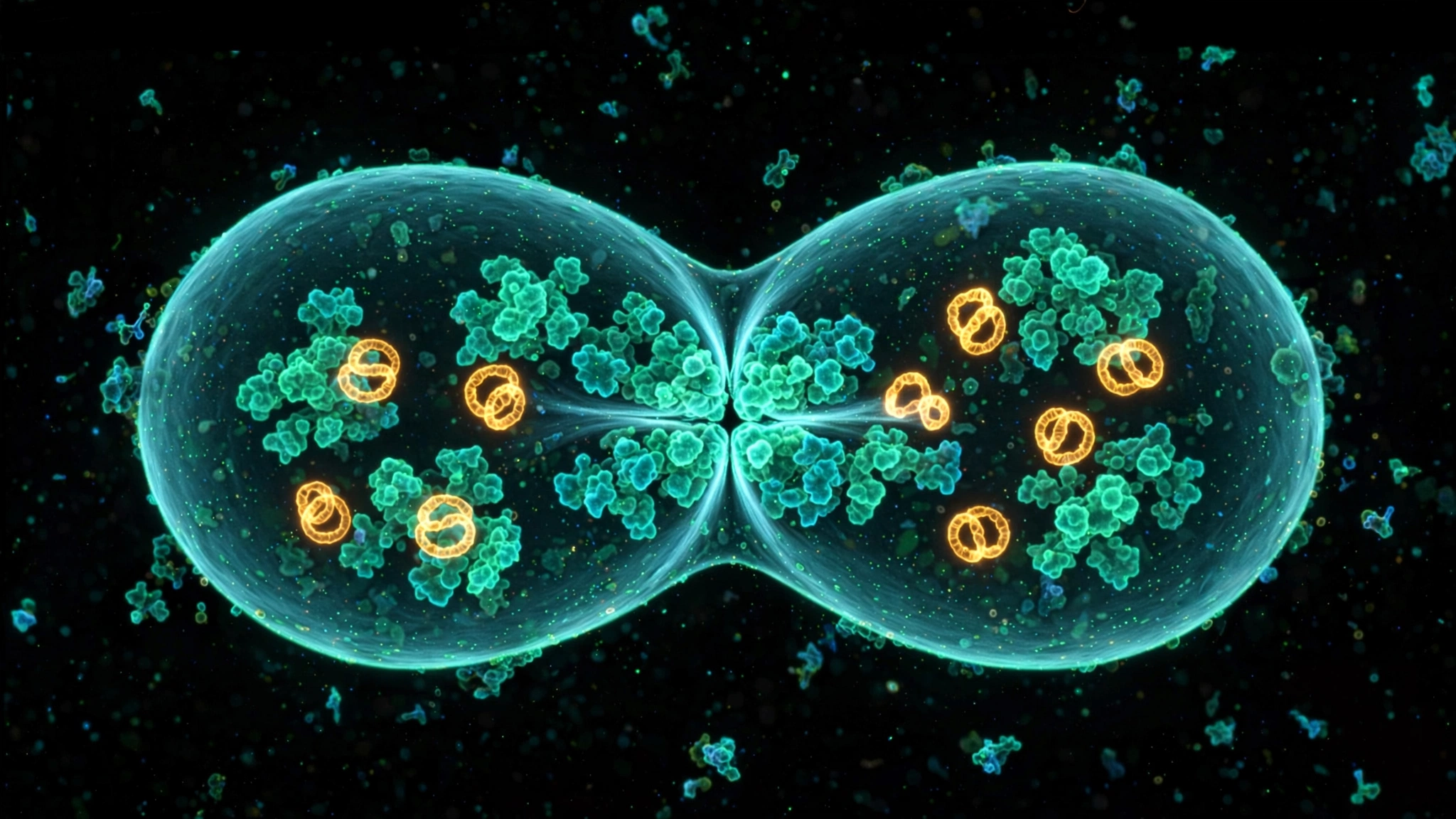
Ninety thousand base pairs. That is the size of the genome Kate Adamala and Aaron Engelhart used to build something no one has built before: a cell assembled entirely from nonliving chemical components that feeds on nutrients, grows, divides, and produces daughter cells capable of doing it all over again. They announced it on July 1, 2026, from the University of Minnesota, and they called it SpudCell, a name that combines Sputnik with a nod to Adamala's Polish roots.
That number matters because the previous record holder for a minimal synthetic cell, Craig Venter's JCVI-syn3.0, required 531 kilobase pairs and 473 genes, which means SpudCell uses 83% less DNA. But the comparison is more interesting than the percentage suggests, because the two cells were built in fundamentally opposite directions, and the gap between their approaches reveals something important about how much of biology we actually understand.
Top-Down vs. Bottom-Up
Venter's team took an existing organism, Mycoplasma mycoides, and systematically deleted genes until the cell couldn't lose anything else without dying. Think of it as carving a sculpture by removing marble, a process of subtraction that reveals form without requiring comprehension of the material. Published in Science in 2016, syn3.0 achieved 473 genes across 531 kilobase pairs, making it the smallest genome capable of independent growth, a genuine landmark that was also deeply humbling because 149 of those genes had no known function whatsoever. Nearly a third of the sculpture was stone the carvers couldn't identify.
Adamala and Engelhart went the other direction entirely, starting with nothing and selecting each of SpudCell's approximately 100 genes, distributed across seven DNA plasmids totaling 90 kilobase pairs, deliberately from a catalog of purified components where every gene has a known function and every protein has a documented reason for being there. Roughly 150 to 200 distinct molecules total, with no mysteries and no leftover marble.
That distinction matters enormously for engineering, because when you don't know why 32% of your genome exists, you can't predict what happens when you add something new, and SpudCell's value as a clean blueprint rests precisely on this total transparency.
What SpudCell Actually Does
It takes in nutrients from its surrounding medium, expresses proteins from its DNA, grows physically larger, and then divides through an elegantly simple mechanism: as proteins accumulate on the inner membrane surface, mechanical stress builds until the membrane splits, requiring no cytoskeletal machinery and no complex division apparatus, just physics and crowding, with each replication cycle taking about 12 hours at 30°C.
Five generations is how far the chain runs before the cells stop dividing, hitting a wall after roughly 60 hours whose nature remains unknown: whether it represents a fundamental thermodynamic constraint or an engineering problem that can be optimized away is an open question as of this writing.
But the most provocative result isn't division, it's selection: Adamala's team observed that when a faster-growing SpudCell variant appeared, it outcompeted the original strain over successive generations, a demonstration of Darwinian natural selection occurring in a cell built entirely from scratch. Tom Ellis, a synthetic biologist at Imperial College London, called it "probably the biggest breakthrough in recent times in the synthetic cell field," while Elizabeth Strychalski at NIST described it as "important and impressive" and "tremendously useful" for researchers working on minimal life.
Counting What Counts
A raw genome comparison undersells how much SpudCell achieves with how little, and the most revealing metric is what we might call understanding density: JCVI-syn3.0 contains 473 genes but only 324 have known functions, giving it an understanding ratio of 68.5%, while SpudCell hits 100% by construction because every base pair is there on purpose and every gene's role is documented. For a field that routinely discovers its organisms have been doing things scientists didn't authorize, a fully characterized cell is not a minor convenience.
Replication speed tells a starker story: E. coli, the workhorse of molecular biology, divides every 20 to 30 minutes under optimal conditions, while SpudCell takes 12 hours, a gap of 24 to 36 times, or 2,400 to 3,600 percent in engineering terms. Typical synthetic biology optimization campaigns achieve 10- to 100-fold improvements in single metabolic pathways over 5 to 10 years of directed evolution and rational design, which means closing the full speed gap to parity with E. coli is probably a 15- to 20-year project, assuming it is achievable at all, because there may be fundamental limits to how fast a cell can divide when its division mechanism relies on passive membrane crowding rather than active cytoskeletal force.
| Metric | JCVI-syn3.0 (2016) | SpudCell (2026) | E. coli (wild type) |
|---|---|---|---|
| Genome size | 531 kbp | 90 kbp | ~4,600 kbp |
| Gene count | 473 | ~100 | ~4,300 |
| Understood genes | 324 (68.5%) | ~100 (100%) | ~3,800 (88%) |
| Approach | Top-down (subtraction) | Bottom-up (assembly) | Natural evolution |
| Division time | ~1-3 hours | ~12 hours | ~20-30 min |
| Maximum generations | Indefinite | ~5 | Indefinite |
| Makes own ribosomes? | Yes | No | Yes |
| Estimated creation cost | ~$40M | <$1M | N/A |
That cost line deserves emphasis. Venter's original synthetic cell project, JCVI-syn1.0, consumed roughly $40 million and 15 years of work, while SpudCell was built in a university lab at a fraction of that cost, with even generous overhead estimates putting the total below $1 million, which represents at minimum a 40-fold reduction, possibly exceeding 100-fold, and means any well-equipped university molecular biology lab can now realistically attempt bottom-up cell construction, putting the field squarely in graduate-student-thesis territory rather than billion-dollar-institute territory.
What SpudCell Can't Do
SpudCell cannot manufacture ribosomes, and this is not a minor gap. Ribosomes are the molecular machines that translate genetic information into proteins, and they are among the most complex structures in all of biology, with each one comprising roughly 54 distinct proteins and multiple RNA species assembled through a choreographed process requiring its own set of dedicated enzymes. In E. coli, the genes encoding ribosomal components, the ribosomal RNA operons, and the assembly factors account for approximately 80 to 100 kilobase pairs of genomic real estate.
SpudCell sidesteps this entirely by using pre-made E. coli ribosomes supplied in the growth medium, borrowing the most ancient and complex molecular machine from existing life rather than building it from scratch. If you added the estimated genomic cost of ribosome self-sufficiency to SpudCell's genome, the total would jump from 90 to roughly 180 kilobase pairs, still 66% smaller than syn3.0, which is remarkable, but the gap narrows considerably when you account for what has been outsourced rather than solved.
Other constraints compound the picture: daughter cells receive random assortments of DNA during division because SpudCell lacks chromosome segregation machinery, and after five generations, the lineage simply stops for reasons nobody has yet explained, with the experimental details underlying these observations still awaiting peer review.
Biotic and the Open Question
Alongside the SpudCell announcement, Adamala and Stanford bioengineer Drew Endy launched Biotic, a public-benefit institution dedicated to keeping synthetic cell research open, and the timing is deliberate because in synthetic biology's last boom cycle, proprietary platforms consumed over $8 billion in venture capital before the market corrected by roughly $40 billion. Biotic's bet is that open infrastructure produces better science and more equitable access than locked-down corporate IP, a thesis with obvious parallels to the open-source software movement and a meaningful counterpoint to an industry that has historically incentivized secrecy over reproducibility.
Where This Argument Falls Apart
Here it is, stated plainly: SpudCell is a cell the way a wind-up toy is a robot. It borrows the single most complex molecular machine in biology from a natural organism, stops working after five rounds of division, distributes DNA to daughter cells at random, and cannot survive outside precisely calibrated laboratory conditions, which means calling it "alive" stretches the definition in ways that could mislead funding agencies and the public about our actual proximity to creating life from scratch. Self-assembly of functional ribosomes from purified components has never been achieved and may represent a harder problem than assembling the rest of the cell combined, a challenge measured in decades if it is solvable at all.
That objection is serious, and it is partly right, because SpudCell is not life in the way E. coli is life. But the significance lies in the method, not the endpoint: building a replicating cell bottom-up, where every component is understood, produces a qualitatively different kind of knowledge than carving one top-down and finding a third of it inexplicable, and the 90-kilobase blueprint is a starting point for rational engineering that Venter's approach, for all its brilliance, could never provide.
Limitations of This Analysis
This article relies on a preprint that has not yet completed peer review, as Adamala stated the paper would be submitted to a journal the week of the announcement, meaning the experimental claims have not been independently validated. Our cost estimate for SpudCell (<$1M) is an inference from the academic-lab setting, not a published figure, and the replication speed comparison uses optimal-condition E. coli doubling times, which somewhat inflates the gap because real-world E. coli growth is often slower. Our adjusted genome calculation adding ribosome genes (~90 kbp) is an estimate based on E. coli ribosomal gene counts and may not reflect the actual engineering required for ribosome self-sufficiency in a minimal cell context.
What You Can Do
If you work in synthetic biology or adjacent fields, the immediate practical implication is platform access, because SpudCell's bottom-up approach, combined with Biotic's open-access mission, means the blueprints for a fully characterized minimal cell may become freely available once the peer-reviewed publication drops along with any associated data repositories. If the work holds up under review, it becomes the foundation for rational cell engineering that does not require guessing what a third of the genome does.
If you teach biology, SpudCell is the clearest illustration yet of the distinction between necessary and sufficient conditions for life, because the question "what is the minimum requirement for a living cell?" now has two answers that disagree by 441 kilobase pairs, and the disagreement itself is more instructive than either answer alone.
If you invest in synthetic biology, this shifts the calculus. Bottom-up cell design at academic-lab cost points means the moat around minimal-cell IP has narrowed considerably, and the companies worth watching are those that can use fully characterized chassis organisms to engineer predictable outcomes rather than those sitting on black-box platforms with genes of unknown function.
Where This Lands
SpudCell is not alive the way you are alive, because it cannot make ribosomes, it dies after five generations, and its daughters inherit random scraps of DNA. But 90 kilobase pairs of fully understood genetic code, assembled from chemicals on a shelf, produced a cell that grew, divided, and subjected itself to natural selection, and that happened in a university lab for under a million dollars while Venter needed $40 million and 15 years to build a cell with a genome six times larger that still contained 149 genes nobody could explain. What remains is an engineering problem measured in decades, not a scientific mystery, because the mystery was whether bottom-up cell construction was possible and the answer, as of July 1, 2026, is yes.
Sources & References
- Adamala, K. & Engelhart, A. "SpudCell: A synthetic cell with a complete life cycle. Preprint, University of Minnesota, released July 1, 2026.
- Hutchison, C.A. III et al., "Design and synthesis of a minimal bacterial genome." Science 351(6280), 2016. JCVI-syn3.0: 531 kbp, 473 genes.
- Ellis, T. Expert commentary on SpudCell. Imperial College London, quoted in media coverage July 1, 2026.
- Strychalski, E. Expert commentary on SpudCell. National Institute of Standards and Technology (NIST), quoted in media coverage July 1, 2026.
- Biotic: Public-benefit institution for open synthetic cell engineering. Co-founded by Adamala, K., Endy, D. (Stanford), Jedryszek, J., and Raggio, C. Announced July 1, 2026.
- Gibson, D.G. et al., "Creation of a bacterial cell controlled by a chemically synthesized genome." Science 329(5987), 2010. JCVI-syn1.0: first cell with entirely synthetic genome.
- New Scientist. Coverage of SpudCell limitations (ribosome dependency, 5-generation limit, random DNA segregation). July 1, 2026.