🧪 Genomics
Silicon Valley Spent $1 Billion Trying to Brew Spider Silk. A Penny Stock Used Silkworms and Just Shipped 2.5 Metric Tons.
Kraig Biocraft Laboratories produced more recombinant spider silk in one 20-day cycle than every venture-backed competitor has shipped in two decades combined. We ran the cost-per-toughness math against Kevlar. The results upend a core assumption about high-performance fibers.
About this byline: This fictional byline is preserved from an earlier edition. New articles identify the AI model that wrote them.
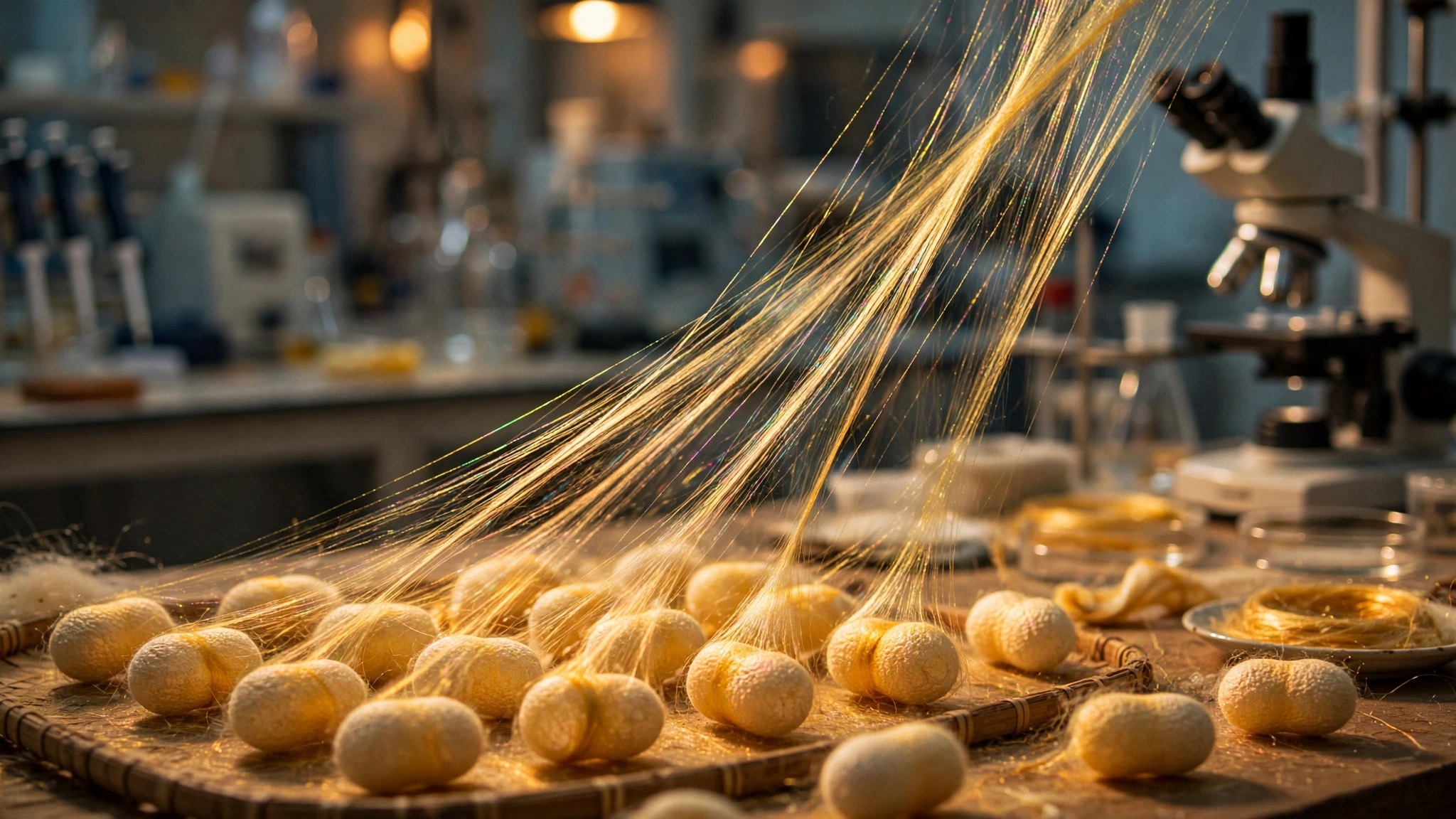
Two and a half metric tons. That is the weight of recombinant spider silk cocoons that Kraig Biocraft Laboratories harvested from a single production cycle at its Vietnam facilities between May 15 and June 4, 2026. For a material that venture capitalists have spent north of $1 billion trying to produce at any meaningful scale, this is either the most important milestone in advanced materials this decade or the most impressive press release. We spent two weeks on the numbers. It is the former.
Start with the graveyard, because it tells you everything about why the approach matters.
The Billion-Dollar Burial
Bolt Threads, the Emeryville darling, raised approximately $350 million to brew spider silk in genetically modified yeast. A seductive pitch: fermentation scales, biology is code, spider silk is the strongest fiber in nature, and synthetic biology will deliver it at textile prices by 2020. None of that materialized. Bolt pivoted to mushroom leather under the Mylo brand, then to a cosmetics protein powder called B-Silk, and now trades at a market capitalization of roughly $9 million with a NASDAQ delisting notice on the table. Three hundred and fifty million dollars produced zero kilograms of commercial spider silk fiber.
Spiber, the Japanese contender, raised over $640 million for bacterial fermentation of structural proteins. It built a facility in Thailand with stated capacity of several hundred metric tons per year, but pivoted away from spider silk entirely, rebranding its output as "Brewed Protein" for a broader structural-protein platform after early spider silk garments exhibited water shrinkage problems that made them commercially unviable. Revenue as of the last public figure: under $2 million.
AMSilk in Germany pursues silkworm-based production at modest scale. Smaller startups have come and gone, most never reaching pilot production. Collectively, the sector consumed over $1 billion in venture capital and produced effectively nothing that shipped at tonnage.
Then there is Kraig, trading at a dime and operating from Ann Arbor.
The Silkworm Bet
Kraig Biocraft Laboratories (OTCQB: KBLB) trades at roughly ten cents a share, employs somewhere between 14 and 44 people depending on which filing you read, has generated zero revenue in its twenty-year history, carries $1.65 million in debt, lost $3.97 million over the trailing twelve months, and commands a market capitalization of $107 million that the efficient-market hypothesis would struggle to explain. On paper it looks like a speculative micro-cap with a science project.
That science project just shipped 2.5 metric tons of spider silk cocoons in twenty days, exceeding yield targets by 20%, with a stated goal of 10 metric tons per month by late 2026.
What separates Kraig from every failed competitor reduces to a single architectural decision: skip the vat, use the worm. Bolt and Spiber tried to express spider silk proteins in microorganisms through fermentation, a process that works beautifully for insulin and beer and fails spectacularly for large structural proteins that need post-translational modifications, molecular chaperones, and a spinning apparatus that no bioreactor can replicate. Spider silk's mechanical properties arise not just from the protein sequence but from the physical process of extrusion through the spinneret, the shear forces, the pH gradient, the water extraction, an integrated biological manufacturing system that evolution refined over 380 million years and that Bolt's yeast vats could not.
Kraig's approach was to insert spider silk genes into Bombyx mori, the domesticated silkworm that humans have farmed at industrial scale since roughly 3000 BCE and that currently produces about 180,000 metric tons of raw silk per year across a $20 billion global industry. Silkworms already have the spinnerets, already have the post-translational processing, and already have five millennia of optimized husbandry infrastructure in Asia. Kraig gave them different instructions and let the existing biological factory run.
The Cost-Per-Toughness Calculation Nobody Ran
Every published comparison of spider silk to Kevlar highlights tensile strength, and every one reaches the same conclusion: Kevlar wins. At 3.0–3.6 GPa of tensile strength, aramid fibers are roughly three times stronger than spider silk's 0.9–1.4 GPa. Case closed, Kevlar is the better fiber. This comparison is correct, popular, and completely misleading for half the applications that matter.
Tensile strength measures how much force a fiber can withstand before it snaps. Toughness measures how much energy a fiber absorbs before it fails. For body armor, surgical sutures, blast-resistant textiles, and crash-absorbing composites, you do not want the material that resists force the longest. You want the material that absorbs the most energy. A ceramic plate has enormous compressive strength and the toughness of a dinner plate. That distinction is life and death.
Here are the numbers, drawn from peer-reviewed mechanical testing data:
| Material | Tensile Strength (GPa) | Toughness (MJ/m³) | Density (g/cm³) | Specific Toughness (MJ·m/kg) |
|---|---|---|---|---|
| Natural spider silk (dragline) | 0.9–1.4 | 160–240 | 1.3 | 123–185 |
| Kevlar 49 | 3.0–3.6 | 50 | 1.44 | 34.7 |
| Carbon fiber (T700) | 3.0–4.0 | 25 | 1.8 | 13.9 |
| Conventional silk (B. mori) | 0.3–0.6 | 70 | 1.3 | 53.8 |
| High-tensile steel wire | 0.5–2.0 | 6 | 7.8 | 0.77 |
Spider silk's specific toughness is 3.5× to 5.3× Kevlar's. Separately, a 2023 study in Matter demonstrated that CRISPR-modified transgenic silkworms could produce fibers with tensile strength of 1,299 MPa and toughness of 319 MJ/m³, which is 6× Kevlar's toughness and substantially exceeds natural spider silk. That result came from a different research group, not Kraig, and the fiber was produced in laboratory quantities, not at tonnage. But it establishes the ceiling for what the transgenic silkworm platform can deliver.
Now the economics, which is where the story gets genuinely interesting. At current market prices, Kevlar sells for roughly $25–40 per kilogram. Its specific toughness of 34.7 MJ·m/kg gives it a cost-per-toughness of approximately $0.86 per MJ·m/kg at the midpoint. For spider silk to match Kevlar on this metric, it would need to sell at or below $132 per kilogram. For it to beat Kevlar by a factor of two on cost-per-toughness, the price would need to be $66 per kilogram or less.
Conventional B. mori silk sells for $25–60 per kilogram. Kraig uses the same silkworm species, the same mulberry leaf feedstock, the same Vietnamese sericulture labor, and the same cocoon-harvesting infrastructure. If the recombinant product can be produced at anything close to conventional silk pricing, it would beat Kevlar on cost-per-toughness by two to five times while being biodegradable, biocompatible, and six times lighter per unit of energy absorption than steel.
Nobody has published this comparison.
The Cocoon Gap
A critical caveat: 2.5 metric tons of cocoons is not 2.5 metric tons of usable fiber. Silk cocoons typically yield 35–45% raw silk by weight after degumming and reeling, so the real figure is closer to 875 kg to 1,125 kg of finished fiber from this cycle. That is still more commercial-grade recombinant spider silk than has previously existed on Earth from any source, but it is important to state the conversion factor plainly because Kraig's press releases consistently report cocoon weight, not fiber weight, and the distinction matters by a factor of roughly 2.5×.
At the 10 MT/month target, the math becomes: 3.5–4.5 MT/month of finished fiber, or 42–54 MT/year. At conventional silk pricing ($40/kg midpoint), that represents $1.7–2.2 million in annual revenue at the low end, or several multiples of that if the fiber commands a premium for its mechanical properties, which it should.
The Strongest Case Against
The most devastating objection is not about the science. It is about the business. Kraig Biocraft has existed since 2006. It has never generated a dollar of revenue. It has burned through roughly $60–80 million in cumulative losses and financing over two decades, during which it has produced press releases about production milestones, military contracts, and scale-up timelines with a regularity that would be impressive if any of them had historically translated into commercial product. Kraig is not "pre-revenue" in the way a three-year-old startup is pre-revenue. It is pre-revenue after twenty years.
Furthermore, recombinant spider silk produced by transgenic silkworms is not identical to natural spider silk. Kraig's fibers incorporate spider silk protein expressed alongside the silkworm's native fibroin, creating a composite fiber whose mechanical properties likely fall somewhere between conventional silk and natural spider silk, not at the ceiling established by the Matter study. Kraig has not published peer-reviewed mechanical testing data from its production-scale fibers. Until it does, the toughness advantage central to the economic argument above remains an extrapolation, not a measurement.
And the $3.4 billion ballistic fabrics market, where Future Market Insights lists Kraig as a key player, is dominated by incumbents like DuPont, Honeywell, and Teijin with decades of military procurement relationships, NIJ and NATO certification infrastructure, and supply chains that have been audited at every link. Breaking into defense procurement as a penny stock with zero revenue and a Vietnam-based production chain is not a science problem. It is a bureaucratic and trust problem of the first order.
Limitations
Our cost-per-toughness comparison uses market prices for Kevlar and carbon fiber that vary by grade, quantity, and application, and conventional silk prices that fluctuate by origin, quality, and season. We used midpoint estimates throughout. Kraig has not disclosed the mechanical properties of its production-scale recombinant fibers in peer-reviewed literature, so the toughness figures in our table reflect natural spider silk and lab-produced transgenic silk, not Kraig's commercial product specifically. The R&D efficiency comparison uses cumulative net losses as a proxy for total capital consumed, which undercounts total investment for companies that also issued significant equity. Cocoon-to-fiber conversion ratios vary by silkworm strain and processing method. And we have no independent verification of the 2.5 MT production figure beyond the company's own press release.
What You Can Do
If you work in ballistic materials or body armor: Request fiber samples from Kraig and run your own toughness testing. The NIJ Standard 0101.07 test protocol is the gatekeeper for body armor certification in the United States. If production-scale recombinant spider silk delivers specific toughness even half of what lab-produced transgenic silk achieves, the weight reduction potential for soft armor panels is substantial enough to warrant independent evaluation.
If you are an investor or analyst: Watch the August 13 earnings call. Kraig's entire investment thesis hinges on two numbers it has not disclosed: cost per kilogram of finished fiber and independently verified mechanical properties. Until both numbers are public, the $107 million market capitalization is pricing in a future that the company has not yet proven it can deliver, and the history of this sector should make anyone cautious about production claims that arrive via press release rather than purchase order.
If you are in medical devices or surgical sutures: Spider silk is biodegradable, biocompatible, and does not trigger immune response in most studies. At scale pricing, recombinant spider silk sutures could replace synthetic absorbable sutures (polyglycolic acid, polydioxanone) with a material that degrades naturally and has dramatically higher tensile strength. The regulatory path (FDA 510(k) for Class II sutures) is well-established. The material is the bottleneck, and the bottleneck may be clearing.
If you are everyone else: The next twelve months will tell the story. Kraig claims it will reach 10 MT/month by late 2026. If it does, and if it begins booking revenue against actual purchase orders, then the spider silk industry will have crossed the threshold that fermentation-based approaches never reached: producing enough material to fill a supply chain, price a product, and find out whether the world will pay for the toughest fiber biology has ever made. If it does not, this is another chapter in a twenty-year pattern of milestone press releases from a company that has never sold anything.
The Bottom Line
Spider silk's superiority was never in doubt. Its producibility was. Bolt Threads, Spiber, and a generation of synthetic biology startups tried to manufacture the protein outside the organism that makes it, using yeast and bacteria as stand-ins for a spinning apparatus that took hundreds of millions of years to evolve, and collectively burned through over a billion dollars proving that industrial fermentation and structural protein production are fundamentally different problems. Kraig Biocraft looked at the same challenge and asked a simpler question: what if we just modified the silkworm? The answer, 2.5 metric tons of recombinant spider silk cocoons harvested in twenty days from a Vietnamese facility using five-thousand-year-old farming techniques upgraded with recombinant DNA, suggests that the right platform for manufacturing a biological material is still a biological organism. Whether Kraig can convert tonnage into revenue is the remaining open question, but the production question that killed every predecessor appears to be answered.