Sixty-three cryogenic tanker trucks carrying liquid methane at minus 162 degrees Celsius, followed by another 111 tankers of liquid oxygen, all converging on a single launch pad in an hours-long procession that SpaceX has described as incompatible with its expansion plans. That is what one Starship launch requires, based on the 630,000 gallons of liquid methane each flight consumes. Every launch summons a convoy of roughly 174 vehicles rumbling down South Texas roads in a choreographed dance of extreme cold and flammable cargo.
So the company is building a pipe.
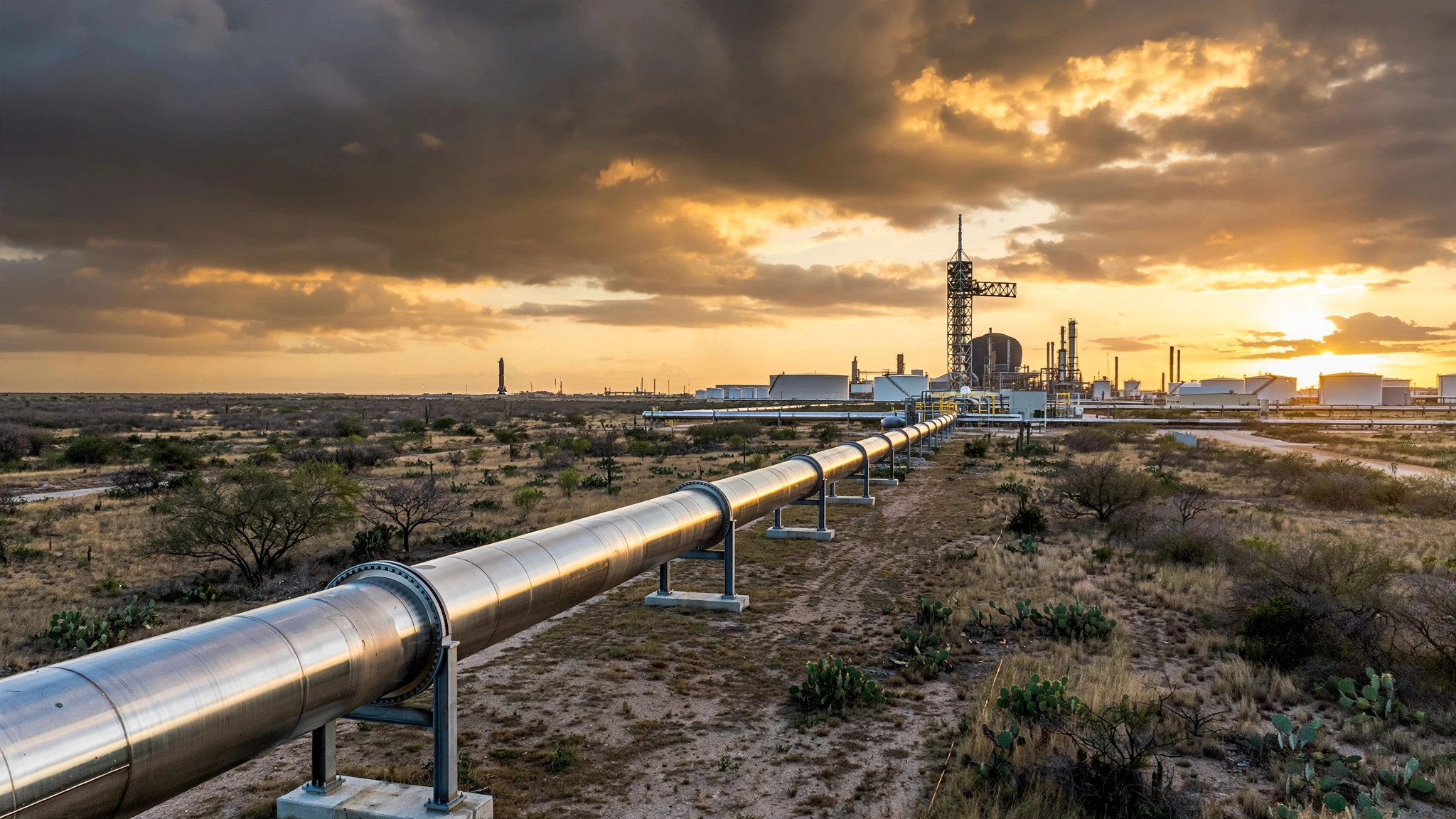
On June 25, Reuters reported that SpaceX affiliate Lone Star Mineral Development has filed with the Texas Railroad Commission to construct Starpipe, an eight-mile, 16-inch natural gas pipeline connecting the Port of Brownsville to Starbase, with construction starting next month and service beginning early 2027. SpaceX President Gwynne Shotwell told CNBC on June 12 that the company planned to "build pipelines, process its own propellant," and was "looking into drilling its own natural gas."
Most coverage treated this as a logistics upgrade, trucks out and pipe in, and left it there. Nobody ran the numbers on what the pipeline's engineering specifications actually imply about SpaceX's launch rate ambitions.
The Weymouth Equation Says More Than SpaceX Will
A pipeline's diameter and length determine its throughput, and the relationship is governed by physics rather than speculation. The Weymouth equation, a gas-flow formula used across the pipeline industry since 1912, relates flow rate to pipe diameter raised to the 8/3 power, divided by the square root of length, gas gravity, and temperature. Plug in Starpipe's known dimensions and the result is startling.
Start with the fuel budget for a single flight. Each Starship launch burns approximately 1,007 metric tons of liquid methane, with roughly 739 tons filling the Super Heavy booster and 330 tons going into the upper stage, derived from publicly documented propellant masses and Raptor's well-characterized 3.6:1 oxidizer-to-fuel ratio. Convert that mass to natural gas equivalent at standard conditions and you get roughly 52,400 MCF per launch, which at the current Henry Hub spot price of approximately $3.30 per million BTU means the raw gas for one flight costs about $179,000 before anyone cools it to cryogenic temperatures.
Now apply that to the pipe: for 16 inches of diameter running 8 miles with methane at a specific gravity of 0.6, even at conservative distribution-level pressures of 300 psia inlet and 100 psia outlet, the Weymouth equation yields approximately 201 MMCF per day, and since each launch needs 52.4 MMCF, that translates to 3.8 Starship refuels per day, or about 1,400 per year.
At moderate transmission pressures of 600 psia inlet and 200 psia outlet, throughput jumps to roughly 403 MMCF per day, enough for 7.7 flights daily or approximately 2,800 launches per year. SpaceX's current FAA license permits 25.
| Scenario | Pipeline Pressure | Daily Gas Flow | Launches/Year |
|---|---|---|---|
| Conservative (distribution) | 300/100 psia | 201 MMCF/day | ~1,400 |
| Moderate (transmission) | 600/200 psia | 403 MMCF/day | ~2,800 |
| Current FAA license | n/a | 3.6 MMCF/day avg | 25 |
Reuters noted that "the pipeline's 16-inch diameter suggests fuel demand exceeding what Starship would require for 25 launches." That is like saying an aircraft carrier exceeds what you need to cross a pond. Even the conservative estimate exceeds the FAA-approved cadence by a factor of 56.
What 1,000 Launches Looks Like on the Ground
Numbers this big need anchoring against something tangible. At 1,000 launches per year, Starbase would consume approximately 52.4 billion cubic feet of natural gas annually, and since the average American household uses about 63 MCF per year according to the EIA, SpaceX's demand at that cadence would equal the residential gas consumption of roughly 832,000 homes, which is a city of about two million people, roughly the size of Houston proper.
Consider the local comparison for a sharper sense of scale. Brownsville sits eight miles from Starbase with a population of approximately 190,000, and at 1,000 launches per year, Starbase would burn through 10.9 times more gas than the entire city next door.
The trucking arithmetic makes the impossibility concrete: sixty-three methane trucks multiplied by 1,000 launches equals 63,000 tanker-truck round trips per year on Cameron County's narrow highways, which means 172 trucks per day, every single day, just for methane, before a single LOX delivery rolls through, and that volume of cryogenic freight moving through a community of 190,000 on two-lane roads is not a traffic problem to be managed but a physical impossibility to be replaced. Over three years of test flights, SpaceX has needed about 250 total methane deliveries. Starpipe does not just save time; it eliminates an impassable wall.
From Wellhead to Orbit
Starpipe is not a solo project but one piece of a supply chain that extends underground.
Reuters' review of Cameron County land records found over 100 paid-up oil and gas leases signed by SpaceX with Texas property owners since 2023. Engineering plans filed with the United States Army Corps of Engineers show a planned liquefaction facility at Starbase to process piped-in natural gas into liquid methane, and the 83-acre site at the Port of Brownsville where Starpipe originates is the subject of 50-year lease negotiations with the city. Fifty-year leases do not suggest hedging.
No launch company has attempted this level of fuel-supply vertical integration, and the gap with competitors is enormous. United Launch Alliance buys refined kerosene from petroleum suppliers. Arianespace purchases liquid hydrogen from Air Liquide. SpaceX is constructing a supply chain that starts with hydrocarbon deposits beneath South Texas, runs through its own pipeline, gets liquefied in its own plant, and terminates on its own launch pad, and if the drilling leases produce usable gas, the company would control every link from wellhead to orbit.
The economics reward the ambition generously: at market rates, total propellant cost per Starship launch falls between $556,000 and $719,000, combining roughly $288,000-$451,000 for pipeline-delivered liquid methane with $268,000 for liquid oxygen produced on-site by SpaceX's air separation units. Drill your own gas at a wellhead cost around $1.00/MMBTU and the methane portion drops to $163,000-$217,000 per launch, pushing total propellant below $500,000 for a vehicle that already produces its own oxidizer from air.
For a rocket targeting $10 million per flight in total cost, fuel at under 5% of that total makes economic sense only if you plan to fly it with relentless frequency.
| Cost Component | Market Rate | Vertical Integration |
|---|---|---|
| Raw natural gas | $179,000 | $54,000 (own wells) |
| Liquefaction | $109,000-$272,000 | $109,000-$163,000 |
| LOX (on-site ASU) | $268,000 | $268,000 |
| Total propellant | $556,000-$719,000 | $431,000-$485,000 |
The Strongest Objection
Pipeline engineers routinely oversize their installations because the marginal cost difference between a 12-inch pipe and a 16-inch pipe during construction is modest compared to eight miles of trenching through South Texas, and since you cannot easily swap a buried pipe for a bigger one later, conservative specifications represent standard practice in an industry where undersizing means excavating everything again. A 16-inch specification could reflect ordinary engineering prudence rather than a thousand-launch roadmap, and interpreting it as a deliberate signal of launch rate ambitions risks reading too much into what may simply be a practical decision to build once and build big.
More fundamentally, fuel supply is one constraint among dozens that must all be solved simultaneously. Pad turnaround time currently runs months rather than hours. Booster refurbishment involves extensive inspection after every flight. The FAA's environmental review process for dramatically higher launch cadences has no precedent, no template, and no public timeline, and the remaining bottlenecks of range scheduling, sonic boom mitigation, non-fuel supply chains, and payload demand each represent constraints as binding as fuel supply. SpaceX has demonstrated none of these capabilities at the rates the pipeline could theoretically support, and Musk's stated ambition of "thousands" of launches per year remains aspiration rather than plan.
What the Numbers Don't Show
This analysis uses assumed operating pressures because the Texas Railroad Commission filing does not specify them in the public record, and actual pipeline capacity could differ meaningfully from the Weymouth estimates depending on these parameters. The liquefaction facility's throughput, which SpaceX has not disclosed, represents the true production bottleneck: a pipeline can deliver gas far faster than a small liquefaction plant can cool it to minus 162 degrees Celsius. The 630,000-gallon-per-launch figure reported by Reuters may also exclude chill-down losses, boiloff, and system residuals that would increase real-world consumption by an estimated 5 to 15 percent.
One calibration check keeps the enormous numbers in perspective. Freeport LNG, a single Gulf Coast export terminal roughly 300 miles up the coast from Starbase, processes about 2,140 MMCF per day. SpaceX's demand at 1,000 launches per year would total 143.6 MMCF per day, about 6.7 percent of one major terminal's throughput, which is significant by launch-industry standards but unremarkable by industrial-gas standards. Starbase would become a midsized industrial consumer of natural gas, not a draw that moves national supply curves.
What You Can Do
If you are a SpaceX investor evaluating post-IPO capital allocation, the combination of Starpipe, 100-plus oil and gas leases, and a planned liquefaction facility signals that management is spending real capital on fuel infrastructure sized for 50 to 100 times the current launch rate, and that level of forward investment either represents extraordinary conviction about Starship's future flight cadence or significant overcapitalization of an unproven supply chain. Watch the FAA's Starbase environmental review for signals about which interpretation is correct.
If you follow launch-industry economics, use the cost tables above to benchmark propellant spending across providers. SpaceX's vertically integrated fuel cost at $431,000-$485,000 per flight, if achieved, would make Starship's total propellant cheaper than the solid-rocket-motor grain in a single Space Launch System booster segment, which costs approximately $60 million and is discarded into the Atlantic Ocean after each use, and that comparison alone tells you where the structural economics of the industry are heading.
If you live in Cameron County, note that an 8-mile gas pipeline is modest infrastructure by itself, but what it enables is not. A 1,000-launch Starbase would be the highest-throughput launch facility in human history, with proportional consequences for air quality, traffic patterns, and community noise exposure, and the Railroad Commission filing represents the opening chapter of a much longer story about what southern Texas becomes.
The Bottom Line
A logistics fix is a bigger tank farm or a second loading dock. Starpipe is not that. This is natural gas infrastructure sized for a launch rate that does not yet exist, built by a company simultaneously signing drilling leases and permitting its own liquefaction plant, a company that already manufactures its own engines, constructs its own launch towers, and produces its own liquid oxygen from the air above its factory floor. The pipeline can deliver enough gas for 1,400 to 2,800 launches per year. Starship has flown 12 times. That gap between numbers is not a mistake. It is a bet.