SpaceX Launched 170 Rockets in 2025 and Charged for 43. The IPO Filing Shows Where the Other $2.4 Billion Went.
SpaceX's 308-page S-1 prospectus reveals three numbers that should give late-stage IPO buyers pause: Starlink's average revenue per user has collapsed from $99 to $66 a month in under three years, the xAI merger destroyed $1.44 for every dollar Starlink earned, and the current market cap values each satellite internet subscriber at $218,000. An original cross-subsidy analysis shows how 127 uncharged rocket launches inflate one segment's margins while concealing another's losses.
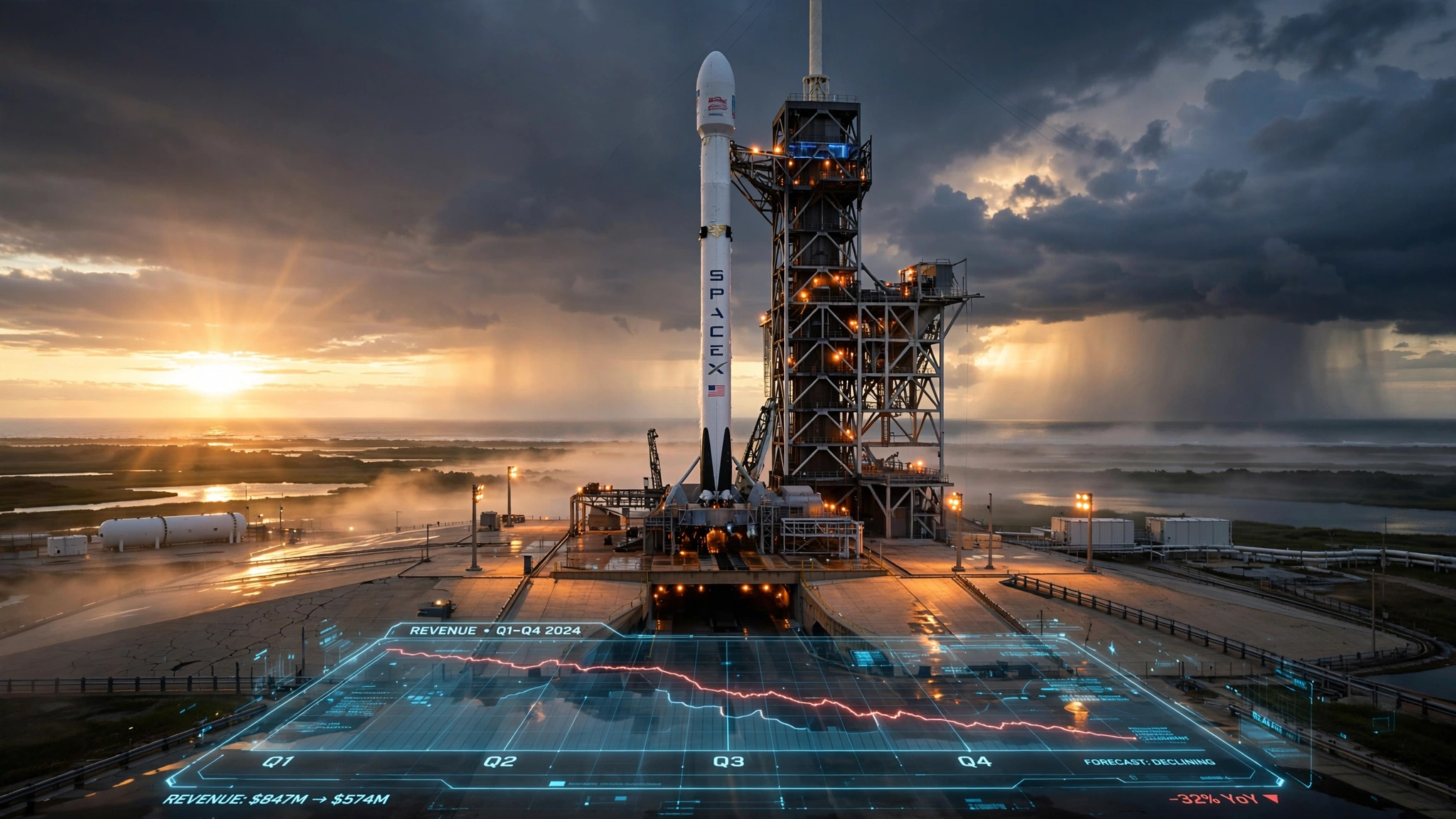
$218,447. That is what SpaceX's current market capitalization assigns to each of its 10.3 million Starlink subscribers, a figure arrived at by dividing the company's roughly $2.25 trillion market cap by the subscriber count disclosed in its S-1 registration statement filed May 20, 2026. AT&T values each wireless subscriber at $2,196. Verizon: $2,114. T-Mobile: $3,589. SpaceX's premium over the average U.S. telco is not 2x or 5x. It is 99x.
Yes, SpaceX is more than an internet provider. It launches rockets. It runs xAI. It plans to put data centers in orbit. But Starlink generated 61% of the company's $18.7 billion in 2025 revenue and all of its operating profit, according to the prospectus financials analyzed by Morningstar. Strip away the AI narrative and the Mars ambitions, and the valuation comes down to one question: is a satellite internet subscriber in rural Indonesia worth 99 times more than an AT&T postpaid customer in Dallas?
What 308 Pages Actually Show
SpaceX priced its IPO at $135 per share on June 12, 2026, raising capital in what Goldman Sachs, Morgan Stanley, and 21 other underwriters called the largest public offering in history. Shares briefly touched $225.64 before settling around $157. Elon Musk retains 85.1% of combined voting power through dual-class stock.
Strip the narrative packaging from the S-1 and the numbers tell a three-act story:
| Segment | 2024 Revenue | 2025 Revenue | 2024 Op. Income | 2025 Op. Income |
|---|---|---|---|---|
| Space (launches) | $3.8B | $4.1B | $21M | ($657M) |
| Connectivity (Starlink) | $7.6B | $11.4B | $2.0B | $4.4B |
| AI (xAI) | $2.6B | $3.2B | ($1.6B) | ($6.4B) |
| Total | $14.0B | $18.7B | $466M | ($2.6B) |
Source: SpaceX Form S-1; all figures in millions. 2025 numbers recast to include xAI absorption (Feb 2026). Net loss for 2025: $4.9B.
Act one: Starlink doubled its subscribers and nearly doubled its profit. Act two: the rocket business that enabled that growth swung from a $21 million profit to a $657 million loss. Act three: xAI, absorbed into SpaceX via an all-stock merger in February 2026, incinerated $6.4 billion in operating losses on $3.2 billion in revenue. Combined net loss for 2025: $4.9 billion.
Without xAI, SpaceX would have earned roughly $3.8 billion in operating profit. With it, the company lost $2.6 billion. A decision made in a boardroom controlled by one person turned a profitable enterprise into one bleeding cash.
The 127 Free Rockets
SpaceX conducted 170 rocket launches in 2025. Of those, 122 carried Starlink satellites and five were Starship development flights. That left 43 missions for paying customers.
Divide $4.1 billion in Space segment revenue by 43 paid launches and you get $102 million per customer mission, a number that surprises nobody who follows launch pricing because SpaceX's Falcon 9 lists at $74 million on its website and premium or complex missions can run considerably higher.
Now divide $4.1 billion by all 170 launches and you get $24 million per launch. Investors who use the second number are making a mistake that the prospectus quietly encourages. As SpaceX states in the S-1 filing: "For launches of our Starlink satellites, the Company does not recognize any inter-segment revenue, rather those launch costs are capitalized in satellites." In plain language: Starlink gets 122 rocket rides per year for free. The bill shows up later, spread across five years of satellite depreciation, not as a launch cost in the quarter the rocket actually flew.
Quantifying this hidden subsidy requires estimating Falcon 9's marginal launch cost, which SpaceX does not disclose and which the S-1 specifically omits. New Space Economy estimates $28 million for a Starlink-class internal mission. Motley Fool analysts put the floor at $15 million. Taking the midpoint of $20 million: 122 Starlink launches multiplied by $20 million equals $2.44 billion in annual launch costs that appear nowhere in the Space segment's revenue line and only trickle into Starlink's expenses over a five-year depreciation window.
In year one, roughly $488 million of that $2.44 billion hits Starlink's books. By year five, with five overlapping annual cohorts of capitalized launch costs depreciating simultaneously, the annual charge approaches $2.4 billion. That amount represents more than half of Starlink's 2025 operating profit.
The ARPU Problem
Revenue per subscriber is falling. Fast.
| Period | Subscribers (M) | ARPU ($/month) | YoY ARPU Change |
|---|---|---|---|
| 2023 | 2.3 | $99 | — |
| 2024 | 4.4 | $91 | -8.1% |
| 2025 | 8.9 | $81 | -11.0% |
| Q1 2026 | 10.3 | $66 | -23.3% |
Source: SpaceX S-1, Connectivity segment operating metrics.
From $99 to $66 in under three years. A 33% decline, and accelerating: the year-over-year drop widened from 8% to 11% to 23%. SpaceX's own management acknowledged in the filing that ARPU will continue falling as international expansion brings in subscribers who pay less, with the company stating it expects "these dynamics to be offset by increased scale and technological advancement."
Scale and efficiency, in other words. Not pricing power.
Run the numbers forward: if Starlink reaches 20 million subscribers at $50 per month, which is the trajectory these figures imply given that two-thirds of recent growth comes from markets with structurally lower willingness to pay, annual revenue would hit $12 billion. At the original $99 ARPU, those same 20 million subscribers would generate $23.8 billion. ARPU compression means SpaceX needs approximately 60% more subscribers to reach the same revenue target, each one generating lower margins because emerging-market customers consume the same orbital bandwidth but contribute less to fixed-cost recovery.
Where does the floor sit? Starlink's total operating costs in 2025 were approximately $7.0 billion against $11.4 billion in revenue. At 10 million subscribers, breakeven monthly ARPU works out to $58. Q1 2026 ARPU of $66 leaves $8 of headroom per subscriber per month. Eight dollars separating profit from loss in a business that constitutes the entirety of SpaceX's positive cash generation.
The xAI Black Hole
Musk merged xAI into SpaceX through an all-stock transaction in February 2026. A PitchBook analysis of the S-1 found that AI-related language constitutes 47% of segment-specific text in the filing and that SpaceX claims a $28.5 trillion total addressable market, of which 93% comes from AI applications. On actual revenue, the AI segment contributed 17%.
On actual losses, it contributed most of them. xAI posted a $6.4 billion operating loss on $3.2 billion in revenue in 2025, for operating margins of negative 199%. Its free cash flow loss hit $14 billion, per PitchBook, implying an FCF margin of negative 449%. For context, Starlink's total operating profit that same year was $4.4 billion. For every dollar Starlink earned, xAI burned $1.44.
SpaceX disclosed one contract that could change this calculus: Anthropic will pay $1.25 billion per month for access to SpaceX's AI computing infrastructure through May 2029, a $15 billion annual commitment that would by itself nearly match the combined revenue of the Space and Connectivity segments. That contract was struck after the 2025 reporting period, meaning its financial impact does not appear in any of the filed segment data. If Anthropic's payments flow through as revenue with reasonable margins, xAI's economics shift materially in 2026. If Anthropic's infrastructure demands force even more capital spending than the contract funds, the black hole deepens.
$218,000 Per Subscriber
Here is the valuation comparison nobody has assembled:
| Company | Market Cap | Subscribers/Users | Value Per Sub | Monthly ARPU | Payback (years) |
|---|---|---|---|---|---|
| SpaceX (Starlink) | $2.25T | 10.3M | $218,447 | $66 | 276 |
| T-Mobile | $290B | 80.8M | $3,589 | ~$48 | 6.2 |
| AT&T | $155B | 70.6M | $2,196 | ~$56 | 3.3 |
| Verizon | $185B | 87.5M | $2,114 | ~$55 | 3.2 |
Payback = Value per subscriber ÷ (Monthly ARPU × 12). SpaceX market cap includes all segments; telco comparisons use total wireless subscribers and blended ARPUs from latest quarterly filings. Sources: SpaceX S-1, S&P Global Market Intelligence.
At current ARPU, each Starlink subscriber would need 276 years to generate enough revenue to justify the market's valuation. T-Mobile's subscribers pay back in 6. AT&T's in 3. Verizon's in 3. Even granting that SpaceX's valuation includes the launch and AI businesses, Starlink is the only division making money, meaning the market is effectively pricing future Starlink growth at rates that assume either massive subscriber expansion, dramatic ARPU recovery, or both. The S-1 data shows subscribers growing while ARPU declines. Not both. Just one.
Strongest Counterargument
Starlink is not a mature telco, and treating it like one is a category error. AT&T competes with Verizon, T-Mobile, cable companies, and fiber providers for 330 million Americans who already have internet access. Starlink's addressable market includes roughly 3 billion people who do not. At 10.3 million subscribers out of 3 billion potential users, penetration stands at 0.3%. Even modest capture rates at lower ARPUs produce staggering revenue: 90 million subscribers at $50 per month would yield $54 billion annually, delivered over infrastructure whose marginal cost per additional user declines with each batch of satellites launched on rockets SpaceX builds itself.
This is the genuine bull case, and it has force. No terrestrial telco has ever faced a serviceable market this large with this little competition in most geographies. If SpaceX captures 3% of the unconnected population at prices developing-market customers can afford, the ARPU decline is a feature rather than a defect, a deliberate expansion strategy in which lower prices unlock larger total revenue. Every metric in the S-1 supports the trajectory of the growth story. What it does not support is the current price of admission.
Limitations
Falcon 9 marginal launch costs of $15 to $28 million are analyst estimates from New Space Economy and Motley Fool; SpaceX does not disclose this figure and the S-1 explicitly omits it, meaning the $2.44 billion hidden subsidy calculation uses a midpoint that could be off by 40% in either direction. Satellite depreciation assumes a five-year useful life, which is industry convention but not confirmed for V2 satellites whose actual orbital longevity is uncertain. xAI's 2025 segment numbers were retrospectively recast following the February 2026 merger, meaning the cash flows within SpaceX's corporate structure prior to absorption may differ from the reported figures. Telco subscriber comparisons conflate different service types: SpaceX serves broadband customers while AT&T, T-Mobile, and Verizon metrics reflect wireless phone subscribers with higher churn but also higher attach rates for bundled services. Finally, the Anthropic contract at $1.25 billion per month could fundamentally alter xAI's unit economics in ways that 2025 data cannot capture, and this analysis does not model that scenario because the terms are not yet in the audited financials.
The Bottom Line
SpaceX is a genuinely extraordinary engineering company. It launched more mass to orbit in 2025 than every other entity on Earth combined. Starlink provides internet access to 10.3 million subscribers across 164 countries, many of them in places where the alternative is no connectivity at all. Falcon 9 has achieved a reusability cadence that seemed impossible a decade ago, and Starship, if it works at scale, could reduce per-kilogram launch costs by another order of magnitude.
None of that makes the stock cheap at $2.25 trillion. What the S-1 reveals is a company where one profitable segment subsidizes 127 internal rocket launches per year through capitalized costs that take five years to surface, where ARPU is falling faster each quarter as the subscriber base tilts toward lower-paying markets, and where a single executive decision to absorb xAI transformed a profitable company into one losing nearly $5 billion annually. The engineering works. The accounting deserves the same scrutiny investors give the rockets.
What You Can Do
If you already own SPCX, read pages 73 through 91 of the S-1 yourself, specifically the inter-segment accounting policies and the Connectivity ARPU disclosure, because your broker's research note probably divided revenue by total launches and arrived at a meaningless number. If you are considering buying, calculate the implied subscriber count at various ARPU levels needed to justify the market cap, then ask whether 90 million people paying $50 a month is a reasonable base case or an act of faith. If you work in telecom or satellite broadband, watch Q2 2026 ARPU closely because the $66 Q1 figure represents a 23% year-over-year decline at a time when subscriber growth is decelerating from doubling to roughly 15% quarterly, and the crossover point where subscriber additions can no longer outrun ARPU compression is closer than most models show. If you are a regulator evaluating the SpaceX-xAI merger retroactively, the FCF numbers merit attention: a $14 billion annual free cash flow loss in the AI segment, funded entirely by the earnings of a satellite communications monopoly, raises questions about cross-subsidization that the FCC has historically examined in terrestrial telecom contexts.