🚀 Space
SpaceX's 33-Engine Math Problem: Why $1 Trillion Evaporated in 31 Days
When you strap 33 engines to one rocket, 99% reliability per engine still gives you a 28% chance of something going wrong at ignition. That equation just erased a trillion dollars.
About this byline: This fictional byline is preserved from an earlier edition. New articles identify the AI model that wrote them.
July 17, 2026
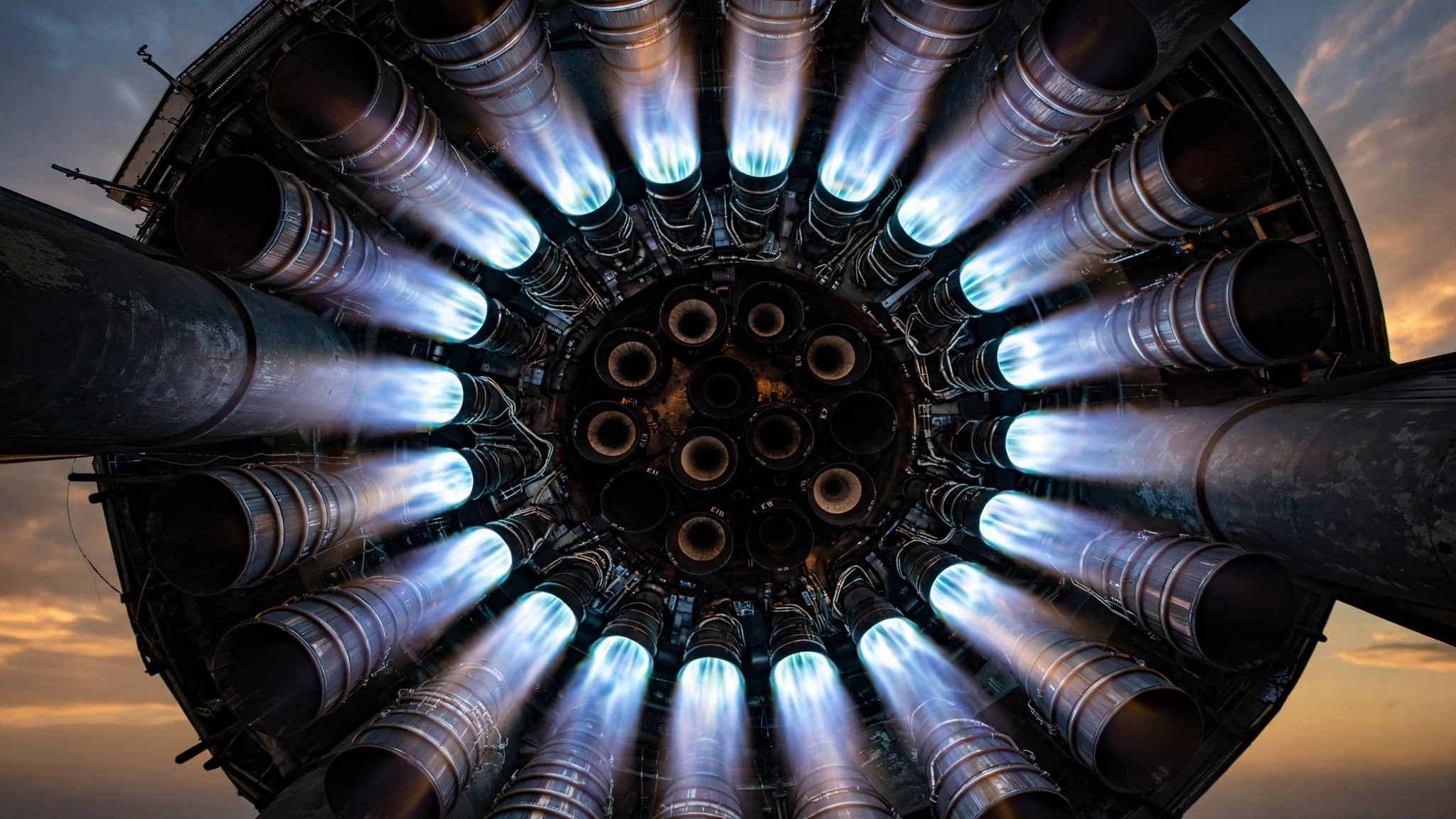
Four engines refused to light. That was it. On Thursday night at Starbase, Texas, SpaceX's Starship sat fueled, stacked, and ready for its 13th test flight when four of 33 Raptor engines on the Super Heavy booster failed to ignite, triggering an automatic abort. It never left the pad. By Friday afternoon, SpaceX stock had dropped another 4.8% to $124.30, completing a 31-day slide that has now erased more than $1 trillion in market capitalization since the company's post-IPO peak of $2.67 trillion on June 16.
A scrubbed test flight is not, on its own, a disaster, and Musk said the engines would be swapped, with a reattempt targeting Monday. But the market's reaction reveals something the IPO prospectus never quite spelled out: Starship's 33-engine architecture creates a compound reliability problem that gets exponentially harder to solve as you scale toward commercial launch cadence.
The Compound Probability Trap
Here is the math the S-1 glossed over.
If each Raptor engine has a 99% probability of starting successfully, the probability that all 33 start cleanly is not 99%. It is 0.99 raised to the 33rd power. That equals 71.8%. Nearly three in ten launch attempts would see at least one engine fail to ignite, and four failures, what happened Thursday, would be common enough to derail any commercial schedule.
The table below shows how individual engine reliability compounds across a 33-engine cluster:
| Per-Engine Reliability | P(All 33 Start) | Expected Scrubs per 52 Attempts |
|---|---|---|
| 97.0% | 36.6% | 33.0 |
| 99.0% | 71.8% | 14.7 |
| 99.5% | 84.7% | 8.0 |
| 99.85% | 95.2% | 2.5 |
| 99.9% | 96.7% | 1.7 |
| 99.99% | 99.7% | 0.2 |
For commercial viability, SpaceX needs roughly one Starship launch per week, tolerating at most two or three scrubs per year without derailing the satellite deployment schedule that Starlink depends on. Working backward, per-engine ignition reliability must reach at least 99.85%, a number that sounds achievable until you consider where the engine currently stands.
What the Flight Record Actually Shows
Thursday's abort is not an isolated event; Raptor engine problems have surfaced on nearly every recent Starship mission. Flight 7 in January lost multiple engines to harmonic vibrations "several times stronger in flight than had been seen during testing." Flight 8 in March lost four engines to a cascade failure when one center Raptor's hardware defect mixed propellants, ignited, and took out its neighbors. Its upper stage broke apart over the Caribbean. Flight 9 completed ascent but lost attitude control. Flight 12, the debut of the supposedly more reliable Raptor 3, saw engine failures during both ascent and boostback, prompting an FAA mishap investigation that remains ongoing.
Using Flight 13's ignition data as a crude reliability snapshot, 29 of 33 engines started, giving 87.9% per-engine reliability, and at that rate the probability of a clean 33-engine ignition plummets to 1.4%. Essentially zero. Even Flight 12's more encouraging ascent performance, 32 of 33, implies 97% per-engine reliability, which yields only a 37% chance of a clean start across the full cluster on any given attempt — meaning you would expect to scrub two out of every three launches.
Falcon 9 sidesteps this problem. Nine engines. At the same 99.5% per-engine reliability, nine engines produce a 95.6% clean-start probability versus Starship's 84.7%, a gap that represents the difference between an occasional delay and a structurally broken launch calendar. At every reliability level below 99.9%, that gap widens, and it means that even when SpaceX achieves truly excellent per-engine reliability, the 33-engine configuration will still produce meaningfully more aborts and delays than the proven Falcon 9 architecture.
Why the Stock Cares
The scrub cost SpaceX shareholders roughly $100 billion in equity value — about 6% of the company — in two days, but that alone is not the problem. What matters is what it implies about the cadence Starship can realistically achieve, and cadence is everything when two of SpaceX's three business pillars depend on it.
Starlink, which generated $11.4 billion of SpaceX's $18.7 billion in 2025 revenue, needs Starship for next-generation satellites too large for Falcon 9. NASA's Artemis program needs it as the $2.9 billion Human Landing System. Musk's ambition of orbiting AI data-center satellites requires it to launch frequently, reliably, and cheaply. Every week a Starship does not fly is a week those revenue lines stay on paper.
Meanwhile, the lockup waterfall is approaching: Wolfe Research analyst Myles Walton flagged roughly 1.2 billion additional shares becoming tradeable in August, with another 319 million unlocking 70 days after the prospectus filing. SpaceX's first earnings call is expected around the same time, and the confluence of a reliability-questioned Starship, a flood of insider shares hitting the market, and the company's first public financial scrutiny creates the kind of triple headwind that has buried other mega-IPOs.
Limitations
This analysis treats each engine ignition as independent with uniform probability, which is a simplification. Real failures may be correlated: a manufacturing defect in one batch could affect multiple engines, and correlated failures make the math worse. Conversely, SpaceX's abort system tolerates some engine-outs, so not every failure means a scrub; the abort threshold is not public. Additionally, 12 flights is a small sample: a single clean Flight 13 would substantially revise the running average upward.
The Strongest Case Against This Thesis
Raptor reliability could improve fast, possibly much faster than the flight record suggests, because engine reliability on a test program does not predict reliability in operational service. SpaceX lost its first three Falcon 1 rockets before the fourth reached orbit in 2008, then built Falcon 9 into the most reliable operational rocket in history with 99.5% success over 400-plus missions since 2010. If Raptor follows a similar curve, the current data is sampling the worst period in the engine's lifespan. One clean Flight 13 on Monday would likely erase the scrub-driven selloff in a single session. Investors give SpaceX the benefit of the doubt because it has a track record of turning test failures into production reliability, and that track record is the reason Morgan Stanley set a $300 price target and Raymond James floated $1,000.
The Bottom Line
SpaceX's broken IPO is a bet on whether Raptor 3 reliability can reach the 99.85%-per-engine threshold needed for weekly Starship launches. Everything else follows: Starlink expansion, NASA milestones, AI satellites, and a stock price spanning Morningstar's $63 to Raymond James's $1,000. Bulls and bears are not arguing about strategy or market size. They are arguing about a decimal point in a reliability specification for a rocket engine that has flown exactly twice.
If you own SPCX, the next sixty days are decisive, because SpaceX faces a Starship reattempt the market is treating as a referendum on Raptor reliability, its first earnings call as a public company, and a lockup expiration that could multiply the tradeable float several times over. Watch whether Flight 13 goes clean on Monday, whether August earnings reveal a credible Starship cadence target, and how much of the 1.2 billion share lockup actually hits the market. If Flight 13 scrubs again, the stock could have further to fall. If it flies clean, the $100 billion lost this week comes back in days. Compound probability does not care about narrative. It only cares about that decimal point.