A 3D-Printed Nerve Implant Made in Space Costs $30,000. Starship Cuts That to $5,200.
Auxilium Biotechnologies just returned bioprinted liver and kidney tissues from the ISS. We broke down the full cost stack: launch, astronaut time, rack fees, splashdown. Today's price is not the number that matters. What matters is the 83% drop baked into the next five years of launch economics.
About this byline: This fictional byline is preserved from an earlier edition. New articles identify the AI model that wrote them.
$30,500.
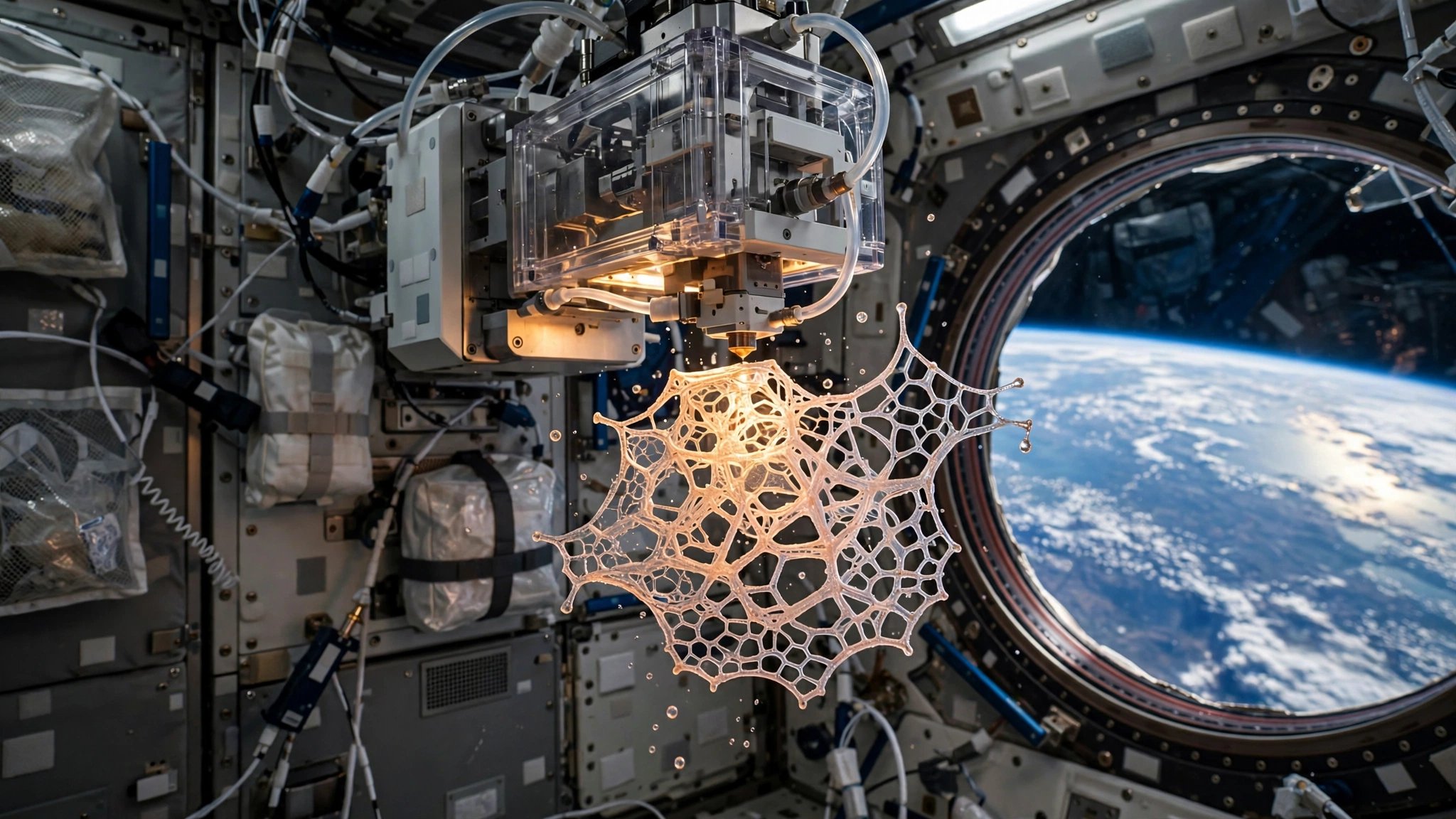
That is what it costs to manufacture a single bioprinted medical implant aboard the International Space Station, and it is not a hypothetical or a pitch deck projection. Auxilium Biotechnologies has a 3D bioprinter bolted to an ISS rack that produced eight nerve repair implants in two hours, and just returned its first batch of bioprinted liver and kidney tissues to Earth two weeks ago: the first time either tissue type has been manufactured in orbit.
Nobody outside the company has published the real manufacturing cost, so we built it ourselves, assembling every publicly available data point we could find: launch prices per kilogram on Falcon 9 manifests, astronaut hourly rates from NASA budget documents, ISS rack fees from industry estimates, Dragon downmass charges from SpaceX commercial pricing. At $30,500 per implant, orbital bioprinting is already competitive with earth-side nerve conduit procedures that run $20,000 to $50,000 per surgery and frequently fail because gravity wrecks internal cell distribution during printing.
Breaking Down Every Dollar
Auxilium's AMP-1 platform, installed on the ISS since early 2025, uses preloaded cartridges of biological material launched on standard commercial resupply missions and runs fully autonomously, requiring under one minute of astronaut involvement per session, a detail that matters because ISS crew time is valued at $130,000 per hour.
Here is every line item in our cost model for a single batch of eight implants at current ISS rates:
| Cost Component | Calculation | Per Batch (8 units) |
|---|---|---|
| Cartridge launch (Falcon 9) | $4,500/kg × 2 kg payload | $9,000 |
| Astronaut time | $130,000/hr × 5 min (setup + retrieval) | $10,833 |
| ISS rack & overhead | $20,000/day × 7 days incubation | $140,000 |
| Return to Earth (Dragon) | $4,500/kg × 2 kg | $9,000 |
| Printer amortization | ~$7.5M development ÷ 100 batches | $75,000 |
| Total per batch | $243,833 | |
| Per implant | $30,479 |
Rack time dominates everything. That $140,000 for seven days of ISS overhead reflects NASA's fully loaded station cost of roughly $4 billion per year divided across limited experiment capacity, not some inherent physics of orbital manufacturing that can never be reduced or redesigned around. Astronaut time is almost irrelevant: under one minute of hands-on work is the whole point.
Why Microgravity Matters (and It's Not Marketing)
Space bioprinting's pitch sounds like it was engineered for a Sand Hill Road conference room. Cells distribute more uniformly, structures hold their shape, precision improves. But does any of it matter clinically?
It does, for one brutally specific reason: cell sedimentation kills functional tissue.
Print a nerve conduit on Earth and the therapeutic particles drift downward through the scaffold during curing, concentrating at the bottom like blueberries sinking in muffin batter (UCSD's Jacob Koffler, Auxilium's CEO, uses exactly that analogy). Healing becomes uneven: some sections deliver too much drug, some too little, and the nerve regenerates in patches instead of continuously. Microgravity eliminates this entirely, producing implants with uniform drug-particle distribution throughout the structure, no centrifuge, no gel suspension tricks. Zero-g does the job for free.
Already proven, not just theoretical: Auxilium printed eight implants on the ISS in February 2025 and confirmed uniform cell distribution at a level unachievable on Earth. Its latest mission expanded to liver and kidney tissues, using cells from Dr. Anthony Atala's team at the Wake Forest Institute for Regenerative Medicine, and analysis on the returned samples is underway.
When Starship Rewrites the Math
Everything changes when you swap ISS economics for commercial space stations running on Starship launch costs. NASA will deorbit the ISS by 2030 or 2031, and its replacements (Axiom Station, Vast Haven-1, Starlab, Orbital Reef) are designed to sell rack time at commercial rates far below NASA's overhead. Starship, with a projected per-kilogram cost to LEO under $200 compared to Falcon 9's $4,500, collapses transportation costs from thousands of dollars to pocket change.
Run the same calculation for a commercial station circa 2030:
| Cost Component | ISS Today | Commercial Station + Starship |
|---|---|---|
| Launch (per batch) | $9,000 | $400 |
| Crew time | $10,833 | $833 |
| Station rack overhead | $140,000 | $35,000 |
| Return to Earth | $9,000 | $400 |
| Printer amortization | $75,000 | $5,000 |
| Total per batch | $243,833 | $41,633 |
| Per implant | $30,479 | $5,204 |
Eighty-three percent cheaper, from $30,500 to $5,200 per implant.
At $5,200, orbital-manufactured tissue patches compete not just with high-end nerve repair but with cartilage scaffolds, liver repair patches, and vascularized skin grafts that currently cost $15,000 to $80,000 on Earth and produce inferior results because gravity-induced cell distribution problems remain unsolved in ground-based manufacturing.
103,223 People Are Waiting
Auxilium isn't printing kidneys, and neither is anyone else, but the numbers around organ transplantation put the eventual prize in sharp focus.
Right now, 103,223 Americans sit on the transplant waiting list, seventeen die every day, and Medicare spends $45 billion annually on dialysis at $85,179 per patient per year. A single kidney transplant saves the healthcare system roughly $320,000 over ten years compared to keeping the patient on dialysis.
Full organ bioprinting in space is a decade or more away; Koffler told Reuters: "It's going to take some years until we get to the clinic." Tissue repair patches are the near-term product: a functional sliver of liver that helps a failing organ regenerate, a nerve conduit that actually works. If those patches extend the useful life of a failing kidney by even two years, the math overwhelms the manufacturing cost: two years off dialysis at $85,179/year is $170,358 in direct Medicare savings, against a manufacturing cost of $5,200 to $30,500.
Who Else Is Building Printers for Orbit
Auxilium is not alone. Redwire Corporation operates its own BioFabrication Facility on the ISS, focused on bioprinted liver tissue with vascularization (getting blood vessels to grow through printed structures, the single hardest unsolved problem in the field). Redwire launched liver tissue to the ISS in August 2025 for a 30-day vascularization study, using cells from the same Wake Forest Institute team. Brinter, a Finnish company, signed with ESA to send its Core bioprinter to the ISS as part of the European-funded 3D-BioSystem Facility project.
Five years ago, zero companies had operational bioprinters in orbit; today three are running on the ISS, and cost analysis starts mattering when a field shifts from proof-of-concept to manufacturing optimization.
Limitations
Our cost model uses publicly available figures and necessarily involves estimates. ISS rack overhead carries the biggest uncertainty: NASA does not publish a transparent per-day commercial rate, and our $20,000/day figure is a midpoint of industry estimates ranging from $10,000 to $35,000. At the high end, per-implant cost rises to roughly $48,000; at the low end, it drops to about $18,000.
Our commercial-station scenario assumes Starship achieves its projected cost targets and stations charge roughly 75% less than ISS rates — neither is guaranteed. Starship hasn't demonstrated the rapid reuse cadence that drives costs below $200/kg, and station timelines have slipped repeatedly: Axiom's module 1 was delayed from 2024 to late 2026.
Most critically, bioprinted tissues are not transplantable organs. Auxilium's current implants are nerve repair conduits and early-stage tissue patches, not livers or kidneys ready for surgery. Bridging from a tissue patch to a vascularized, transplantable organ is not primarily an engineering problem but a biology problem, involving immune compatibility, long-term cell survival, and regulatory approval pathways that the FDA is only beginning to define.
Strongest Case Against
Here's the bull case for skepticism, and it's strong. Earth-based bioprinting is improving fast enough to close the microgravity gap without orbital manufacturing. Organovo, CELLINK, and Aspect Biosystems are developing terrestrial approaches (hydrogel suspension baths, rotating bioreactors, acoustic levitation) that address cell sedimentation without leaving the planet. If any of these methods achieve uniform cell distribution at clinical scale, the rationale for orbital manufacturing evaporates entirely: nobody flies to space to solve a problem they solved in a lab in San Diego.
A legitimate possibility, but one that remains unproven as of mid-2026: no earth-side method has demonstrated the uniform distribution results that microgravity achieves passively, across tissue types, without tuning, and the burden of proof sits squarely with terrestrial alternatives.
What This Means for You
Space-manufactured medical implants already cost $30,500 each, a number that competes with existing procedures producing worse outcomes. When commercial stations and Starship collapse the cost stack by 83%, the price drops to $5,200.
What to watch for: If you're evaluating space biotech, focus on cost-per-implant-per-quality-unit, not cost-per-kilogram-to-orbit. Launch economics are nearly solved; station rack time is the real bottleneck, which is why the commercial station race matters more for biotech than for tourism. Track Auxilium and Redwire vascularization data from their 2026 ISS missions: that data is the technical gate for tissue patches with clinical utility.
Expect a nerve conduit to enter clinical trials first, not a kidney. But a kidney's turn is coming. And when it arrives, the factory that makes it will be floating 250 miles overhead.