South Korea Just Committed 107% of Its GDP to Memory Chips. The Last Time It Bet This Big, Profits Fell 89% in One Year.
Samsung Electronics and SK Hynix pledged a combined 3,200 trillion won ($2.07 trillion) in semiconductor investment on June 29, 2026. South Korea's nominal GDP is $1.93 trillion. Two companies in one country just committed more than their nation's entire annual economic output to a single product category that crashed 89% in operating profit the last time supply outran demand. An original analysis of the payback arithmetic, the historical cycle risk, and why the stock market's verdict arrived two days before the first shovel.
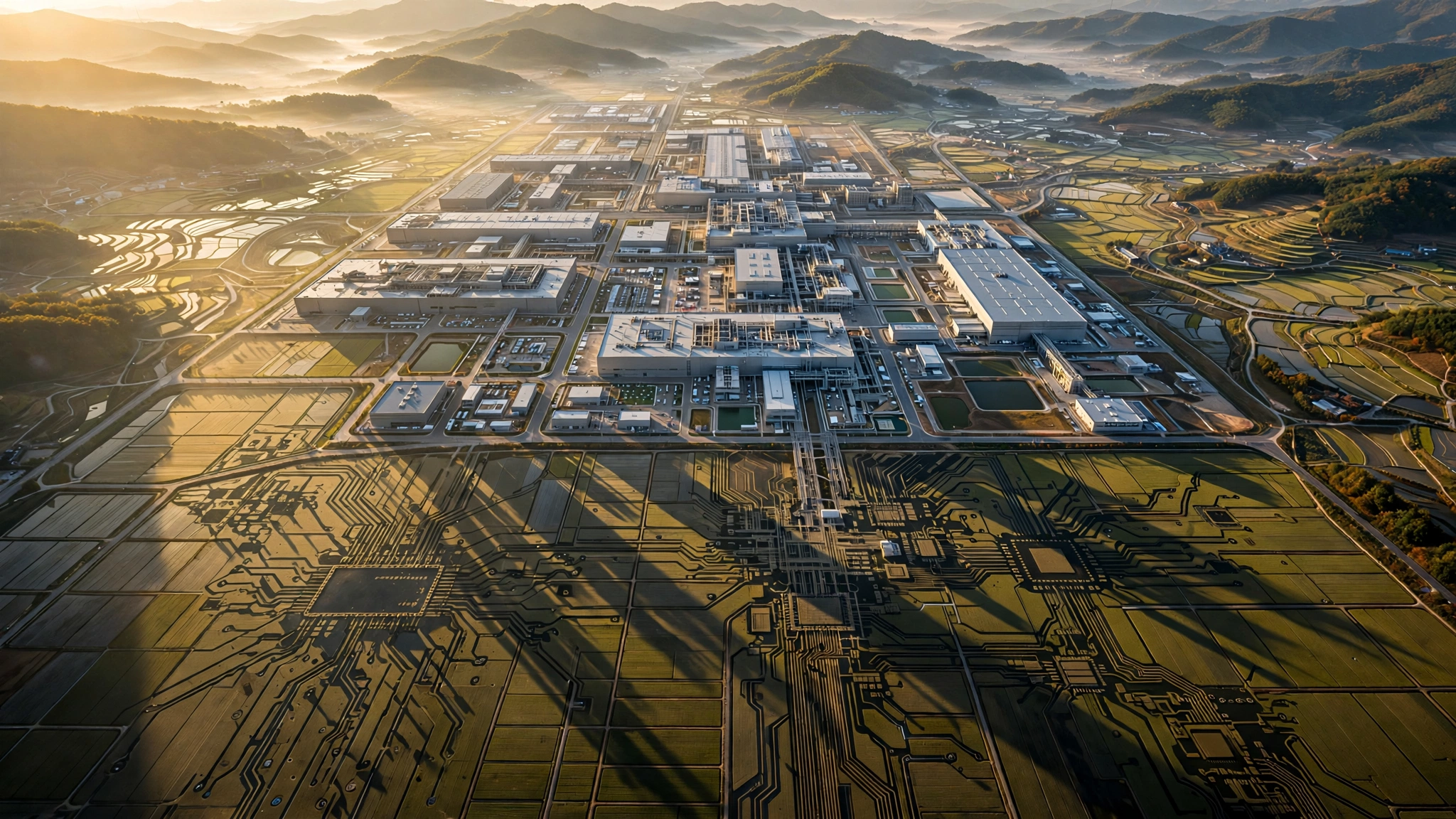
$2.07 trillion. That is what Samsung Electronics and SK Hynix have pledged, in aggregate, to invest in semiconductor manufacturing across South Korea over the coming decade, a sum that includes a new 800 trillion won ($500 billion) chip cluster in South Jeolla Province, major expansions at the existing Yongin mega-cluster east of Seoul, and SK Hynix's freshly detailed $64 billion NAND factory and advanced packaging plant in Cheongju. President Lee Jae Myung bowed to the chairmen at the Blue House ceremony on June 29, framing the initiative as a matter of national survival in the AI era. Two days later, Samsung stock fell 8.6%, SK Hynix dropped 7.1%, and the DRAM ETF collapsed 10.8% in a single session.
Nobody disputes that the investment is enormous, but what nobody has calculated is how enormous relative to the economy underwriting it, what the payback arithmetic actually looks like at peak margins, or what happens if the most cyclical product category in technology turns on the two companies while they are mid-construction on the largest industrial buildout in history.
A Country Betting Itself
South Korea's 2026 nominal GDP, according to the International Monetary Fund, is $1.93 trillion, making it the world's fourteenth-largest economy by output. Divide the pledged investment by that GDP figure and you get 1.07x, not 1.07 percent, not 1.07 per thousand, but a ratio that exceeds one: Samsung and SK Hynix have committed 107% of their country's entire annual economic output to memory chips, a concentration of industrial ambition without precedent in modern economic history.
For perspective, consider what other nations have committed to their semiconductor ambitions: the United States' CHIPS and Science Act allocates $52 billion in direct subsidies against a $28.8 trillion GDP, which works out to 0.18% of national output, making South Korea's semiconductor commitment roughly 600 times larger as a share of its economy. Even China's gross productive investment across all sectors, from infrastructure to manufacturing to real estate, totals $5.9 trillion annually according to McKinsey's Global Institute, and South Korea is concentrating more than a third of that equivalent into a single product line.
There is a caveat worth stating plainly: the $2.07 trillion encompasses some previously announced projects, including the Yongin cluster pledged in 2024 and earlier expansion commitments, so not all of this represents new money flowing into new decisions. But the incremental commitments alone are staggering by any reasonable standard, because the southwest cluster represents $500 billion in new capacity (larger than the entire GDP of Norway), and SK Hynix's Cheongju buildout at $64 billion exceeds the annual defense budget of Germany.
The Payback Problem
Here is the calculation that nobody covering this story seems to have run, even though the inputs are publicly available in quarterly earnings filings from both companies.
In fiscal year 2025, SK Hynix posted a record operating profit of 47.21 trillion won ($33.1 billion), more than doubling the previous year's figure on the back of soaring HBM demand from AI datacenters, while Samsung's memory division earned approximately 24.9 trillion won ($17.4 billion), bringing the combined memory operating profit for the two companies to roughly $50.5 billion in what both acknowledged were peak-cycle conditions with extraordinary margins driven by HBM revenue that more than doubled year-over-year at SK Hynix alone.
$2.07 trillion divided by $50.5 billion in peak annual memory profit equals 41 years of payback, meaning that at the best margins the memory industry has ever produced across its entire existence, Samsung and SK Hynix would need four decades of uninterrupted peak earnings to recoup their aggregate commitment. Even if you generously include Samsung's non-memory profits from smartphones, displays, and foundry services, bringing the combined operating profit for both companies to $63.6 billion, payback still stretches to 32.5 years at margins that have never been sustained for even three consecutive years in memory chip history.
These investments will generate revenue cumulatively over the life of each fab, which typically produces chips for 15-20 years after construction, and the $2.07 trillion is not a cash outflow due tomorrow but rather a commitment spread over more than a decade. A discounted cash flow model would give a more nuanced picture. But the raw comparison still captures something essential about the scale of the commitment relative to the industry's demonstrated earning power.
| Metric | Value | Source |
|---|---|---|
| Total investment pledged | $2.07T (3,200T won) | Reuters, Jun 30 2026 |
| South Korea GDP (2026) | $1.93T | IMF / Worldometer |
| Investment / GDP ratio | 1.07x | Calculated |
| Combined memory OP (FY2025) | ~$50.5B | SK Hynix + Samsung earnings |
| Payback at peak memory profit | 41 years | Calculated |
| Payback at total corporate profit | 32.5 years | Calculated |
| US CHIPS Act subsidies / GDP | 0.18% | Calculated |
| South Korea chip investment / GDP | 107% | Calculated |
Memory Is Cyclical. The Scale Is Not.
In 2017, DRAM revenue grew 61.8% year-over-year in what analysts enthusiastically called a "super cycle," with Samsung and SK Hynix together commanding 73.5% of the global DRAM market and earning operating margins above 50% that seemed, at the time, to represent a new structural baseline for the industry rather than a cyclical peak.
Eighteen months later, that baseline had evaporated. DRAM prices crashed 30% in early 2019 in the steepest drop the industry had seen in eight years, Samsung's semiconductor operating profit fell 70% from its 2018 peak while SK Hynix's collapsed 89%, and both companies responded by slashing capex aggressively, with Samsung terminating its Pyeongtaek expansion and cutting spending to $8 billion while SK Hynix dropped to $5.5 billion. Recovery took two full years of constrained supply before margins returned to healthy levels.
That bust happened on a combined annual capex base of roughly $13.5 billion, and today's commitment is 153 times larger. If a 2019-style downturn arrived while these fabs were mid-construction, the companies would face a choice that has no good answer: continue pouring tens of billions into capacity that has no demand, or halt construction and write off partially built factories worth more than the GDP of most countries, absorbing losses that would ripple through South Korea's banks, its construction sector, its government tax revenues, and ultimately its national accounts.
The trigger may already be visible. On July 1, 2026, the same day SK Hynix's CEO was detailing his Cheongju buildout with the president at his side, both companies' stocks cratered because Meta Platforms announced plans to sell computing power externally, raising the possibility that hyperscalers were starting to see excess AI computing capacity. One announcement from one American company erased more than $30 billion in combined market value from the two firms that had, 48 hours earlier, pledged their country's GDP to the same bet.
The Strongest Case For
The strongest counterargument is structural rather than cyclical, and it deserves to be stated at full strength because it may well prove correct. AI inference workloads scale linearly with users: every Meta AI query, every ChatGPT response, every autonomous vehicle perception cycle requires high-bandwidth memory, and TrendForce projects that 70% of all memory produced in 2026 will go to data centers, up from roughly 30% five years ago, while Micron exited the consumer memory market entirely in December 2025. That is not a cyclical demand spike, and it is not driven by temporary overbuilding among hyperscalers; it looks, for the first time in memory's history, like a permanent structural shift in what these chips are actually used for.
Samsung and SK Hynix also control roughly 75% of the global DRAM market, and in an oligopoly this concentrated, the two players can (and historically have) managed supply to prevent the kind of uncontrolled price collapse that destroys margins. When DRAM prices dropped in 2018, both companies cut production rather than flood the market, and with only three meaningful producers globally (add Micron), coordinating supply discipline is a straightforward exercise in game theory that the three firms have practiced for decades. South Korea's government is further de-risking the bet with 15% tax credits on semiconductor capex for large companies (up from 8%), 25% for midsize firms, and accelerated infrastructure development for water and power at fab sites.
What This Analysis Does Not Prove
Several limitations deserve explicit acknowledgment, because the numbers above, while striking, depend on assumptions and data boundaries that shape their meaning. First, the $2.07 trillion figure includes previously announced projects, and isolating the truly new commitment is difficult because neither company has published a clear breakdown separating incremental spending from reaffirmed prior pledges. Second, the investment is spread over a decade or more, meaning annual cash outflows are a fraction of the total pledge, and the won-dollar exchange rate (1,553 won per dollar at the June 29 announcement) will fluctuate substantially over that period in ways that could materially change the dollar-denominated total. Third, the 41-year payback calculation uses a single year of peak profits as the denominator; if AI-driven demand pushes memory profits permanently and structurally higher, the arithmetic improves dramatically, though "permanently higher" is precisely what analysts said about DRAM margins in 2017 before they cratered. Fourth, the investment generates cumulative revenue over the full operating life of each fab rather than annual profit alone, and a proper discounted cash flow model that accounts for multi-decade production would give a more nuanced picture of returns.
What You Can Do With This
If you hold semiconductor stocks, particularly Samsung (005930.KS) or SK Hynix (000660.KS), the 41-year payback number should reframe your position: these companies are priced for perfection, with SK Hynix up 307% year-to-date and Samsung up 179%, both trading as though HBM demand will compound indefinitely and memory downturns are extinct. Stress-test your thesis against a 2019-style reset where operating profit falls 70-89%, the stock drops 50-60%, and the companies are still contractually obligated to fund construction on fabs that will not produce a single chip for years. If you cannot hold through that scenario without selling, your position is too large.
If you are a policymaker watching from Washington, Tokyo, or Brussels, South Korea's move raises the stakes for everyone because any country now considering semiconductor sovereignty needs to compete with a commitment equivalent to 107% of a major economy's GDP. CHIPS Act subsidies of $52 billion look quaint against that backdrop. If South Korea succeeds and doubles its memory production capacity within five years, it will lock in manufacturing dominance for a generation; if it fails, the ripple effects on global supply chains, AI infrastructure timelines, and consumer electronics pricing will be severe and global.
If you are an engineer, researcher, or technologist in the memory space, the implication is directly practical: South Korea is about to double its DRAM production capacity within five years, and it needs people to design, build, and operate those fabs, in a country with the world's lowest fertility rate (0.72 children per woman according to OECD data) whose workforce to staff this expansion does not yet exist. Immigration policy, fab automation, and advanced packaging R&D will all accelerate rapidly, and both companies will be hiring aggressively through 2027 for positions that did not exist eighteen months ago.
The Bottom Line
Two companies in a country of 51 million people have committed more than their nation produces in a year to a single product category that has, within living memory, vaporized 89% of one company's earnings in twelve months. At peak profits, the bet requires four decades to pay back. The market signaled its anxiety by wiping $30 billion in value from these two firms on the very day the investment details were announced, responding not to any fundamental change in memory demand but to a single signal from a single American company that excess AI computing capacity might exist somewhere. South Korea is banking everything on the proposition that AI has permanently rewritten the demand curve for memory, that what looks like a cycle is actually a step function, that this time really is different. If that proposition holds, Samsung and SK Hynix will have built the most valuable manufacturing infrastructure on Earth. If it doesn't, the consequences will cascade from two balance sheets into the GDP of an entire nation that staked its economic future on the enduring hunger of machines for memory.