⚡ Energy
The First Third-Party-Validated Solid-State Battery Is in Mass Production. Its Factory Covers 0.05% of World Demand.
ProLogium's Gen 3.5 cell hit 381 Wh/kg in TÜV testing and is the first published to pass China's legal "all-solid-state" definition, with a 10x margin. Its factory builds ~6,250 EV packs a year. CATL installs that many every 11 hours.
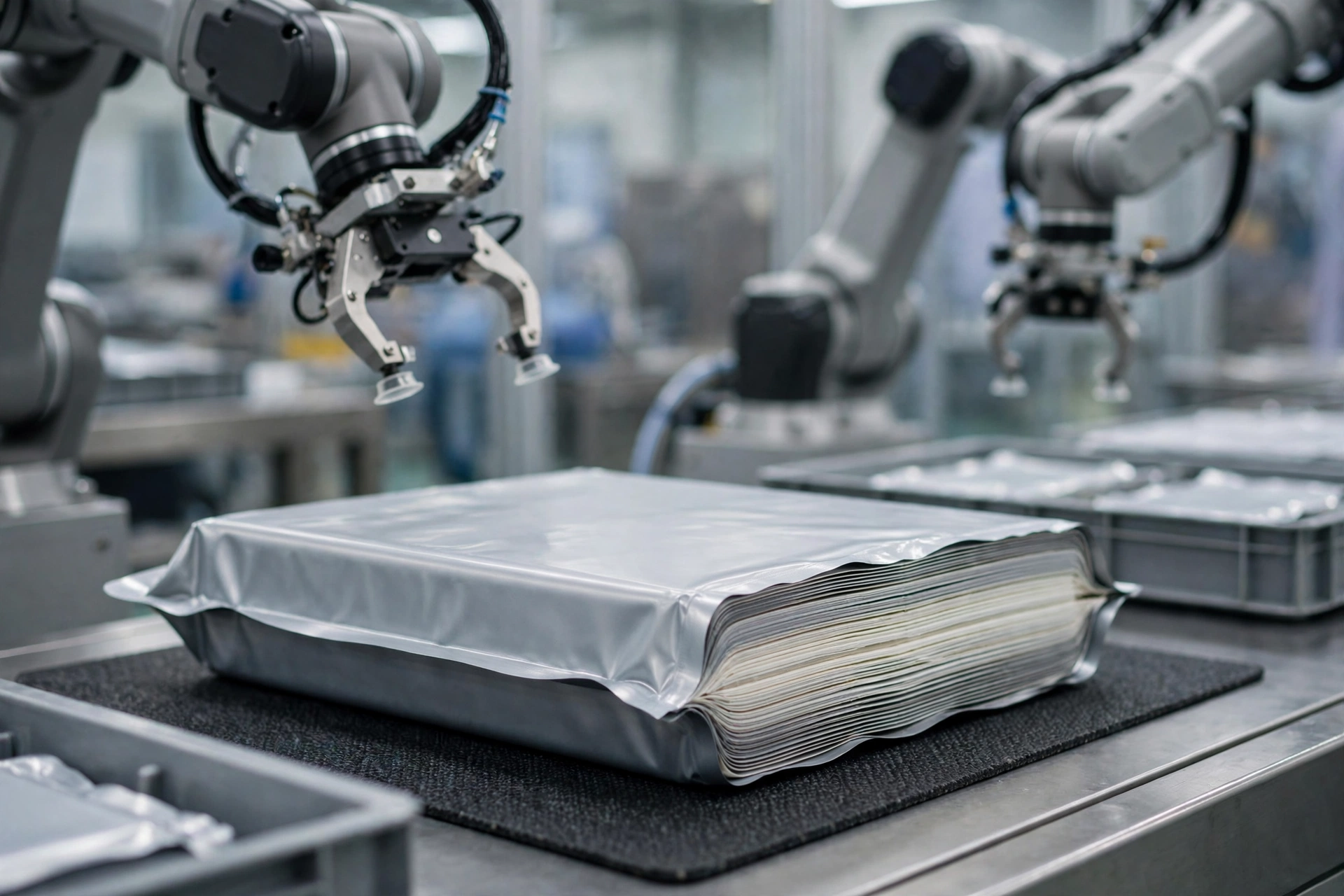
CATL installs as many batteries in eleven hours, working at its current pace in China alone, as ProLogium's celebrated new solid-state factory can produce in a full year. On September 2, the Taiwanese company announced its Gen 3.5 Lithium Ceramic Battery had entered mass production, with a third-party TÜV report validating 381 watt-hours per kilogram and 903 watt-hours per liter, figures that beat every commercial lithium-ion cell on the market. Both the announcement and the validation are real. So is the punchline: the scale is almost comically small.
Mercedes-Benz-backed ProLogium has shipped more than 2.4 million cells since 2013, a track record few in the solid-state race can claim. Its 185.4 amp-hour large-format cell now rolls off a production line instead of sitting in a lab. At 0.5 gigawatt-hours of annual capacity, planning 1 to 2, it cannot move the needle on an industry installing on the order of 1,000 gigawatt-hours a year.
The test that ends the label war
Apart from the factory, the more durable news is a test. UL Solutions evaluated the ProLogium cell under China's GB/T 43568-2026, the country's first national standard for solid-state EV batteries, released in July 2026. The methodology is brutal: bake the cell at 120 degrees Celsius under vacuum for six hours, then weigh it, since any liquid electrolyte boils off. Classification as all-solid-state allows at most 0.5 percent mass loss. ProLogium measured under 0.05 percent, clearing the bar by more than tenfold.
Why this matters is a story of marketing run amok. For years, Chinese automakers have sold packs as "solid-state" that retained liquid electrolyte, most visibly SAIC-backed IM Motors promoting its QingTao-developed "Light-Year Solid-State" battery. China's new taxonomy ends the ambiguity: cells are liquid, hybrid solid-liquid, or solid-state, and the word "semi-solid-state" does not exist in the standard at all. That 0.5 percent threshold is twice as strict as the 1 percent the China Society of Automotive Engineers had proposed. China has submitted the standard to the International Electrotechnical Commission, which means the definition is auditioning to become the global one.
That definition now has money attached. Effective September 1, China exempts solid-state batteries from its battery consumption tax through December 2028, while conventional lithium batteries get taxed at 2 percent, rising to 4 percent in September 2027. Suddenly the 6-hour vacuum bake is not a laboratory curiosity: passing it is worth real margin on every pack sold in China, and failing it reclassifies a "solid-state" product into a taxed category. When definitions carry tax consequences, the industry takes them seriously.
What 381 Wh/kg actually buys
Energy density is abstract until it meets a car. Take a 75 kilowatt-hour pack, typical for a long-range EV, with an industry-standard cell-to-pack mass ratio of 0.75.
| Pack design | Cell mass | Pack mass | Cell volume |
|---|---|---|---|
| ProLogium 381 Wh/kg cells | 197 kg | 263 kg | 83 L |
| Baseline NMC, 285 Wh/kg cells | 263 kg | 351 kg | 104 L |
| Difference | 66 kg saved | 88 kg saved | 21 L saved |
Eighty-eight kilograms is real but not transformative at fixed pack size. Holding pack weight constant instead is the interesting version: a 351-kilogram pack of ProLogium cells at the same 0.75 ratio carries 100.3 kilowatt-hours, versus 75 today, a 33.7 percent range gain before any other improvements. Twenty-one liters of freed volume is roughly a carry-on suitcase returned to the chassis: not a revolution in the cars of 2027, but headroom that compounds.
The scale audit
Now the other arithmetic, the one press releases skip: ProLogium calls Taoyuan a "Giga-level manufacturing facility," but its operational capacity is 0.5 gigawatt-hours.
| Metric | Value |
|---|---|
| Taoyuan annual output | 0.5 GWh = ~6,250 packs of 80 kWh |
| Share of ~1,000 GWh global annual EV battery demand | ~0.05% |
| CATL monthly installs in China | 33.08 GWh (China EV DataTracker) |
| Time for CATL to install 0.5 GWh | ~11 hours |
| Scale-up needed to reach 1% of global demand | 20x |
Six thousand two hundred fifty packs a year is a large pilot program, or a small luxury model run. It is not mass production in any sense that touches mainstream car prices. Dunkirk, the planned factory in France, is the facility that would have to prove otherwise, and its timeline remains the number to watch. Until then, this is a validated cell design looking for its gigafactory, not a gigafactory shipping a validated cell.
The solid-state scorecard
Grade the field on three axes: independent validation, a legal definition the cell passes, and capacity within an order of magnitude of relevance.
| Program | Density claim | Independent test | GB/T 43568 status | Scale |
|---|---|---|---|---|
| ProLogium Gen 3.5 | 381 Wh/kg, TÜV | Yes (TÜV, UL) | Pass, 10x margin | 0.5 GWh/yr |
| FAW / CANEB semi-solid | 500 Wh/kg (claimed) | No | Hybrid solid-liquid by definition | Prototype vehicle testing |
| Dongfeng eπ 007 pack | 350 Wh/kg (claimed) | No | Unpublished | Mass production delayed to 2027 |
| Toyota | Undisclosed | No | Unpublished | Pilot line, 2027–2028 target |
| Samsung SDI | Undisclosed | No | Unpublished | Pilot line |
| QuantumScape | Undisclosed | No | Unpublished | Pilot line |
ProLogium leads the scorecard and it is not close, which says as much about the field as about ProLogium. FAW's 500 Wh/kg semi-solid claim is the higher number, but "semi" is now a legal fiction under GB/T 43568: it classifies as hybrid solid-liquid, and the manganese-for-nickel cost story is unverified. Exactly one company has a validated, legally classifiable, manufactured solid-state cell, and it makes 0.05 percent of what the world needs.
The strongest case against
Here is the bear case at full strength, because it is genuinely strong. Cell-level watt-hours per kilogram has never been the binding constraint on EV adoption. What constrains adoption is cost per kilowatt-hour, cycle life, charge-rate durability, and manufacturing yield, none of which ProLogium disclosed. A TÜV energy-density report is a weigh-in, not a road test: it says nothing about how the ceramic separator survives 1,000 fast-charge cycles, what the cells cost at 0.5 GWh versus at 50, or whether the Logithium edge-frame architecture yields at automotive defect rates.
Then the graveyard. Every "mass production" solid-state announcement since 2020 has arrived attached to a sub-1-gigawatt-hour facility and a multi-year ramp that slipped. ProLogium's own history counsels caution: the LCB platform dates to 2012, commercial production to 2013, yet thirteen years later the EV-grade output is 0.5 GWh. Sharpest version: the announcement changes nothing about EV economics in 2026 or 2027, since the cells that exist will flow to specialty programs first. Anyone pricing a car purchase around solid-state availability is waiting for a factory that has not been built, at a price nobody has published, with durability data nobody has shared.
Limitations
Here is the honest accounting. The 381 Wh/kg and 903 Wh/L figures are TÜV cell-level results; pack-level energy density, cycle life, fast-charge performance, and cost per kWh are undisclosed, and cell records routinely shrink 15 to 25 percent at pack level. The 0.75 cell-to-pack ratio and the 285 Wh/kg baseline are representative industry figures, not a named competitor's spec, so read the savings as illustrative. GB/T 43568-2026 details come from the December 2025 draft and July 2026 release reporting; Part 1 covers terminology only. Global demand near 1,000 GWh a year is an order-of-magnitude estimate.
What you can do
For car buyers, the actionable read is blunt: do not delay a purchase waiting for solid-state. Nothing at meaningful volume ships before 2028. Buy the best lithium-ion car available now; the 34 percent headroom arrives in the 2030s fleet, not in your driveway.
For investors, grade every "solid-state mass production" claim on three axes: an independent test report you can read, a GB/T 43568 classification the cell passes with published data, and nameplate capacity against the 1-percent-of-demand bar of roughly 10 GWh. A claim missing any axis is marketing. Watch the Dunkirk timeline, any disclosed dollars-per-kWh or cycle-life data, and whether CATL or BYD publish their own GB/T 43568 results.
For automakers selling into China, the vacuum-bake test is now a cost line item. Quote the GB/T classification with test data on the spec sheet, not the marketing label, because the 2026–2028 tax exemption prices the definition into cost. If your "solid-state" pack retains liquid electrolyte, reclassify it voluntarily before a regulator or a competitor does it for you.
The Bottom Line
A Taiwanese company did what a decade of solid-state startups promised: it built a cell, had outsiders weigh it, and passed the first legal definition of "all-solid-state" with room to spare. Excellent cell, tiny factory, consequential definition, since China just attached a tax exemption to the standard and handed it to the IEC. Solid-state batteries have crossed from laboratory claim to manufactured product; they have not crossed from product to industry. About twenty Taoyuans separate those two crossings; the honest way to watch the gap close is to count gigawatt-hours, not press releases.
Sources
- ProLogium press release, Sept 2, 2026 (Gen 3.5 LCB: 185.4 Ah, 381 Wh/kg, 903 Wh/L per TÜV; UL Solutions GB/T 43568-2026 test under 0.05% vs 0.5% limit; Taiwan mass production; 2.4M cells shipped since 2013)
- CnEVPost, Dec 31, 2025 (GB/T draft: liquid / hybrid solid-liquid / solid-state categories; no semi-solid category; electrolyte-type breakdown)
- TechNode, Feb 11, 2026 (July 2026 release schedule; CATARC verification; IEC submission)
- Electrek, Feb 11, 2026 (0.5% weight-loss threshold vs 1% CSAE proposal)
- State Council Information Office, July 20, 2026 (solid-state tax-exempt Sept 2026–Dec 2028; conventional lithium taxed 2%, then 4%)
- Electribe, Sept 6, 2026 (Taoyuan 0.5 GWh operational, 1–2 GWh planned)
- CarNewsChina, Sept 6, 2026 (Mercedes backing; ~6,250 packs/yr; IM Motors QingTao "Light-Year" controversy)
- The Electric Viking, 2026 (CATL 33.08 GWh monthly China installs via China EV DataTracker)